
AI and BLE for Entertainment Venues
AI-Driven Venue Operations with BLE-Based Real-Time Intelligence
Artificial intelligence is changing how entertainment venues manage attendee flow, event operations, assets, staff coordination, and facility utilization. AI for entertainment venues can analyze location, proximity, occupancy, dwell time, movement patterns, equipment status, and environmental information captured through connected devices. BLE gateways, BLE beacons, and BLE sensors provide a practical data-acquisition layer for these applications, particularly where venues need zone-level visibility across arenas, concert halls, theaters, convention centers, exhibition facilities, festivals, and multi-purpose event spaces. The resulting AI system can identify congestion, forecast demand, detect abnormal movement patterns, optimize staffing, improve asset availability, and support faster operational decisions. For venue operators, the objective is not simply to collect location data. It is to convert operational signals into actionable information for crowd management, event scheduling, facility operations, security coordination, equipment utilization, and attendee experience. GAO provides BLE hardware, IoT systems, software, and technical support for organizations implementing these connected operational workflows.
AI and BLE-Powered Entertainment Venue Operations
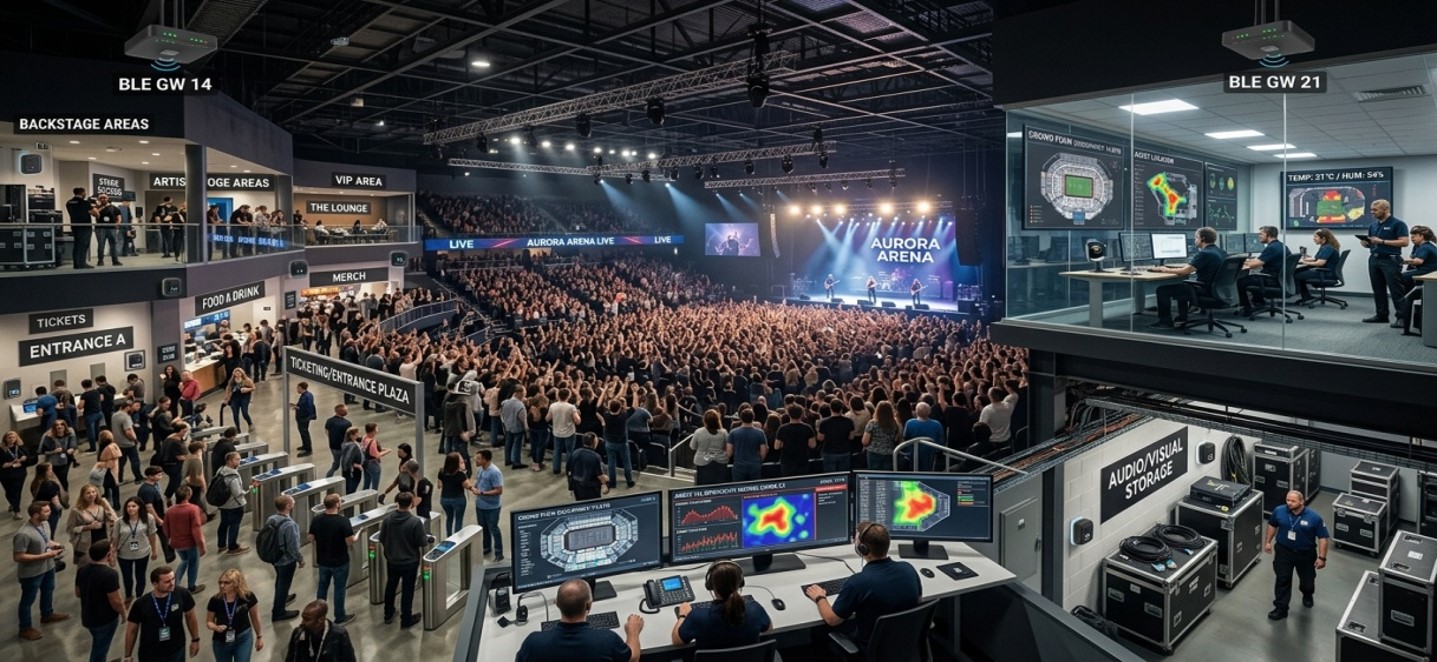
This visual illustrates a modern entertainment venue using BLE beacons, gateways, and sensors to capture operational data across audience, backstage, equipment, and facility areas. AI analyzes crowd movement, occupancy, asset locations, and environmental conditions to support real-time venue operations and decision-making.
What AI Means for Modern Entertainment Venue Operations
AIoT, or Artificial Intelligence of Things, combines artificial intelligence with connected devices, sensors, gateways, and operational systems. For entertainment venues, this means converting physical activity into structured operational data that AI models can analyze.
A venue can generate thousands of operational events during a single concert, sporting entertainment event, exhibition, theater performance, convention, or festival. These events can include entry activity, movement between zones, queue formation, equipment relocation, room occupancy, environmental changes, staff presence, and asset utilization.
Traditional monitoring frequently requires staff to observe these conditions manually or review disconnected reports after an event. An AI-driven system instead creates a continuous data pipeline that can identify patterns while venue operations are taking place.
Important AI applications include:
- AI crowd flow analysis for detecting congestion around entrances, exits, corridors, escalators, seating areas, and concession zones.
- AI occupancy analytics for estimating utilization of rooms, halls, lounges, exhibition areas, and controlled-access spaces.
- AI attendee movement analysis for understanding dwell time, zone transitions, session participation, and event traffic patterns.
- AI asset tracking for locating production equipment, portable displays, AV equipment, tools, cases, and other mobile venue assets.
- AI staff and service coordination for identifying operational demand across cleaning, facilities, guest services, technical support, and event operations.
- AI anomaly detection for identifying movement or occupancy patterns that differ from established operational baselines.
- Predictive maintenance support for connected venue equipment when BLE sensors provide condition or usage information.
- AI-driven event planning based on historical attendance, zone utilization, queue behavior, equipment movement, and facility usage.
The value comes from combining multiple signals rather than relying on one sensor type. A BLE beacon can provide an identifier or proximity signal, while BLE sensors can provide additional information such as temperature or other measurable conditions. Gateways collect those signals and forward them to software where rules, analytics, machine learning models, and operational applications can interpret them.
GAO’s BLE hardware selection includes gateways and beacons that can be incorporated into customized tracking and monitoring systems. Its existing event-oriented solutions demonstrate applications such as attendee activity monitoring, movement analysis, crowd-density management, and venue-zone tracking.
Entertainment Venue Applications for AI and BLE
Entertainment venues vary considerably in physical layout and operating model. A permanent arena requires different data collection from a temporary festival site, while a convention center may need detailed session-room analytics rather than continuous arena occupancy information.
AI Crowd Flow and Congestion Analysis
Large concerts, exhibitions, festivals, and conventions can create rapidly changing concentrations of people. BLE-based location and proximity signals can provide zone-level observations that AI models use to estimate traffic patterns.
The system can compare current activity with historical baselines and predefined capacity thresholds. When traffic increases unexpectedly around a gate, corridor, concession area, or session room, the software can generate an operational alert.
Useful outputs include:
- Zone occupancy estimates.
- Average dwell time.
- Entry and exit flow.
- Queue-duration trends.
- High-traffic-zone identification.
- Movement between event areas.
- Abnormal traffic patterns.
The engineering objective is not to treat BLE positioning as an exact substitute for every high-precision location technology. Signal propagation is affected by venue construction, people density, metal structures, equipment, RF interference, and gateway placement. For this reason, AI models should normally work with zones, confidence values, historical patterns, and multiple observations rather than assuming every BLE event represents an exact coordinate.
AI Attendee Engagement and Event-Zone Analytics
Exhibition halls, conventions, museums, entertainment complexes, and multi-stage festivals often contain numerous areas competing for attendee attention. BLE beacons or BLE-enabled credentials can support proximity and movement analysis when the deployment is designed around appropriate consent, privacy, and data-governance requirements.
AI can analyze:
- Session attendance patterns.
- Exhibition booth dwell time.
- Movement between stages.
- Repeat visits to specific zones.
- Traffic variation during event schedules.
- Utilization of VIP and hospitality areas.
- Relationships between schedule changes and attendee movement.
These insights can help event managers improve room allocation, session scheduling, signage placement, staffing levels, and future event layouts.
AI Asset Tracking for Production and Venue Equipment
Entertainment venues frequently move high-value operational assets between loading docks, storage rooms, backstage areas, production zones, control rooms, exhibition floors, and event spaces.
BLE asset beacons can associate a digital identifier with equipment such as:
- Audio equipment.
- Lighting equipment.
- Video production equipment.
- Portable displays.
- Stage equipment.
- Technical cases.
- Temporary event infrastructure.
- Maintenance equipment.
- Mobile service equipment.
AI can analyze asset movement history to identify unusual relocation, repeated search patterns, underutilization, excessive idle time, or potential maintenance requirements.
This application becomes especially valuable where equipment is shared among multiple event spaces. Instead of asking staff to search manually for an item, the asset management software can present its most recently observed zone and movement history.
AI Facility and Environmental Monitoring
BLE sensors can extend AI analysis beyond movement. Environmental measurements can support operational monitoring for equipment rooms, storage areas, backstage facilities, exhibition spaces, and other controlled environments.
AI can establish normal operating ranges and detect deviations that require attention. Depending on the sensor type, applications may include temperature monitoring, humidity monitoring, equipment condition indicators, and other facility measurements.
The important engineering consideration is sensor placement. A technically capable sensor produces little value if it is installed where its readings do not represent the condition of the monitored area.
AI and BLE Architecture for Entertainment Venue Operations
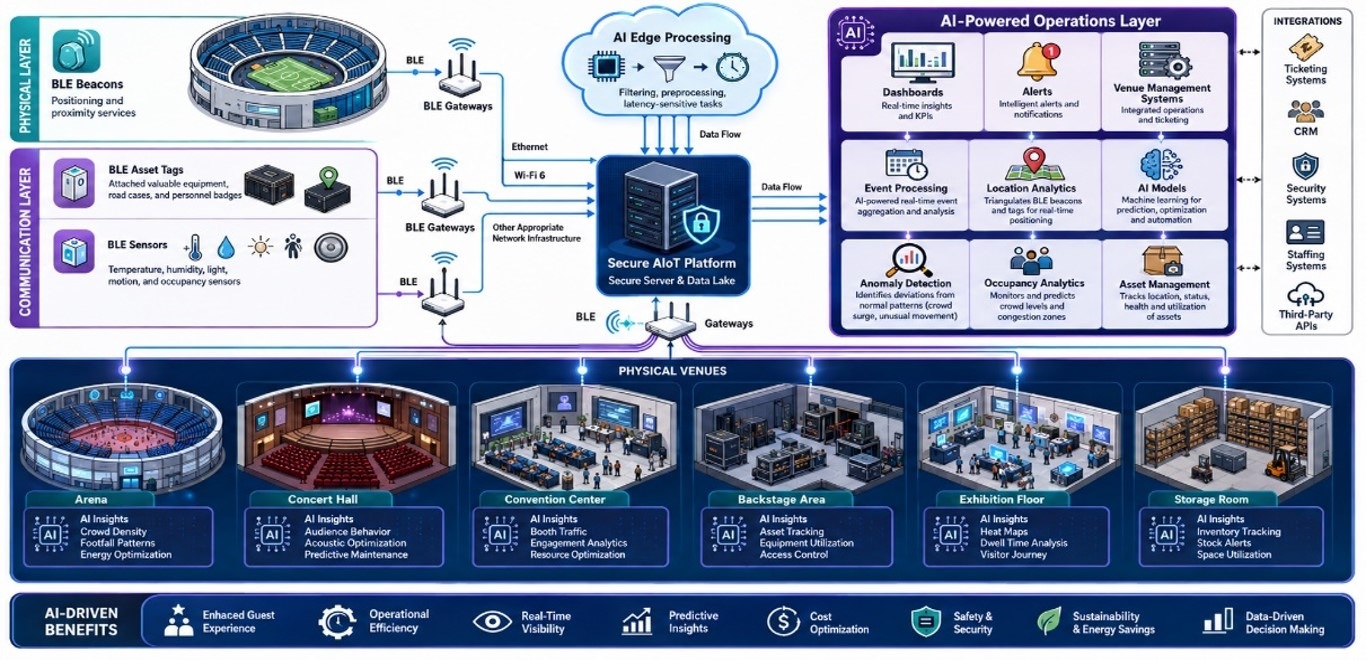
This architecture diagram illustrates how BLE beacons, asset tags, sensors, and gateways collect data across entertainment venues and transmit it through network infrastructure to edge, server, or cloud processing. AI analytics transform the data into occupancy insights, asset intelligence, anomaly detection, dashboards, alerts, and venue-management actions.
Entertainment Venue Operational Workflow from BLE Data to AI Decisions
A reliable AI venue system should be designed as an operational workflow rather than as an isolated collection of BLE devices.
Data Acquisition Across Venue Zones
BLE gateways receive advertisements or sensor information from nearby BLE devices. Beacons can be installed at fixed locations or attached to mobile assets, credentials, or equipment. Sensor devices can periodically transmit measurements.
Gateway placement should reflect the physical venue rather than simply applying a uniform grid. Entry gates, loading docks, backstage corridors, equipment rooms, exhibition zones, session rooms, high-traffic paths, and outdoor areas may require different coverage strategies.
A site survey should evaluate:
- Venue dimensions and floor plans.
- Wall and partition materials.
- Metal structures.
- Stage and production equipment.
- Expected attendee density.
- Gateway mounting locations.
- Power availability.
- Ethernet or wireless network availability.
- RF interference.
- Outdoor versus indoor operating conditions.
- Maintenance accessibility.
Communication and Edge Processing
BLE gateways form the connection between local wireless devices and the venue’s data-processing environment. Depending on the gateway and deployment design, data can be forwarded through Ethernet, Wi-Fi, cellular connectivity, or another appropriate network connection.
Edge processing can reduce unnecessary upstream traffic by filtering duplicate observations, validating device messages, normalizing timestamps, and applying basic rules before information reaches centralized software.
For event operations, this can be important because a venue may experience a sharp increase in device activity when thousands of attendees enter or move through the facility.
Middleware and Data Normalization
Middleware receives device events and converts heterogeneous signals into structured records that applications can understand.
A normalized event might include:
- Device identifier.
- Gateway identifier.
- Venue zone.
- Received signal information.
- Sensor measurement.
- Event type.
- Confidence or quality indicator.
- Device status.
Data normalization is essential for AI because inconsistent identifiers, timestamps, missing values, duplicate observations, and poorly defined zones can degrade model performance.
AI Analytics and Operational Decisions
After data validation, analytics software can calculate occupancy estimates, dwell time, movement patterns, asset presence, and abnormal conditions. Machine learning models can then identify patterns that are difficult to detect through fixed rules alone.
For example, a venue may establish a normal traffic pattern for a concert entrance. If current observations indicate a sustained deviation, the AI system can classify the condition and notify the appropriate operations team.
The final action may include:
- Dispatching guest-service personnel.
- Opening an alternative entrance.
- Adjusting staff allocation.
- Investigating an equipment-location exception.
- Checking an environmental condition.
- Escalating an operational alert.
- Recording the event for post-event analysis.
The AI system should support human decision-making rather than automatically taking safety-critical actions without appropriate validation and operational controls.
BLE Hardware, AI Software, and Deployment Models for Entertainment Venues
The technology selection should follow the operational problem rather than starting with a specific device. BLE is particularly useful where entertainment venues require low-power proximity, presence, zone-level location, or sensor telemetry across distributed spaces.
BLE Gateways
BLE gateways collect signals from beacons and BLE sensors and forward relevant information to processing software. Gateway selection should consider coverage, antenna characteristics, processing capability, network interfaces, power options, enclosure requirements, mounting conditions, and expected device density.
GAO supplies BLE gateways in different configurations and supports BLE-based systems that can be managed through server or cloud environments.
BLE Beacons and BLE Sensors
BLE beacons provide identifiable signals that can represent fixed venue zones or mobile objects. For asset tracking, the beacon can be associated with a production case, technical tool, display, or other equipment record.
BLE sensors add measured operational information where required. Sensor selection should be based on the actual variable being monitored, required sampling interval, battery requirements, environmental conditions, and calibration requirements.
AI and Machine Learning Software
The software layer can combine device events with venue maps, asset records, event schedules, access information, and historical operational data.
Depending on the application, models may include:
- Classification models for identifying operational states.
- Time-series models for forecasting occupancy or traffic.
- Clustering methods for identifying recurring movement patterns.
- Anomaly-detection models for unusual activity.
- Regression models for estimating dwell time or demand.
- Predictive models for maintenance-related indicators.
Model selection should be driven by data quality and operational requirements. A simpler statistical model may outperform a complex machine learning model when the venue has limited historical data.
Cloud Version
A cloud-hosted deployment can centralize information from multiple venues, support remote monitoring, simplify multi-site analytics, and provide centralized software administration.
This model is appropriate when venue operators need:
- Multi-site reporting.
- Centralized event analytics.
- Remote operational visibility.
- Cross-venue historical analysis.
- Elastic computing capacity during large events.
- Centralized software maintenance.
GAO’s published systems demonstrate cloud-based processing for event traffic and participant analysis using wireless IoT technologies, including BLE.
Server Version
A server deployment places software on customer-managed infrastructure such as an edge server, private data center, venue server, or other privately hosted environment. This can be appropriate where organizations require tighter control over data location, network connectivity, system integration, or operational policies.
A server deployment can also reduce dependency on wide-area connectivity for applications that need local processing. GAO describes non-cloud and local-server approaches for IoT wireless systems where internal-network operation, security requirements, or connectivity limitations make centralized cloud processing less suitable.
Security and Integration Considerations
Entertainment venue deployments should apply security controls across devices, gateways, networks, servers, cloud services, APIs, and administrative accounts.
Key controls include:
- Device identity management.
- Secure gateway configuration.
- Network segmentation.
- Encryption in transit.
- Access control based on operational roles.
- Credential rotation.
- Software and firmware update procedures.
- Audit logging.
- Backup and recovery procedures.
- API authentication.
- Data retention controls.
- Privacy-aware handling of attendee-related information.
Integration should also be planned before deployment. Relevant systems may include venue management software, event scheduling systems, access-control systems, asset management software, facility management systems, ticketing systems, workforce applications, notification systems, and business intelligence tools.
The engineering objective is to create a dependable chain from physical venue activity to trusted operational information, with clear ownership of data, device management, software integration, cybersecurity, and maintenance responsibilities.
GAO Engineering Experience for BLE-Based Venue Systems
GAO is headquartered in New York City and Toronto, Canada, and describes itself as a global top-10 BLE and RFID supplier with three decades of innovation. GAO’s published information also states that more than 11,000 RFID and BLE systems have been deployed across more than 70 countries.
For entertainment venues, that experience is relevant because successful deployments depend on more than selecting beacons or gateways. RF coverage, installation conditions, device battery life, network availability, data modeling, software integration, commissioning, and long-term support all influence system performance.
GAO and its sister companies, GAO Research Inc. and GAO Tek Inc., form GAO Group. The group has served organizations in the United States and Canada, including Fortune 500 companies, research organizations, universities, and government agencies, while investing in product and system R&D, quality assurance, and technical support.
GAO’s product portfolio includes BLE gateways, BLE beacons, RFID equipment, IoT hardware, and related systems that can be configured around different operational requirements.
The next stage of a venue deployment is therefore not simply adding more devices. It requires validating the business case, designing coverage, commissioning the wireless infrastructure, integrating operational software, establishing cybersecurity controls, measuring KPIs, and continuously tuning the AI models against real event conditions.
Technical Capabilities and Operational Improvements
Combining AI with BLE-generated venue data can improve operational visibility because the system continuously converts physical events into structured information. The strongest results occur when AI is applied to a clearly defined operational problem and supported by reliable device data.
Real-Time Occupancy and Crowd Intelligence
AI can combine BLE observations with venue zones, historical attendance patterns, event schedules, and other available operational information to estimate changing occupancy conditions.
For example, a concert venue may experience relatively low traffic before doors open, rapid concentration around entry gates during admission, movement toward seating areas shortly afterward, and periodic congestion near concessions during breaks. A static occupancy report cannot adequately represent these changes.
AI-based analysis can identify:
- Increasing occupancy in specific zones.
- Persistent congestion rather than temporary traffic.
- Unexpected movement between zones.
- Changes in normal attendee flow.
- Differences between planned and actual event behavior.
- Recurring congestion locations across multiple events.
These findings can support event-control teams, guest services, facilities personnel, and security coordinators without requiring every operational decision to be automated.
Predictive Venue Operations
Historical BLE events can become training data for forecasting models. A venue can compare previous events according to event type, expected attendance, schedule, venue configuration, entrance configuration, and operating conditions.
Predictive analytics can help estimate:
- Expected arrival patterns.
- High-demand time windows.
- Zone utilization.
- Queue development.
- Equipment demand.
- Staffing requirements.
- Facility utilization.
- Recurring operational exceptions.
Prediction should be treated as decision support. Venue managers should be able to review the factors contributing to an alert or forecast instead of receiving an unexplained AI recommendation.
Intelligent Asset Visibility
AI asset tracking can provide more than a last-seen location. A system can analyze the historical movement of technical equipment and identify operational patterns.
For example, if production equipment repeatedly moves between a storage area and several stages, the system can establish normal movement sequences. A deviation from that sequence can trigger an investigation.
Useful metrics include:
- Asset utilization rate.
- Average search time.
- Asset dwell time by zone.
- Frequency of movement.
- Time between checkout and return.
- Unusual movement events.
- Equipment idle time.
- Maintenance-related utilization indicators.
This can reduce unnecessary manual searches and improve preparation for events where large quantities of production equipment must be staged within limited time windows.
AI-Assisted Facility Management
Environmental and equipment-related BLE sensor data can complement building and facility management systems. AI models can identify deviations from expected conditions and prioritize alerts according to severity and persistence.
For example, a temporary temperature increase in a heavily occupied exhibition area may have a different operational meaning from a sustained temperature change inside an equipment storage room.
Context-aware analytics can therefore reduce false alarms by considering:
- Event schedules.
- Zone occupancy.
- Equipment operating status.
- Historical environmental conditions.
- Duration of the deviation.
- Time of day.
- Venue operating mode.
This approach is more useful than applying the same threshold to every room.
AI Intelligence for Entertainment Venue Operations
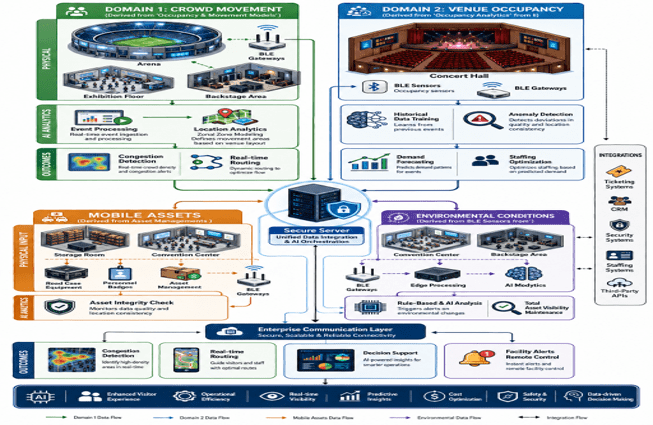
This infographic shows how BLE-generated data from crowd movement, venue occupancy, mobile assets, and environmental conditions flows through gateways into AI analytics. It highlights how these inputs support congestion detection, demand forecasting, asset visibility, facility alerts, staffing decisions, and event performance analysis.
Deployment Engineering for Entertainment Venues
A successful deployment begins before hardware installation. Venue operators should establish the operational questions the system must answer and then determine what data is required to answer them.
Planning and Site Survey
A site survey should document the physical and technical characteristics of each venue.
Important considerations include:
- Floor plans and zone boundaries.
- Entrance and exit locations.
- Stage and backstage layouts.
- Equipment storage locations.
- Expected attendee density.
- Gateway mounting positions.
- Network infrastructure.
- Electrical power availability.
- RF interference sources.
- Building materials.
- Temporary structures.
- Outdoor coverage requirements.
- Maintenance access.
BLE propagation can change substantially when a venue is full. Human bodies absorb and obstruct radio signals, while temporary structures, metal equipment, production trusses, lighting systems, and partitions can alter signal behavior.
Consequently, a design validated in an empty venue should be tested again under representative operating conditions.
Hardware Selection and Installation
Device selection should be based on the required measurement and operating environment.
For BLE gateways, engineering criteria can include:
- BLE version and supported profiles.
- Number of concurrently observed devices.
- Antenna configuration.
- Network interface options.
- Processing capability.
- Power requirements.
- Enclosure characteristics.
- Mounting method.
- Environmental tolerance.
- Remote management capability.
For BLE beacons and sensors, relevant criteria include:
- Battery life.
- Transmission interval.
- Transmission power.
- Sensor accuracy.
- Environmental rating.
- Physical mounting.
- Tamper considerations.
- Maintenance requirements.
Battery-operated devices should be positioned where periodic maintenance is practical. A beacon installed above a stage or inside a difficult-to-access production structure may create unnecessary maintenance costs even if its initial installation is inexpensive.
Commissioning and Calibration
Commissioning should verify the complete chain from BLE transmission to the operational application.
Testing should cover:
- Device registration.
- Gateway connectivity.
- Signal reception.
- Timestamp accuracy.
- Zone assignment.
- Data transmission.
- Duplicate-event handling.
- Device failure detection.
- Dashboard visibility.
- Alert generation.
- API integration.
- Data retention.
- User permissions.
Zone-level accuracy should be validated using representative test devices placed at known positions. The objective is to determine whether the system can reliably distinguish the operational zones that matter to the venue.
Integration Testing
BLE data becomes substantially more valuable when integrated with existing venue software.
Potential integrations include:
- Ticketing and admission systems.
- Event scheduling software.
- Venue management systems.
- Asset management systems.
- Facilities management software.
- Workforce management systems.
- Security and access-control systems.
- Business intelligence tools.
- Notification systems.
- Maintenance management software.
API design should specify data ownership, authentication, event schemas, error handling, retry mechanisms, rate limits, timestamps, and data-retention requirements.
An integration should also define what happens when the connected system is unavailable. Local buffering at gateways or edge servers can prevent temporary network failures from becoming permanent data gaps.
KPIs for AI-Enabled Entertainment Venue Management
AI projects should be evaluated through operational metrics rather than device counts. The appropriate KPI set depends on the venue’s objectives.
Crowd and Attendee KPIs
Relevant measures include:
- Average queue duration.
- Maximum queue duration.
- Entry throughput.
- Exit throughput.
- Zone occupancy.
- Average dwell time.
- Congestion frequency.
- Congestion duration.
- Movement between event zones.
- Session-room utilization.
These KPIs can be compared across events to identify recurring operational problems.
Asset and Equipment KPIs
Asset-focused deployments can measure:
- Asset location accuracy.
- Asset search time.
- Asset utilization.
- Asset idle time.
- Equipment movement frequency.
- Unreturned equipment incidents.
- Time required for event setup.
- Time required for event teardown.
- Maintenance response time.
System Performance KPIs
Technical teams should also measure:
- BLE gateway availability.
- Device reporting rate.
- Data latency.
- Event-processing latency.
- Message-loss rate.
- Battery life.
- Sensor availability.
- API success rate.
- Alert accuracy.
- False-positive rate.
AI model performance should be monitored separately from wireless infrastructure performance. A model can perform poorly because of insufficient training data even when gateways and sensors are functioning correctly.
AI and BLE KPI Dashboard for Entertainment Venue Operations
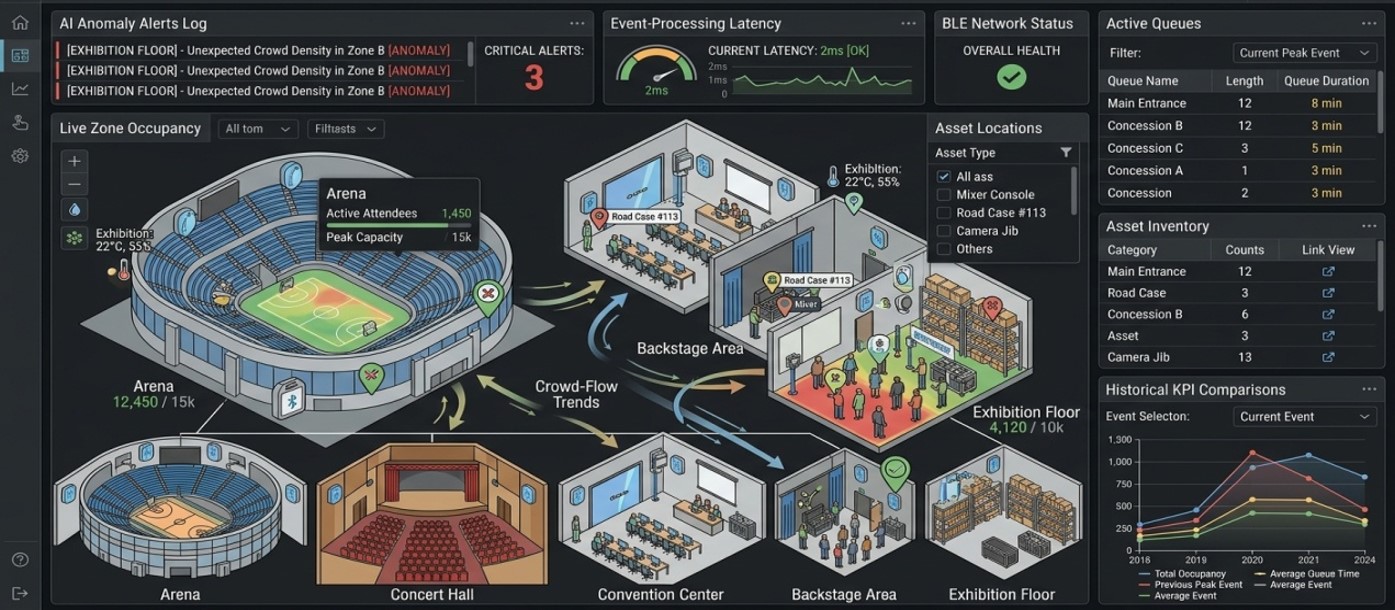
This dashboard mockup illustrates how venue operations and technical teams can monitor crowd activity, zone occupancy, queue duration, asset locations, BLE gateway health, environmental conditions, AI alerts, and event-processing performance in one operational view. It connects real-time venue intelligence with historical KPI analysis to support faster operational decisions and system optimization.
Cybersecurity, Privacy, and Data Governance
Entertainment venues may process information that can become sensitive when combined with attendee identity, ticketing information, access records, or other personal data. BLE deployments should therefore distinguish between anonymous operational telemetry and information that can be associated with identifiable individuals.
A privacy-aware design should consider:
- Data minimization.
- Purpose limitation.
- Appropriate retention periods.
- Access controls.
- Secure APIs.
- Administrative audit logs.
- Device authentication.
- Network segmentation.
- Secure firmware management.
- Incident-response procedures.
- Separation of operational and personally identifiable information.
Where BLE credentials are associated with named attendees, organizations should establish clear policies governing collection, use, retention, and access.
AI models should also avoid unnecessary collection of personally identifying information. For many crowd-flow applications, aggregated zone-level information can provide useful operational intelligence without storing individual movement histories.
Cybersecurity should extend to gateways and field devices because a compromised gateway can affect both data integrity and operational availability.
Scalability from One Venue to Multi-Venue Operations
A pilot deployment should normally begin with a measurable operational problem rather than attempting to instrument every venue zone simultaneously.
A practical rollout can focus on a representative area such as:
- A major entrance.
- A high-traffic corridor.
- A production equipment room.
- A convention session area.
- A backstage equipment zone.
- A concession area.
- A VIP hospitality zone.
The pilot should establish a baseline before AI optimization is introduced. This makes it possible to determine whether the solution actually improves the selected KPI.
After validation, additional zones can be introduced using standardized device registration, naming conventions, zone definitions, gateway configurations, data schemas, and maintenance procedures.
Multi-venue deployments require particular attention to consistency. A “Zone A” at one facility should not automatically mean the same operational concept at another facility. Venue identifiers, event identifiers, zone types, and asset categories should therefore be represented through a structured data model.
GAO’s experience supplying wireless and RFID-based systems provides a foundation for adapting hardware and system configurations to different operating environments rather than assuming that one deployment design fits every venue.
Implementation Recommendations for AI and BLE Venue Projects
Technical teams can reduce deployment risk by treating AI, wireless infrastructure, software integration, and venue operations as one connected project.
Recommended practices include:
- Define the operational problem before selecting hardware.
- Establish measurable baseline KPIs.
- Perform RF and physical site surveys.
- Design venue zones around actual operational workflows.
- Select gateway locations based on coverage and network availability.
- Validate BLE performance under realistic attendee density.
- Use edge filtering where high event volumes make centralized processing inefficient.
- Normalize timestamps and device identifiers before AI processing.
- Separate anonymous operational analytics from personally identifiable information.
- Integrate with existing venue software through documented APIs.
- Test network failures and gateway outages before commissioning.
- Establish device replacement and battery-maintenance procedures.
- Monitor AI false positives and false negatives after deployment.
- Retrain models when venue layouts, event formats, or operating patterns change.
- Maintain cybersecurity controls throughout the device lifecycle.
- Expand only after the pilot demonstrates measurable operational value.
The most important implementation lesson is that AI accuracy depends heavily on operational data quality. Better machine learning cannot compensate indefinitely for incorrect zone definitions, missing gateway data, inconsistent timestamps, poorly maintained devices, or incomplete event records.
Why AI and BLE Matter for the Future of Entertainment Venues
Entertainment venues are becoming increasingly data-driven environments. Event managers need timely information about crowd movement, venue utilization, equipment availability, environmental conditions, and operational exceptions while events are taking place.
BLE provides a practical mechanism for capturing proximity, presence, asset, and sensor information across distributed venue areas. AI adds the ability to interpret these observations at a scale that manual monitoring cannot easily achieve.
The combination is particularly valuable when it is integrated with venue scheduling, asset management, facility operations, ticketing, access control, and business intelligence systems.
GAO can support organizations evaluating BLE gateways, BLE beacons, BLE sensors, RFID equipment, IoT hardware, and related technical systems for customized venue applications. The appropriate configuration depends on the venue’s physical environment, operational requirements, data policies, network infrastructure, and desired AI outcomes.
Building the Future of AI and IoT for Entertainment Venues with Aperture Venture Studio and GAO
For more than three decades, GAO Group of Companies has invested heavily in R&D for industrial BLE, RFID, and IoT technologies. As generative AI became increasingly useful for practical industrial applications, we expanded our work in AIoT, combining AI with connected devices, sensors, BLE, RFID, and IoT systems. We have also developed Aperture Venture Studio to advance AI and IoT solutions relevant to operational domains such as entertainment venues. Aperture brings together technical specialists, executives, investors, and technology companies, while our Aperture Ventures Summit and TekSummit provide forums for discussing advanced AI and IoT applications. We welcome qualified participants as advisors, employees, investors, or customers interested in practical AI and IoT solutions.