
AI and BLE for EV Battery Pack Production
AI-Driven EV Battery Pack Production with Connected Manufacturing Data
AI is transforming EV Battery Pack Production by turning production, quality, equipment, and material data into actionable manufacturing intelligence. Battery pack assembly involves hundreds of tightly controlled activities, including cell preparation, module assembly, busbar installation, battery management system integration, thermal management, enclosure assembly, electrical testing, and end-of-line validation. AI can identify process deviations, predict equipment problems, improve traceability, and support quality decisions when reliable production data is available. BLE beacons, BLE sensors, and BLE gateways can provide location, identification, environmental, and equipment-state data around battery assembly areas without requiring every asset to be permanently wired. GAO supplies BLE hardware products and IoT systems that can support these connected manufacturing scenarios. Combined with machine learning, computer vision, edge processing, manufacturing execution software, and production databases, BLE-enabled data capture can help battery manufacturers connect physical production activity with AI-driven decisions.
AI-Enabled EV Battery Pack Production Data Flow
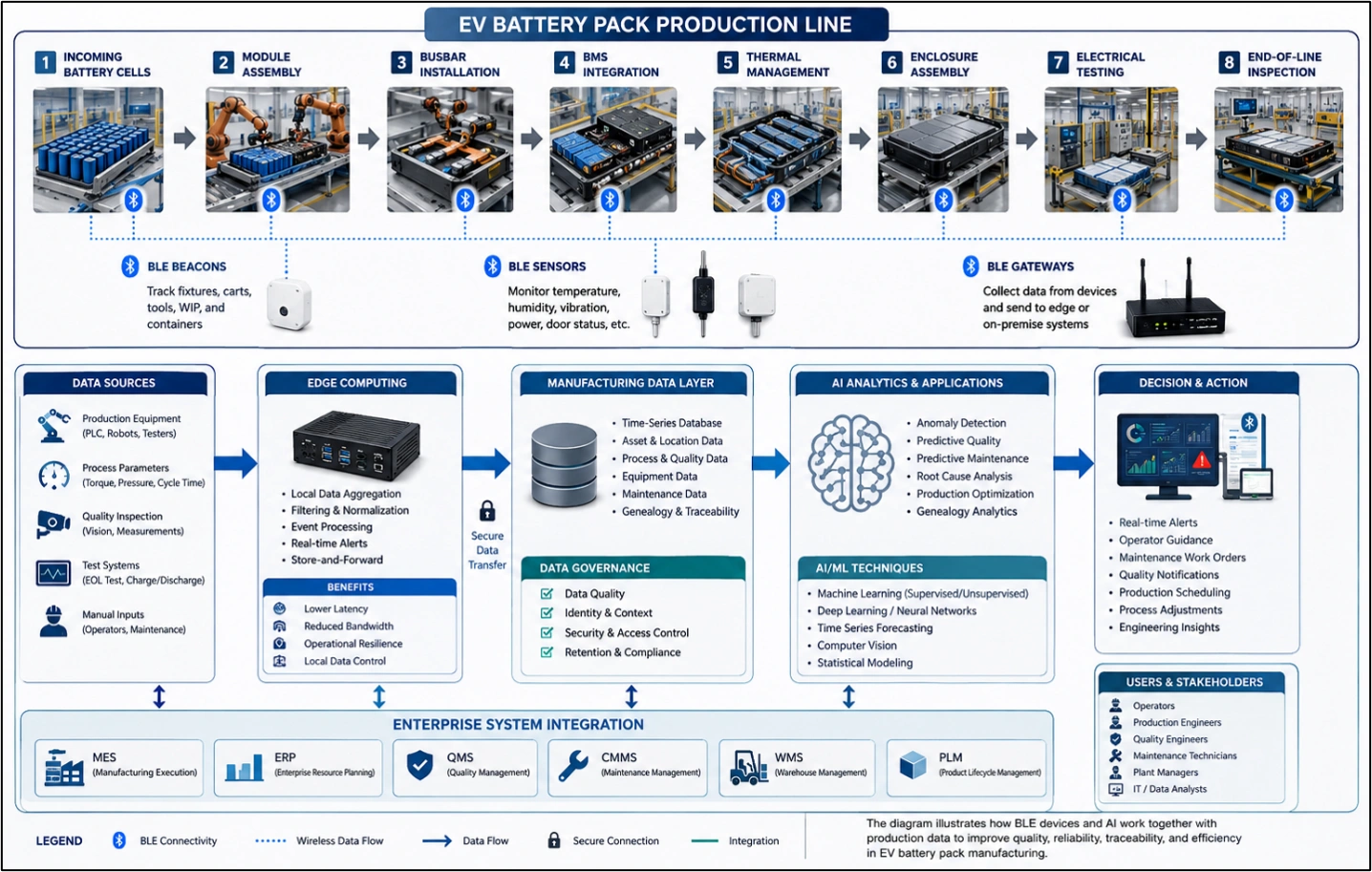
This infographic illustrates how BLE beacons, BLE sensors, and BLE gateways collect production data across EV battery pack manufacturing. The data flows through edge computing, manufacturing databases, AI analytics, and enterprise systems to support predictive quality, predictive maintenance, traceability, and production decisions.
Why AI Matters in EV Battery Pack Production
EV battery pack production has unusually demanding quality and traceability requirements because a defect introduced during cell, module, or pack assembly can affect electrical performance, thermal behavior, safety, warranty exposure, and vehicle reliability. AI helps manufacturers analyze relationships among production conditions that are difficult to evaluate manually.
Relevant AI applications include:
- AI battery quality inspection: Machine learning can identify abnormal production patterns associated with electrical, dimensional, thermal, or assembly defects.
- Predictive maintenance for battery assembly equipment: Equipment data can be analyzed to identify patterns that precede failures in torque tools, conveyors, welding equipment, test systems, and material-handling equipment.
- AI production traceability: AI can correlate battery cells, modules, tools, operators, workstations, test results, and production events to improve genealogy analysis.
- AI-assisted material tracking: BLE-enabled identification can help locate cell containers, module carriers, battery pack fixtures, test equipment, and work-in-process materials.
- AI process optimization: Production data can reveal bottlenecks, recurring process deviations, excessive waiting time, and abnormal cycle-time patterns.
- AI environmental monitoring: Sensor data can help identify abnormal temperature, humidity, or other environmental conditions in areas where battery materials and assembly processes require controlled conditions.
- AI anomaly detection: Statistical and machine learning models can identify deviations from expected production behavior without requiring every abnormal condition to be manually predefined.
- AI-assisted root-cause analysis: Correlating production events with inspection and test records can help engineers investigate recurring defects.
EV Battery Pack Production Applications for AI and BLE
Cell and Material Traceability
Battery manufacturers need reliable visibility into where cells, cell trays, module carriers, and other production materials are located and how they move through manufacturing operations. BLE beacons attached to reusable containers or mobile production assets can provide location events through strategically deployed gateways.
AI can combine these events with manufacturing orders, barcode or RFID records, workstation data, and MES transactions. This makes it possible to identify abnormal material movements, extended dwell times, misplaced containers, and production delays.
GAO’s BLE hardware can serve as one data acquisition layer within a broader traceability system, particularly where mobile assets need wireless identification or location visibility.
Module Assembly and Work-in-Process Tracking
Module assembly introduces multiple dependencies among cells, fixtures, tools, operators, and workstations. An AI-enabled production system can associate these events with a specific manufacturing order or battery genealogy record.
BLE sensors and beacons can help determine whether mobile fixtures and module carriers are present at designated work areas. Gateways collect nearby device events and transmit them to processing software. AI models can then analyze movement patterns, station dwell time, queue formation, and unusual process sequences.
This approach is particularly useful when manufacturers need to understand why a module remains at a workstation longer than its expected cycle time.
Battery Pack Assembly and Line Balancing
Pack assembly commonly includes mechanical enclosure work, electrical connections, busbar installation, BMS integration, cooling or thermal management components, sealing, fastening, and inspection.
AI can evaluate production history to identify stations that repeatedly constrain throughput. BLE-generated location events can add another dimension by showing the movement of fixtures, carts, tools, or work-in-process packs.
The combined data can support:
- Cycle-time analysis
- Station utilization analysis
- Work-in-process visibility
- Bottleneck identification
- Fixture movement analysis
- Abnormal dwell-time detection
- Production schedule adherence
- Line-balancing decisions
The engineering objective is not simply to collect more location data. It is to capture the minimum reliable data required to explain production behavior.
Predictive Maintenance for Battery Manufacturing Equipment
Battery pack production depends on equipment such as automated conveyors, robotic handling systems, torque tools, welding systems, electrical test equipment, leak-testing systems, thermal management equipment, and end-of-line test stations.
AI-based predictive maintenance can analyze equipment telemetry, maintenance history, operating cycles, alarms, temperature, vibration, current, or other available signals. BLE sensors can supplement fixed industrial sensors when mobile equipment, tools, fixtures, or environmental conditions need additional data collection.
A practical implementation should distinguish between safety-critical equipment monitoring and supplementary operational sensing. BLE should not replace a dedicated safety control system or a certified industrial control mechanism where such systems are required.
EV Battery Production Workflow from BLE Data to AI Decisions
A connected EV battery production system typically begins with physical events on the factory floor and ends with an operational decision.
Data Acquisition at Battery Manufacturing Workstations
Data may originate from:
- BLE beacons attached to battery carriers, fixtures, tools, containers, and mobile equipment
- BLE sensors measuring relevant environmental or equipment conditions
- BLE gateways positioned around assembly cells and production zones
- Barcode or QR identification systems
- RFID readers where higher-confidence item identification is required
- PLCs and industrial controllers
- Torque tools and fastening systems
- Welding and electrical test equipment
- Machine vision inspection systems
- Battery management system test equipment
- Environmental monitoring devices
- Operator terminals and production workstations
BLE is most useful when the manufacturing problem involves wireless identification, presence detection, proximity, movement, or supplementary sensing rather than deterministic control of safety-critical machinery.
Wireless Communication and Gateway Processing
BLE devices communicate locally with gateways positioned to provide appropriate coverage. Gateway placement requires consideration of metal battery enclosures, production machinery, racks, conveyors, electromagnetic conditions, antenna orientation, and the physical layout of assembly cells.
Battery manufacturing facilities can contain large metallic structures that affect radio propagation. A site survey and pilot installation are therefore important before defining final gateway locations.
Gateways can filter or normalize received information before transmitting relevant events to software through IP networks. This reduces unnecessary data transmission and allows the system to distinguish useful production events from transient wireless observations.
Edge, Server, and Cloud Data Processing
The gateway layer can forward information to an edge computer, factory server, private data center, or cloud-hosted service. Processing location should be selected according to latency, connectivity, data governance, cybersecurity requirements, existing IT infrastructure, and the type of AI workload.
Real-time production alerts may benefit from local processing because a temporary WAN outage should not necessarily prevent operators from receiving critical operational information. Historical analytics and model training can often be performed on centralized infrastructure.
Middleware and Manufacturing Software Integration
Middleware connects BLE events with manufacturing applications. A well-designed integration layer can normalize device identifiers, timestamps, gateway information, asset identities, production orders, workstation IDs, and event types.
Integration may involve:
- MES
- ERP
- Quality management systems
- Warehouse management systems
- Asset management software
- Maintenance management systems
- Production databases
- Data historians
- REST APIs
- MQTT messaging
- OPC UA
- SQL databases
- Event-driven integration services
A key implementation lesson is to establish a consistent asset and event model before building AI models. A machine learning system should know whether an observed device represents a battery carrier, module fixture, tool, container, or production asset.
AI Analytics and Manufacturing Decisions
After data normalization, AI models can detect anomalies, predict maintenance events, classify production conditions, forecast process performance, or identify relationships between production variables and quality outcomes.
The resulting decision may trigger an operator notification, maintenance work order, quality inspection, material investigation, production rescheduling, or process-engineering review.
EV Battery Pack Production Data-to-AI Decision Workflow
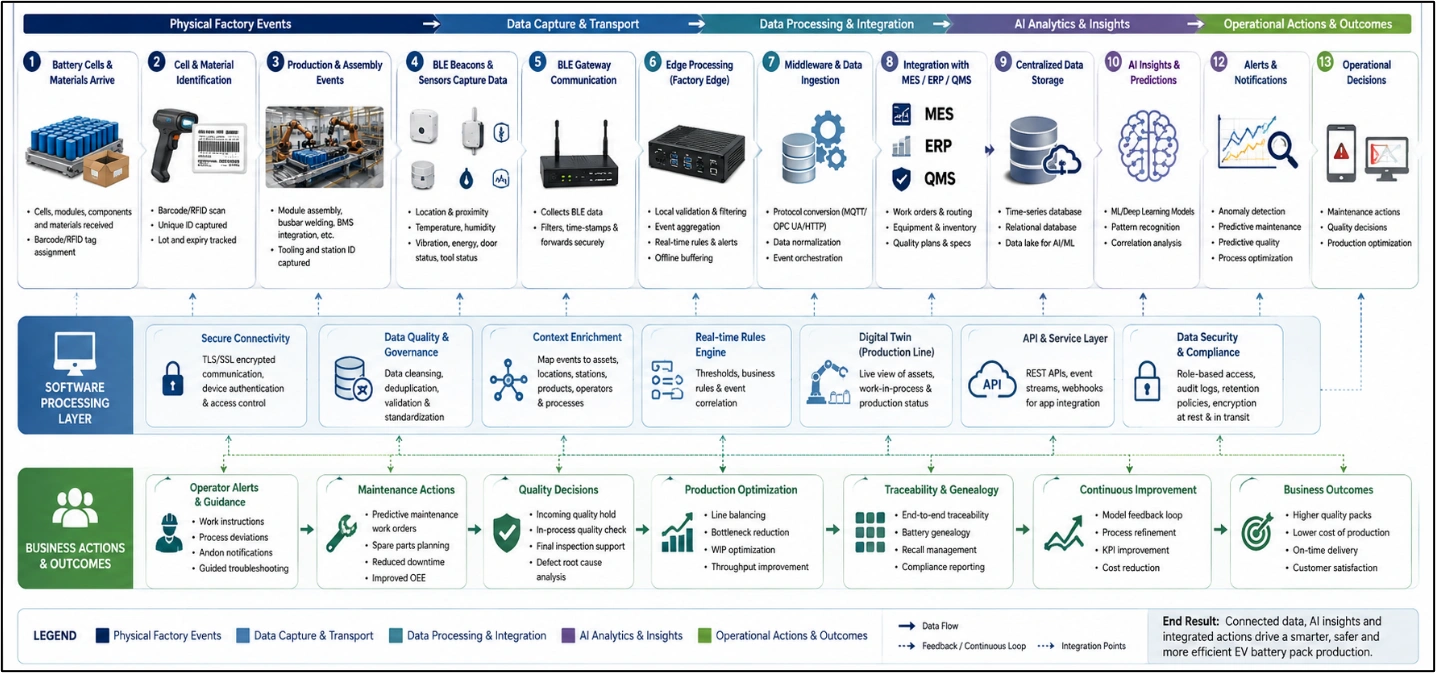
This workflow shows how battery cells, production events, BLE data, and manufacturing systems move through edge processing and AI analytics to support predictive maintenance, quality decisions, production optimization, and traceability.
Technical Foundation for AI-Enabled Battery Pack Manufacturing
BLE Hardware for Battery Production
BLE beacons can provide wireless identity or proximity information for mobile battery production assets. BLE sensors can capture selected environmental or equipment conditions, while BLE gateways receive transmissions and forward relevant events to processing software.
Gateway placement is a major engineering consideration. Battery production areas can contain metal racks, tooling, conveyors, enclosures, and machinery that influence RF propagation. Gateway density should therefore be determined through site testing rather than a simple coverage estimate.
GAO provides BLE beacons, sensors, gateways, and related IoT hardware that can be incorporated into battery production tracking and monitoring systems.
AI and Machine Learning Methods
Different battery manufacturing problems require different analytical approaches.
- Anomaly detection can identify unusual production behavior when labeled defect data is limited.
- Classification models can categorize production states or quality conditions.
- Regression models can estimate continuous variables such as process performance or expected cycle time.
- Time-series models can analyze equipment and environmental measurements over time.
- Clustering can identify recurring production patterns without predefined categories.
- Computer vision models can inspect components, connections, labels, welds, or assembly conditions where suitable image data is available.
- Predictive models can estimate maintenance or quality risk from historical production and equipment data.
Model selection should follow the manufacturing problem and available data rather than starting with a preferred AI algorithm.
Cloud Version and Server Version for Battery Manufacturing
A Cloud Version uses cloud-hosted software and infrastructure to store, process, visualize, and analyze production data. It can be appropriate for organizations operating multiple facilities or requiring centralized analytics, remote engineering access, elastic computing resources, and consolidated AI model management.
A Server Version runs software on factory servers, customer-managed servers, private data centers, edge servers, or other privately hosted enterprise infrastructure. It can be preferable where production data must remain within controlled infrastructure, connectivity to external cloud services is restricted, or local processing is important.
A hybrid deployment can combine local event processing with centralized analytics. For example, a factory server may process BLE gateway events and maintain production continuity while selected historical datasets are transferred to centralized infrastructure for AI model development.
Communication, APIs, and Data Security
A production-grade solution should separate wireless device communication from enterprise application security. BLE devices should use appropriate authentication and encryption capabilities, while gateways and servers should be protected through network segmentation, access controls, credential management, secure APIs, logging, and software update procedures.
MQTT can be useful for event-based IoT messaging, while REST APIs can support application integration. OPC UA may be relevant where production equipment and industrial control systems need standardized data exchange.
Security design should also consider gateway credentials, device provisioning, certificate management where applicable, network access, role-based permissions, audit logs, data retention, and remote maintenance procedures.
Data Quality and Model Governance
AI deployment should include validation of sensor accuracy, device identity, timestamps, gateway coverage, missing data, duplicate events, and inconsistent production records.
Battery manufacturing also benefits from maintaining a clear relationship between AI predictions and source data. Engineers should be able to determine which production variables contributed to an alert and whether the underlying data is reliable.
A model should therefore be monitored after deployment for changes in production conditions, equipment configuration, battery chemistry, process parameters, and defect patterns. Model performance that is acceptable during pilot production may deteriorate when the production line or product configuration changes.
Practical Deployment Considerations for EV Battery Pack Production
A successful implementation starts with a clearly defined manufacturing problem rather than indiscriminate sensor deployment. A battery manufacturer may initially focus on a specific production constraint such as locating mobile fixtures, reducing work-in-process search time, improving pack genealogy, identifying abnormal station dwell time, or predicting failures in selected production equipment.
The deployment team should establish:
- The production process and stations involved
- The assets and materials requiring visibility
- Required location or proximity accuracy
- Data collection frequency
- Gateway placement requirements
- Existing MES, ERP, QMS, and maintenance software
- Required AI outputs
- Operator and engineering workflows
- Network and cybersecurity requirements
- Cloud, server, or hybrid processing requirements
- Data retention and governance policies
- Acceptance criteria and measurable KPIs
A controlled pilot is generally more informative than attempting to instrument an entire battery facility immediately. Pilot results can establish RF behavior, device battery life, event reliability, gateway density, data quality, integration effort, and AI feasibility before production-wide deployment.
BLE Deployment Layout for AI-Enabled EV Battery Pack Production
This factory-floor diagram maps BLE beacons, sensors, and gateways across EV battery production areas, including cell staging, module assembly, BMS integration, testing, and finished-pack staging. It also shows connections to edge processing, MES/QMS/ERP systems, data storage, AI analytics, and operational actions.
GAO Experience Supporting Connected Manufacturing Systems
GAO’s work with BLE, RFID, and IoT hardware products and systems provides a practical foundation for organizations evaluating wireless identification and sensing in manufacturing environments. GAO Group companies, including GAO and its sister companies GAO Research and GAO Tek, are based in New York City and Toronto, Canada.
For three decades, GAO Group has supplied technology to customers across the United States and Canada, including Fortune 500 companies, leading R&D organizations, universities, and government agencies. Its engineering approach includes product R&D, quality assurance, remote technical assistance, and onsite support where required.
For EV battery pack production, this experience is relevant because successful IoT deployment depends on more than selecting wireless devices. Device characteristics, factory RF conditions, software integration, production workflows, data quality, maintenance requirements, and operational objectives all need to work together.
AI Capabilities That Improve EV Battery Pack Production
Combining AI with connected production data can improve how battery manufacturers monitor, diagnose, and optimize pack assembly. The strongest results typically come from connecting AI outputs to an existing manufacturing process rather than treating AI as a separate analytics exercise.
Predictive Quality and Defect Detection
AI can analyze production variables, inspection results, equipment states, environmental conditions, and process history to identify patterns associated with battery pack defects. For example, a model can compare torque results, assembly timing, component genealogy, temperature measurements, and end-of-line test outcomes to identify combinations that correlate with quality failures.
Computer vision can complement these models by inspecting visible assembly characteristics such as component placement, labels, connectors, fasteners, weld characteristics, and other suitable visual features.
The practical advantage is earlier intervention. Instead of discovering every problem during final testing, manufacturers can identify abnormal process conditions closer to where they occur.
Battery Genealogy and Traceability
Battery genealogy links individual cells, modules, components, production stations, tools, operators, process parameters, inspection results, and final pack records.
AI can analyze this genealogy to identify recurring relationships between upstream production conditions and downstream failures. BLE can supplement identification and movement information for mobile fixtures, carriers, tools, and containers.
A robust genealogy system should retain deterministic identifiers from manufacturing systems rather than relying solely on wireless proximity information. BLE observations are most valuable when they add contextual information about movement, presence, or location.
Production Bottleneck Detection
Cycle-time variation can create significant constraints in battery pack assembly. AI can analyze station-level production records and identify recurring delays.
BLE-generated movement events can provide additional evidence about where work-in-process materials or fixtures spend time. Combining these observations with MES records can help distinguish between a true process bottleneck and a downstream material-handling delay.
Potential optimization targets include:
- Station cycle time
- Work-in-process dwell time
- Fixture availability
- Material replenishment delays
- Equipment downtime
- Test-station queues
- Operator waiting time
- Production-order delays
Predictive Maintenance and Equipment Reliability
Predictive maintenance models can estimate failure risk by learning from equipment telemetry, alarms, maintenance history, operating cycles, and production conditions.
For battery manufacturing, candidate equipment may include torque tools, robotic systems, conveyors, welding equipment, test stations, cooling equipment, material-handling systems, and other production machinery.
BLE sensors can provide supplementary measurements where wireless sensing is technically appropriate. The maintenance system can then use AI-generated risk scores to prioritize inspections or maintenance activities.
A useful implementation connects the prediction to a maintenance workflow. An alert that does not reach the maintenance team or generate an actionable work order has limited operational value.
Measuring AI Performance in EV Battery Pack Production
AI and BLE projects should be evaluated through manufacturing KPIs rather than device counts alone. The objective is to demonstrate measurable improvement in production quality, reliability, traceability, throughput, or resource utilization.
Relevant KPIs can include:
- First-pass yield
- Defect rate
- Scrap rate
- Rework rate
- End-of-line test failure rate
- Mean time between failures
- Mean time to repair
- Unplanned equipment downtime
- Preventive maintenance compliance
- Average station cycle time
- Work-in-process dwell time
- Material search time
- Fixture utilization
- Production-order adherence
- Traceability completeness
- Asset-location accuracy
- BLE event reliability
- Gateway message delivery rate
- AI anomaly detection precision
- False-positive alert rate
- Predictive maintenance lead time
- Model prediction accuracy
- Quality escape rate
- Overall equipment effectiveness
KPI selection should match the original production problem. For example, a fixture-location project should not be judged primarily by AI model accuracy. It should be evaluated through measures such as search time, fixture utilization, production delays, and asset-location reliability.
EV Battery Pack Production Implementation Lifecycle
Define the Manufacturing Problem
The first step is to identify a measurable production problem. Examples include excessive fixture-search time, poor work-in-process visibility, recurring equipment failures, inconsistent station cycle times, incomplete genealogy, or difficulty identifying the source of quality deviations.
The problem statement should define the affected production area, baseline KPI, required improvement, data sources, and operational owner.
Survey the Production Environment
Engineers should document production stations, equipment, material flow, metal structures, gateway mounting locations, network availability, environmental conditions, and existing identification technologies.
For BLE deployments, RF behavior should be tested around battery assembly equipment and metallic structures before finalizing gateway density.
Select Hardware and Data Sources
Hardware selection should reflect the required function.
BLE beacons are appropriate for many mobile identification and proximity applications. BLE sensors can support environmental or equipment monitoring where their measurement characteristics satisfy the use case. BLE gateways provide the connection between local wireless devices and software.
Other technologies may be used alongside BLE. RFID can provide deterministic item identification in appropriate workflows, while PLCs, industrial sensors, machine vision, and test equipment can supply process-specific information.
GAO can support organizations evaluating BLE, RFID, and IoT hardware products for these connected manufacturing requirements.
Build the Data and Integration Layer
The implementation should establish a common data model linking device IDs with physical assets, production stations, work orders, and manufacturing events.
Integration testing should verify:
- Device registration
- Gateway connectivity
- Timestamp consistency
- Asset identity mapping
- Event delivery
- Duplicate-event handling
- Missing-data handling
- API reliability
- MES integration
- QMS integration
- Maintenance-system integration
- Database performance
- Access control
- Audit logging
Commission and Validate
Commissioning should be performed under representative production conditions. RF testing performed during an empty factory shift may not represent actual performance when battery packs, metal racks, carts, operators, and production equipment are present.
Validation should measure the actual business KPI alongside technical metrics.
Optimize and Scale
Once the pilot achieves its acceptance criteria, the system can be expanded to additional stations or production lines.
Scaling should not simply mean installing more devices. Gateway capacity, network traffic, database growth, device battery replacement, software monitoring, cybersecurity, AI model maintenance, and support procedures must all be considered.
EV Battery Pack Production AI Deployment Lifecycle
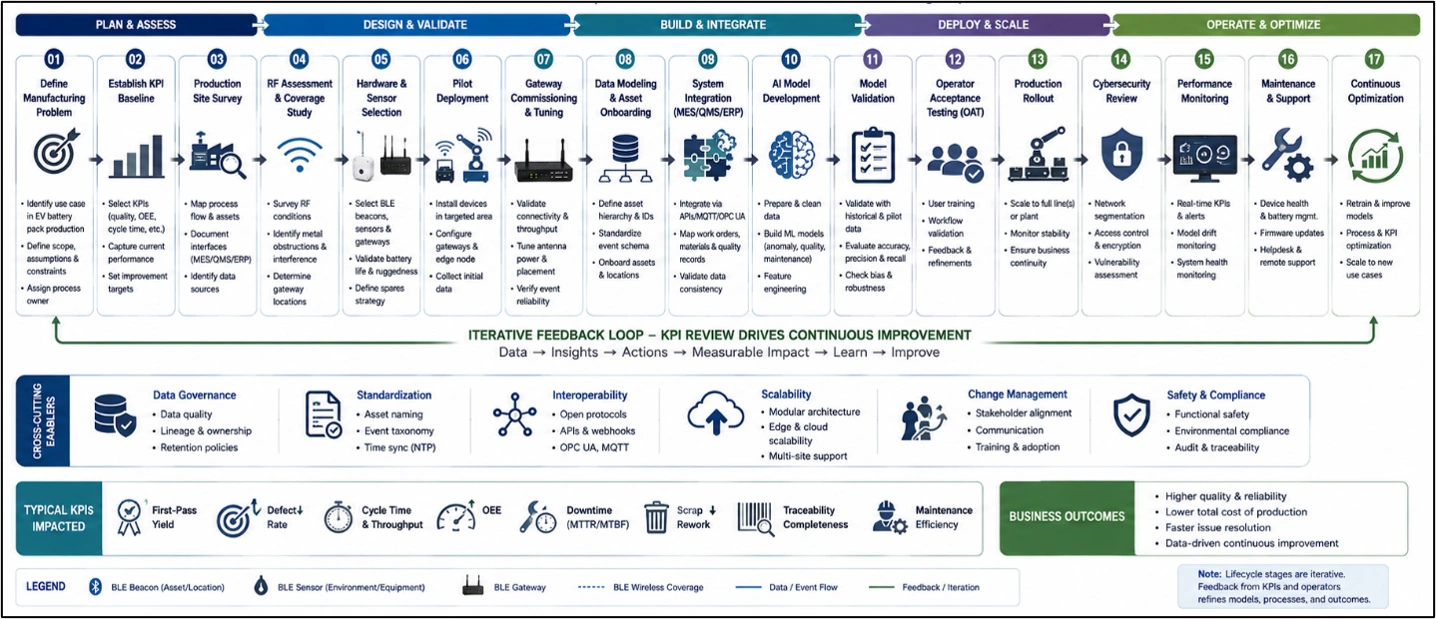
This lifecycle diagram presents a KPI-driven implementation path for AI-enabled connected technology in EV battery pack production, from manufacturing problem definition and site assessment through BLE deployment, data integration, AI validation, production rollout, cybersecurity, monitoring, and continuous optimization
Cybersecurity and Operational Reliability
Connected battery manufacturing systems introduce additional devices, network connections, APIs, and software services that need to be governed throughout their operational lifecycle.
Security controls should include:
- Network segmentation between production equipment and general IT networks
- Strong authentication for gateways and software accounts
- Controlled device provisioning
- Credential rotation
- Encrypted communications where supported
- Role-based access control
- Secure API authentication
- Audit logging
- Vulnerability management
- Controlled firmware and software updates
- Backup and recovery procedures
- Monitoring for unauthorized device activity
- Defined remote-support procedures
Battery manufacturing systems also require operational resilience. A temporary network outage should not unnecessarily stop production when the affected functionality is non-critical. Local buffering or edge processing can allow gateways to retain events until connectivity is restored.
Safety-critical battery production functions should remain under appropriately designed industrial control and safety systems. AI recommendations should not be treated as a substitute for required safety controls, interlocks, emergency systems, or certified protection mechanisms.
Engineering Trade-Offs in BLE-Enabled Battery Production
BLE provides useful wireless visibility, but engineering teams should understand where it is and is not the right choice.
BLE can be attractive for mobile assets because installation can be less intrusive than permanently wiring every tracked item. However, location accuracy depends on the chosen positioning method, gateway geometry, RF conditions, antenna characteristics, and environmental interference.
Battery manufacturing facilities also contain large conductive structures that can affect signal behavior. This makes physical testing important.
Other considerations include:
- Location accuracy versus infrastructure cost: Higher positioning precision can require additional gateways or more sophisticated methods.
- Battery life versus transmission frequency: More frequent transmissions can improve event responsiveness but may reduce beacon or sensor battery life.
- Coverage versus RF interference: Additional gateways can improve coverage, but excessive device density may increase system complexity.
- Cloud accessibility versus local control: Cloud processing supports centralized analytics, while local servers can provide stronger control over data location and connectivity dependencies.
- AI sensitivity versus false alarms: Highly sensitive anomaly detection can generate excessive alerts if models are not properly calibrated.
- Automation versus human validation: Quality and maintenance recommendations may require engineer or operator review before action.
These trade-offs should be documented during solution design rather than discovered after production deployment.
Scaling AI Across EV Battery Manufacturing Operations
Once an initial production use case is validated, the same data principles can support additional applications.
A manufacturer may expand from fixture tracking into material-flow analysis, predictive maintenance, production anomaly detection, quality genealogy, environmental monitoring, and AI-assisted process optimization.
Multi-line deployments require consistent device naming, asset identifiers, event formats, time synchronization, data retention policies, and model governance. Without standardization, each production line can become an isolated data source that is difficult to compare.
A centralized software layer can provide common analytics while allowing individual factories to retain appropriate local processing and operational controls.
GAO’s BLE, RFID, and IoT product portfolio can support different stages of this expansion, while system integration should remain aligned with the manufacturer’s existing production software and engineering processes.
AI and BLE Recommendations for EV Battery Pack Production
Manufacturers considering AI-enabled connected production should prioritize measurable operational problems and establish the data foundation before expanding AI workloads.
Recommended engineering practices include:
- Start with a production problem that has a measurable baseline KPI.
- Map the complete battery genealogy and material flow before selecting tracking hardware.
- Use BLE where wireless identification, proximity, location, or supplementary sensing provides meaningful value.
- Combine BLE observations with MES, QMS, ERP, PLC, machine vision, and test-system data when appropriate.
- Perform RF testing under realistic production conditions.
- Establish consistent device, asset, workstation, and event identifiers.
- Select Cloud Version, Server Version, or hybrid deployment according to latency, connectivity, cybersecurity, and data-governance requirements.
- Keep safety-critical control functions independent of experimental AI recommendations.
- Validate AI models against production outcomes rather than relying only on laboratory metrics.
- Monitor false positives, false negatives, data drift, and changing production conditions.
- Design device maintenance and battery replacement procedures before production rollout.
- Build cybersecurity and software-update processes into commissioning rather than treating them as post-deployment activities.
- Expand only after the pilot demonstrates measurable production value.
The Business Value of AI-Enabled EV Battery Pack Production
The most significant benefit of AI in battery pack manufacturing is the ability to connect fragmented production observations into actionable operational intelligence.
A manufacturer can move from asking “Where is the fixture?” to understanding how fixture availability affects station utilization. The organization can move from “Why did this pack fail testing?” to examining upstream production conditions, component genealogy, process timing, equipment behavior, and inspection results.
Similarly, predictive maintenance can move maintenance teams from reacting to equipment failures toward prioritizing interventions according to predicted operational risk.
These capabilities can contribute to improved first-pass yield, lower rework, better equipment utilization, stronger traceability, reduced production delays, and faster root-cause analysis. The actual improvement depends on production maturity, data quality, model performance, process discipline, and integration quality.
The technology therefore should be viewed as an engineering tool for improving manufacturing decisions, not as a replacement for manufacturing expertise.
Moving Toward Data-Driven EV Battery Pack Manufacturing
AI-enabled EV Battery Pack Production requires a combination of reliable physical data capture, appropriate wireless infrastructure, industrial software integration, machine learning, production engineering, and disciplined deployment practices.
BLE beacons, sensors, and gateways can provide useful contextual data for mobile assets, fixtures, containers, equipment, and selected environmental conditions. AI can then turn these observations and other manufacturing data into anomaly detection, predictive quality, predictive maintenance, production optimization, and traceability insights.
Organizations planning such deployments should begin with a clearly defined manufacturing problem, establish measurable KPIs, conduct a representative pilot, validate the data pipeline, and select the appropriate Cloud Version, Server Version, or hybrid implementation.
GAO provides BLE, RFID, and IoT hardware products and systems that can serve as building blocks for connected manufacturing applications. Organizations evaluating EV battery production tracking, monitoring, or AI integration can learn more about GAO’s technology products and technical support to determine which approach fits their manufacturing environment.
Building the Future of Industrial AI and IoT with Aperture Venture Studio and GAO RFID Inc.
For more than three decades, GAO Group of Companies has invested heavily in R&D for industrial BLE, RFID, and IoT. As AI has become increasingly useful in industrial applications, we have advanced AI and IoT technologies for connected manufacturing, including EV battery pack production. We have also established Aperture Venture Studio to advance practical AI and IoT solutions relevant to manufacturing and other industries.
Aperture brings together AI and IoT technical experts, entrepreneurial and operational executives, investors, and leading companies. We have also developed Aperture Ventures Summit and TekSummit to discuss advanced AI and IoT topics and foster technical communities.
We welcome professionals and organizations interested in contributing as:
- Advisors, co-founders, or employees
- Investors
- Customers