
AI and BLE for Facility Navigation
How AI Improves Smart Tire Manufacturing with BLE-Enabled Data
AI is increasingly being applied to Smart Tire Manufacturing to improve quality inspection, production traceability, equipment reliability, material flow, and process control. BLE serves as a practical data-acquisition layer through BLE beacons, BLE sensors, and BLE gateways that identify mobile assets, capture environmental or machine-related conditions, and provide location and status data around tire production areas. AI software can combine this BLE data with PLC signals, machine-vision results, MES records, SCADA data, maintenance history, and production parameters to identify process deviations and support faster decisions. For tire manufacturers, the value comes from connecting physical production activity with time-series analytics and AI models rather than treating asset tracking and production data as separate systems. GAO supplies BLE, RFID, and IoT hardware products and systems that can support these data-capture requirements across tire manufacturing facilities.
Why AI Matters to Modern Smart Tire Manufacturing
Smart Tire Manufacturing involves tightly controlled sequences including rubber mixing, extrusion, calendering, bead preparation, tire component assembly, green tire building, curing, inspection, finishing, warehousing, and shipment. Each stage produces operational data, while critical assets such as molds, material carts, racks, curing equipment, AGVs, forklifts, tools, and inspection equipment move throughout the facility.
AI becomes useful when these data streams are correlated with production context.
For example, an AI model can evaluate whether an abnormal curing temperature trend, repeated equipment vibration events, extended mold movement time, or unusual work-in-process dwell time is associated with downstream quality defects. BLE can provide the asset identity, location, movement history, and selected sensor measurements needed to establish that relationship.
Key Smart Tire Manufacturing applications include:
- AI-assisted tire quality inspection using machine vision, defect classification, and anomaly detection.
- AI-based predictive maintenance for mixers, extruders, calenders, tire builders, curing presses, conveyors, compressors, and material-handling equipment.
- BLE-based tracking of tire molds, material carts, racks, tools, fixtures, inspection devices, and mobile production equipment.
- AI-assisted work-in-process visibility by correlating BLE location events with MES production orders and routing information.
- Environmental monitoring for temperature and humidity in areas where material storage and process conditions require tighter control.
- AI analysis of equipment and process data to identify bottlenecks affecting OEE, cycle time, scrap rate, throughput, and changeover performance.
- Digital traceability of production assets and selected material-handling activities.
- AI-supported anomaly detection for abnormal asset movement, excessive dwell time, missing equipment, or unexpected production-area transitions.
AI and BLE-Enabled Smart Tire Manufacturing Workflow
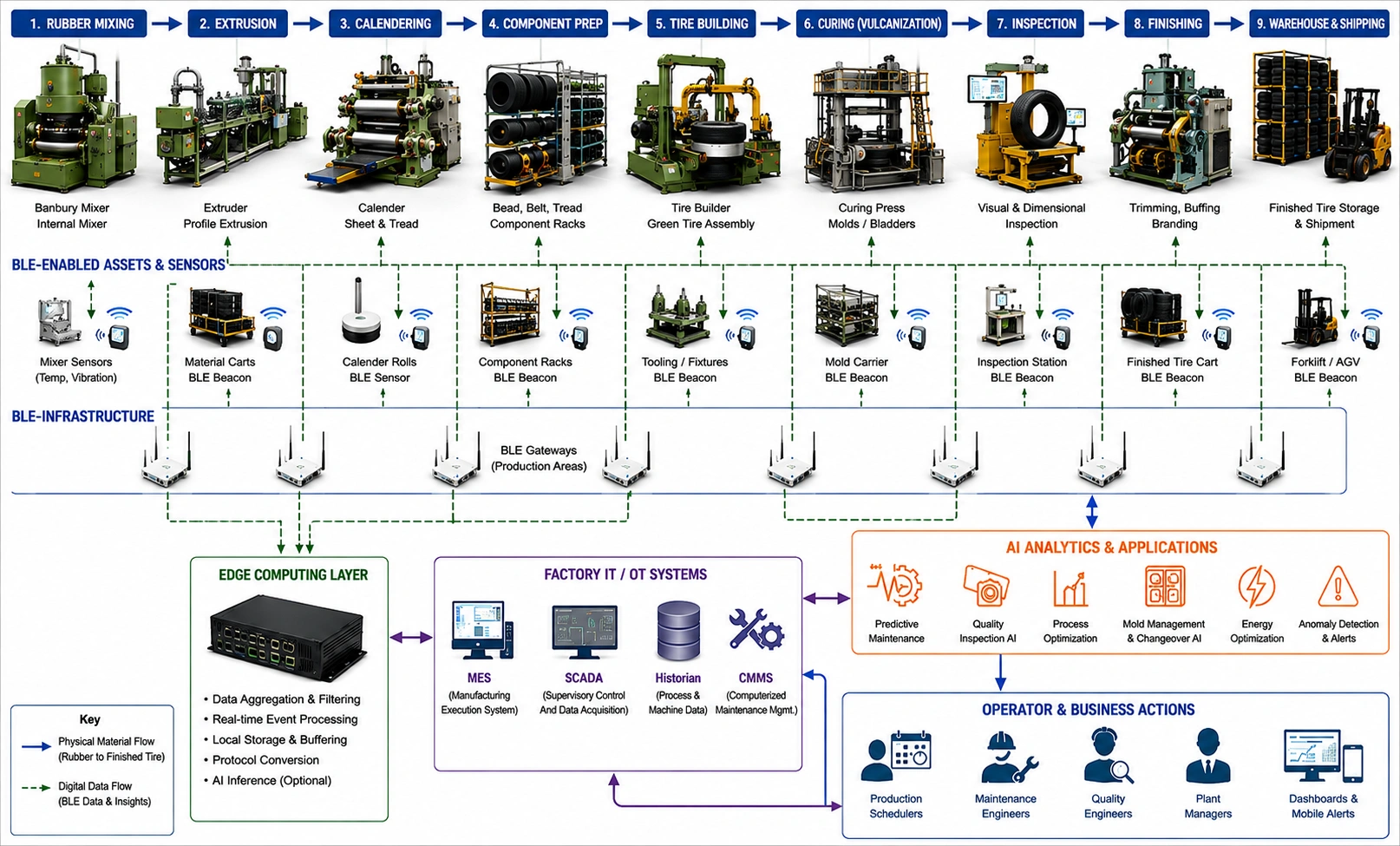
This workflow illustrates how BLE beacons, BLE sensors, and BLE gateways connect tire manufacturing processes from rubber mixing through warehouse shipment. It shows how BLE data moves through edge computing, factory IT/OT systems, and AI analytics to support predictive maintenance, quality inspection, process optimization, mold management, energy optimization, and anomaly detection.
Smart Tire Manufacturing Processes Most Relevant to AI and BLE
The strongest use cases occur where physical asset movement, machine conditions, production timing, and quality outcomes need to be correlated.
Smart Tire Manufacturing Process BLE Data AI Application Operational Outcome
Rubber compound handling Cart, rack, container location Dwell-time and flow analysis Better material movement control
Extrusion Equipment status and nearby asset data Anomaly detection Earlier process deviation detection
Calendering Equipment-area conditions Process correlation Reduced variation and waste
Tire building Tool and fixture location Cycle-time analysis Improved line utilization
Mold management Mold identity and movement Predictive scheduling Reduced mold-search and changeover delays
Curing Press-area asset and sensor data Maintenance and anomaly models Improved equipment availability
Final inspection Inspection equipment identity Defect classification Better quality analytics
Finished tire handling Rack and pallet location Flow optimization Improved traceability and throughput
AI should not be treated as a replacement for established manufacturing controls. PLCs, safety systems, quality gates, MES transactions, and validated process controls remain responsible for deterministic production functions. AI is more appropriate for prediction, classification, anomaly detection, optimization recommendations, and decision support.
From BLE Data Capture to AI-Driven Production Decisions
A Smart Tire Manufacturing AI solution normally begins with data capture at the production asset or work area.
BLE beacons can provide persistent digital identities for molds, carts, racks, tools, fixtures, and other mobile assets. BLE sensors can add measurements such as temperature, humidity, acceleration, vibration, or other application-specific values. BLE gateways receive advertisements or sensor messages and forward relevant information to factory software.
The resulting data flow can be organized as:
- Data acquisition from BLE beacons, BLE sensors, PLCs, machine controllers, vision systems, and industrial sensors.
- BLE gateway processing for device discovery, filtering, timestamping, signal-quality evaluation, and forwarding.
- Local network transmission using Ethernet, Wi-Fi, or other approved industrial connectivity.
- Edge processing for buffering, normalization, rule evaluation, protocol conversion, and low-latency analytics.
- Middleware integration with MQTT, REST APIs, OPC UA, databases, historians, or message brokers where appropriate.
- Data association with production orders, tire specifications, equipment IDs, mold IDs, work centers, operators, and quality records.
- AI processing using time-series analysis, anomaly detection, classification, regression, computer vision, forecasting, or optimization techniques.
- MES, CMMS, SCADA, ERP, quality-management software, or dashboards receiving actionable results.
- Production personnel using alerts, work instructions, maintenance recommendations, scheduling information, or quality investigations to take action.
The critical engineering requirement is data context. A BLE location event stating that a mold is near a curing press is useful, but an event associated with a specific mold ID, press ID, production order, tire specification, timestamp, cycle state, and maintenance record is substantially more valuable for AI analysis.
BLE Hardware and Software for Smart Tire Manufacturing
BLE is particularly useful for tire plants because many important assets are mobile and do not justify wired network connections. BLE communication is also well suited to low-power beacons and battery-operated sensors, while gateways can provide the connection between BLE devices and factory networks.
Bluetooth specifications define the interoperable technologies used by Bluetooth devices, with current adopted Core specifications extending through Bluetooth Core 6.3. The appropriate version should be selected according to the required features, device qualification, gateway compatibility, power requirements, and procurement lifecycle rather than simply choosing the newest specification. (Bluetooth® Technology Website)
Relevant components include:
- BLE beacons for persistent identification of molds, carts, racks, tools, fixtures, and other mobile assets.
- BLE sensors for temperature, humidity, acceleration, vibration, or other measured parameters required by the use case.
- BLE gateways for collecting nearby BLE transmissions and transferring data to edge servers or factory software.
- Industrial computers or edge servers for local data processing and temporary data buffering.
- Ethernet and industrial Wi-Fi for gateway backhaul where appropriate.
- MQTT or similar publish-subscribe messaging for lightweight event transport.
- OPC UA for integration with industrial control and information systems where supported.
- REST APIs for integration with MES, CMMS, ERP, analytics, or custom applications.
- Time-series databases for sensor and equipment data.
- Relational databases for asset master data, production records, and transactional information.
- AI inference software for anomaly detection, forecasting, classification, and operational recommendations.
BLE positioning should also be engineered according to the required accuracy. A tire plant that only needs to determine whether a mold is in a curing area has very different requirements from an application that needs precise positioning within a production cell. Gateway density, antenna placement, RF interference, metal structures, equipment movement, battery life, advertisement intervals, signal filtering, and calibration all affect results.
AI and BLE Architecture for Smart Tire Manufacturing
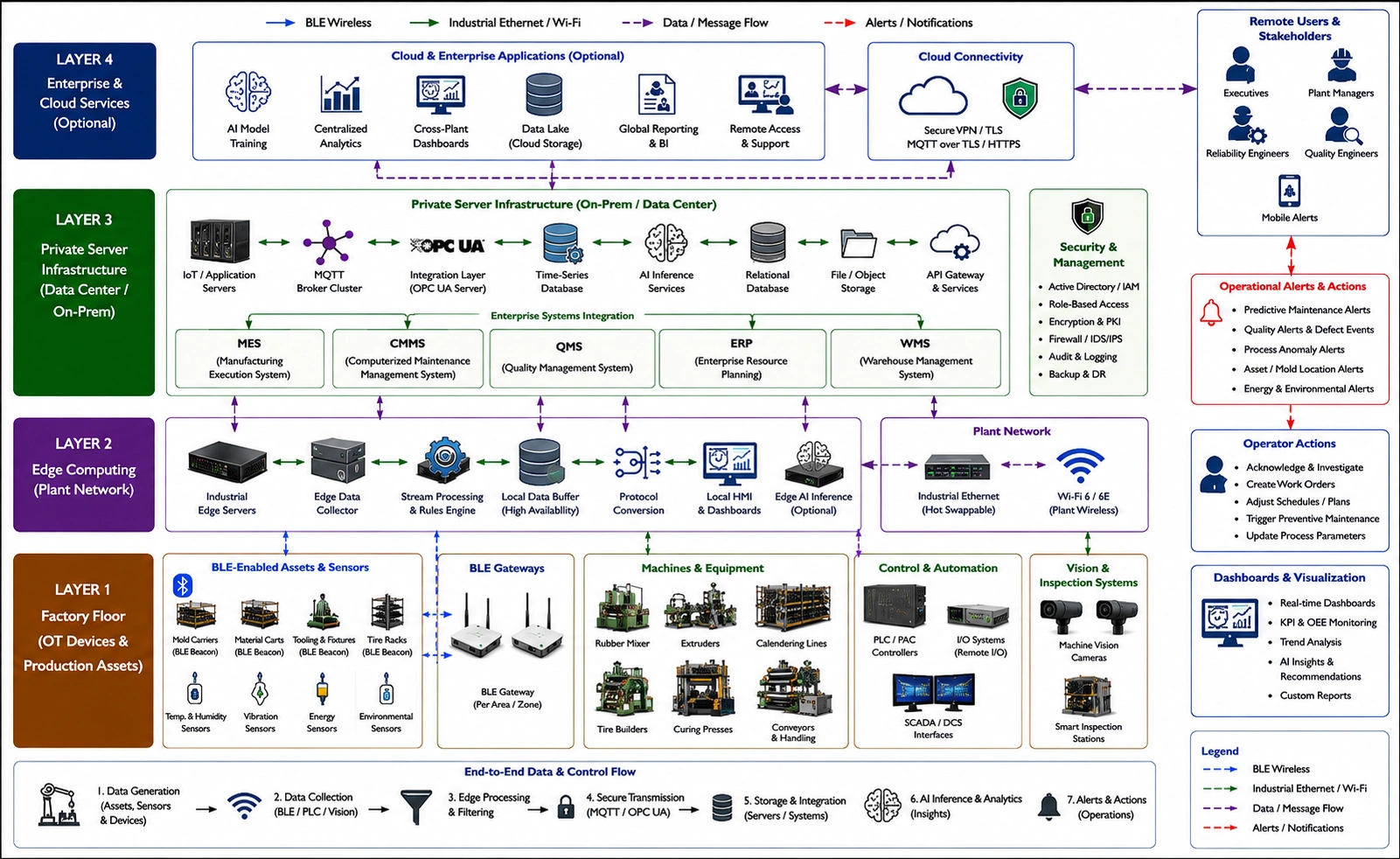
This architecture diagram shows how BLE-tagged molds, carts, racks, tools, pallets, sensors, and production equipment connect through BLE gateways, industrial networks, and edge computing. It illustrates integration with MES, SCADA/HMI, CMMS/EAM, historians, ERP systems, AI analytics, and optional cloud services to support predictive maintenance, quality inspection, asset tracking, anomaly detection, and production optimization.
Cloud and Server Deployment for Tire Manufacturing AI
Smart Tire Manufacturing organizations can deploy AI and BLE software using either cloud-hosted services or privately managed server infrastructure. The appropriate model depends on production latency, cybersecurity requirements, network availability, corporate IT policy, data governance, and the desired degree of local control.
Cloud Version
A cloud-hosted deployment can centralize BLE gateway data, asset records, AI models, analytics, and multi-site reporting. This approach is useful for tire manufacturers operating multiple plants that need consolidated visibility across production locations.
Cloud deployment can support:
- Centralized AI model management.
- Cross-plant benchmarking of OEE, downtime, asset utilization, and quality indicators.
- Long-term storage of sensor and asset-event data.
- Scalable analytics workloads.
- Remote engineering and maintenance support.
- Centralized dashboards for manufacturing and operations leadership.
The primary engineering considerations are WAN availability, secure gateway-to-cloud communication, data latency, bandwidth, cloud identity management, data retention, and the ability to continue essential operations if external connectivity is interrupted.
Server Version
A Server Version places the application software on customer-managed edge servers, factory servers, private data centers, or other privately hosted infrastructure. This approach is often preferable where production data must remain within controlled environments or where local processing is required for operational continuity.
Server deployment can support:
- Low-latency AI inference close to production equipment.
- Local operation during WAN or Internet outages.
- Integration with factory-controlled databases and MES systems.
- Customer-managed network segmentation and access control.
- Local retention of sensitive production and quality data.
- Integration with existing industrial IT and OT security policies.
A hybrid model can also be practical. BLE gateways may send operational data to an edge server for immediate processing while selected aggregated data is transferred to cloud software for long-term analytics and multi-site reporting.
Engineering Considerations Before Deploying AI and BLE
A successful Smart Tire Manufacturing deployment requires more than installing BLE devices and connecting an AI model. RF behavior, asset identity, data quality, process variation, system integration, cybersecurity, and maintenance requirements should be addressed during design.
Important engineering considerations include:
- Establishing an asset master that consistently maps BLE identifiers to mold IDs, rack IDs, cart IDs, equipment IDs, and production records.
- Conducting an RF site survey before fixing gateway locations, particularly around metal structures, curing equipment, presses, conveyors, and dense machinery.
- Selecting beacon transmission intervals and sensor sampling rates according to battery life, positioning requirements, and AI data requirements.
- Defining event timestamps and clock synchronization so BLE events can be accurately correlated with PLC, MES, and quality records.
- Using edge buffering so temporary network failures do not automatically result in missing production events.
- Establishing gateway health monitoring and battery-level monitoring for battery-powered BLE devices.
- Testing location accuracy under actual production conditions rather than relying only on laboratory measurements.
- Separating deterministic machine control from AI recommendations unless a safety-certified control pathway has been specifically engineered.
- Validating AI models against representative production data, including product changes, seasonal conditions, equipment aging, and known process disturbances.
- Defining data ownership, retention, access control, and cybersecurity responsibilities before connecting BLE gateways to production networks.
Industrial cybersecurity should also be addressed as part of the initial design rather than after deployment. IEC 62443 provides a structured approach for industrial automation and control system security, including secure product development and operational security practices. IEC PAS 62443-1-6:2025 specifically addresses applying the IEC 62443 series to Industrial Internet of Things deployments. (IEC Webstore)
For automotive-related manufacturing environments, ISO/SAE 21434 provides cybersecurity engineering requirements across the lifecycle of road-vehicle electrical and electronic systems. It is relevant to product cybersecurity programs and supply-chain engineering, although a factory BLE deployment should not be represented as automatically compliant with ISO/SAE 21434 merely because that standard is considered during the project. (ISO)
GAO Support for BLE and IoT Data Capture in Tire Manufacturing
GAO has supplied BLE, RFID, and IoT hardware products and systems to organizations requiring asset identification, wireless sensing, tracking, and operational data collection. GAO is headquartered in New York City and Toronto, Canada, and its technology work supports applications where BLE gateways, BLE beacons, BLE sensors, RFID technologies, and related IoT hardware must operate as part of a larger information system.
GAO and its sister companies, GAO Research Inc. and GAO Tek Inc., form GAO Group, with operations based in New York City and Toronto. For three decades, the companies have served customers across the United States and Canada, including Fortune 500 companies, R&D organizations, universities, and government agencies. The group has invested substantially in product and system R&D, supported by quality-assurance processes and remote or onsite technical assistance.
The next stage of Smart Tire Manufacturing deployment is to connect these data-capture capabilities with AI models, manufacturing software, cybersecurity controls, commissioning procedures, and measurable production KPIs.
AI Applications That Improve Tire Production Performance
AI provides the greatest operational value when it converts production, equipment, quality, and asset data into decisions that would be difficult to make manually. BLE contributes the physical context required to associate those decisions with specific molds, carts, racks, tools, machines, and production areas.
AI-Based Predictive Maintenance for Tire Manufacturing Equipment
Tire plants contain equipment with substantial mechanical, thermal, pneumatic, and electrical complexity. Mixers, extruders, calenders, tire builders, curing presses, conveyors, compressors, pumps, motors, and material-handling systems can generate early indicators of degradation before a visible failure occurs.
AI models can combine equipment telemetry with BLE-enabled asset information and maintenance history to identify abnormal behavior.
Potential inputs include:
- Vibration and acceleration measurements
- Motor temperature
- Bearing temperature
- Machine operating cycles
- Equipment runtime
- Energy consumption
- Maintenance history
- Alarm frequency
- BLE asset location
- Tool or fixture movement
- Production cycle time
- Ambient temperature and humidity
An anomaly-detection model can establish a baseline for normal equipment behavior and flag deviations. Predictive models can estimate failure risk or remaining useful life when sufficient historical failure data exists.
A practical implementation should distinguish between anomaly detection and failure prediction. An anomaly score can be useful even when the plant lacks enough historical failures to train a reliable remaining-useful-life model. This distinction prevents manufacturers from overstating AI performance.
AI Quality Inspection for Finished Tires
Computer vision is increasingly applicable to tire inspection because cameras can capture tread, sidewall, bead, surface, and dimensional characteristics at production speed. AI models can classify known defects and identify visual anomalies that require operator review.
BLE can complement machine vision by associating inspection results with:
- Tire or batch identifiers
- Production cells
- Inspection stations
- Tooling
- Molds
- Material-handling assets
- Production timestamps
This association allows quality engineers to investigate whether a defect is concentrated around a particular production line, mold, machine, shift, process condition, or material batch.
A strong quality system should retain the original inspection image or an appropriate reference to it, the model result, confidence score, inspection timestamp, product specification, and relevant manufacturing context. Human review should remain available for low-confidence cases.
AI-Assisted Mold Management
Tire molds are high-value production assets that can create significant operational disruption when unavailable, misplaced, incorrectly staged, or delayed during changeover.
BLE beacons attached to mold carriers or other suitable assets can provide location events to BLE gateways positioned around production and storage areas.
AI can then analyze:
- Mold movement frequency
- Mold dwell time
- Storage duration
- Changeover duration
- Press utilization
- Mold-to-production-order relationships
- Historical mold usage
- Maintenance intervals
- Cleaning or inspection cycles
The resulting analysis can help planners identify recurring changeover delays, underutilized molds, excessive movement, or staging problems.
AI-Powered Tire Mold Management with BLE Location Intelligence
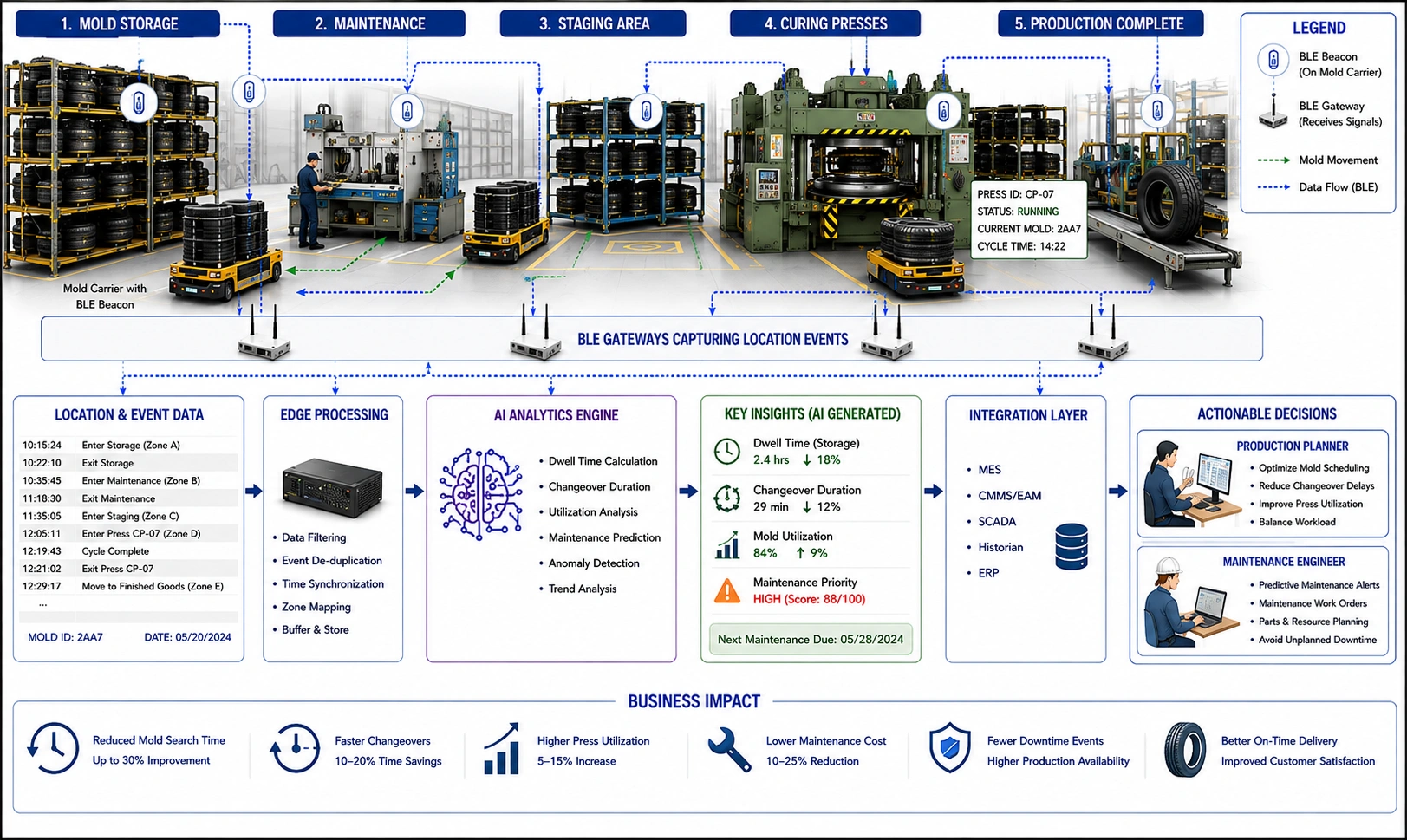
This process illustration shows BLE beacon-equipped tire mold carriers moving through storage, maintenance, staging, curing, and production areas. BLE gateways capture location events that feed edge processing and AI analytics for dwell-time analysis, changeover optimization, mold utilization, anomaly detection, and predictive maintenance, enabling production planners and maintenance engineers to make data-driven decisions.
AI-Driven Production and Material Flow Optimization
Material movement can become a hidden constraint in tire manufacturing. Rubber compounds, calendered material, extruded components, bead assemblies, green tires, racks, carts, molds, and finished tires may move between production areas many times during a shift.
BLE can provide location and movement events while AI analyzes the resulting time-series data.
Useful KPIs include:
- Work-in-process dwell time
- Material travel time
- Queue duration
- Production cycle time
- Changeover duration
- Asset utilization
- Equipment utilization
- OEE
- Throughput
- Scrap rate
- Rework rate
- Unplanned downtime
- Mean time between failures
- Mean time to repair
AI can identify recurring bottlenecks by comparing movement patterns with production schedules and equipment states. For example, if a tire-building cell repeatedly waits for a specific fixture or material cart, BLE movement records can provide evidence of the delay rather than relying solely on operator observations.
The result can support production scheduling, material staging, maintenance planning, and staffing decisions.
Integration with MES, SCADA, CMMS, ERP, and Quality Systems
BLE and AI should normally be integrated into existing Smart Tire Manufacturing software rather than operated as isolated applications.
A typical integration model may include:
- MES for production orders, routing, work-center status, genealogy, and production events.
- SCADA for process monitoring and operator visualization.
- PLCs for deterministic machine control and equipment state.
- Historian or time-series databases for process measurements.
- CMMS or EAM software for work orders, maintenance history, and asset records.
- ERP systems for materials, inventory, purchasing, production planning, and business transactions.
- Quality-management software for inspections, nonconformances, corrective actions, and quality records.
- AI software for anomaly detection, forecasting, classification, optimization, and decision support.
- BLE gateways for wireless asset and sensor data acquisition.
OPC UA can be appropriate when industrial equipment exposes standardized machine or process information. MQTT can be useful for event-oriented IoT messaging between gateways, edge software, and application services.
The integration layer should normalize identifiers. A mold may have one identifier in maintenance software, another in MES, and a BLE device address associated with its physical beacon. A common asset identity model is therefore essential.
Cybersecurity and Reliability for BLE-Enabled Tire Plants
Wireless devices connected to manufacturing networks should be treated as part of the plant’s operational technology environment.
Security controls should include:
- Unique device identities
- Controlled gateway provisioning
- Network segmentation
- Role-based access control
- Strong authentication
- Encrypted communication where supported
- Secure software updates
- Gateway hardening
- Audit logging
- Vulnerability management
- Credential rotation
- Device inventory
- Configuration backups
- Security monitoring
BLE deployments also require RF resilience. Tire plants contain substantial metal equipment, motors, electrical infrastructure, racks, presses, and moving machinery that can affect radio propagation. Gateway placement should therefore be validated through a physical site survey and production-floor pilot.
Battery-powered BLE devices require lifecycle planning. Battery replacement intervals should be estimated using actual advertisement intervals, sensor sampling rates, temperature conditions, transmission power, and battery characteristics.
A deployment that performs well during commissioning but lacks battery monitoring and gateway health monitoring can gradually lose data quality as devices age.
Testing, Commissioning, and Operational Validation
Commissioning should be treated as an engineering process rather than simply confirming that BLE devices are visible.
Testing should cover:
- BLE device discovery
- Device identity mapping
- Gateway coverage
- Location accuracy
- Sensor measurement accuracy
- Gateway failover or recovery
- Network interruption behavior
- Edge buffering
- Timestamp accuracy
- Database integrity
- MES integration
- CMMS integration
- AI inference latency
- Alert delivery
- Battery monitoring
- Cybersecurity controls
- Data retention
- Operator workflows
A representative pilot should include real production conditions. Testing only in an empty production area can produce misleading RF and positioning results because machinery, racks, vehicles, personnel, and materials can materially change signal behavior.
AI models should also undergo validation against production data that includes normal variation. A model trained exclusively on ideal operating conditions may generate excessive false positives once deployed.
AI and BLE Smart Tire Manufacturing Commissioning Checklist
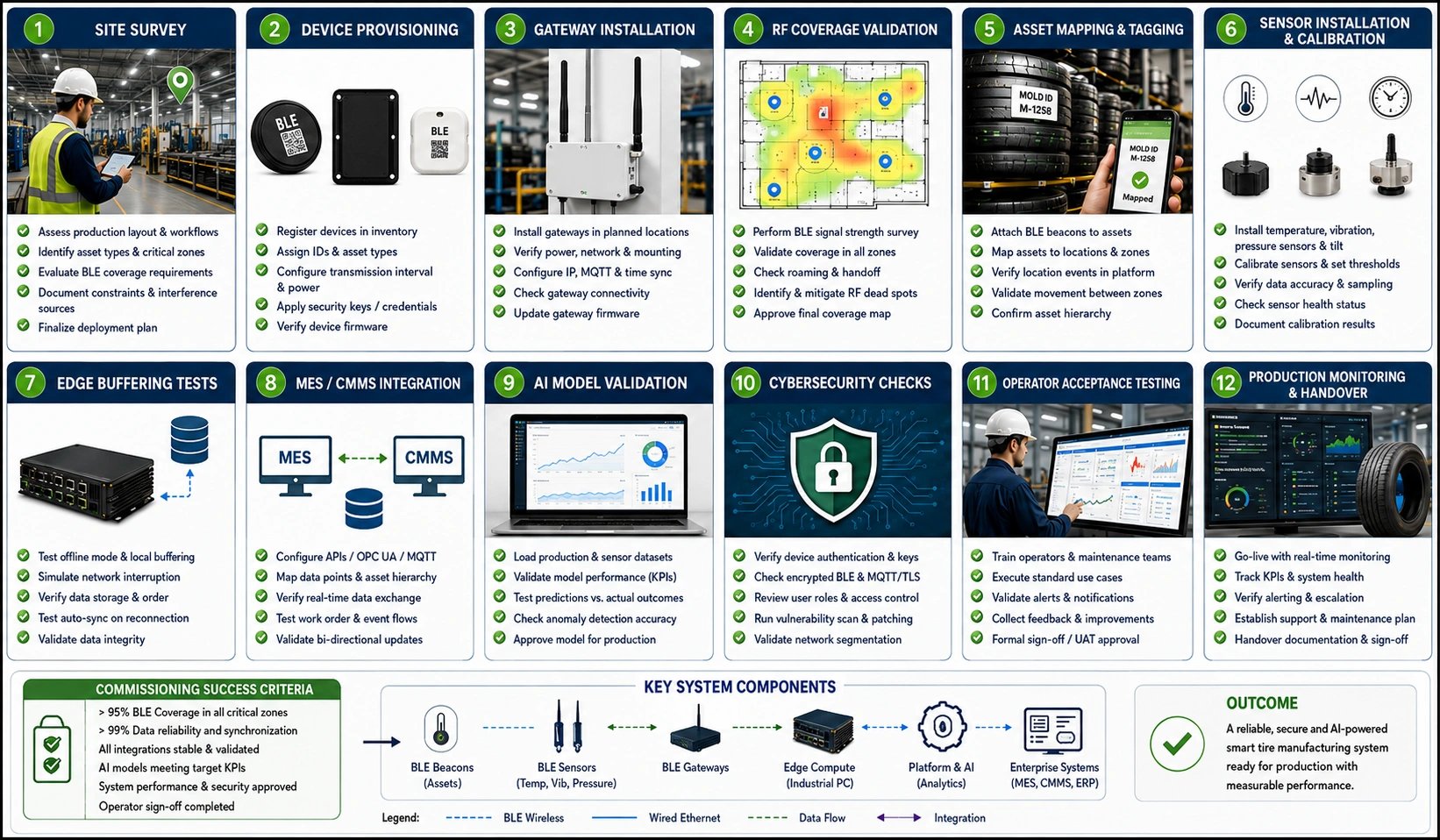
This commissioning checklist infographic presents the major validation stages required before production acceptance of an AI and BLE Smart Tire Manufacturing system. It covers site surveying, BLE device provisioning, gateway installation, RF validation, asset mapping, sensor calibration, edge buffering, MES and CMMS integration, AI model validation, cybersecurity testing, operator acceptance, and production monitoring.
Scaling AI and BLE Across Tire Manufacturing Plants
Scaling from one production cell to multiple lines or factories introduces additional engineering requirements.
A standardized device and asset model can simplify expansion. BLE beacon naming, gateway configuration, device metadata, production-area identifiers, and event schemas should be defined before large-scale deployment.
Multi-site scaling should consider:
- Different factory layouts
- Different RF environments
- Different MES and ERP installations
- Regional cybersecurity requirements
- Device lifecycle management
- Gateway configuration management
- AI model version control
- Data retention requirements
- Local versus centralized inference
- Network availability
- Maintenance responsibilities
AI models may also require site-specific calibration. A model trained on one tire plant may not perform identically at another plant because equipment, product mix, process parameters, ambient conditions, maintenance practices, and production schedules can differ.
A practical scaling strategy therefore uses a common data model and deployment methodology while allowing site-specific configuration.
Measuring the Business Value of AI in Smart Tire Manufacturing
AI and BLE projects should be evaluated through measurable manufacturing outcomes rather than device counts.
Useful KPIs include:
- OEE improvement
- Unplanned downtime reduction
- Mean time to repair
- Mean time between failures
- Changeover time
- Mold retrieval time
- Asset utilization
- WIP dwell time
- Production throughput
- Scrap percentage
- Rework percentage
- First-pass yield
- Inspection accuracy
- False-positive rate
- Material handling time
- Energy consumption per tire
- Maintenance cost per production hour
For example, reducing the time required to locate and stage a tire mold can have a measurable effect on changeover performance. Similarly, identifying equipment anomalies early can reduce unplanned downtime if maintenance personnel can intervene before a production-critical failure.
The financial evaluation should account for hardware, installation, gateway infrastructure, software, integration, maintenance, battery replacement, cybersecurity, AI development, and ongoing model management.
Practical Implementation Recommendations for GAO Customers
A phased deployment is usually more effective than attempting to instrument every tire-manufacturing asset simultaneously.
A practical sequence is:
- Select one high-value use case such as mold tracking, curing-press maintenance, or material-cart visibility.
- Establish the asset and production data model.
- Conduct an RF site survey.
- Install a limited number of BLE beacons, sensors, and gateways.
- Connect the data to an edge server or selected cloud service.
- Integrate the required MES, CMMS, SCADA, or database information.
- Establish baseline KPIs before enabling AI recommendations.
- Validate data quality and operational workflows.
- Train and validate the selected AI models.
- Measure the improvement against the baseline.
- Expand to additional production areas after technical and operational acceptance.
GAO can support organizations evaluating BLE beacons, BLE sensors, BLE gateways, RFID products, and related IoT hardware for these types of industrial data-capture requirements. Engineering teams should select devices according to environmental conditions, range, battery requirements, measurement accuracy, mounting method, ingress protection, network connectivity, and required operating life.
Key Takeaways for AI-Enabled Smart Tire Manufacturing
AI can help tire manufacturers move from isolated production data toward predictive and context-aware manufacturing decisions. BLE is particularly useful where mobile assets, tooling, molds, carts, racks, and environmental conditions need to be identified or monitored without extensive wired infrastructure.
The most effective implementations combine BLE data with MES, PLC, SCADA, CMMS, quality, and production information. AI then adds anomaly detection, prediction, classification, forecasting, and optimization.
Successful deployment depends on accurate asset identity, RF engineering, data quality, cybersecurity, integration, model validation, and measurable KPIs. GAO’s experience supplying BLE, RFID, and IoT hardware and systems can help organizations evaluate the physical data-capture layer required for Smart Tire Manufacturing applications.
Building the Future of Industrial AI and IoT with Aperture Venture Studio and GAO RFID Inc.
For more than three decades, GAO Group of Companies has invested heavily in R&D for industrial BLE, RFID, and IoT. As generative AI became increasingly useful for industrial applications, we expanded our work across AI and IoT technologies, including BLE and RFID, and we founded Aperture Venture Studio to help develop and scale AI and IoT solutions relevant to manufacturing, mobility, and other industries.
Aperture has attracted AI and IoT technical experts, entrepreneurial and operational executives, investors, and leading companies. We have also developed the Aperture Ventures Summit and TekSummit to discuss advanced AI and IoT topics.
These efforts have helped us build technical communities around AI and IoT. We welcome professionals to engage with us as:
- Advisors, co-founders, or employees
- Investors
- Customers
“`html
AI-Powered Facility Navigation with BLE Positioning and Location Intelligence
AI for facility navigation combines machine learning, indoor positioning, location intelligence, and BLE infrastructure to help people and organizations navigate complex buildings and operational sites. BLE beacons, gateways, and sensors provide the location signals needed to determine where people, mobile equipment, assets, and other tagged objects are located. AI can then interpret these location events to improve wayfinding, identify navigation bottlenecks, predict congestion, and support operational decisions.
For hospitals, manufacturing facilities, warehouses, campuses, laboratories, transportation facilities, and large commercial buildings, facility navigation is more than displaying a digital floor plan. Effective navigation requires accurate indoor positioning, reliable BLE coverage, continuously updated maps, context-aware routing, and integration with operational systems. AI extends these capabilities by learning movement patterns and facility conditions rather than relying only on static location rules.
GAO provides BLE beacons, gateways, sensors, RFID and IoT technologies that can be incorporated into facility navigation systems. Its experience supplying hardware products and systems to organizations in the United States and Canada supports practical deployment considerations such as device placement, RF validation, asset mapping, integration, and ongoing system maintenance.
AI-Powered Facility Navigation System Overview
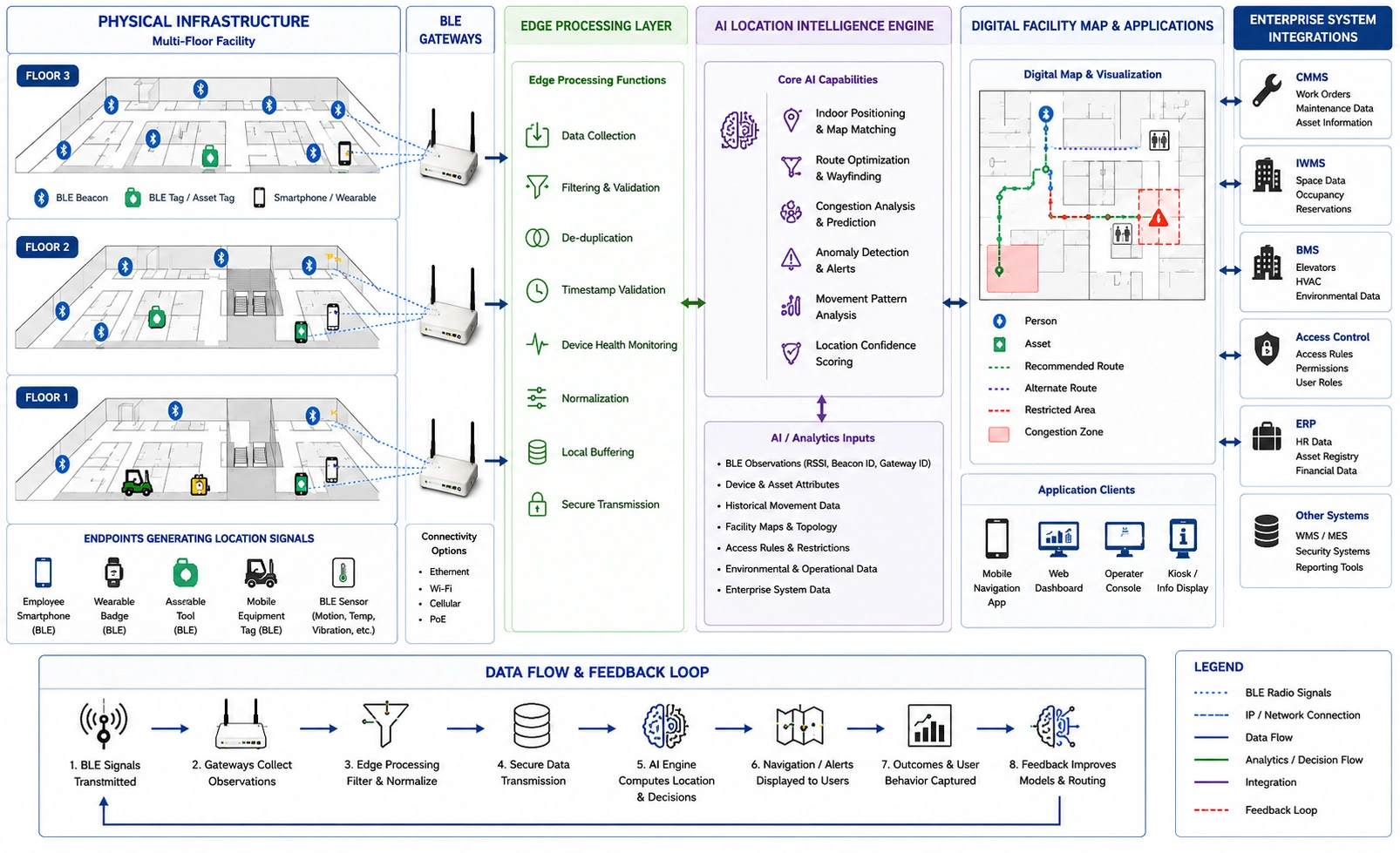
This system diagram illustrates how BLE beacons, tags, smartphones, and gateways collect location signals across a multi-floor facility. Edge processing, AI location intelligence, digital maps, and enterprise integrations convert those signals into indoor positioning, route optimization, congestion analysis, anomaly detection, and navigation decisions.
What AI-Powered Facility Navigation Means for Modern Buildings
Traditional indoor navigation generally depends on predetermined maps and positioning rules. A user selects a destination, the system calculates a route, and the application provides turn-by-turn instructions. This approach works well when the facility layout and operating conditions remain stable, but complex facilities frequently change.
Construction areas can temporarily close corridors. Production equipment can obstruct walkways. Warehouse staging areas can change throughout the day. Security restrictions can prevent access to specific zones. Elevators, doors, loading areas, cleanrooms, and controlled spaces can introduce additional routing constraints.
AI allows the navigation system to incorporate these changing conditions.
From Indoor Positioning to Context-Aware Navigation
BLE provides the radio infrastructure needed to observe proximity and location signals. A BLE beacon can periodically transmit an identifier, while a BLE-enabled tag, smartphone, wearable, or sensor detects nearby devices. Gateways can collect BLE information and forward it to edge or server software.
Depending on the required positioning accuracy and site conditions, the solution may use received signal strength indication, beacon proximity, angle-related measurements where supported, or a combination of BLE observations with other positioning inputs. AI can help convert imperfect observations into more useful location estimates by learning from historical signal behavior and facility-specific conditions.
This distinction is important because BLE signal strength is affected by walls, metal structures, machinery, people, shelving, doors, and other RF propagation conditions. A production-ready facility navigation system therefore requires RF surveys and calibration rather than assuming that a beacon’s nominal transmission range represents its actual navigation zone.
AI Improves the Navigation Decision Layer
AI can analyze more than a user’s current position. A facility navigation solution can evaluate:
- Current user or asset location
- Destination and permitted access zones
- Historical movement patterns
- Corridor and doorway congestion
- Elevator availability
- Temporary facility restrictions
- Typical travel times between zones
- Asset movement history
- Abnormal movement patterns
- Frequently requested destinations
- Navigation failures and route deviations
The result is a navigation system that can become increasingly context-aware as operational data accumulates.
For example, an employee traveling between two production areas may normally take a particular corridor. If location data indicates persistent congestion or a temporary obstruction, an AI-assisted routing engine can identify a viable alternative. A facilities team can also use the same location data to understand recurring congestion rather than treating every navigation problem as an isolated event.
Facility Navigation Applications Enabled by AI and BLE
Facility navigation requirements differ substantially by operating environment. A hospital requires different location logic from a warehouse, laboratory, or manufacturing site. The BLE hardware may be similar, but the maps, routing rules, AI models, user interfaces, and integrations need to reflect the operational environment.
Hospital and Healthcare Facility Navigation
Large healthcare facilities can contain multiple buildings, floors, departments, restricted areas, diagnostic rooms, pharmacies, laboratories, and service corridors. Visitors and staff may need different routes to the same destination.
AI-enabled facility navigation can support:
- Indoor wayfinding for patients and visitors
- Staff navigation between departments
- Location-aware directions to diagnostic rooms
- Accessible routing that avoids stairs where appropriate
- Route optimization around restricted areas
- Wayfinding across multiple buildings
- Navigation to frequently requested services
- Analysis of recurring navigation difficulties
- Location-aware operational notifications
BLE beacons can establish reference points throughout corridors and rooms, while smartphones or dedicated tags can provide moving location signals. Facility maps and access rules can then be combined with positioning data to calculate permitted routes.
Manufacturing Facility Navigation
Manufacturing environments create additional challenges because machinery, metal structures, production cells, safety zones, forklifts, storage areas, and temporary work areas can affect both movement and RF propagation.
A manufacturing facility navigation system can help operators locate:
- Production lines
- Work cells
- Maintenance areas
- Tool rooms
- Spare-parts storage
- Quality inspection stations
- Safety equipment
- Supervisors and designated personnel
- Mobile equipment
- Tagged production assets
AI can analyze movement data to identify frequently congested paths, unusual travel patterns, or recurring delays between operational zones. When integrated with maintenance or manufacturing systems, location context can also help technicians find the relevant equipment or work area more quickly.
GAO’s BLE and IoT hardware can serve as the physical data-acquisition layer for these applications, while customer software can process location information according to facility-specific navigation and operational requirements.
Warehouse and Distribution Facility Navigation
Warehouse navigation combines people, mobile assets, inventory locations, staging areas, docks, aisles, and loading zones. Unlike a conventional office building, warehouse layouts may change frequently as inventory and equipment move.
AI-assisted navigation can support:
- Worker navigation to storage locations
- Forklift route guidance
- Dock and staging-area navigation
- Location of mobile equipment
- Route optimization around temporary obstructions
- Analysis of repeated travel paths
- Identification of high-traffic areas
- Search assistance for tagged assets
- Navigation between receiving, storage, picking, packing, and shipping zones
BLE sensors and tags can provide location events, while gateways collect observations across the facility. AI models can use the resulting historical data to identify normal movement patterns and detect deviations.
Corporate Campuses, Universities, and Large Commercial Facilities
Large campuses often combine buildings, parking structures, pedestrian paths, elevators, meeting rooms, laboratories, service areas, and restricted zones. Users may need navigation across both indoor and outdoor areas.
Facility navigation software can combine BLE positioning with existing maps and other location technologies to support:
- Building-to-building wayfinding
- Floor-level navigation
- Room finding
- Accessible routes
- Visitor navigation
- Staff navigation
- Event-based routing
- Restricted-area awareness
- Location-based facility services
AI can identify destinations that generate frequent navigation requests and areas where users commonly deviate from recommended routes.
AI-Powered Facility Navigation Applications Across Industries
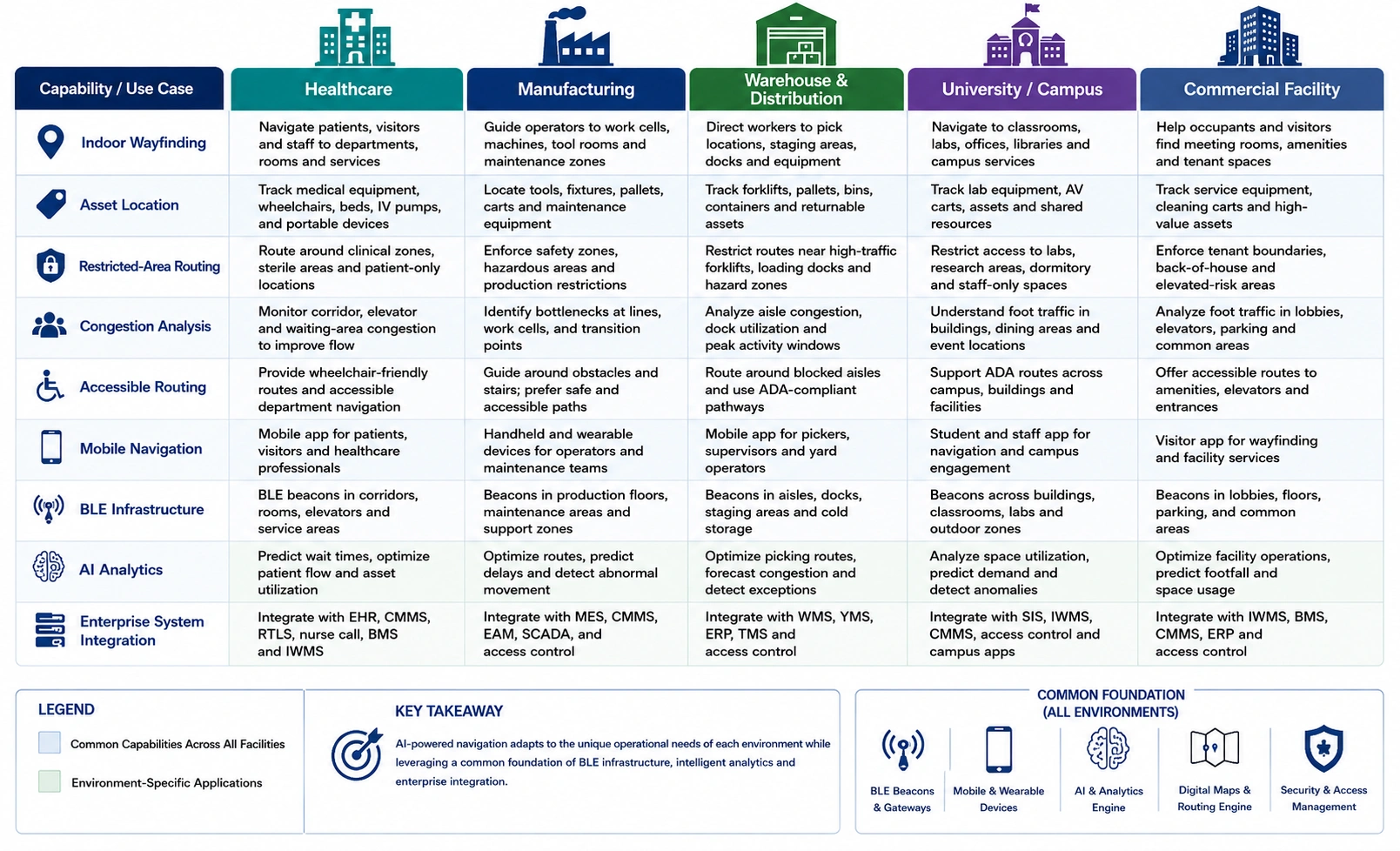
This comparison matrix shows how AI-powered facility navigation applies across healthcare, manufacturing, warehouse and distribution, university campuses, and commercial facilities. It compares indoor wayfinding, asset location, restricted-area routing, congestion analysis, accessible routing, mobile navigation, BLE infrastructure, AI analytics, and enterprise system integration.
Facility Navigation Workflow from BLE Signals to AI Decisions
A production facility navigation solution typically follows a data path that begins with physical BLE signals and ends with a navigation recommendation, operational alert, or analytics result.
BLE Data Acquisition
BLE beacons are positioned at known locations throughout the facility. Their identifiers provide reference points that allow the positioning system to associate detected signals with known areas.
BLE tags, smartphones, wearables, equipment tags, or sensors provide the moving or monitored endpoints. The specific device depends on the application. A visitor may use a smartphone, while a forklift, maintenance tool, or mobile asset may use a dedicated BLE tag.
Beacon placement should be determined from a site survey rather than from theoretical coverage alone. Engineers need to consider wall construction, machinery, shelving, floor transitions, electromagnetic conditions, human occupancy, and required positioning accuracy.
Gateway Collection and Edge Processing
BLE gateways collect observations from nearby devices and forward them to processing software. Depending on deployment requirements, gateways may use Ethernet, Wi-Fi, cellular connectivity, or another available backhaul.
Edge processing can perform initial filtering, timestamp validation, duplicate suppression, buffering, device health monitoring, and data normalization. Local buffering becomes particularly important in facilities where network interruptions should not result in permanent loss of location events.
Location Estimation and Data Normalization
The location service converts BLE observations into usable positioning information. Raw signal strength should not automatically be treated as an exact distance measurement because RF conditions vary substantially across facilities.
Calibration data can improve the relationship between observed signal characteristics and known facility zones. Positioning logic may combine multiple observations rather than relying on a single beacon.
AI Analytics and Navigation Decisions
AI models can then analyze location histories and operational context. Depending on the application, these models may include classification, anomaly detection, clustering, time-series analysis, probabilistic positioning, or route optimization techniques.
The AI layer can produce decisions such as:
- Recommended route
- Alternative route
- Congestion warning
- Estimated travel time
- Unusual movement alert
- Frequently visited location analysis
- Navigation demand prediction
- Asset location confidence score
Enterprise System Integration
Facility navigation becomes more useful when location information is connected to systems already used by operations and facilities teams. Relevant integrations can include computerized maintenance management systems, integrated workplace management systems, building management systems, manufacturing execution systems, warehouse management systems, access control, ERP software, digital maps, and mobile applications.
The integration should define clear ownership of location data. The navigation system may provide current coordinates and confidence values, while an enterprise application provides asset identity, work orders, permissions, room information, or operational status.
BLE-to-AI Facility Navigation Workflow
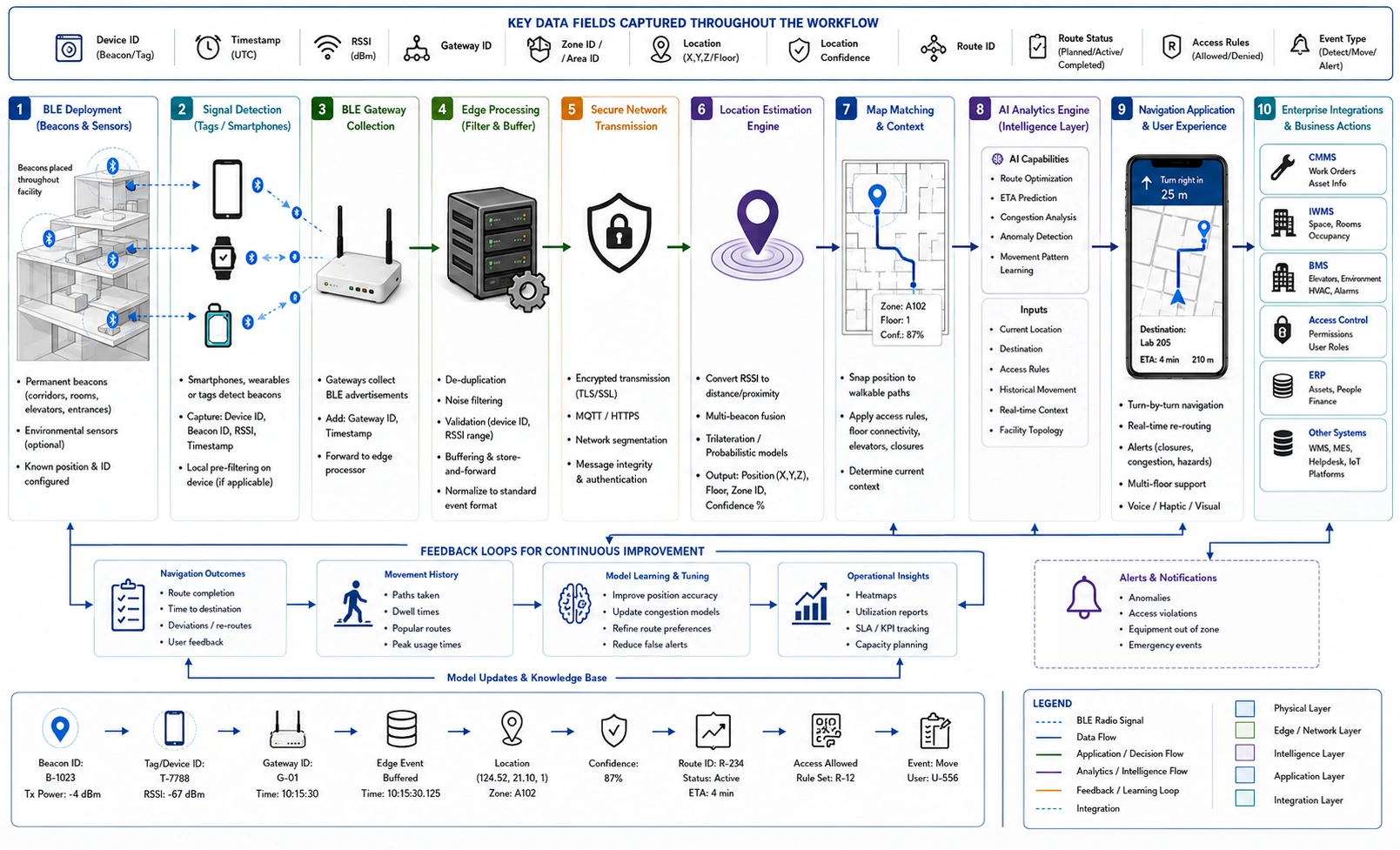
This workflow diagram shows how BLE signals move from beacons and sensors through gateways, edge processing, secure transmission, location estimation, map matching, AI analytics, navigation applications, and enterprise integrations. It also illustrates data fields, navigation outcomes, alerts, and feedback loops for continuous AI model improvement.
BLE Hardware and Software Components for Facility Navigation
A reliable facility navigation system depends on coordinated hardware, communication, positioning software, AI processing, maps, and enterprise integration. Component selection should be driven by the required positioning performance and operating environment rather than by device specifications in isolation.
BLE Beacons
BLE beacons act as fixed reference points. Their identifiers allow the navigation software to associate radio observations with known facility locations.
Important engineering considerations include:
- Transmission power
- Advertising interval
- Battery life
- Mounting position
- Enclosure requirements
- Environmental conditions
- RF interference
- Physical access for maintenance
- Device identity management
Beacon density should reflect the required positioning method and the physical characteristics of the site.
BLE Tags and Sensors
BLE tags can be attached to mobile assets, tools, equipment, carts, forklifts, or other objects requiring location visibility. Sensors can additionally provide operational data such as motion, temperature, vibration, or device status where supported.
For people-centered navigation, smartphones or BLE-enabled wearables may serve as the endpoint. The appropriate device depends on whether the primary requirement is visitor wayfinding, employee navigation, asset tracking, or a combination.
BLE Gateways
BLE gateways bridge local BLE communications and the facility’s IP network. Gateway placement affects collection reliability, latency, and coverage.
A practical deployment should validate:
- BLE reception quality
- Gateway coverage
- Ethernet or Wi-Fi availability
- Network latency
- Backhaul reliability
- Power availability
- Local buffering requirements
- Gateway failover requirements
- Device provisioning and remote management
GAO’s hardware-focused approach is relevant where facility operators require BLE and IoT devices that can be incorporated into larger location and navigation systems rather than treated as isolated devices. GAO’s quality assurance processes and remote or onsite technical support are also relevant during commissioning and deployment.
Maps, Positioning Software, and Navigation Logic
The software layer maintains facility maps, floor relationships, zones, access restrictions, points of interest, and route rules. Map data should reflect operational reality. A visually accurate floor plan is not sufficient if it does not represent restricted doors, temporary closures, service corridors, elevator behavior, or accessibility requirements.
Positioning software receives BLE observations and produces location estimates. Navigation software then applies destination, routing, and facility constraints.
AI Models for Facility Navigation
AI can be introduced incrementally. A facility does not necessarily need a complex generative AI system to achieve measurable improvements.
Suitable AI methods may include:
- Machine learning for signal-based positioning
- Classification for zone identification
- Anomaly detection for unusual movement
- Clustering for movement-pattern analysis
- Time-series models for congestion prediction
- Optimization algorithms for route selection
- Probabilistic models for location confidence
- Natural-language interfaces for destination requests where appropriate
A technically sound implementation should establish deterministic positioning and routing behavior before adding more sophisticated AI functions. This makes system behavior easier to validate, troubleshoot, and explain to operations teams.
Cloud Version and Server Version
A Cloud Version can host navigation software, analytics, device management, maps, and AI processing within managed cloud infrastructure. This model is useful for organizations operating multiple facilities that need centralized monitoring, software updates, and cross-site analytics.
A Server Version can be deployed on customer-managed servers, edge servers, private data centers, facility servers, or other privately hosted infrastructure. This approach may be preferred where location data must remain within controlled infrastructure, network connectivity is restricted, integration with private systems is extensive, or operational policies require local processing.
Some facilities can use a hybrid model, keeping time-sensitive BLE processing and buffering close to the facility while sending selected normalized data to centralized software for analytics.
Communication and Security
BLE provides local wireless communication, while gateways commonly use IP-based networks for upstream data transfer. MQTT, HTTPS, WebSockets, REST APIs, and other protocols may be used depending on the gateway and software design.
Security should cover the complete data path:
- Secure device provisioning
- Unique device identities
- Authenticated gateway connections
- Encryption in transit
- Access-controlled APIs
- Role-based software permissions
- Network segmentation
- Firmware management
- Audit logging
- Credential rotation
- Secure server administration
- Data retention controls
Facility navigation can reveal sensitive information about employee movement, visitors, equipment, and restricted areas. Access to detailed location records should therefore be governed according to the organization’s security and privacy requirements.
Deployment, Commissioning, and Facility Navigation Validation
Successful facility navigation deployment depends heavily on site-specific engineering. BLE positioning performance can vary significantly between an open office, hospital corridor, warehouse aisle, manufacturing floor, and multi-story campus. A system that performs well in one environment cannot automatically be expected to provide the same positioning quality elsewhere.
Site Survey and Navigation Requirements
Deployment should begin by documenting the facility’s physical and operational characteristics.
Key inputs include:
- Floor plans and building elevations
- Required positioning accuracy
- Navigation zones and points of interest
- User groups and navigation permissions
- Restricted and controlled areas
- Accessible-route requirements
- Elevator and stair locations
- Temporary or frequently changing areas
- BLE and network infrastructure
- Gateway mounting and power locations
- Areas containing significant metal or RF obstructions
The engineering team should also establish measurable acceptance criteria before installing large numbers of devices. For example, a navigation project may define acceptable zone-level accuracy, location update latency, gateway availability, event-loss tolerance, and route calculation response time.
BLE Beacon Placement and RF Validation
Beacon placement is one of the most important factors affecting indoor positioning. The installation plan should account for the height and orientation of each beacon, nearby metal structures, walls, machinery, doors, and expected human occupancy.
Commissioning should include physical verification of beacon identifiers and locations. RF measurements should then be performed at representative navigation points rather than only around the beacon itself.
Testing should cover:
- Open corridors
- Corners and intersections
- Elevators
- Stairwells
- Rooms with dense walls
- Metal-intensive areas
- High-occupancy locations
- Areas with multiple overlapping beacon signals
- Facility boundaries and transition zones
Signal measurements collected during commissioning can also become useful training or calibration data for positioning models.
Device Provisioning and Asset Mapping
Every installed beacon and gateway should have a controlled identity and documented physical location. Device records should associate identifiers with buildings, floors, zones, rooms, and installation coordinates.
This prevents a common operational problem where the software database says a beacon is installed in one location while the physical device has been moved to another location.
A controlled provisioning process should include device registration, configuration, labeling, installation verification, firmware status, battery information where applicable, and maintenance ownership.
Navigation and AI Acceptance Testing
AI-assisted navigation should be tested using real facility scenarios rather than only synthetic data.
Test cases can include:
- Normal navigation between frequently used destinations
- Navigation across multiple floors
- Temporary corridor closures
- Restricted-area routing
- Elevator transitions
- Accessible route requests
- Gateway communication interruptions
- Missing BLE observations
- Incorrect or stale map information
- High-traffic periods
- Multiple simultaneous users
- Route deviation and recalculation
The objective is not simply to prove that a user can reach a destination. Testing should determine whether the location estimate, route recommendation, map state, and AI decision remain reliable under realistic operating conditions.
AI-Powered BLE Facility Navigation Commissioning Checklist
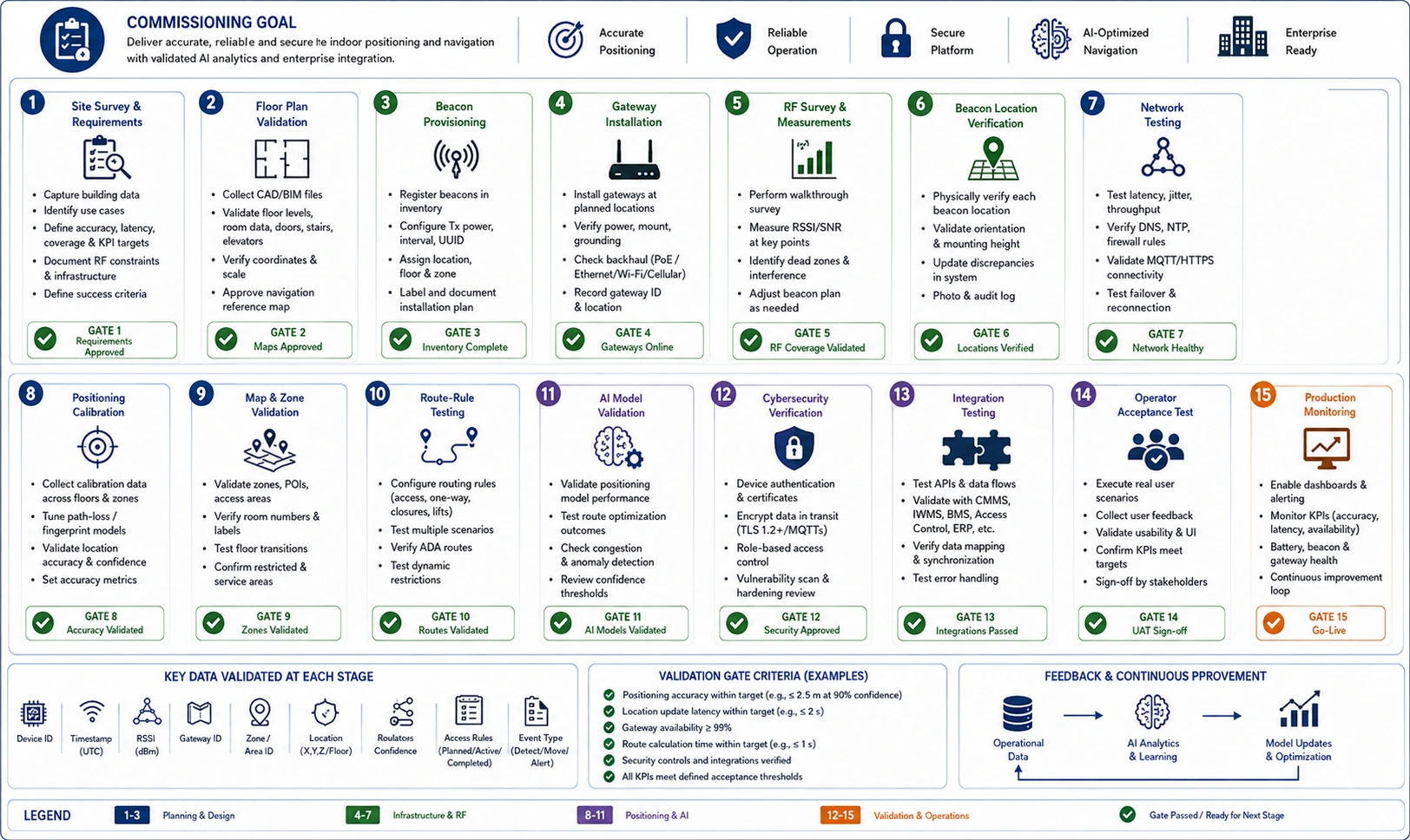
This infographic presents 15 technical commissioning stages, from site survey and BLE provisioning through RF validation, positioning calibration, AI model validation, cybersecurity, integration testing, operator acceptance, and production monitoring.
Integrating AI Facility Navigation with Operational Software
Facility navigation becomes substantially more useful when location information is connected to existing operational applications.
CMMS and Maintenance Workflows
A computerized maintenance management system can contain work orders associated with equipment, rooms, production areas, or facility infrastructure. Navigation software can use that location information to guide technicians to the relevant work area.
For example, a maintenance application could provide a technician with the location of an assigned asset and a recommended route from the technician’s current position. Location history can also help organizations analyze technician travel time between work orders.
The integration should preserve the distinction between asset identity and physical position. BLE location data indicates where an asset is observed, while the CMMS remains the authoritative source for maintenance records.
IWMS and Building Operations
Integrated workplace management systems can contain information about rooms, buildings, occupants, space utilization, and facility services. BLE positioning can provide additional location observations that help operational teams understand how spaces are actually used.
AI can identify patterns such as recurring congestion around particular areas or unusual changes in movement between buildings and floors.
BMS and Access Control
Building management systems can provide contextual information about elevators, doors, environmental conditions, and other facility equipment. Access control systems can define which users are permitted to enter controlled areas.
Combining these data sources with navigation rules can prevent routing software from recommending paths through inaccessible zones.
The integration must be designed carefully because access authorization and location estimation serve different purposes. A navigation system should not assume that physical proximity means a user has permission to enter a location.
Mobile Applications and Digital Maps
Most people interacting with facility navigation will experience the solution through a mobile application, kiosk, browser interface, wearable, or dedicated operational device.
The user interface should present location confidence appropriately. If the system cannot determine a precise position, it may be preferable to show the user as being within a zone rather than presenting a misleading exact coordinate.
Map data should also support multiple floors, elevators, stairs, entrances, exits, restricted areas, accessible routes, and temporary closures.
AI Optimization for More Accurate and Reliable Facility Navigation
AI should solve measurable facility navigation problems rather than being introduced solely as an additional software feature.
Improving Indoor Positioning
Machine learning can learn relationships between BLE signal observations and known facility locations. This can be useful where RF behavior is too complex for a simple distance model.
Training and validation data should represent different facility conditions. A model trained only during an empty-building commissioning period may perform differently when the facility becomes occupied.
Relevant variables can include:
- BLE signal strength
- Beacon identifiers
- Gateway observations
- Timestamp
- Device type
- Floor and zone
- Historical location
- Environmental conditions where available
- Movement direction
- Previous position
- Known facility constraints
Predicting Congestion
Location histories can reveal recurring movement concentrations. Time-series analysis can estimate when particular corridors, entrances, elevators, or transition points are likely to become congested.
Navigation software can use those predictions to recommend alternative routes.
This can also help facilities teams distinguish between temporary congestion and persistent layout problems. Repeated congestion near a particular doorway, for example, may indicate that the physical layout needs operational review rather than another navigation rule.
Detecting Abnormal Movement
Anomaly detection can identify movement patterns that differ significantly from established operating behavior.
Potential examples include:
- An asset entering an unexpected zone
- A mobile device remaining stationary unusually long
- Movement through an unusual route
- A tagged asset leaving an expected operating area
- Unexpected activity during restricted hours
AI-generated alerts should be treated as decision support unless the system has been validated for a specific automated action. False positives can quickly reduce operator trust.
Continuous Model Validation
AI models used for positioning and navigation require ongoing validation because facilities change.
Moving machinery, remodeling, new partitions, changed storage layouts, new access restrictions, and additional BLE devices can alter the underlying conditions.
Operational monitoring should therefore track model performance and identify when recalibration is required.
Technical and Business Benefits of AI-Powered Facility Navigation
Combining AI with BLE-based location sensing can produce benefits at several operational levels.
Faster Wayfinding
Accurate indoor positioning reduces the time users spend searching for rooms, departments, equipment, service areas, and other destinations.
The benefit is particularly significant in large facilities where users are unfamiliar with the building or where destinations change frequently.
Better Visibility of Mobile Assets
BLE tags can provide location information for mobile equipment, tools, carts, forklifts, and other valuable assets.
AI can go beyond displaying the current location by analyzing movement history and identifying unusual or inefficient movement patterns.
Improved Facility Utilization
Movement data can reveal how people move through buildings and which areas experience sustained demand.
Facilities teams can use these insights when evaluating space utilization, signage, service locations, corridor layouts, and operational processes.
Reduced Operational Travel
Maintenance technicians, facilities personnel, warehouse workers, and other mobile employees can spend substantial time traveling between operational locations.
Location-aware applications can reduce unnecessary searching and provide more efficient routes between tasks.
More Responsive Navigation
AI allows routing decisions to incorporate changing facility conditions instead of relying exclusively on static routes.
This can make navigation more resilient to temporary closures, congestion, operational restrictions, and other changes.
Scalable Multi-Facility Operations
A standardized BLE device and software approach can be expanded from one building to multiple facilities when maps, device identities, location schemas, APIs, and operational processes are standardized.
Multi-site deployments should avoid assuming that every building requires identical beacon density or positioning parameters. Each facility should undergo appropriate RF validation while maintaining common data and management standards.
Facility Navigation KPIs for Engineering and Operations Teams
A facility navigation deployment should be measured using technical and operational KPIs rather than relying only on application usage statistics.
KPI What It Measures Why It Matters
Positioning Accuracy Difference between estimated and validated position Determines navigation reliability
Location Confidence Confidence associated with a location estimate Helps identify uncertain positioning
Route Completion Rate Percentage of navigation sessions reaching the intended destination Measures practical navigation effectiveness
Route Deviation Rate Frequency of users departing from recommended routes Can indicate routing or map problems
Navigation Latency Time required to calculate or update a route Affects user experience
BLE Gateway Availability Operational availability of gateways Indicates infrastructure reliability
Beacon Health Battery, signal, and communication status where available Supports preventive maintenance
Location Event Completeness Percentage of expected events successfully received Identifies data-quality problems
Average Travel Time Time required to move between selected locations Supports operational optimization
Congestion Duration Time zones remain above defined traffic thresholds Supports facility planning
Asset Search Time Time required to locate tagged equipment Measures direct operational value
Organizations should establish baseline values before deploying AI optimization. Otherwise, it becomes difficult to distinguish genuine improvement from normal operational variation.
Facility Navigation Cybersecurity and Data Governance
Location information can be operationally sensitive. It may reveal employee movement, visitor behavior, equipment locations, restricted areas, or facility operating patterns.
Security controls should therefore extend beyond the BLE radio layer.
Important controls include:
- Device identity management
- Secure gateway provisioning
- Network segmentation
- Encryption for data in transit
- Role-based access control
- API authentication
- Audit logging
- Software and firmware updates
- Credential lifecycle management
- Location-data retention policies
- Administrative access controls
- Backup and recovery procedures
Organizations should also determine which location information needs to be retained and for how long. Real-time navigation may require current location but not necessarily long-term individual movement histories.
Privacy requirements should be addressed during system design rather than after deployment. Where people are being located, organizations should establish appropriate policies concerning data access, retention, transparency, and authorized use.
Implementation Recommendations for AI and BLE Facility Navigation
A practical implementation should proceed incrementally.
- Define navigation use cases and measurable business outcomes before selecting hardware.
- Survey the facility and document RF conditions before finalizing beacon placement.
- Establish positioning accuracy and latency requirements for each application.
- Separate fixed infrastructure identities from mobile asset identities.
- Maintain accurate digital maps and zone definitions.
- Validate BLE coverage under realistic occupancy and operating conditions.
- Use edge buffering where temporary network outages could cause unacceptable data loss.
- Establish deterministic routing rules before introducing more complex AI decisions.
- Integrate location information with authoritative enterprise systems rather than duplicating master data unnecessarily.
- Use location confidence values so applications can distinguish reliable positions from uncertain estimates.
- Test elevators, restricted zones, temporary closures, and multi-floor transitions explicitly.
- Monitor beacon and gateway health after commissioning.
- Revalidate positioning models after significant facility layout changes.
- Protect location data with appropriate authentication, authorization, encryption, logging, and retention controls.
- Establish technical and operational KPIs before production rollout.
- Start with a representative facility area or navigation workflow and expand after acceptance criteria are met.
GAO’s three decades of R&D and customer service experience across BLE, RFID, and IoT technologies provides a foundation for organizations evaluating the hardware and systems required for these deployments. GAO, headquartered in New York City and Toronto, Canada, has served customers across the United States and Canada, including Fortune 500 companies, leading R&D organizations, universities, and government agencies. Its products and systems are supported by quality assurance processes and remote or onsite technical expertise.
Selecting a Practical AI and BLE Facility Navigation Solution
The most effective facility navigation deployments begin with the operational problem rather than the wireless technology. Organizations should first determine whether their primary requirement is visitor wayfinding, employee navigation, accessible routing, asset location, congestion analysis, technician navigation, or a combination of these applications.
BLE then provides a practical sensing layer for collecting proximity and location observations. Gateways connect the BLE infrastructure to processing systems, while positioning software, maps, AI analytics, and enterprise integrations turn those observations into useful operational information.
GAO can support organizations evaluating BLE beacons, gateways, sensors, RFID and related IoT hardware for facility navigation applications. The appropriate solution depends on the facility’s physical environment, positioning requirements, network infrastructure, security policies, integration requirements, and deployment model.
A well-engineered system should be validated through site surveys, controlled commissioning, realistic navigation testing, operational KPI measurement, and ongoing device and model monitoring.
Key Takeaways for AI-Powered Facility Navigation
AI-powered facility navigation uses BLE-enabled sensing as a foundation for understanding where people and assets are located inside complex facilities. The most important engineering lesson is that positioning quality depends on the complete system, including beacon placement, RF conditions, gateways, maps, location algorithms, network reliability, and operational rules.
AI adds value when it addresses specific problems such as uncertain positioning, congestion, route optimization, movement anomalies, and changing facility conditions.
Organizations planning a deployment should define measurable requirements, validate the physical environment, integrate with existing operational software, and establish cybersecurity and data-governance controls from the beginning. GAO’s BLE, RFID, and IoT hardware expertise can help organizations evaluate the physical infrastructure required for these applications and develop practical deployment approaches.
Building the Future of Industrial AI and IoT with Aperture Venture Studio and GAO RFID Inc.
For more than three decades, GAO Group of Companies has invested heavily in R&D for industrial BLE, RFID, and IoT technologies. As generative AI became increasingly useful for industrial applications, we expanded our work across AI and IoT, including BLE and RFID, and founded Aperture Venture Studio to build, launch, and scale technology companies addressing practical AI and IoT opportunities such as facility navigation and location intelligence.
Aperture has attracted AI and IoT technical experts, entrepreneurial and operational executives, investors, and leading companies. We have also developed the Aperture Ventures Summit and TekSummit to discuss advanced AI and IoT topics. These activities have helped build technical communities around applied AI and IoT.
We welcome participation as:
- Advisors, co-founders, or employees
- Investors
- Customers
GAO continues to provide BLE, RFID, and IoT hardware products and systems supported by engineering expertise, quality assurance, and technical support for organizations developing practical location-aware solutions.