
AI and BLE for Fashion Manufacturing
AI-Driven Fashion Manufacturing with BLE
AI and IoT are changing Fashion Manufacturing by connecting garment production data with real-time information from materials, work-in-process, equipment, and finished products. AI can analyze production schedules, sewing-line performance, material movement, quality results, machine conditions, and warehouse activity to identify bottlenecks and support operational decisions. BLE Beacons, BLE Sensors, and BLE Gateways provide location and condition data for assets such as fabric rolls, garment bundles, sewing-machine tools, cutting dies, carts, racks, pallets, and work-in-process containers.
AI-supported BLE solutions are particularly useful where garments move through many sequential operations and where manual tracking creates delays or inaccurate production records. Fashion manufacturers can combine BLE events with MES, ERP, WMS, QMS, PLM, CMMS, and production-planning data to create a more complete view of manufacturing execution. GAO supplies BLE, RFID, and IoT hardware and systems that can support these connected Fashion Manufacturing workflows.
How AI and BLE Improve Fashion Manufacturing Operations
Fashion Manufacturing involves highly variable product styles, colors, sizes, fabrics, sewing operations, finishing requirements, and customer orders. A single production order can pass through fabric receiving, inspection, spreading, marker making, cutting, bundling, sewing, pressing, finishing, inspection, packing, warehousing, and shipment.
AI helps interpret the large volume of operational data generated across these activities. BLE adds physical visibility by identifying where mobile materials and production resources are located and when they move between defined zones.
The combination can help answer practical questions such as:
- Where is the fabric roll required for the next cutting order?
- Which garment bundle is waiting too long between sewing operations?
- Which sewing line has insufficient work-in-process?
- Which cutting table or spreading machine is underutilized?
- Where are portable sewing tools and change parts located?
- Which production orders are accumulating excessive dwell time?
- Which sewing machines show operating behavior associated with maintenance requirements?
- Which finished-goods orders have not reached the expected staging area?
- Which warehouse movements could delay customer shipment?
AI can then convert these observations into alerts, forecasts, priorities, or recommended actions.
AI Applications for Fashion Manufacturing
AI Garment and Work-In-Process Tracking
Garment bundles, cut panels, partially assembled garments, and finished pieces frequently move between cutting tables, sewing stations, pressing areas, inspection points, and finishing operations. Manual bundle tracking can make it difficult to determine the exact production status of an order.
BLE Beacons attached to reusable bundle carriers, racks, carts, or production containers can provide location events as work-in-process moves between defined manufacturing zones. AI can analyze movement history and compare actual dwell times against expected routing.
This supports:
- Work-in-process location visibility
- Bundle dwell-time analysis
- Sewing-line balancing
- Production bottleneck identification
- Order-priority management
- Delayed-operation alerts
- Production status estimation
The objective is not simply to locate a bundle, but to determine whether its physical movement is consistent with the planned manufacturing sequence.
AI Fabric Roll and Raw-Material Management
Fabric rolls represent a critical material resource in apparel and Fashion Manufacturing. Rolls may be received, inspected, stored, moved to spreading, staged for cutting, returned to storage, or allocated to another production order.
BLE Beacons can identify fabric rolls, roll carriers, pallets, or storage units, while BLE Gateways detect movement through receiving, inspection, warehouse, staging, and cutting areas. RFID can complement BLE when item-level or material identification requires direct tag reading at controlled points.
AI can combine material location with ERP inventory records, production orders, fabric specifications, color information, lot numbers, and cutting schedules to identify:
- Fabric availability risks
- Excessive material dwell time
- Misplaced fabric rolls
- Cutting-order staging delays
- Material replenishment requirements
- Warehouse congestion
- Potential production interruptions
GAO hardware can be incorporated into material-tracking workflows where Fashion Manufacturing facilities need automated visibility of mobile inventory and reusable handling assets.
AI Cutting Room Optimization
The cutting room connects fabric preparation with downstream garment assembly. Spreading machines, cutting tables, automatic cutters, marker systems, cutting dies, fabric rolls, cut panels, and bundles must be coordinated with production schedules.
AI can evaluate historical cutting performance, order priorities, fabric availability, machine utilization, changeover requirements, and work-in-process conditions to support cutting-room scheduling.
BLE location data can provide additional information about whether the required fabric roll, cutting tools, or bundle carriers are physically available near the assigned cutting area.
AI-driven analysis can identify:
- Cutting-table idle periods
- Fabric staging delays
- Cutter utilization patterns
- Excessive movement of materials
- Cutting-order conflicts
- Delayed bundle transfer
- Equipment support requirements
Predictive Maintenance for Sewing and Production Equipment
Sewing machines, overlock machines, coverstitch machines, buttonhole machines, button-attaching machines, embroidery machines, pressing equipment, steam systems, cutting machines, and automated material-handling equipment require dependable availability.
Predictive maintenance models can combine machine operating information, maintenance history, vibration or environmental sensor readings where appropriate, downtime records, work orders, and production schedules.
BLE can add contextual information by locating maintenance tools, portable diagnostic equipment, spare components, and change parts. AI can then prioritize maintenance activities based on equipment condition and production impact.
Potential outcomes include:
- Earlier identification of abnormal machine behavior
- Reduced unplanned downtime
- Better maintenance scheduling
- Faster technician response
- Improved spare-part availability
- Better equipment utilization
- Reduced disruption to sewing-line output
AI Quality and Defect-Risk Detection
Fashion Manufacturing quality depends on fabric condition, cutting accuracy, sewing consistency, seam quality, dimensions, color, finishing, labeling, and packaging. Computer vision can inspect fabric defects, seam characteristics, garment appearance, measurements, and other visual attributes.
AI can combine inspection results with production context such as machine, operator station, fabric lot, style, sewing operation, and production order. This can help identify recurring defect patterns and potential upstream causes.
BLE can provide location context for mobile inspection instruments, garment bundles, sample racks, or quality-control assets. The technology is most useful when physical movement information complements established QMS and inspection data.
AI Sewing-Line Balancing and Production Optimization
Sewing operations can contain dozens of sequential tasks with different cycle times and skill requirements. Imbalances can cause work-in-process accumulation at one operation while downstream stations remain starved.
AI can analyze operation cycle times, bundle movement, order requirements, machine availability, staffing information, and historical production performance to identify line-balancing opportunities.
BLE-based movement events can indicate when garment bundles enter or leave defined sewing-line zones. This provides additional evidence for determining actual WIP movement rather than relying only on manual production updates.
AI can support:
- Bottleneck identification
- Operation sequencing
- Workstation utilization analysis
- WIP allocation
- Production-rate forecasting
- Line-balancing decisions
- Delayed-bundle alerts
Fashion Manufacturing Workflows Supported by AI
Fabric Receiving, Inspection, and Storage
Raw fabric enters the facility through receiving and is commonly identified by supplier, purchase order, fabric type, color, lot, roll number, and other material attributes. Inspection may verify width, shade, defects, weight, and other specifications before the roll becomes available for production.
BLE tracking can associate physical fabric movement with inventory records, while AI can identify discrepancies between planned and observed material availability. A roll physically remaining in a receiving or quarantine area can be distinguished from inventory that enterprise software shows as available for production.
Fabric Relaxation, Spreading, Marker Making, and Cutting
Fabric may require relaxation before spreading and cutting according to its construction and manufacturing requirements. Spreading equipment prepares layers for cutting based on the marker plan, while automated or manual cutting equipment produces panels and garment components.
AI can analyze fabric utilization, spreading performance, cutting schedules, material availability, and machine utilization. BLE can provide location information for fabric rolls, spreading resources, cutting tools, carts, and reusable carriers.
The resulting data can help production teams identify why a scheduled cutting order has not started, whether required material has reached the cutting room, and whether completed bundles have moved toward sewing.
Bundling and Sewing Operations
Cut panels are organized into bundles according to style, size, color, operation, and production order. These bundles then move through sewing operations that may include seaming, overlocking, hemming, pocket attachment, collar assembly, sleeve setting, buttonhole creation, button attachment, and other garment-specific processes.
AI can model operation cycle times and bundle movement to identify sewing-line constraints. BLE events can help establish where bundles are physically waiting and how long they have remained there.
This is especially useful for high-mix Fashion Manufacturing environments where frequent style changes and different garment constructions make production-flow analysis more complex.
Embroidery, Printing, Washing, and Specialized Processing
Some garments require embroidery, screen printing, digital printing, garment washing, dyeing, heat transfer, laser processing, or other specialized operations. These activities can introduce additional production queues and external or internal routing steps.
AI can forecast queue buildup and compare planned routing with actual movement. BLE can track reusable garment carriers, racks, carts, or production containers as they move between specialized processing areas.
Where garments or components leave the primary manufacturing facility for subcontracted processing, enterprise systems can retain order and logistics records while physical tracking technologies provide additional visibility into reusable transport assets.
Pressing, Finishing, Inspection, and Packing
Finished garments may pass through thread trimming, pressing, steaming, folding, measurement verification, final inspection, labeling, tagging, and packing.
AI can correlate inspection findings with style, fabric lot, production operation, machine, and order information. It can also identify unusual accumulation of finished garments before packing.
BLE tracking can help locate garment racks, packing carts, reusable containers, inspection equipment, and order-specific staging assets.
Finished-Goods Warehousing and Shipment
Packed garments move into finished-goods storage, order consolidation, staging, loading, and shipment. WMS and ERP systems can maintain inventory and order records, while BLE can provide physical location information for pallets, cartons, racks, carts, and staging equipment.
AI can identify warehouse congestion, shipment-priority conflicts, incomplete order staging, unusual dwell times, and potential loading delays.
This creates a connection between production completion and customer fulfillment. A production order is not operationally complete simply because the final garment has passed inspection. The garments must also be packed, located, consolidated, staged, and loaded according to shipment requirements.
Fashion Manufacturing Asset Tracking and Material-Flow Challenges
Fashion Manufacturing contains many mobile assets that are difficult to monitor through fixed production systems alone. Fabric rolls, garment bundles, carts, racks, pallets, tools, cutting equipment, maintenance resources, and finished-goods containers can move continuously between departments.
Common operational challenges include:
- Fabric-roll location uncertainty
- Garment-bundle misplacement
- Excessive WIP dwell time
- Cutting-room staging delays
- Sewing-line bottlenecks
- Missing production tools
- Change-part search delays
- Maintenance response delays
- Underutilized sewing equipment
- Excessive movement between production zones
- Finished-goods staging congestion
- Packing-area delays
- Warehouse search time
- Shipment staging errors
- Inaccurate physical inventory location
- Limited visibility into subcontracted processing assets
AI becomes more effective when these physical events are connected with production and business records. BLE provides a practical method for collecting location events from mobile assets without requiring every movement to be entered manually by an operator.
AI and BLE Data Flow Across Fashion Manufacturing
A connected Fashion Manufacturing solution begins with physical events and ends with operational action. The data flow can include BLE Beacons attached to selected assets, BLE Sensors collecting condition information, and BLE Gateways detecting transmissions across manufacturing zones.
Gateway data can move to an edge computer where duplicate observations are filtered and location events are normalized. The resulting information can then be transferred to cloud-hosted software or privately hosted server software.
Middleware can associate device identifiers with production assets and translate location events into business events. For example, a BLE event showing that a garment bundle entered a sewing-line staging zone can be associated with a specific production order through MES or ERP data.
AI services can then evaluate:
- Asset location
- Zone transitions
- Dwell time
- Production sequence
- Machine utilization
- Material availability
- Maintenance history
- Quality results
- Warehouse movement
- Shipment status
The resulting recommendation or alert can return to production planning, warehouse management, maintenance, quality, or logistics personnel for action.
Fashion Manufacturing AI and BLE End-to-End Production Workflow
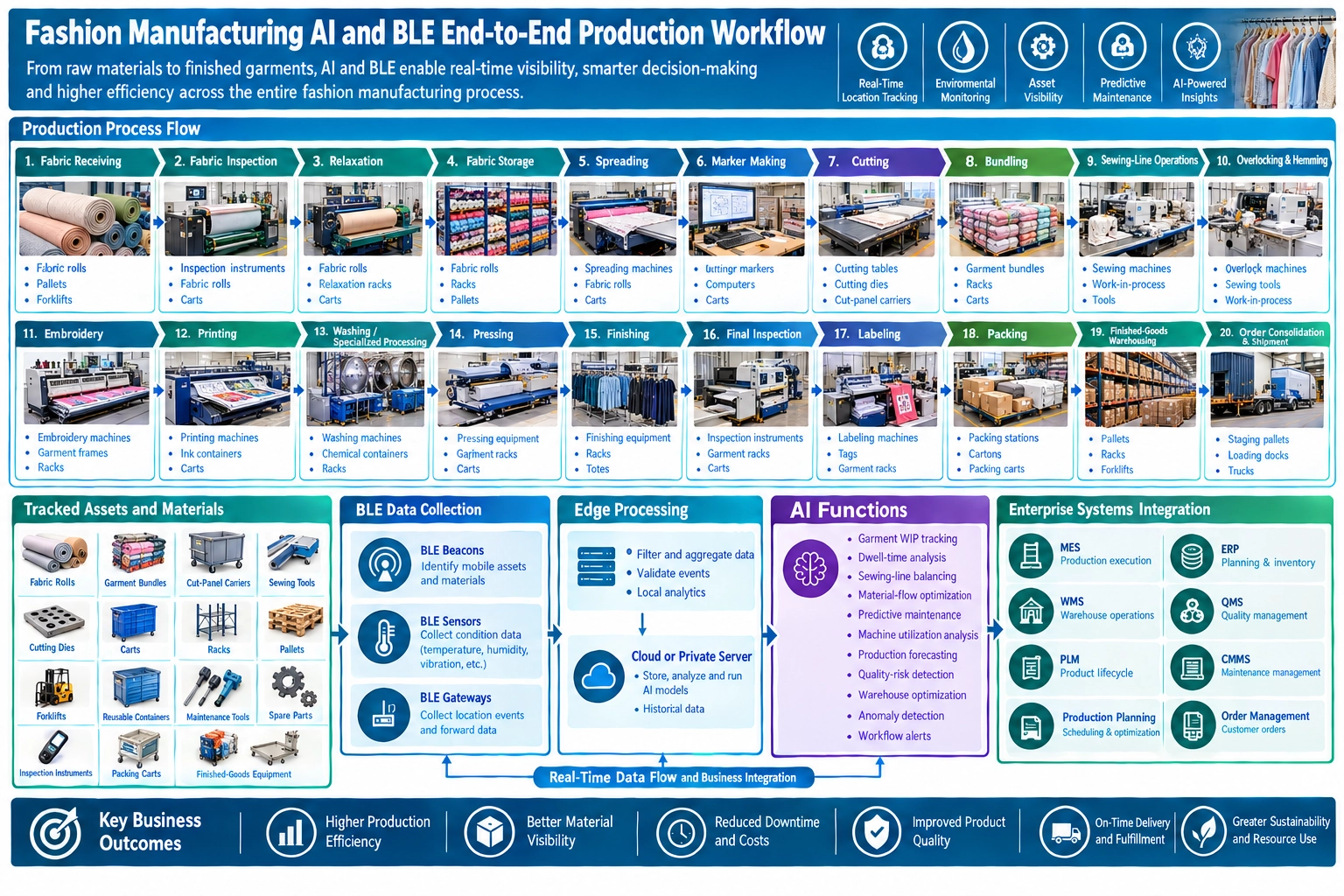
The completed infographic maps Fashion Manufacturing from fabric receiving through finished-goods warehousing and shipment. It shows tracked materials and production assets, BLE data collection, edge and cloud or private-server processing, AI functions, enterprise software integration, and resulting operational benefits.
AI-Enabled Fashion Manufacturing Planning and Control
Production planning for Fashion Manufacturing must account for style complexity, order quantities, size and color combinations, fabric availability, cutting capacity, sewing-line capacity, skilled labor requirements, finishing capacity, quality requirements, and shipment deadlines.
AI can use historical production data and current operating conditions to improve production forecasts and identify potential conflicts before they become line-level disruptions.
BLE adds physical evidence to planning decisions. If production software indicates that a fabric roll is available but its BLE location places it in another warehouse zone, the discrepancy can be investigated before the cutting schedule is released. Similar logic can identify whether required garment bundles, racks, tools, or finished-goods containers are physically available.
GAO can provide BLE and RFID hardware products and systems that support these location-data requirements, allowing Fashion Manufacturing teams to evaluate physical tracking as part of broader AI-driven production control.
AI Applications for Fashion Manufacturing Quality and Traceability
Traceability is increasingly important where manufacturers need to understand the relationship between raw materials, production operations, quality results, and finished garments.
A production record can associate a garment or garment batch with fabric lot information, cutting activity, sewing operations, inspection results, finishing operations, packing records, and shipment information. AI can analyze this historical information to identify patterns associated with defects, rework, returns, or production delays.
BLE can contribute physical movement records for reusable carriers, racks, WIP containers, and selected production assets. RFID may be preferable for specific garment or item identification requirements where direct tag reading at controlled checkpoints provides greater identification certainty.
The engineering objective should be to select the identification technology according to the required read range, identification granularity, environment, throughput, and business process rather than forcing one technology into every Fashion Manufacturing workflow.
Operational Challenges That Shape AI and BLE Deployment
Fashion Manufacturing deployments must account for physical and process conditions that affect data quality. Sewing floors can contain dense equipment layouts, moving operators, garment racks, carts, metal structures, electrical equipment, and changing WIP positions. Cutting rooms and warehouses introduce different coverage and material-handling conditions.
Engineering teams should therefore evaluate:
- Required location accuracy by production zone
- Asset density and expected movement frequency
- BLE Gateway coverage
- Tag mounting and durability
- Battery life for BLE Sensors and active devices
- Environmental conditions
- Network connectivity
- Edge-processing requirements
- Data latency
- MES and ERP integration
- WMS and QMS data availability
- Asset-to-device association
- AI model training data
- Alarm thresholds
- Operator workflows
- Cybersecurity controls
- Maintenance requirements
The correct deployment may use different tracking approaches for fabric rolls, garment bundles, production tools, finished-goods racks, and warehouse inventory. A controlled pilot can determine which assets justify continuous BLE tracking and which processes are better served by RFID, barcode, machine data, or existing enterprise records.
Technical Capabilities for AI and BLE in Fashion Manufacturing
AI-driven Fashion Manufacturing requires coordinated sensing, location intelligence, edge processing, enterprise software integration, and analytics. BLE Beacons, BLE Sensors, and BLE Gateways are most valuable when they supply physical production information that complements MES, ERP, WMS, QMS, PLM, and CMMS data.
BLE Hardware for Fashion Production
BLE Beacons can be attached to fabric rolls, garment-bundle carriers, racks, carts, pallets, reusable containers, maintenance tools, cutting equipment accessories, and other mobile resources. BLE Sensors can monitor selected environmental or equipment conditions such as temperature, humidity, vibration, or shock when those measurements have operational significance.
BLE Gateways receive beacon and sensor transmissions across production zones and forward relevant observations to edge computers or server software. Gateway placement should consider sewing-machine density, cutting-room layouts, metal structures, storage racks, garment racks, warehouse aisles, and other physical conditions that influence wireless coverage.
AI Models for Fashion Manufacturing
Fashion Manufacturing can use time-series forecasting, anomaly detection, classification, clustering, predictive maintenance models, process mining, optimization, and machine-learning-based risk scoring.
Models can analyze sewing-line cycle times, bundle dwell periods, fabric availability, machine utilization, production queues, quality results, warehouse movement, and order status. Historical MES, ERP, WMS, CMMS, QMS, and production data can improve model performance when the underlying records are sufficiently accurate and representative.
Edge Processing and Data Normalization
Edge processing can filter duplicate BLE observations, normalize timestamps, associate devices with production zones, and convert raw wireless observations into useful business events.
For example, an edge system can determine that a garment-bundle carrier has moved from cutting to a sewing-line staging area. Only the meaningful movement event needs to be forwarded to higher-level software rather than every raw radio observation.
Cloud Version and Server Version
A Cloud Version uses cloud-hosted software managed within cloud infrastructure. This approach can be appropriate for Fashion Manufacturing organizations operating multiple facilities that need centralized reporting, AI model management, historical analytics, and cross-site production visibility.
A Server Version runs on customer-managed or privately hosted infrastructure, including factory servers, private data centers, edge servers, or other controlled enterprise environments. It can be appropriate when production data must remain within controlled infrastructure, connectivity is limited, or local processing and organizational IT policies are priorities.
Hybrid implementations can retain time-sensitive processing locally while sending selected events and historical data to centralized cloud software.
Fashion Manufacturing Deployment Engineering
A successful deployment starts with a production-process assessment rather than simply installing BLE Gateways throughout a facility. Engineers should map material routes, production zones, asset movement, wireless conditions, and required location accuracy.
Asset Tagging and Mounting
Tag selection should reflect the physical characteristics of each Fashion Manufacturing asset. A fabric-roll tag, garment-rack tag, maintenance-tool tag, and reusable-container tag may have different mounting requirements.
Mounting should avoid locations where tags can be damaged during cutting, sewing, pressing, washing, transportation, or warehouse handling. Battery-powered devices should also be positioned for practical inspection and replacement.
Gateway Coverage and Location Accuracy
Gateway locations should be selected using actual production-zone requirements. A warehouse may require aisle-level visibility, while a sewing floor may only require identification of the relevant production area.
Higher location accuracy generally requires additional infrastructure, calibration, and installation effort. Manufacturers should therefore define the business requirement first. If the operational decision only requires knowing that a garment bundle is in the sewing department, sub-meter positioning may provide little additional value.
Commissioning and Testing
Commissioning should verify:
- BLE device identity and asset association
- Gateway coverage in active production areas
- Location-event reliability
- Sensor measurement quality
- Battery behavior
- Data latency
- Edge-processing performance
- Network connectivity
- MES and ERP transactions
- WMS location updates
- CMMS maintenance events
- QMS data relationships
- AI alerts and anomaly detection
- Operator response procedures
Testing should occur under normal Fashion Manufacturing conditions with workers, garment racks, carts, machinery, and typical WIP volumes present.
Fashion Manufacturing Software Integration
BLE data becomes operationally useful when it is connected to the systems already managing Fashion Manufacturing.
MES and Production Planning Integration
MES can provide production orders, operations, sewing-line assignments, machine status, quantities, and production progress. BLE movement events add physical context to these records.
AI can compare planned production sequences with observed WIP movement and identify delayed bundles, unexpected routing, line starvation, or excessive accumulation between operations.
Production-planning systems can use these insights to prioritize orders, adjust line assignments, or identify potential schedule conflicts.
ERP and PLM Integration
ERP systems provide information about orders, inventory, purchasing, customers, and production requirements. PLM systems can provide style, product, material, specification, and revision information.
Combining these records with physical fabric and WIP movement can help determine whether the materials required for a particular style are available and correctly positioned.
AI can use historical production and order information to improve material planning and identify potential shortages or schedule risks.
WMS and Finished-Goods Operations
WMS integration connects warehouse records with the physical movement of fabric rolls, garment racks, cartons, pallets, and finished goods.
AI can analyze storage density, movement frequency, staging dwell, order consolidation, and loading sequences. BLE location events can identify where a required order or handling asset is physically located.
This is particularly useful during peak shipment periods when multiple styles, sizes, colors, and customer orders may be staged simultaneously.
CMMS and Maintenance Integration
CMMS records can include work orders, equipment history, spare parts, technician assignments, and maintenance schedules.
AI can combine these records with equipment condition data and production impact to prioritize maintenance. BLE can locate maintenance tools, portable diagnostic equipment, spare components, and change parts.
The resulting workflow can reduce technician search time while helping maintenance teams schedule work around sewing-line and cutting-room production requirements.
QMS and Inspection Integration
QMS data can include garment inspection results, defect classifications, corrective actions, rework records, and quality trends.
AI can correlate quality information with production operations, fabric lots, machines, styles, and production periods. This can help quality engineers identify recurring defect patterns and investigate upstream causes.
BLE contributes physical context when the location or movement of inspection instruments, garment racks, samples, or WIP carriers is relevant.
Security and Interoperability for Fashion Manufacturing
Fashion Manufacturing data can include production schedules, customer orders, inventory information, machine performance, quality records, and facility activity. Security should therefore be incorporated into the system design from initial planning.
Network and Access Controls
BLE Gateways, edge computers, application servers, and enterprise interfaces should operate within controlled network environments. Role-based access can restrict production, maintenance, quality, warehouse, and administrative information according to job responsibilities.
Secure authentication, access logging, patch management, backup procedures, and controlled remote administration should be included in the operational support plan.
Data Integrity and Governance
Asset identifiers should be mapped consistently between BLE devices and enterprise records. A fabric roll, garment bundle, rack, or maintenance tool should not have conflicting identifiers across MES, WMS, ERP, or CMMS.
Data-retention policies should define which raw observations are retained and which processed events become the long-term operational record. AI models should also be monitored for data drift when Fashion Manufacturing processes, product mixes, machines, or production volumes change.
Interoperability
Integration can use APIs, message-based interfaces, database connections, middleware, file exchange, or other supported enterprise interfaces.
Interoperability testing should verify business meaning rather than merely confirming that data has transferred. For example, a garment-bundle location event should correctly update the intended production record and not simply appear as an unassociated device message.
Technical and Business Benefits for Fashion Manufacturing
Combining AI with BLE-enabled physical visibility can improve several areas of Fashion Manufacturing.
Faster Material and WIP Identification
Physical location data reduces manual searching for fabric rolls, garment bundles, racks, carts, and reusable containers. AI adds value by identifying which missing or delayed assets are most likely to affect production.
Better Sewing-Line Utilization
AI can analyze bundle movement, cycle times, machine availability, and production queues to identify sewing-line imbalances. BLE events provide additional evidence about where WIP is accumulating.
Reduced Unplanned Downtime
Predictive models can identify patterns associated with equipment degradation, while BLE can improve access to maintenance tools and portable resources. Earlier intervention can reduce the production impact of equipment failures.
Improved Warehouse and Shipment Execution
Location intelligence helps warehouse teams find finished-goods racks, pallets, cartons, and staging resources. AI can identify congestion and prioritize movements associated with shipment deadlines.
Better Quality Investigation
AI can correlate inspection outcomes with fabric lots, production operations, machines, and production periods. This gives quality teams stronger evidence when investigating recurring defects and rework.
Scalable Multi-Facility Visibility
Standardized asset identifiers and data models can allow Fashion Manufacturing organizations to extend proven workflows from one sewing floor or warehouse to additional production facilities.
GAO’s experience supplying BLE, RFID, and IoT hardware and systems can support organizations evaluating this type of expansion, particularly where physical asset visibility needs to be connected with existing production and business software.
Fashion Manufacturing KPIs for AI and BLE Programs
The effectiveness of a deployment should be measured through operational KPIs rather than the number of BLE devices installed.
Relevant measures include:
- Fabric-roll search time
- Garment-bundle location accuracy
- Material staging time
- Yarn and fabric availability
- Cutting-room utilization
- Sewing-line throughput
- Machine utilization
- OEE
- Changeover time
- Equipment availability
- Unplanned downtime
- Maintenance response time
- Mean time to repair
- WIP dwell time
- Finished-goods dwell time
- Warehouse congestion
- Inventory accuracy
- Quality deviation rate
- Rework rate
- Scrap rate
- Order-staging time
- Dock turnaround time
- On-time shipment rate
Baseline values should be recorded before deployment. Post-deployment measurements can then determine whether the AI and BLE solution has produced a meaningful operational improvement.
Implementation Recommendations for Fashion Manufacturing
Start with a Measurable Production Problem
A practical first project could target fabric-roll search, garment-bundle visibility, sewing-line WIP delays, maintenance-tool availability, finished-goods staging, or warehouse congestion.
The initial scope should define the baseline KPI, assets to be tracked, required location accuracy, data sources, responsible personnel, and expected operational action.
Select the Appropriate Identification Technology
BLE is well suited to continuous location visibility for mobile Fashion Manufacturing assets and reusable handling resources. RFID can be more appropriate for controlled identification checkpoints or item-level identification requirements. Barcodes and machine-generated production records can remain useful where they already provide reliable event capture.
Using complementary technologies can produce a more practical solution than attempting to make one identification method serve every process.
Pilot a Representative Production Zone
A cutting room, sewing line, finished-goods warehouse, or maintenance workflow can provide a controlled pilot.
The pilot should include normal production volumes and should evaluate radio coverage, tag durability, data accuracy, integration behavior, operator acceptance, battery requirements, and KPI improvement.
Validate AI Before Automating Decisions
AI recommendations should be tested against historical and live production conditions. False positives, missed events, incomplete data, and changing production patterns should be monitored.
Human review remains important for quality decisions, maintenance authorization, production changes, and other actions where operational judgment is required.
Standardize Before Scaling
Once a pilot demonstrates measurable value, organizations should standardize asset naming, tag mounting, gateway configuration, network connectivity, data interfaces, device maintenance, and reporting definitions.
GAO can help Fashion Manufacturing organizations evaluate BLE Beacons, BLE Sensors, BLE Gateways, RFID technologies, and supporting IoT hardware according to their facility layout, asset types, production processes, and integration requirements.
Key Takeaways for AI and BLE in Fashion Manufacturing
- AI can analyze fabric, garment WIP, production, machine, quality, warehouse, and shipment data to identify operational risks and improvement opportunities.
- BLE provides continuous physical visibility for selected mobile Fashion Manufacturing assets, materials, tools, racks, carts, and reusable containers.
- Sewing-line balancing benefits when AI combines production records with actual garment-bundle movement.
- Cutting-room and fabric-roll visibility can reduce material search and staging delays.
- Predictive maintenance can combine machine condition, maintenance history, and production impact to prioritize interventions.
- MES, ERP, PLM, WMS, CMMS, and QMS integration connects physical events with established Fashion Manufacturing processes.
- Cloud Version deployment is useful for centralized analytics and multi-facility visibility, while Server Version deployment can support controlled or privately hosted environments.
- BLE and RFID should be selected according to identification requirements, read conditions, location accuracy, throughput, and process design.
- Pilot deployments should establish measurable baselines before expanding across production areas.
- Cybersecurity, data integrity, interoperability, device maintenance, and AI model monitoring should be addressed throughout the deployment lifecycle.
Building the Future of Industrial AI and IoT with GAO
For more than three decades, GAO has invested heavily in R&D covering industrial BLE, RFID, and IoT technologies and has expanded these capabilities to support AI-driven industrial applications. For Fashion Manufacturing, this work aligns with connected material tracking, production visibility, equipment monitoring, and AI-assisted operational analysis. GAO’s sister companies, GAO Research and GAO Tek, together with GAO form the GAO Group, serving organizations across the United States and Canada, including Fortune 500 companies, R&D firms, universities, and government agencies. Headquartered in New York City and Toronto, GAO maintains stringent quality processes and provides expert remote and onsite support.