
AI and BLE for Financial Data Centers
AI-Driven Operations for Financial Data Centers
AI and BLE for Financial Data Centers combines Artificial Intelligence of Things (AIoT) with Bluetooth Low Energy (BLE) gateways, beacons, and sensors to improve visibility across critical computing environments. BLE sensors can capture temperature, humidity, vibration, differential conditions, equipment status, location, and other operational signals, while BLE gateways aggregate field data for edge or server-side processing. AI models can then identify anomalies, predict equipment problems, correlate environmental conditions with IT infrastructure behavior, and support faster operational decisions. For financial data centers, where availability, physical security, auditability, energy efficiency, and controlled change management are critical, this combination provides a practical way to convert distributed facility and asset data into actionable intelligence. GAO supplies BLE, RFID, and IoT hardware products and systems that can support these monitoring and tracking requirements while integrating with existing data center software and operational processes.
AIoT-Enabled Financial Data Center: Real-Time Monitoring, Predictive Maintenance & Operational Intelligence
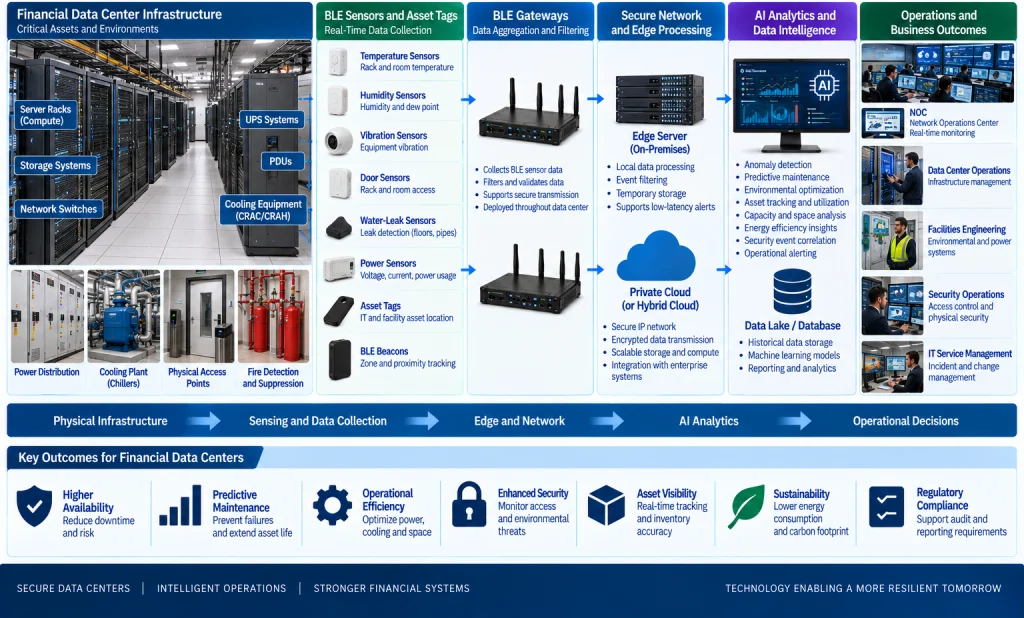
This visual shows how BLE sensors and asset tags monitor temperature, humidity, vibration, water leaks, power conditions, access, and equipment location across critical financial data center infrastructure. BLE gateways, secure edge and cloud processing, databases, and AI analytics transform this data into anomaly detection, predictive maintenance, environmental optimization, asset visibility, capacity insights, and operational alerts for NOC, facilities, security, and IT teams.
Why AI Matters in Financial Data Center Operations
Financial data centers operate under strict availability, security, capacity, and compliance requirements. A small environmental deviation can become significant when it affects densely populated server racks, storage systems, network equipment, or power infrastructure. Traditional monitoring often depends on fixed building management systems, equipment telemetry, manual inspections, and isolated management consoles. Those sources can provide valuable information, but they may not provide sufficient granular visibility into mobile assets, localized environmental conditions, or operational patterns.
AI adds analytical capability to this existing data. Instead of treating every sensor reading as an isolated event, machine learning models can establish normal operating patterns and identify deviations. For example, a gradual temperature increase around a particular rack row can be correlated with cooling behavior, workload conditions, airflow restrictions, or changes in equipment density. Similarly, vibration readings from power or cooling equipment can contribute to predictive maintenance models when combined with maintenance history and equipment operating conditions.
BLE provides a practical sensing and identification layer for these applications. Battery-powered BLE devices can be positioned close to assets or environmental points without requiring extensive new cabling. Gateways collect the BLE signals and forward normalized data to software where rules, analytics, and AI models can process it.
The resulting AIoT solution is particularly useful when financial data center operators need to correlate physical conditions, equipment location, maintenance activity, and operational events rather than simply collect more telemetry.
Financial Data Center Use Cases for AI and BLE
AI-Based Asset Tracking and Location Intelligence
Financial data centers contain high-value servers, storage devices, network equipment, test equipment, spare components, tools, batteries, and other controlled assets. BLE beacons and asset tags can provide location information that complements configuration management databases (CMDBs), data center infrastructure management (DCIM) software, IT service management (ITSM) systems, and inventory records.
AI can analyze movement histories and identify unusual asset movements, repeated searches, location inconsistencies, or deviations from expected equipment workflows. This is useful during equipment installation, decommissioning, maintenance, rack changes, and hardware replacement.
The engineering objective is not simply to determine where an asset is located. The more valuable objective is to establish reliable relationships between asset identity, physical location, rack position, maintenance status, ownership, change ticket, and operational event.
Predictive Maintenance for Critical Infrastructure
Power and cooling equipment represent major operational dependencies in financial data centers. UPS systems, battery cabinets, PDUs, cooling units, pumps, fans, compressors, and other mechanical and electrical equipment can generate temperature, vibration, current, humidity, or other condition signals.
BLE sensors can supplement existing equipment telemetry by providing localized measurements where wired instrumentation is impractical. AI models can use historical readings, maintenance records, alarm events, and operating conditions to detect abnormal behavior.
A useful implementation separates early warning from automatic control. AI-generated predictions can initially be routed to facility engineers for validation rather than directly changing critical equipment settings. This approach reduces operational risk while allowing data scientists and facilities teams to validate model performance.
Rack-Level Environmental Monitoring
Room-level temperature and humidity measurements can conceal localized conditions. Hot spots may develop within individual rack rows or around equipment with unusual heat loads even when the average room temperature appears normal.
BLE temperature and humidity sensors can increase measurement density without installing dedicated Ethernet cabling at every monitoring point. AI can analyze measurements across rack zones and compare environmental behavior with cooling operation, equipment density, time of day, and workload patterns.
This supports earlier identification of:
- Rack hot spots and abnormal thermal gradients
- Cooling imbalance between rack rows
- Persistent humidity deviations
- Airflow-related anomalies
- Environmental conditions associated with equipment alarms
- Areas requiring additional inspection or sensor deployment
AI-Assisted Physical Security and Access Monitoring
Physical security is particularly important for financial data center facilities because unauthorized movement of equipment can create security, operational, and compliance risks.
BLE beacons, gateways, and location-aware sensors can supplement badge access systems and surveillance controls. AI can correlate authorized access events with asset movement, maintenance schedules, work orders, and equipment locations.
BLE should not be treated as the sole physical security mechanism. Financial data centers should retain access-control systems, surveillance, visitor management, logging, and established security procedures. BLE-derived location information is most valuable as an additional operational signal that can help security and data center teams investigate exceptions.
Financial Data Center Operational Workflow from Sensing to AI Decisions
A production deployment normally begins with a physical measurement or identification event. BLE sensors and beacons capture localized data from assets, equipment zones, racks, rooms, or controlled operational areas. BLE gateways receive those signals and forward them through the financial data center’s secured IP infrastructure.
The data collection layer should include device identifiers, timestamps, signal information, sensor readings, gateway identity, and location context where applicable. Time synchronization is important because AI models become less reliable when events from different systems cannot be placed accurately on a common timeline.
The gateway layer can perform initial filtering, buffering, validation, and protocol conversion. Edge processing is useful when the site needs continued operation during WAN interruptions or when sensitive operational telemetry should remain within a controlled environment.
A middleware service can normalize BLE data and expose it to existing systems. Typical integration targets include:
- Data center infrastructure management (DCIM) systems
- Building management systems (BMS)
- Computerized maintenance management systems (CMMS)
- IT service management (ITSM) software
- Configuration management databases (CMDB)
- Security information and event management (SIEM) systems
- Network management and observability tools
- Enterprise asset management (EAM) software
- Private cloud analytics environments
- Operational dashboards and notification services
AI services then transform the collected information into predictions, anomaly scores, classifications, correlations, or recommendations. A financial data center operations team can use those outputs to prioritize inspection, initiate a maintenance workflow, investigate an asset movement, adjust monitoring coverage, or escalate a developing environmental condition.
The final stage is the operational response. Every high-value AI alert should have a defined owner, severity level, escalation path, response procedure, and audit trail. This human-in-the-loop design is especially important for critical infrastructure where an incorrect automated action can have consequences beyond the individual sensor or device.
AIoT Data Flow for Financial Data Centers: From BLE Sensing to AI-Driven Operational Intelligence
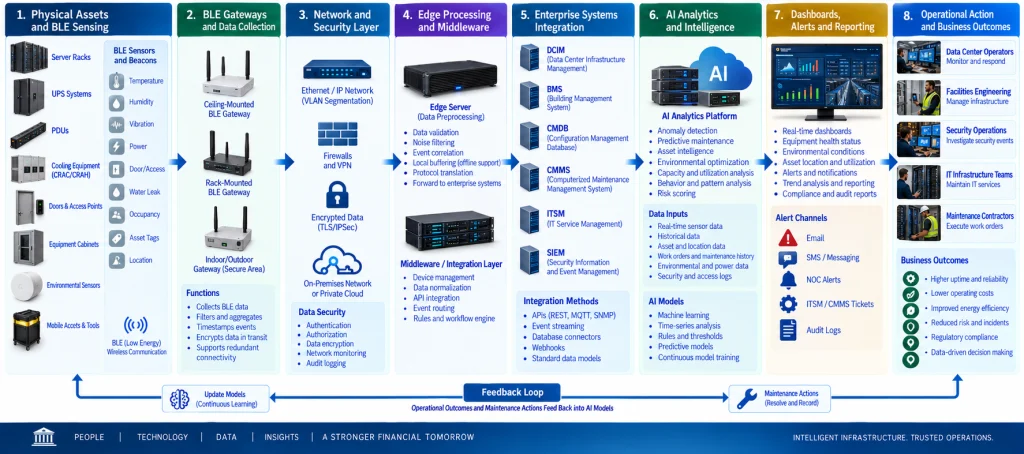
This diagram illustrates the end-to-end AIoT data flow in a financial data center, from BLE sensing of physical infrastructure through secure gateways, edge processing, enterprise systems, and AI analytics. It shows how real-time insights drive dashboards, alerts, maintenance actions, security responses, and continuous AI model improvement.
BLE Components and AI Data Infrastructure for Financial Data Centers
BLE Sensors and Beacons
BLE sensors provide localized measurements such as temperature, humidity, vibration, contact state, motion, or other supported parameters. Beacons can provide identification or location reference points for equipment and operational zones.
Device selection should consider battery life, measurement accuracy, operating temperature range, enclosure requirements, mounting method, radio performance, maintenance access, and replacement procedures. Battery-powered devices are attractive for retrofit projects, but battery management becomes an operational requirement when hundreds or thousands of endpoints are deployed.
BLE Gateways
BLE gateways form the connection between low-power wireless devices and the financial data center’s IP network. Gateway placement should account for rack density, equipment obstructions, radio propagation, antenna characteristics, interference, required coverage, and maintenance access.
Gateways should also support appropriate buffering and health monitoring. A sensor that is functioning correctly but cannot reliably reach its gateway should be treated as an operational fault rather than silently disappearing from the data set.
Edge Processing and Server Software
Edge computing can filter and preprocess BLE data close to the financial data center. This can reduce unnecessary network traffic and maintain selected functions during temporary connectivity failures.
Server-based software can host device management, data storage, rules, analytics, dashboards, and AI services within customer-controlled infrastructure. For organizations with strict data residency, security, or network segmentation requirements, privately hosted processing can be preferable.
Cloud Version and Server Version
A Cloud Version uses cloud-hosted software for device management, data aggregation, analytics, dashboards, and AI processing. It can simplify centralized management across geographically distributed financial data centers and support consolidated analytics where security policies permit the required telemetry to leave the site.
A Server Version runs software on edge servers, customer-managed servers, private data centers, or other privately hosted infrastructure. This approach is appropriate when financial data center operators require greater control over network boundaries, data retention, authentication, integration points, or operational availability.
A hybrid implementation can also keep raw or sensitive operational data within controlled infrastructure while forwarding selected aggregated metrics to approved cloud services.
Security and Communications
BLE deployments in financial data centers should use appropriate Bluetooth security mechanisms, device authentication, encrypted communications where supported, secure gateway configuration, network segmentation, access controls, certificate or credential management, software patching, logging, and device lifecycle procedures.
The BLE layer should complement, not replace, established cybersecurity controls. Security teams should assess gateways and management software as part of the organization’s wider attack surface, including their connections to DCIM, BMS, CMDB, ITSM, SIEM, and other systems.
GAO’s BLE and IoT hardware can be incorporated into monitoring and tracking solutions where the deployment requires battery-powered sensing, gateway connectivity, asset identification, or localized operational data collection.
AI Capabilities That Improve Financial Data Center Operations
The value of AI in financial data centers comes from combining continuous physical-world observations with operational history and established engineering rules. BLE-enabled data collection can provide additional context to AI models, but the operational outcome depends on how accurately the solution represents the physical environment and how effectively its predictions are integrated into data center procedures.
Anomaly Detection for Critical Infrastructure
AI-based anomaly detection can establish normal operating ranges for individual rooms, rack zones, power equipment, cooling systems, and other monitored assets. Rather than relying exclusively on static thresholds, statistical and machine learning models can identify unusual combinations or gradual changes.
For example, a temperature reading that remains below a conventional alarm threshold may still represent a significant anomaly if the same rack normally operates at a substantially lower temperature. Combining environmental measurements with equipment state and historical patterns can therefore improve early warning.
Practical implementations should retain deterministic thresholds for safety-critical conditions. AI should augment established alarms rather than replace hard engineering limits.
Predictive Maintenance and Failure Prevention
Predictive maintenance models can evaluate sensor trends alongside equipment age, maintenance history, alarm frequency, operating conditions, and previous failures. A model may identify an increasing probability of abnormal behavior before a conventional alarm is triggered.
Financial data center operators can use these predictions to prioritize inspections and maintenance windows. This can help reduce unexpected interventions while allowing technicians to schedule work around planned maintenance and change-management procedures.
The quality of predictive maintenance depends heavily on historical data. A deployment should therefore establish a data collection period before making aggressive failure predictions. Model outputs should also be validated against actual maintenance findings.
Environmental Optimization and Energy Intelligence
AI can correlate temperature, humidity, equipment density, cooling behavior, and time-dependent operating patterns to identify opportunities for improved cooling efficiency.
BLE sensors can increase measurement granularity around rack rows and equipment zones. AI can then identify recurring thermal patterns and provide recommendations to facilities engineers.
Any automated optimization should respect equipment manufacturer specifications, environmental operating limits, redundancy requirements, and established change-control procedures. Efficiency should never be pursued by compromising availability or thermal resilience.
Asset and Maintenance Intelligence
Combining BLE location data with maintenance records creates a richer operational history. A maintenance team can associate an asset with its physical location, service history, technician activity, work order, replacement event, and eventual decommissioning.
AI can use this information to identify recurring maintenance patterns, frequently moved equipment, assets associated with repeated incidents, and locations requiring additional monitoring.
This can improve inventory accuracy and reduce time spent physically searching for equipment during maintenance and deployment activities.
Engineering Considerations for BLE Deployment in Financial Data Centers
A successful deployment begins with a site survey rather than simply installing sensors according to a predetermined spacing rule. Data center construction materials, rack density, cable trays, metal enclosures, electrical equipment, walls, doors, and equipment cabinets can influence BLE signal propagation.
Radio Coverage and Gateway Placement
Gateway locations should be selected using actual site conditions and required service levels. Engineers should evaluate signal strength, packet reliability, interference, antenna orientation, gateway capacity, and overlapping coverage.
High-value monitoring points may require redundant coverage. A single gateway should not become a hidden single point of failure for critical environmental information.
Sensor Density and Measurement Quality
More sensors do not automatically produce better AI. Excessive devices can increase maintenance requirements, battery replacement workload, wireless traffic, and data-management complexity.
Sensor density should therefore follow the physical variability of the monitored environment. Rack-level thermal monitoring, for example, may justify substantially higher sensor density than monitoring a relatively uniform storage area.
Battery and Device Lifecycle Management
Battery-powered BLE devices require a defined lifecycle program. Financial data center operators should track installation date, battery status, expected replacement interval, physical location, firmware version, and maintenance history.
Device management software should generate alerts before batteries reach critical levels. Scheduled replacement can then be coordinated with routine facility inspections instead of creating unexpected maintenance work.
Integration with Existing Data Center Systems
BLE data becomes substantially more useful when linked to established systems rather than stored in a separate dashboard.
Useful integrations include:
- DCIM for rack, room, capacity, and facility context
- BMS for environmental and mechanical infrastructure
- CMDB for configuration and asset relationships
- CMMS or EAM for maintenance planning and work orders
- ITSM for incident and change-management processes
- SIEM for security-event correlation
- Network monitoring systems for infrastructure context
- Data warehouses and analytics systems for historical analysis
Data models should use consistent asset identifiers and location references. A temperature sensor identified differently in the BLE management system and DCIM creates avoidable reconciliation problems and weakens AI analysis.
This workflow traces data from BLE-enabled racks, UPS systems, PDUs, cooling equipment, access points, cabinets, and mobile assets through BLE gateways, secure networks, edge processing, middleware, and enterprise systems. AI analytics transform validated operational data into predictive maintenance, anomaly detection, asset intelligence, dashboards, alerts, and human actions, with maintenance outcomes feeding back into continuous model improvement.
Financial Data Center AI and BLE Implementation Lifecycle
A controlled implementation reduces technical and operational risk by progressing from requirements definition to validated production use.
Requirements and Use-Case Definition
The first step is to identify the operational problem. Examples include rack-level thermal visibility, mobile asset tracking, predictive maintenance, equipment-location accuracy, or maintenance response optimization.
Each use case should have a measurable outcome, defined data requirements, responsible operational team, and acceptable false-positive and false-negative rates.
Site Survey and Hardware Selection
Engineers should document physical construction, rack arrangement, environmental conditions, network availability, gateway locations, asset categories, sensor mounting positions, and maintenance accessibility.
Hardware selection should consider:
- BLE version and supported profiles
- Sensor measurement accuracy
- Transmission interval
- Battery capacity and expected life
- Enclosure and environmental rating
- Gateway processing and connectivity
- Ethernet, Wi-Fi, cellular, or other backhaul requirements
- Firmware management
- Authentication and security capabilities
- Integration interfaces
Installation and Commissioning
Installation should be followed by a commissioning process rather than assuming that powered devices are operationally ready.
Testing should verify sensor identity, measurement accuracy, timestamp behavior, radio coverage, gateway connectivity, data transmission, device health, software integration, and alert generation.
Critical measurements should be compared against calibrated or trusted reference instruments where appropriate.
AI Model Validation
AI models should first operate in a controlled observation mode. Operators can compare model predictions against known events, maintenance records, environmental measurements, and actual equipment conditions.
Important performance measurements include detection precision, recall, false-alarm frequency, prediction lead time, missing-data rates, and model drift.
A model that produces many technically correct alerts but overwhelms data center operators may have limited operational value.
Production Optimization and Scale-Up
After validation, the solution can be expanded to additional rooms, rack rows, equipment classes, or geographically distributed financial data centers.
Scaling should include gateway capacity planning, network bandwidth, database growth, device provisioning, firmware management, battery logistics, AI model retraining, and operational staffing.
GAO can support organizations that require BLE, RFID, and IoT hardware products and systems for these types of deployments, including applications where wireless sensing and asset identification must operate alongside existing facility and IT infrastructure.
AIoT Deployment Lifecycle for Financial Data Centers: From Planning to Secure Multi-Site Scaling
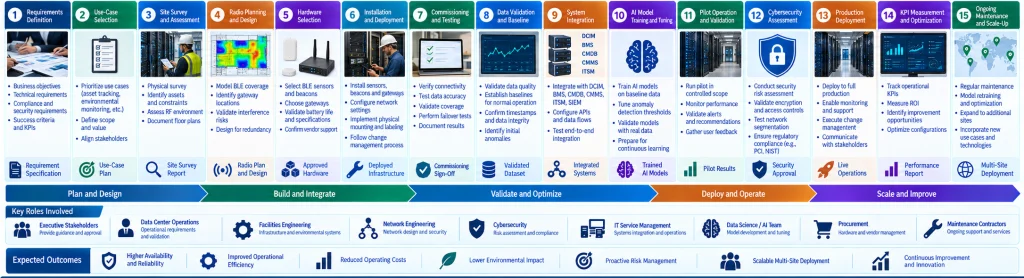
This lifecycle visual presents a structured progression for deploying AI-enabled BLE solutions in financial data centers, from requirements, site surveys, radio planning, and hardware selection through installation, integration, AI model training, pilot validation, cybersecurity assessment, and production deployment. It concludes with KPI measurement, optimization, ongoing maintenance, and multi-site scaling while highlighting the technical teams responsible throughout the lifecycle.
Security, Reliability, and Governance
Financial data centers require security controls that extend from physical devices to software and enterprise networks. BLE devices and gateways should therefore be included in asset inventories and cybersecurity assessments.
Important controls include:
- Device authentication and controlled provisioning
- Secure gateway administration
- Network segmentation
- Least-privilege access
- Encrypted communications where supported
- Firmware and software patch management
- Credential and certificate lifecycle management
- Centralized logging
- Time synchronization
- Backup and recovery procedures
- Configuration baselines
- Physical protection of gateways
- Monitoring for unexpected device behavior
AI governance also matters. Model decisions should be traceable to source measurements and timestamps. Operators should be able to determine why a particular alert was generated and whether the underlying data was complete.
Critical operational decisions should retain appropriate human oversight. AI-generated recommendations can inform technicians and managers while established safety controls, equipment interlocks, and emergency procedures remain authoritative.
Business Value of AI-Enabled Financial Data Center Monitoring
The strongest business case comes from connecting technical improvements to operational outcomes.
AI-supported asset intelligence can reduce the time required to locate equipment and reconcile physical inventory. Predictive maintenance can provide additional planning time for critical infrastructure interventions. More granular environmental monitoring can expose localized conditions that room-level monitoring may overlook.
Improved data quality also supports compliance and operational reporting. A consistent history of device measurements, asset movements, maintenance actions, and alerts can provide useful evidence during internal reviews, engineering investigations, and operational audits.
Scalability is another advantage. Once data models, gateway standards, integration methods, security controls, and operating procedures have been validated at one location, they can be adapted for additional financial data center facilities.
The business value should therefore be evaluated across availability, maintenance efficiency, asset control, environmental resilience, operational visibility, security support, and infrastructure planning, rather than treating BLE deployment as an isolated technology project.
Practical Recommendations for Financial Data Center Deployment
Financial data center organizations evaluating AI and BLE should prioritize operational requirements before selecting hardware or software.
- Start with a measurable operational problem such as rack thermal visibility, asset location accuracy, or predictive maintenance.
- Conduct a physical BLE site survey before determining gateway quantities or sensor placement.
- Define sensor accuracy, sampling interval, battery life, coverage, and availability requirements before procurement.
- Establish common identifiers linking BLE devices to racks, assets, rooms, work orders, and CMDB records.
- Keep safety-critical thresholds and equipment protection mechanisms independent of AI predictions.
- Validate AI models against real maintenance events and trusted reference measurements.
- Use human-in-the-loop workflows for consequential operational decisions.
- Segment BLE gateways and supporting systems appropriately within the financial data center network.
- Monitor gateway health, sensor availability, battery condition, firmware versions, and communication quality.
- Define data retention and access policies before collecting large volumes of environmental and location information.
- Measure operational outcomes using response time, detection quality, maintenance efficiency, asset accuracy, and infrastructure performance.
- Design the system so additional financial data center sites can be added without rebuilding the entire integration approach.
Building a Reliable AIoT Foundation for Financial Data Centers
AI and BLE can provide financial data centers with a practical mechanism for collecting more granular physical-world information and turning that information into operational intelligence. The most effective deployments do not treat wireless sensors as an isolated technology. They connect sensing, gateway communications, edge or server processing, AI analytics, DCIM and IT systems, cybersecurity controls, and human operating procedures.
GAO’s experience supplying BLE, RFID, and IoT hardware products and systems can help organizations address the physical data-collection layer required by these applications. Headquartered in New York City and Toronto, Canada, GAO is ranked among the world’s top 10 leading B2B and B2G BLE and RFID suppliers. Its work has supported customers across the United States and Canada, including Fortune 500 companies, R&D organizations, universities, and government agencies.
GAO Group has invested substantially in product and system R&D and maintains stringent quality assurance and remote or onsite technical support capabilities. For financial data center teams, this experience is relevant when selecting sensing hardware, gateways, asset-identification technologies, and supporting IoT systems that must operate within established facility, IT, and security requirements.
Building the Future of Industrial AI and IoT with Aperture Venture Studio and GAO
For more than three decades, GAO Group has invested heavily in R&D for industrial BLE, RFID, and IoT. As AI became increasingly useful for industrial applications, we expanded our work across AIoT, edge intelligence, machine learning, computer vision, and connected systems. We founded Aperture Venture Studio to support the development and scaling of AI and IoT solutions relevant to operational environments such as financial data centers.
Aperture brings together AI and IoT technical experts, operational leaders, investors, and technology companies. Through initiatives including the Aperture Ventures Summit and TekSummit, advanced AI and IoT topics are explored with technical and industry communities.
We welcome professionals and organizations interested in contributing as:
- Advisors, co-founders, or employees
- Investors
- Customers