
AI and BLE for Fleet Operations
AI-Driven Fleet Operations for Vehicle Utilization, Maintenance, and Dispatch
AI-driven fleet operations combine vehicle data, driver activity, maintenance records, dispatch information, route conditions, fuel or energy consumption, cargo requirements, and connected equipment data to improve how commercial fleets are planned, dispatched, maintained, and utilized. AI can forecast vehicle demand, identify maintenance risks, optimize dispatch decisions, detect operational anomalies, and improve fleet utilization across transportation networks.
BLE gateways, beacons, and sensors can provide supporting information for selected fleet assets and localized operating conditions. Examples include trailers, containers, mobile equipment, maintenance tools, removable equipment, yard assets, and vehicle-adjacent resources. BLE is therefore one component of a broader AI and IoT solution that can also include GPS, telematics, CAN bus data, RFID, barcode, cameras, cellular connectivity, and fleet management software.
Fleet operations span vehicle acquisition, assignment, dispatch, routing, fueling or charging, inspections, maintenance, yard management, loading and unloading, driver operations, compliance activities, and vehicle retirement. Each stage generates operational data that can be analyzed by AI.
AI can correlate vehicle mileage, engine or battery information, fault codes, driver behavior, route conditions, utilization, maintenance history, delivery schedules, and asset movements. This creates a more complete operating picture than relying on individual telematics or maintenance records.
GAO supplies BLE, RFID, and other IoT technology-based hardware products and systems that can support connected fleet operations. The appropriate combination depends on fleet type, vehicle environment, operating geography, asset characteristics, data requirements, and integration with existing fleet management systems.
How AI Transforms Fleet Operations
Fleet operators increasingly need to manage transportation capacity while controlling fuel or energy consumption, maintenance costs, vehicle downtime, safety exposure, and service commitments. AI can help transform these activities by identifying patterns across large volumes of operational data.
AI applications for Fleet Operations include:
- Fleet demand forecasting based on historical utilization, routes, seasonal activity, and transportation requirements
- Vehicle utilization analysis to identify underused, overused, or poorly allocated vehicles
- Predictive maintenance based on diagnostic data, mileage, operating conditions, fault codes, and maintenance history
- AI route optimization using delivery requirements, traffic, vehicle capacity, road conditions, and operating constraints
- Driver behavior analysis using telematics, vehicle events, and historical safety patterns
- Fuel and energy consumption optimization
- Vehicle replacement and lifecycle planning
- Fleet dispatch optimization
- Trailer and container utilization analysis
- Yard congestion and vehicle movement analysis
- Charging demand forecasting for electric fleets
- Exception detection for vehicles, assets, routes, and maintenance activities
- AI-assisted compliance monitoring
- Fleet capacity planning
BLE supports selected applications where localized asset presence or environmental information is useful. GPS and telematics generally remain more appropriate for vehicle positioning and vehicle operating data, while BLE can complement those systems around yards, maintenance facilities, depots, warehouses, and vehicle staging areas.
Fleet Operations Workflows Supported by AI
Vehicle Acquisition and Fleet Planning
Fleet planning requires decisions about vehicle types, capacity, operating range, utilization, replacement cycles, maintenance costs, and expected transportation demand.
AI can analyze historical utilization and projected transportation requirements to identify vehicle shortages, excess capacity, and replacement priorities. For mixed fleets, models can compare diesel, gasoline, hybrid, and electric vehicles according to route characteristics, duty cycles, energy costs, maintenance history, and charging availability.
Fleet managers can use these insights to improve vehicle acquisition planning and reduce the risk of purchasing vehicles that do not match actual operating requirements.
Vehicle Assignment and Dispatch
Dispatch teams must match vehicles and drivers with routes, cargo requirements, schedules, geographic constraints, and vehicle capabilities.
AI can evaluate current vehicle availability, maintenance status, route length, payload requirements, driver schedules, traffic, and service commitments. It can recommend suitable vehicles and identify potential conflicts before dispatch.
BLE can support localized identification of selected vehicles, trailers, carts, tools, or yard resources when GPS or telematics does not provide the required facility-level visibility.
Yard and Depot Operations
Fleet yards contain tractors, trailers, trucks, vans, containers, maintenance equipment, fueling resources, charging stations, spare parts, and other mobile assets. Manual searches can consume significant time when asset populations are large.
AI can analyze yard movements, dispatch schedules, maintenance status, and vehicle availability to improve staging decisions. BLE-tagged assets can provide zone-level information that helps personnel locate selected resources around depots and maintenance facilities.
Vehicle Inspection and Pre-Trip Operations
Pre-trip and post-trip inspections help identify vehicle defects and maintenance requirements. Inspection applications can capture tire condition, lights, brakes, fluid levels, body damage, safety equipment, and other checks.
AI can identify recurring defects, compare inspection results with maintenance history, and detect patterns associated with specific vehicle types or operating conditions. This can help fleet managers prioritize inspections and maintenance resources.
Fleet Maintenance and Repair
Maintenance operations include preventive maintenance, predictive maintenance, corrective repairs, parts management, work-order scheduling, technician assignment, inspections, and vehicle release.
AI can combine diagnostic data, engine hours, mileage, fault codes, vibration, temperature, maintenance history, and utilization to estimate failure risk. Maintenance teams can prioritize vehicles according to predicted risk and operational importance.
BLE sensors can supplement condition monitoring for selected equipment or localized environments where appropriate. BLE beacons can also help locate maintenance tools and mobile equipment within a fleet maintenance facility.
Routing and Vehicle Utilization
Fleet routing involves balancing service requirements with vehicle capacity, travel time, fuel or energy consumption, driver schedules, road conditions, and customer commitments.
AI can optimize route sequences and identify routes that are likely to create excessive mileage, idle time, or late arrivals. Fleet managers can use these recommendations to improve vehicle utilization and reduce unnecessary travel.
GPS and telematics remain the primary sources for vehicle movement and driving behavior. BLE can provide localized supporting information at depots, yards, warehouses, and other controlled fleet facilities.
Fueling, Charging, and Energy Management
Fuel and energy costs can represent a significant portion of fleet operating expenses. AI can analyze fuel consumption, idle time, route characteristics, vehicle load, driving behavior, weather, and vehicle condition.
For electric fleets, AI can forecast charging demand based on route schedules, state of charge, vehicle availability, charging capacity, and expected departures. This can reduce charging conflicts and help fleet operators schedule vehicles according to operational requirements.
Vehicle Return and End-of-Shift Processing
Returning vehicles may require inspection, refueling or charging, cleaning, unloading, defect reporting, and reassignment. AI can analyze return patterns to identify recurring delays or capacity constraints.
Connected asset information can also help verify whether selected equipment, tools, trailers, or removable resources are present before vehicles are released for the next operating cycle.
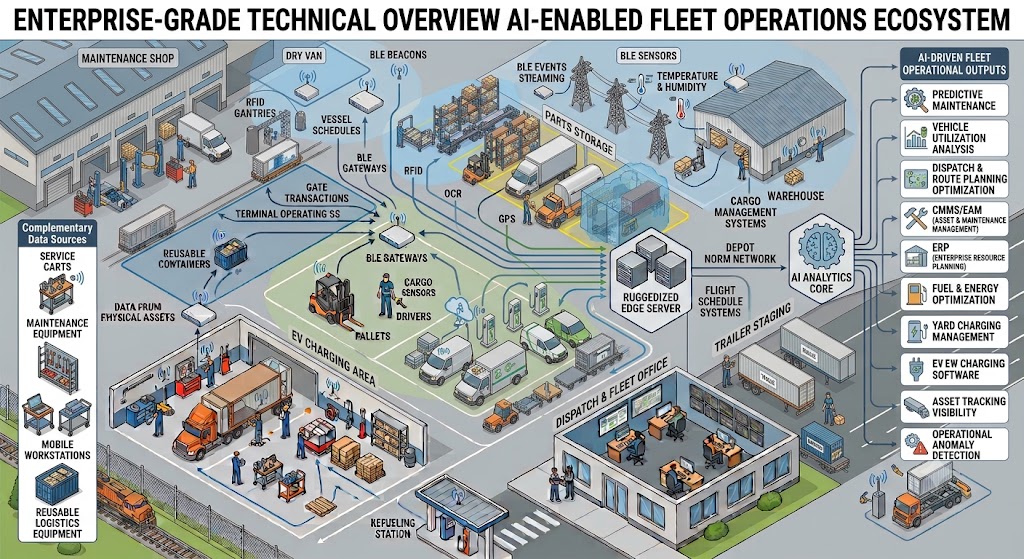
AI Applications Across Fleet Operations
AI Fleet Demand Forecasting and Capacity Planning
Fleet demand can vary by season, customer requirements, geography, day of week, route density, and transportation contracts. AI can analyze historical dispatch records, shipment volumes, route requirements, vehicle utilization, and planned transportation activity to forecast future fleet demand.
The resulting forecasts can help managers determine whether additional vehicles, rentals, driver capacity, maintenance resources, or charging infrastructure may be required.
AI Vehicle Utilization Optimization
Fleet utilization analysis can identify vehicles that spend excessive time idle, operate below expected capacity, or experience unusually high utilization.
AI can compare vehicle availability, route assignments, mileage, operating hours, payload, downtime, and service schedules. Managers can then adjust assignments or investigate whether fleet composition needs to change.
AI Predictive Fleet Maintenance
Predictive maintenance is one of the most valuable AI applications for fleet operations because unexpected vehicle failures can disrupt transportation schedules and create expensive recovery work.
AI can evaluate diagnostic trouble codes, mileage, engine hours, battery condition, vibration, temperature, maintenance history, inspection results, and driving patterns. Models can generate vehicle-specific risk scores and recommend inspection or maintenance priorities.
For electric vehicles, predictive models can also consider battery health, charging history, temperature exposure, state-of-charge patterns, and energy consumption.
AI Driver Behavior and Fleet Safety Analytics
AI can analyze harsh braking, rapid acceleration, speeding events, excessive idling, cornering behavior, seat-belt events, and other telematics information.
The objective should be to identify patterns that can support coaching, route planning, vehicle assignment, and safety programs rather than relying on isolated events. Fleet managers can distinguish persistent patterns from occasional anomalies.
AI Fuel and Energy Optimization
AI can correlate fuel consumption or electricity usage with vehicle type, route characteristics, load, driving behavior, weather, idle time, traffic, and maintenance condition.
The analysis can identify vehicles with abnormal consumption and help determine whether the cause is route selection, driving behavior, mechanical condition, payload, tire condition, or another operational factor.
AI Dispatch and Route Optimization
AI can optimize dispatch decisions using vehicle availability, driver schedules, service windows, vehicle capacity, route geography, traffic, maintenance status, and transportation priorities.
The system can also evaluate potential disruptions before dispatch and recommend alternate vehicle assignments or route sequences.
AI Yard and Trailer Management
Fleet yards can become congested when vehicles, trailers, containers, maintenance assets, and charging or fueling activities compete for limited space.
AI can analyze vehicle arrival patterns, dispatch schedules, maintenance status, trailer movements, yard zones, and loading requirements to improve staging decisions.
BLE can provide zone-level information for selected trailers and mobile assets where local visibility is needed.
AI Fleet Lifecycle and Replacement Planning
Vehicle replacement decisions involve acquisition cost, maintenance expense, fuel or energy consumption, downtime, utilization, residual value, operating environment, and regulatory requirements.
AI can combine these factors to estimate lifecycle cost and identify vehicles approaching an economically or operationally appropriate replacement point.
Fleet Operations Data Flow and AI Decision Process
A practical AI and IoT solution should connect physical fleet activities with reliable digital records. The data path generally extends from vehicle and facility data acquisition through communications, edge processing, enterprise software, AI analytics, and operational action.
Fleet Data Acquisition
Fleet Operations can generate data from:
- GPS position records
- Vehicle telematics
- CAN bus information
- Electronic control units
- Diagnostic trouble codes
- Engine and transmission data
- Battery management systems
- Charging equipment
- Fuel management systems
- Driver applications
- Electronic logging systems
- Vehicle inspection applications
- Maintenance work orders
- CMMS and EAM systems
- Tire pressure monitoring systems
- Cameras and computer vision
- RFID readers
- Barcode systems
- BLE gateways
- BLE beacons
- BLE environmental and condition sensors
- Trailer tracking systems
- Yard management systems
- TMS and dispatch software
- ERP systems
- Weather and traffic services
These sources should use controlled identifiers and synchronized timestamps so AI models can associate vehicle, driver, route, asset, maintenance, and facility events correctly.
Communication and Edge Processing
Vehicle telematics commonly communicates through cellular networks, while depot systems can use Ethernet, Wi-Fi, and other local connectivity. BLE gateways can collect localized events from tagged assets and sensors within maintenance shops, yards, warehouses, and staging areas.
Edge systems can filter duplicate BLE observations, validate device identities, normalize timestamps, calculate zone-level presence, and buffer events during temporary connectivity interruptions.
This local processing can reduce unnecessary network traffic and provide faster responses for selected fleet facility workflows.
Middleware and Fleet Software
Middleware connects device and vehicle information with operational applications. Relevant software includes:
- Fleet management systems
- Transportation management systems
- CMMS and EAM software
- Yard management systems
- Dispatch software
- Route optimization software
- Fuel management systems
- EV charging management software
- Driver management applications
- ERP systems
- Asset management software
- Safety and compliance systems
- Business intelligence software
- Data warehouse systems
APIs, event messaging, database interfaces, and integration services can transfer normalized information between these systems.
AI Analytics and Fleet Decisions
AI models can produce:
- Vehicle failure-risk scores
- Maintenance priorities
- Fleet utilization forecasts
- Dispatch recommendations
- Route optimization recommendations
- Fuel and energy consumption forecasts
- Driver behavior risk indicators
- Yard congestion predictions
- Trailer utilization recommendations
- Fleet replacement priorities
- Charging demand forecasts
- Operational anomaly alerts
These outputs can support dispatchers, fleet managers, maintenance supervisors, yard personnel, drivers, safety teams, and transportation planners.
GAO can supply connected hardware products and systems that support selected data acquisition and asset-visibility requirements within this larger fleet information flow.
Fleet Operations Challenges Addressed by AI
Fleet operators face interconnected operational pressures that can reduce vehicle availability, increase operating cost, and affect transportation service.
Common challenges include:
- Vehicle downtime
- Unplanned mechanical failures
- Underutilized vehicles
- Excessive vehicle mileage
- High fuel consumption
- Increasing electricity demand for EV fleets
- Inefficient vehicle assignment
- Route congestion
- Driver availability constraints
- Trailer and container imbalance
- Yard congestion
- Maintenance scheduling conflicts
- Incomplete inspection data
- Difficulty locating mobile maintenance assets
- Fragmented fleet and maintenance records
- Inconsistent telematics data
- Charging infrastructure constraints
- Excessive idling
- Safety-risk patterns
- Aging fleet populations
- Unplanned replacement costs
- Limited network-wide operational visibility
AI is most valuable when it connects these problems to specific operational actions. A predictive maintenance alert, for example, becomes useful when it can prioritize a vehicle, identify the likely maintenance requirement, check parts availability, and help the maintenance team schedule work before the vehicle is required for dispatch.
GAO’s experience supplying BLE, RFID, and other IoT hardware products and systems can help organizations evaluate the connected-device layer needed for these fleet workflows.
BLE Hardware and AI Software for Fleet Operations
BLE can provide localized presence and condition data for selected fleet assets and operating areas. It complements, rather than replaces, GPS, telematics, RFID, barcode identification, cameras, and other fleet technologies. GAO provides BLE gateways, beacons, sensors, RFID equipment, and other IoT hardware that can support fleet-specific deployments.
BLE Beacons for Selected Fleet Assets
BLE beacons can identify the presence of maintenance tools, inspection equipment, mobile workstations, service carts, reusable equipment, selected trailers, and other movable fleet resources. A beacon can provide an asset identifier that a nearby gateway detects when the asset enters or leaves a defined zone.
Fleet operators can use these events to identify equipment that remains in a maintenance bay, determine whether required inspection equipment is available, or reduce time spent searching for mobile service resources. BLE should not be treated as a universal vehicle tracking method because GPS and telematics provide more appropriate wide-area vehicle location and operating data.
BLE Gateways for Fleet Yards and Maintenance Facilities
BLE gateways can be installed around fleet depots, maintenance shops, parts areas, vehicle staging zones, charging areas, fueling areas, and selected yard locations. Gateways receive nearby beacon or sensor transmissions and forward relevant events to local or centralized fleet software.
Zone-level detection can support trailer presence, equipment availability, maintenance workflow status, and movement between selected operational areas. Edge processing can filter duplicate detections and temporarily retain events when network connectivity is interrupted.
BLE Sensors for Fleet Facilities and Equipment
BLE sensors can collect temperature, humidity, environmental, or selected condition data from fleet facilities and equipment where those measurements support an operational requirement. Examples include parts storage, maintenance areas, charging facilities, refrigerated or temperature-sensitive resources, and equipment that requires localized condition monitoring.
AI can combine these measurements with maintenance records, vehicle schedules, environmental conditions, and other operational data to identify abnormal patterns and prioritize action.
AI, Middleware, and Fleet Software Integration
AI software can consume BLE events together with GPS, telematics, TMS, CMMS/EAM, yard management, ERP, fuel management, charging management, inspection, and driver data. Middleware normalizes identifiers, timestamps, event types, and asset relationships before information reaches analytics and decision systems.
APIs, event messaging, database integration, and edge processing can connect the connected-device layer with existing fleet software. GAO can support organizations evaluating the hardware and connectivity components required for these integrations.
Cloud and Server Deployment for Fleet Operations
Cloud Version
A cloud deployment can centralize fleet information across multiple depots, regions, vehicle classes, and operating companies. Cloud-hosted software can support centralized AI model development, cross-depot analytics, fleet reporting, operational dashboards, alert management, and long-term data analysis.
Cloud deployment can simplify capacity expansion when fleet data volumes increase. It also supports organizations operating geographically distributed fleets that require a common view of vehicle utilization, maintenance performance, dispatch activity, energy consumption, and asset movement.
Engineering teams should evaluate connectivity requirements, data governance, cybersecurity, latency, data residency, integration dependencies, and vendor management before selecting a cloud deployment.
Server Version
A server deployment can place fleet software and AI processing on customer-managed servers, private data centers, edge servers, or privately hosted enterprise infrastructure. This approach can be useful when local processing, low latency, network independence, private IT controls, or specific data-management requirements are important.
Local servers can continue selected operational functions during temporary WAN or Internet outages. Edge processing can also reduce the amount of raw device data transmitted to centralized systems by filtering and aggregating events locally.
Hybrid Deployment
A hybrid model can combine local processing with centralized cloud analytics. Edge or server systems can manage immediate operational decisions, local alerts, gateway communications, and temporary data buffering, while cloud systems perform cross-depot analysis, historical reporting, model development, and enterprise-level fleet optimization.
This arrangement can be useful for large transportation organizations that require both local operational resilience and centralized fleet visibility.
Engineering Considerations for AI-Enabled Fleet Operations
BLE Coverage and Device Placement
Fleet facilities contain metal vehicles, trailers, racks, machinery, doors, walls, charging equipment, and other objects that can affect radio propagation. BLE coverage should therefore be validated under actual operating conditions rather than assumed from theoretical range.
Engineering teams should conduct an RF survey, evaluate gateway placement by operating zone, account for interference, establish appropriate reporting intervals, and consider beacon battery life. Vehicle positioning and wide-area fleet tracking should continue to rely on technologies designed for those requirements.
Asset Identity and Fleet Traceability
Every tracked asset should have a stable identity that can be associated with the fleet’s asset master. Beacon identifiers should map correctly to trailer numbers, equipment IDs, maintenance resources, or other authorized records.
A BLE presence event indicates that a device was detected within a particular coverage area. It should not automatically be interpreted as proof of a completed transaction, maintenance action, loading event, or vehicle movement unless the business workflow provides the necessary validation.
Data Quality and Event Normalization
AI fleet applications depend on consistent timestamps, identifiers, location references, maintenance records, and vehicle operating data. Duplicate BLE detections, stale events, missing telemetry, clock differences, disconnected gateways, and inconsistent asset records can reduce analytical accuracy.
Data pipelines should normalize events, reconcile conflicting records, monitor device health, and assign appropriate confidence levels. AI models should also distinguish between actual operational anomalies and incomplete data.
Fleet System Integration
AI fleet solutions should integrate with existing fleet management software, TMS, CMMS/EAM, yard management, ERP, fuel management, EV charging software, driver systems, safety applications, and compliance systems where appropriate.
Integration design should define which system owns each important record. For example, a fleet management system may remain authoritative for vehicle status, a CMMS for maintenance work orders, a TMS for transportation orders, and a yard management system for selected yard transactions.
Operational Trade-Offs
Technology selection should match the operational requirement. BLE can be effective for local presence and proximity detection, while GPS is generally better suited to wide-area vehicle positioning. RFID can support controlled identification workflows, barcode can support visual identification, and computer vision can support selected inspection and safety applications.
Similarly, edge processing can provide lower latency and resilience, while cloud processing can provide centralized analytics and broader computational capacity. Battery-powered BLE devices can reduce wiring requirements, but reporting frequency affects battery life.
BLE should therefore be deployed selectively where localized fleet asset visibility or condition sensing provides measurable operational value.
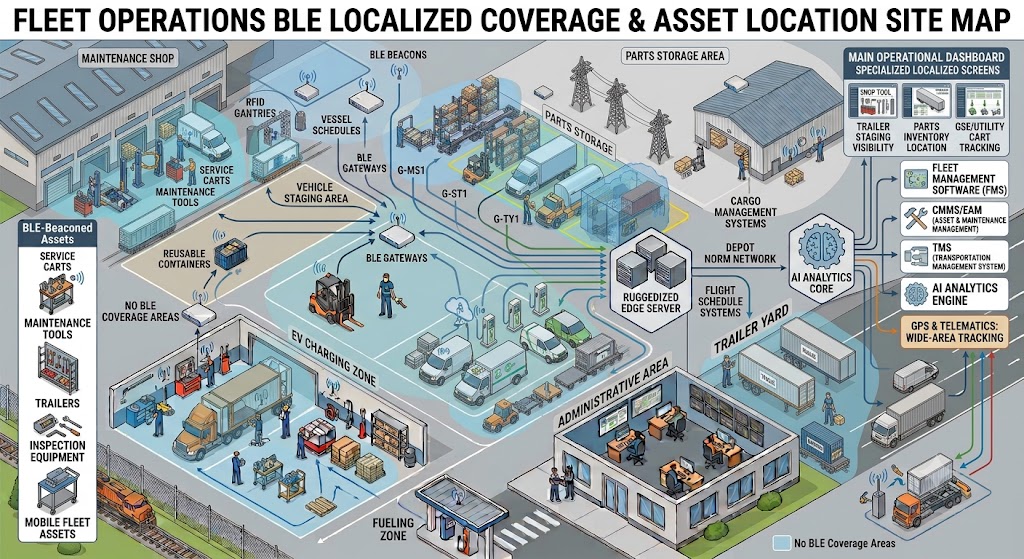
AI Use Cases That Improve Fleet Operations Performance
Predictive Vehicle Failure and Maintenance Risk
AI can combine engine data, diagnostic trouble codes, mileage, operating hours, maintenance history, inspection findings, temperature, battery information, and repair records to estimate failure risk.
Maintenance teams can prioritize vehicles based on predicted risk rather than relying exclusively on fixed maintenance intervals. This can help reduce unplanned roadside failures, improve shop scheduling, and allocate technicians and replacement parts more effectively.
Fleet Capacity and Utilization Forecasting
AI can analyze historical dispatch records, seasonal demand, vehicle classes, routes, delivery volumes, operating hours, and availability to forecast fleet capacity requirements.
The resulting forecasts can identify underutilized vehicles, potential capacity shortages, and opportunities to rebalance vehicles between depots. BLE can supplement these decisions by identifying selected assets present in specific facilities or staging zones.
AI Dispatch and Route Optimization
AI can evaluate orders, vehicle availability, driver constraints, traffic conditions, delivery windows, vehicle capabilities, route history, and operating costs. Dispatch recommendations can then account for changing conditions instead of relying solely on static schedules.
Route optimization can reduce unnecessary mileage, improve vehicle utilization, and support more predictable delivery operations.
Yard and Trailer Flow Optimization
AI can analyze trailer arrivals, departures, dwell times, loading activity, appointment schedules, yard capacity, and vehicle movements to identify congestion and inefficient staging.
BLE can provide localized presence information for selected trailers and yard equipment where zone-level detection is appropriate. Combining this information with TMS and yard management data can improve trailer assignment and reduce unnecessary searches.
Fuel and Energy Efficiency Optimization
AI can identify patterns in fuel consumption, idling, vehicle load, route selection, driving behavior, terrain, weather, and maintenance condition.
For electric fleets, similar analytics can evaluate charging demand, charging duration, vehicle schedules, battery state of charge, charger availability, and energy costs. These insights can support more efficient charging schedules and reduce charging conflicts.
EV Charging Demand Prediction
AI can forecast charging requirements based on vehicle schedules, battery capacity, route plans, state of charge, historical charging behavior, and expected operating demand.
Fleet managers can use these forecasts to coordinate charging station availability, vehicle dispatch, energy consumption, and charging windows. This is especially useful for depots where several electric vehicles compete for a limited number of charging points.
Fleet Asset Accountability
AI can combine asset master records, maintenance transactions, yard events, RFID reads, BLE presence events, GPS information, and operator activity to identify discrepancies.
Selected BLE-tagged tools and equipment can be associated with maintenance zones or vehicle service operations. This can reduce search time and improve accountability for mobile resources.
Safety and Driver Risk Analytics
AI can analyze harsh braking, acceleration, speeding, distraction indicators, fatigue-related patterns, inspection findings, collision events, and route conditions where such data is available.
Safety teams can identify recurring risk patterns and focus training, vehicle inspections, or operational changes where they are most needed.
Vehicle Lifecycle and Replacement Planning
AI can compare maintenance costs, downtime, mileage, age, utilization, fuel or energy consumption, repair frequency, and residual value indicators.
Fleet managers can use these insights to identify vehicles approaching economically unfavorable operating conditions and develop replacement schedules based on total operating performance rather than vehicle age alone.
Cybersecurity and Data Protection for Fleet Operations
AI-enabled fleet systems connect vehicles, gateways, sensors, software, servers, mobile devices, and enterprise applications. Security controls should therefore cover both the connected-device layer and the systems that consume fleet information.
Important controls include:
- Device identity and authentication for gateways, sensors, and connected equipment.
- Gateway hardening and removal of unnecessary services.
- Encryption for supported communications and protected data transfers.
- Network segmentation between connected fleet devices and critical enterprise systems.
- Least-privilege access for operators, administrators, vendors, and applications.
- Secure credential and certificate management.
- Controlled firmware and configuration updates.
- Centralized logging and security monitoring where appropriate.
- Integration with enterprise security monitoring or SIEM systems.
- Defined data retention and deletion policies.
- Access controls for fleet, driver, maintenance, and operational records.
- Cloud and private-server security governance.
- Backup, recovery, failover, and incident-response procedures.
- Regular review of connected-device inventory and software versions.
BLE asset sensing should be treated separately from vehicle cybersecurity controls. A BLE beacon identifying a service cart does not provide the same security function as authentication and protection for a vehicle ECU, telematics device, or fleet management application.
Organizations should evaluate applicable transportation, privacy, cybersecurity, contractual, and internal information-security requirements for their specific fleet operations rather than assuming that one security model applies to every deployment.
Deployment Lifecycle for Fleet Operations
Planning and Fleet Site Assessment
Deployment should begin with the operational problem rather than the hardware. Fleet teams should identify whether the priority is vehicle utilization, predictive maintenance, dispatch efficiency, yard congestion, trailer accountability, EV charging, mobile equipment visibility, or another measurable business requirement.
A site assessment should document fleet types, depots, yards, maintenance areas, network availability, existing software, asset identities, RF conditions, security requirements, and operating schedules.
Hardware Selection and Pilot
Hardware should be selected according to the workflow, environment, coverage requirement, power availability, installation constraints, and integration requirements.
A pilot should focus on a limited number of vehicles, assets, zones, or maintenance workflows. Baseline measurements should be captured before deployment so the organization can determine whether the solution produces measurable improvement.
Integration and System Testing
Testing should verify data flow between connected devices, gateways, edge systems, fleet management software, TMS, CMMS/EAM, yard systems, ERP, and AI applications.
Test scenarios should include normal operations, duplicate events, missing connectivity, incorrect asset mappings, gateway outages, delayed telemetry, vehicle movement, maintenance events, and high-volume operational periods.
Commissioning and Operational Validation
The system should be validated using real fleet workflows. Drivers, dispatchers, maintenance technicians, yard personnel, and fleet managers should confirm that events and recommendations correspond to actual operations.
Operational validation should include peak dispatch periods, vehicle arrivals and departures, maintenance shifts, loading operations, charging periods, and other conditions that could expose integration or coverage problems.
Optimization and Model Tuning
AI models require monitoring after deployment. Fleet conditions change as routes, vehicles, drivers, maintenance practices, seasons, and operating volumes change.
Model performance should be reviewed for false positives, false negatives, data drift, changing asset populations, and changes in operational behavior. Human review remains important for significant maintenance, dispatch, safety, and replacement decisions.
Maintenance and Device Lifecycle
Connected hardware requires its own lifecycle management. Fleet teams should track gateway availability, beacon battery status, sensor health, firmware versions, installation locations, device assignments, and replacement schedules.
Maintenance procedures should also cover damaged devices, reassignment of assets, retired vehicles, replaced trailers, and changes to depot layouts.
Scaling Across Depots and Fleet Regions
After a successful pilot, deployment can expand from one workflow to additional zones, vehicle groups, facilities, and regions. Standardized asset identifiers, integration methods, cybersecurity controls, installation procedures, and KPI definitions can simplify scaling across a distributed fleet.
KPIs for AI-Enabled Fleet Operations
Fleet organizations can measure AI and IoT deployments through operational, financial, maintenance, safety, and data-quality indicators such as:
- Fleet utilization rate
- Vehicle availability
- Vehicle downtime
- Unplanned maintenance events
- Preventive maintenance compliance
- Mean time to repair
- Maintenance cost per mile
- Fuel consumption per mile
- Energy consumption per mile
- Idle time
- Route completion rate
- On-time departure
- On-time delivery
- Dispatch response time
- Vehicle assignment accuracy
- Empty miles
- Trailer utilization
- Yard dwell time
- Yard congestion
- Asset recovery time
- Asset location accuracy
- EV charging utilization
- Charging queue time
- Battery state-of-health trend
- Driver safety event rate
- Inspection completion
- Defect recurrence
- Data completeness
- AI alert precision and false-positive rate
- Fleet software uptime
- BLE gateway availability
- Beacon and sensor battery life
These KPIs should be established before deployment whenever possible. Comparing baseline and post-deployment performance provides a stronger measure of business value than counting connected devices alone.
Practical Benefits of AI and BLE for Fleet Operations
AI can improve fleet operations when it converts fragmented operational data into timely decisions and measurable actions. BLE can strengthen selected workflows where local asset presence or condition information is useful.
Key benefits include:
- Improved vehicle availability through earlier identification of maintenance risks.
- Reduced unplanned downtime through predictive maintenance.
- Better fleet utilization through demand and capacity forecasting.
- Lower fuel and energy costs through route, idling, and operating analysis.
- Faster maintenance response through better prioritization and asset visibility.
- Improved dispatch accuracy through AI-assisted vehicle and route assignment.
- Better yard and trailer visibility through integrated location and presence information.
- Reduced search time for selected mobile maintenance tools and equipment.
- Improved EV charging coordination through demand prediction.
- Better driver safety insight through analysis of operational and behavioral data.
- More consistent multi-depot reporting through centralized analytics.
- Stronger operational traceability through integrated fleet, maintenance, yard, and asset records.
Implementation Recommendations for Fleet Operations
Fleet organizations should approach AI and BLE deployment as an operational improvement program rather than a hardware installation project.
- Lead with a measurable business problem such as downtime, utilization, dispatch performance, yard congestion, or charging demand.
- Define the authoritative system for every important fleet event and record.
- Use BLE only where localized presence, proximity, or condition sensing fits the workflow.
- Continue using GPS and telematics for wide-area vehicle location and vehicle operating data.
- Integrate with existing fleet management, TMS, CMMS/EAM, yard, ERP, fuel, and charging systems.
- Use edge processing where local latency, resilience, or intermittent connectivity requires it.
- Use cloud analytics for cross-depot reporting, historical analysis, and centralized AI model management.
- Include cybersecurity requirements from the pilot stage.
- Test BLE coverage under actual vehicle, trailer, equipment, and yard conditions.
- Establish data ownership, retention, access, and governance policies.
- Maintain a formal connected-device lifecycle process.
- Keep human supervision for significant maintenance, safety, dispatch, and fleet replacement decisions.
- Establish baseline KPIs before deployment and compare them with post-deployment performance.
- Scale from one high-value workflow to additional zones, depots, and fleet regions after operational validation.
GAO Engineering and Technology Support for Fleet Operations
GAO supplies BLE gateways, BLE beacons, BLE sensors, RFID products, and other IoT hardware systems that can support fleet operations and connected transportation workflows. We can help organizations evaluate connected-device requirements for depots, maintenance facilities, yards, selected vehicles, trailers, mobile equipment, and other fleet assets.
GAO is headquartered in New York City and Toronto, Canada, and has served customers in the United States and Canada for approximately three decades. Our experience includes work with Fortune 500 companies, leading R&D organizations, universities, and U.S. and Canadian government agencies. We invest heavily in R&D and maintain stringent quality-assurance processes for our technology products.
Our support can extend from hardware selection and deployment considerations to integration planning and technical troubleshooting. Remote and on-site expert support can help fleet organizations address practical installation, connectivity, device management, and operational requirements.
Building the Future of Industrial AI and IoT with Aperture Venture Studio and GAO RFID Inc.
For more than three decades, GAO has invested heavily in R&D involving industrial BLE, RFID, and IoT. As generative AI became useful for industrial applications, we expanded our work combining AI with connected technologies for practical fleet operations requirements. We founded Aperture Venture Studio to support AI and IoT solutions for vehicle utilization, predictive maintenance, dispatch optimization, yard management, and connected transportation workflows. Aperture brings together AI and IoT experts, operational leaders, investors, and leading companies. We also support technical discussion through Aperture Ventures Summit and TekSummit and welcome advisors, investors, and customers.