
AI and BLE for Food Retail Chains
AI-Driven Operations for Food Retail Chains
AI and BLE for Food Retail Chains combine artificial intelligence with low-power wireless sensing, location data, and connected store equipment to improve inventory visibility, cold-chain monitoring, asset utilization, replenishment, and operational decision-making. BLE gateways, beacons, and sensors provide frequent observations from refrigerated cases, storage areas, sales floors, receiving zones, and other operating locations. AI software can then analyze these observations alongside POS transactions, inventory records, maintenance data, staffing information, and external conditions to identify anomalies, forecast demand, prioritize replenishment, and support faster operational decisions. For food retail chains, this combination is particularly valuable because product freshness, temperature compliance, shelf availability, shrink, labor productivity,
and energy consumption are closely connected. GAO provides BLE hardware, RFID technologies, IoT products, and related systems that can be incorporated into food-retail monitoring and automation projects. Its existing food and beverage
retail solutions address operational equipment such as refrigeration units, freezers, walk-in coolers, ovens, grills, mixers, shelving, and storage equipment.
Integrated AI & BLE Sensing: Modernizing Food Retail Operations
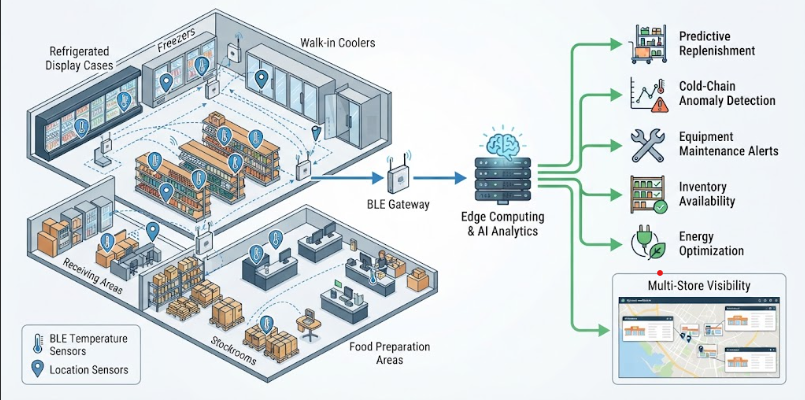
This illustration demonstrates how BLE temperature and location sensors, deployed throughout various zones of a modern grocery store (from freezers to receiving), transmit data via gateways to a central edge and AI analytics platform. The processed data then fuels actionable insights for predictive replenishment, cold-chain monitoring, maintenance, inventory, and energy optimization. The diagram emphasizes the interconnected workflow from physical sensing to intelligent business outcomes across multiple store locations.
Why AI Matters in Food Retail Chain Operations
Food retail chains operate with a combination of highly perishable inventory, distributed stores, frequent replenishment cycles, refrigeration equipment, strict food-safety procedures, and variable consumer demand. These conditions create a large volume of operational data but also make that data difficult to interpret manually.
AI changes the role of connected sensing by converting raw observations into operational predictions and prioritized actions. A temperature sensor can report that a refrigerated case has exceeded a threshold. An AI model can go further by determining whether the deviation resembles a temporary door-opening event, a recurring equipment problem, an overloaded case, or an emerging refrigeration failure.
The same principle applies to inventory. Store-level inventory systems can report stock quantities, while BLE-enabled sensing can provide contextual information about where equipment, mobile carts, containers, or other tagged assets are located. AI can combine these observations with POS demand, historical sales, promotions, seasonality, delivery schedules, and replenishment records to identify stores or departments that require attention.
For food retail chains, practical AI applications include:
- Predictiveinventory replenishment for high-volume and perishable products
- Demandforecasting by store, department, SKU category, day, and time period
- Cold-chainanomaly detection for refrigerated cases, freezers, and storage rooms
- Predictivemaintenance for refrigeration and food-preparation equipment
- Shelfand stockroom activity analysis
- Assetutilization and location monitoring
- Foodwaste prediction and reduction
- Energyoptimization for refrigeration, HVAC, and lighting
- Laborand task prioritization
- Detectionof abnormal operating conditions
- Store-leveloperational performance analysis
- Supportfor food traceability and recall investigations
The engineering objective is not simply to collect more sensor data. The objective is to establish reliable data pipelines in which relevant observations reach the right software system with sufficient accuracy, timing, and context to support a measurable business action.
Food Retail Applications Where AI Delivers the Most Value
AI-Powered Inventory and Replenishment
Food retail inventory changes continuously. Receiving teams unload deliveries, stock clerks replenish shelves, customers remove products, returns occur, damaged merchandise is recorded, and perishables move through limited shelf-life windows.
AI-based inventory management can combine POS transactions, inventory databases, historical demand, promotion schedules, delivery information, and
BLE-generated operational data. The resulting model can identify unusual demand patterns and recommend where store personnel should concentrate replenishment activities.
BLE is particularly useful when the business needs location or condition information that conventional transactional systems cannot provide. BLE beacons can establish location references, while BLE gateways collect nearby beacon and sensor transmissions. BLE sensors can additionally report conditions such as temperature or vibration where appropriate.
For example, a food retail chain could associate a temperature sensor with a refrigerated storage location and combine its telemetry with inventory records. AI software could identify products potentially exposed to abnormal conditions and prioritize inspection rather than treating every temperature event as an emergency.
Cold-Chain Monitoring and Food Safety
Cold-chain management is one of the strongest applications for AI-enabled sensing in food retail because temperature deviations can affect product quality, food safety, waste, and operating costs.
Food retail environments may include:
- Walk-inrefrigerators
- Walk-infreezers
- Refrigerated displaycases
- Frozenfood cases
- Dairycoolers
- Meatand seafood display cases
- Beveragecoolers
- Prepared-foodrefrigeration
- Receiving-areacold storage
- Temporaryholding areas
BLE temperature sensors can transmit periodic measurements through nearby gateways. The data can be forwarded to edge or cloud software for storage, visualization, alerting, and analysis.
AI adds another layer by identifying patterns rather than relying exclusively on fixed thresholds. A model can learn normal temperature behavior for a particular case, location, operating schedule, or equipment type. Deviations can then be ranked according to severity and probable operational cause.
This approach can reduce unnecessary alerts while helping maintenance and store personnel respond to potentially significant events earlier.
End-to-End Cold-Chain AI Workflow: From Sensing to Action
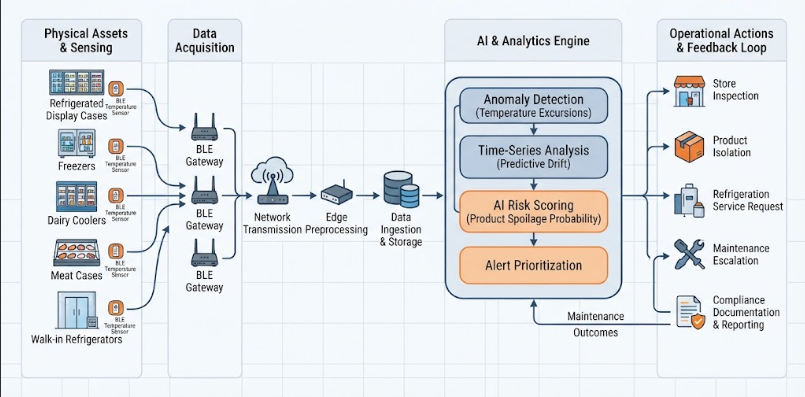
This technical diagram illustrates the complete workflow of an AI-powered cold-chain monitoring system for grocery stores. It shows the journey from physical BLE temperature sensors in refrigeration units through data acquisition, ingestion, and storage. A central AI engine performs anomaly detection and risk scoring to prioritize alerts, leading to specific operational actions like product isolation or maintenance. A feedback loop from these actions is also included to continuously improve the AI models.
Predictive Maintenance for Refrigeration Equipment
Refrigeration failures can cause product loss and disrupt store operations. Preventive maintenance schedules help, but calendar-based maintenance does not necessarily reflect the actual condition of equipment.
AI can analyze sensor readings and maintenance history to identify early indicators of abnormal behavior. Depending on the available sensing hardware,
useful signals may include temperature trends, vibration, operating cycles, environmental conditions, and equipment status.
BLE-connected sensors can provide low-power telemetry from distributed equipment. The AI system can compare current behavior with historical operating patterns and generate maintenance priorities.
A practical deployment should avoid treating every anomaly as a confirmed equipment failure. Instead, AI outputs should normally be treated as decision support, with configurable thresholds, confidence scores, technician verification, and maintenance records used to improve future predictions.
Food Waste Reduction
Food waste is influenced by demand variability, expiration dates, temperature exposure, over-ordering, damaged products, promotions, and store-specific purchasing behavior.
AI can estimate waste risk by combining inventory levels with sales velocity, product category, remaining shelf life, temperature history, promotions, and historical waste records.
BLE sensing can contribute contextual information about storage conditions and the location of monitored assets. When this information is connected with inventory and POS systems, food retail operators can move from simple historical reporting toward predictive waste management.
The resulting recommendations may include adjusting replenishment quantities, accelerating markdown decisions, transferring products between locations, changing ordering parameters, or investigating recurring storage problems.
From Store Sensors to AI-Driven Decisions
A practical AI and BLE solution for a food retail chain should be designed as a complete operational data flow rather than as an isolated sensor deployment.
Data Acquisition at the Store Level
The first stage consists of collecting observations from physical store operations. BLE sensors and beacons can be deployed according to the operational problem rather than simply covering every available location.
Typical data sources include:
- BLEtemperature sensors in refrigeration and cold-storage areas
- BLEbeacons attached to mobile or movable operational assets
- BLE-enabledcondition sensors
- BLElocation references around departments and stockrooms
- POStransaction systems
- Inventorymanagement software
- Storereceiving systems
- Maintenanceand CMMS records
- Workforce andtask-management systems
- Energy-managementsystems
- ExistingRFID and barcode infrastructure
The selection of sensor placement is important. Refrigerated equipment may have different temperature gradients, airflow patterns, door-opening frequencies, and operating cycles. A sensor positioned incorrectly can produce data that appears precise but does not accurately represent the condition that the retailer needs to monitor.
BLE Gateways and Store Connectivity
BLE gateways collect transmissions from nearby BLE sensors and beacons and forward relevant information to downstream software. Depending on the gateway design and store infrastructure, connectivity may use Ethernet, Wi-Fi, cellular networking, or another supported network connection.
Gateway placement should account for:
- Storefloor layout
- Refrigerationequipment construction
- Metalshelving and racks
- Wallsand cold-room structures
- Radiointerference
- Gatewaycoverage
- Networkavailability
- Poweravailability
- Maintenanceaccessibility
Food retail stores contain many materials and electrical devices that can influence wireless propagation. A deployment therefore benefits from a site survey and commissioning process rather than relying solely on theoretical radio range.
Edge Processing and Data Normalization
Edge processing can reduce unnecessary network traffic and provide faster responses for selected applications. A gateway or local computing device can validate incoming measurements, remove malformed records, attach timestamps, normalize device identifiers, and temporarily buffer data during network interruptions.
For a distributed food retail chain, local buffering is particularly important. A temporary WAN outage should not automatically result in permanent loss of refrigeration telemetry.
Normalized data can then be forwarded to centralized software using suitable protocols such as MQTT or HTTPS, depending on the system design and integration requirements. Existing GAO food-retail materials identify MQTT, HTTP/HTTPS, Bluetooth-related standards, OPC UA, and other communication technologies among relevant technologies for connected retail deployments.
Enterprise IoT Data-Flow Diagram: Food Retail Chain AI Integration
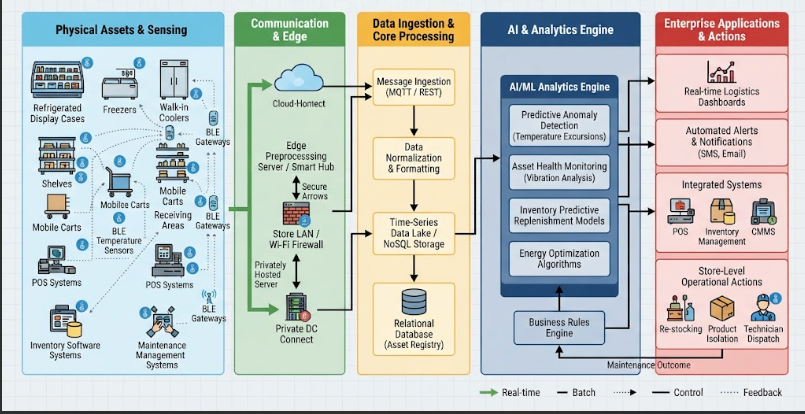
This comprehensive data-flow diagram illustrates the journey of IoT data from physical assets like refrigerated cases and sensors in a food retail chain. The data travels through BLE gateways and edge processing to a central cloud or private data center. The core AI and analytics engine processes this data to provide predictive insights, which are then visualized on dashboards and integrated into enterprise systems (POS, CMMS) to drive automated store-level actions.
Deployment Models for Food Retail Chains
Cloud Version
A cloud-hosted deployment is suitable for food retail chains that need centralized visibility across many stores and want common software management across geographically distributed locations.
The cloud environment can receive telemetry from multiple stores, maintain centralized device and location records, run AI models, aggregate store-level KPIs, and provide role-based dashboards.
Cloud deployment is particularly useful when the retailer requires:
- Centralizedmonitoring across many locations
- Cross-storeAI analysis
- Centralizedmodel management
- Remotedevice monitoring
- Fleet-widereporting
- Scalabledata storage
- Integrationwith cloud-hosted business software
- Remoteoperational support
The cloud does not eliminate the need for local processing. Store-level gateways can continue to perform data validation, buffering, and selected event processing so that important operations remain resilient during connectivity interruptions.
Server Version
A server deployment places the software on customer-managed infrastructure such as an edge server, private data center, store server, or other privately hosted enterprise infrastructure.
This model can be appropriate when food retail chains require greater control
over data location, network connectivity, system integration, or internal IT policies. A privately hosted deployment may be preferred where:
- Storeconnectivity is unreliable
- Sensitiveoperational data must remain within controlled infrastructure
- Existingretail software runs on private servers
- TheIT department requires direct infrastructure management
- Localprocessing is important for operational continuity
- Integrationwith legacy store systems is required
- Corporatecybersecurity policies restrict certain cloud services
GAO’s existing food and beverage retail material describes both local-server and cloud software deployment models, allowing the deployment approach to be matched to customer requirements rather than treating one model as universally appropriate.
AI, BLE Hardware, and Software Components
A food retail AI solution normally contains several coordinated technical layers. BLE is one enabling layer, while AI, enterprise software, networking, and operational processes determine the final value.
Component Food Retail Function
BLE temperature sensors Monitor refrigerated and frozen storage conditions
BLE beacons Provide location references for stores, departments, fixtures, or assets
BLE gateways Collect nearby BLE transmissions and forward data
Edge server or gateway processor
Validate, buffer, normalize, and optionally process data locally
Cloud or private server Store telemetry and operational records Time-series database Maintain historical sensor measurements
AI/ML models Detect anomalies, forecast conditions, and prioritize actions Rules engine Apply food-retail thresholds and operational policies
POS integration Connect demand and transaction information Inventory integration Relate sensor observations to stock and replenishment CMMS integration Convert maintenance indicators into service workflows
Dashboard software Present store, department, equipment, and KPI information APIs Exchange data with existing retail applications
GAO’s BLE offering includes gateways and beacons designed for connected sensing applications, while its broader food-retail material identifies BLE gateways, BLE tags/beacons, software, cloud services, RFID readers, and RFID tags as components that can be combined according to the application.
The most effective implementation therefore begins with the operational question, such as “Which refrigeration units are developing abnormal behavior?” or “Which stores are at increased risk of stockout or waste?” The engineering team can then determine which measurements, BLE devices, integrations, AI models, and software workflows are actually necessary.
Deployment Model Comparison: AI-Enabled Food Retail Monitoring
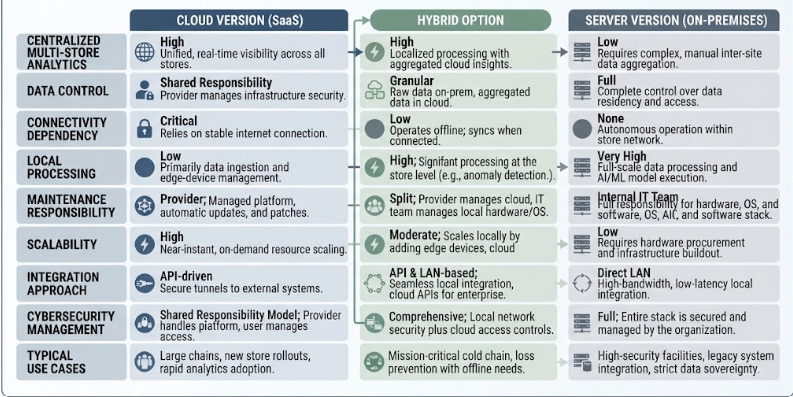
This comparison infographic evaluates Cloud (SaaS), Hybrid, and Server (On-Premises) deployment models for AI-enabled food retail monitoring across criteria like analytics, data control, and connectivity. It highlights how cloud models offer high centralized visibility and scalability, on-premises servers provide full data control and autonomous operation, and the hybrid option balances localized edge processing with cloud insights.
Engineering Considerations Before a Multi-Store Deployment
A successful food retail deployment requires more than selecting sensors and installing gateways. The design should account for store construction, refrigeration equipment, network topology, power availability, device maintenance, data quality, cybersecurity, and integration with existing retail software.
A useful deployment process begins with a representative pilot store. The pilot should contain the types of equipment and operating conditions expected across the broader chain. Engineers can then evaluate BLE coverage, sensor placement, gateway density, network reliability, battery behavior, data latency, alert accuracy, and integration performance before expanding to additional locations.
Key engineering checks include:
- Confirmthe required measurement accuracy and sampling interval for each application
- Identifythe physical mounting position for every monitored sensor
- ConductBLE coverage testing around refrigeration equipment and storage areas
- Measurewireless interference and attenuation caused by metal equipment and shelving
- Validategateway backhaul connectivity
- Definelocal data buffering requirements
- Establishdevice identity and asset-location relationships
- Testtime synchronization across gateways and servers
- Definealarm severity and escalation rules
- ValidateAPI integration with POS, inventory, CMMS, and other systems
- Establishbattery replacement and sensor maintenance procedures
- Testoperation during network outages
- Establishrole-based access controls
- Encryptdata during network transmission
- Maintaindevice inventory and firmware records
- Definedata retention and audit requirements
- Establishprocedures for false-positive investigation
- ValidateAI recommendations against store personnel decisions
The pilot should measure operational KPIs rather than simply proving that sensor data can be displayed. Relevant measurements may include refrigeration incident response time, temperature excursion duration, food waste, stockout frequency, replenishment time, maintenance response time, asset utilization, energy consumption, and false-alert rate.
AI Models for Food Retail Chain Decision Support
The value of AI in food retail chains depends on selecting models that match the operational decision being made. A temperature-monitoring application may require time-series anomaly detection, while replenishment planning may depend on demand forecasting and classification models. A single AI model should not be expected to solve every store operation.
Demand Forecasting and Inventory Optimization
Demand forecasting models can evaluate historical POS transactions together with seasonality, promotions, holidays, local demand patterns, delivery schedules, and store-level inventory information. Machine learning can identify relationships that are difficult to capture with static reorder rules.
For perishable products, the model should consider both expected demand and the cost of excess inventory. A forecast that improves sales availability but increases spoilage may not improve the retailer’s overall result.
BLE-generated operational information can provide additional context, particularly when location or environmental conditions influence inventory handling. The AI system can therefore combine transactional and physical-world data rather than treating inventory as a purely database-based problem.
Anomaly Detection for Refrigeration and Store Equipment
Anomaly detection is particularly suitable for food retail equipment because normal operating patterns can vary by store, equipment type, time of day, and environmental conditions.
A model can establish a baseline from historical observations and flag deviations that deserve investigation. For example, a gradual change in the temperature profile of a freezer may be more significant than a short temperature increase caused by routine door opening.
AI-generated alerts should include sufficient context for store personnel or maintenance technicians to act. Useful information can include:
- Equipmentor location identifier
- Currentand historical readings
- Durationof the abnormal condition
- Severityscore
- Previousrelated incidents
- Possiblecontributing conditions
- Recommendedinspection priority
- Associatedinventory or product information
Predictive Maintenance and Failure Risk
Predictive maintenance models can estimate the likelihood of equipment problems based on historical sensor readings, service records, operating cycles, and previous failures.
A practical implementation should connect predictions to a maintenance workflow. An alert that never reaches a technician does not create operational value.
Integration with a CMMS or maintenance-management system can create a service request, assign a priority, associate the affected equipment, and retain the technician’s findings. Those findings can subsequently become training or validation data for the AI system.
Integrating AI with Food Retail Software
AI-enabled sensing should complement existing retail software rather than create another isolated information source. Integration is therefore a central engineering consideration.
POS and Inventory Systems
POS data provides actual sales behavior, while inventory software provides recorded stock levels, purchase orders, transfers, receiving information, and replenishment status.
Combining these records with sensor-derived information can improve the context available to AI models. For example, an apparent inventory anomaly can be evaluated against recent sales, receiving activity, and store-level operational conditions before generating an exception.
CMMS and Maintenance Systems
Maintenance integration allows refrigeration and equipment anomalies to become actionable service events. The integration should preserve equipment identifiers across the BLE system and maintenance database.
This requires consistent asset naming and identity management. If the BLE system identifies a freezer by one identifier while the CMMS uses another, automated workflows can produce incorrect assignments.
ERP, WMS, and Supply Chain Systems
Larger food retail chains may connect AI systems with ERP, warehouse management, transportation, procurement, and supplier systems.
This can support broader decisions such as:
- Adjustingreplenishment quantities
- Prioritizingstore deliveries
- Identifyingdistribution bottlenecks
- Investigatingrecurring receiving problems
- Evaluatingsupplier-related temperature incidents
- Coordinatinginventory transfers
- Improvingpurchase-order planning
APIs, message brokers, database integration, and standardized data models can be used according to the retailer’s existing IT environment.
Enterprise Integration Diagram: AI-Enabled Food Retail Ecosystem
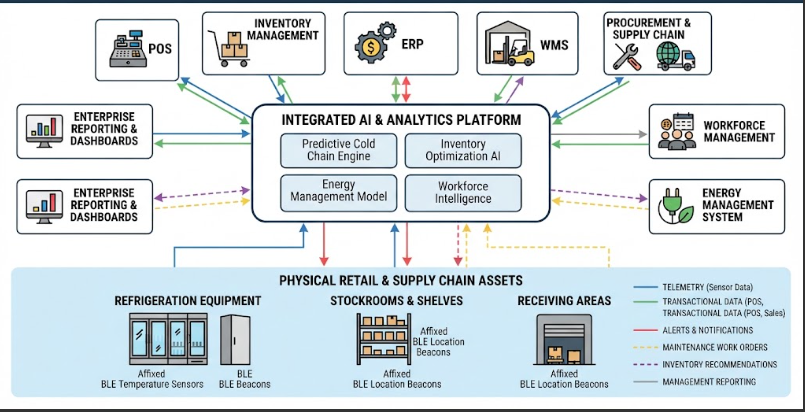
This technical diagram illustrates the central role of an AI and analytics platform in connecting diverse physical retail assets with core enterprise software systems. It shows bidirectional data flows—distinguishing telemetry, transactional data, alerts, and recommendations—between the AI hub and applications like POS, inventory, ERP, and CMMS. The visual demonstrates how real-time intelligence from sensors and beacons is integrated into operations to optimize cold chains, stock levels, energy use, and workforce management.
Cybersecurity and Data Governance for Food Retail IoT
Food retail chains should treat connected sensors and gateways as part of the organization’s technology environment rather than as standalone monitoring devices.
Security controls should begin at device provisioning and continue through communications, software access, data storage, maintenance, and decommissioning.
Important controls include:
- Uniquedevice identities
- Securedevice provisioning
- Strongauthentication
- Encryptedcommunications
- Role-basedaccess control
- Networksegmentation
- Securegateway configuration
- Firmwareand software update procedures
- Credentialrotation
- Centralizedlogging
- Audittrails
- Data-retentionpolicies
- Backupand recovery procedures
- Monitoringfor unauthorized devices
- Securedevice retirement
Network segmentation is particularly useful when gateways share connectivity with existing store systems. Separating IoT traffic from critical business systems can limit the potential impact of a compromised device.
AI systems also require data governance. Training data should be evaluated for missing values, incorrect timestamps, sensor drift, duplicate records, and
inconsistent asset identifiers. Poor data quality can produce apparently sophisticated AI outputs that are operationally unreliable.
Human review remains important for safety-sensitive decisions. An AI model should support food retail personnel and maintenance teams rather than automatically overriding established food-safety procedures.
Scaling from One Pilot Store to a Food Retail Chain
Multi-store expansion should be controlled through repeatable deployment procedures.
A representative pilot can first establish technical feasibility. The next stage should validate the installation process, device configuration, software integration, operational workflows, and support requirements.
A scalable rollout typically includes:
- Sitesurvey and store classification
- Equipmentand asset inventory
- Sensorand gateway placement design
- Deviceprovisioning
- Networkconfiguration
- Installationand commissioning
- Connectivityverification
- Data-qualityvalidation
- Softwareintegration testing
- AImodel validation
- Storepersonnel training
- Operationalacceptance testing
- Monitoringand support
- Performancereview
- Controlledexpansion to additional stores
Store classification can reduce deployment complexity. A small urban store, large supermarket, warehouse-style grocery location, and food-service-oriented retail
site may require different gateway densities, sensor quantities, network arrangements, and operational workflows.
GAO can support organizations that require BLE, RFID, and IoT hardware and systems for these types of connected applications, with experience supplying technology to organizations in the U.S. and Canada. GAO Group companies have served Fortune 500 companies, R&D organizations, universities, and government agencies and maintain quality-assurance and technical-support processes for their products and systems.
Measuring AI and BLE Performance in Food Retail Chains
Technology deployment should be evaluated using operational measurements rather than device counts alone.
| KPI | What It Measures | Potential AI Contribution |
| Temperature excursion duration | Time outside defined temperature conditions | Anomaly detection and early warning |
| Mean response time | Speed of response to equipment incidents | Alert prioritization |
| Refrigeration failure rate | Frequency of equipment failures | Predictive maintenance |
| Food waste rate | Product discarded relative to inventory or sales | Waste-risk prediction |
| Stockout rate | Frequency of unavailable products | Demand forecasting |
| Inventory accuracy | Difference between recorded and actual inventory | Anomaly identification |
| Replenishment time | Time required to restore shelf availability | Task prioritization |
| False-alert rate | Percentage of alerts requiring no action | Model optimization |
| Asset utilization | Use of mobile or operational equipment | Location analytics |
| Energy consumption | Energy used by stores or equipment | AI-based optimization |
| Maintenance cost | Cost associated with equipment servicing | Failure prediction |
| Forecast accuracy | Difference between predicted and actual demand | ML model evaluation |
The most meaningful KPI should be connected to the original business problem. If the purpose of a refrigeration deployment is reducing product loss, sensor uptime
alone is insufficient. The project should also measure temperature incidents, response times, product disposition, waste, and maintenance outcomes.
AI models should be monitored after deployment because store conditions change. New refrigeration equipment, changed operating schedules, promotions, store remodeling, seasonal weather, and different customer behavior can alter the data distribution.
Practical Implementation Recommendations
Successful food retail AI deployments generally result from disciplined engineering rather than simply adding more sensors or more sophisticated models.
Recommended practices include:
- Beginwith a clearly defined operational problem and measurable KPI
- Selectsensors based on measurement requirements rather than device availability
- Performa physical site survey before determining gateway locations
- TestBLE performance around metal refrigeration equipment and shelving
- Maintainconsistent device, equipment, and location identifiers
- Uselocal buffering where network interruptions could cause unacceptable data loss
- Separatesafety-critical rules from experimental AI recommendations
- IntegrateAI alerts with existing maintenance and store workflows
- ValidateAI predictions against real store outcomes
- Establishprocedures for sensor calibration and battery replacement
- Monitormodel performance after deployment
- Protectgateways and sensors using appropriate network and authentication controls
- Pilotrepresentative stores before chain-wide deployment
- Standardizeinstallation and commissioning procedures
- Documentsystem interfaces and data ownership
- Designfor future integration with RFID, barcode, POS, ERP, WMS, and CMMS systems
A hybrid approach can be particularly useful. Local edge processing can provide resilient collection and rapid event handling, while centralized cloud or private-server software can perform broader analytics and cross-store comparisons.
Business Value of AI-Enabled Food Retail Monitoring
Combining AI with connected sensing can improve several food retail processes simultaneously because the same operational data can serve multiple applications.
Better Product Availability
Demand forecasting and operational alerts can help store teams prioritize replenishment and reduce avoidable stockouts.
Lower Food Waste
AI can identify products and locations associated with elevated waste risk by combining sales, inventory, environmental, and historical waste information.
Faster Equipment Response
Anomaly detection can identify unusual refrigeration behavior before a complete equipment failure, giving maintenance teams additional time to investigate.
Improved Operational Visibility
Centralized analytics can allow managers to compare stores, departments, equipment groups, and operating conditions using consistent measurements.
More Efficient Use of Store Resources
AI-generated priorities can help personnel focus on exceptions rather than manually reviewing every sensor reading or operational record.
Scalable Multi-Store Operations
Standardized BLE sensing and software integration can provide a repeatable foundation for expanding monitoring from a pilot location to larger groups of stores.
GAO Expertise in BLE, RFID, and Connected Food Retail Solutions
GAO is headquartered in New York City and Toronto, Canada, and is recognized among leading B2B and B2G suppliers of BLE and RFID technologies. GAO and its sister companies, GAO Research Inc. and GAO Tek Inc., form the GAO Group, with operations based in New York City and Toronto.
For food retail chains, this technical background is relevant because large deployments frequently require more than an individual sensor. They may involve BLE gateways, beacons, sensors, RFID equipment, networking components, software, integration services, and technical support.
GAO has invested substantially in research and development of BLE, RFID, and IoT products and systems. Its customers in the U.S. and Canada include Fortune 500 companies, leading R&D organizations, universities, and government agencies.
Quality assurance and technical support are important parts of the delivery process, including remote and onsite support where required.
Food retail organizations evaluating AI-enabled monitoring can therefore approach the deployment as an engineering project that combines physical sensing, communications, software, AI analytics, and operational integration.
AI-Enabled Food Retail Use-Case Matrix
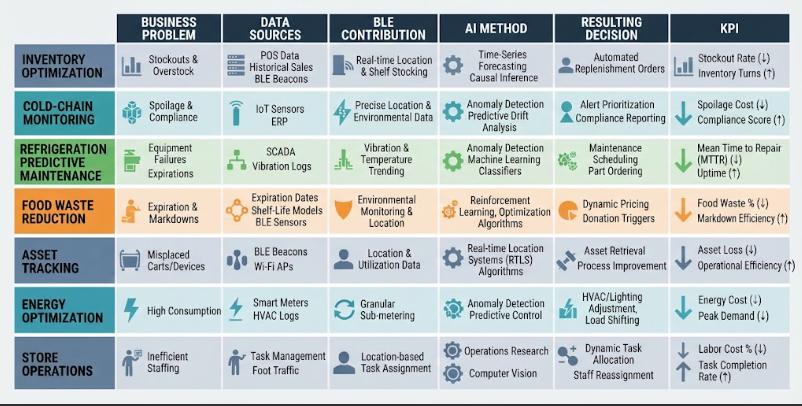
This matrix maps core food retail challenges—such as inventory management, cold-chain monitoring, and predictive maintenance—to their corresponding data sources, BLE contributions, and AI methods. It outlines how advanced analytics translate sensor data into actionable operational decisions and measurable KPIs. The comprehensive overview serves as a strategic guide for deploying AI solutions across grocery environments.
Building an AI-Enabled Food Retail Operating Model
AI and BLE should be evaluated as complementary parts of a broader food retail information system. BLE provides a practical method for collecting location and condition observations from physical environments, while AI determines how those observations can support forecasting, anomaly detection, prioritization, and operational decisions.
The strongest implementations connect physical measurements with the systems that already control store operations. Temperature observations become more
valuable when connected with equipment records and maintenance workflows. Inventory signals become more useful when combined with POS demand and replenishment information. Asset location becomes more actionable when linked to store tasks and operational schedules.
GAO can help organizations evaluate BLE, RFID, and IoT hardware and system requirements according to the physical environment, connectivity requirements, software integration needs, and intended operational outcomes. Organizations can learn more about GAO’s relevant technologies, products, and technical support when planning food retail monitoring and AI-enabled IoT projects.
Building the Future of Industrial AI and IoT with Aperture Venture Studio and GAO RFID Inc.
For more than three decades, GAO Group of Companies has invested heavily in R&D of industrial BLE, RFID, and IoT. As AI became increasingly useful for industrial applications, we expanded our work in AI and IoT, including BLE and RFID, and founded Aperture Venture Studio to advance practical AI and IoT solutions for industries such as food retail and connected commerce.
Aperture has attracted AI and IoT technical experts, entrepreneurial and operational executives, investors, and leading companies. We have also developed Aperture Ventures Summit and TekSummit to discuss advanced AI and IoT topics. We welcome you to join us as:
- Advisors,Co-founders, or Employees
- Investors
- Customers