
AI and BLE for Footwear Production
AI-Driven Footwear Production with BLE
Artificial intelligence is transforming footwear production by helping manufacturers improve material availability, production scheduling, work-in-process visibility, quality control, and finished-goods inventory management. AI-driven asset tracking and inventory intelligence can connect footwear materials, production equipment, work orders, and warehouse operations to more timely operational decisions.
GAO supports these applications with BLE Gateways, BLE Beacons, and BLE Sensors that capture location, movement, and environmental information across footwear manufacturing facilities. AI and IoT systems can analyze this information alongside manufacturing and business data to identify material delays, production bottlenecks, equipment problems, and inventory discrepancies.
For footwear manufacturers, the value of AI-enabled BLE tracking is not simply knowing where an item is. It is using reliable operational data to help determine what needs attention, why a workflow is delayed, and which action can improve production performance.
AI-Driven Footwear Production Workflow with BLE and AIoT
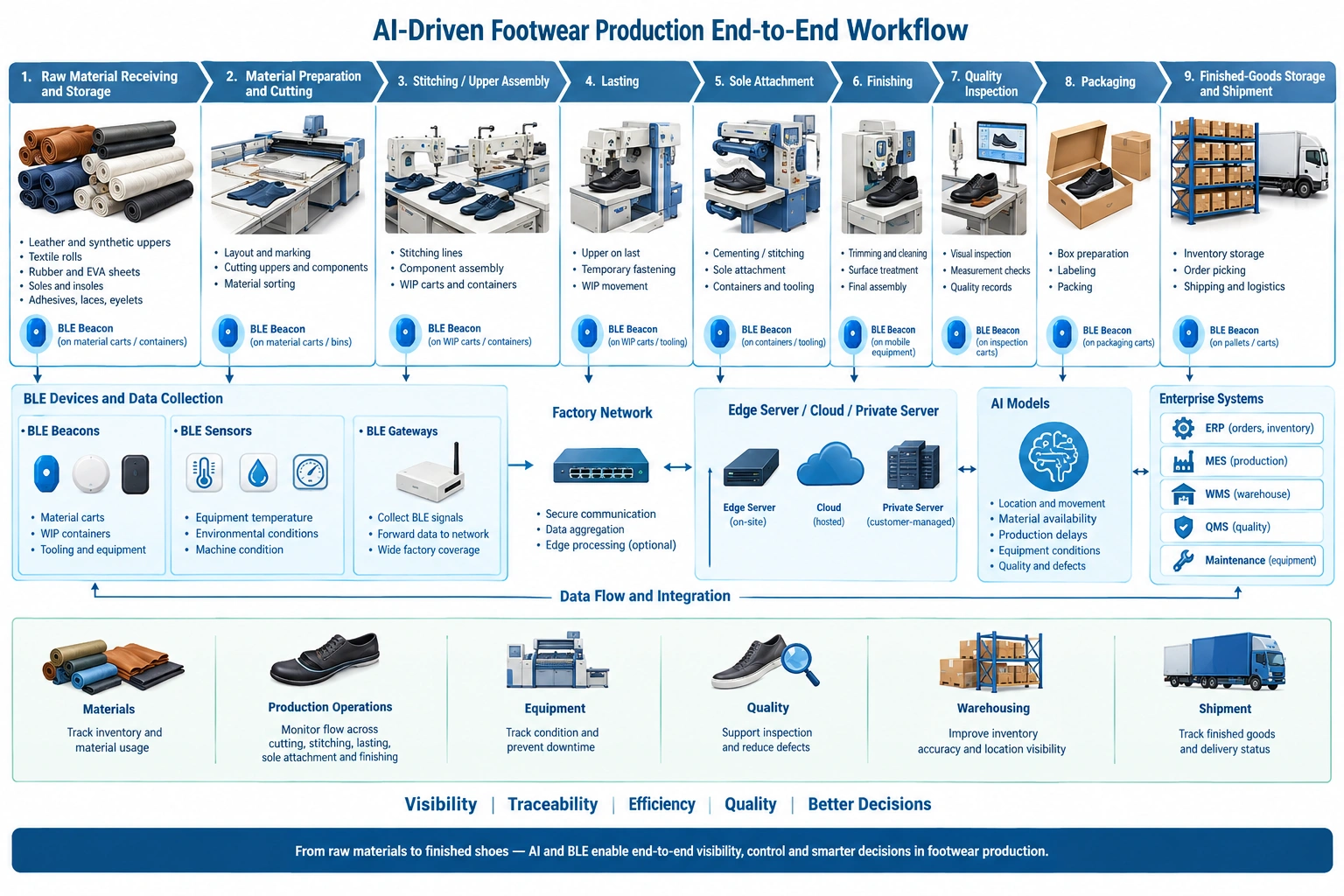
This infographic illustrates an end-to-end footwear manufacturing workflow, from raw material receiving and cutting through stitching, lasting, sole attachment, finishing, quality inspection, packaging, and shipment. It shows how BLE Beacons, BLE Sensors, and BLE Gateways connect production assets to AI analytics, edge or cloud software, and enterprise systems. The visual highlights how AI-supported data collection improves material visibility, production coordination, equipment monitoring, quality management, and finished-goods tracking.
How AI Is Transforming Footwear Manufacturing Operations
AI-driven footwear production combines artificial intelligence with connected manufacturing equipment, IoT sensors, operational data, and enterprise software. This approach is commonly called AIoT, or Artificial Intelligence of Things.
For footwear manufacturers, AIoT can support decisions across the production lifecycle:
- AI material tracking: Identify where upper materials, sole components, adhesives, and work-in-process items are located and whether they are available for the next production step.
- AI inventory management: Analyze material movements, consumption, replenishment requirements, and stock discrepancies across raw material stores, production areas, and finished-goods warehouses.
- AI production scheduling: Use production status, material readiness, equipment availability, and work-order information to support better scheduling decisions.
- AI predictive maintenance: Analyze equipment sensor readings, operating patterns, and maintenance history to identify potential equipment problems before they cause unexpected downtime.
- AI quality management: Combine inspection records, process data, and equipment conditions to help identify recurring quality issues and investigate their causes.
- AI warehouse management: Improve visibility into footwear components, production batches, packed cartons, and finished-goods movement between storage and dispatch.
BLE is an enabling technology in these solutions. It supplies location, presence, movement, and sensor information that AI models can use alongside other manufacturing data.
Why Footwear Production Needs AI-Enabled Visibility
Footwear manufacturing involves multiple material types, specialized production steps, and frequent movement of work-in-process between departments. A production order may depend on the timely availability of upper materials, soles, insoles, adhesives, laces, and other components.
Operational problems can arise when:
- Materials are physically available but their location is unknown.
- Cut components wait too long before stitching.
- Stitched uppers are not delivered to lasting on time.
- Soles or adhesives are unavailable at the required workstation.
- Production carts remain in the wrong department.
- Equipment downtime disrupts stitching, cutting, lasting, or sole attachment.
- Finished footwear cartons are misplaced or delayed in the warehouse.
AI-supported tracking can help identify these conditions using data from connected assets, production systems, and operational workflows. The objective is to support earlier intervention and better coordination between production, warehouse, quality, and maintenance teams.
Footwear Production Applications for AI and BLE
AI-enabled BLE tracking is most useful when it addresses a specific footwear manufacturing problem. The following applications connect AI methods with the physical materials, production workflows, and business systems used by footwear manufacturers.
AI Raw Material and Component Tracking
Footwear production depends on the timely availability of diverse materials and components. These include leather, synthetic leather, mesh, textile uppers, rubber, EVA, polyurethane, insoles, adhesives, laces, eyelets, and other shoe components.
AI-supported material tracking can help manufacturers:
- Identify the location of material carts, reusable containers, and selected component batches.
- Monitor the movement of materials from receiving to raw material storage and production staging.
- Detect unusual material dwell times or repeated movements between departments.
- Compare expected material availability with actual production requirements.
- Support replenishment decisions when components are approaching a shortage.
- Investigate material shortages that may cause production orders to wait.
BLE Beacons can be attached to selected reusable carts, bins, and containers. BLE Gateways collect beacon signals at defined areas, while AI software analyzes movement and location data. Where exact positioning is required, the manufacturer should validate gateway placement, signal coverage, and location accuracy for the facility’s physical conditions.
AI Cutting and Material Preparation
Cutting departments transform leather, synthetic materials, textile rolls, and other sheet materials into upper components and other shoe parts. Material staging, cutting schedules, and component availability directly affect downstream stitching and assembly.
AI can support cutting operations by analyzing:
- Material availability and production order requirements.
- Cutting machine utilization and production queues.
- Material staging delays.
- Work-in-process movement between cutting and stitching.
- Repeated material handling or unplanned waiting.
- Equipment downtime and maintenance records.
BLE tracking can provide visibility into tagged material carts, reusable containers, and selected equipment. AI models can combine this information with cutting schedules and MES data to help production managers identify bottlenecks.
Engineering consideration: BLE location data should not be treated as a substitute for material traceability. Where batch, lot, color, size, or material composition matters, the system should integrate with ERP, MES, or a suitable inventory database to associate physical items with their actual material identities.
AI Stitching and Upper Assembly Management
Stitching and upper assembly involve multiple operations, including sewing, joining, reinforcement, and preparation for lasting. Work-in-process can accumulate when stitching capacity does not match cutting output or when required materials are not available.
AI-driven production visibility can help identify:
- Work-in-process waiting between cutting and stitching.
- Delays in moving stitched uppers to the next operation.
- Sewing machine downtime and utilization patterns.
- Production queues that exceed planned processing time.
- Repeated movement of carts between stitching lines.
- Material shortages affecting particular styles or production orders.
BLE Beacons on selected WIP carts can help capture movement between production areas. AI software can use this data alongside MES work-order information to identify unusual dwell times and support production coordination.
AI Lasting, Sole Attachment, and Finishing
Lasting, sole attachment, and finishing are important footwear production stages where material readiness, machine availability, and process timing can affect output.
Relevant AI applications include:
- Detecting production delays caused by missing uppers, soles, insoles, or adhesives.
- Analyzing machine utilization and downtime.
- Supporting maintenance planning for lasting and sole attachment equipment.
- Monitoring the movement of WIP carts between assembly and finishing.
- Identifying recurring delays before quality inspection.
- Comparing planned and actual production cycle times.
BLE Sensors may be useful for monitoring selected equipment conditions, such as temperature or other supported environmental parameters. The choice of sensor depends on the machine, measurement requirements, and the manufacturer’s operating environment.
AI analysis can help maintenance and production teams identify patterns that require investigation. However, predictive maintenance models must be validated against actual machine behavior and maintenance records before being used for critical decisions.
AI Quality Inspection and Finished Footwear Tracking
Footwear quality management may involve visual inspection, dimensional checks, sole attachment checks, stitching inspection, and other product-specific quality activities.
AI can support quality operations by analyzing:
- Inspection records and defect categories.
- Production order and batch information.
- Machine operating conditions.
- Rework and rejection trends.
- WIP movement between production and quality inspection.
- Finished-goods location and availability.
Computer vision may be used where image-based inspection is appropriate. BLE tracking can complement this by providing information about the location and movement of WIP carts, inspection containers, and finished-goods handling assets.
GAO’s BLE hardware can support the data collection layer for selected tracking applications. The actual inspection method, sensor selection, and integration design should be determined by the footwear manufacturer’s quality requirements.
AI and BLE for Footwear Production: Operational Challenges and Solutions
Footwear manufacturers should select AI and BLE use cases based on measurable operational problems rather than deploying tracking technology without a defined business objective.
| Footwear production challenge | AI-enabled approach | BLE-enabled data contribution |
|---|---|---|
| Raw material location uncertainty | Analyze material availability and movement history | Location and presence of tagged carts, bins, and containers |
| Cutting department staging delays | Identify waiting patterns and production dependencies | Movement between raw material storage and cutting |
| Stitching work-in-process buildup | Analyze dwell time and production queues | WIP cart movement and area presence |
| Sole or upper component shortages | Compare production requirements with material availability | Component container and material handling visibility |
| Production equipment downtime | Analyze equipment operating data and maintenance history | Selected equipment condition or asset movement data |
| Cart and container congestion | Identify repeated movements and prolonged area occupancy | BLE Beacon presence and movement data |
| Finished-goods location discrepancies | Analyze inventory records and movement history | Tagged carton handling assets or storage containers |
| Quality inspection delays | Identify waiting time and recurring bottlenecks | WIP movement into and out of inspection areas |
The BLE data contribution depends on the selected hardware and deployment design. A beacon attached to a cart provides different information from a temperature sensor installed on a machine. AI software should use the data that is actually available and avoid assuming that BLE tracking alone can determine every production condition.
AI Material Availability and Inventory Intelligence
Footwear production often requires materials to be available at the correct time, in the correct quantity, and for the correct production order. AI inventory management can help compare planned requirements with available stock and material movement data.
Potential benefits include:
- Earlier identification of component shortages.
- Better visibility into material staging.
- Improved coordination between warehouse and production teams.
- More informed replenishment decisions.
- Reduced time spent searching for tagged material handling assets.
AI inventory systems should integrate with ERP or WMS data to understand stock quantities, material identities, and order requirements. BLE location information adds physical visibility but does not replace inventory transaction records.
AI Production Bottleneck Detection
A bottleneck may occur when one department cannot process work at the rate required by the overall production schedule. For example, cutting may complete material faster than stitching can process it, or sole attachment may wait for available uppers.
AI can analyze production data to identify:
- Unusual WIP waiting times.
- Repeated congestion in specific production areas.
- Production queues that exceed normal operating patterns.
- Differences between planned and actual cycle times.
- Delays associated with equipment or material availability.
BLE Gateways and Beacons can provide movement information for selected WIP carts and reusable containers. The resulting data can be used alongside MES records to help production managers investigate the source of delays.
AI Predictive Maintenance for Footwear Equipment
Footwear production equipment includes cutting machines, sewing machines, lasting machines, sole attachment equipment, presses, conveyors, and other specialized machinery.
Predictive maintenance uses data such as:
- Equipment operating conditions.
- Vibration or temperature readings where supported.
- Machine utilization.
- Maintenance history.
- Downtime records.
- Production interruptions.
BLE Sensors may collect selected equipment-related measurements, while other machine data may come from PLCs, industrial sensors, or existing machine interfaces. AI models can identify unusual patterns and support maintenance planning.
Important engineering distinction: A BLE Beacon that identifies equipment location is not equivalent to a machine condition sensor. A predictive maintenance solution requires appropriate condition data, validated models, and a defined maintenance response process.
Footwear Manufacturing Operational Challenges and AI Solution Matrix
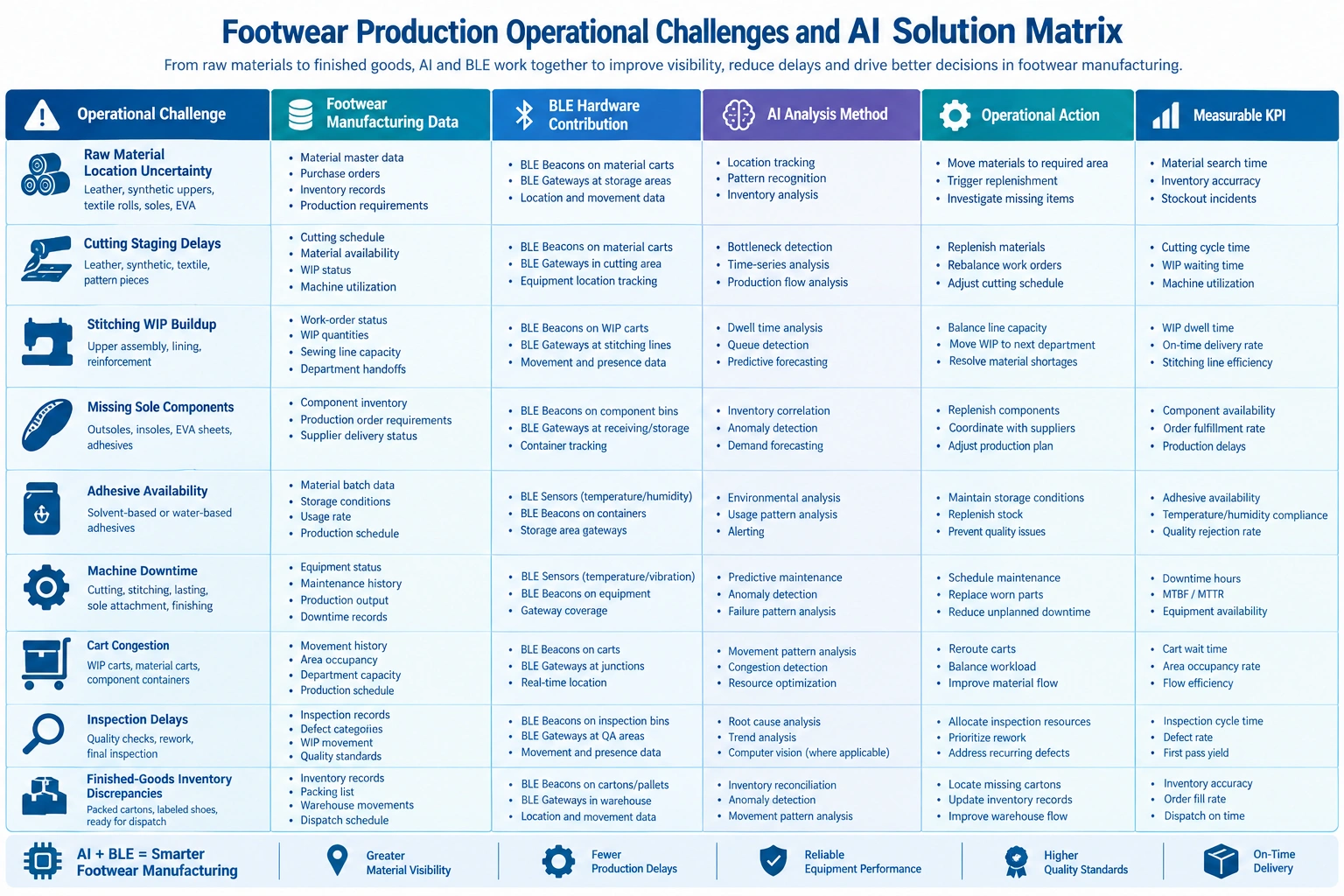
This infographic compares nine footwear production challenges with AI analysis methods, BLE hardware contributions, operational actions, and measurable KPIs. It covers raw material location uncertainty, cutting and stitching delays, missing sole components, adhesive availability, machine downtime, cart congestion, inspection delays, and finished-goods inventory discrepancies. The matrix shows how AI and BLE support better material visibility, production coordination, equipment performance, quality management, and on-time delivery.
AIoT Data Flow for Footwear Production
An AIoT solution for footwear production connects physical assets and operational data with AI models and business systems. The data flow should be designed around the manufacturer’s actual production processes and information requirements.
Data Acquisition from Footwear Manufacturing Operations
Data may originate from:
- BLE Beacons attached to selected material carts, WIP containers, and reusable handling assets.
- BLE Sensors monitoring selected environmental or equipment conditions.
- BLE Gateways installed at receiving, storage, cutting, stitching, assembly, finishing, inspection, and warehouse areas.
- ERP material and production-order records.
- MES work-order and production-status records.
- WMS inventory and warehouse movement records.
- QMS inspection and defect records.
- Maintenance management software and machine data interfaces.
- Manual operator inputs and barcode or RFID systems where applicable.
BLE is most useful for physical visibility into selected assets and areas. Other systems provide the material identity, production context, and business transaction information needed for AI analysis.
Communication Infrastructure and Data Transport
BLE Gateways receive signals from nearby BLE devices and forward relevant data to the software environment. Depending on the deployment, gateway connectivity may use Ethernet, Wi-Fi, or another supported network connection.
A typical data path is:
Footwear Manufacturing Operations
Materials, WIP carts, equipment, production and warehouse activities
BLE Data Acquisition
BLE Beacons, BLE Sensors, BLE Gateways
Network and Data Processing
Gateway connectivity, data ingestion, filtering, timestamps and asset association
AI and Operational Analytics
Location intelligence, inventory analysis, bottleneck detection, maintenance insights
Footwear Production Business Systems
ERP, MES, WMS, QMS, maintenance software and operational dashboards
Operational Decisions
Replenish materials, move WIP, investigate delays, schedule maintenance, coordinate production
Edge Processing, Cloud Software, and Server Deployment
AIoT data processing may take place at the factory edge, in cloud-hosted software, or on privately managed servers. The correct choice depends on the footwear manufacturer’s connectivity, data governance, latency, integration, and operational requirements.
- Edge processing: Useful when the factory needs local data handling, reduced dependence on external connectivity, or timely local processing.
- Cloud software: Suitable when the manufacturer wants centrally managed software, multi-site visibility, and cloud-hosted analytics.
- Private server deployment: Useful when the manufacturer requires software to run on customer-managed servers, private data centers, factory servers, or other privately hosted enterprise infrastructure.
These deployment options can be combined. For example, a factory may collect BLE data locally, perform initial processing at the edge, and forward selected information to cloud or private-server software for broader analytics.
AI and BLE for Footwear Production: Enterprise Integration
Footwear production data becomes more valuable when it is connected to existing manufacturing and business software.
ERP Integration
ERP systems may contain information about:
- Material master data.
- Purchase orders and supplier records.
- Production orders.
- Inventory quantities.
- Product styles, sizes, and colors.
- Material requirements and replenishment.
AI and BLE solutions can use ERP information to associate physical tracking data with production requirements. For example, a tagged material cart may be linked to the materials required for a particular footwear production order.
MES Integration
MES software provides manufacturing execution information, such as work-order status, production progress, workstation activities, and production performance.
MES integration can help AI models connect physical movement data with actual production operations. A WIP cart observed in a stitching area may be associated with an order that is waiting for the next production step.
The integration should define:
- Asset identifiers.
- Production order identifiers.
- Workstation or department identifiers.
- Event timestamps.
- Material and WIP associations.
- Data exchange methods.
- Error handling and reconciliation.
WMS Integration
WMS software supports warehouse inventory, storage locations, picking, replenishment, and dispatch activities.
For footwear manufacturers, WMS integration can help connect physical asset movement with finished-goods storage and material handling. BLE tracking may provide visibility into selected carts, containers, or handling assets, while WMS maintains the authoritative inventory transactions.
QMS and Maintenance Integration
QMS integration can connect production events with inspection records, defect categories, rework, and quality investigations.
Maintenance software integration can connect equipment conditions and utilization data with maintenance schedules, work orders, and downtime records.
AI models can use these combined data sources to identify patterns, but any production or maintenance action should be validated against the actual operational context.
AI and BLE for Footwear Production: Deployment Considerations
A practical deployment should begin with a clearly defined operational problem and a measurable business objective.
Start with a Specific Footwear Manufacturing Use Case
A manufacturer might begin with:
- Raw material cart tracking between storage and cutting.
- WIP cart visibility between stitching and lasting.
- Finished-goods handling asset tracking.
- Equipment condition monitoring for selected production machines.
- Inventory location visibility for reusable component containers.
A focused pilot can help validate location accuracy, gateway coverage, data quality, integration requirements, and operational usefulness before expanding to additional departments.
Validate BLE Coverage and Location Accuracy
BLE performance depends on the facility’s physical environment. Footwear factories may contain machinery, metal structures, storage racks, moving carts, and other objects that affect radio signals.
Important engineering considerations include:
- Gateway placement and coverage.
- Beacon mounting position.
- Interference and signal attenuation.
- Battery life and maintenance.
- Asset movement patterns.
- Required location accuracy.
- Network availability.
- Calibration and testing.
A BLE tracking solution should be tested in the actual factory environment rather than assuming that a laboratory performance result will apply everywhere.
Define Data Ownership and System Integration
Before deployment, the manufacturer should establish which system owns each type of information.
For example:
| Data type | Likely authoritative system |
|---|---|
| Material master and purchase orders | ERP |
| Production order and work-center status | MES or ERP |
| Warehouse inventory transactions | WMS or ERP |
| Inspection and defect records | QMS |
| Equipment maintenance history | CMMS or maintenance software |
| BLE asset location events | BLE tracking software |
| AI predictions and alerts | AI analytics software |
This separation helps avoid duplicate records and makes it easier to investigate discrepancies.
Measure Operational Performance
A footwear manufacturer should evaluate the solution using measurable indicators rather than relying only on the presence of a tracking dashboard.
Relevant KPIs include:
- Material search time.
- WIP dwell time.
- Production order waiting time.
- Cutting-to-stitching transfer time.
- Stitching-to-lasting transfer time.
- Machine downtime.
- Production schedule adherence.
- Inventory location accuracy.
- Finished-goods dispatch delays.
- Maintenance response time.
BLE Hardware and AI Software for Footwear Production
AI-enabled footwear manufacturing depends on reliable data from physical operations. BLE Gateways, BLE Beacons, and BLE Sensors provide one part of that data collection system, while AI software, enterprise applications, and network infrastructure support analysis and operational decisions.
For footwear manufacturers, the right combination depends on the materials being tracked, the production processes being monitored, the required location accuracy, and the factory’s IT environment.
BLE Beacons for Footwear Materials and Work-in-Process
BLE Beacons are compact wireless devices that transmit Bluetooth Low Energy signals. In footwear production, they can be attached to selected mobile assets, including:
- Material carts carrying leather, synthetic uppers, textile components, or soles.
- Reusable bins containing insoles, laces, eyelets, and other shoe components.
- WIP carts moving cut components between cutting and stitching.
- Carts carrying stitched uppers to lasting.
- Reusable containers used in sole attachment and finishing.
- Selected production tools and mobile equipment.
A beacon identifier can be associated with an asset record in the tracking software. BLE Gateways receive the transmitted signals and forward the data for processing.
The beacon itself does not determine the complete production status of a footwear order. The software must associate the asset with material, batch, work order, or department information where required.
BLE Gateways for Factory Location Visibility
BLE Gateways collect signals from nearby BLE devices and transmit the data to the tracking software. Their placement should reflect the actual movement of footwear materials and WIP.
Potential gateway locations include:
- Raw material receiving and storage.
- Cutting and material preparation.
- Stitching lines.
- Lasting and sole attachment.
- Finishing and quality inspection.
- Finished-goods warehouses.
- Dispatch and loading areas.
Gateway density depends on the required location accuracy and the physical characteristics of the facility. A zone-level tracking system may require fewer gateways than a solution intended to distinguish between adjacent workstations.
GAO supplies BLE hardware products and systems for industrial and commercial tracking applications. For a footwear deployment, gateway selection and installation should be validated through a site survey and practical testing.
BLE Sensors for Equipment and Environmental Data
BLE Sensors can measure supported physical conditions and transmit data through BLE connectivity. Their application in footwear production depends on the measurement requirements.
Potential applications include:
- Monitoring selected equipment temperature.
- Monitoring environmental conditions in material storage areas.
- Supporting condition monitoring for suitable production assets.
- Tracking environmental conditions relevant to adhesives or other materials when technically appropriate.
- Collecting sensor readings for AI analysis.
A sensor must be selected according to the required measurement range, accuracy, sampling frequency, battery life, mounting method, and operating environment.
For machine condition monitoring, BLE Sensors may complement data from PLCs, industrial sensors, and machine controllers. A BLE location beacon alone is not a predictive maintenance sensor.
AI Models for Footwear Manufacturing
AI software can analyze data from BLE tracking, manufacturing systems, sensors, and operational records.
Relevant methods include:
- Machine learning: Identify patterns in production delays, material movement, equipment utilization, and inventory discrepancies.
- Anomaly detection: Identify unusual dwell times, unexpected movement, or abnormal equipment readings.
- Predictive analytics: Estimate potential maintenance or production risks based on historical and current data.
- Time-series analysis: Analyze sensor readings and operational changes over time.
- Computer vision: Support image-based footwear inspection where suitable cameras, training data, and inspection criteria are available.
- Optimization models: Support production scheduling, material allocation, and resource planning.
- Rules-based automation: Trigger alerts or workflows when defined conditions are met.
AI model performance depends on the quality of the data. Footwear manufacturers should validate predictions against actual production events and establish processes for reviewing incorrect alerts.
Cloud Version vs Server Version for Footwear Production
GAO’s AI and BLE solutions can be evaluated using two broad software deployment approaches: Cloud Version and Server Version.
Cloud Version
The Cloud Version is a cloud-hosted software deployment managed within cloud infrastructure. It may be appropriate for footwear manufacturers that want centralized software management, remote access, and visibility across multiple production facilities.
Potential advantages include:
- Centralized software updates and maintenance.
- Multi-site production visibility.
- Cloud-hosted analytics and AI processing.
- Easier access for authorized production, warehouse, and management teams.
- Integration with cloud-based ERP, MES, WMS, or other business software.
- Centralized data storage and reporting.
A cloud deployment still requires reliable connectivity between BLE Gateways and the software environment. Where a factory has intermittent connectivity, local buffering or edge processing may be needed to avoid losing important tracking events.
Server Version
The Server Version is software deployed on edge servers, customer-managed servers, private data centers, factory servers, or other privately hosted enterprise infrastructure. It is not limited to traditional on-premises deployment.
This model may be appropriate for footwear manufacturers that require:
- Greater control over software hosting.
- Integration with privately hosted ERP, MES, WMS, or QMS systems.
- Local processing of selected operational data.
- Private-network deployment.
- Specific data governance or cybersecurity requirements.
- Continued local operation when external connectivity is limited.
A factory may host the software on a server inside the manufacturing facility, while another organization may use a private data center or customer-managed server located elsewhere.
Edge, Cloud, and Private Server Integration
The deployment model should match the factory’s operational requirements.
| Requirement | Cloud Version | Server Version |
|---|---|---|
| Centralized multi-site visibility | Well suited | Possible with appropriate networking |
| Customer-managed hosting | Limited to supported arrangements | Well suited |
| Local data processing | May use edge components | Can use local servers |
| Private enterprise network integration | Depends on connectivity and configuration | Often suitable |
| Centralized software maintenance | Generally simpler | Customer-managed responsibility may be greater |
| Factory connectivity limitations | Requires buffering or local processing where needed | Local processing can reduce external dependency |
| Existing private ERP/MES systems | Requires secure integration | Can support local integration where compatible |
Deployment Recommendation for Footwear Manufacturers
A footwear manufacturer should consider the Cloud Version when centralized management, multi-site reporting, and cloud-hosted analytics are important. The Server Version may be more suitable when private hosting, local integration, or customer-controlled infrastructure is a priority.
A hybrid deployment may combine BLE Gateways and edge processing at the factory with cloud or private-server analytics. The actual design should be based on network reliability, data requirements, system compatibility, cybersecurity, and the manufacturer’s operational goals.
GAO can support the evaluation of BLE hardware and system requirements for footwear manufacturing applications.
Cybersecurity and Data Governance for AI-Enabled Footwear Production
Footwear manufacturing systems may handle production orders, supplier information, inventory data, equipment records, and quality information. AI and BLE deployments should protect this information while maintaining reliable factory operations.
BLE Device and Gateway Security
Security considerations include:
- Device identity and authentication where supported.
- Secure gateway configuration.
- Protected network communication.
- Firmware and software update management.
- Access control for gateway administration.
- Monitoring of unexpected devices or communication behavior.
- Battery and device maintenance procedures.
The exact security capabilities depend on the BLE hardware, gateway, network, and software selected.
Enterprise Software and Network Security
A footwear manufacturer’s AI and BLE system should be integrated into its existing IT and OT security practices.
Relevant measures include:
- Role-based access control.
- Secure API connections to ERP, MES, WMS, and QMS.
- Network segmentation where appropriate.
- Encryption in transit and at rest where supported.
- Audit logs for important system actions.
- Backup and recovery procedures.
- Software patching and vulnerability management.
- Defined retention policies for operational data.
The system should also distinguish between tracking information, material master data, production records, and AI-generated recommendations. This supports clearer data ownership and auditability.
AI Data Quality and Model Governance
AI results are only as reliable as the data supplied to the models. Footwear manufacturers should establish processes for:
- Validating asset identifiers.
- Checking timestamp accuracy.
- Detecting missing or duplicate tracking events.
- Reconciliating BLE location data with production records.
- Monitoring model performance.
- Reviewing false alerts and missed events.
- Defining who can approve automated actions.
- Maintaining records of important AI-driven decisions.
AI recommendations should support qualified operational personnel rather than bypassing required production, quality, or safety controls.
Technical Benefits of AI and BLE for Footwear Production
Combining AI with BLE tracking can improve operational visibility and support better production decisions. The benefits depend on the quality of implementation and the specific footwear workflows selected.
Improved Material and WIP Visibility
BLE tracking can provide more timely information about the location of selected material carts, containers, and WIP assets.
AI can analyze that information alongside production requirements to help identify:
- Materials waiting too long in staging.
- WIP carts that have not reached the next department.
- Repeated movement between production areas.
- Potential shortages affecting production orders.
- Unusual delays in material handling.
The result is improved visibility into physical production flow.
Better Production Coordination
AI-driven analysis can help production teams understand where delays occur and which workflows require attention.
For example, if stitching WIP consistently waits longer than expected before lasting, the manufacturer can investigate whether the cause is material availability, staffing, machine capacity, or production scheduling.
BLE tracking contributes movement data, while MES and other systems provide the context needed to determine the cause.
More Informed Maintenance Planning
AI predictive maintenance can help identify unusual equipment patterns when suitable sensor and machine data is available.
Potential benefits include:
- Earlier identification of equipment conditions requiring investigation.
- Better maintenance scheduling.
- Reduced unexpected downtime when predictions are accurate and acted upon.
- Improved coordination between maintenance and production.
- More informed decisions about equipment servicing.
Actual maintenance improvements should be measured using downtime records, maintenance response times, and equipment performance data.
Scalable Multi-Department Visibility
A footwear manufacturer can begin with a focused use case and expand to additional departments after validating the initial deployment.
A potential expansion path includes:
- Raw material receiving and storage.
- Cutting and preparation.
- Stitching and upper assembly.
- Lasting and sole attachment.
- Finishing and quality inspection.
- Finished-goods storage.
- Dispatch and logistics.
Scaling requires consistent asset identifiers, gateway coverage, software integration, data quality controls, and maintenance procedures.
Implementing AI and BLE for Footwear Production with GAO
A successful deployment should connect technology selection with actual footwear production requirements.
Planning and Requirements Definition
Start by identifying the manufacturing process and the problem to be improved.
Important planning questions include:
- Which footwear materials or assets need tracking?
- Is zone-level location sufficient, or is more precise positioning required?
- Which production departments generate the most significant delays?
- Which equipment conditions need monitoring?
- Which existing software systems contain the required data?
- What are the expected operational outcomes?
- What cybersecurity and data governance requirements apply?
The answers determine the appropriate BLE devices, gateway arrangement, software, and integration approach.
Hardware Selection and Factory Commissioning
Hardware selection should consider the actual production environment.
Relevant criteria include:
- BLE Beacon battery life.
- Beacon mounting method.
- Sensor measurement requirements.
- Gateway communication options.
- Factory coverage.
- Equipment and material handling conditions.
- Maintenance access.
- Device durability.
- Location accuracy requirements.
Commissioning should include gateway installation, device registration, signal testing, asset association, network validation, and operational testing.
Integration, Testing, and Optimization
The solution should be tested with real footwear production workflows.
Testing may cover:
- Material cart movement from storage to cutting.
- WIP transfer between stitching and lasting.
- Finished-goods movement through warehouse operations.
- Equipment sensor data collection.
- ERP, MES, WMS, and QMS data integration.
- Alert generation and operational response.
- Data quality and event reconciliation.
- Software access and security controls.
After commissioning, the manufacturer should review performance and optimize gateway placement, device settings, data processing, and workflow rules where necessary.
GAO’s Role in Footwear Manufacturing Technology
GAO provides BLE, RFID, and IoT hardware products and systems for organizations that need reliable data collection and asset visibility. Its engineering-oriented approach can support the evaluation of tracking hardware, sensor requirements, system integration, and deployment considerations.
Headquartered in New York City and Toronto, Canada, GAO is among the leading B2B and B2G BLE and RFID suppliers worldwide. GAO, together with GAO Research Inc. and GAO Tek Inc., forms GAO Group, which has served customers in the United States and Canada for three decades, including Fortune 500 companies, research organizations, universities, and government agencies.
GAO’s R&D investment, quality assurance processes, and remote or onsite technical support provide a foundation for evaluating AIoT and BLE applications in footwear production.
Key Takeaways for AI and BLE in Footwear Production
AI-driven footwear production can improve visibility into materials, WIP, equipment, quality activities, and finished-goods operations when the solution is designed around actual manufacturing workflows.
Key implementation insights include:
- AI inventory management benefits from accurate material identities, inventory records, and physical tracking data.
- BLE Gateways, BLE Beacons, and BLE Sensors provide different types of operational information and should be selected according to the use case.
- AI models require reliable data from production, warehouse, maintenance, and quality systems.
- Cloud Version and Server Version deployments should be evaluated according to connectivity, hosting, integration, and data governance requirements.
- Factory commissioning and location testing are essential for reliable BLE tracking.
- Production KPIs should be defined before deployment to measure operational improvements.
- AI recommendations should be validated and integrated into clear operational response processes.
GAO supports organizations evaluating BLE, RFID, and IoT hardware products and systems for manufacturing and asset tracking applications. Learn more about GAO’s technology solutions and engineering support to determine how AI-enabled BLE tracking may fit your footwear production requirements.
Building the Future of Industrial AI and IoT with Aperture Venture Studio and GAO RFID Inc.
For more than three decades, GAO Group of Companies has invested heavily in R&D of industrial BLE, RFID, and IoT. As generative AI has become useful in industrial applications, we have been developing AI and IoT technologies, including BLE and RFID, and founded Aperture Venture Studio to build, launch, and scale next-generation AI and IoT companies for various industries.
Aperture attracts AI and IoT technical experts, entrepreneurial and operational executives, investors, and leading companies. Our Aperture Ventures Summit and TekSummit discuss advanced AI and IoT topics, helping build technical communities.
We welcome you to join us as:
- Advisors, Co-founders, or Employees
- Investors
- Customers