
AI and BLE for Forging Operations
AI-Driven Forging Operations with BLE-Based Industrial Data
AI is transforming forging operations by converting production, equipment, environmental, and asset data into actionable decisions across heating, die preparation, forming, trimming, heat treatment, inspection, material handling, and maintenance. AI models can identify process deviations, predict equipment problems, optimize production conditions, and improve traceability when they receive reliable operational data. BLE gateways, BLE beacons, and BLE sensors provide a practical wireless data layer for collecting equipment status, temperaturerelated measurements, location information, vibration, utilization, and other operating signals around forging presses, furnaces, dies, tooling, material handling equipment, and work-inprocess. For forging operations, the value comes primarily from the AI applications rather than wireless connectivity itself. BLE makes selected operational data easier to capture and associate with jobs, assets, work centers, and production events. GAO supplies BLE, RFID, and IoT hardware products and systems that can support these data collection requirements across demanding industrial environments.
AI-Enabled BLE Smart Forging Plant for Predictive Maintenance
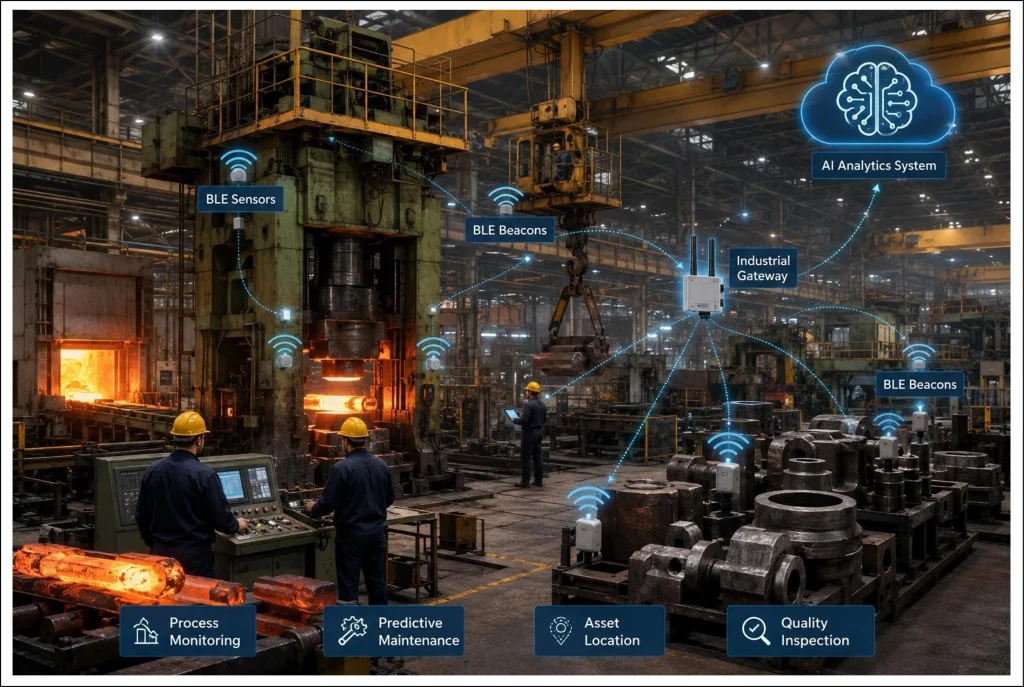
A realistic industrial forging plant featuring a hydraulic forging press, billet heating furnace, cranes, conveyors, operators, and finished components. BLE sensors and beacons connect machinery and assets to an industrial gateway and AI analytics system, illustrating process monitoring, predictive maintenance, asset location, and quality inspection.
Why AI Matters in Forging Operations
Forging is highly sensitive to process conditions. Billet temperature, furnace residence time, die condition, press force, stroke behavior, lubrication, material grade, transfer time, cooling conditions, and heat-treatment parameters can influence dimensional accuracy, mechanical properties, surface condition, and downstream inspection results. Traditional manufacturing systems often capture production counts and machine states without fully connecting those signals to the operational circumstances surrounding each forging job. AI can close this gap by correlating time-series equipment data with production orders, tooling records, maintenance history, inspection results, and process parameters. Relevant AI applications include:
- AI predictive maintenance for forging presses: Machine-learning models can analyze vibration, motor current, hydraulic pressure, temperature, cycle behavior, and alarm history to identify abnormal operating patterns before an unplanned press failure.
- AI furnace monitoring: Models can evaluate furnace temperature profiles, heating duration, billet movement, and production context to identify conditions associated with underheating, overheating, excessive residence time, or process inconsistency.
- AI forging process optimization: Historical production data can be analyzed to determine relationships among billet condition, press parameters, die condition, cycle time, and quality outcomes.
- AI quality prediction: Machine-learning models can associate process variables with dimensional inspection, hardness, metallurgical test results, surface defects, and other quality measurements.
- AI die and tooling management: AI can estimate tooling deterioration using cycle counts, operating conditions, maintenance records, and process deviations.
- AI asset tracking: BLE location data can help associate dies, containers, carts, tooling sets, and work-in-process with forging cells, storage areas, maintenance stations, and inspection locations.
- AI production scheduling: Historical cycle times, equipment availability, tooling requirements, maintenance status, and work-order information can support more realistic scheduling decisions.
- AI anomaly detection: Unsupervised or semi-supervised models can detect unusual machine behavior even when there are insufficient labeled failure events for conventional supervised learning. GAO’s BLE and IoT hardware can serve as the field-level data collection layer while AI software performs the higher-level analysis. The engineering objective is not to attach sensors everywhere, but to identify which signals materially improve a forging decision.
Forging Operations Where AI Creates the Most Value
Press and Hammer Monitoring
Forging presses and hammers generate repeated mechanical cycles that create valuable timeseries data. Vibration, temperature, motor condition, hydraulic behavior, cycle duration, and operating state can provide indicators of equipment degradation. AI models can establish normal operating envelopes for individual machines and detect deviations that may indicate bearing problems, hydraulic abnormalities, lubrication issues, alignment concerns, or abnormal loading. BLE sensors can supplement existing PLC and industrial control data where additional measurements are needed without extensive new wiring. BLE gateways positioned around forging cells can forward selected sensor readings to local software for analysis.
Furnace and Billet Traceability
Heating operations require accurate control of temperature and residence time. AI can compare furnace conditions with billet material, production order, alloy or grade, target process parameters, and downstream quality outcomes. BLE beacons can identify containers or material-handling units, while BLE sensors can collect selected environmental or equipment measurements. The resulting event history can help establish where material was located and which production area handled it. For high-value forgings, BLE identification can also complement RFID or barcode-based identification where the manufacturing process already uses those technologies.
Die, Tooling, and Fixture Management
Forging dies experience repeated thermal and mechanical loading. Their condition directly affects dimensional consistency, flash formation, surface quality, and production interruptions. An AI tooling-management application can combine:
- Die identification
- Forging cycle counts
- Press assignment
- Maintenance records
- Die change history
- Production temperature conditions
- Tooling location
- Inspection results
- Repair and refurbishment history BLE beacons attached to suitable tooling carriers or reusable assets can provide location context. A gateway can report the beacon’s presence to the manufacturing system, allowing software to associate tooling movement with work orders and maintenance activities.
Heat Treatment and Post-Forging Operations
Heat treatment introduces additional variables such as furnace temperature, soak duration, quenching conditions, cooling rate, batch composition, and material identification. AI can identify relationships between heat-treatment histories and later hardness, dimensional, metallurgical, or inspection results. This enables process engineers to investigate recurring deviations using evidence from multiple production stages rather than relying solely on manual records. BLE sensing can provide supplementary location and environmental information around batch handling, staging, and equipment utilization where appropriate.
AI Applications Across the Forging Production line
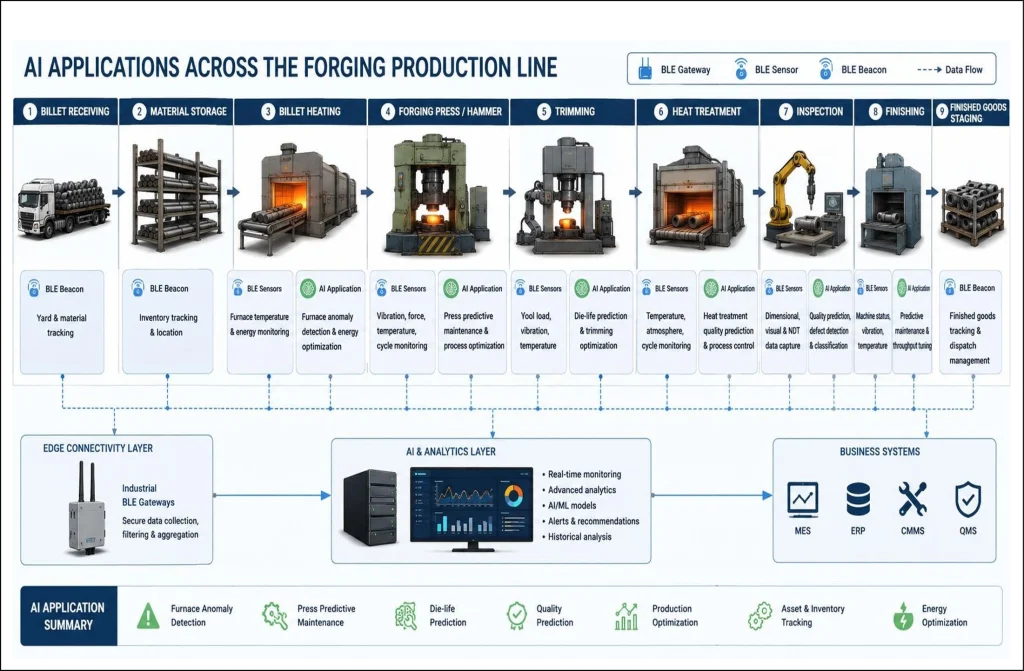
A horizontal engineering diagram maps AI applications across nine forging stages, from billet receiving and heating through forging, trimming, heat treatment, inspection, finishing, and staging. It shows BLE sensors, beacons, gateways, AI analytics, and business systems supporting predictive maintenance, quality prediction, asset tracking, and production optimization.
From Forging Data Capture to AI-Based Production Decisions
A practical AI solution for forging operations normally follows a data path from the physical production area to analytics and then to a controlled business or maintenance action.
Data Acquisition at the Forging Cell
The first layer consists of existing industrial control signals and additional sensing. PLCs, CNC or machine controllers where applicable, furnace instrumentation, condition-monitoring sensors, inspection equipment, and maintenance systems may already provide substantial information. BLE sensors become useful when the required measurement is difficult or costly to wire. Potential measurements include vibration, temperature, equipment condition, environmental conditions, or other application-specific signals. BLE beacons can provide identification or location context for movable assets such as tooling carriers, dies, carts, containers, and selected work-in-process units.
BLE Gateway and Edge Processing
BLE gateways receive wireless data from nearby BLE sensors and beacons. Gateway placement is important because forging plants can contain large metal structures, presses, furnaces, enclosures, cranes, and other sources of radio-frequency obstruction or multipath effects. Local gateway software can perform initial filtering, timestamping, validation, buffering, and protocol conversion before forwarding data to higher-level software. Edge processing is particularly useful when forging operations require rapid local detection or when connectivity to a remote server cannot be assumed continuously.
Middleware and Data Normalization
A middleware layer can normalize data from BLE gateways, PLCs, SCADA systems, historians, inspection equipment, and maintenance software. A useful normalized record may associate:
- Asset ID
- Machine or forging cell
- Production order
- Material or heat number
- Tooling ID
- Timestamp
- Sensor measurement
- Machine state
- Process step
- Operator or work-center context where appropriate
- Quality result
- Maintenance event This contextualization is critical. A temperature value without a machine, material, process stage, and timestamp has limited value for AI.
AI Analytics and Decision Support
The normalized data can feed machine-learning models, statistical process control, anomalydetection algorithms, forecasting models, or optimization methods. A typical sequence is: Physical Process → BLE/Industrial Data Capture → Gateway → Edge Processing → Middleware → Historical Data → AI Model → Decision Support → Maintenance, Quality, or Production Action AI results should normally be treated as decision support until they have been validated against actual forging outcomes. A model predicting an equipment anomaly should trigger inspection or verification rather than automatically shutting down a critical press unless the control strategy has been formally engineered and validated.
Forging AI Data-to-Decision Workflow for Smart Manufacturing
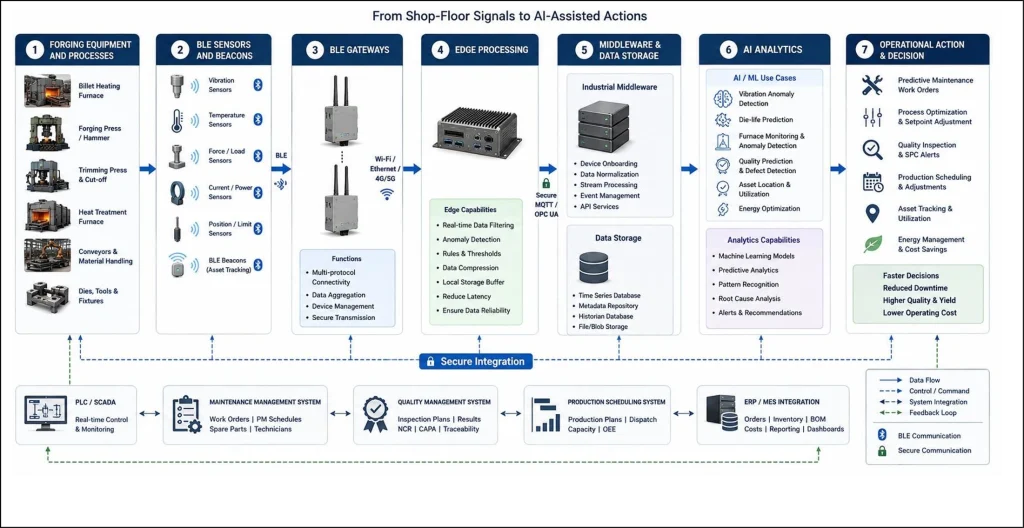
An enterprise engineering diagram illustrates the seven-stage data journey from forging equipment and BLE sensors to gateways, edge processing, middleware, AI analytics, and operational decisions. It also shows integration with PLC/SCADA, maintenance, quality, production scheduling, and ERP/MES systems for predictive, connected forging operations.
BLE Hardware and Software for Forging AI Solutions
BLE should be selected according to the measurement, identification, and location problem rather than treated as a universal replacement for wired industrial instrumentation.
BLE Sensors
BLE sensors can collect selected physical measurements and transmit them wirelessly to nearby gateways. For forging operations, sensor selection should consider temperature exposure, mechanical vibration, shock, dust, oil, electromagnetic conditions, mounting method, battery requirements, sampling frequency, and required measurement accuracy. High-temperature zones around furnaces and forging dies require particular attention. A BLE device rated for general industrial conditions should not automatically be assumed suitable for direct exposure to forging heat or severe mechanical impact. Sensor placement may therefore need thermal shielding, remote mounting, or installation at a cooler measurement point.
BLE Beacons
BLE beacons are useful when the primary requirement is identifying or locating mobile objects rather than measuring a physical parameter. Forging applications can include:
- Die carts
- Tooling carriers
- Material containers
- Scrap containers
- Maintenance equipment
- Mobile inspection equipment
- Work-in-process carriers
- Reusable fixtures Location accuracy depends on gateway density, radio environment, beacon configuration, antenna characteristics, installation height, and the positioning method used by the software.
BLE Gateways
BLE gateways provide the connection between wireless field devices and the plant’s IP network or local computing environment. A forging installation should evaluate:
- BLE coverage around presses and furnaces
- Gateway mounting locations
- Metal obstruction and radio propagation
- Ethernet or Wi-Fi backhaul
- Power availability
- Local buffering
- Time synchronization
- Device management
- Network segmentation
- Gateway redundancy where operationally justified GAO provides BLE and IoT hardware products and systems that can be incorporated into industrial data collection designs, including deployments where wireless sensing supplements existing automation and manufacturing systems.
Cloud and Server Deployment for Forging Operations
Cloud Version
A cloud-hosted solution can be appropriate when forging organizations operate multiple plants and need centralized analytics, cross-site model development, consolidated dashboards, or remote engineering access. Cloud deployment can support centralized storage of production histories, AI model training, fleet-level equipment analysis, and comparison of machine behavior across facilities. Connectivity requirements should be evaluated carefully because the physical forging process must continue safely even if external connectivity is temporarily unavailable. Critical control functions should therefore remain within appropriately engineered local control systems rather than depending solely on cloud connectivity.
Server Version
A server-based deployment can run on a factory server, customer-managed infrastructure, private data center, or other privately hosted computing environment. This approach is useful when forging data must remain within controlled infrastructure, when plant connectivity is limited, or when the organization requires tighter control over data processing and integration. A local server can receive data from BLE gateways, integrate with MES, SCADA, historians, CMMS or EAM software, and run AI inference close to production operations.
Selecting the Deployment Model
The decision should be based on operational requirements rather than a preference for cloud or local computing.
| Requirement | Cloud Version | Server Version |
|---|---|---|
| Multi-site analytics | Strong fit | Possible with centralized private infrastructure |
| Local operation during WAN outage | Requires local buffering or edge processing | Strong fit |
| Centralized AI model training | Strong fit | Strong fit with suitable computing resources |
| Factory-controlled data processing | Depends on cloud configuration | Strong fit |
| Remote engineering access | Convenient | Requires secure remote access |
| Integration with local manufacturing systems | Requires secure connectivity | Often simpler |
| Site-level latency | Edge processing may still be required | Strong fit |
| IT control over infrastructure | Lower direct infrastructure management | Higher customer responsibility |
The most robust design can use both local processing and cloud or private-server analytics. The choice should follow the required latency, data governance, connectivity, cybersecurity, maintenance, and integration model.
Engineering Considerations Before Deploying AI and BLE
Forging operations require more than installing wireless sensors and training an AI model. A successful deployment starts with a measurable production or maintenance problem. Key engineering questions include:
- Which forging decision needs improvement?
- Which process variable provides evidence for that decision?
- Is the required data already available through PLC, SCADA, historian, MES, or inspection systems?
- Which measurements require additional BLE sensing?
- How will sensor readings be associated with a specific machine, die, material heat, or production order?
- What sampling rate is required for the AI application?
- Can the sensor withstand the actual thermal, mechanical, and environmental conditions?
- Where should BLE gateways be installed to provide reliable coverage?
- What happens when wireless connectivity is temporarily unavailable?
- How will sensor and gateway timestamps be synchronized?
- How will AI predictions be validated against actual maintenance and quality outcomes?
- Which actions remain human-controlled?
- How will cybersecurity requirements be applied to wireless devices, gateways, servers, and integrations? The strongest implementation approach normally begins with a bounded forging use case, establishes a reliable baseline dataset, validates the data path, and then expands AI applications after measurable performance has been demonstrated.
Integrating AI and BLE with Forging Production Systems
AI-driven forging operations become significantly more useful when wireless field data is correlated with existing manufacturing records. BLE should therefore complement, rather than replace, established industrial control and information systems.
MES, SCADA, PLC, and Historian Integration
A forging solution can combine BLE-derived information with PLC and SCADA signals such as press state, cycle count, hydraulic pressure, motor status, furnace temperature, alarms, and production counters. Historical process data can be stored in an industrial historian and correlated with quality and maintenance events. MES integration adds production context such as work orders, routing steps, material identification, tooling assignments, quantities, and production status. This allows AI models to distinguish between normal differences caused by different forging recipes and genuine equipment or process anomalies.
CMMS and EAM Integration
Predictive-maintenance applications require a connection between equipment condition and maintenance history. CMMS or EAM systems can provide work orders, failure codes, inspection records, spare-parts usage, maintenance intervals, and asset histories. An AI model can use this information to estimate maintenance risk and prioritize inspections. BLE asset-location information can additionally help maintenance personnel determine where tooling, mobile equipment, or selected maintenance assets are located.
ERP and Quality-System Integration
ERP systems provide information about orders, materials, inventory, purchasing, and production requirements. Quality systems provide inspection measurements, nonconformance records, corrective actions, laboratory results, and release status. Connecting these records creates a broader production history. For example, a quality deviation can be investigated against billet history, furnace conditions, press behavior, die usage, heat treatment, and inspection results instead of examining each record independently. GAO’s BLE, RFID, and IoT products and systems can support the field-data portion of these integrations, while the customer’s existing manufacturing and business software remains the system of record where appropriate.
Forging Plant Systems Integration Architecture with BLE and AI
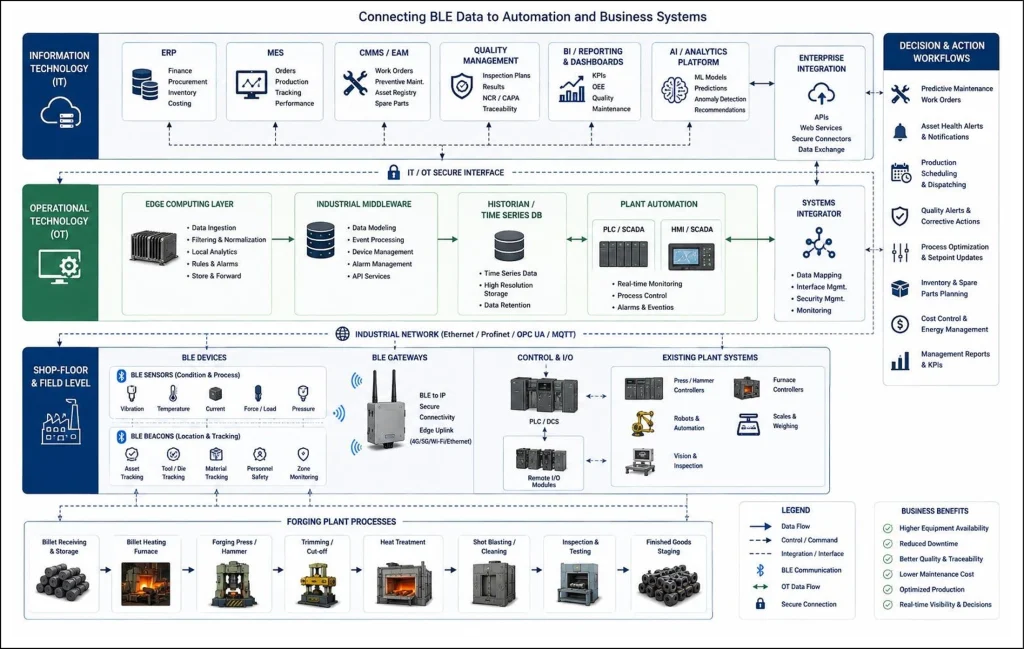
A detailed enterprise architecture diagram shows how BLE sensors, beacons, and gateways connect forging shop-floor equipment with edge computing, middleware, historians, PLC/SCADA, MES, CMMS/EAM, quality management, ERP, BI, and AI analytics. The layered design illustrates secure data exchange and decision workflows across OT and IT environments.
AI Models for Forging Process and Equipment Intelligence
Different forging applications require different analytical methods. Selecting a model based on the available data and decision requirement is more important than selecting an algorithm because it is considered advanced.
Predictive Maintenance Models
Supervised machine-learning models can be trained using historical examples of normal and abnormal equipment behavior when sufficiently labeled failure data exists. Classification models can estimate the probability of a known failure mode, while regression models can estimate remaining useful life when appropriate degradation data is available. Where failure labels are scarce, anomaly-detection techniques can establish normal operating behavior and flag deviations. Useful inputs may include vibration features, temperature, motor current, hydraulic pressure, cycle time, alarm frequency, and equipment utilization.
Time-Series and Forecasting Models
Forging equipment generates sequential data rather than isolated measurements. Time-series analysis can identify trends in press behavior, furnace conditions, cycle duration, energy consumption, and other variables. Models should account for production recipes, machine states, changeovers, planned downtime, maintenance activities, and different material grades. Otherwise, normal production changes can be incorrectly classified as faults.
Computer Vision for Forged-Part Inspection
Computer vision can support automated inspection of forged components for visible characteristics such as surface defects, dimensional features, incomplete forming, flash-related conditions, or other application-specific anomalies. Vision systems can be combined with process information so that an AI model can investigate relationships between an observed defect and upstream forging conditions. BLE is generally an enabling identification or context technology in this scenario rather than the primary sensing mechanism.
Digital Process Models and Optimization
Statistical models and machine-learning methods can estimate relationships between process parameters and quality outcomes. Where sufficient validated data exists, optimization methods can recommend process settings within approved operating limits. AI recommendations should remain bounded by engineering specifications, machine capabilities, material requirements, safety constraints, and established process windows. AI should not override protective interlocks or validated machine-control logic without a separately engineered control strategy.
Cybersecurity for BLE-Enabled Forging AI
Wireless sensing introduces additional endpoints into a production environment. Cybersecurity should therefore be considered during system design rather than added after commissioning.
Device and Gateway Security
BLE sensors, beacons, and gateways should use appropriate authentication, access controls, secure configuration, and supported firmware-management processes. Gateway devices should not expose unnecessary services to production networks. Network segmentation can limit communication between wireless gateways, industrial control systems, edge servers, and business networks.
Data and Application Security
Data transmitted from forging cells should be protected according to its sensitivity and organizational requirements. Access to AI dashboards, maintenance recommendations, production information, and quality records should follow role-based authorization. Security controls should cover:
- Device identity and authentication
- Gateway access control
- Network segmentation
- Encrypted communications where supported and appropriate
- Secure software updates
- Credential management
- Logging and audit trails
- Backup and recovery
- Vulnerability management
- Incident-response procedures
- Controlled remote engineering access GAO has served U.S. and Canadian organizations, including Fortune 500 companies, research and development organizations, universities, and government agencies. Our experience supplying industrial hardware and systems reinforces the importance of quality assurance, reliable deployment practices, and technical support alongside the technology itself.
Commissioning and Validation in Forging Plants
AI and BLE deployments should be commissioned as engineering systems rather than treated as simple device installations.
Site Survey and Hardware Validation
A pre-deployment survey should identify forging cells, presses, furnaces, tooling areas, material routes, maintenance locations, network connections, power sources, and environmental constraints. BLE gateway locations should then be tested under actual operating conditions. Large metal equipment, moving cranes, enclosures, machinery, and human activity can alter radio propagation.
Sensor Calibration and Data Validation
Each sensor should be associated with a unique device identity and documented installation location. Measurement accuracy should be verified against an appropriate reference instrument where required. Data validation should check:
- Timestamp consistency
- Missing measurements
- Unexpected value ranges
- Duplicate readings
- Battery condition
- Gateway connectivity
- Sensor identity
- Sampling interval
- Signal quality
- Association with the correct asset
AI Model Validation
Historical production data should be separated appropriately into training, validation, and test datasets. Data leakage must be avoided because it can produce unrealistically high model performance. Model evaluation should use metrics appropriate to the application. A predictive-maintenance model, for example, should be evaluated not only for classification accuracy but also for false alarms, missed events, warning lead time, and operational consequences. For quality applications, precision, recall, false-reject rate, false-accept rate, and inspection throughput may be more meaningful than generic model accuracy.
Forging AI Commissioning Lifecycle: From Use Case to Continuous
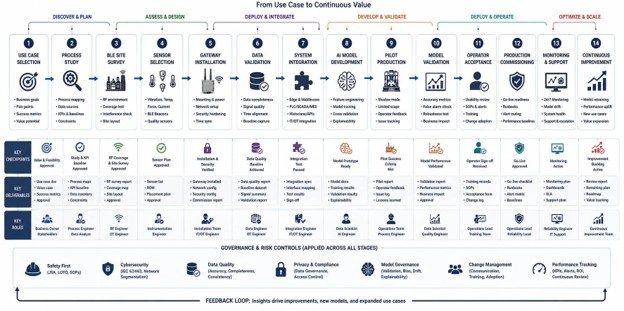
Improvement A professional engineering lifecycle diagram maps 14 stages of forging AI deployment, from usecase selection and BLE site surveys through sensor installation, data validation, model development, pilot production, commissioning, monitoring, and continuous improvement. Safety, cybersecurity, data quality, model governance, and performance checkpoints are applied throughout.
Forging Operations KPIs for AI and BLE Programs
Technology deployment should be tied to measurable forging performance. Appropriate KPIs depend on the use case and production environment. Relevant measures include:
- Overall equipment effectiveness
- Press utilization
- Press downtime
- Unplanned maintenance hours
- Mean time between failures
- Mean time to repair
- Forging cycle time
- Furnace utilization
- Furnace temperature deviation
- Billet heating cycle consistency
- Die change duration
- Die life measured in production cycles
- Tooling-related downtime
- First-pass yield
- Scrap rate
- Rework rate
- Nonconformance rate
- Dimensional inspection pass rate
- Surface-defect rate
- Energy consumption per forged part
- Production throughput
- Work-in-process residence time
- Material traceability completeness
- Asset-location accuracy
- Maintenance response time
- Predictive-maintenance warning lead time
- AI false-alarm rate
- AI detection rate
- BLE data availability
- Sensor uptime
- Gateway uptime
A useful measurement program establishes a baseline before deployment. For example, reducing maintenance downtime is difficult to attribute to predictive analytics unless historical downtime, failure modes, maintenance response, and production utilization have been recorded consistently.
AI-Powered Forging Plant Operations KPI Dashboard
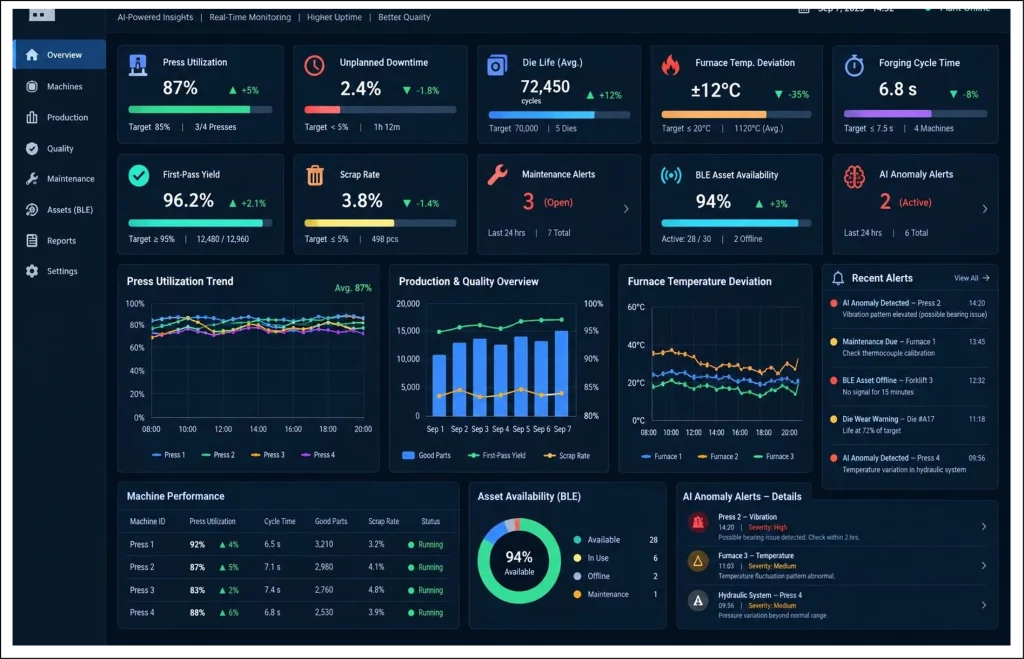
An industrial forging operations dashboard visualizes key KPIs including press utilization, unplanned downtime, die life, furnace temperature deviation, cycle time, first-pass yield, scrap rate, maintenance alerts, BLE asset availability, and AI anomaly alerts.
Practical Implementation Strategy for Forging Operations A phased
deployment generally reduces technical and operational risk.
Start with a Defined Production Problem
Select a problem where measurable data and business impact already exist. Predictive maintenance for a frequently used forging press, die tracking, furnace anomaly detection, or work-in-process visibility can provide a more manageable starting point than attempting to instrument an entire facility.
Establish the Data Baseline
Collect sufficient operational history before making strong AI claims. The baseline should include production states, maintenance events, quality outcomes, process conditions, and relevant sensor information. Data should be labeled according to the actual forging process. A press running a different die set or material grade may naturally produce a different signal profile and should not automatically be treated as abnormal.
Pilot the BLE Layer
Install a limited number of sensors, beacons, and gateways around the selected production area. Verify coverage, battery behavior, measurement quality, gateway reliability, network performance, and asset associations. The pilot should operate through representative production cycles rather than only during a controlled demonstration.
Validate the AI Decision
Compare AI outputs with maintenance inspections, process-engineering findings, laboratory results, or quality inspection results. Record false alarms and missed events. Operators and maintenance engineers should be involved in evaluating recommendations because domain knowledge is essential for interpreting machine behavior.
Scale by Reusing Proven Design Patterns
Once a pilot demonstrates reliable data collection and measurable operational value, the same engineering principles can be applied to additional presses, furnaces, tooling groups, or production cells. Scaling should not mean blindly duplicating hardware. Each production area should be evaluated for radio conditions, equipment type, process variables, network connectivity, and environmental exposure.
Long-Term Maintenance and Scalability
Forging environments change continuously. Production recipes, tooling, equipment condition, network infrastructure, and software versions can all change the statistical behavior of operational data. BLE device inventories should therefore be maintained as part of normal asset management. Battery replacement, sensor calibration, gateway firmware, mounting integrity, and device health should be monitored. AI models also require lifecycle management. Model performance should be reviewed when new materials, dies, machines, operating procedures, or production recipes are introduced. A model that performs well on one forging press may not automatically generalize to another press with different mechanics, capacity, control behavior, or operating history. Site-specific calibration and transfer-learning approaches may be appropriate where sufficient data exists.
AI Scaling Roadmap for Forging Cells, Plants, and Smart Manufacturing.
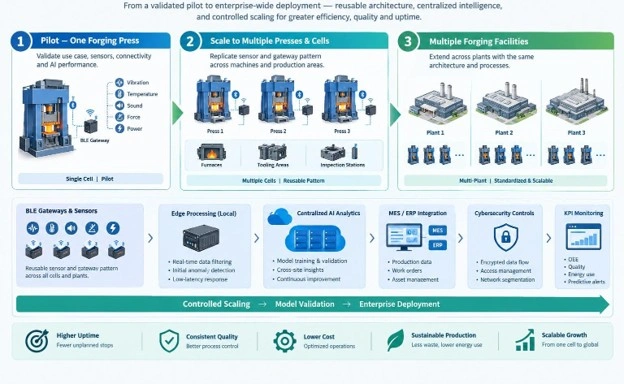
Enterprise forging AI roadmap illustrating the controlled expansion from a pilot press to multiple production cells and plants, with BLE sensors, edge processing, centralized AI analytics, MES/ERP integration, cybersecurity, and KPI monitoring.
Business and Operational Value of AI for Forging Operations
The business case for AI in forging should be connected to measurable production outcomes. AI-based predictive maintenance can reduce avoidable interruptions when the available sensor data provides sufficient warning of equipment degradation. Better die and tooling visibility can reduce search time and improve changeover coordination. Furnace analytics can help identify process deviations before they propagate into downstream quality problems. AI-assisted quality prediction can also shift quality management toward earlier intervention. Instead of identifying every issue only after final inspection, engineers can investigate upstream process variables associated with recurring defects. BLE contributes value where wireless identification, location, or sensing reduces installation complexity or improves visibility that existing wired systems do not provide economically. The greatest benefit occurs when those data streams are combined with manufacturing context and used by AI or analytics software to support an operational decision.
Key Takeaways for AI and BLE in Forging Operations
AI for forging operations is most effective when it addresses a clearly defined production, maintenance, quality, tooling, or material-flow problem.
The main implementation lessons are:
- Start with a measurable forging problem rather than a technology-first deployment.
- Use existing PLC, SCADA, MES, historian, quality, and maintenance data before adding unnecessary sensors.
- Use BLE sensors where wireless measurement provides a practical engineering advantage.
- Use BLE beacons for appropriate movable-asset identification and location applications.
- Place BLE gateways according to actual plant radio conditions rather than theoretical coverage alone.
- Contextualize sensor measurements with machines, tooling, materials, production orders, and timestamps.
- Use edge processing where local availability or low latency matters.
- Select cloud or privately hosted server deployment according to connectivity, data governance, integration, and operational requirements.
- Validate AI recommendations against real maintenance, process, and quality outcomes.
- Protect BLE gateways, servers, software interfaces, and industrial networks with appropriate cybersecurity controls.
- Establish baseline KPIs before deployment so operational improvement can be measured.
- Treat AI models and connected devices as lifecycle-managed engineering assets.
- Expand from validated pilot use cases to additional forging cells only after data quality and operational value are demonstrated.
GAO supports organizations implementing BLE, RFID, and IoT-based hardware and systems for industrial data collection, identification, monitoring, and asset visibility. GAO is headquartered in New York City and Toronto, Canada, and is ranked among the top 10 leading B2B and B2G BLE and RFID suppliers globally. Through our engineering and technical support capabilities, we can help organizations evaluate suitable hardware and system configurations for demanding forging environments.
Building the Future of Industrial AI and IoT with Aperture Venture Studio and GAO RFID Inc.
For more than three decades, GAO Group of Companies has invested heavily in R&D for industrial BLE, RFID, and IoT. As generative AI became increasingly useful for industrial applications, we expanded our work in AI and IoT, including BLE and RFID, and founded Aperture Venture Studio to build, launch, and scale next-generation AI and IoT solutions relevant to industries such as forging and metal processing.
Aperture brings together AI and IoT technical experts, entrepreneurial and operational executives, investors, and leading companies. We have also developed Aperture Ventures Summit and TekSummit to discuss advanced AI and IoT topics.
Together, these activities support technical communities focused on practical industrial AI and IoT development. We welcome you to join us as:
- Advisors, co-founders, or employees
- Investors
- Customers