
AI and BLE for Furniture Production
AI-Driven Furniture Production with BLE
AI is transforming furniture production by helping manufacturers connect material availability, production scheduling, work-in-process movement, equipment conditions, quality activities, warehouse operations, and shipment planning. AI-driven manufacturing systems can analyze production and asset data to identify material shortages, excessive WIP dwell time, equipment abnormalities, bottlenecks, and inventory discrepancies before they create larger operational problems.
BLE Gateways, BLE Beacons, and BLE Sensors can provide physical-world data from furniture factories. Beacons can identify the location of material carts, panel racks, WIP containers, tools, and selected mobile assets. Sensors can provide environmental or equipment-related measurements where appropriate. Gateways collect BLE information and forward it to edge, cloud, or privately hosted software.
For furniture manufacturers, the value comes from combining this physical data with ERP, MES, WMS, QMS, CMMS, production scheduling, and AI analytics. The resulting system can help production teams move from manually searching for materials and investigating delays after they occur to using timely operational information for faster decisions.
AI-Driven Furniture Production End-to-End Workflow with BLE Tracking and Enterprise
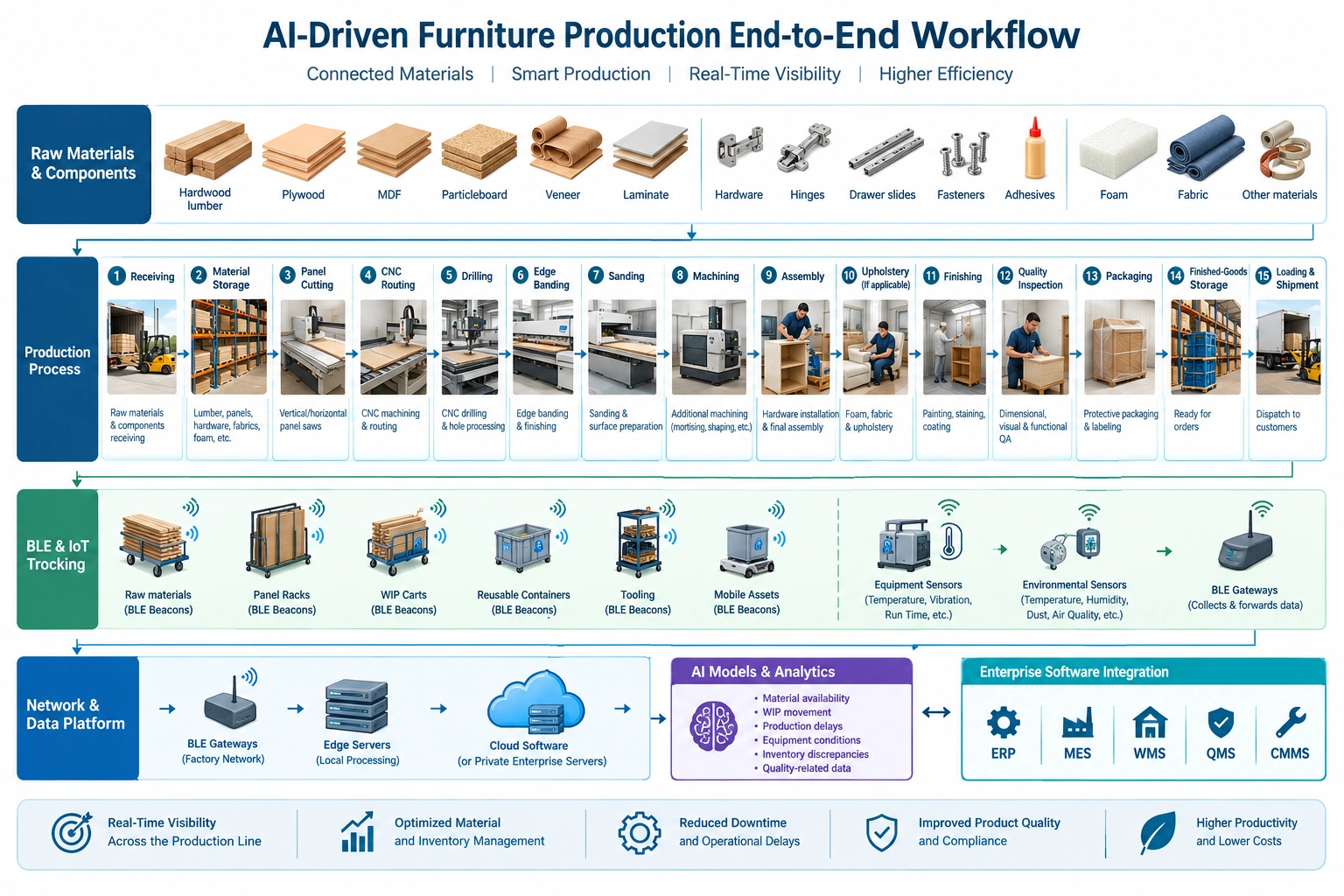
This visual illustrates a complete furniture manufacturing workflow from raw material receiving through production, assembly, finishing, packaging, and shipment. It shows how BLE beacons, sensors, gateways, AI analytics, and enterprise software systems work together to improve visibility, inventory control, production efficiency, quality management, and operational performance.
How AI Is Transforming Furniture Manufacturing Operations
AIoT, or Artificial Intelligence of Things, combines artificial intelligence with IoT devices, sensors, connected equipment, and industrial systems. Furniture manufacturers can apply this approach to physical production processes where material movement, machine conditions, production status, and inventory information influence manufacturing performance.
AI can support furniture production through several closely related applications:
- AI material tracking: Analyze the location and movement of lumber, sheet goods, hardware, components, material carts, and WIP.
- AI inventory management: Compare physical movement and production requirements with ERP and WMS inventory records.
- AI production scheduling: Consider material readiness, machine availability, WIP status, and production priorities when supporting scheduling decisions.
- AI predictive maintenance: Analyze appropriate machine and sensor data to identify abnormal equipment behavior.
- AI quality management: Analyze inspection records, defect categories, production conditions, and process information to identify recurring quality problems.
- AI warehouse management: Improve visibility into finished furniture, packaged components, pallets, carts, and picking activities.
- AI production bottleneck detection: Identify unusual waiting time between panel processing, machining, assembly, finishing, and packaging.
- AI demand and replenishment analysis: Use historical orders, inventory information, and production requirements to support material planning.
BLE serves as an enabling data collection technology rather than the AI itself. The physical information gathered from BLE devices becomes more useful when associated with production orders, material identities, machine records, warehouse transactions, and quality data.
Why Furniture Production Needs AI-Enabled Visibility
Furniture manufacturing contains many material transformations and handoffs. A single finished product can depend on sheet material, cut panels, edge-banded components, machined parts, hardware, fasteners, adhesives, finishing materials, upholstery components, and assembly activities.
Operational problems can occur when:
- A required MDF or plywood panel is available but cannot be located quickly.
- Cut panels remain in a staging area longer than planned.
- CNC-machined components are not transferred to the correct assembly area.
- Hardware kits are separated from the furniture orders that require them.
- WIP carts accumulate between machining and assembly.
- A CNC router, edge bander, panel saw, or sanding machine experiences unexpected downtime.
- Finished furniture remains in a warehouse location that does not match the expected inventory record.
- Packaging or picking delays prevent completed orders from reaching the loading area.
AI can analyze patterns across these events and help identify where attention is required. BLE can provide physical movement and presence information that is difficult to obtain from ERP or MES records alone.
Furniture Production Applications for AI and BLE
AI Tracking for Lumber, Panels, and Raw Materials
Furniture factories may handle hardwood, softwood, plywood, MDF, particleboard, HDF, veneer, laminate, glass, metal components, foam, fabric, adhesives, and hardware. The physical movement of these materials can be difficult to track manually when production areas contain large quantities of similar-looking materials.
AI-enabled material visibility can help manufacturers:
- Monitor the movement of material carts and reusable containers.
- Identify where selected panel racks or material handling assets are located.
- Detect prolonged staging of materials before cutting.
- Compare material availability with production-order requirements.
- Identify unusual movement patterns that may indicate material handling problems.
- Support replenishment decisions for frequently consumed materials.
BLE Beacons can be installed on selected material carts, racks, bins, and reusable containers. BLE Gateways positioned around receiving, storage, cutting, and production areas can collect location-related signals.
The tracking system should maintain the distinction between an asset’s physical location and the material inventory record. ERP or WMS software may remain authoritative for quantity, material code, lot, purchase order, and inventory transaction information.
AI for Panel Cutting and CNC Processing
Panel processing is a critical stage in furniture production. Panel saws, CNC routers, CNC machining centers, drilling machines, and other equipment transform raw sheet goods into components required for downstream operations.
AI can analyze:
- Cutting schedules and production orders.
- Material availability.
- Machine utilization.
- WIP waiting time.
- CNC production queues.
- Machine downtime.
- Rework and scrap records.
- Transfer time between processing stages.
BLE tracking can provide movement information for panel carts and WIP racks. When this data is associated with MES or production-order information, AI can identify unusual waiting patterns.
For example, if cut panels repeatedly remain in a staging zone before CNC drilling, the manufacturer can investigate whether the constraint is machine capacity, scheduling, material handling, operator availability, or an upstream process issue.
AI for Edge Banding, Drilling, and Component Processing
Edge banding and drilling operations often depend on correctly prepared panels reaching the appropriate machine in the required sequence.
AI can support:
- Identification of WIP accumulation before edge banding.
- Analysis of machine utilization.
- Detection of abnormal production-cycle patterns.
- Identification of repeated component handling.
- Coordination of drilling and machining capacity with assembly requirements.
- Analysis of rework associated with component-processing operations.
BLE Beacons on WIP carts can provide movement events between processing areas. The resulting information can be combined with MES data to establish expected versus actual transfer times.
AI for Furniture Assembly and Hardware Management
Assembly operations may include joining panels, installing hinges, drawer slides, handles, fasteners, shelves, legs, doors, and other components. Modular furniture and customized furniture can introduce additional material and order dependencies.
AI-driven assembly visibility can help identify:
- Missing hardware kits.
- WIP waiting before assembly.
- Assembly stations with unusually long cycle times.
- Repeated movement of WIP carts.
- Component shortages affecting specific orders.
- Production orders waiting for machined or finished components.
BLE Beacons can track selected carts, bins, and reusable hardware containers. AI software can correlate movement information with work orders and assembly schedules.
A practical deployment should avoid treating BLE presence as proof that every required component is physically complete. The system should use inventory and production records to establish the actual component requirement.
AI for Upholstery and Furniture Finishing
Upholstered furniture introduces additional processes such as foam preparation, fabric cutting, sewing, frame preparation, upholstery, trimming, and inspection. Wood furniture may instead use staining, painting, coating, drying, sanding, and other finishing processes.
AI can analyze:
- WIP movement between upholstery or finishing operations.
- Material availability.
- Production cycle times.
- Rework and quality records.
- Environmental sensor data where relevant.
- Equipment utilization.
- Finished-product waiting time before packaging.
BLE Sensors can support environmental monitoring where a particular process requires temperature, humidity, or another measurable condition. Sensor selection should be based on the actual process requirement rather than assuming that every finishing operation requires the same measurement.
AI Quality Management for Furniture Production
Furniture quality issues may involve dimensions, surface defects, edge quality, joinery, hardware installation, finish appearance, upholstery workmanship, packaging damage, or other product-specific requirements.
AI-supported quality management can combine:
- Inspection results.
- Defect classifications.
- Rework records.
- Production order information.
- Machine operating data.
- Material information.
- WIP movement.
- Computer vision data where appropriate.
Computer vision can support selected visual inspection tasks, while BLE can provide contextual information about where and when a WIP item moved through the production process.
This combination can help quality teams investigate recurring defects rather than relying only on final inspection results.
AI Solution Matrix for Furniture Manufacturing Operations and BLE-Enabled Process Optimization
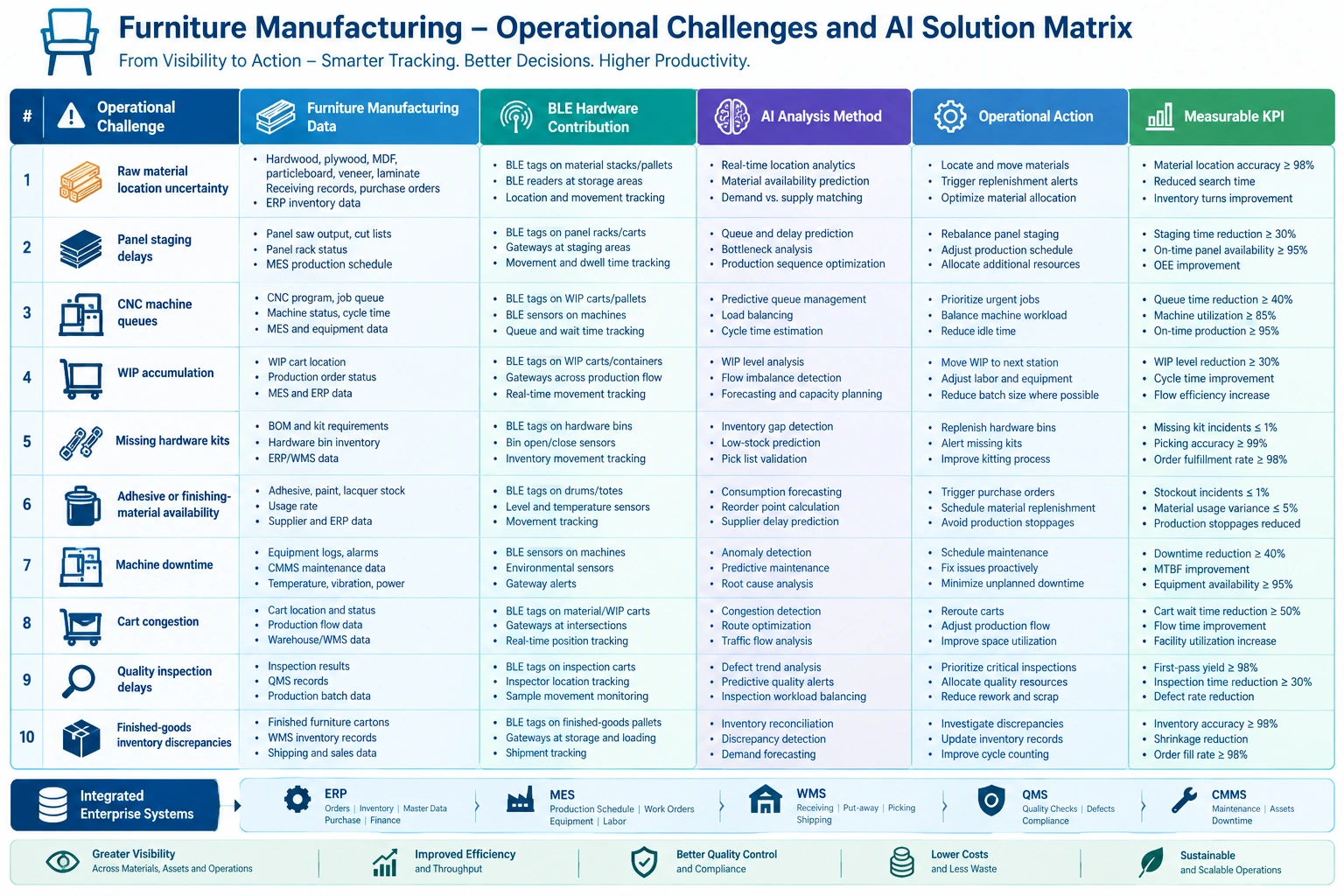
This visual presents a detailed matrix that maps common furniture manufacturing challenges to BLE-enabled data collection, AI analysis techniques, operational responses, and measurable performance indicators. It demonstrates how BLE tracking data combined with ERP, MES, WMS, QMS, and CMMS systems supports improved material flow, production efficiency, inventory accuracy, equipment utilization, and quality control across furniture production facilities.
AIoT Data Flow for Furniture Production
A furniture manufacturing AIoT solution should connect physical production events with operational and business information. The data flow begins with materials, equipment, WIP, and finished products and ends with AI-supported decisions.
Data Acquisition Across Furniture Factory Operations
Potential data sources include:
- BLE Beacons attached to material carts, panel racks, WIP carts, hardware containers, tooling, and selected mobile assets.
- BLE Sensors monitoring suitable equipment or environmental conditions.
- BLE Gateways installed near receiving, raw material storage, panel processing, assembly, finishing, quality, warehouse, and dispatch areas.
- ERP material master and production-order information.
- MES production status and work-center information.
- WMS inventory and warehouse movement records.
- QMS inspection and defect information.
- CMMS maintenance history and work orders.
- Machine controller, PLC, or industrial sensor data where available.
- Operator and production reporting systems.
BLE provides physical visibility into selected assets. ERP, MES, WMS, QMS, CMMS, and machine data provide the context needed to interpret those physical events.
Communication and Data Processing
A typical furniture production data flow can follow this sequence:
Furniture Factory Operations
Raw materials, panel racks, WIP carts, machinery, assembly stations, finishing areas, quality stations, warehouses, and loading areas.
BLE Data Collection
BLE Beacons, BLE Sensors, and BLE Gateways collect asset, location, presence, and selected condition information.
Factory Network
Gateway data moves through the appropriate wired or wireless factory network to local or remote processing resources.
Edge, Cloud, or Private Server
Data can be filtered, buffered, processed, stored, and made available to analytics software.
AI Analytics
AI models analyze material availability, movement patterns, WIP dwell time, machine conditions, inventory discrepancies, production delays, and quality-related information.
Enterprise Systems
ERP, MES, WMS, QMS, CMMS, and other compatible business systems provide additional operational context.
Business Action
Production teams can investigate delays, move WIP, replenish materials, schedule maintenance, adjust production priorities, or investigate quality problems.
Edge Processing for Furniture Factories
Edge processing can be useful when furniture production requires local data handling or rapid response. A factory may process selected BLE events locally before sending relevant information to cloud or private-server software.
Potential reasons include:
- Limited or intermittent external network connectivity.
- Requirement for local event processing.
- Reduced transmission of unnecessary raw data.
- Local operational dashboards.
- Integration with factory-managed systems.
- Faster handling of selected production events.
Edge processing should be designed according to actual latency requirements. Not every BLE event requires real-time AI inference, and excessive processing at the edge can increase deployment complexity without providing meaningful operational value.
Furniture Manufacturing Systems and AI Integration
AI-driven furniture production becomes more useful when physical tracking information is connected to the systems that already manage manufacturing operations.
ERP and Material Planning Integration
ERP systems may contain:
- Material master records.
- Purchase orders.
- Supplier information.
- Production orders.
- Bill of materials.
- Inventory quantities.
- Product and component information.
- Material requirements.
AI can use this information to compare planned requirements with physical material movement. For example, if a production order requires a specific panel material, the system can combine ERP requirements with the location of relevant material handling assets.
MES Integration for Production Visibility
MES software can provide production status, work-center information, production schedules, and work-order events.
Integration with AI and BLE can associate physical WIP movement with manufacturing operations. This can help identify situations where a cart has reached a production area but the corresponding manufacturing operation has not started, or where WIP remains in a staging zone longer than expected.
Important integration fields may include:
- Asset identifier.
- Work-order identifier.
- Production operation.
- Work center.
- Department.
- Timestamp.
- Material or component identifier.
- WIP status.
- Production quantity.
WMS Integration for Furniture Warehousing
Furniture warehouses may contain raw materials, components, flat-packed products, assembled furniture, pallets, cartons, and customer orders.
WMS integration can connect physical movement with inventory transactions, picking, staging, and dispatch.
BLE tracking may help locate selected carts, pallets, racks, or reusable containers, while the WMS remains responsible for inventory transactions and warehouse records.
QMS and CMMS Integration
QMS integration can connect WIP and production information with inspection results, defects, rework, and corrective actions.
CMMS integration can connect machine-related information with maintenance work orders, service history, spare parts, and maintenance schedules.
AI can analyze these combined datasets to identify recurring relationships between equipment conditions, production delays, maintenance events, and quality problems.
BLE Hardware and AI Software for Furniture Production
Furniture manufacturers should select BLE hardware according to the physical assets, movement patterns, environmental conditions, and location requirements of each production area. BLE is most valuable when it supplies reliable physical-world information that can be combined with manufacturing and business data.
BLE Beacons for Furniture Materials and WIP
BLE Beacons can be attached to selected mobile assets rather than directly to every individual furniture component. Suitable applications may include:
- Material carts carrying plywood, MDF, particleboard, veneer, or laminate.
- Panel racks used between cutting and machining operations.
- WIP carts carrying cut or machined furniture components.
- Reusable bins containing hardware, fasteners, hinges, drawer slides, or handles.
- Tooling carts and selected mobile production equipment.
- Pallets, carts, or reusable containers used for finished furniture.
Each beacon should have a unique identifier associated with an asset record in the tracking software. The association between a beacon and its assigned asset should be maintained through commissioning and asset-management procedures.
A beacon provides an identification and signal source. It should not be treated as an inventory system by itself. Material quantity, product configuration, bill of materials, and production-order information should remain associated with the appropriate manufacturing or business system.
BLE Gateways for Furniture Factory Visibility
BLE Gateways receive signals from nearby BLE devices and transfer the collected information to the appropriate software environment.
Potential gateway locations include:
- Raw material receiving.
- Lumber and sheet-good storage.
- Panel cutting.
- CNC machining.
- Edge banding and drilling.
- Assembly.
- Upholstery or finishing.
- Quality inspection.
- Finished-goods storage.
- Shipping and loading areas.
Gateway placement should be determined through a site survey and testing. Metal machinery, storage racks, building materials, production layouts, and other radio-frequency conditions can affect BLE signal behavior.
A zone-level tracking requirement generally has different gateway requirements from an application that needs more precise location determination. Manufacturers should define the required location resolution before finalizing hardware quantities.
BLE Sensors for Equipment and Environmental Monitoring
BLE Sensors can collect selected measurements from furniture production environments and equipment.
Potential applications include:
- Environmental monitoring in material storage areas.
- Temperature or humidity monitoring where materials or processes require it.
- Condition measurements for appropriate production equipment.
- Monitoring selected finishing or storage environments.
- Providing time-series data for AI anomaly detection.
Machine condition monitoring may also require PLC data, industrial sensors, vibration sensors, current measurements, or machine-controller information. A BLE Beacon used for asset identification does not provide predictive-maintenance information unless paired with appropriate sensing capabilities.
AI Methods for Furniture Manufacturing
AI methods should be selected according to the manufacturing problem rather than added simply because AI is available.
Relevant approaches include:
- Machine learning: Identify recurring patterns in production delays, material movement, equipment utilization, and inventory discrepancies.
- Anomaly detection: Identify unusual WIP dwell times, unexpected asset movement, or abnormal sensor measurements.
- Predictive analytics: Estimate potential equipment or production risks using historical and current data.
- Time-series analysis: Analyze equipment or environmental measurements over time.
- Computer vision: Support selected surface, dimensional, assembly, or finish inspection tasks when suitable image data is available.
- Optimization: Support production scheduling, material allocation, and resource planning.
- Rules-based automation: Trigger alerts or workflows when predefined operational conditions occur.
AI model outputs should be validated against actual furniture production events. False positives, missed events, and changing production conditions should be monitored after deployment.
Cloud Version and Server Version for Furniture Manufacturing
Furniture manufacturers may require different software deployment models depending on their IT policies, factory connectivity, integration requirements, and data governance practices.
Cloud Version
The Cloud Version uses cloud-hosted software managed within cloud infrastructure. It can be appropriate for manufacturers operating multiple furniture plants or requiring centralized access to production and warehouse information.
Potential advantages include:
- Centralized software management.
- Multi-factory visibility.
- Cloud-based analytics and AI processing.
- Remote access for authorized personnel.
- Integration with cloud-hosted ERP, MES, WMS, QMS, or maintenance systems.
- Centralized reporting and software updates.
Reliable connectivity remains important. Where a furniture factory has intermittent external connectivity, local buffering or edge processing can preserve important events until communication is restored.
Server Version
The Server Version uses software deployed on edge servers, customer-managed servers, private data centers, factory servers, or other privately hosted enterprise infrastructure.
This approach can be appropriate when a furniture manufacturer requires:
- Customer-controlled software hosting.
- Private-network operation.
- Local processing of production information.
- Integration with privately hosted ERP or MES systems.
- Specific data governance requirements.
- Reduced dependence on external connectivity.
Server Version does not mean only a traditional on-premises server. A company may use a privately hosted server at another corporate facility or a customer-managed private data center.
Selecting the Appropriate Deployment
The deployment decision should consider the actual furniture manufacturing environment.
| Requirement | Cloud Version | Server Version |
|---|---|---|
| Multi-factory visibility | Strong fit | Possible with appropriate networking |
| Customer-controlled hosting | More limited | Strong fit |
| Local processing | Can use edge components | Strong fit |
| Private factory network | Depends on connectivity | Strong fit |
| Centralized software maintenance | Generally simpler | More customer-managed |
| Intermittent external connectivity | Requires local buffering or edge processing | Local processing can reduce dependency |
| Existing private enterprise systems | Requires secure integration | Often suitable where compatible |
A hybrid approach can also be appropriate. BLE Gateways and edge computing can handle selected factory operations locally while cloud or private-server software performs broader analytics, reporting, and multi-site management.
Cybersecurity and Data Governance for Furniture Production
AI and BLE systems should be incorporated into the furniture manufacturer’s existing IT and operational technology security practices.
BLE and Gateway Security
Relevant controls can include:
- Device identity and controlled device registration.
- Secure gateway configuration.
- Protected communication between gateways and software.
- Access control for gateway administration.
- Firmware and software update procedures.
- Monitoring of unexpected devices or abnormal communication.
- Battery and device-maintenance procedures.
The exact security capabilities depend on the selected hardware and software.
Enterprise Software Security
Integration with ERP, MES, WMS, QMS, and CMMS should use controlled interfaces and appropriate authentication.
Furniture manufacturers should consider:
- Role-based access control.
- Network segmentation where appropriate.
- Encryption in transit and at rest where supported.
- API authentication and authorization.
- Audit logging.
- Backup and recovery.
- Vulnerability and patch management.
- Data retention policies.
- Controlled access to production and inventory information.
The security model should distinguish between physical tracking events, inventory records, production information, maintenance data, and AI-generated recommendations.
AI Data Quality and Model Governance
AI decisions require reliable manufacturing data. A furniture manufacturer should monitor:
- Asset identifier accuracy.
- Timestamp consistency.
- Missing tracking events.
- Duplicate events.
- Incorrect asset-to-material associations.
- BLE location accuracy within required zones.
- ERP and WMS inventory reconciliation.
- AI false-positive and false-negative rates.
- Model performance over time.
Production personnel should have defined procedures for reviewing significant AI recommendations rather than automatically executing every recommendation.
Operational Benefits of AI-Driven Furniture Production
Faster Material and WIP Identification
AI-supported asset visibility can reduce the time production personnel spend searching for material carts, panel racks, WIP carts, hardware containers, and other mobile assets.
The benefit comes from combining physical location information with production requirements. A production planner can determine not only where a selected cart is located, but also which order or operation requires its contents when the appropriate manufacturing data is available.
Reduced Production Waiting Time
AI can analyze WIP dwell time between cutting, CNC machining, edge banding, drilling, assembly, finishing, and packaging.
Repeated delays can reveal process constraints that may otherwise be difficult to identify. Production managers can investigate whether the underlying cause is machine capacity, scheduling, material shortages, labor availability, transportation between work areas, or quality rework.
Better Equipment Utilization and Maintenance Planning
AI can combine machine utilization, maintenance history, production schedules, and suitable sensor data to identify equipment conditions that deserve investigation.
Relevant equipment may include:
- Panel saws.
- CNC routers.
- CNC machining centers.
- Edge banding machines.
- Drilling machines.
- Sanding equipment.
- Finishing equipment.
- Compressors and supporting utilities.
The objective is not simply to predict failure. A useful system should help maintenance teams prioritize inspections and coordinate maintenance with production schedules.
Improved Inventory Accuracy
Finished furniture, components, pallets, carts, and reusable containers can move through several warehouse and production locations. AI can identify discrepancies between expected and observed movement patterns.
BLE can provide physical movement information, while WMS and ERP systems remain important sources for inventory transactions and product records.
Improved Quality Investigation
Quality teams can use production and movement history to investigate where a defective product or component passed through the manufacturing process.
Combining QMS records with WIP movement, machine information, material data, and production-order information can help identify recurring sources of defects and rework.
Furniture Production KPIs for AI and BLE Deployments
Manufacturers should establish measurable objectives before deployment. Useful KPIs can include:
- Material search time.
- Material staging time.
- WIP dwell time.
- Production-order cycle time.
- Production schedule adherence.
- Machine utilization.
- Unplanned machine downtime.
- Mean time between failures.
- Mean time to repair.
- Inventory location accuracy.
- Finished-goods picking accuracy.
- Hardware-kit shortage rate.
- First-pass yield.
- Rework rate.
- Scrap rate.
- Quality inspection cycle time.
- Order fulfillment time.
- Warehouse dwell time.
- Loading delay.
- On-time shipment rate.
The selected KPIs should correspond to the actual problem being addressed. Tracking large volumes of BLE events without linking them to measurable operational outcomes does not by itself create manufacturing value.
Implementing AI and BLE in Furniture Production
Define the Furniture Manufacturing Use Case
Implementation should begin with a clearly defined operational problem rather than hardware installation.
Typical starting points include:
- Difficulty locating sheet goods or material carts.
- Excessive WIP accumulation.
- Poor visibility between CNC processing and assembly.
- Machine downtime affecting production schedules.
- Finished-goods inventory discrepancies.
- Repeated quality or rework problems.
- Inefficient warehouse picking and staging.
The manufacturer should establish baseline KPIs before deploying the solution.
Select Assets, Hardware, and Data Sources
The next step is to identify the assets and information required to solve the selected problem.
The assessment should cover:
- Material carts and racks.
- WIP carts and containers.
- Hardware bins.
- Tooling and mobile equipment.
- Finished-goods pallets.
- BLE Gateway locations.
- Required BLE Sensor measurements.
- ERP, MES, WMS, QMS, and CMMS data.
- Existing machine and PLC information.
Not every furniture component requires an individual BLE device. Tracking should focus on assets whose location or condition materially affects the target workflow.
Conduct Site Survey and Commissioning
A factory survey should evaluate:
- Production-area layout.
- Metal structures and machinery.
- Gateway mounting locations.
- Radio-frequency conditions.
- Network connectivity.
- Asset movement paths.
- Required location zones.
- Power availability.
- Environmental conditions.
Commissioning should verify beacon registration, gateway communication, asset associations, event timestamps, location behavior, network connectivity, and software integration.
Integrate and Test with Real Production
Testing should use actual furniture manufacturing workflows rather than laboratory-only scenarios.
A practical pilot can evaluate:
- Material movement from receiving to storage.
- Panel movement from storage to cutting.
- WIP movement from cutting to CNC machining.
- Component movement to assembly.
- Finished-product movement to warehouse.
- Warehouse picking and shipping.
- Equipment monitoring.
- Quality-event association.
The manufacturer should compare system events with physical production events and existing ERP, MES, and WMS records.
Optimize and Scale
After the initial deployment, manufacturers can evaluate gateway placement, tracking coverage, data quality, AI performance, alert thresholds, and user workflows.
Expansion can then proceed to additional production areas such as:
- Raw material storage.
- Panel processing.
- CNC machining.
- Edge banding and drilling.
- Assembly.
- Upholstery.
- Finishing.
- Quality inspection.
- Finished-goods warehousing.
- Shipping.
GAO supplies BLE, RFID, and IoT hardware products and systems that organizations can use for asset tracking, sensing, and connected operational applications. Our engineering support can help organizations evaluate appropriate hardware and deployment requirements for furniture production use cases.
GAO Expertise for AI-Enabled Furniture Production
GAO is headquartered in New York City and Toronto, Canada, and is ranked among the top 10 leading B2B and B2G, with a lesser degree of B2B2C and B2D, BLE and RFID suppliers in the world. GAO supplies hardware products and systems for organizations requiring BLE, RFID, and IoT-based data collection and operational visibility.
GAO, GAO Research Inc., and GAO Tek Inc. form GAO Group, with operations based in New York City and Toronto. For three decades, GAO Group has served customers across the United States and Canada, including Fortune 500 companies, leading R&D firms, prestigious universities, and U.S. and Canadian government agencies.
Our substantial investment in R&D, stringent quality assurance processes, and remote or onsite expert support help organizations evaluate and deploy technology according to their operational requirements.
Key Takeaways for AI and BLE in Furniture Production
AI-driven furniture production is most effective when AI analytics are connected to reliable manufacturing, inventory, equipment, and physical asset data.
Key implementation considerations include:
- Use AI to address measurable furniture manufacturing problems such as WIP delays, material shortages, equipment downtime, inventory discrepancies, and quality issues.
- Use BLE Beacons to identify selected mobile assets rather than assuming every furniture component requires a beacon.
- Use BLE Sensors when actual equipment or environmental measurements are required.
- Use BLE Gateways according to the required factory coverage and location resolution.
- Integrate physical tracking with ERP, MES, WMS, QMS, and CMMS information.
- Establish KPI baselines before deployment.
- Validate BLE events against actual furniture production workflows.
- Select Cloud Version, Server Version, edge processing, or a hybrid approach according to IT, connectivity, integration, and data governance requirements.
- Treat cybersecurity, data quality, and AI model validation as part of the deployment rather than as post-deployment activities.
Furniture manufacturers evaluating AI-driven asset tracking, inventory management, production visibility, equipment monitoring, and warehouse operations can learn more about GAO’s BLE, RFID, and IoT hardware products, systems, engineering capabilities, and technical support.
Building the Future of Industrial AI and IoT with Aperture Venture Studio and GAO RFID Inc.
For more than three decades, GAO Group of Companies has invested heavily in R&D of industrial BLE, RFID, and IoT. Since generative AI proved useful in industrial applications, we have developed AI and IoT technologies, including BLE and RFID, and founded Aperture Venture Studio to develop and scale AI and IoT solutions relevant to industries such as furniture manufacturing.
Aperture attracts AI and IoT technical experts, entrepreneurial and operational executives, influential investors, and leading companies. We also organize the Aperture Ventures Summit and TekSummit to discuss advanced AI and IoT topics.
We welcome you to join us as:
- Advisors, Co-founders, or Employees
- Investors
- Customers