
AI and BLE for Gas Distribution Networks
AI-Driven Gas Distribution Monitoring and Field Operations
Artificial intelligence is changing how gas distribution networks collect, interpret, and act on operational data from pipelines, regulator stations, valves, service connections, odorization equipment, and field assets. AIoT combines AI with connected sensors, gateways, beacons, and operational systems to convert distributed measurements into actionable information for gas utilities. BLE provides a practical low-power communications layer for selected monitoring, asset-location, worker-support, and environmental sensing applications, particularly where wiring is expensive or difficult. AI can correlate BLE-derived telemetry with SCADA, GIS, work management, inspection, weather, maintenance, and historical incident data to identify abnormal conditions and prioritize field actions. For gas distribution operators, the value is not simply more sensor data. The objective is better risk evaluation, faster anomaly recognition, more informed maintenance, improved field productivity, and stronger operational visibility while preserving required safety procedures and human decision authority. PHMSA’s Distribution Integrity Management Program requires operators to understand system characteristics, identify threats, evaluate risks, implement measures, monitor performance, and continually improve the program. (PHMSA)
AI-Enabled BLE System for Gas Distribution Network Monitoring
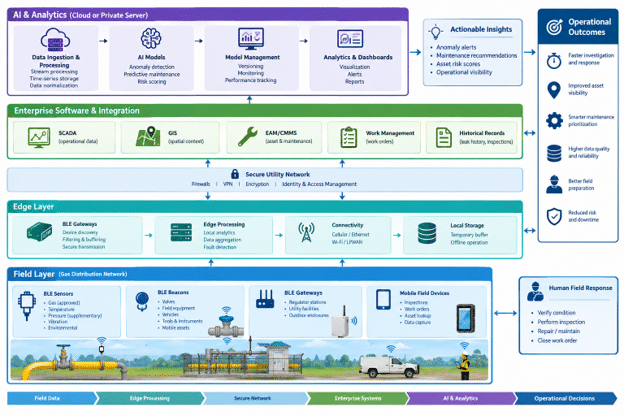
This visual illustrates how BLE sensors, beacons, gateways, edge processing, and utility software connect gas distribution field data with AI analytics. It highlights the flow from asset monitoring to anomaly detection, predictive maintenance, and human field response.
What AI Means for Gas Distribution Networks
AI for gas distribution networks is most useful when it addresses a defined operational decision rather than simply adding another analytics dashboard. A practical AIoT implementation combines field observations with asset context, historical records, operating conditions, and work history.
Relevant AI methods include:
- Anomaly detection: identifies unusual pressure, temperature, vibration, acoustic, environmental, occupancy, or equipment-state patterns.
- Time-series machine learning: evaluates changing measurements from regulators, stations, meters, and distributed sensors.
- Predictive maintenance: estimates deterioration or abnormal behavior so maintenance teams can investigate before equipment performance degrades further.
- Risk-based prioritization: combines asset condition, location, service population, threat history, inspection results, and operational context to support maintenance planning.
- Computer vision: can analyze inspection imagery for selected above-ground assets, signage, vegetation encroachment, excavation indicators, corrosion evidence, or equipment condition.
- Natural-language AI: can help technicians and engineers retrieve information from inspection records, operating procedures, maintenance histories, and engineering documentation.
- Forecasting: can support demand, pressure, workload, environmental-condition, and resource planning when adequate historical data is available.
- Edge AI: can perform selected detection tasks near the field device when latency, connectivity, bandwidth, or data-retention requirements make continuous cloud processing unsuitable.
The distinction between an AI prediction and a safety decision is important. AI output should normally be treated as decision support unless the specific application has been engineered, validated, approved, and governed for automated control. Gas distribution operations involve physical hazards, regulated procedures, and consequences that can extend beyond the IT environment.
PHMSA’s current DIMP guidance emphasizes risk evaluation, high-risk infrastructure, interactive threats, leak-management effectiveness, and appropriate risk models. AI can support those activities, but it does not replace an operator’s integrity-management responsibilities. (PHMSA)
Where AI Creates Operational Value in Gas Distribution
Gas distribution networks are geographically dispersed and contain large numbers of assets with different operating histories, materials, configurations, and environmental exposures. This creates an unusually strong use case for combining localized sensing with centralized analytics.
Leak Detection and Environmental Monitoring
Gas leak management is one of the most safety-sensitive applications. BLE-connected sensors can provide localized measurements in selected controlled environments, facilities, valve locations, regulator stations, meter areas, or other locations where sensor placement and hazardous-location requirements permit.
AI can compare sensor readings against baseline conditions and contextual variables to identify patterns that warrant investigation.
A technically sound implementation should distinguish:
- Gas concentration sensing from regulatory leak survey procedures
- Early-warning monitoring from certified gas detection
- Sensor alarm thresholds from AI anomaly scores
- Field investigation from automated intervention
- BLE communications availability from actual sensor availability
- Correlated evidence from a single anomalous measurement
AI becomes more useful when a potential anomaly is correlated with asset location, recent maintenance, weather, excavation activity, pressure behavior, previous leak history, and inspection records.
Regulator Station and Valve Monitoring
Regulator stations contain equipment whose condition can influence pressure management and distribution reliability. BLE sensors can provide supplementary telemetry for selected temperature, vibration, enclosure, environmental, or equipment-state measurements.
AI models can identify deviations from normal operating signatures and prioritize inspection.
Potential applications include:
- Regulator enclosure condition monitoring
- Temperature trend analysis
- Vibration-based equipment condition monitoring
- Valve-position verification where appropriate instrumentation exists
- Unauthorized enclosure opening detection
- Water ingress or abnormal environmental-condition detection
- Battery-powered sensor health monitoring
- Station equipment inspection prioritization
- Maintenance-history correlation
BLE should not be assumed to replace existing SCADA instrumentation. A better engineering approach is to use BLE where wireless supplementary sensing is technically appropriate and integrate the resulting information with established operational systems.
Field Asset Visibility and Work Management
Gas distribution utilities manage valves, regulators, service equipment, test instruments, leak detection equipment, vehicles, excavation tools, PPE, calibration equipment, and other field resources.
BLE beacons can associate physical assets with digital identities and location observations. BLE gateways can collect beacon or sensor transmissions at depots, stations, vehicles, maintenance facilities, and other instrumented areas.
AI can then help identify:
- Equipment frequently moved between work areas
- Assets that remain unused despite maintenance demand
- Missing or unexpectedly relocated equipment
- Repeated equipment searches
- Abnormal movement patterns
- Maintenance resources likely to be required for upcoming work
- Work orders affected by equipment availability
GAO supplies BLE gateways, beacons, sensors, and related IoT hardware that can be configured for asset visibility and monitoring requirements. Its existing BLE and RFID experience includes asset-tracking applications where location awareness and physical identification need to be connected to operational software. (GAO RFID)
BLE Asset Visibility and AI Analytics for Gas Distribution Networks
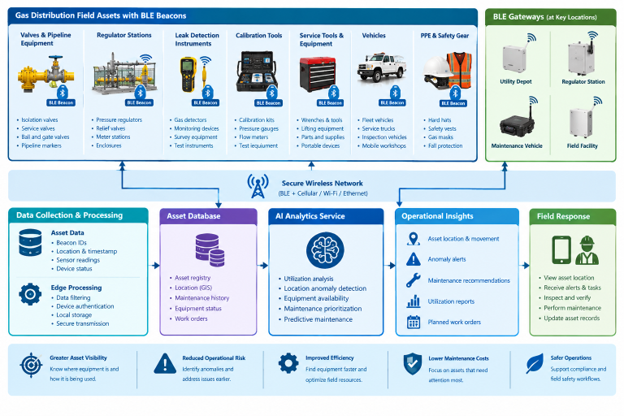
This infographic shows how BLE beacons attached to gas distribution equipment, tools, vehicles, and safety gear connect through BLE gateways to asset databases and AI analytics. It illustrates how location, utilization, equipment status, and maintenance data support anomaly detection, work prioritization, and safer field operations.
Field Technician Productivity and Safety Support
Gas distribution field technicians routinely work across geographically distributed assets. Their work can involve locating valves, reviewing asset records, inspecting facilities, documenting conditions, carrying specialized equipment, and responding to work orders.
BLE can support selected operational workflows by providing proximity or location context for equipment and workers where appropriate.
AI can use that information alongside:
- Work-order status
- Asset hierarchy
- GIS location
- Technician qualifications
- Equipment availability
- Historical maintenance
- Inspection requirements
- Travel time
- Site access conditions
- Weather information
The resulting system can help dispatchers and supervisors make better-informed resource decisions. It should not bypass qualification requirements, permit procedures, lockout/tagout requirements, confined-space procedures, hazardous-location requirements, or other established safety controls.
Gas Distribution AIoT Deployment Scenarios
A useful deployment begins with a clearly defined operational problem and then determines which measurements are required to support the decision.
| Gas distribution scenario | Data captured | AI contribution | Operational action |
|---|---|---|---|
| Regulator station monitoring | Temperature, vibration, enclosure state, environmental data | Anomaly detection and condition assessment | Inspection or maintenance review |
| Field equipment tracking | BLE beacon identity, gateway observations, location context | Utilization and movement analysis | Reallocate or locate equipment |
| Leak-management support | Gas sensor readings and asset context | Pattern recognition and prioritization | Field verification |
| Valve and facility inspection | Asset identity, inspection records, location | Risk-based work prioritization | Schedule inspection |
| Maintenance depot management | Equipment location and availability | Demand and utilization analysis | Prepare equipment for field work |
| Technician workflow support | Asset proximity, work order, equipment data | Task-context recommendations | Improve field preparation |
| Environmental monitoring | Temperature, humidity, enclosure or facility conditions | Threshold and anomaly detection | Investigate abnormal conditions |
| Asset condition management | Sensor telemetry plus maintenance history | Predictive maintenance models | Plan maintenance |
These applications should be evaluated according to the actual hazard classification, sensing technology, required accuracy, environmental conditions, wireless coverage, battery-life requirements, cybersecurity controls, and regulatory obligations.
From Gas Distribution Field Data to AI-Driven Decisions
The complete workflow begins at the physical asset and ends with an operational action. BLE is only one part of that chain.
Data Acquisition at Gas Distribution Assets
Sensors and beacons generate measurements or identifiers associated with physical equipment. Depending on the use case, data can include temperature, vibration, humidity, gas concentration, equipment state, beacon identity, battery condition, signal strength, or proximity information.
Sensor selection should begin with the measurement requirement, not with the wireless protocol. For example, a utility should first establish the required measurement range, accuracy, response time, calibration interval, environmental rating, hazardous-location requirements, and maintenance procedure before selecting a BLE sensor.
BLE Communication and Gateway Collection
BLE gateways receive wireless transmissions from nearby sensors or beacons and forward relevant information to an edge server, utility network, or cloud service.
Bluetooth LE supports low-power communications, while Bluetooth Mesh can support many-to-many device networks designed for large-scale monitoring and automation applications. Bluetooth SIG documentation describes Mesh as suitable for networks containing tens, hundreds, or thousands of devices, with provisioning and security mechanisms designed for commercial and industrial deployments. (Bluetooth® Technology Website)
Gas distribution deployments still require RF engineering. Steel cabinets, underground structures, pressure-regulation equipment, concrete structures, electrical equipment, terrain, vehicles, and other obstructions can alter signal behavior. Gateway placement should therefore be validated through site surveys rather than determined only from nominal radio range.
Edge Processing and Data Normalization
An edge gateway or local server can perform initial processing before data reaches enterprise analytics software.
Typical functions include:
- Device authentication
- Data validation
- Timestamp normalization
- Duplicate filtering
- Sensor-health checks
- Buffering during network outages
- Local threshold evaluation
- Protocol conversion
- Data compression
- Local anomaly detection
- Secure forwarding to centralized systems
Edge processing is particularly useful for geographically distributed gas facilities where connectivity is intermittent or where sending every raw measurement to a central system would create unnecessary bandwidth and storage requirements.
Enterprise Data Integration
AI becomes substantially more useful when wireless observations are associated with authoritative utility records.
Potential integrations include:
- SCADA
- GIS
- EAM
- CMMS
- Work management software
- Asset registries
- Leak-management databases
- Inspection management systems
- Mobile workforce applications
- Historian databases
- Environmental and weather data
- Identity and access management systems
GIS provides spatial context. EAM and CMMS provide asset and maintenance context. SCADA provides operational process information. Work management systems provide the field-action context. AI can combine these information sources to generate more useful operational signals than isolated sensor data can provide.
End-to-End AIoT Workflow for BLE-Enabled Gas Distribution Operations
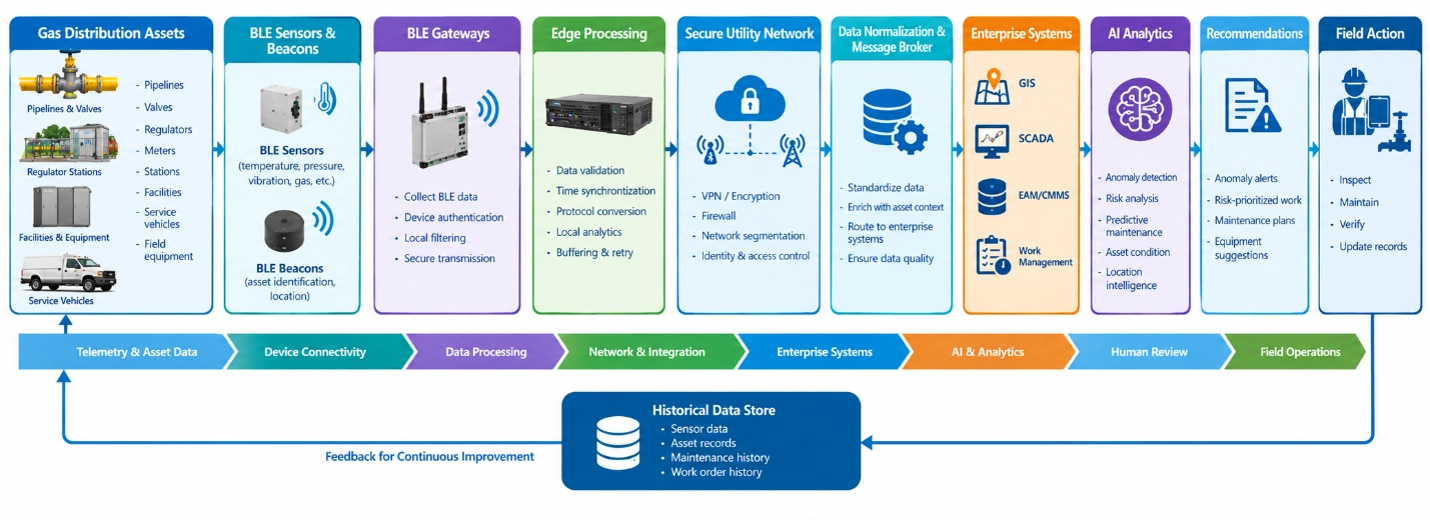
This workflow diagram illustrates how gas distribution asset data moves from BLE sensors and beacons through gateways, edge processing, secure utility networks, enterprise systems, and AI analytics. It shows how AI-generated recommendations reach human field teams and feed verified results back into historical data.
AI Analytics and Decision Support
The analytics layer should transform normalized observations into outputs that operations teams can understand and verify.
A practical gas distribution AI system may produce:
- Anomaly scores
- Asset condition indicators
- Risk-prioritized work queues
- Maintenance recommendations
- Sensor-health alerts
- Equipment utilization reports
- Geographic anomaly clusters
- Inspection-priority suggestions
- Trend forecasts
- Natural-language summaries of supporting evidence
The AI output should retain traceability. Engineers should be able to determine which measurements, assets, timestamps, maintenance records, and model conditions contributed to an alert.
That requirement becomes especially important when AI outputs influence integrity-management activities. PHMSA requires operators to maintain a DIMP process that evaluates threats and risks, implements measures, measures performance, and periodically evaluates and improves the program. AI should therefore be incorporated into existing governance rather than treated as an independent decision process. (PHMSA)
Engineering Considerations Before Deployment
Gas distribution environments introduce constraints that are different from ordinary commercial IoT deployments.
Hazardous Locations and Sensor Certification
A BLE sensor is not automatically suitable for installation near natural gas equipment. Equipment selection must account for the applicable hazardous-location classification, certification requirements, enclosure characteristics, temperature range, ingress protection, intrinsic-safety requirements where applicable, and local utility engineering standards.
A wireless sensor that works well in a general equipment room may be unsuitable in a classified location. The sensing element, battery, electronics, enclosure, antenna, and installation method all need to be evaluated as part of the intended deployment.
Measurement Quality and Calibration
AI cannot compensate indefinitely for poor instrumentation.
Gas distribution operators should establish:
- Sensor accuracy requirements
- Calibration intervals
- Sensor drift limits
- Battery replacement procedures
- Environmental operating limits
- Data-quality thresholds
- Missing-data handling
- Outlier treatment
- Reference-instrument procedures
- Maintenance ownership
AI models should distinguish a physical anomaly from a sensor anomaly. A sudden change in readings can represent an actual field condition, sensor degradation, communication loss, calibration drift, or a damaged device.
Wireless Coverage and Battery Life
BLE deployments should be engineered around the actual physical environment rather than theoretical range.
Important variables include:
- Gateway density
- Antenna orientation
- Building materials
- Metallic structures
- Underground locations
- Transmission interval
- Advertising interval
- Connection duration
- Transmit power
- Battery chemistry
- Temperature
- Sensor sampling rate
- Network topology
- Required data latency
Bluetooth LE includes mechanisms such as LE Power Control and LE Coded PHY that can influence range, reliability, and power consumption depending on device support and deployment conditions. (Bluetooth® Technology Website)
OT Cybersecurity and Network Segmentation
Wireless sensing should not create an uncontrolled pathway into operational technology networks.
A gas distribution deployment should consider:
- Device identity and authentication
- Encryption in transit
- Secure provisioning
- Credential management
- Gateway hardening
- Network segmentation
- Least-privilege access
- Firmware management
- Vulnerability management
- Logging and monitoring
- Certificate or key lifecycle management
- Remote-access controls
- Data retention
- Incident-response procedures
NIST’s OT security guidance emphasizes that operational technology has unique performance, reliability, and safety requirements and recommends security measures that account for the physical consequences of OT systems. (NIST) NIST CSF 2.0 provides a broader risk-management framework that can be used to organize cybersecurity outcomes, governance, and risk-management activities. (NIST)
Deployment Planning for Gas Distribution Networks
A technically successful project normally begins with a bounded operational use case rather than a network-wide sensor rollout.
The planning process should establish:
- Which gas distribution asset or workflow needs improvement
- Which operational decision the AI system will support
- What measurements are actually required
- Which measurements already exist in SCADA or other systems
- Which new sensors are necessary
- Where BLE coverage is technically feasible
- Whether the installation location has hazardous-area restrictions
- How data will be associated with GIS and asset records
- Which team owns the resulting alert
- What constitutes an actionable anomaly
- How alerts will be verified in the field
- How false positives and false negatives will be measured
- What cybersecurity controls are required
- Which regulatory and utility engineering requirements apply
For U.S. gas distribution operators, this planning should be aligned with the operator’s applicable requirements under 49 CFR Part 192 and its DIMP processes. PHMSA’s current Part 192 materials specifically identify requirements applicable to gas distribution integrity management, including §192.1007 and related provisions. (PHMSA)
GAO can support this type of deployment with BLE gateways, beacons, sensors, RFID hardware, and related IoT systems, allowing the wireless layer to be selected according to the operational requirement rather than forcing a single hardware configuration across every gas distribution location. GAO’s documented experience includes BLE and RFID systems for asset tracking and other operational environments, supported by R&D and technical support capabilities. (GAO RFID)
AI-Enabled Gas Distribution Performance and Operational Benefits
Combining AI with connected field sensing can improve gas distribution operations when the underlying data is reliable, correctly associated with assets, and incorporated into established work processes. The strongest results generally come from connecting AI outputs to decisions that already have an accountable owner.
Faster Detection of Abnormal Conditions
AI can continuously evaluate incoming measurements instead of relying exclusively on periodic manual review. A model can establish a baseline for a regulator station, facility, sensor, or other monitored asset and identify deviations that warrant investigation.
For example, an anomaly model can consider a temperature or vibration change together with asset age, recent maintenance, operating conditions, and previous observations. This provides more context than a fixed threshold alone.
The practical benefit is earlier identification of conditions requiring human investigation, not an assumption that every model-generated anomaly represents a confirmed gas leak or equipment failure.
Risk-Based Maintenance Prioritization
Gas distribution utilities often have more inspection and maintenance requirements than field personnel can address simultaneously. AI can help organize available information into a prioritized work queue.
Useful inputs can include:
- Asset criticality
- Material and construction characteristics
- Asset age
- Leak history
- Inspection findings
- Maintenance history
- Sensor trends
- Operating conditions
- Geographic location
- Nearby excavation or construction activity
- Previous failure patterns
- Work-order history
A risk model can then identify assets requiring closer review. Engineers can validate the model’s recommendation against utility procedures before creating or modifying a work order.
Improved Field Asset Availability
BLE beacons and gateways can provide location observations for mobile equipment and selected field resources. AI can analyze those observations to identify utilization patterns that are difficult to see through manually maintained spreadsheets.
A utility may use these insights to determine whether frequently required inspection equipment is available at the correct depot, whether specialized instruments are repeatedly moved between service areas, or whether equipment appears unavailable despite being recorded as active.
This can reduce time spent searching for equipment and improve field preparation without requiring every physical asset to be continuously tracked at centimeter-level precision.
Better Sensor and Device Operations
A large sensor deployment creates its own maintenance workload. Battery depletion, communication gaps, sensor drift, firmware problems, damaged equipment, and gateway outages can create apparent data anomalies.
AI can monitor device-health characteristics separately from physical process measurements.
A mature system should therefore maintain distinct states such as:
- Normal physical measurement
- Physical measurement anomaly
- Suspected sensor fault
- Communication failure
- Low battery
- Calibration overdue
- Gateway unavailable
- Insufficient data confidence
This separation prevents operations personnel from treating a telecommunications problem as evidence of a gas distribution condition.
Scalable Monitoring Across Distributed Assets
Gas distribution networks can contain thousands of geographically dispersed assets. Wireless sensing can reduce the installation effort for selected supplementary measurements where cabling is impractical.
Scaling should still be controlled. Adding more sensors does not automatically improve an AI model. Excessive low-value telemetry can increase storage, communications, cybersecurity, device-management, and data-quality requirements.
A better scaling strategy is to expand from validated use cases while measuring:
- Alert precision
- False-positive rate
- False-negative investigations
- Sensor availability
- Gateway availability
- Battery life
- Data completeness
- Time from alert to field verification
- Maintenance cost per monitored asset
- Percentage of AI recommendations accepted after engineering review
BLE Hardware and Software Selection for Gas Distribution
BLE is most useful when it satisfies the physical and operational requirements of a particular gas distribution application.
BLE Sensors
Sensor selection should reflect the parameter being measured rather than the availability of a particular wireless device.
Potential measurements include temperature, humidity, vibration, pressure-related supplementary measurements, enclosure status, environmental conditions, or gas concentration where the selected sensor is specifically approved and appropriate for the intended location.
Gas sensing deserves special engineering scrutiny. Sensor technology, detection range, response characteristics, cross-sensitivity, calibration requirements, hazardous-location certification, installation location, and alarm methodology must be evaluated independently of BLE connectivity.
BLE Beacons
BLE beacons primarily provide a digital identity that can be detected by gateways or compatible mobile equipment.
For gas distribution operations, beacons can be associated with:
- Portable inspection instruments
- Calibration equipment
- Maintenance tools
- Vehicles
- Valve-related field equipment
- Mobile service equipment
- Storage containers
- Other non-safety-critical assets
The beacon identifier should map to an authoritative asset record rather than becoming the asset record itself.
BLE Gateways
Gateways provide the connection between local BLE devices and the wider software environment.
A gateway may perform device discovery, filtering, buffering, authentication, protocol conversion, and secure transmission. Industrial installations should also consider enclosure rating, power availability, temperature range, antenna placement, cellular or Ethernet connectivity, local storage, remote management, and recovery behavior after network interruption.
GAO provides BLE gateways, beacons, sensors, RFID equipment, and associated IoT hardware that can be incorporated into asset visibility and sensing projects. Hardware selection can therefore be based on the required deployment environment, sensing requirement, communications method, and integration model.
Cloud Version and Server Version
A Cloud Version can be appropriate when a gas utility needs centralized monitoring across multiple service territories and has approved cloud connectivity for the relevant data. Cloud-hosted software can simplify centralized updates, analytics processing, storage management, and access across geographically distributed operations.
A Server Version can be deployed on customer-managed edge servers, private data centers, utility-controlled facilities, or other privately hosted infrastructure. This approach can be appropriate when operational requirements call for greater control over data location, network connectivity, integration boundaries, system availability, or internal cybersecurity policies.
The choice should be based on data classification, connectivity, latency, cybersecurity requirements, operational ownership, integration requirements, lifecycle cost, and utility IT/OT policies rather than assuming one deployment model is universally preferable.
AI Software and Data Processing
A complete AI solution may contain several software functions:
- Device registry
- Sensor data ingestion
- Time-series storage
- Asset-data normalization
- Message brokering
- Rules processing
- Machine-learning inference
- Model monitoring
- Alert management
- GIS integration
- Work-order integration
- Dashboarding
- Audit logging
- User and role management
Machine-learning models should also be version-controlled. When an anomaly model is updated, the utility should retain enough information to understand which model version generated a particular recommendation.
Integration with Gas Utility Systems
AI should augment existing gas distribution software rather than create an isolated data silo.
SCADA Integration
SCADA provides operational measurements and control information from applicable gas distribution facilities. AI can consume selected SCADA data for contextual analysis while keeping control functions within the appropriate SCADA and safety-control environment.
A common design principle is read-oriented AI integration for early deployments. AI consumes operational information, generates recommendations, and sends those recommendations to authorized personnel or established work-management processes.
Any future automated control function requires substantially more rigorous engineering, validation, cybersecurity assessment, fail-safe design, and operational authorization.
GIS Integration
GIS is essential for understanding where gas distribution assets are located and how they relate spatially.
Associating sensor and beacon identifiers with GIS asset IDs enables analysis such as:
- Anomaly clusters by service territory
- Repeated issues near particular facilities
- Asset condition by geographic area
- Inspection workload by district
- Sensor coverage gaps
- Field equipment distribution
- Relationship between maintenance activity and observed conditions
EAM and CMMS Integration
EAM and CMMS systems contain maintenance history, asset hierarchy, work orders, parts information, labor records, and maintenance schedules.
AI can use these records to distinguish a newly emerging anomaly from an expected post-maintenance condition. Conversely, confirmed field findings can become training data for future models.
This creates a feedback loop:
Sensor observation → AI analysis → engineering review → field inspection → confirmed condition → work order → maintenance result → historical record → model improvement
That feedback loop is one of the most important characteristics of a sustainable AI implementation.
AI-to-Work-Order Integration for Gas Distribution Maintenance
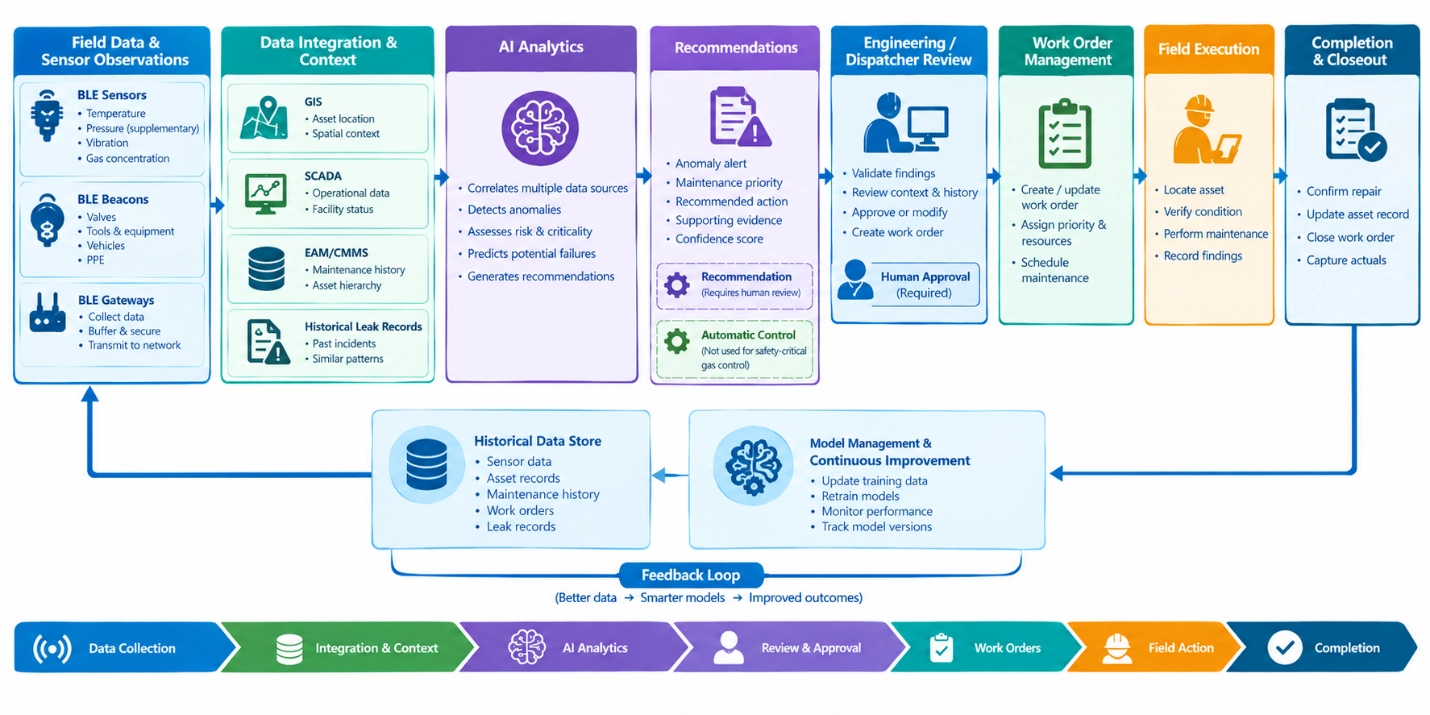
This workflow shows how BLE sensor observations are combined with GIS, SCADA, EAM/CMMS, and historical leak records to generate AI-based anomaly and maintenance recommendations. Human review controls work-order creation, followed by technician verification, maintenance, completion, and feedback for continuous model improvement.
AI Model Governance and Operational Validation
AI accuracy should be measured against the actual gas distribution task.
A model that detects statistical anomalies accurately may still have limited operational value if most alerts cannot be investigated or if the model produces excessive false positives.
Model Validation
Validation datasets should represent the actual operating environment, including seasonal variation, normal maintenance conditions, sensor failures, communications interruptions, and known abnormal events where sufficient historical data exists.
Useful evaluation measures include:
- Precision
- Recall
- False-positive rate
- False-negative rate
- Detection latency
- Data completeness
- Alert acknowledgment time
- Field-confirmation rate
- Model drift
- Sensor-fault classification accuracy
The appropriate metric depends on the application. A leak-management support system, for example, may have very different tolerance for missed events than an equipment-utilization model.
Human-in-the-Loop Operations
Gas distribution personnel should understand why an AI system generated an alert. A useful alert can identify:
- Affected asset
- Location
- Observation period
- Relevant measurements
- Historical baseline
- Anomaly score or confidence
- Related maintenance records
- Similar previous events
- Recommended verification step
- Model version
This makes AI more auditable and helps engineers distinguish useful recommendations from model noise.
Implementation, Commissioning, and Optimization
A phased deployment reduces technical and operational risk.
Pilot and Site Validation
The initial deployment should focus on representative gas distribution locations rather than selecting only ideal sites.
Pilot testing should verify:
- BLE coverage
- Gateway placement
- Sensor measurement quality
- Battery performance
- Environmental durability
- Data transmission reliability
- Asset-ID mapping
- Cybersecurity controls
- Integration with utility software
- Alert workflow
- Technician usability
A site survey should be completed before finalizing gateway locations. Measurements should be taken under realistic conditions, including metallic obstructions, equipment enclosures, vehicles, walls, and other structures likely to influence RF performance.
Commissioning and Acceptance Testing
Commissioning should verify the complete chain rather than testing sensors in isolation.
A practical acceptance procedure can include:
- Device registration
- Sensor identity verification
- Gateway communication testing
- Timestamp validation
- Data-quality validation
- Network-failure testing
- Gateway restart and recovery testing
- Battery-status reporting
- Alert-generation testing
- User-access testing
- Integration testing
- Work-order workflow testing
- Cybersecurity verification
- Audit-log verification
AI models should undergo separate acceptance testing using defined datasets and documented performance criteria.
Production Optimization
Once the system is operational, performance should be reviewed continuously.
Engineering teams should investigate recurring false alerts instead of simply suppressing them. A high false-positive rate can indicate inappropriate thresholds, poor sensor placement, inadequate contextual data, sensor degradation, or an unsuitable model.
Model retraining should follow controlled change management. Training data should be versioned, model changes documented, and significant performance changes reviewed before production deployment.
Gas Distribution KPIs for AIoT Programs
A practical KPI framework should measure operational outcomes rather than merely counting connected devices.
| KPI category | Example measurement | Why it matters |
|---|---|---|
| Detection | Time from abnormal measurement to alert | Measures monitoring responsiveness |
| Investigation | Alert-to-field-verification time | Connects analytics with operations |
| Data quality | Percentage of valid telemetry | Indicates trustworthiness of analytics |
| Connectivity | Gateway and sensor availability | Measures communications reliability |
| Maintenance | Preventive versus reactive work ratio | Shows maintenance-planning impact |
| Asset management | Equipment search time | Measures field productivity |
| AI performance | Precision and recall | Quantifies model behavior |
| Device health | Battery replacement interval | Indicates sensing lifecycle efficiency |
| Integration | Successful work-order handoff rate | Measures system interoperability |
| Cybersecurity | Unresolved device-security events | Tracks operational technology risk |
| Field operations | Technician travel or preparation time | Measures workflow efficiency |
| Reliability | Repeat anomaly rate by asset | Helps identify recurring equipment issues |
These measurements should be established before deployment so the utility can determine whether the solution produced a meaningful operational improvement.
Standards, Regulations, and Engineering References
Requirements vary according to jurisdiction, asset type, installation environment, and utility operating practices. U.S. gas distribution projects should consider applicable provisions of 49 CFR Part 192, including gas distribution integrity-management requirements. PHMSA also publishes guidance concerning DIMP implementation and related pipeline safety requirements.
Cybersecurity planning can reference NIST SP 800-82, which addresses the security characteristics and requirements of operational technology, and NIST Cybersecurity Framework 2.0 for broader cybersecurity risk management.
BLE implementation should follow the capabilities and security mechanisms supported by the applicable Bluetooth specifications and profiles. Bluetooth SIG documentation provides technical information on Bluetooth LE and Bluetooth Mesh capabilities.
For actual deployment, the utility’s engineering, safety, cybersecurity, regulatory, and legal teams should determine which federal, state, provincial, local, and utility-specific requirements apply. BLE certification alone does not establish that a particular sensor or gateway is appropriate for a hazardous gas-service location.
Practical Design Recommendations for Gas Distribution AI
Several implementation principles consistently improve the technical quality of AIoT projects for gas distribution networks.
- Start with a defined operational decision rather than a general objective to “use AI.”
- Determine the required measurement before selecting the BLE sensor.
- Treat hazardous-location suitability as a device and installation requirement, not merely a communications requirement.
- Maintain authoritative asset IDs across BLE devices, GIS, EAM/CMMS, SCADA, and work-management systems.
- Separate sensor faults and communication failures from actual gas distribution anomalies.
- Use edge processing where local buffering, connectivity limitations, bandwidth, or response requirements justify it.
- Keep AI recommendations traceable to measurements and source records.
- Establish model-performance KPIs before production deployment.
- Preserve human review for operational decisions unless a specific automated function has undergone appropriate engineering and authorization.
- Segment BLE and IoT networks from safety-critical OT systems.
- Design battery maintenance and device lifecycle management before installing large numbers of wireless sensors.
- Validate RF performance at representative gas distribution facilities.
- Pilot the complete workflow from field sensing through work-order closure rather than evaluating hardware alone.
- Expand only after demonstrating measurable operational value and acceptable cybersecurity, maintenance, and data-quality performance.
GAO’s experience supplying BLE, RFID, and IoT hardware and systems can be relevant where gas distribution operators need connected asset identification, sensing, gateway infrastructure, or related technical support. GAO has served organizations in the United States and Canada for approximately three decades, including Fortune 500 companies, research and development organizations, universities, and government agencies. Its R&D activities and quality-assurance processes support deployments where hardware reliability, technical documentation, and remote or onsite assistance are important project considerations.
From Connected Gas Assets to Actionable Intelligence
AI for gas distribution networks is most effective when it connects reliable field observations with the systems that engineers and field personnel already use. BLE sensors can provide selected measurements, while BLE beacons can identify mobile and distributed equipment and BLE gateways can collect local wireless data. The larger value comes from integrating those observations with GIS, SCADA, EAM/CMMS, inspection records, work management, and historical operating data.
For gas utilities, implementation should focus on measurable outcomes such as faster investigation, improved asset visibility, more informed maintenance prioritization, higher data quality, and better field preparation. Successful deployments also require careful attention to hazardous-location requirements, RF coverage, battery management, cybersecurity, data governance, model validation, and human oversight.
GAO provides BLE, RFID, and IoT hardware products and systems that can support these requirements, together with technical assistance for organizations evaluating sensing, identification, gateway, and connected-asset solutions. Readers evaluating an AI-enabled gas distribution project can learn more about GAO’s relevant technologies, engineering capabilities, and technical support resources through its technology solutions.
Building the Future of Industrial AI and IoT with Aperture Venture Studio and GAO RFID Inc.
For more than three decades, GAO Group of Companies has invested heavily in R&D for industrial BLE, RFID, and IoT. As generative AI has become useful for industrial applications, we have expanded our work in AI and IoT, including BLE and RFID, and founded Aperture Venture Studio to build, launch, and scale AI and IoT companies addressing practical industrial challenges such as connected gas distribution operations.
Aperture has attracted AI and IoT technical experts, entrepreneurial and operational executives, investors, and leading companies. We have also developed the Aperture Ventures Summit and TekSummit to examine advanced AI and IoT topics.
Our work has helped build technical communities around AI and IoT. We welcome participation as:
- Advisors, co-founders, or employees
- Investors
- Customers