
AI and BLE for Genomic Research
AI-Enabled BLE Monitoring for Genomic Research
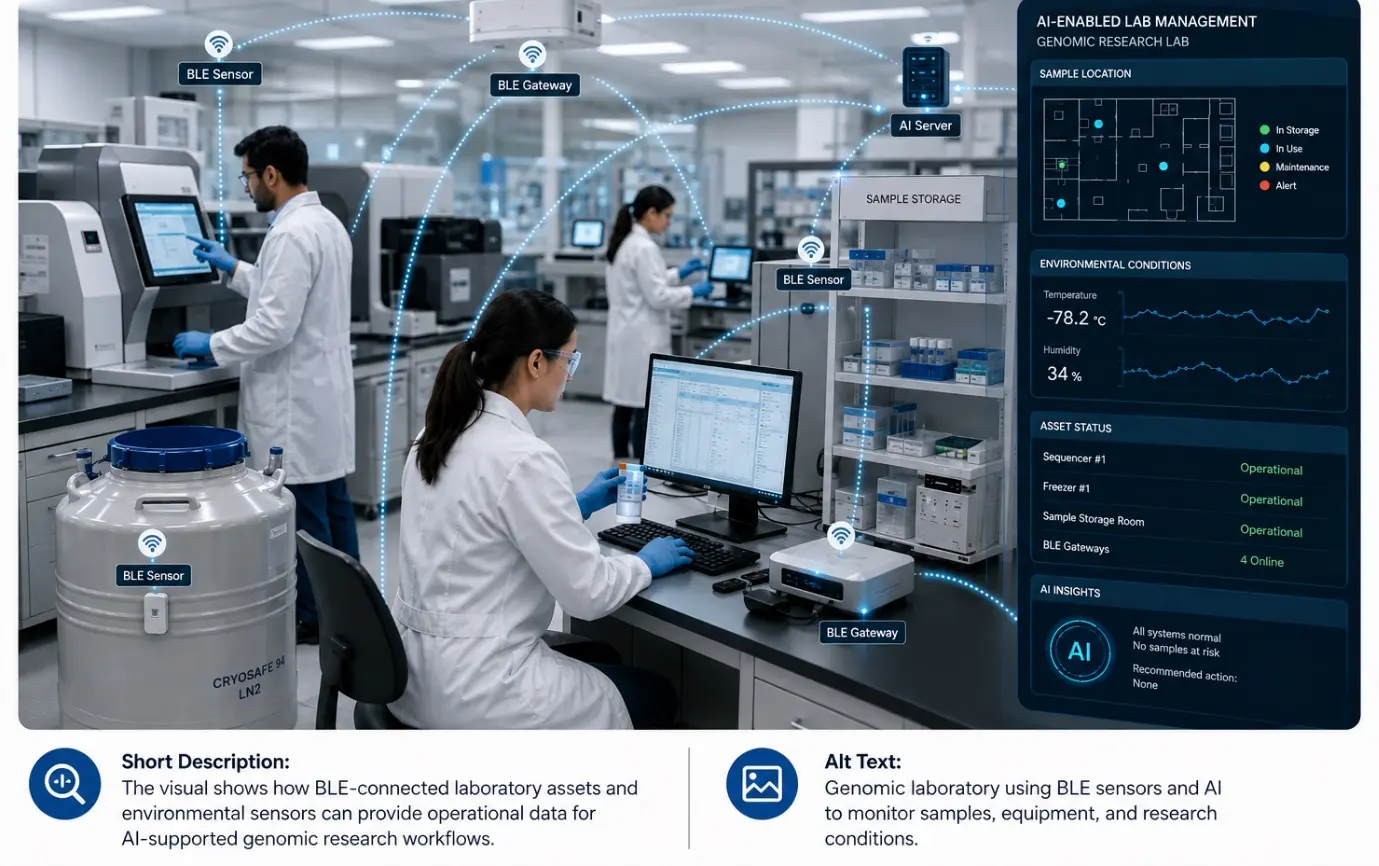
The visual shows how BLE-connected laboratory assets and environmental sensors can provide operational data for AI-supported genomic research workflows.
AI-Enabled Genomic Research with BLE Connectivity
Artificial intelligence is becoming increasingly useful in genomic research because modern laboratories generate large volumes of data from sequencing instruments, sample handling activities, environmental sensors, laboratory information systems, and research databases. AI can help researchers and laboratory operations teams identify patterns, detect anomalies, prioritize information, and support decisions across these workflows. BLE provides a practical wireless connectivity layer for selected laboratory assets, samples, containers, equipment, and environmental sensors.
For genomic research facilities, the value is not simply connecting laboratory objects. The objective is to create reliable operational data that AI systems can use alongside sequencing, experimental, and laboratory records. BLE gateways can collect location and sensor information and transmit it to software for analysis, alerting, and integration with laboratory systems. This can support sample traceability, freezer monitoring, equipment utilization, personnel workflow analysis, and environmental condition management.
GAO supplies BLE, RFID, and IoT hardware products and systems that can support these connected research environments. Its experience serving U.S. and Canadian organizations, including R&D firms, universities, government agencies, and Fortune 500 companies, provides a practical foundation for deploying connected technologies in demanding technical environments.
Why AI Matters in Genomic Research Operations
Genomic research depends on accurate samples, controlled laboratory conditions, reliable equipment, and traceable experimental processes. A small operational error can compromise a research run, delay sequencing activities, or require valuable samples to be retested.
AI can support genomic research operations by converting continuous operational data into actionable information. Rather than relying exclusively on manual inspections or isolated records, laboratory teams can use AI-assisted analysis to identify abnormal conditions and prioritize attention.
Important applications include:
- Sample location intelligence:AI can analyze BLE location events to identify where samples, racks, containers, or mobile laboratory assets are located and detect unusual movement patterns.
- Cold-chain monitoring:BLE temperature sensors can continuously report conditions around refrigerators, freezers, specimen storage areas, and other temperature-sensitive environments. AI can identify abnormal temperature trends before they become significant incidents.
- Equipment utilization analysis:Connected equipment data can help identify underused instruments, heavily utilized sequencing equipment, recurring bottlenecks, and unusual operating patterns.
- Workflow anomaly detection:AI can compare observed laboratory movements and events against expected workflows to identify potential process deviations.
- Research asset management:BLE tags and sensors can provide operational visibility into instruments, portable devices, sample containers, carts, and other mobile laboratory assets.
- Predictive maintenance support:Sensor data from laboratory equipment can be analyzed to identify patterns associated with equipment degradation or abnormal operation.
- Environmental monitoring:BLE sensors can monitor temperature, humidity, and other measurable conditions relevant to laboratory operations, with AI helping identify trends and anomalies.
The resulting system can support researchers, laboratory managers, facilities teams, quality personnel, and IT teams without replacing scientific judgment.
AI Applications in BLE-Connected Genomic Research
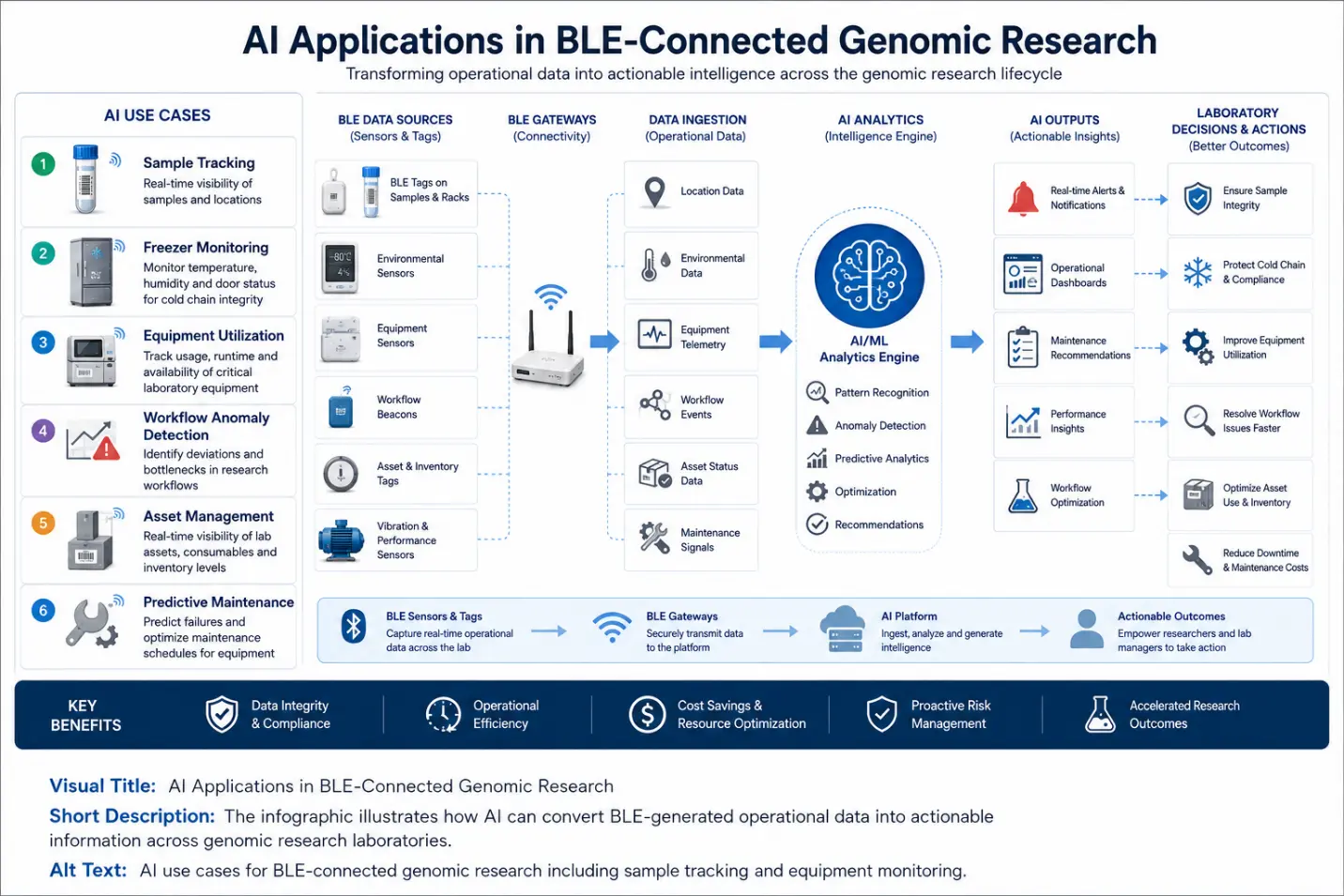
The infographic illustrates how AI can convert BLE-generated operational data into actionable information across genomic research laboratories.
Genomic Research Workflows Supported by Connected Data
Genomic research involves multiple interconnected workflows, including sample preparation, storage, sequencing, analysis, quality control, equipment management, and research documentation. BLE can provide additional operational data at points where manual tracking or fixed infrastructure does not provide sufficient visibility.
A representative workflow begins when a sample, rack, container, or laboratory asset receives an appropriate BLE tag or is associated with a BLE-enabled sensor. Nearby gateways receive beacon transmissions and forward relevant data to server or cloud software. The software can associate the incoming events with identifiers maintained in laboratory information systems or other authorized databases.
AI can then analyze the operational information against predefined rules, historical patterns, or machine-learning models. An abnormal freezer temperature trend, unexpected sample movement, or unusual equipment utilization pattern can generate an alert for the appropriate laboratory or facilities team.
The workflow can include:
- Data acquisition:BLE beacons and sensors generate identification, location, temperature, humidity, or other relevant operational data.
- Wireless communication:BLE transmits information to strategically positioned gateways within the laboratory or research facility.
- Gateway processing:Gateways collect nearby BLE transmissions and forward validated information to the appropriate software environment.
- Data processing:Server or cloud software stores, filters, normalizes, and associates incoming events with laboratory records.
- AI analysis:Machine-learning or rule-based methods evaluate patterns, detect anomalies, and identify operational conditions requiring attention.
- Laboratory integration:Relevant information can be exchanged with laboratory information management systems, laboratory information systems, maintenance software, facility management systems, or authorized databases.
- Operational response:Researchers, laboratory managers, facilities personnel, or quality teams receive alerts or recommendations and take the appropriate action.
- Historical analysis:Recorded data can support trend analysis, utilization studies, incident investigation, and process improvement.
The quality of the AI output depends heavily on the quality and context of the underlying data. For this reason, sensor placement, gateway coverage, identifier management, time synchronization, data validation, and integration design are important engineering considerations.
BLE Infrastructure for Genomic Laboratory Environments
BLE is particularly useful where laboratories need wireless connectivity for relatively low-power devices, mobile assets, environmental sensors, and location-aware equipment. BLE beacons can periodically transmit identifiers, while BLE sensors can transmit measurements such as temperature or humidity.
A genomic research deployment can contain several hardware and software components:
- BLE beacons:Small battery-powered devices can identify samples, racks, containers, equipment, or other assets when appropriate tagging is practical.
- BLE sensors:Sensors can measure environmental or equipment-related conditions and transmit measurements wirelessly.
- BLE gateways:Gateways receive BLE transmissions and forward information to a server or cloud environment through an available network connection.
- Edge processing:Local processing can filter or validate data before transmission, reducing unnecessary network traffic and supporting faster local responses.
- Server software:A privately hosted server can collect BLE data, manage devices, perform processing, and integrate with laboratory or facility systems.
- Cloud software:Cloud-hosted software can provide centralized access across multiple research locations when organizational policies and data governance requirements permit.
- AI services:AI models can analyze operational datasets to identify anomalies, forecast trends, classify events, or support decision-making.
- Enterprise integrations:APIs, databases, middleware, and other interfaces can connect BLE-generated information with laboratory and facility software.
GAO provides BLE gateways, beacons, sensors, RFID products, and related IoT systems that can be selected according to the operational requirements of a connected research environment.
BLE and AI System for Genomic Laboratory Operations
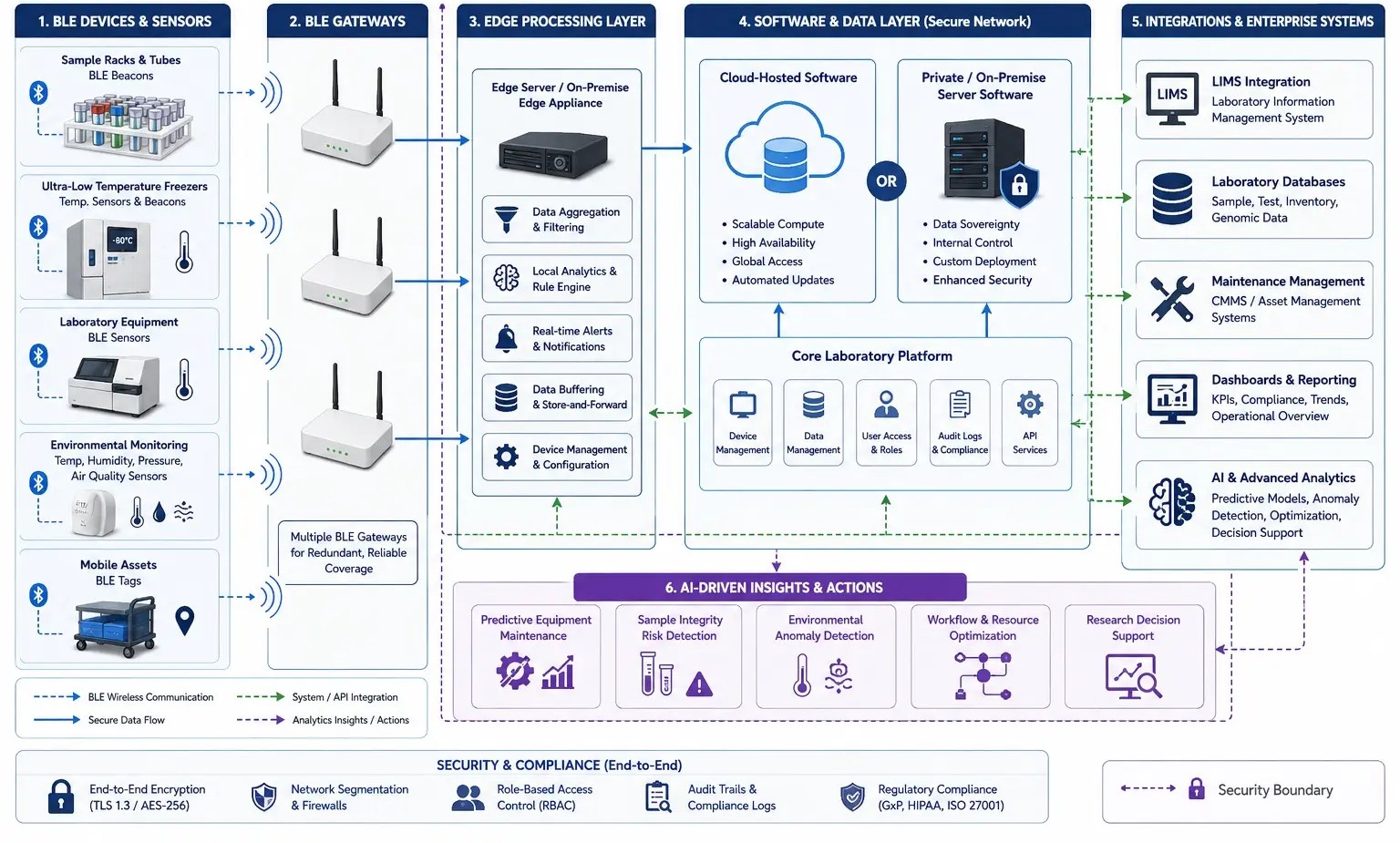
The diagram shows how BLE devices transmit laboratory operational data through gateways and software to AI analytics and research management systems.
Cloud and Server Deployment Options
Genomic research organizations may have different requirements for data governance, network access, security, integration, and operational control. A cloud-hosted deployment can be appropriate when researchers need centralized access across multiple facilities and the organization permits relevant operational data to be processed through cloud infrastructure.
A cloud deployment can simplify centralized software management and support geographically distributed research operations. BLE gateways can transmit approved data to cloud services where analytics, dashboards, alerting, and AI processing are performed.
A server deployment can be preferable when a research organization requires greater control over infrastructure, network boundaries, data processing, or integration with privately hosted laboratory systems. Server software can operate on customer-managed servers, private data centers, edge servers, or other controlled infrastructure.
The appropriate choice depends on the sensitivity of the information being handled, network policies, latency requirements, existing IT infrastructure, integration requirements, and organizational security controls. A hybrid arrangement can also be considered when local processing is needed for immediate operational decisions while selected information is transferred to centralized software for broader analysis.
For genomic research, deployment decisions should distinguish between operational sensor information and sensitive scientific or personally identifiable information. BLE itself does not determine the required data governance model. The complete system must be designed around the organization’s information security and research data policies.
Engineering Considerations Before Deployment
BLE deployments in genomic laboratories require more than installing tags and gateways. Radio propagation can be affected by laboratory walls, metal equipment, refrigerators, freezers, shelving, dense equipment layouts, and other physical structures. A site survey should therefore be conducted before final gateway placement.
Important considerations include:
- Coverage planning:Determine where BLE signals need to be detected and how accurately location must be estimated.
- Battery management:Select beacon and sensor configurations based on transmission frequency, environmental conditions, battery life, and maintenance schedules.
- Sensor placement:Place temperature and environmental sensors where measurements represent the actual condition being monitored rather than simply the nearest convenient location.
- Identifier management:Maintain consistent relationships between BLE device identifiers and laboratory asset records.
- Network resilience:Provide reliable connectivity between gateways and the processing environment.
- Time synchronization:Maintain accurate timestamps so that sensor events can be correlated with laboratory activities and equipment records.
- Calibration and validation:Validate sensors according to the laboratory’s operational requirements and applicable procedures.
- Security controls:Protect gateway communications, software interfaces, credentials, and administrative access.
- Integration testing:Confirm that BLE events are correctly associated with the corresponding laboratory records before relying on AI-generated alerts.
These engineering decisions determine whether the resulting data is sufficiently reliable for operational use.
BLE Deployment Lifecycle for Genomic Research
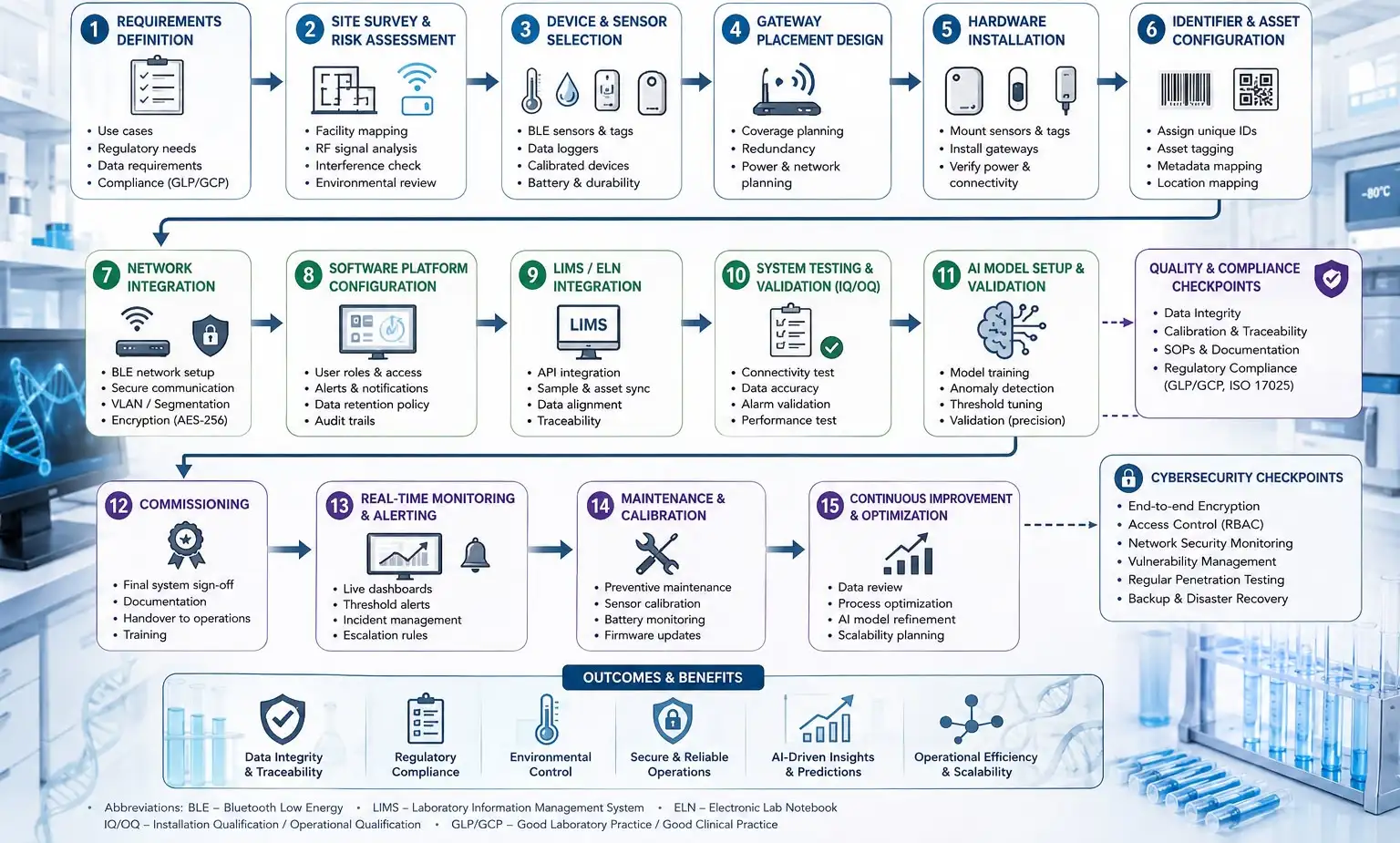
The workflow presents the major engineering and operational stages required to deploy and maintain BLE-connected genomic research systems.
AI Analytics for Sample and Asset Traceability
Sample traceability is one of the most important operational concerns in genomic research. Laboratories may handle large numbers of tubes, racks, containers, reagents, instruments, and mobile assets across preparation rooms, sequencing areas, storage rooms, and analysis facilities.
BLE can provide additional location and movement information that complements existing laboratory identification methods. AI can then analyze this information to identify unusual movement patterns or operational bottlenecks.
For example, a laboratory may establish expected movement zones for sample racks between preparation, storage, sequencing, and analysis areas. If a rack remains in an unexpected location for an extended period, an AI-assisted system can flag the event for review.
This does not mean AI should independently determine the scientific status of a sample. Instead, it provides operational intelligence that allows laboratory personnel to investigate exceptions earlier.
Potential operational metrics include:
- Sample retrieval time
- Asset search time
- Sample movement frequency
- Storage utilization
- Unplanned movement events
- Equipment utilization
- Alert response time
- Environmental excursion duration
- Sensor availability
- Gateway connectivity
Combining these measurements with existing laboratory records can provide a more complete picture of research operations.
Environmental Monitoring and Cold-Storage Protection
Genomic research frequently depends on controlled storage conditions. Refrigerators, freezers, ultra-low-temperature storage equipment, and other controlled environments may contain samples that are difficult or expensive to replace.
BLE temperature sensors can provide continuous measurements without requiring every storage location to be physically inspected. AI can evaluate the resulting time-series data to distinguish ordinary fluctuations from patterns that may indicate developing problems.
For example, a gradual temperature increase may be operationally more significant than a short fluctuation caused by routine access. An AI model can analyze historical temperature behavior and identify deviations that deserve investigation.
The system can support:
- Continuous temperature monitoring
- Threshold-based alerts
- Trend analysis
- Abnormal-condition detection
- Equipment performance analysis
- Storage-area monitoring
- Incident investigation
- Maintenance prioritization
Sensor placement remains critical. A sensor mounted in a location that does not accurately represent the storage condition can produce misleading data regardless of how sophisticated the AI model is.
AI-Assisted Temperature Monitoring for Genomic Samples
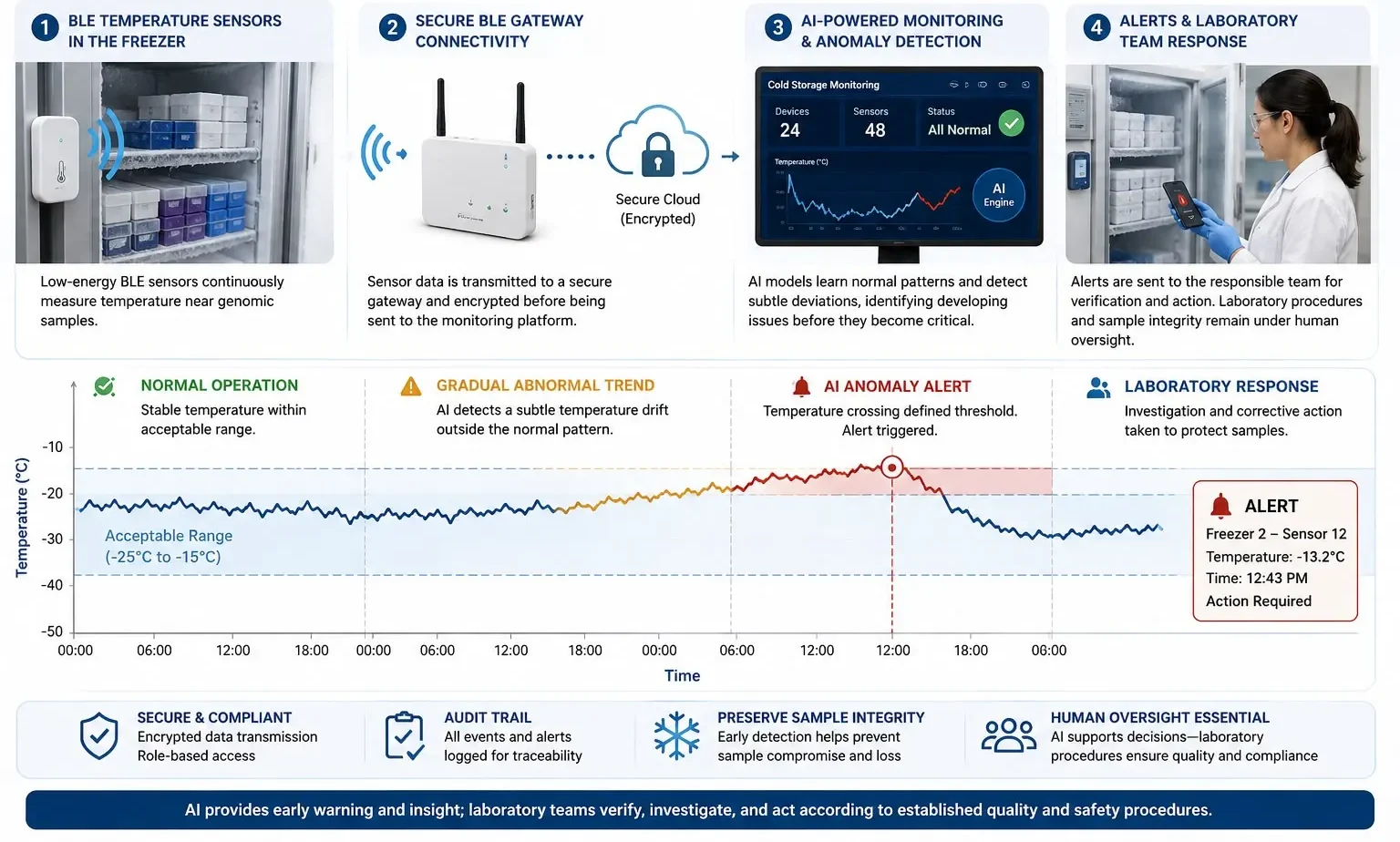
The visual explains how BLE temperature sensors and AI-based anomaly detection can help laboratory teams identify developing cold-storage problems.
Equipment Utilization and Predictive Maintenance
Sequencers, centrifuges, thermal cyclers, liquid handling equipment, imaging systems, freezers, and other laboratory instruments represent significant operational investments. Their availability can directly affect research throughput.
AI-supported equipment monitoring can help laboratory managers understand how equipment is being used and where recurring operational constraints occur.
BLE sensors can contribute location and utilization information for mobile or distributed equipment. Additional equipment data can come from authorized interfaces, operational logs, maintenance systems, or other connected sources.
AI analysis can help identify:
- Repeated periods of underutilization
- Unexpected equipment movement
- Recurring operational interruptions
- Maintenance patterns
- Abnormal utilization behavior
- Potential scheduling bottlenecks
- Equipment availability trends
Predictive maintenance should be implemented carefully. An AI model can identify patterns associated with abnormal behavior, but maintenance decisions should remain aligned with equipment manufacturer requirements, laboratory procedures, validation requirements, and qualified technical personnel.
GAO’s BLE and IoT hardware can provide a connectivity layer for selected assets and equipment where wireless monitoring is technically appropriate.
Integrating AI, BLE, and Laboratory Software
The operational value of connected genomic research data increases when it can be associated with existing software systems.
Potential integration points include:
- Laboratory Information Management Systems (LIMS)
- Laboratory Information Systems (LIS)
- Electronic laboratory notebooks
- Research databases
- Facility management software
- Computerized maintenance management systems
- Inventory management software
- Identity and access management systems
- Data warehouses
- Analytics and reporting software
Integration should follow the organization’s approved interfaces and data governance policies. BLE device identifiers should not be treated as substitutes for authoritative laboratory identifiers. Instead, the software layer should maintain controlled relationships between physical devices and authorized records.
APIs, database interfaces, middleware, and event-based integrations can transfer relevant information between systems. Data normalization is particularly important when multiple laboratories use different naming conventions or asset identifiers.
AI models should also receive appropriately contextualized information. A temperature reading without a timestamp, sensor identity, storage location, and associated equipment record may have limited operational value. Context converts isolated sensor measurements into useful research operations data.
Security and Data Governance
Genomic research environments require careful separation between operational telemetry and sensitive research information. BLE-connected systems should therefore be designed with security controls appropriate to the information being transmitted and processed.
Important controls can include:
- Device authentication and controlled provisioning
- Secure gateway administration
- Network segmentation
- Role-based access control
- Credential management
- Encrypted communications where supported and appropriate
- Software patch management
- Audit logging
- Data retention policies
- Backup and recovery procedures
- Monitoring of unauthorized access
- Controlled API credentials
- Regular security testing
BLE should be treated as one component of the overall security design. Security cannot be achieved solely by selecting a wireless protocol. Gateways, servers, cloud services, APIs, databases, administrator accounts, and connected laboratory systems all require appropriate controls.
Research organizations should also establish clear policies defining what information can be transmitted through the connected system and where that information can be stored.
Scaling from One Laboratory to Multiple Research Facilities
A successful pilot should not automatically be treated as a production deployment. Genomic research organizations should evaluate whether the solution can scale while maintaining reliable device identification, network connectivity, data quality, security, and operational support.
A practical expansion strategy can begin with a limited use case such as freezer temperature monitoring or high-value equipment tracking. Once the data pipeline has been validated, additional sensors and assets can be introduced.
Scaling considerations include:
- Standardized device configuration
- Consistent asset identifiers
- Gateway placement standards
- Battery replacement procedures
- Sensor calibration procedures
- Centralized monitoring
- Software update processes
- Data retention
- Integration standards
- Security policies
- AI model validation
- Staff training
- Technical support
For geographically distributed research sites, cloud-hosted software may simplify centralized monitoring where permitted. Organizations requiring local processing or stricter infrastructure control may instead use privately hosted server deployments.
Cloud and Server Deployment Options for Genomic Research
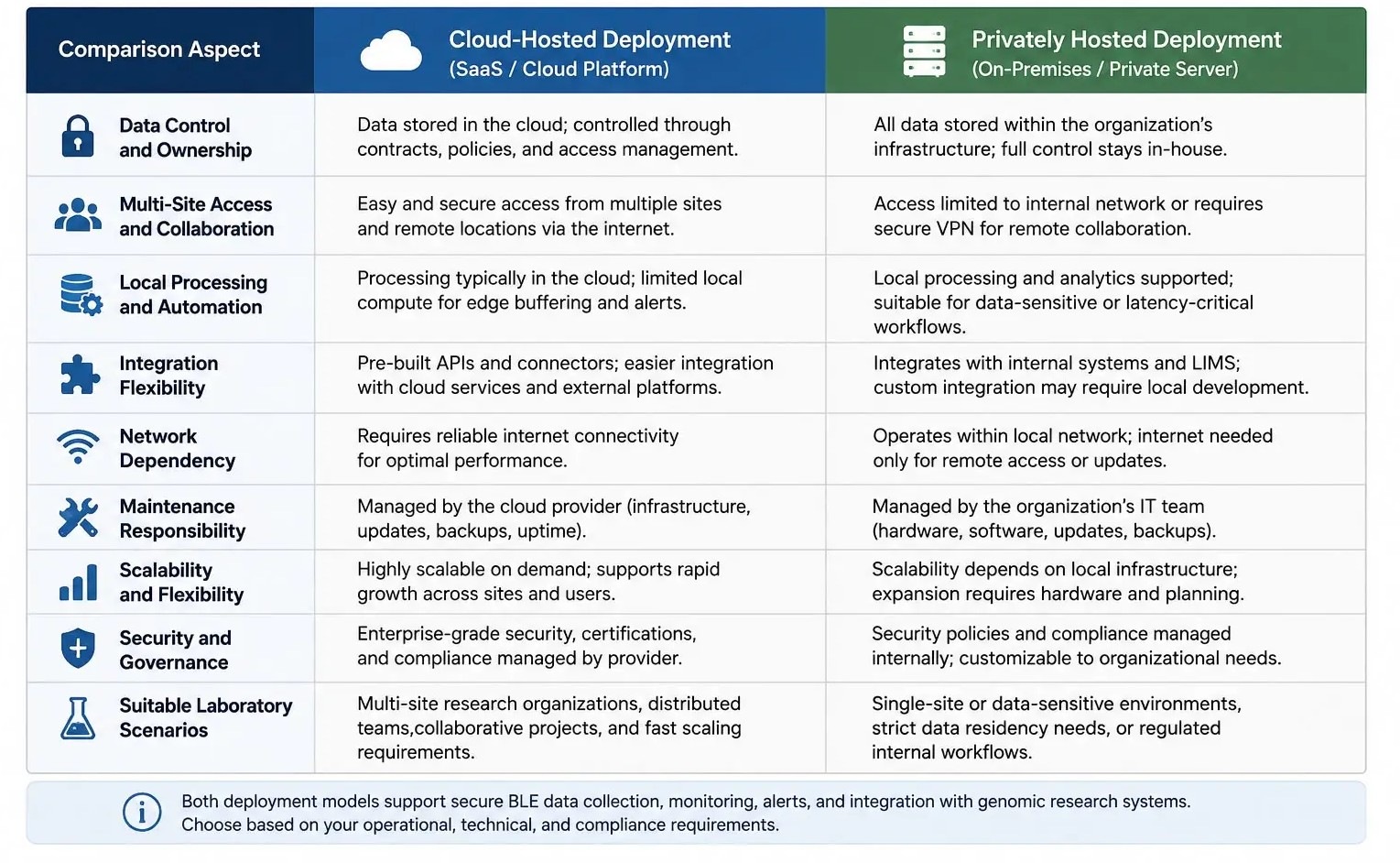
The comparison helps research organizations evaluate cloud-hosted and privately hosted deployment approaches according to operational and technical requirements.
Measuring Operational Performance
The effectiveness of an AI-enabled genomic research solution should be measured using operational KPIs rather than the number of connected devices alone.
Useful measurements can include:
- Reduction in sample and asset search time
- Reduction in manual environmental checks
- Number of detected environmental excursions
- Mean alert response time
- Equipment utilization rate
- Equipment downtime
- Gateway availability
- Sensor availability
- Battery replacement frequency
- False-positive alert rate
- Data completeness
- Integration error rate
- Maintenance response time
- Storage-condition compliance
These measurements should be established before deployment whenever possible. Baseline measurements allow research organizations to determine whether the system is actually improving laboratory operations.
AI model performance should also be evaluated independently. An anomaly detection system that produces excessive false alerts may create additional workload rather than reducing it. Model thresholds and decision rules should therefore be validated against real laboratory conditions.
Practical Implementation Recommendations
A technically successful genomic research deployment requires coordination between laboratory personnel, researchers, facilities teams, IT professionals, cybersecurity teams, and system integrators.
Recommended practices include:
- Start with a clearly defined operational problem rather than deploying sensors without a measurable objective.
- Perform a physical BLE site survey before finalizing gateway locations.
- Select sensor types according to the actual measurement requirements of each laboratory environment.
- Establish authoritative asset and sample identifiers before integrating BLE events with laboratory software.
- Validate data quality before training or deploying AI models.
- Use edge processing where local filtering or low-latency decisions provide a clear operational advantage.
- Select cloud or privately hosted server deployment according to security, integration, network, and governance requirements.
- Test environmental sensors under realistic laboratory conditions.
- Establish procedures for battery replacement, sensor maintenance, calibration, gateway monitoring, and device replacement.
- Validate AI alerts with laboratory personnel before using them for operational escalation.
- Maintain human oversight for decisions that affect research samples, laboratory quality procedures, or scientific workflows.
- Design for interoperability so that future laboratory systems can consume relevant operational data without replacing the entire solution.
GAO can support organizations evaluating BLE, RFID, and IoT hardware and systems for research environments, including applications involving asset monitoring, environmental sensing, location awareness, and connected laboratory operations.
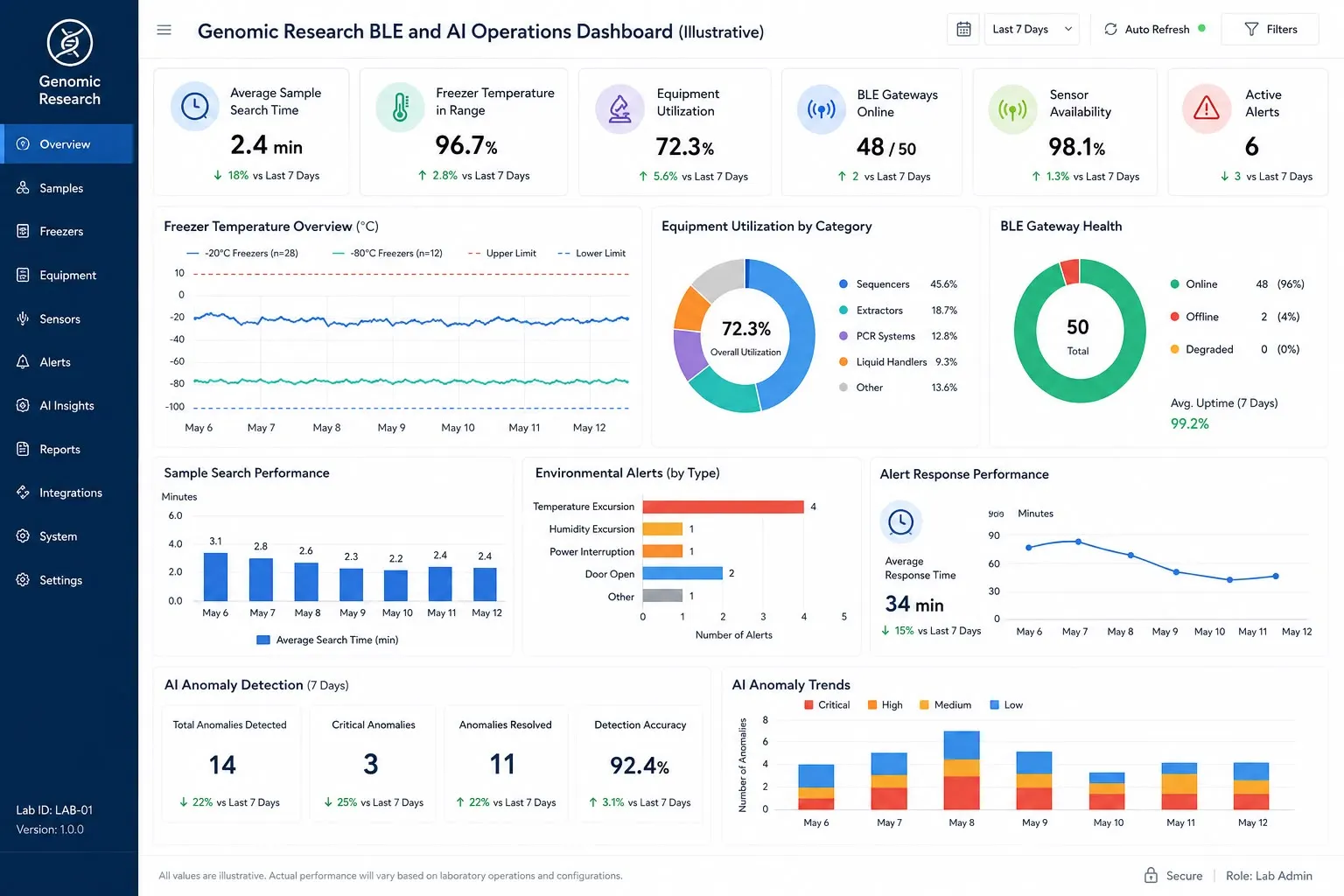
Genomic Research BLE and AI Operations Dashboard
Key Takeaways for Genomic Research
AI can provide greater operational intelligence for genomic research when it is supported by reliable real-world data. BLE-enabled sensors, beacons, and gateways can contribute that data by connecting laboratory assets, environmental conditions, and mobile equipment to software systems.
The strongest implementations begin with a specific research operations problem, establish reliable data collection, integrate with existing laboratory systems, and validate AI outputs against real workflows. Sample traceability, cold-storage monitoring, equipment utilization, predictive maintenance support, and workflow anomaly detection are practical areas where connected data can deliver measurable value.
GAO provides BLE, RFID, and IoT hardware products and systems that can support these connected environments. GAO’s engineering-oriented approach, research and development investment, quality assurance processes, and technical support are relevant to organizations implementing connected laboratory systems across research facilities.
Building the Future of Industrial AI and IoT with Aperture Venture Studio and GAO RFID Inc.
For more than three decades, GAO Group of Companies has invested heavily in R&D for industrial BLE, RFID, and IoT technologies. As AI has become increasingly useful in industrial and research applications, we have expanded our work across AI and IoT technologies, including connected solutions relevant to genomic research, laboratory monitoring, and intelligent asset management.
Aperture Venture Studio brings together AI and IoT technical experts, entrepreneurial and operational executives, investors, and leading companies to advance practical technology initiatives. Our Aperture Ventures Summit and TekSummit provide forums for discussing advanced AI and IoT topics and building technical communities around these technologies.
We welcome you to join us as:
- Advisors, Co-founders or Employees
- Investors
- Customers
GAO’s Experience Supporting Connected Research Environments
Headquartered in New York City and Toronto, Canada, GAO is recognized among the leading B2B and B2G BLE and RFID suppliers globally. GAO, GAO Research, and GAO Tek form the GAO Group, with operations based in New York City and Toronto.
For three decades, the GAO Group has served organizations across the United States and Canada, including Fortune 500 companies, leading R&D organizations, prestigious universities, and government agencies. The group has invested substantially in research and development and maintains stringent quality assurance processes.
For genomic research organizations evaluating connected laboratory systems, this experience can support the selection and deployment of BLE, RFID, sensor, gateway, and IoT technologies according to specific operational requirements.
GAO’s BLE, RFID, IoT, and AI Technology Journey
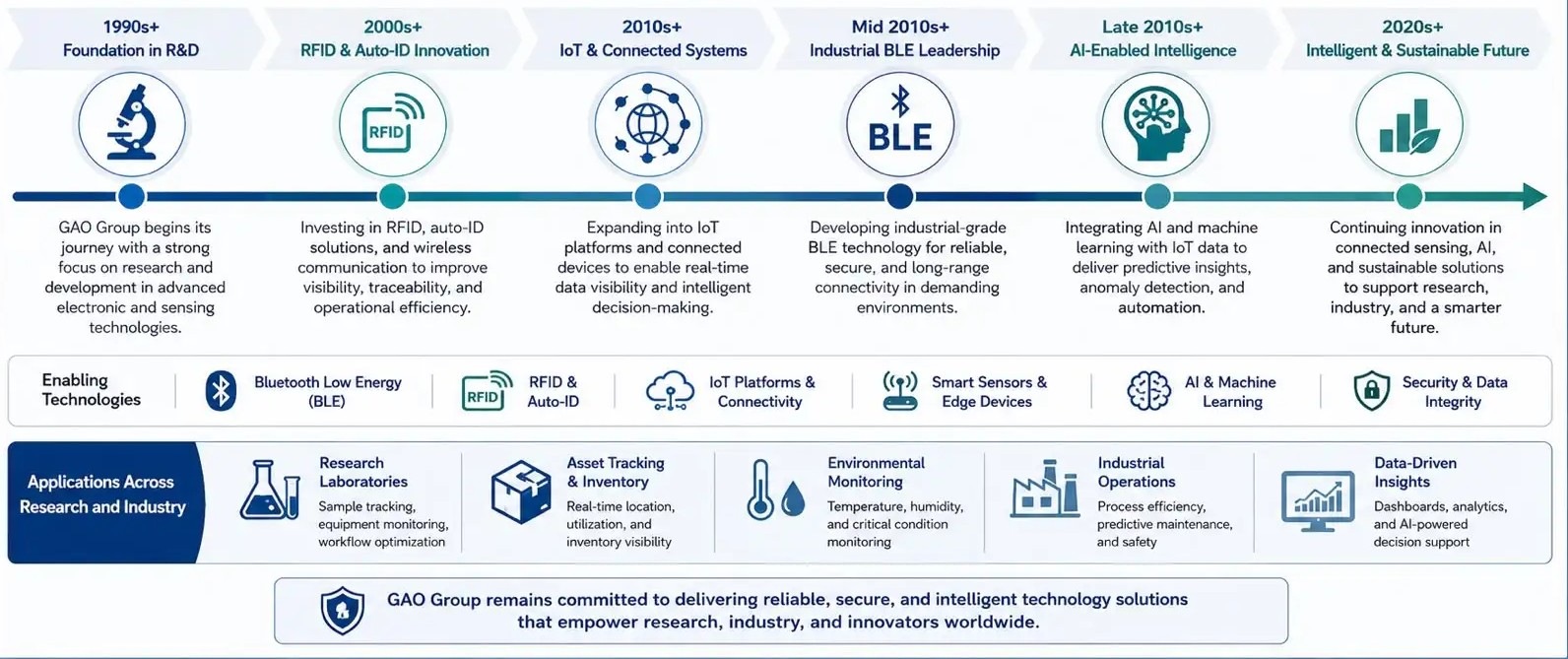
The timeline presents GAO’s long-term focus on research and development in connected technologies supporting industrial and research applications.
Learn More About AI-Enabled Genomic Research Solutions
Genomic research increasingly depends on reliable operational information alongside scientific data. AI can help interpret that information, while BLE-connected sensors, beacons, and gateways can provide the underlying visibility required for applications such as sample tracking, environmental monitoring, equipment utilization, and workflow analysis.
Successful deployment depends on engineering fundamentals: appropriate sensor selection, reliable wireless coverage, accurate identifiers, secure data handling, validated integrations, and AI models that are evaluated against real laboratory conditions.
GAO can help organizations assess BLE, RFID, IoT, sensing, gateway, and connected-system requirements for genomic research environments. Contact GAO to discuss the hardware, software, integration, and technical support requirements of your research operation.