
AI for Harbor Operations Using BLE-Connected Assets and Sensors
AI and BLE for Harbor Operations
Artificial intelligence is helping harbor operators turn fragmented asset, equipment, personnel, and environmental data into actionable operational intelligence. For Harbor Operations, BLE gateways, beacons, and sensors provide a practical data-acquisition layer for tracking movable assets, monitoring equipment conditions, identifying operational patterns, and supporting safer yard and terminal workflows. AI can correlate BLE events with terminal operating systems, maintenance records, work orders, access-control data, vessel schedules, and other operational information to detect anomalies, predict maintenance requirements, and prioritize actions. This combination is particularly useful where conventional manual inspections, barcode scans, or isolated equipment records cannot provide continuous visibility. For example, AI-supported asset tracking can identify unexpected movement of cargo-handling equipment, detect abnormal utilization patterns, and help maintenance teams prioritize equipment requiring inspection. BLE is therefore not the objective itself. It is an enabling technology for AI-driven harbor asset visibility, equipment monitoring, workflow optimization, and operational decision support.
What AI-Enabled Harbor Operations Mean for Maritime Facilities
Harbor Operations encompass a highly coordinated environment involving vessels, berths, container yards, warehouses, gates, cargo-handling equipment, maintenance areas, access roads, personnel, and support facilities. Operational decisions frequently depend on knowing where equipment is located, whether it is available, how it is being used, and whether its condition is changing.
AIoT combines artificial intelligence with IoT devices, sensors, connected equipment, and industrial systems. For Harbor Operations, this means BLE-generated observations can become inputs to machine learning, Industrial AI, Edge AI, and other analytical methods rather than remaining isolated location or sensor records.
BLE beacons can be attached to mobile equipment, tools, containers, maintenance assets, safety equipment, or other trackable items. BLE sensors can collect operational measurements such as temperature, vibration, humidity, or other relevant conditions depending on the selected hardware. BLE gateways receive these transmissions and forward usable events to local software, servers, or cloud-hosted applications.
The resulting data can support operational questions such as:
- Where is a particular harbor asset now?
- Has a vehicle, tool, or piece of handling equipment entered an unauthorized zone?
- How long does equipment remain idle between assignments?
- Which equipment shows utilization or sensor patterns associated with maintenance requirements?
- Are critical assets available when a vessel or cargo-handling operation requires them?
- Which movement patterns indicate an operational exception?
- Which maintenance activities should receive priority based on observed operating conditions?
GAO supplies BLE and IoT hardware products and systems that can be incorporated into these Harbor Operations workflows, allowing organizations to select data-capture components according to coverage, environmental conditions, asset type, communication requirements, and integration needs.
AI-Enabled Harbor Operations Data Flow with BLE and AI
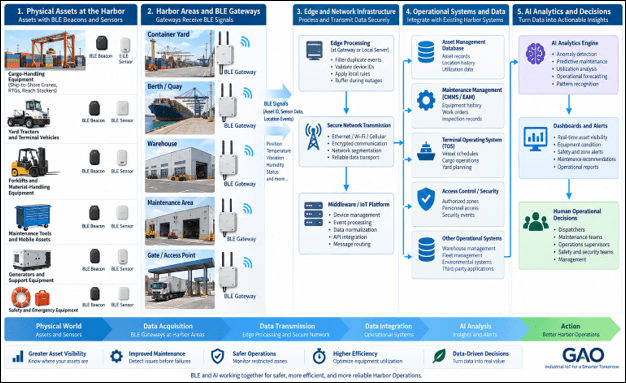
This visual shows how BLE beacons and sensors on harbor assets transmit data through BLE gateways, edge processing, secure networks, middleware, and operational systems to AI analytics. It illustrates how AI converts harbor asset and equipment data into predictive maintenance, safety alerts, operational insights, and human decisions.
Harbor Operations Applications for AI-Driven Asset Visibility
AI becomes most valuable when BLE observations are connected to specific Harbor Operations workflows. A harbor does not simply need a list of tagged assets. It needs information that helps dispatchers, terminal managers, maintenance personnel, safety teams, and operations supervisors make better decisions.
AI Asset Tracking for Harbor Equipment
Mobile harbor equipment can be difficult to track consistently when assets move between yards, maintenance areas, warehouses, berths, and other operational zones. BLE beacons can provide recurring identification events while gateways positioned at strategic locations collect those observations.
AI software can use historical location events to establish normal movement patterns and identify exceptions. A sudden movement of an asset outside its expected operating area, prolonged inactivity, or unexpected presence in a restricted zone can generate an operational alert for human verification.
This approach is useful for assets such as:
- Yard tractors and terminal tractors
- Forklifts and material-handling equipment
- Maintenance tools and mobile service equipment
- Portable generators and electrical equipment
- Safety and emergency-response equipment
- Inspection instruments
- High-value mobile harbor assets
The engineering objective should be defined by the required location granularity. A harbor may need zone-level visibility rather than continuous centimeter-level positioning. Gateway placement, radio propagation, metal structures, containers, vehicles, cranes, and other obstructions should therefore be evaluated during deployment planning.
AI Equipment Monitoring and Predictive Maintenance
Maintenance teams can combine BLE-connected sensor information with equipment history, inspection results, runtime records, and work orders. Machine learning models can then identify patterns associated with abnormal equipment behavior or maintenance requirements.
For example, vibration or temperature observations from BLE sensors can be evaluated alongside equipment utilization and previous maintenance events. A change from the established operating pattern may trigger an inspection recommendation rather than waiting for a scheduled maintenance interval or equipment failure.
For Harbor Operations, this can support:
- Maintenance prioritization for cargo-handling equipment
- Detection of abnormal temperature or vibration conditions
- Identification of equipment operating outside expected patterns
- Maintenance scheduling based on observed usage
- Reduction of unnecessary manual inspection rounds
- Improved visibility into mobile equipment condition
AI predictions should not automatically trigger high-impact maintenance actions without appropriate validation. Harbor maintenance workflows can use confidence thresholds, equipment criticality, operating context, and technician confirmation before creating or escalating a work order.
AI-Enabled Yard and Asset Workflow Optimization
Harbor yards involve continuous movement of cargo, equipment, vehicles, personnel, and support resources. Delays can occur when required equipment cannot be located quickly, assets are underutilized, or resources are allocated based on outdated information.
BLE event data can provide an additional operational signal for AI models. Historical movement and utilization patterns can help identify bottlenecks, recurring idle periods, unusual asset dwell times, or inefficient equipment allocation.
AI-based decision support can help operations teams evaluate questions such as:
- Which available equipment is closest to a required work area?
- Which assets are consistently underutilized?
- Where do equipment handoff delays occur?
- Which operational zones experience recurring congestion?
- Which assets should be inspected before assignment?
- How should available equipment be prioritized for upcoming work?
BLE therefore contributes operational observations, while AI provides the analytical layer needed to turn those observations into recommendations.
AI Harbor Asset Tracking and Predictive Maintenance Workflow
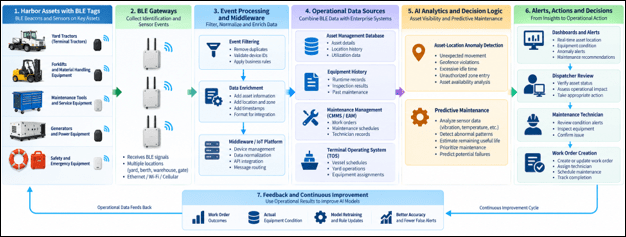
The visual illustrates how BLE-tagged harbor assets send identification and sensor data through gateways and middleware into asset, maintenance, and terminal systems. AI then detects location anomalies and predicts maintenance needs, leading to alerts, human verification, work orders, and continuous model improvement.
Harbor Safety and Restricted-Zone Monitoring
Safety-sensitive harbor areas may contain heavy equipment, moving vehicles, cranes, restricted infrastructure, and controlled access zones. BLE-enabled identification can provide another source of operational evidence when an asset enters or remains within an area where it should not normally operate.
AI can analyze repeated movement events to identify recurring exceptions rather than treating every isolated event as equally significant. For example, an unexpected asset presence may be compared with operating schedules, authorized zones, maintenance status, and previous movement patterns.
Such systems should complement established safety controls rather than replace them. Physical barriers, access-control systems, safety procedures, worker training, alarms, and human supervision remain important components of harbor safety.
Harbor Operations Workflow from BLE Data to AI Decisions
A practical AI-enabled Harbor Operations solution normally begins with data acquisition and progresses through several processing and decision stages.
Data Acquisition at the Harbor Edge
BLE beacons identify tagged assets, while BLE sensors can produce environmental or equipment-condition observations. Gateways installed at suitable locations receive these transmissions. Gateway placement should account for container stacks, steel structures, cranes, warehouses, vehicles, weather exposure, interference, and the required coverage area.
The deployment should also establish how frequently devices transmit, how long batteries are expected to operate, and what data is genuinely required. Excessive transmission frequency can increase battery consumption and create unnecessary event volume without materially improving operational decisions.
Edge Processing and Communication
BLE gateways can perform local event handling before information is transmitted to downstream systems. Filtering duplicate observations, validating device identifiers, applying basic rules, and buffering events during temporary network interruptions can reduce unnecessary traffic and improve operational resilience.
Harbor deployments may use Ethernet, Wi-Fi, cellular, or other available networking technologies between gateways and backend systems. The appropriate choice depends on site coverage, infrastructure availability, network segmentation, bandwidth, latency requirements, and cybersecurity policies.
Middleware and Operational Data Integration
Middleware converts device events into usable business information. A raw BLE observation becomes more valuable when it can be correlated with an asset identifier, equipment record, operational zone, maintenance status, work order, or scheduled activity.
Integration may involve asset-management software, computerized maintenance management systems, terminal operating systems, warehouse management systems, access-control software, databases, dashboards, and notification systems.
GAO’s role as a supplier of BLE, RFID, and IoT hardware products and systems can support the physical data-capture layer while integration software connects those observations with the harbor’s existing operational environment.
AI Analytics and Human Decision-Making
AI models can operate on historical and real-time data to detect anomalies, forecast maintenance requirements, identify utilization patterns, and support operational prioritization. Edge AI may be appropriate when decisions require low latency or when connectivity to centralized systems is intermittent. Cloud-hosted processing can be useful for larger-scale historical analysis, centralized model management, and multi-site reporting.
The final operational step should connect AI output to a defined business action. Depending on the use case, this may be an alert to a dispatcher, an inspection recommendation for a maintenance technician, an exception displayed on an operations dashboard, or a request for human verification.
AI-Enabled Harbor Operations Decision Workflow
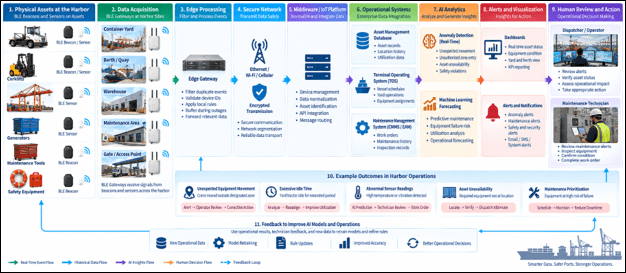
The visual presents an end-to-end Harbor Operations workflow, showing how BLE beacons and sensors feed gateways, edge processing, secure networks, middleware, and operational systems. AI analytics identify anomalies and forecast maintenance needs, while dashboards, human review, operational actions, and feedback support continuous improvement.
BLE Hardware and Software Considerations for Harbor Deployment
Harbor Operations require technology selection based on the physical environment and operational objective rather than simply selecting a wireless device category. BLE beacons, sensors, and gateways should be evaluated according to range requirements, mounting conditions, battery life, environmental exposure, radio performance, maintenance requirements, and integration capabilities.
BLE beacons generally provide an identity or broadcast signal associated with an asset. BLE sensors add measurable operational information where condition monitoring is required. BLE gateways collect device transmissions and forward relevant data to edge or centralized software.
A harbor deployment should evaluate whether zone-level tracking is sufficient or whether more precise positioning is necessary. Containers, steel equipment, cranes, vehicles, and other structures can influence radio propagation. Pilot testing should therefore be conducted in representative operating zones before large-scale installation.
Security should also be considered from the device through the backend system. Device identity management, secure network segmentation, access controls, encrypted communications where supported, software updates, credential management, logging, and monitoring should be incorporated into the deployment plan.
GAO has served organizations in the United States and Canada for three decades, including Fortune 500 companies, leading R&D organizations, universities, and government agencies, while investing in R&D, quality assurance, and technical support for BLE, RFID, and IoT products and systems. This experience is relevant when selecting hardware for deployments where environmental conditions, interoperability, reliability, and long-term support are important engineering considerations.
Cloud Version and Server Version for Harbor Operations
The software handling BLE and AI data can be deployed using either cloud-hosted or privately hosted infrastructure, depending on operational, security, integration, and governance requirements.
Cloud Version
A cloud-hosted software deployment can centralize data from multiple harbor facilities and provide scalable computing resources for AI analytics. It is particularly useful for organizations managing multiple terminals or sites that need centralized reporting, model management, and remote access.
Cloud deployment can simplify infrastructure scaling, but network connectivity, data governance, cybersecurity requirements, latency, and integration with harbor operational systems must be evaluated before implementation.
Server Version
A Server Version can run on edge servers, customer-managed servers, private data centers, harbor facility servers, or other privately hosted enterprise infrastructure. This model may be appropriate where operational data must remain within controlled infrastructure, where local processing is preferred, or where integration with existing private systems is a major requirement.
Edge or private-server processing can also provide resilience when external connectivity is limited. The trade-off is that the organization assumes greater responsibility for server capacity, software maintenance, security updates, backup, monitoring, and lifecycle management.
The appropriate deployment model can also be hybrid. Time-sensitive event processing may occur close to the harbor operation, while historical analytics, reporting, and model development can use centralized infrastructure.
Technical Capabilities and Operational Value of AI-Enabled Harbor Operations
Combining AI with BLE-generated operational data can improve Harbor Operations when the solution is designed around measurable workflows rather than simply increasing the number of connected devices. The strongest results generally come from correlating location, condition, utilization, maintenance, and operational context.
Continuous Asset Visibility
BLE-based identification can provide more frequent asset observations than manual inventory checks. AI can organize these events into useful operational information, including current zone, movement history, dwell time, utilization patterns, and unexpected movements.
For harbor managers, this can reduce the uncertainty associated with locating mobile equipment and critical support assets. The value increases when asset visibility is connected to dispatching, maintenance, and work planning rather than being maintained as a standalone tracking database.
Anomaly Detection for Harbor Equipment and Operations
AI anomaly detection can establish expected patterns from historical BLE events and sensor readings. Deviations can then be evaluated according to asset type, location, operating schedule, and equipment status.
Potential examples include:
- Equipment moving outside its normal operating zone
- Critical equipment remaining idle for an unusual period
- Unexpected entry into a restricted operational area
- Temperature or vibration readings deviating from an established baseline
- Repeated equipment movements associated with operational delays
- Assets appearing unavailable when scheduled for harbor operations
Anomaly detection should account for legitimate operational exceptions. A maintenance movement, emergency response, or temporary reassignment should not automatically be interpreted as a security or operational failure. Contextual rules and human verification help reduce false positives.
Predictive Maintenance and Maintenance Prioritization
AI-supported predictive maintenance can combine BLE sensor observations with equipment age, utilization, inspection records, historical failures, and maintenance work orders.
Rather than treating every asset identically, models can help maintenance teams rank equipment according to condition indicators and operational criticality. This is particularly relevant for equipment whose failure could disrupt vessel servicing, cargo handling, yard movement, or other time-sensitive activities.
A practical implementation should establish clear thresholds for alerting and distinguish between:
- Informational observations
- Maintenance recommendations
- Technician inspection requirements
- High-priority operational alerts
- Conditions requiring immediate human intervention
This separation prevents AI predictions from being mistaken for confirmed equipment failures.
Improved Equipment Utilization
Harbor equipment represents a significant operational resource. AI can analyze movement and utilization histories to identify assets that are consistently underused, frequently idle, or repeatedly assigned to inefficient workflows.
Combining location data with work schedules can help supervisors evaluate equipment allocation and identify recurring delays. The goal is not necessarily to maximize utilization of every asset. Critical standby equipment may intentionally have low utilization because its availability is more important than continuous use.
Operational Scalability
A well-designed BLE and AI solution can expand from a pilot involving a defined group of assets to additional yards, warehouses, maintenance areas, or terminal facilities.
Scalability depends on more than adding gateways and tags. Organizations should establish consistent asset identifiers, naming conventions, device-management procedures, data retention policies, API interfaces, network segmentation, and AI model governance before expanding deployment.
GAO can support organizations selecting BLE, RFID, and IoT hardware products and systems as their Harbor Operations requirements develop from individual use cases toward broader operational deployments.
AI Methods Relevant to Harbor Operations
Different Harbor Operations use cases require different analytical approaches. Selecting an AI method should follow the business problem, data availability, required response time, and consequences of an incorrect prediction.
Machine Learning for Operational Pattern Analysis
Supervised and unsupervised machine learning can analyze historical asset movements, utilization records, sensor readings, and maintenance outcomes.
Unsupervised anomaly detection is useful when the organization has large quantities of operational data but limited examples of confirmed failures. The model can identify observations that differ substantially from established patterns.
Supervised models can be used when sufficient historical examples exist, such as equipment conditions associated with known maintenance events. Model performance should be evaluated against operationally meaningful metrics rather than relying only on generic model accuracy.
Time-Series Forecasting
Time-series models can analyze sensor and utilization data over time to identify trends and forecast potential changes. For harbor equipment, this can support maintenance planning, resource forecasting, and operational capacity analysis.
Sensor frequency should be matched to the physical phenomenon being monitored. Collecting high-frequency data is not automatically beneficial if the resulting information cannot improve a maintenance or operational decision.
Edge AI
Edge AI can process selected BLE and sensor data near the harbor operation. This approach can reduce latency, limit unnecessary transmission of raw data, and provide continued local processing during temporary network interruptions.
It is especially useful for applications where an operational response must occur quickly or where connectivity is inconsistent.
Computer Vision as a Complementary Technology
Computer vision can provide visual information that BLE cannot. Cameras can observe vehicle behavior, cargo-handling activities, safety conditions, and other visual events, while BLE provides persistent device or asset identification.
These technologies can therefore complement one another. A harbor may use BLE to identify a particular piece of equipment and computer vision to evaluate the surrounding operational event.
Supporting Technologies and Integration for Harbor Operations
BLE should normally be treated as one component of a broader operational data system.
| Technology | Primary Harbor Operations Role | Relationship with AI |
|---|---|---|
| BLE beacons | Asset identification and presence detection | Supplies asset movement and zone events |
| BLE sensors | Equipment or environmental measurements | Supplies condition data for analytics |
| BLE gateways | BLE data collection | Transfers observations to processing systems |
| RFID | Identification and inventory workflows | Adds complementary item-level identification |
| GNSS | Outdoor positioning | Provides geographic location where appropriate |
| Computer vision | Visual event detection | Adds contextual visual information |
| Equipment telemetry | Machine operating data | Provides machine-level operational signals |
| Terminal Operating System | Terminal workflow management | Supplies operational context |
| CMMS/EAM | Maintenance and asset records | Connects predictions to maintenance actions |
| Access control | Controlled entry and identity events | Adds authorization context |
| Network infrastructure | Data transport | Connects edge systems with backend software |
The appropriate combination depends on the harbor workflow. BLE may be particularly useful where assets need frequent identification within defined operational zones. GNSS may be more appropriate for wide-area outdoor positioning. RFID can complement BLE where controlled identification at gates, inventory points, or specific read zones is required.
Cybersecurity and Data Governance for Harbor AI Systems
Connectivity between BLE devices, gateways, harbor networks, operational software, and AI systems introduces cybersecurity considerations that should be addressed during system design rather than after deployment.
Important controls include:
- Unique device identification and credential management
- Network segmentation between IoT devices and critical operational systems
- Access control based on user roles and operational responsibilities
- Secure communication between gateways and backend systems
- Software and firmware update procedures
- Logging of device, gateway, user, and system activity
- Monitoring for unauthorized device behavior
- Backup and recovery procedures
- Controlled API access to operational systems
- Data retention and governance policies
BLE device security should also be considered in the context of physical access. Devices attached to outdoor equipment may be exposed to tampering, environmental conditions, accidental damage, or unauthorized removal.
AI introduces additional governance requirements. Harbor operators should retain sufficient information to determine why an alert was generated, what data contributed to the decision, who verified the result, and what action was taken. This creates an operational audit trail and helps improve future model performance.
Engineering Considerations Before Harbor Deployment
A successful Harbor Operations deployment should begin with the operational problem rather than with a predetermined hardware configuration.
Define the Operational KPI
The project team should establish measurable outcomes before selecting devices. Relevant KPIs may include:
- Asset location accuracy by operational zone
- Asset availability
- Equipment utilization
- Equipment idle time
- Mean time to locate critical equipment
- Maintenance response time
- Unplanned equipment downtime
- Predictive maintenance alert precision
- False-alert rate
- Gateway availability
- Battery replacement interval
- Data-event processing latency
The selected KPI should directly relate to an operational decision. Tracking more devices or collecting more events is not itself a business outcome.
Conduct a Harbor Site Survey
Radio performance should be tested under actual operating conditions. Container stacks, steel structures, cranes, warehouses, vehicles, machinery, and changing asset configurations can influence BLE performance.
The survey should evaluate:
- Gateway placement
- Required coverage zones
- Signal behavior around metal structures
- Expected device density
- Battery-powered device placement
- Network connectivity
- Environmental exposure
- Maintenance access
- Potential interference
- Required location granularity
A representative pilot should include the physical conditions expected during normal harbor operations rather than relying solely on laboratory tests.
Establish Data and Integration Requirements
Before commissioning, the project team should define asset identifiers, data fields, event formats, APIs, retention requirements, user roles, and integration points.
The BLE system should fit existing operational processes. For example, an AI maintenance recommendation is substantially more useful when it can be associated with the correct asset record and maintenance workflow rather than requiring technicians to manually reconcile separate systems.
Validate AI Models Before Operational Automation
AI models should initially operate with controlled human review. Historical data can be used to establish baselines, while pilot deployments can measure false positives, missed anomalies, and alert response times.
Human verification is especially important where an incorrect prediction could interrupt cargo handling, unnecessarily remove equipment from service, or create a safety-related response.
Deployment, Commissioning, and Lifecycle Management
A phased implementation reduces technical and operational risk.
Planning and Hardware Selection
Select BLE beacons, sensors, and gateways according to the asset type, environmental conditions, transmission requirements, battery expectations, and required coverage. Define the operational zones and integration requirements before installation.
Installation and Commissioning
Install devices according to documented mounting and coverage requirements. Verify gateway connectivity, device identification, event reception, timestamps, asset associations, and network performance.
Commissioning should include physical walkthroughs of representative harbor routes and operating areas. Test normal movements as well as unexpected movement scenarios.
Integration Testing
Validate data flow from BLE devices through gateways, middleware, databases, AI services, dashboards, and operational systems. Confirm that events are not duplicated, incorrectly associated, or lost during temporary connectivity interruptions.
Integration testing should also verify user permissions, alert routing, audit records, and system recovery.
Operational Optimization
After deployment, analyze real operating data to determine whether gateway placement, transmission intervals, filtering rules, alert thresholds, or AI models require adjustment.
The system should evolve according to measured performance. For example, excessive false alerts may indicate that the model lacks operational context or that rules need refinement.
Maintenance and Lifecycle Management
BLE devices and gateways require ongoing lifecycle management. Battery replacement schedules, device health monitoring, firmware updates, gateway maintenance, spare inventory, and asset reassignment procedures should be documented.
When a harbor asset changes ownership, operating zone, or maintenance status, its digital association should also be updated. Otherwise, AI models can receive incorrect labels and gradually lose analytical reliability.
Selecting the Right AI and BLE Approach for Harbor Operations
Harbor operators should avoid assuming that one tracking technology or AI method can address every operational requirement. The correct solution depends on the asset, location, workflow, environmental conditions, required accuracy, response time, and existing software.
A practical selection process should consider:
- Define the operational problem and measurable KPI.
- Identify the assets, equipment, zones, and workflows involved.
- Determine whether identification, positioning, condition monitoring, or a combination is required.
- Evaluate BLE, RFID, GNSS, computer vision, telemetry, and other complementary technologies.
- Conduct a representative site survey.
- Select gateway and sensor locations based on measured conditions.
- Determine cloud, private-server, edge, or hybrid processing requirements.
- Integrate operational and maintenance systems.
- Establish cybersecurity and device-management controls.
- Pilot the solution with human verification.
- Measure performance against predefined KPIs.
- Scale only after operational and technical performance has been demonstrated.
GAO provides BLE, RFID, and IoT hardware products and systems for organizations that need to connect physical assets and operational processes with digital information. Its engineering and technical support capabilities can help organizations evaluate appropriate hardware and system configurations for specific deployment requirements.
Key Takeaways for AI-Enabled Harbor Operations
AI-enabled Harbor Operations can use BLE-generated asset and sensor data to improve visibility, identify operational anomalies, support predictive maintenance, analyze equipment utilization, and provide better information for dispatchers and maintenance teams.
The most important implementation lessons are:
- Start with a defined harbor workflow and KPI rather than a device-first deployment.
- Treat BLE as an enabling data-acquisition technology within a broader operational system.
- Design gateway placement around actual harbor radio conditions.
- Combine BLE events with maintenance, scheduling, asset, and terminal data to provide AI with operational context.
- Use Edge AI where low latency or local resilience is important.
- Use cloud or private-server processing according to connectivity, governance, integration, and operational requirements.
- Keep human verification in the decision loop for high-impact actions.
- Measure false alerts, missed events, latency, availability, and operational outcomes.
- Plan cybersecurity, device lifecycle management, and model governance from the beginning.
- Use complementary technologies such as RFID, GNSS, computer vision, and equipment telemetry where they provide information that BLE cannot.
For organizations evaluating AI-driven asset tracking, equipment monitoring, and operational intelligence for Harbor Operations, GAO can provide BLE, RFID, and IoT hardware products and systems together with technical expertise to support deployment planning and integration.
AI-Enabled Harbor Operations Reference Architecture
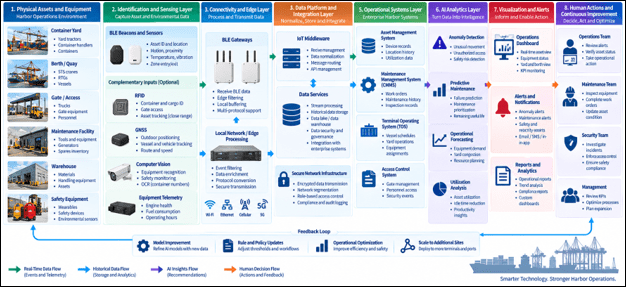
The visual presents a layered reference architecture for AI-enabled Harbor Operations, connecting physical assets, BLE sensing, gateways, edge processing, secure networks, middleware, operational systems, AI analytics, dashboards, and human actions. It also shows complementary RFID, GNSS, computer vision, and equipment telemetry inputs, plus feedback loops for continuous improvement.
About GAO and Its Industrial Technology Expertise
Headquartered in New York City and Toronto, Canada, GAO is ranked among the top 10 leading B2B and B2G BLE and RFID suppliers worldwide. GAO and its sister companies, GAO Research Inc. and GAO Tek Inc., form GAO Group, with operations based in New York City and Toronto.
For three decades, GAO Group has served customers across the United States and Canada, including Fortune 500 companies, leading R&D firms, prestigious universities, and U.S. and Canadian government agencies. The group has invested substantially in product and system R&D and maintains stringent quality assurance processes.
For Harbor Operations, this background supports a practical approach to selecting BLE, RFID, and IoT technologies according to real deployment requirements. GAO also provides remote and onsite technical support to help organizations address hardware selection, system deployment, integration, and operational issues.
Building the Future of Industrial AI and IoT with Aperture Venture Studio and GAO RFID Inc.
For more than three decades, GAO Group of Companies has invested heavily in R&D of industrial BLE, RFID, and IoT. As generative AI became useful for industrial applications, we expanded our work across AI and IoT technologies, including BLE and RFID, and founded Aperture Venture Studio to build, launch, and scale next-generation AI and IoT companies for applications such as Harbor Operations and other industries.
Aperture has attracted AI and IoT technical experts, entrepreneurial and operational executives, influential investors, and leading companies. We have also developed the Aperture Ventures Summit and TekSummit to discuss advanced AI and IoT topics. GAO welcomes advisors, co-founders, employees, investors, and customers interested in advancing practical AI and IoT solutions.