
AI and BLE for Healthcare Campuses
AI-Driven Healthcare Campus Operations with BLE
AI and BLE can help healthcare campuses convert location, environmental, equipment, and operational signals into actionable intelligence. BLE beacons and sensors provide low-power data from medical equipment, mobile assets, staff workflows, temperature-sensitive areas, and facility environments, while BLE gateways transfer that information to local or cloud software for analytics. AI can then identify abnormal movement patterns, predict equipment demand, detect environmental deviations, optimize asset utilization, and support operational decisions. The resulting solution is particularly relevant to hospitals, outpatient centers, diagnostic facilities, rehabilitation centers, laboratories, and multi-building medical campuses where thousands of assets and people move through complex spaces. GAO supplies BLE gateways, beacons, sensors, RFID products, and related IoT systems that can provide the underlying data infrastructure for these healthcare use cases.
Healthcare Campus AI + BLE Architecture
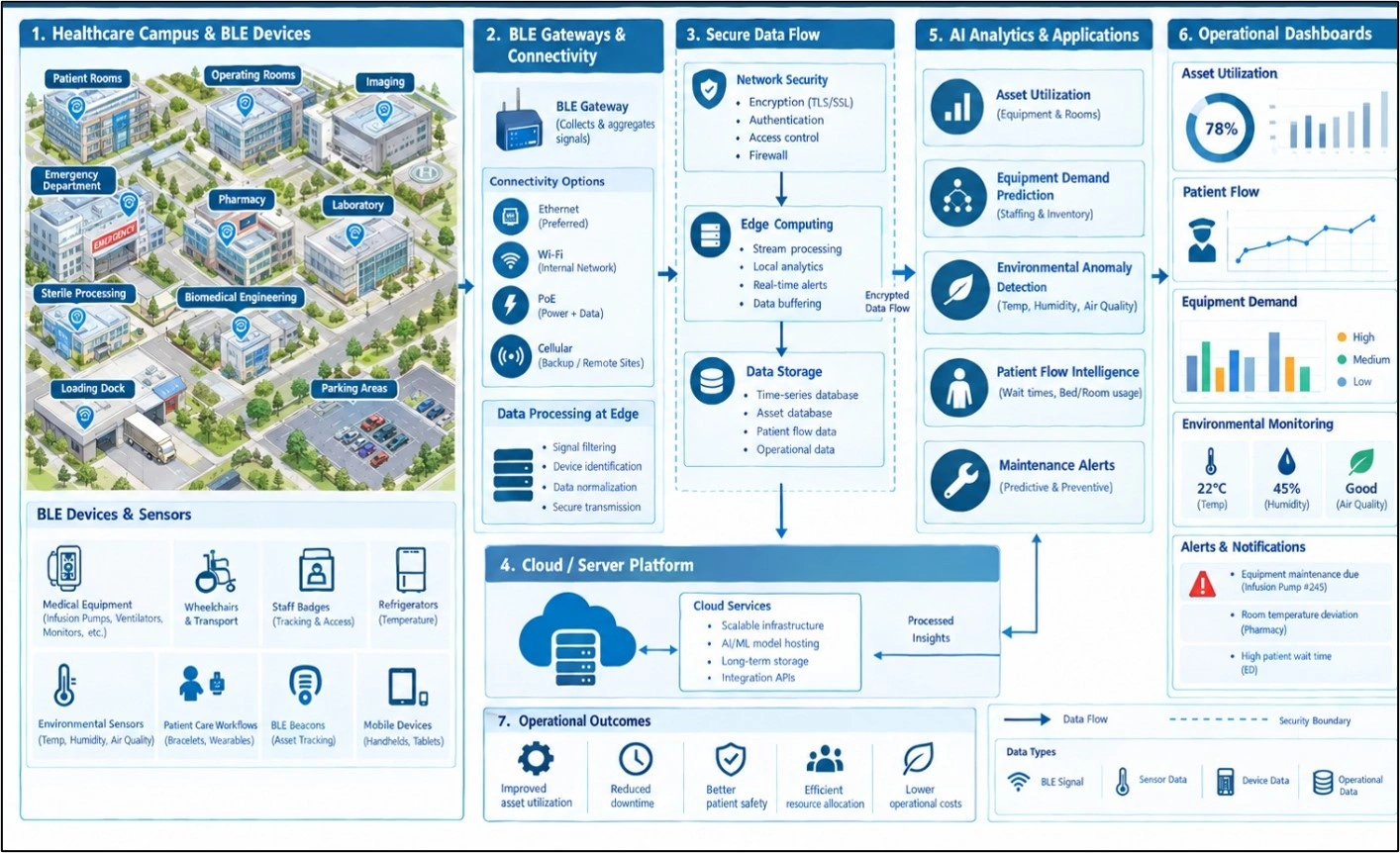
A corporate technical diagram illustrating the end-to-end data pipeline of an enterprise healthcare campus. BLE beacons across hospital departments send real-time signals via network gateways to Edge and Cloud AI analytics engines, generating operational intelligence outputs like equipment demand prediction and patient-flow insights.
What AI Means for BLE-Enabled Healthcare Campuses
Healthcare campuses generate large volumes of operational data, but the information required to make decisions is often distributed across disconnected systems. A hospital may know that an infusion pump exists in its asset database while not knowing its current location, utilization state, proximity to a patient-care area, or whether it is likely to be needed during the next clinical shift. Similarly, facilities teams may receive temperature readings from refrigerators or medication-storage areas without an analytical model that distinguishes normal fluctuations from conditions requiring intervention.
AIoT addresses this gap by combining artificial intelligence with connected sensors, devices, equipment, and operational systems. AI methods can include machine learning, anomaly detection, time-series forecasting, classification, optimization, computer vision where appropriate, and Edge AI for latency-sensitive decisions.
BLE provides one practical data-acquisition layer. A beacon can identify or represent an asset or location, while a BLE sensor can report temperature, humidity, vibration, motion, battery condition, or other measurable parameters. Gateways receive these signals and pass relevant observations to software for correlation and analysis. GAO’s BLE gateway portfolio includes connectivity options involving Wi-Fi, Ethernet, PoE, cellular, and BLE, allowing healthcare deployments to be matched to building conditions and existing network infrastructure.
The important engineering distinction is that BLE does not itself create clinical intelligence. Its role is to provide a practical wireless observation layer. AI creates additional value by correlating these observations with healthcare workflows, locations, schedules, asset records, maintenance history, environmental thresholds, and operational events.
For healthcare campuses, this distinction is important because not every tracked object should be treated as patient data. A BLE signal indicating that an equipment asset is near a nursing station may be operational information, whereas information that directly associates an individual with a clinical event may become protected health information. System designers therefore need data classification, access controls, retention policies, and appropriate separation between operational telemetry and clinical records. HHS requires covered entities and business associates to apply administrative, physical, and technical safeguards to electronic protected health information, including access control, audit controls, authentication, integrity protection, and transmission security.
Priority AI Applications Across Healthcare Campuses
AI Medical Equipment Tracking and Utilization
Medical equipment tracking is one of the most practical applications for AI-enabled BLE deployments. Hospitals may manage infusion pumps, patient monitors, wheelchairs, beds, stretchers, portable ultrasound equipment, ventilators, defibrillators, mobile diagnostic equipment, and other high-value assets across departments.
BLE beacons attached to selected equipment can provide location observations to gateways positioned throughout the campus. AI software can analyze historical movement and utilization patterns to distinguish equipment that is actively used from equipment that is repeatedly parked, underutilized, or frequently moved between departments.
The resulting intelligence can support:
- Equipment availability prediction before clinical shifts
- Identification of frequently misplaced mobile equipment
- Department-level utilization analysis
- Detection of abnormal asset movement
- Maintenance scheduling based on utilization patterns
- Reduction of unnecessary equipment purchases
- Faster equipment retrieval by clinical and biomedical engineering teams
A practical deployment should not attempt to locate every asset with the same accuracy. High-value mobile equipment may justify room-level or zone-level location intelligence, while low-value equipment may only require department-level visibility.
GAO’s BLE gateway systems are designed to collect signals from BLE beacons and transfer the resulting information to centralized processing systems, supporting applications such as asset tracking and monitoring.
AI Patient Flow and Healthcare Facility Movement Analysis
Patient movement is another area where AI can provide operational value, particularly when the objective is to understand aggregate workflow rather than continuously identify individuals.
BLE infrastructure can provide zone-level observations around emergency departments, imaging suites, laboratories, operating-room areas, registration zones, elevators, and outpatient clinics. AI models can analyze movement sequences and timestamps to identify bottlenecks.
Potential analytical outputs include:
- Excessive waiting time between registration and clinical service
- Congestion around diagnostic departments
- Abnormally long transport intervals
- Repeated movement between specific care zones
- Capacity constraints during particular hours
- Variations between scheduled and actual workflow
- Opportunities to rebalance staff or transport resources
Healthcare organizations should carefully define the identity model before deploying such functionality. Anonymous or pseudonymous operational identifiers may be appropriate for some workflow analytics, while applications involving identifiable patient information require stronger privacy and security controls.
AI Environmental Monitoring for Patient-Care and Storage Areas
Temperature, humidity, vibration, and other environmental parameters can be particularly important in healthcare facilities. Examples include vaccine and medication storage, blood and specimen areas, laboratories, cleanrooms, pharmacies, operating-room support areas, and equipment rooms.
BLE sensors can provide recurring measurements, while AI models can establish normal operating patterns and detect deviations.
Instead of simply generating a threshold alarm, an AI-enabled system can examine:
- Rate of temperature change
- Duration of deviation
- Historical behavior
- HVAC operating patterns
- Door-opening frequency
- Sensor relationships
- Location-specific environmental conditions
- Time of day and occupancy conditions
This can help facilities teams prioritize events that are more likely to require intervention.
A useful implementation principle is to preserve deterministic safety thresholds alongside AI analytics. AI should supplement established alarm and compliance procedures rather than replace required safety controls.
AI Predictive Maintenance for Healthcare Facility Equipment
Healthcare campuses depend on HVAC systems, generators, pumps, compressors, medical gas infrastructure, elevators, sterilization equipment, refrigeration systems, and other facility assets.
BLE sensors can contribute vibration, temperature, runtime, or other telemetry where technically appropriate. AI models can compare current readings with historical patterns and maintenance records to identify potential deterioration.
For example, a gradual change in vibration on a critical mechanical asset may be more useful when correlated with operating hours and previous maintenance events than when viewed as an isolated sensor reading.
The maintenance workflow can therefore progress from:
- Sensor observation
- Data validation
- Anomaly detection
- Condition assessment
- Maintenance prioritization
- Work-order generation
- Technician intervention
- Post-maintenance verification
Integration with computerized maintenance management systems can allow AI-generated recommendations to become actionable maintenance tasks rather than remaining isolated dashboard alerts.
Infusion Pump AI Asset Tracking Flow
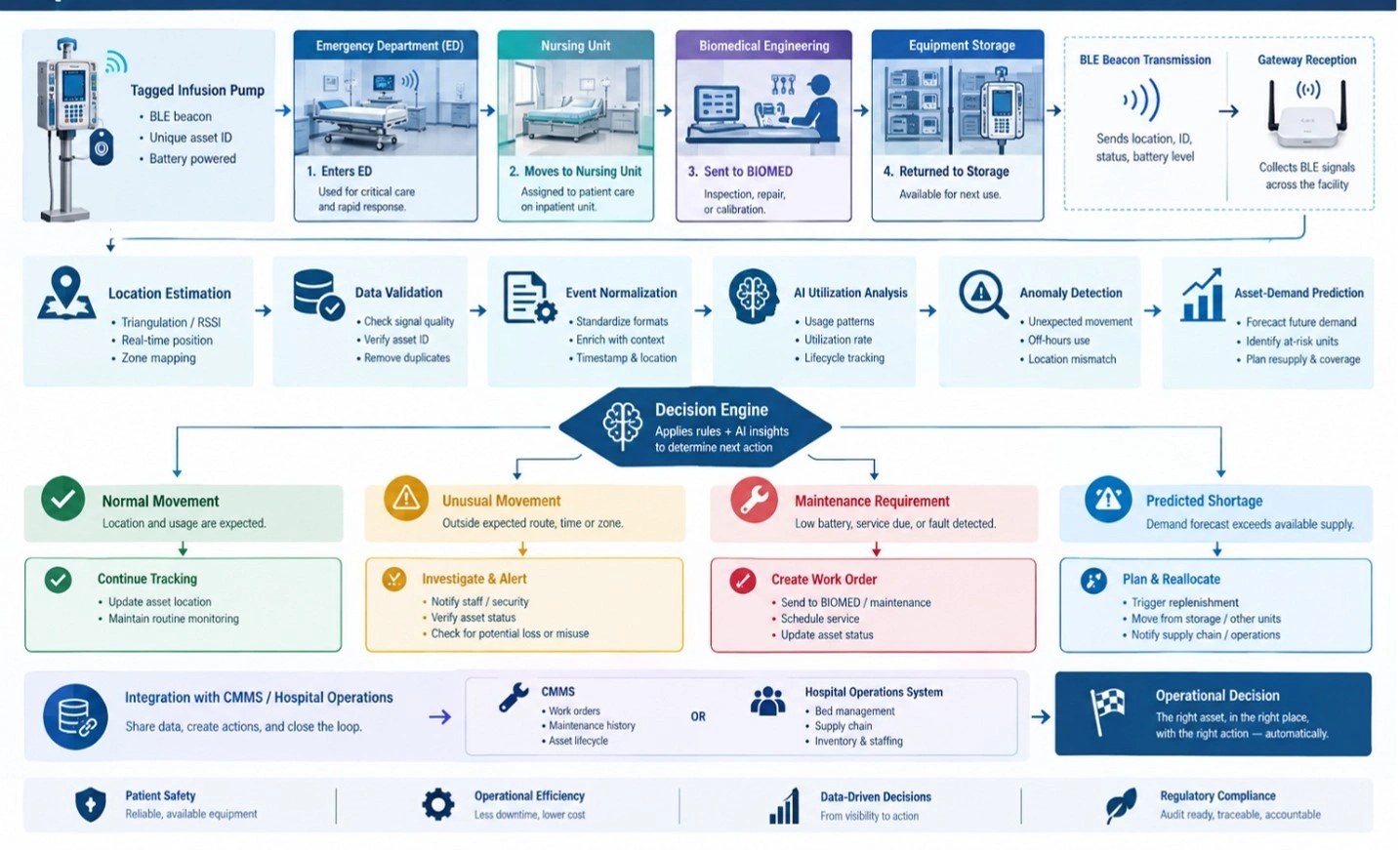
An engineering workflow diagram tracing an infusion pump’s location in a hospital, showing how BLE gateway data is processed by AI analytics to trigger maintenance, shortage, and relocation actions via a CMMS system.
Healthcare Campus Deployment Scenarios and Engineering Priorities
Healthcare campuses vary considerably in physical layout, clinical workflow, building construction, network availability, and operational requirements. A successful AI-enabled BLE solution therefore starts with the operational problem rather than with the wireless hardware.
| Healthcare campus scenario | AI objective | BLE data contribution | Key engineering consideration |
|---|---|---|---|
| Hospital asset management | Predict equipment demand and improve utilization | Asset identity and location observations | Room and zone accuracy |
| Emergency department | Identify workflow congestion | Movement events and zone transitions | High device density |
| Pharmacy and medication storage | Detect environmental abnormalities | Temperature and humidity telemetry | Sensor calibration and alarm integrity |
| Laboratory | Monitor environmental conditions and equipment | Sensor readings and asset location | Validation and traceability |
| Biomedical engineering | Predict maintenance requirements | Equipment location and condition data | CMMS integration |
| Operating-room support | Improve equipment availability | Equipment movement and utilization | Workflow sensitivity |
| Outpatient clinics | Analyze operational flow | Zone-level movement data | Privacy-aware identity design |
| Multi-building campus | Coordinate equipment and facility operations | Campus-wide gateway observations | Roaming, network coverage, and synchronization |
The physical environment has a major effect on BLE performance. Concrete walls, elevator shafts, metal equipment, medical machinery, dense human occupancy, and RF interference can affect signal behavior. Room-level positioning should therefore be validated through a site survey and commissioning test rather than inferred from theoretical radio range.
GAO’s product portfolio includes indoor BLE gateways, outdoor gateways, multi-connectivity gateways, and gateway options supporting protocols such as MQTT or HTTP on selected models.
Healthcare Campus Data Workflow from BLE Signals to AI Decisions
A practical deployment normally contains several processing stages.
Data Acquisition
BLE beacons and sensors generate observations associated with equipment, locations, environmental conditions, or operational events. Sensor configuration should account for measurement interval, battery life, calibration requirements, environmental conditions, and the consequence of missed readings.
Gateway Collection and Communication
BLE gateways receive local wireless signals and forward selected data through the healthcare campus network. Depending on the installation, connectivity may use Ethernet, PoE, Wi-Fi, or cellular communication. GAO offers gateway models using combinations of these communication paths, including gateways intended for indoor and outdoor environments.
Gateway placement should consider RF coverage, network availability, electrical power, maintenance access, physical security, and the consequences of gateway failure.
Edge Processing and Data Validation
Edge processing can reduce unnecessary traffic and provide faster local handling of events. A gateway or nearby edge server may filter duplicate observations, normalize timestamps, validate sensor payloads, remove clearly invalid readings, and buffer data during temporary network outages.
This layer is particularly useful for healthcare campuses because network availability cannot always be assumed across every building, basement, mechanical area, parking structure, or remote facility.
Middleware and Enterprise Integration
Normalized observations can then move into middleware, databases, analytics software, or application services. Integration targets may include:
- CMMS and computerized maintenance systems
- Computer-aided facility management software
- Hospital asset management systems
- Inventory systems
- Building management systems
- Environmental monitoring software
- Hospital operations dashboards
- Identity and access management services
- Data warehouses and analytics systems
The integration layer should preserve the distinction between raw observations, interpreted events, and AI-generated recommendations. This improves auditability and makes troubleshooting easier.
AI Analytics and Operational Action
AI models can operate on historical and real-time observations to produce forecasts, classifications, anomaly scores, utilization models, or optimization recommendations.
For example, an equipment-management workflow could combine current asset location, historical movement, department demand, equipment availability, maintenance status, and scheduled procedures to predict where equipment shortages are likely to occur.
The final step is operational action. A useful system should connect AI outputs to a responsible role, such as a biomedical engineering manager, facilities engineer, nurse manager, supply-chain coordinator, or hospital operations team.
Cloud Version and Server Version for Healthcare Campus AI
Healthcare organizations can select between cloud-hosted and privately hosted deployment models based on data governance, network design, operational responsibility, integration requirements, and security policies.
Cloud Version is appropriate when healthcare organizations want centralized software management across multiple hospitals, outpatient buildings, laboratories, and satellite facilities. Gateway data can be securely transmitted to cloud services where centralized analytics, dashboards, fleet management, model updates, and multi-site reporting are performed. This model can simplify scaling when a healthcare organization operates geographically distributed facilities.
Server Version places software on customer-managed servers, private data centers, edge servers, or other privately hosted enterprise infrastructure. This approach can be preferable when healthcare IT teams require tighter control over data processing locations, network segmentation, system dependencies, or integration with existing internal applications.
A hybrid arrangement can also be practical. Edge systems can perform immediate filtering and event handling, while centralized servers or cloud infrastructure perform historical analytics and model training.
Security should be designed into every layer. HHS identifies confidentiality, integrity, and availability as core Security Rule objectives and requires safeguards such as access controls, audit controls, authentication, integrity protection, and transmission security for applicable ePHI. FDA guidance also emphasizes cybersecurity across the lifecycle of connected medical devices, while noting that network connectivity can introduce additional cybersecurity risks.
For BLE deployments supporting healthcare operations, practical controls include device identity management, network segmentation, encrypted communications where supported, certificate or credential management, secure gateway configuration, firmware lifecycle management, least-privilege access, centralized logging, vulnerability management, and documented incident-response procedures. NIST guidance similarly emphasizes that IoT products should be considered as components of broader information systems because their acquisition and integration can change organizational cybersecurity risk.
AI-Enabled Healthcare Campus Capabilities and Operational Benefits
AI becomes most valuable when BLE observations are combined with healthcare-specific operational data. The objective is not simply to display where an asset is located, but to use historical and real-time information to improve decisions made by clinical support, facilities, biomedical engineering, pharmacy, supply-chain, and hospital operations teams.
Higher Medical Equipment Availability
AI can forecast equipment demand by analyzing historical utilization, department schedules, asset movement, maintenance status, and time-of-day patterns. This allows equipment managers to identify likely shortages before they affect clinical operations.
BLE location data provides the asset visibility required to determine whether equipment is available, already assigned, undergoing maintenance, or located in another department.
The practical outcome can include:
- Faster equipment retrieval
- Better allocation of mobile medical devices
- Higher utilization of existing equipment
- Reduced unnecessary equipment purchases
- Improved readiness for scheduled procedures
Faster Maintenance Response
Combining equipment location with maintenance intelligence helps biomedical engineering teams determine both what requires attention and where the equipment is located.
AI can identify abnormal operating patterns, while BLE can provide recent location observations. A CMMS can then receive the resulting maintenance event or recommendation.
This reduces the operational gap between detecting a problem and assigning a technician to the correct asset.
Improved Environmental Control
AI-based environmental monitoring can identify patterns that conventional threshold alarms may not reveal. For example, repeated temperature excursions may correlate with particular periods of high door activity, HVAC cycles, or equipment loading.
BLE sensors can provide the underlying measurements, while AI can classify abnormal conditions and prioritize alerts.
Healthcare facilities should still retain fixed regulatory thresholds and conventional alarms for safety-critical applications. AI should provide additional analysis rather than become the sole protection mechanism.
Better Healthcare Campus Capacity Planning
Movement and utilization data can reveal how clinical and support areas behave over time.
AI models can analyze:
- Department occupancy patterns
- Equipment demand
- Transport activity
- Diagnostic workflow
- Waiting intervals
- Service utilization
- Building-level activity
- Seasonal operational changes
These insights can support decisions concerning staffing, equipment allocation, space utilization, and facility planning.
Improved Security and Operational Accountability
BLE-enabled asset monitoring can help identify unusual movement of high-value equipment. AI can establish expected movement patterns and flag deviations for investigation.
Security teams can correlate these events with access-control records, while biomedical engineering and facilities teams can investigate whether the movement represents legitimate maintenance, clinical use, relocation, or an unexplained event.
This approach creates an operational audit trail without assuming that every BLE observation represents a security incident.
Healthcare Campus KPIs for AI and BLE Programs
A healthcare organization should define success metrics before installing the system. The most useful KPIs measure operational outcomes rather than simply counting BLE messages.
| KPI | What it measures | AI contribution |
|---|---|---|
| Asset retrieval time | Time required to locate and deliver equipment | Predicts equipment location and demand |
| Equipment utilization | Percentage of available time an asset is actively used | Identifies underutilized and high-demand assets |
| Asset availability | Percentage of time equipment is ready for use | Combines location and maintenance status |
| Preventive maintenance compliance | Maintenance completed according to schedule | Forecasts maintenance workload |
| Mean time to repair | Time from maintenance initiation to restoration | Prioritizes work and identifies recurring issues |
| Environmental excursion rate | Frequency of temperature or humidity deviations | Detects abnormal patterns |
| Alarm response time | Time between alert and intervention | Prioritizes operational events |
| Equipment loss or misplacement rate | Frequency of assets becoming difficult to locate | Detects unusual movement |
| Patient transport interval | Time associated with movement between operational zones | Identifies workflow bottlenecks |
| Gateway data availability | Reliability of the wireless data-collection layer | Identifies infrastructure failures |
| Sensor data completeness | Percentage of expected readings received | Detects device or connectivity problems |
| AI alert precision | Percentage of alerts that require meaningful action | Helps tune AI models |
KPIs should be segmented by building, department, asset class, shift, and operational process where appropriate. A campus-wide average can conceal problems in an emergency department or specialized laboratory.
Planning and Commissioning an AI-Enabled BLE Healthcare Campus
Successful deployments begin with a clearly defined operational problem.
Define the Healthcare Workflow
Teams should document the workflow before selecting hardware. A medical-equipment tracking project, for example, should identify where equipment originates, where it is stored, who moves it, where it is used, when it enters maintenance, and which software contains the authoritative asset record.
Facilities projects should similarly document environmental monitoring points, existing Building Management System integrations, alarm procedures, HVAC zones, and maintenance responsibilities.
Select the Right BLE Devices
Device selection should be based on the physical and operational environment.
Important parameters include:
- Required location accuracy
- Battery operating life
- Sensor measurement accuracy
- Temperature and humidity range
- Mounting method
- IP rating where relevant
- RF characteristics
- Gateway coverage
- Local storage or buffering requirements
- Firmware update mechanisms
- Communication interfaces
- Maintenance accessibility
GAO provides BLE beacons, sensors, gateways, and related IoT hardware that can be incorporated into healthcare asset-monitoring and environmental-monitoring solutions. Hardware selection should still be validated against the specific hospital environment and application requirements.
Perform an RF and Network Site Survey
BLE performance should be tested in representative areas rather than assumed from a manufacturer’s nominal range.
Healthcare buildings can contain:
- Reinforced concrete
- Steel structures
- Medical equipment
- Elevator shafts
- Dense partitions
- Shielded rooms
- Mechanical spaces
- High human occupancy
- Wi-Fi and other RF systems
The survey should measure signal behavior and gateway placement under realistic operating conditions.
Commission the System
Commissioning should verify the entire chain from physical device to business application.
Testing should cover:
- Beacon identification
- Sensor measurement accuracy
- Gateway reception
- Network connectivity
- Timestamp synchronization
- Data transmission
- Edge buffering
- Middleware transformation
- Database persistence
- AI event generation
- Dashboard accuracy
- CMMS or facility-system integration
- Alarm escalation
- Device failure behavior
- Recovery following network interruption
A healthcare deployment should also establish acceptance criteria before production activation.
Healthcare BLE Commissioning Lifecycle
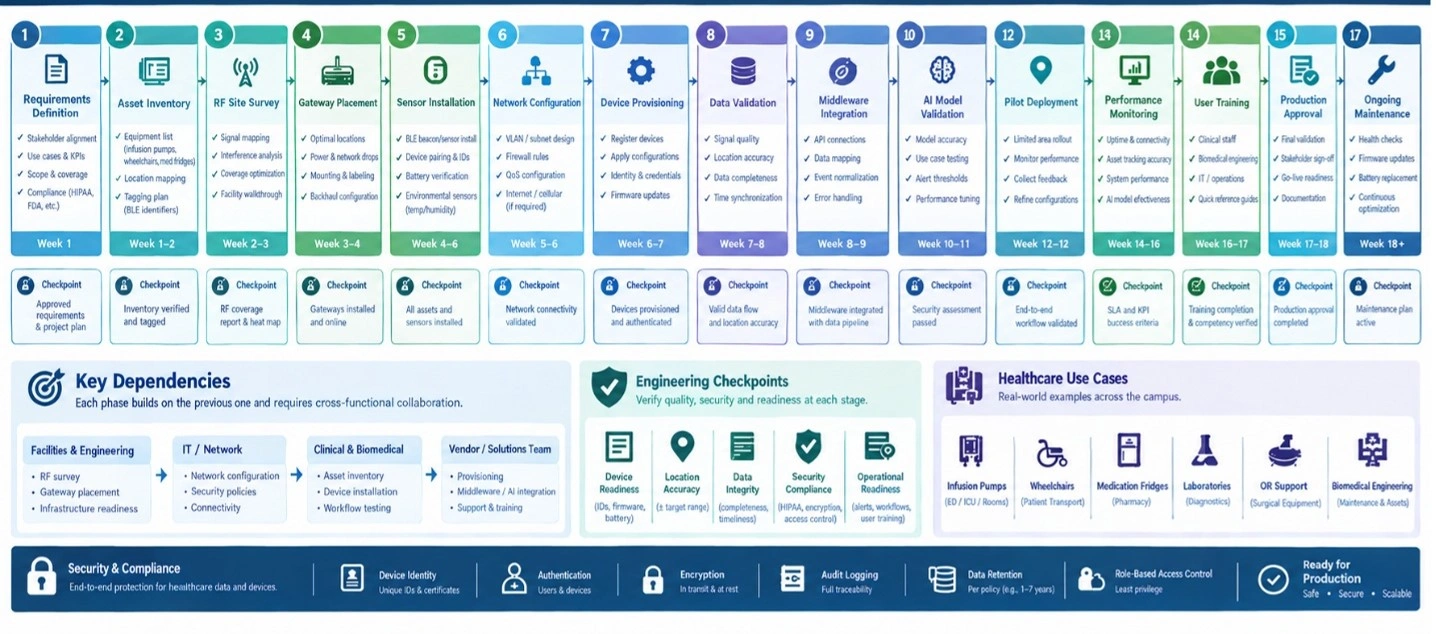
A 6-phase engineering workflow diagram illustrating the complete deployment process for a Bluetooth Low Energy (BLE) asset tracking system across a healthcare campus, spanning from initial planning and site survey to final production acceptance and ongoing maintenance.
Interoperability with Healthcare IT and Facility Systems
BLE data becomes considerably more useful when connected to existing healthcare software rather than creating another isolated application.
Integration requirements may involve:
- CMMS and computerized maintenance management systems
- Building Management Systems
- Asset management databases
- Inventory and supply-chain applications
- Laboratory information systems
- Hospital operational databases
- Data warehouses
- Business intelligence software
- Identity and access-management systems
- Enterprise notification services
The integration design should establish authoritative sources for asset identity, department information, maintenance status, and user permissions.
Healthcare interoperability also requires careful separation of operational telemetry from clinical information. HL7 and FHIR are widely used healthcare interoperability standards, but they should not automatically be applied to every BLE observation. A simple equipment-location event may be better handled through an asset-management interface or event API than through a clinical data exchange.
The correct integration method depends on the business process and the destination system.
Cybersecurity and Privacy for BLE Healthcare Deployments
Cybersecurity should cover the entire data path rather than focusing only on the BLE radio.
A practical security program should consider:
- Unique device identities
- Secure provisioning
- Gateway authentication
- Network segmentation
- Encryption in transit
- Secure API access
- Role-based authorization
- Administrative access controls
- Firmware lifecycle management
- Vulnerability assessment
- Security logging
- Audit trails
- Backup and recovery
- Credential rotation
- Device decommissioning
- Data retention
Healthcare organizations should also determine whether BLE-derived data can be associated with an identifiable patient, employee, clinician, or visitor.
A location signal attached to a medical device is generally different from a location signal explicitly linked to an identifiable patient. That distinction should influence database design, access permissions, retention periods, and integration boundaries.
The HIPAA Security Rule provides requirements for protecting applicable electronic protected health information, while NIST provides cybersecurity guidance relevant to IoT device acquisition and deployment.
GAO’s experience supplying connected hardware to organizations in the United States and Canada also supports an engineering approach in which hardware selection, connectivity, software integration, and technical support are considered together.
Scaling from a Pilot Hospital Area to a Healthcare Campus
A pilot should demonstrate a measurable operational improvement rather than merely proving that BLE devices communicate.
A useful pilot might focus on one department, such as biomedical equipment storage, an emergency department equipment pool, a laboratory, or a pharmacy environmental-monitoring area.
The pilot should establish:
- Baseline KPI measurements
- Defined asset population
- Gateway coverage
- Data-quality targets
- Location accuracy requirements
- Integration requirements
- Security controls
- AI model performance criteria
- Operational ownership
- Maintenance procedures
After validation, deployment can expand to additional departments and buildings.
Scaling requires attention to device provisioning, gateway fleet management, network capacity, data volume, database retention, software licensing, model monitoring, firmware updates, and support procedures.
The most effective scaling strategy is usually operationally incremental. Expanding hardware before validating the workflow can multiply inaccurate data and unnecessary alerts.
Practical Implementation Recommendations for Healthcare Campuses
Healthcare organizations evaluating AI-enabled BLE should prioritize operational value and data quality.
- Start with a measurable healthcare workflow such as medical equipment utilization, environmental monitoring, or biomedical maintenance.
- Define the required location granularity before selecting beacons and gateways.
- Conduct an RF site survey in representative clinical and facility environments.
- Establish asset naming and identity conventions before connecting BLE observations to enterprise software.
- Separate raw sensor observations from interpreted AI events.
- Keep deterministic safety thresholds for critical environmental and clinical-support applications.
- Validate AI recommendations against actual healthcare workflows before automating actions.
- Design privacy controls according to the information associated with each data stream.
- Use edge processing where rapid local response, network resilience, or bandwidth reduction is important.
- Select Cloud Version or Server Version according to healthcare IT governance, integration, security, and operational requirements.
- Establish cybersecurity controls for devices, gateways, networks, APIs, servers, and cloud services.
- Measure operational KPIs before and after deployment.
- Build device replacement, battery management, firmware updates, calibration, and gateway maintenance into the operating model.
- Expand from a validated pilot instead of deploying campus-wide without performance evidence.
GAO Technology Support for AI-Enabled Healthcare Operations
GAO provides BLE gateways, beacons, sensors, RFID hardware, and related IoT products that can serve as data-acquisition components for healthcare monitoring and asset-management solutions. Our product range includes gateway configurations designed for different connectivity and deployment requirements, allowing system integrators and healthcare technology teams to select hardware according to site conditions.
Headquartered in New York City and Toronto, Canada, GAO is ranked among the top 10 leading B2B and B2G BLE and RFID suppliers worldwide. GAO and its sister companies, GAO Research and GAO Tek, form GAO Group, with operations based in New York City and Toronto.
For three decades, GAO Group has served organizations across the United States and Canada, including Fortune 500 companies, leading research and development organizations, universities, and government agencies. Its work includes substantial R&D investment, stringent quality assurance processes, and technical support delivered remotely or onsite.
For healthcare campus projects, this combination of hardware expertise and engineering support can help organizations evaluate device selection, gateway deployment, connectivity, integration requirements, and operational implementation.
Key Takeaways for AI and BLE in Healthcare Campuses
AI-enabled BLE solutions can provide healthcare campuses with a practical way to connect physical assets and facility conditions with operational intelligence. The strongest use cases generally begin with clearly measurable problems such as medical equipment availability, asset utilization, environmental monitoring, predictive maintenance, or workflow congestion.
BLE supplies the observation layer, while AI adds forecasting, anomaly detection, classification, and decision support. The resulting solution becomes more useful when connected to CMMS, asset management, facility management, analytics, and other healthcare IT systems.
Healthcare organizations should prioritize RF validation, data quality, cybersecurity, privacy, interoperability, deterministic safety controls, and lifecycle maintenance from the beginning. GAO can support these projects through BLE, RFID, and IoT hardware products and technical expertise.
Building the Future of Industrial AI and IoT with Aperture Venture Studio and GAO RFID Inc.
For more than three decades, GAO Group of Companies has invested heavily in R&D of industrial BLE, RFID, and IoT. As generative AI became increasingly useful for industrial and healthcare operations, we expanded our work across AI and IoT technologies and established Aperture Venture Studio to support the development and scaling of AI and IoT solutions relevant to healthcare facilities, connected buildings, and other operational environments.
Aperture brings together AI and IoT technical experts, executives, investors, and technology companies. Through initiatives such as Aperture Ventures Summit and TekSummit, we also facilitate discussion of advanced AI and IoT technologies. We welcome advisors, employees, investors, and customers to participate in these initiatives and technical communities.