
AI Asset Tracking for Healthcare Products Manufacturing
Connecting Healthcare Manufacturing Assets to AI Decisions
AI asset tracking for healthcare products manufacturing combines location events, sensor measurements, and production records to identify material delays, equipment shortages, and handling exceptions. Bluetooth Low Energy (BLE) beacons, sensors, and gateways provide observations from production floors and storage areas. AI software interprets those observations alongside work orders, inspection results, and approved routing information.
For manufacturers of diagnostic cartridges, catheters, surgical instruments, wound-care products, and medical-device assemblies, the objective extends beyond finding a missing cart. Manufacturers need to understand whether the correct materials reached an authorized operation, whether calibrated tooling is available, and whether sensitive components experienced unacceptable storage conditions.
A well-designed solution connects physical movement with manufacturing execution, warehouse, maintenance, and quality records. GAO supplies BLE, RFID, and IoT hardware and systems that can support this visibility. The resulting information helps production supervisors investigate bottlenecks, quality teams assess exceptions, and planners make better-informed scheduling decisions.
Healthcare Manufacturing Asset Tracking and Production-Zone Visibility
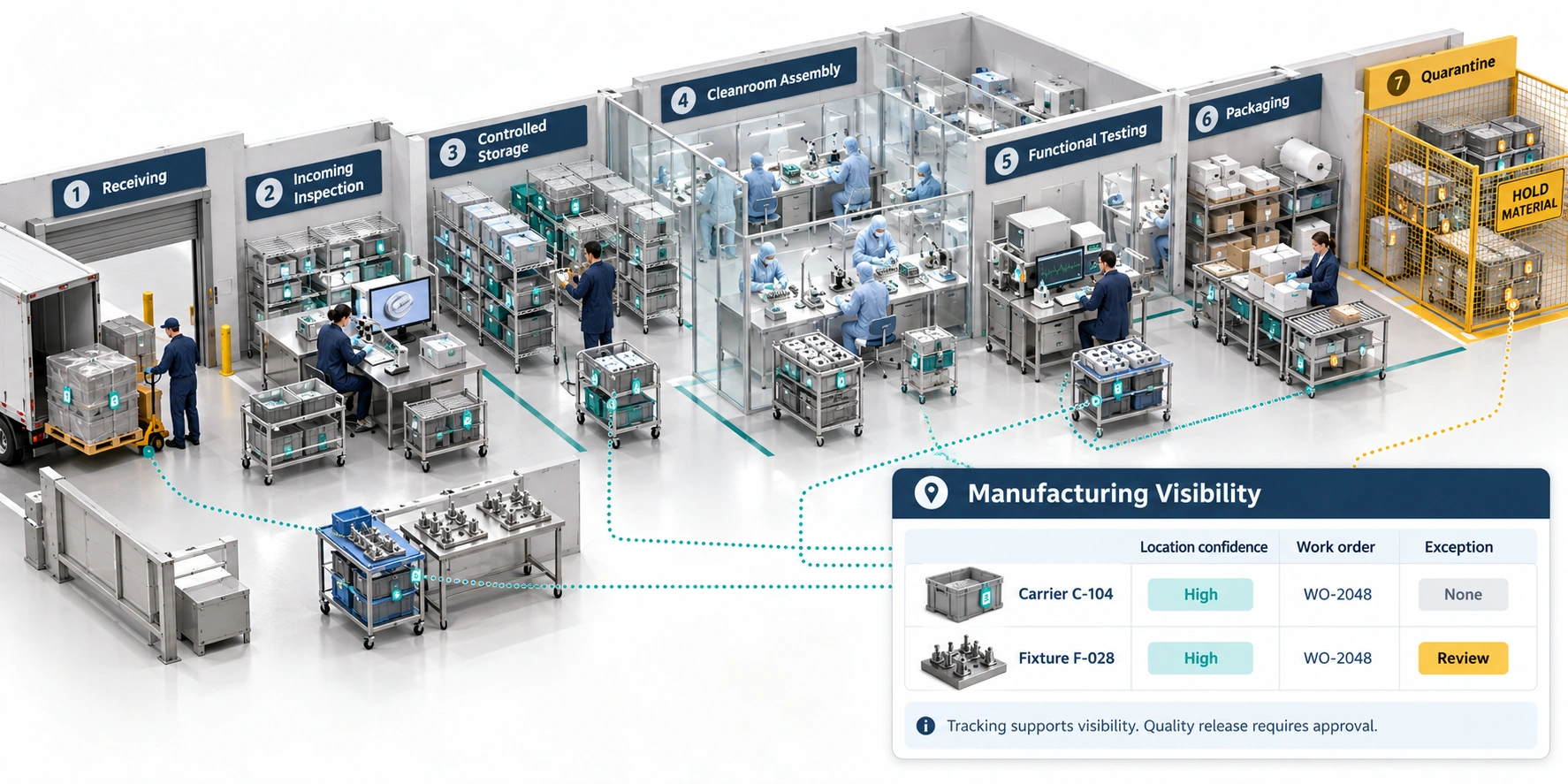
This isometric illustration shows seven healthcare manufacturing zones, from receiving to packaging and quarantine. Tagged carriers and fixtures connect to a dashboard displaying location confidence, work-order associations, and exceptions. An amber enclosure separates quarantined materials.
How AI Turns Manufacturing Observations into Operational Evidence
Separate Asset Identity, Location, and Quality Status
Healthcare manufacturing decisions require three distinct types of information: what an item is, where it is likely located, and whether it is authorized for use.
A reusable tote may carry components from receiving to inspection and then to catheter assembly. Its wireless identifier establishes the tote’s identity, but the manufacturing system must maintain the association between that tote, its contents, and the applicable lot. Reusing the tote without closing the previous association can incorrectly attribute movement to a completed batch.
Location is also different from disposition. Detecting a carrier near a released-material rack does not prove that incoming inspection passed. Approved, rejected, and quarantined status must come from the designated quality or inventory system.
GAO hardware can provide identification and sensing inputs, while the implementation must define which business system owns each status. This separation helps prevent a convenient dashboard from becoming an uncontrolled substitute for authoritative production records.
Match AI Methods to the Manufacturing Question
Artificial Intelligence of Things, or AIoT, combines AI with connected devices, sensors, equipment, and industrial systems. Healthcare products manufacturing benefits when each analytical method addresses a defined production problem.
- Dwell-time prediction: Estimate whether a diagnostic cartridge lot will exceed its expected queue time before reagent dispensing or final assembly.
- Anomaly detection: Identify unusual movement of surgical-instrument trays between finishing, inspection, and packaging.
- Resource forecasting: Predict shortages of released assembly fixtures using scheduled work orders and observed fixture turnaround.
- Condition trend analysis: Detect abnormal temperature behavior in storage used for temperature-sensitive adhesives or diagnostic reagents.
- Computer vision: Examine visible assembly or packaging features, using cameras and a separately evaluated inspection model rather than beacon data alone.
Rules remain appropriate for explicit requirements, such as blocking a tooling assignment when calibration has expired. AI is more useful when patterns vary across product families, shifts, and manufacturing routes.
Priority Applications Across Healthcare Products Manufacturing
Work-in-Process Visibility for Device Assembly
Catheter, infusion-set, and diagnostic-device assembly often involve component preparation, bonding, curing, inspection, and testing. A delayed carrier can disrupt downstream operations even when individual machines remain available.
Tracking reusable work-in-process (WIP) carriers helps estimate queue entry, departure, and dwell time. Combining those events with manufacturing execution system (MES) records allows analytics to distinguish a normal curing hold from an unexpected inspection backlog.
Deployment should prioritize meaningful production boundaries. A gateway covering two adjacent work cells may establish general presence without reliably distinguishing which operation received the carrier. Where an operation requires confirmed receipt, use an operator transaction, barcode scan, or another verified handoff.
Measure queue-time variation, overdue WIP, and production interruptions caused by missing carriers. Compare equivalent product routes rather than pooling assemblies with different processing requirements.
Calibrated Tooling and Test-Fixture Availability
Medical-device assembly depends on torque tools, electrical test fixtures, leak-test adapters, dimensional gauges, and product-specific nests. Locating a fixture quickly has limited value if it is overdue for calibration or incompatible with the scheduled device revision.
An AI asset tracking solution can combine fixture movement with maintenance records, calibration status, and approved equipment-to-product relationships. Production planners can then identify a likely fixture shortage before a work order reaches its test operation.
GAO identification hardware can support fixture visibility, but calibration authority should remain with the controlled calibration or maintenance system. A recommended fixture must satisfy both availability and approved-use criteria.
Useful measures include tooling search time, fixture-related line stoppages, calibration retrieval completion, and utilization by compatible product family.
Condition Monitoring for Sensitive Components
Diagnostic reagents, selected polymers, adhesives, and packaging materials may require controlled storage or handling conditions. Requirements depend on the material specification and approved manufacturing process.
Sensors associated with a storage location or carrier can provide temperature and humidity observations. Analytics can identify recurring door-opening effects, abnormal warming trends, or repeated handling delays.
However, an ambient sensor attached to a tote does not automatically measure the temperature of every component inside it. Sensor placement, response time, measurement uncertainty, and calibration must match the intended use.
An exception should initiate the approved investigation process. Quality personnel need the relevant material identity, exposure history, specification, and supporting evidence before determining disposition.
Sterilization and Packaging Handoffs
Manufacturers of sterile healthcare products must distinguish pre-sterilization staging, processing, post-process handling, and released finished goods. Tracking transport carts or reusable carriers can improve handoff visibility between packaging operations and an internal or contract sterilization provider.
Wireless location history cannot establish sterilization effectiveness or sterile-barrier integrity. Those conclusions depend on the applicable validated process and quality evidence.
Tag selection also requires care. Heat, radiation, pressure, and chemical exposure can exceed a device’s operating limits. An implementation may therefore track the external carrier or remove the tag before processing, using a controlled reassociation afterward.
Healthcare Manufacturing Asset Tracking Applications Compared
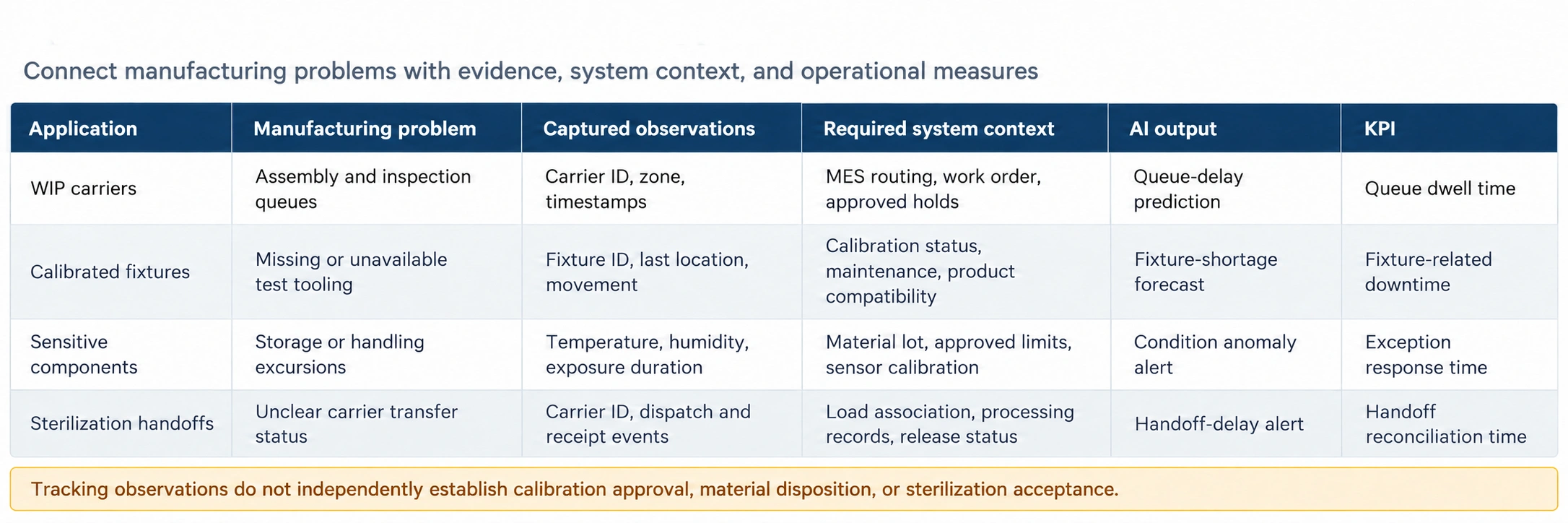
The table compares four tracking applications: WIP carriers, calibrated fixtures, sensitive components, and sterilization handoffs. It links manufacturing problems to observations, system context, AI outputs, and KPIs, with a note clarifying that tracking alone does not establish quality acceptance.
From Production-Floor Data to Controlled Business Actions
Capture and Associate Manufacturing Events
Begin by registering each tracked carrier, fixture, or sensor against a controlled asset record. Where a carrier contains production material, record the lot or work-order association and its effective time.
Capture the observation timestamp, receiving gateway, device identifier, sensor value where applicable, and relevant signal-quality information. Distinguish when an event occurred from when the server received it, especially during network interruptions.
Transport, Buffer, and Normalize Observations
Gateways forward observations through approved factory networks to edge software or hosted services. Local buffering should preserve events during temporary outages within defined capacity limits.
Middleware removes duplicates, reconciles timestamps, converts sensor units, and maps device identifiers to manufacturing assets. Unknown devices, expired associations, and invalid measurements should enter an exception queue rather than silently updating production records.
Add MES, Warehouse, and Quality Context
Integrations enrich observations with routing steps, material status, fixture compatibility, storage requirements, and work-order priority.
For example, a carrier remaining near functional testing may represent normal waiting, a failed test awaiting review, or an unrecorded transfer. Location alone cannot distinguish these cases. MES and quality records provide the context needed for useful analysis.
The interface design should specify ownership, retry behavior, duplicate handling, and reconciliation. GAO hardware selection should be coordinated with these integration requirements so device observations support the intended manufacturing decisions.
Produce Predictions and Assign Accountable Actions
AI software can rank likely bottlenecks, predict resource shortages, or identify unusual exposure patterns. Each output should include its timestamp, relevant supporting observations, and an indication of uncertainty.
Production supervisors may receive a task to investigate a delayed carrier. Maintenance teams may retrieve a fixture approaching calibration expiry. Quality teams may review an exposure exception.
Record acknowledgement and resolution so the manufacturer can evaluate whether alerts improve operations. Approved deterministic controls should govern consequential actions; model predictions should not silently release material or override established quality decisions.
BLE and AI Workflow for Healthcare Manufacturing Decisions
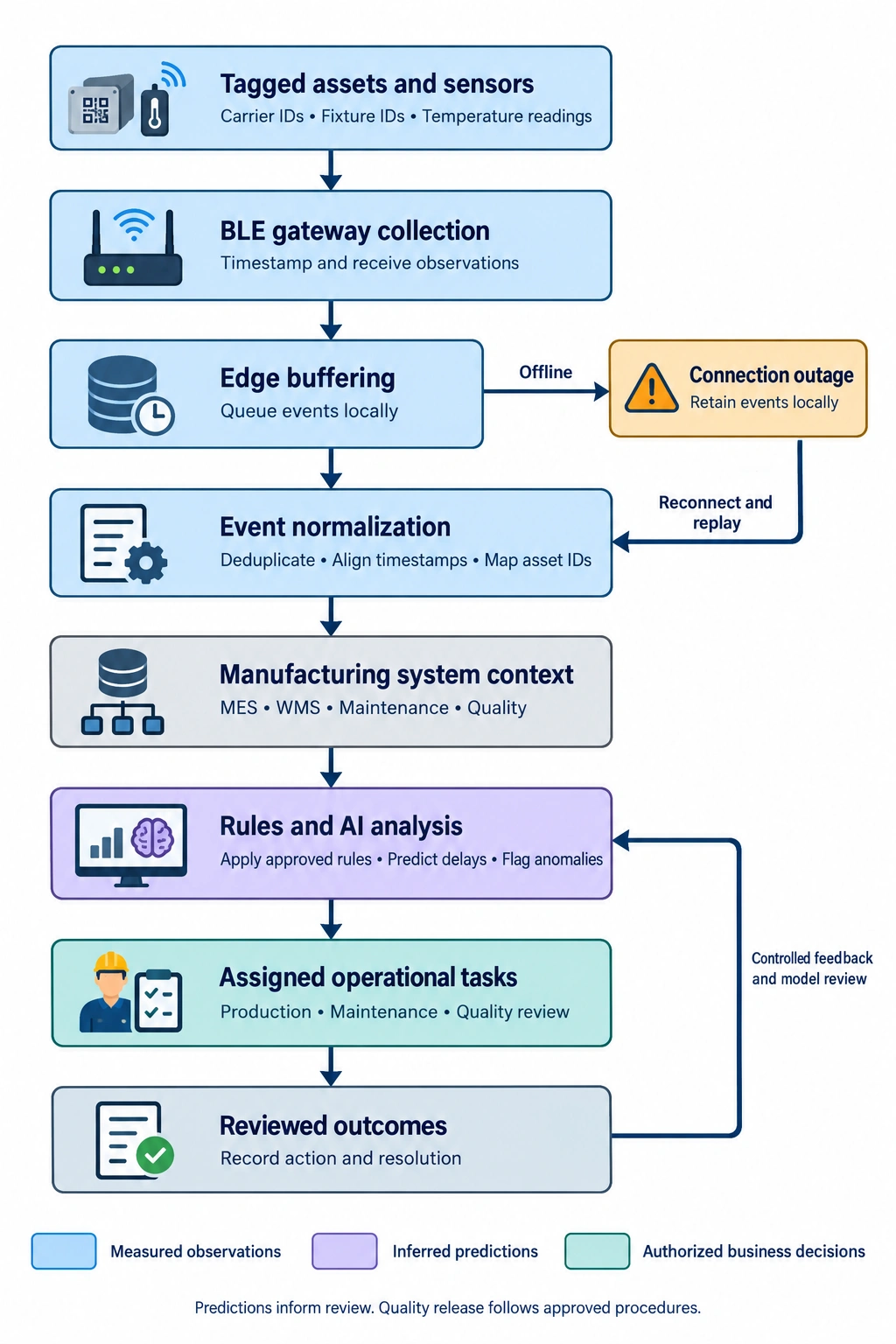
The diagram traces asset and sensor observations through BLE collection, edge buffering, event normalization, manufacturing-system context, and AI analysis to assigned operational tasks. It shows outage recovery and controlled feedback from reviewed outcomes, while distinguishing measured observations, inferred predictions, and authorized decisions.
GAO Hardware and Software Considerations for Manufacturing Deployment
BLE Devices and Factory Connectivity
BLE beacons identify reusable carriers and fixtures; BLE sensors add measurements such as temperature or motion; gateways collect observations for processing. Healthcare manufacturing installations should evaluate enclosure cleanability, mounting security, battery servicing, and compatibility with local cleaning agents.
Received signal strength indicator (RSSI) measurements support proximity estimation but should not be treated as exact coordinates. Bluetooth Direction Finding uses compatible devices and antenna arrangements for direction measurements. Required positioning performance must be demonstrated in the actual manufacturing environment rather than inferred from a Bluetooth version number.
Ethernet or approved Wi-Fi can connect gateways to factory services. MQTT over TLS or HTTPS may transport observations, depending on the selected equipment and software. Verify supported interfaces before procurement.
Edge Processing and AI Software
Edge software can filter observations, maintain local queues, and execute approved rules near assembly operations. Model selection should follow the available evidence: statistical baselines for queue behavior, supervised models for labeled delays, or anomaly detection when confirmed failure examples are scarce.
Separate model development from controlled production deployment. Preserve model versions, input definitions, evaluation results, and rollback procedures. Missing sensor readings should generate a data-quality state instead of an assumed normal condition.
Cloud Version and Server Version
A Cloud Version uses cloud-hosted software managed within cloud infrastructure. It can suit manufacturers coordinating multiple device plants, centralized analytics, and shared reporting, provided connectivity, data residency, retention, and supplier responsibilities meet requirements.
A Server Version runs on customer-managed or privately hosted infrastructure, including factory servers, private data centers, edge servers, or private cloud servers. It can suit facilities requiring local continuity or tighter control over production data.
Either model needs tested backup, recovery, access management, monitoring, and interface ownership. Hybrid arrangements can retain local event handling while sharing selected records for cross-site analysis.
Security and Quality-System Boundaries
Segment gateway networks, use unique credentials, restrict administrative access, and maintain supported firmware. Broadcast identifiers should not expose sensitive product or personnel information. Where authenticated telemetry or device configuration is required, verify the selected devices’ security capabilities.
For U.S. medical-device manufacturers subject to the requirements, FDA’s Quality Management System Regulation became effective February 2, 2026, incorporating ISO 13485:2016 by reference. Applicability and assurance activities depend on the product, process, and software’s intended use; installing tracking hardware does not establish compliance.
Healthcare Manufacturing Hosting Comparison: Cloud, Private Servers, and Hybrid
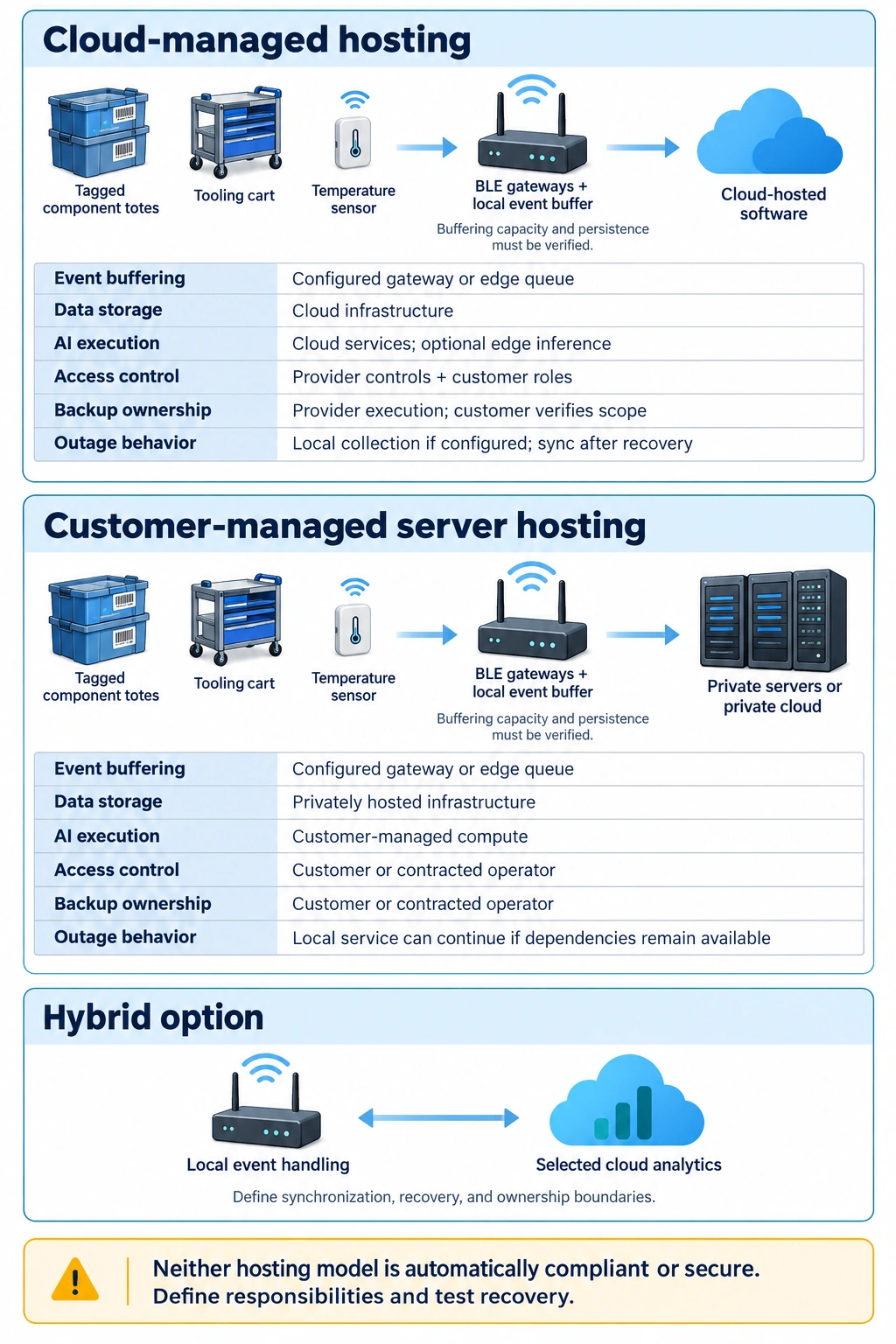
The visual compares cloud-managed and customer-managed server deployments using the same factory assets and BLE gateway layer. Responsibility tables cover buffering, storage, AI execution, access, backups, and outages. A hybrid option and caution note emphasize defined responsibilities and tested recovery.
Commissioning AI Asset Tracking for Healthcare Production
Define Acceptance Criteria Around Manufacturing Decisions
A healthcare manufacturing pilot should test whether the solution supports a specific operational decision. Finding a tagged cart on a demonstration screen is insufficient if production supervisors cannot distinguish an overdue assembly carrier from one completing an approved hold.
Define acceptance criteria before selecting gateway locations or training prediction models.
- WIP visibility: Correctly associate carriers with active work orders and identify overdue queues at selected assembly or inspection operations.
- Fixture availability: Locate compatible test fixtures while displaying current calibration and maintenance status.
- Condition monitoring: Detect defined exposure events using sensors with suitable measurement range, uncertainty, and response time.
- Operational response: Deliver actionable exceptions to the responsible production, maintenance, or quality role within an agreed interval.
GAO hardware evaluation should follow these requirements. The manufacturer can then assess whether the selected devices, software interfaces, and installation approach meet the intended use.
Test Radio Coverage During Actual Production
Stainless-steel workstations, enclosed test equipment, moving personnel, material racks, and loaded carts can affect wireless observations. Survey coverage with representative equipment arrangements and production activity.
Test tagged carriers when empty, fully loaded, stacked, and positioned at different heights. Evaluate adjacent rooms and cleanroom boundaries to identify observations that could incorrectly suggest a transfer.
Use persistence thresholds and transition logic to reduce rapid switching between neighboring zones. Excessive filtering, however, can delay recognition of a genuine movement. Tune that trade-off against the manufacturing task rather than optimizing only for a visually stable dashboard.
Record uncertain or stale locations explicitly. A last-known location should retain its timestamp so operators can judge whether it remains useful.
Verify Interfaces, Recovery, and Manufacturing Exceptions
Commissioning should include more than normal carrier movement. Challenge the system with situations that could corrupt manufacturing context.
- Reassign a reusable carrier after its previous work order closes.
- Disconnect a gateway and verify buffered-event recovery.
- Deliver duplicate or out-of-order events.
- Change a fixture’s calibration status while it remains visible.
- Move a quarantined carrier through an authorized transport corridor.
- Replace a sensor and verify its identity and calibration association.
Confirm that recovery does not create duplicate manufacturing transactions or overwrite approved quality status. Quality and production personnel should review exception handling before the solution becomes part of routine work.
Commissioning Acceptance Criteria for Healthcare Manufacturing Asset Tracking
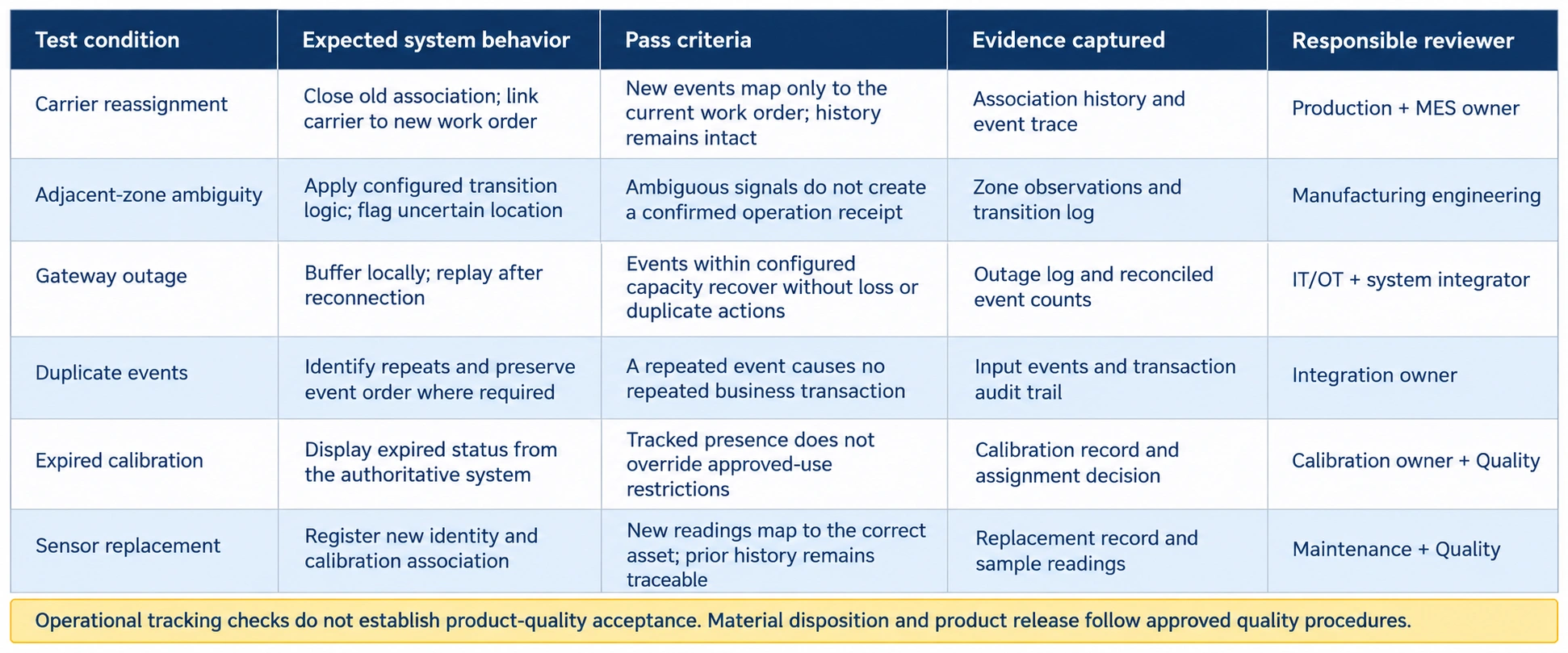
The matrix covers carrier reassignment, zone ambiguity, gateway outages, duplicate events, expired calibration, and sensor replacement. Each scenario includes expected behavior, pass criteria, supporting evidence, and a reviewer role. A highlighted note separates tracking verification from product-quality acceptance.
Operational Value and Performance Measurement
Reduce Search Time and Fixture-Related Delays
Reliable asset visibility can reduce the time technicians spend searching for leak-test adapters, assembly nests, or inspection gauges. The benefit comes from combining recent location observations with equipment identity and approved-use status.
Measure median and upper-percentile search time before and after deployment. Also track production minutes lost because required tooling was unavailable. A reduction in search time does not necessarily improve output if the actual constraint is test capacity or an unresolved quality hold.
GAO tracking inputs can help expose these distinctions, allowing manufacturers to target investment toward the constraint that limits the relevant device production line.
Improve WIP Flow and Material Handling
Queue analytics can reveal recurring accumulation before bonding, functional testing, or packaging. Predictions become more useful when they account for product revision, staffing, planned holds, and available downstream capacity.
A supervisor might redistribute compatible fixtures or adjust work-order sequencing after reviewing an expected backlog. Such actions can reduce unnecessary waiting without bypassing required processing steps.
Monitor queue dwell time by operation and product family, overdue carrier counts, and schedule adherence. Preserve approved hold times as a separate category so analytics do not incorrectly classify necessary processing as waste.
Strengthen Exception Investigation
Linked movement, condition, and work-order records can help quality personnel reconstruct a handling event. Investigators can identify which carriers were present, which materials were associated with them, and where evidence is incomplete.
The value depends on trustworthy timestamps, controlled associations, and accessible source observations. An AI-generated explanation should remain distinguishable from measured data and reviewer conclusions.
Evaluate investigation preparation time, unresolved association errors, and the proportion of alerts that lead to a documented action. Avoid claiming improved first-pass yield unless production evidence supports a causal relationship.
Establish a Balanced Manufacturing Scorecard
| Measure | Manufacturing purpose | Interpretation requirement |
|---|---|---|
| Tooling search time | Assess fixture retrieval efficiency | Compare equivalent fixture types and shifts |
| WIP queue dwell time | Identify assembly and inspection delays | Exclude approved processing holds |
| Actionable-alert precision | Assess alert usefulness | Define a useful intervention consistently |
| Event completeness | Evaluate tracking evidence | Measure against expected observable events |
| Location age | Identify stale asset information | Display time since the last trustworthy observation |
| Carrier-association accuracy | Protect work-order context | Audit reassignment and carrier reuse |
| Condition-exception response time | Assess handling escalation | Separate acknowledgement from final disposition |
Set targets from the manufacturer’s baseline and process risk. Universal improvement percentages can conceal differences between high-volume disposable-device lines and lower-volume surgical-instrument production.
Maintaining AI Performance as Manufacturing Changes
Monitor Models by Product Route and Shift
A delay model trained on one diagnostic-device assembly route may perform poorly after a new cartridge design introduces additional inspection steps. Changes in shift patterns, fixture availability, and rework practices can also alter predictions.
Evaluate performance separately for relevant product families and operating conditions. Time-based evaluation helps reveal whether the model remains useful on later production data. Prevent future information, such as a completed inspection result, from entering a prediction intended to occur before inspection.
Reviewed outcomes should feed a controlled improvement process. Do not treat every acknowledged alert as proof that the prediction was correct.
Manage Device and Software Changes
Battery replacement, gateway relocation, firmware updates, and changes to carrier mounting can alter observation quality. Include these activities in maintenance procedures and retain sufficient configuration history to investigate unexpected behavior.
GAO device selection should consider service access, replacement availability, supported firmware, and the practical cost of maintaining tags in controlled production areas.
Retest affected workflows after consequential changes. Expanding a storage rack, moving a packaging line, or changing gateway coverage may require renewed zone testing even when the application software remains unchanged.
Scale Without Losing Manufacturing Context
Expansion across healthcare manufacturing sites requires consistent asset definitions and local process knowledge. A “released fixture” status must have an agreed meaning, while individual plants may use different calibration systems or work-order structures.
Estimate gateway loading, event volume, retention needs, and integration capacity before increasing device counts. Preserve local operation during connectivity disruptions where required, and reconcile recovered events without duplicating actions.
Standardize reusable interface definitions while keeping product-specific routing, handling limits, and disposition rules under the appropriate site controls.
Selecting GAO Support for Healthcare Manufacturing
GAO is headquartered in New York City and Toronto, Canada. Its published company materials describe it as a top-10 global B2B and B2G BLE and RFID supplier; this is a company-reported positioning statement rather than an independently established ranking here.
Our related companies include GAO Research and GAO Tek. Over more than three decades, we have served organizations across the United States and Canada, including Fortune 500 companies, research organizations, universities, and government agencies.
Our investment in research and development, quality assurance, and remote or onsite technical support provides a foundation for hardware and systems discussions. Healthcare products manufacturers should use those discussions to review device suitability, integration responsibilities, commissioning evidence, and ongoing support requirements.
Planning a Practical Healthcare Manufacturing Implementation
AI asset tracking delivers practical value when physical observations connect to the decisions that govern healthcare production. Accurate carrier associations, reliable event handling, and authoritative quality records matter as much as locating hardware.
Begin with a bounded problem, such as missing assembly fixtures or unexplained inspection queues. Establish a baseline, verify observations under production conditions, and evaluate whether recommended actions improve the selected operational measure. Expand only after the manufacturer understands performance limits and maintenance responsibilities.
Contact GAO to discuss BLE gateways, beacons, sensors, and supporting IoT systems for your healthcare products manufacturing workflows. Share the relevant assets, production routes, environmental conditions, and integration requirements so the evaluation can focus on an appropriate implementation.
Building the Future of Industrial AI and IoT with Aperture Venture Studio and GAO
For more than three decades, GAO has invested in industrial BLE, RFID, and IoT research and development. Our work increasingly connects these technologies with AI for manufacturing visibility and operational decisions. Through Aperture Venture Studio, we support AI and IoT collaboration relevant to healthcare products manufacturing. Aperture brings together technical specialists, operational leaders, investors, and industry participants. Aperture Ventures Summit and TekSummit provide forums for advanced AI and IoT discussions. We welcome participation from:
- Advisors, co-founders, and employees
- Investors
- Customers seeking practical industrial AI and IoT solutions