
AI and BLE for Home Care Products
AI-Driven Asset Tracking for Home Care Products Manufacturing
Home care products manufacturing includes household cleaning products, detergents, disinfectants, surface cleaners, laundry products, air-care products, paper-based household products, and related consumer packaged goods. These operations depend on reliable movement of raw materials, containers, production tooling, reusable handling equipment, pallets, finished goods, and maintenance resources across receiving, storage, production, packaging, and distribution areas. How AI is Transforming BLE Asset Tracking gives manufacturers a way to convert location and condition data into operational decisions rather than relying solely on manual searches, spreadsheets, barcode scans, or periodic inventory checks. BLE beacons, BLE sensors, and BLE gateways provide location and condition inputs, while AI analyzes movement patterns, dwell time, equipment behavior, inventory exceptions, and workflow bottlenecks. The resulting AIoT solution can improve asset utilization, material availability, production continuity, maintenance response, warehouse execution, and shipment readiness for Home Care Products manufacturing.
What AI-Driven BLE Asset Tracking Means for Home Care Products
AI-driven asset tracking combines asset identification and location data with machine learning, anomaly detection, predictive analytics, process analysis, and workflow automation. The objective is not simply to determine where a pallet, chemical container, tote, cart, mobile production aid, or maintenance tool is located. The more valuable objective is to understand whether an asset is where it should be, whether its movement is consistent with the production plan, and whether its behavior indicates an operational problem.
Home Care Products manufacturing creates particularly useful conditions for AI-based asset tracking because material and equipment flows cross multiple functional areas. A typical operation can involve bulk raw-material receiving, ingredient staging, liquid or powder preparation, blending, filling, capping, labeling, case packing, palletizing, finished-goods warehousing, order staging, and truck loading. Reusable totes, drums, intermediate bulk containers, pallets, carts, change parts, tooling, inspection equipment, and maintenance instruments can move repeatedly between these areas.
AI can establish expected movement patterns from historical and real-time data. A cart that normally moves from a packaging area to a staging zone but remains stationary for an unusually long period can generate an exception. A pallet that enters a shipping area without a corresponding warehouse or order event can be flagged for investigation. A production asset that repeatedly remains outside its assigned operating zone can reveal inefficient handling or poor work-cell organization.
GAO supports organizations implementing BLE, RFID, and IoT-based hardware systems that can provide the underlying data needed for these operational applications. The engineering objective is to select sensing, identification, gateway, and integration methods according to the physical environment and the business process rather than treating asset tracking as a standalone technology project.
AI Applications for Home Care Products Asset Tracking
AI Asset Location Intelligence
AI asset location intelligence transforms raw location observations into useful information about asset availability and movement. Home Care Products manufacturers can track reusable containers, raw-material handling equipment, pallets, carts, production tools, mobile quality instruments, and maintenance resources across defined zones.
Location analytics can identify:
- Assets that remain stationary beyond an expected dwell threshold
- Assets entering restricted, incorrect, or unexpected production zones
- Frequently misplaced production and maintenance resources
- Excessive movement between warehouse and production areas
- Repeated searches for carts, containers, tooling, or inspection equipment
- Underutilized assets that could be reassigned to another production area
AI models can combine location events with MES, WMS, ERP, CMMS, and production scheduling information. This contextual relationship is important because the same asset movement can have different meanings depending on the production schedule. A pallet waiting in finished-goods storage may be normal when its order is not yet released, while the same dwell time can represent a fulfillment problem for an urgent customer order.
Inventory and Material Movement Optimization
Home Care Products production depends on timely availability of packaging materials, ingredients, containers, closures, labels, cartons, pallets, and other production inputs. Asset tracking becomes more valuable when AI correlates physical movement with consumption, production schedules, inventory records, and replenishment requirements.
AI can detect situations such as:
- Packaging materials positioned at the wrong filling or packaging line
- Containers or closures remaining in staging areas longer than expected
- Raw-material handling units approaching a production shortage
- Repeated movement of the same material between warehouse zones
- Pallets occupying high-priority staging locations
- Discrepancies between recorded and observed material locations
Predictive inventory analysis can estimate when materials will be required based on production schedules and historical consumption. The system can then prioritize replenishment before a line experiences a material-related interruption.
Production Workflow and Bottleneck Detection
Home Care Products facilities often operate high-throughput filling, capping, labeling, cartoning, case-packing, and palletizing equipment. Production continuity can be affected by material staging, changeover preparation, mobile equipment availability, tooling, or movement of work-in-process.
AI can evaluate asset movement and process timestamps to identify bottlenecks that are difficult to detect through individual equipment signals. For example, repeated delays between material staging and filling may indicate a handling constraint rather than a machine failure. Similarly, excessive movement of change parts between storage and packaging lines can increase changeover duration.
Process mining and anomaly detection can compare actual workflows with expected production sequences. The resulting analysis can support production planners, supervisors, warehouse teams, and maintenance personnel in determining whether the constraint originates from material availability, equipment readiness, staffing, staging, or workflow design.
Predictive Maintenance for Mobile and Production Assets
Maintenance teams frequently manage both fixed equipment and mobile resources. Pumps, mixers, conveyors, filling machines, labeling systems, palletizers, forklifts, mobile carts, inspection instruments, change parts, and maintenance tools can all contribute to production performance.
AI-based maintenance analysis can combine equipment condition data, asset location, operating history, maintenance records, and utilization. BLE sensors can provide selected environmental or condition measurements, while asset beacons can identify where mobile resources are being used.
Potential applications include:
- Predicting abnormal equipment behavior before a production interruption
- Identifying assets with unusually high utilization
- Correlating repeated failures with specific production zones
- Detecting maintenance tools or instruments that are unavailable when required
- Improving preventive-maintenance scheduling using actual asset usage
- Reducing time spent searching for mobile maintenance resources
GAO’s BLE and RFID hardware can support these applications when the selected devices and gateways are matched to the operating environment, asset type, and required data frequency.
Quality and Compliance Traceability
Quality operations in Home Care Products manufacturing can involve raw-material verification, batch records, packaging inspection, label verification, weight checks, chemical or physical testing, environmental monitoring, and release procedures. Asset location data can strengthen traceability by connecting physical assets with production batches, work orders, inspection events, and quality records.
AI can identify unusual relationships between asset movements and quality events. For example, repeated quality deviations associated with a particular production area, mobile container, tooling set, or changeover sequence can become an investigation signal.
BLE asset tracking does not replace validated quality systems or formal batch controls. Instead, it can supply additional operational evidence that helps quality teams reconstruct physical movements and investigate deviations more efficiently.
Home Care Products Manufacturing AI and BLE Asset Tracking Workflow
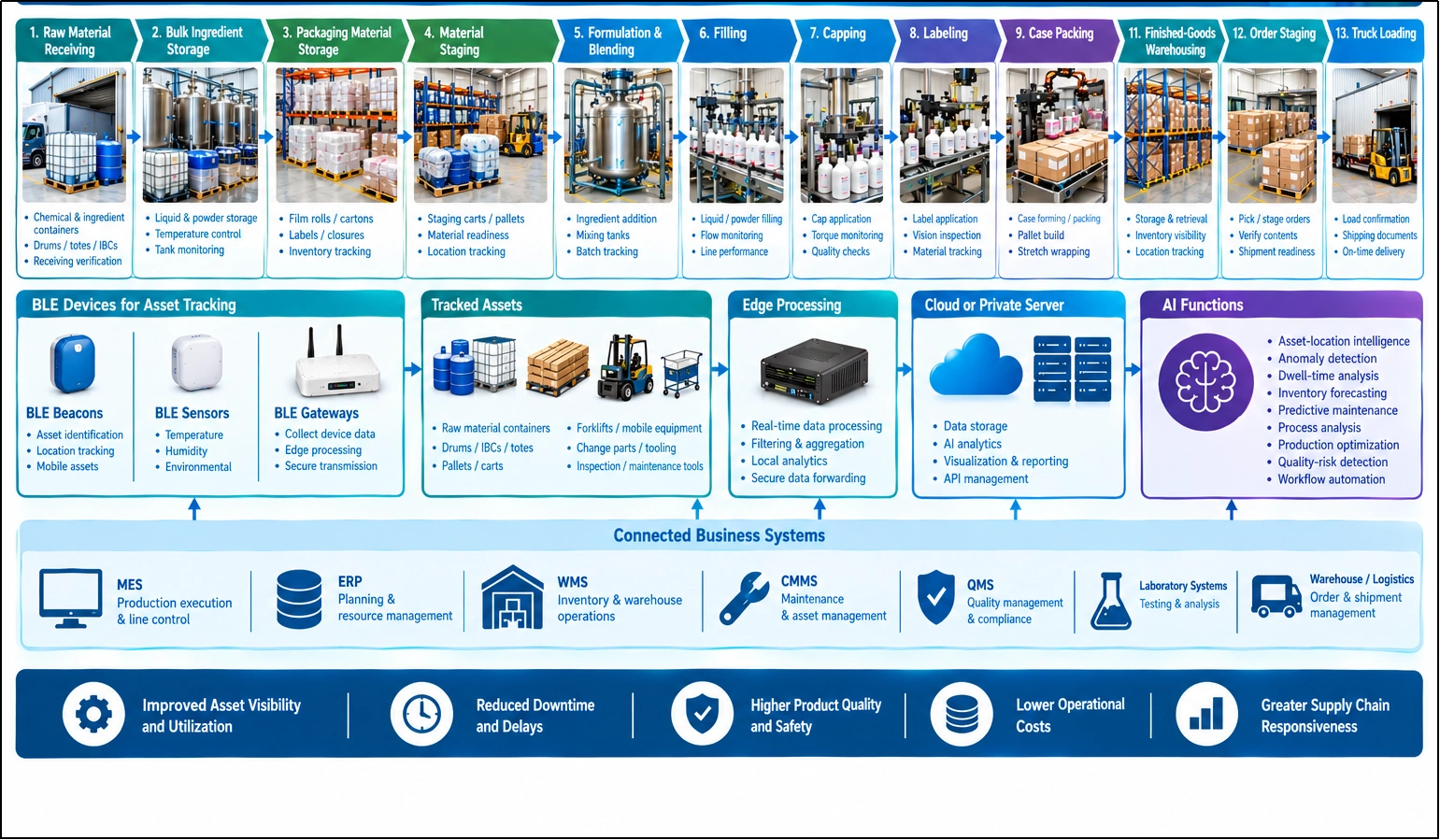
The completed infographic maps Home Care Products manufacturing from raw-material receiving through truck loading, showing BLE asset tracking, edge processing, cloud or private server systems, and AI analytics. It highlights how connected manufacturing data supports asset visibility, predictive maintenance, production efficiency, quality, and supply-chain responsiveness.
Home Care Products Manufacturing Workflows Supported by AI Asset Tracking
Raw-Material Receiving and Storage
Receiving operations can involve bulk liquids, powders, concentrates, fragrances, additives, packaging components, containers, closures, cartons, labels, and pallets. AI-supported asset tracking can connect incoming material locations with receiving records and warehouse assignments.
Location intelligence can help warehouse personnel determine whether a material has reached the correct storage zone, whether a container remains in receiving longer than expected, or whether a high-priority material is available for an upcoming production order.
Environmental requirements can also influence deployment decisions. Certain Home Care Products materials may require controlled temperature, humidity, segregation, or restricted handling. BLE sensors can provide supporting environmental observations where appropriate, while enterprise inventory systems remain the authoritative source for material status and quantity.
Material Staging and Production Preparation
Material staging connects warehouse execution with production scheduling. Ingredients, containers, closures, labels, cartons, pallets, and production tooling must arrive at the correct line at the correct time.
AI can compare planned material staging with observed asset movement. A material container that has not moved toward the scheduled production area can generate an early warning. Repeated staging delays can also reveal warehouse layout problems, insufficient carts, poor replenishment policies, or scheduling conflicts.
Formulation, Filling, and Packaging Operations
Formulation and blending operations depend on controlled material addition, equipment availability, batch execution, and appropriate transfer to filling operations. Filling and packaging require coordinated availability of containers, closures, labels, cartons, pallets, and change parts.
AI can analyze asset movement alongside batch and production events to identify deviations from normal workflows. This helps distinguish isolated delays from recurring process constraints.
Finished-Goods Warehousing and Order Staging
After palletizing, finished Home Care Products may move through staging, storage, picking, consolidation, and shipping preparation. AI can analyze pallet dwell time, warehouse movement, order priority, and dock activity to improve fulfillment decisions.
Location-based intelligence can identify:
- Finished pallets waiting beyond planned dwell time
- Pallets positioned in inefficient warehouse locations
- Orders lacking required finished-goods assets
- Excessive movement between storage and staging zones
- Congestion near shipping docks
- Loading resources that are not available when required
Maintenance, Quality, and Support Workflows
Production performance also depends on maintenance tools, inspection equipment, change parts, calibration resources, and other mobile assets. Tracking these resources can reduce delays that are not visible through production-machine data.
AI can learn normal support workflows and identify repeated delays between a maintenance request and tool or technician arrival. Quality teams can similarly use location information to determine where inspection resources, samples, or production-support equipment were located during a particular operational event.
Home Care Products Manufacturing Asset Tracking and AI Solution Matrix
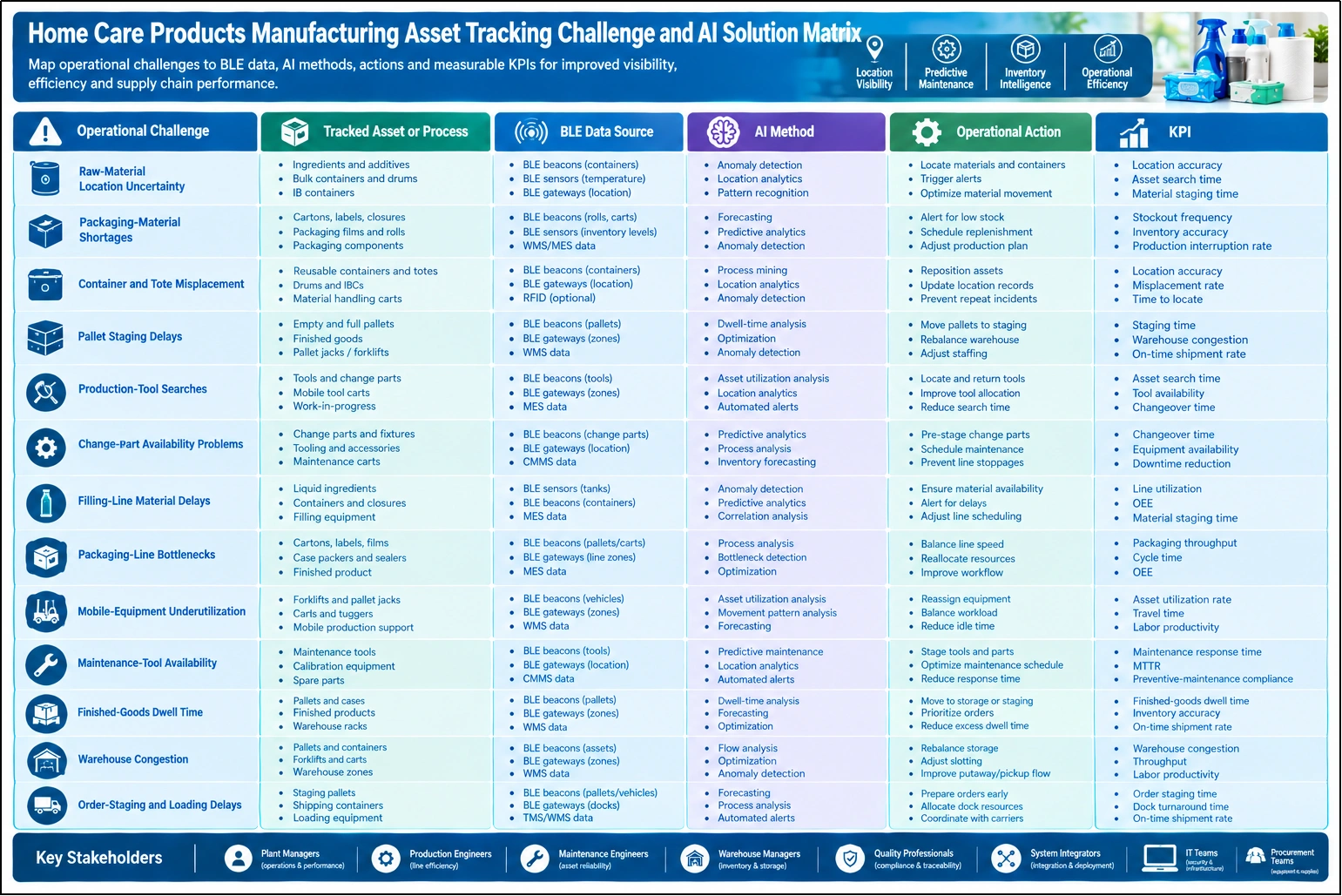
The completed matrix connects Home Care Products manufacturing challenges with tracked assets, BLE data sources, AI methods, operational actions, and KPIs. It highlights practical applications for material visibility, production support, maintenance, warehousing, and shipment execution.
Technical Capabilities for AI-Driven Home Care Products Asset Tracking
AI-Based Anomaly Detection
Anomaly detection establishes normal movement, dwell, utilization, and workflow patterns for Home Care Products assets. The system can compare current events against historical behavior and operational rules to identify exceptions such as an ingredient container remaining in receiving, a pallet entering an unexpected warehouse zone, or a change-part cart failing to reach a packaging line before a scheduled changeover.
AI models can use time, location, asset identity, production order, equipment state, and warehouse events as contextual variables. Combining these signals reduces false alerts compared with simple geofencing because an asset’s expected location can change according to the production schedule.
Predictive Maintenance and Asset Performance
Predictive maintenance becomes more effective when equipment condition is combined with actual utilization and location. A maintenance team can identify whether a mobile production asset, pump, conveyor component, filling-machine support device, or inspection instrument is being used more intensively than expected.
BLE sensors can provide selected condition measurements such as temperature or vibration where the sensor is suitable for the application. BLE beacons provide asset identity and movement information. AI can correlate these observations with CMMS work orders, maintenance history, operating hours, and production events to identify maintenance priorities.
The practical benefit is earlier intervention. Maintenance personnel can prioritize an asset showing abnormal behavior rather than relying exclusively on calendar-based preventive maintenance intervals.
Production and Material-Flow Optimization
AI can analyze the movement of materials and assets around formulation, filling, packaging, palletizing, and warehouse operations. The objective is to reduce unnecessary movement while ensuring that production lines receive required resources at the required time.
Optimization models can evaluate:
- Material staging duration
- Asset utilization by production area
- Cart and pallet movement frequency
- Changeover preparation time
- Warehouse-to-line replenishment cycles
- Finished-goods movement between storage and shipping
- Dock and loading resource utilization
GAO can provide BLE and RFID hardware that supplies physical asset and material-flow data for these analytical workflows, with device selection based on range, battery requirements, environmental conditions, mounting method, and integration requirements.
Intelligent Inventory and Asset Management
Traditional inventory records generally indicate what should exist and where it should be recorded. AI-driven asset tracking adds operational visibility into where physical resources are actually located and how they move.
For Home Care Products manufacturers, this distinction is important for reusable containers, pallets, carts, packaging components, production tooling, maintenance resources, and warehouse handling equipment. AI can identify discrepancies between expected and observed locations and prioritize exceptions according to production requirements.
Inventory intelligence can also identify underutilized assets and recurring movement patterns. This can support decisions about asset allocation, warehouse zoning, replenishment policies, and resource requirements.
AI-Assisted Quality Investigation
Quality investigations often require reconstruction of events across production, material handling, equipment operation, and inspection activities. Location and movement records can provide additional evidence for these investigations.
AI can correlate asset-location events with batch records, quality events, production orders, laboratory results, equipment states, and inspection timestamps. A quality engineer can then examine whether a recurring deviation corresponds with a specific production area, container, tooling configuration, material-handling sequence, or changeover event.
Such analysis should supplement, rather than replace, validated QMS procedures, laboratory controls, release processes, and applicable product-quality requirements.
BLE Deployment and Engineering Considerations for Home Care Products
BLE Sensor Selection and Environmental Protection
BLE device selection should reflect the actual Home Care Products manufacturing environment. Filling and cleaning areas may expose devices to moisture, chemical residues, temperature variation, washdown activity, or mechanical impact. Warehouse applications have different requirements involving forklifts, pallet racks, loading docks, and battery-operated mobile equipment.
Engineers should evaluate:
- Required sensing parameters
- Operating temperature and humidity range
- Ingress protection requirements
- Chemical exposure
- Mechanical mounting and impact risk
- Battery life
- Radio range and antenna orientation
- Calibration requirements where applicable
- Maintenance and replacement procedures
BLE sensors should be deployed only where the measured variable provides meaningful operational value. A sensor should not be installed merely because the technology supports that measurement.
Gateway Placement and Coverage
BLE gateways receive transmissions from nearby beacons and sensors and forward the information to processing systems. Gateway placement should account for production-line geometry, warehouse rack configuration, metal structures, equipment enclosures, walls, and radio interference.
A site survey should measure actual signal behavior rather than assuming theoretical range. Dense warehouse storage can create different propagation conditions from open production areas. Gateway redundancy may also be appropriate for critical zones where loss of one gateway should not eliminate operational visibility.
Asset Identity and Data Quality
Asset tracking depends on reliable identity management. Each BLE beacon should correspond to a defined asset identifier, while the asset record should contain attributes such as asset class, ownership, production area, maintenance status, and operational role.
Data-quality controls should address:
- Duplicate asset identifiers
- Missing or stale device associations
- Unexpected device movement
- Battery-related communication gaps
- Gateway connectivity failures
- Incorrect zone assignments
- Time synchronization problems
Poor identity management can make accurate BLE measurements operationally misleading. Data governance therefore becomes part of the asset-tracking implementation rather than a separate IT activity.
Battery and Device Maintenance
Battery-powered BLE devices require lifecycle management. Maintenance teams should monitor battery condition, communication frequency, device health, and replacement history.
Predictive battery analysis can prioritize replacement before devices stop communicating. For large Home Care Products facilities, standardized mounting methods and documented replacement procedures can significantly reduce maintenance labor.
Cloud and Server Deployment for Home Care Products
Cloud Version
A cloud-hosted deployment can collect BLE events from multiple Home Care Products facilities and provide centralized analytics, dashboards, alerting, and reporting. Cloud processing is useful when manufacturers need consolidated visibility across several plants, warehouses, or distribution locations.
Cloud software can integrate with enterprise systems through APIs, message brokers, secure web services, or integration middleware. It can also support centralized AI model management and historical data analysis.
The main engineering considerations include network availability, cybersecurity, data residency, identity management, latency requirements, API reliability, and integration with corporate IT policies.
Server Version
A server deployment can place application software on edge servers, factory servers, customer-managed infrastructure, private data centers, or other privately hosted environments. This model can be appropriate when Home Care Products manufacturers require tighter control over operational data, local processing, network independence, or integration with existing manufacturing infrastructure.
Server-based processing can also reduce dependence on external connectivity for time-sensitive operational alerts. A hybrid design may combine local event processing with centralized analytics when both plant-level responsiveness and multi-site reporting are required.
GAO’s experience supplying IoT, BLE, and RFID hardware can support either deployment approach when the hardware, gateway, networking, and software interfaces are specified around the customer’s operational requirements.
Manufacturing Software Integration
MES Integration
MES integration connects physical asset activity with production execution. BLE events can provide supporting context for production orders, line status, material staging, changeovers, and work-in-process movement.
The MES should remain authoritative for production execution data, while the asset-tracking system supplies physical movement and location observations. This separation helps prevent conflicting records.
ERP and WMS Integration
ERP systems provide planning, purchasing, inventory, and order information, while WMS software manages warehouse execution. AI-driven BLE tracking can connect these business records with physical asset movement.
Examples include linking a finished-goods pallet location to an order, identifying packaging materials available near a production line, or detecting a staging delay before it affects shipment preparation.
CMMS Integration
CMMS integration connects asset-location information with maintenance work orders, preventive-maintenance schedules, spare-parts records, and technician activities. Knowing the current location of mobile maintenance resources can reduce response time and unnecessary searching.
QMS and Laboratory Integration
QMS and laboratory systems can provide quality events, inspection records, sampling results, and investigation information. Combining these records with physical asset movements can improve traceability and root-cause analysis without replacing validated quality processes.
Security and Interoperability for AI-Driven Asset Tracking
Security should cover the complete data path from BLE devices through gateways, processing systems, enterprise software, and user interfaces. Device authentication, encrypted communications, role-based access control, secure API credentials, network segmentation, logging, patch management, and controlled administrative access should be incorporated into the design.
Home Care Products manufacturers should also define ownership of device configuration, asset identities, historical location data, and AI-generated alerts. Gateway networks should be separated appropriately from safety-critical control networks when direct integration is not required.
Interoperability is equally important. Standardized APIs, documented data models, timestamp consistency, unique asset identifiers, and integration middleware can reduce dependence on proprietary interfaces. GAO hardware can be evaluated as part of a broader BLE, RFID, and IoT system in which existing MES, ERP, WMS, CMMS, QMS, and IT infrastructure remain important components.
KPIs for AI-Enabled Home Care Products Asset Tracking
Manufacturers should establish a baseline before deploying AI-driven asset tracking and then measure operational changes against that baseline. Relevant KPIs include:
- Asset search time
- Asset location accuracy
- Asset utilization
- Material staging time
- Material availability
- Stockout frequency
- Production interruption caused by material shortages
- Changeover preparation time
- Line utilization
- OEE
- Production throughput
- Unplanned downtime
- MTBF
- MTTR
- Maintenance response time
- Preventive-maintenance compliance
- Packaging-line throughput
- Finished-goods dwell time
- Warehouse congestion
- Pallet staging time
- Order staging time
- Dock turnaround time
- On-time shipment rate
- Inventory accuracy
- Quality deviation frequency
- Defect rate
- Rework rate
- Scrap rate
- Investigation time
- BLE device availability
KPI selection should remain tied to a specific business problem. Tracking more assets does not automatically create more value; improvement should be demonstrated through reduced delays, better utilization, improved production continuity, or stronger operational control.
Implementation Recommendations for Home Care Products Manufacturers
A practical deployment should begin with a defined operational problem rather than a technology-wide rollout. A manufacturer might initially target material staging delays, maintenance-tool searches, finished-goods dwell, or pallet visibility.
Recommended implementation practices include:
- Establish baseline KPIs and current workflow measurements.
- Select a limited group of high-value assets or material-handling units.
- Conduct an RF site survey covering production, warehouse, staging, and shipping areas.
- Select BLE beacons, sensors, and gateways according to physical and environmental requirements.
- Establish unique asset identities and ownership records.
- Validate gateway coverage under normal production conditions.
- Integrate location events with the appropriate MES, WMS, ERP, CMMS, or QMS records.
- Test alert thresholds using actual Home Care Products workflows.
- Validate data quality before training or deploying AI models.
- Apply network segmentation, authentication, encryption, access control, and logging.
- Establish battery replacement and device-maintenance procedures.
- Measure operational improvement against the original baseline.
- Expand only after the initial use case demonstrates measurable value.
Scaling AI and BLE Across Home Care Products Manufacturing
Once a pilot demonstrates reliable data and measurable improvement, manufacturers can extend tracking to additional production lines, warehouses, plants, and distribution operations. Scaling should preserve consistent asset identifiers, device-management procedures, gateway standards, data models, security policies, and KPI definitions.
Multi-site deployment can enable comparative analysis of staging performance, asset utilization, maintenance response, warehouse dwell, and shipment preparation. AI models can identify recurring patterns across facilities while allowing local operating conditions and production processes to remain part of the analysis.
A scalable system should also accommodate complementary technologies. BLE can provide frequent location and condition observations, while RFID, barcode systems, machine data, PLC signals, computer vision, and enterprise software can contribute other forms of operational evidence. The most effective Home Care Products solution uses each technology where it provides the appropriate data quality and economic value.
Key Takeaways for AI-Driven Home Care Products Asset Tracking
How AI is Transforming BLE Asset Tracking is fundamentally about converting physical movement into actionable manufacturing intelligence. For Home Care Products manufacturers, AI can turn BLE-based location and condition observations into better material staging, asset utilization, maintenance planning, production coordination, warehouse execution, quality investigation, and shipment readiness.
Successful implementation depends on more than installing beacons and gateways. Manufacturers need accurate asset identities, reliable data acquisition, appropriate gateway coverage, strong integration with manufacturing software, cybersecurity controls, measurable KPIs, and AI models trained around real operating conditions.
GAO provides BLE, RFID, and IoT hardware and systems that organizations can evaluate for these applications, supported by engineering expertise, technical assistance, and deployment experience. GAO is headquartered in New York City and Toronto, Canada, and is ranked among the top 10 leading B2B and B2G BLE and RFID suppliers globally.
Building the Future of Industrial AI and IoT with GAO
For more than three decades, GAO Group companies have invested heavily in R&D for industrial BLE, RFID, and IoT technologies. As generative AI became increasingly useful for industrial applications, we expanded work combining AI with IoT technologies, including BLE and RFID, for applications such as Home Care Products asset tracking, inventory intelligence, production optimization, and predictive maintenance.
GAO Group companies have served organizations across the U.S. and Canada, including Fortune 500 companies, leading R&D firms, prestigious universities, and government agencies. Our R&D focus, stringent quality assurance, and remote or onsite expert support help organizations evaluate and deploy practical technology solutions.
We welcome organizations interested in learning more about GAO’s BLE, RFID, IoT, and AI-related hardware, systems, engineering expertise, and technical support.