
AI and BLE for Home Medical Services
How AI Improves Home Medical Services with BLE Data
AI-driven home medical services use connected data from patients, caregivers, medical equipment, and care environments to improve how services are scheduled, delivered, monitored, and managed. BLE gateways, beacons, and sensors can provide location, proximity, movement, environmental, and equipment-status data that AI systems analyze alongside care schedules, clinical documentation, remote patient monitoring data, and operational records.
For home health agencies, home infusion providers, durable medical equipment teams, visiting nurses, therapists, and other home-based care organizations, the value is not simply knowing where a tagged item is located. The greater value comes from converting distributed field data into actionable intelligence. AI can identify abnormal equipment movement, predict supply requirements, detect workflow delays, prioritize service exceptions, improve caregiver dispatching, and help operations teams distinguish routine variation from conditions requiring intervention.
This approach is especially relevant because home medical services operate across geographically dispersed residences rather than within a single controlled care facility. GAO supplies BLE, RFID, and IoT hardware products and systems that can support the data collection layer needed for these AI-driven home medical service solutions.
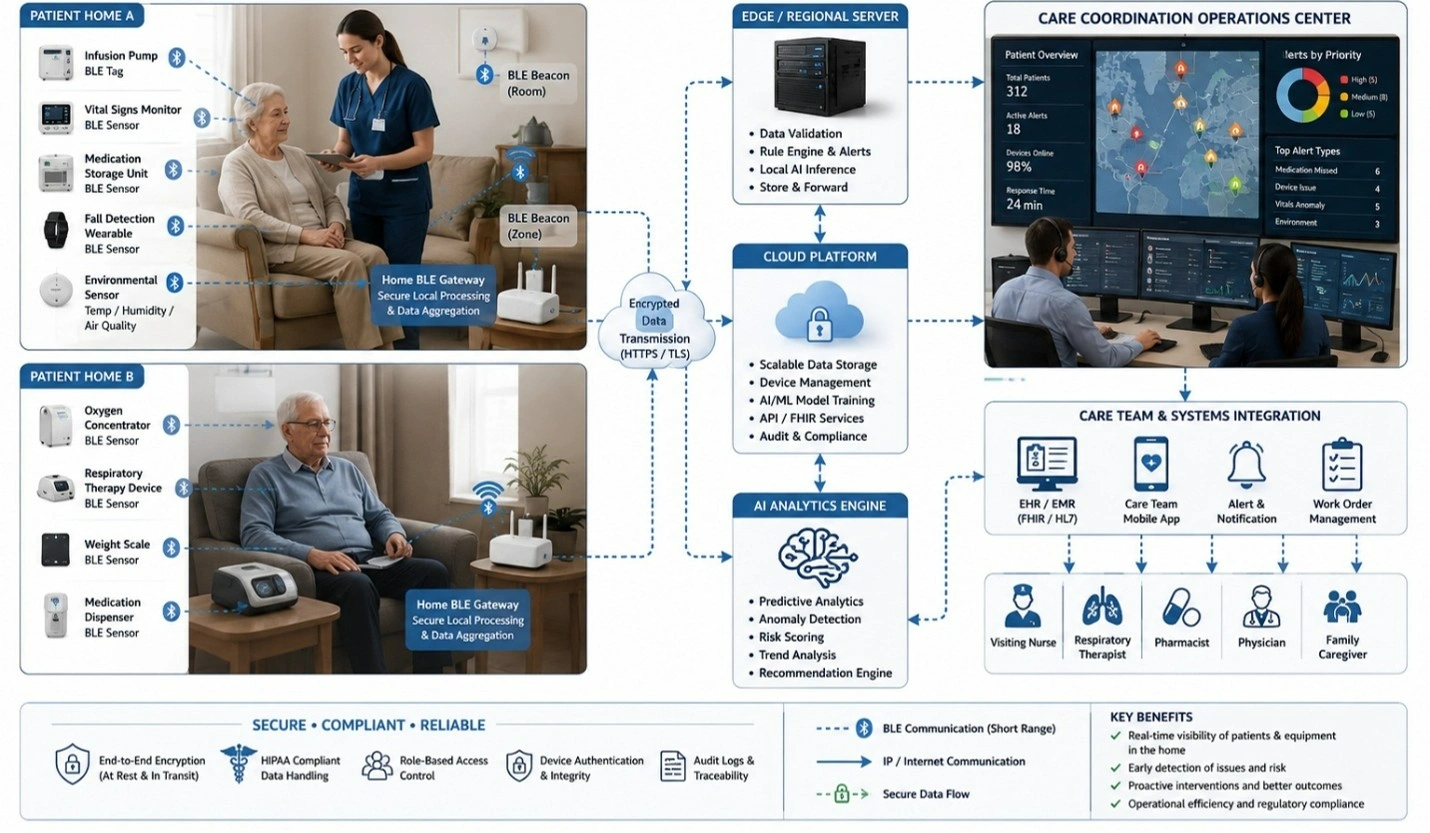
AI and BLE Home Medical Services Data Flow and Connected Care
This infographic illustrates how BLE-tagged medical equipment, patient-home sensors, and BLE gateways collect operational data across distributed home medical services. The data moves through secure edge and cloud processing into AI analytics, care coordination systems, and clinical workflows, enabling proactive alerts, equipment visibility, and coordinated care.
AI, BLE, and the Home Medical Service Environment
Home medical services extend healthcare delivery into patient residences, assisted living environments, and other nontraditional care locations. Common activities include skilled nursing visits, physical and occupational therapy, home infusion, respiratory care, wound care, remote patient monitoring, medication administration, equipment delivery, equipment retrieval, and follow-up care.
These operations create a distinctive data challenge. A home medical provider may manage thousands of patient residences, mobile clinicians, infusion pumps, oxygen-related equipment, portable diagnostic devices, wheelchairs, hospital beds, medication coolers, specimen containers, and other distributed assets. Each item may follow a different custody, maintenance, cleaning, calibration, delivery, or clinical workflow.
BLE supports the physical data layer for many of these use cases because low-energy devices can transmit identifiers and sensor data without requiring continuous high-power communication. BLE beacons can identify rooms, equipment kits, supply containers, or service zones. BLE sensors can capture parameters such as temperature, movement, contact state, or other measured conditions depending on device design. BLE gateways can collect nearby transmissions and forward data to local or remote software.
AI adds a decision layer above this connected infrastructure. Machine learning models can identify patterns across historical visits and operational events. Time-series analytics can evaluate changes in sensor measurements. Anomaly detection can identify unusual asset movement or environmental conditions. Optimization models can improve technician or caregiver routing. Natural language processing can extract operational signals from visit notes, work orders, and care documentation when appropriate privacy and governance controls are applied.
The resulting AIoT system combines artificial intelligence with connected devices, sensors, gateways, and operational software. Edge AI may process selected events close to the data source when response time, connectivity resilience, bandwidth management, or privacy requirements make local processing beneficial. Cloud-hosted or privately managed server software can support broader analytics, longitudinal modeling, reporting, and integration with healthcare information systems.
Why BLE Data Requires AI Interpretation
Raw BLE observations are rarely sufficient for direct operational decisions. Radio signal strength can vary because of walls, furniture, human movement, device orientation, multipath propagation, and interference. A gateway detecting a beacon does not automatically prove precise clinical activity.
AI and analytics therefore become useful for interpreting sequences rather than isolated events. A home medical solution may combine:
- BLE signal observations from gateways or mobile devices
- Timestamped equipment events
- Work-order status
- Caregiver schedules
- Delivery and retrieval records
- Remote patient monitoring measurements
- Maintenance history
- Inventory and supply records
- Geographic service areas
- Environmental measurements
- Exception and incident records
A model can then estimate whether a device is likely in an expected service location, whether a visit workflow is progressing normally, or whether an operational exception should be escalated. Engineering teams should avoid treating BLE location estimates as exact coordinates unless the deployment has been designed and validated for the required accuracy.
GAO can help organizations select and deploy appropriate BLE hardware configurations based on home layouts, expected asset density, power requirements, environmental conditions, communication backhaul, and the accuracy needed for each home medical service workflow.
High-Value AI Applications in Home Medical Services
AI-driven home medical services should begin with a specific operational or care-delivery problem rather than with a generic technology deployment. The most valuable applications generally connect BLE-generated observations with measurable service outcomes.
AI Asset Tracking for Home Medical Equipment
Durable medical equipment and mobile clinical devices frequently move between warehouses, delivery vehicles, patient residences, maintenance centers, and temporary storage locations. Manual asset reconciliation can produce delayed returns, misplaced equipment, duplicate purchases, unnecessary rentals, and inaccurate availability records.
BLE-supported asset visibility can provide recurring observations of tagged equipment. AI models can compare movement patterns with expected delivery, service, maintenance, and retrieval workflows.
Relevant assets may include:
- Infusion pumps
- Portable oxygen concentrators
- Nebulizers
- Suction devices
- CPAP and BiPAP equipment
- Patient lifts
- Wheelchairs
- Hospital beds
- Portable diagnostic kits
- Remote patient monitoring kits
- Medication refrigerators and coolers
- Therapy equipment
- Emergency response kits
AI can identify equipment that remains at a patient location beyond the expected retrieval date, appears in an unexpected service zone, or exhibits movement inconsistent with its assigned work order. Predictive models can also estimate likely equipment demand by analyzing patient admissions, service duration, historical utilization, seasonal patterns, and regional workload.
The business outcome is improved asset utilization, faster recovery of reusable equipment, lower emergency replacement activity, and more reliable availability for incoming patients.
AI-Assisted Caregiver and Service Coordination
Home medical services depend on coordinating clinicians, therapists, technicians, drivers, patients, and support teams across a dispersed territory. Missed appointments, excessive travel, delayed equipment arrival, and poorly sequenced visits can affect both operating cost and continuity of care.
AI optimization can evaluate:
- Patient appointment windows
- Clinician skills and credentials
- Required equipment
- Geographic location
- Traffic and travel estimates
- Expected visit duration
- Priority level
- Follow-up requirements
- Equipment delivery dependencies
- Historical service patterns
BLE-generated proximity or equipment availability events can add real-world operational evidence to scheduling systems. For example, a work order should not assume that a required infusion pump or respiratory device is ready merely because the inventory database lists it as available. Verified operational events can help reduce planning based on stale records.
The strongest implementation pattern keeps clinical judgment and human scheduling authority in the workflow. AI should recommend schedules, identify conflicts, and prioritize exceptions rather than autonomously making clinical decisions outside approved governance processes.
AI Monitoring of Equipment Condition and Service Readiness
Home medical equipment may require inspection, cleaning, calibration, preventive maintenance, battery replacement, or functional verification between patient assignments. Asset records can become fragmented when field service events are documented late or inconsistently.
Connected sensors and BLE observations can support equipment-state monitoring where technically and clinically appropriate. AI can combine runtime, movement, maintenance history, battery data, environmental exposure, and service records to estimate maintenance risk or prioritize inspection.
Useful operational outcomes include:
- Reduced unplanned equipment failures
- Better preventive maintenance scheduling
- Faster identification of devices requiring inspection
- Improved maintenance backlog prioritization
- Reduced unnecessary field dispatches
- More reliable equipment readiness records
Predictive maintenance models should be validated against actual failure and service data. A model that merely identifies frequently serviced equipment without distinguishing preventive service from true failure risk can generate misleading maintenance priorities.
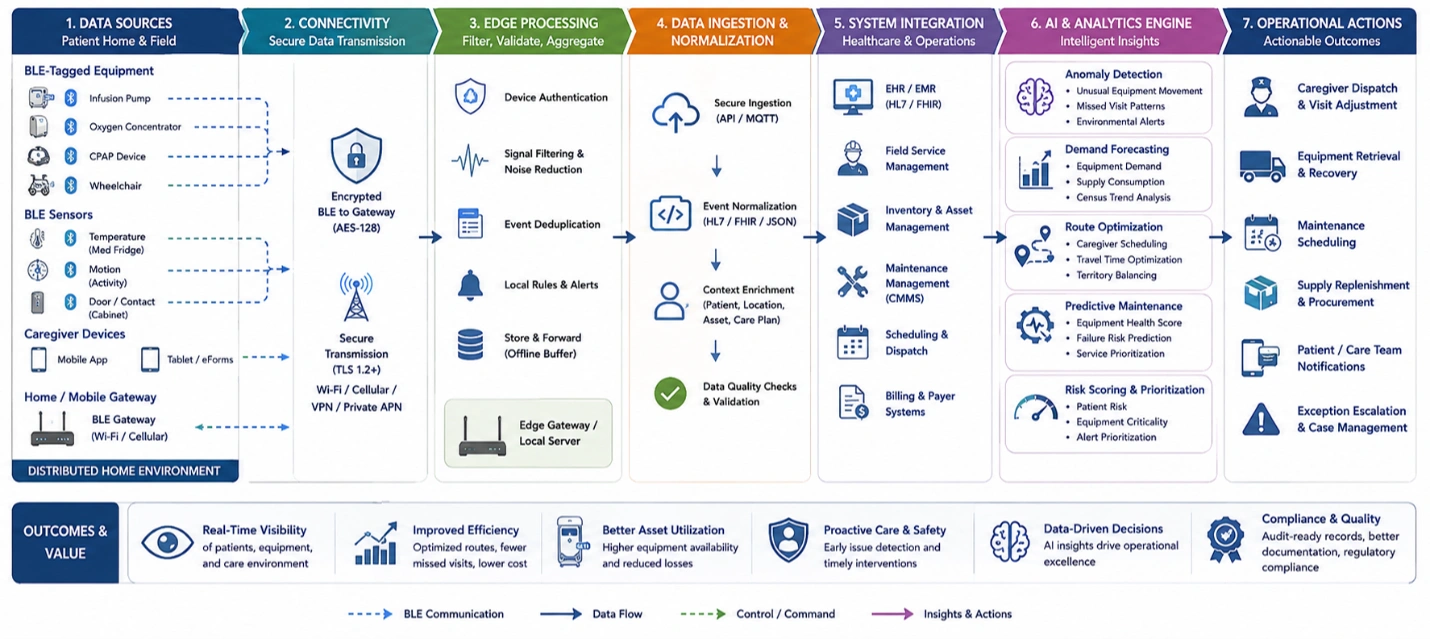
AI-Driven Home Medical Services Workflow with BLE Data and Operational Actions
This workflow diagram shows how BLE-tagged medical equipment, sensors, caregiver devices, and home gateways generate observations that move through secure connectivity, edge processing, data normalization, and healthcare system integration. AI models then analyze the data for anomaly detection, demand forecasting, route optimization, predictive maintenance, and risk prioritization, enabling coordinated operational actions across home medical services.
Complete Data-to-Decision Workflow for AI Home Medical Services
A production AI and BLE solution for home medical services should be designed as a complete operational system rather than as a collection of disconnected sensors. The workflow begins with a defined service event and continues through data validation, interpretation, integration, decision support, and operational action.
Data Acquisition at the Patient Home and in the Field
Data collection may begin with BLE beacons attached to reusable equipment, BLE sensors associated with monitored environmental conditions, gateways installed in controlled service locations, or mobile devices used by authorized field personnel.
A practical deployment separates data by operational purpose. Asset identification, patient monitoring, environmental monitoring, caregiver workflow verification, and security events may have different sampling rates, retention requirements, accuracy expectations, and access controls.
Examples include:
- Detecting the presence of a tagged infusion pump near an authorized gateway
- Recording a temperature threshold event for a monitored medication storage container
- Capturing movement events associated with equipment transport
- Verifying that a service kit is present before a scheduled field procedure
- Identifying prolonged inactivity that may indicate an equipment or workflow exception
Data acquisition design should account for intermittent internet connectivity in patient homes. Local buffering, store-and-forward logic, timestamp synchronization, duplicate-event handling, and reconnection behavior are essential engineering requirements.
Communication, Edge Processing, and Data Normalization
BLE devices communicate with gateways or approved mobile devices using Bluetooth Low Energy protocols. The receiving system filters raw observations, validates device identity, removes duplicates, and applies initial rules before forwarding normalized events.
Edge processing can be valuable when a home medical service requires:
- Local event response during temporary WAN outages
- Reduced transmission of repetitive raw radio observations
- Faster escalation of critical equipment-state events
- Local privacy controls for selected data
- Lower cloud processing volume
Normalized events should contain a consistent device identifier, timestamp, event type, confidence or signal-quality information when relevant, and contextual identifiers necessary for authorized correlation.
Middleware then maps these events into operational software. Integration may involve REST APIs, MQTT-based ingestion, HL7 or FHIR interfaces where appropriate, message queues, webhooks, or database connectors. The appropriate method depends on the systems already used by the home medical provider.
AI Analytics and Decision Support
After data is normalized, AI models can evaluate current events against historical and operational context. Different home medical workflows require different analytical methods.
| Home Medical Service Problem | AI Method | BLE-Enabled Data Contribution | Operational Action |
|---|---|---|---|
| Missing reusable equipment | Anomaly detection | Unexpected location or prolonged absence | Recovery investigation |
| Equipment demand variability | Time-series forecasting | Utilization and movement history | Rebalance equipment inventory |
| Delayed service workflow | Process mining and predictive analytics | Event sequence and timestamps | Escalate workflow exception |
| Excessive field travel | Optimization and predictive modeling | Equipment readiness and service availability | Adjust dispatch plan |
| Maintenance prioritization | Predictive modeling | Usage, movement, service and sensor history | Schedule inspection |
| Unusual environmental event | Threshold analytics and anomaly detection | BLE sensor measurements | Notify responsible team |
Decision outputs should include confidence, supporting evidence, and a clear action owner whenever possible. A dispatch coordinator, biomedical technician, nurse supervisor, or operations manager should be able to understand why an alert was generated.
Integration with Home Medical Software
A home medical AI solution becomes operationally useful when its outputs reach the systems and teams responsible for action. Relevant integrations may include electronic health record systems, electronic visit verification software, field service management software, computerized maintenance management systems, inventory management software, warehouse management systems, scheduling software, customer relationship management systems, and business intelligence tools.
Integration design should avoid directly exposing sensitive patient information to every connected device. A safer pattern uses minimal identifiers at the device layer and performs authorized identity resolution within controlled software services.
GAO’s hardware and system expertise can support the physical and communication layers while integration teams connect validated events to the provider’s existing care-delivery, maintenance, scheduling, and operational software.
BLE, AI, Software, and Infrastructure for Home Medical Services
A reliable AI-driven home medical services solution requires coordinated selection of devices, communication infrastructure, software, analytics, and security controls. BLE technology is one enabling layer rather than the entire solution.
BLE beacons can identify reusable medical equipment, supply containers, mobile care kits, and controlled service zones. BLE sensors can provide measured data relevant to equipment handling or home service conditions. BLE gateways receive nearby device transmissions and forward events to approved edge or remote software. Device selection should consider battery replacement cycles, enclosure design, attachment method, expected transmission interval, range requirements, and the consequences of device loss or failure.
Supporting software typically performs device provisioning, event ingestion, device health monitoring, identity management, data normalization, alert management, reporting, and integration. AI workloads may run as separate services that consume validated event streams and return predictions, anomaly scores, forecasts, or recommendations.
Cloud Version for Distributed Home Medical Operations
A Cloud Version is appropriate when a home medical provider operates across a wide geographic area and requires centralized access to device data, analytics, reporting, and AI model management. Cloud-hosted software can simplify centralized updates and support scalable data processing across many homes and field teams.
Cloud deployment still requires careful design for intermittent connectivity. Gateways and mobile applications should queue data locally when connections fail and synchronize safely after restoration. Sensitive data handling should follow applicable privacy, contractual, security, and regulatory requirements.
Server Version for Greater Data and Operational Control
A Server Version deploys software on customer-managed servers, private data centers, edge servers, or other privately hosted infrastructure. This model may be appropriate when a healthcare delivery organization requires tighter control over data residency, network segmentation, integration pathways, or internal cybersecurity policies.
A Server Version can also support hybrid operation. Local or privately hosted services may process sensitive operational data while selected anonymized or approved datasets are used for centralized analytics. The correct model depends on data classification, integration requirements, IT governance, connectivity, operational scale, and recovery objectives.
Cloud, Server, and Hybrid Deployment Models for AI-Driven Home Medical Services
This block diagram compares Cloud, Server, and Hybrid deployment models for AI-driven home medical services using BLE beacons, sensors, gateways, and caregiver devices. It shows how data moves through edge processing and secure communication into cloud or privately hosted systems, AI analytics, storage, and healthcare applications such as EHR, scheduling, field service, inventory, and maintenance software.
Security Mechanisms for Connected Home Medical Services
Security controls should reflect the fact that patient homes are distributed, less controlled environments. Relevant measures may include:
- Device identity and authenticated provisioning
- Encrypted communications where supported by the complete data path
- Certificate and credential lifecycle management
- Role-based access control
- Network segmentation between operational systems and administrative systems
- Secure remote administration
- Signed software and firmware update processes
- Centralized logging and security monitoring
- Data minimization at the device layer
- Backup and disaster recovery procedures
- Asset inventory and vulnerability management
Healthcare organizations should also evaluate applicable requirements related to protected health information, medical device cybersecurity, privacy, and contractual obligations. Technical controls should be validated against the actual deployment rather than assumed from a device specification alone.
Engineering Considerations Before Deploying AI-Driven Home Medical Services
Successful deployment begins with workflow mapping and measurable objectives. A home medical provider should first identify where operational uncertainty creates measurable cost, risk, delay, or service-quality problems.
Start with a Defined Decision, Not a Device Inventory
A BLE deployment can become expensive and operationally noisy when devices are installed before the organization defines what decisions the resulting data will support. Each monitored workflow should answer questions such as:
- What event needs to be detected?
- What level of location or proximity confidence is required?
- Who owns the resulting alert?
- What action follows the alert?
- How quickly must the event be processed?
- What happens when connectivity is unavailable?
- What evidence is needed to validate AI recommendations?
- How will false positives and missed events be measured?
This approach prevents technology deployment from becoming disconnected from care-delivery or field-service outcomes.
Validate BLE Performance in Representative Homes
Residential environments vary significantly. Apartment buildings, single-family homes, assisted living residences, and rural homes may have different wall materials, floor plans, interference sources, internet availability, and gateway placement constraints.
A site validation process should test:
- Signal detection reliability
- Room or zone discrimination where required
- Gateway coverage
- Device battery performance
- Data loss during internet outages
- Reconnection and event synchronization
- False proximity events
- Physical attachment durability
- Patient and caregiver workflow impact
A pilot should include realistic patient residences rather than relying exclusively on laboratory testing. Signal strength thresholds and AI classification features should be based on observed deployment data.
Establish Operational KPIs Before Scaling
AI and BLE programs should be measured against home medical service outcomes rather than device counts. Useful KPIs may include:
- Equipment recovery cycle time
- Asset utilization rate
- Percentage of equipment with verified status
- Missing asset investigation rate
- Preventive maintenance completion rate
- Unplanned equipment service events
- On-time equipment delivery rate
- First-visit service completion rate
- Caregiver travel time
- Missed or delayed service rate
- Alert precision
- Alert recall
- AI model drift
- Data completeness
- Gateway availability
- BLE event capture reliability
GAO has helped organizations evaluate connected hardware and system requirements where deployment reliability, device selection, data capture, and technical support directly affect the usefulness of downstream operational analytics.
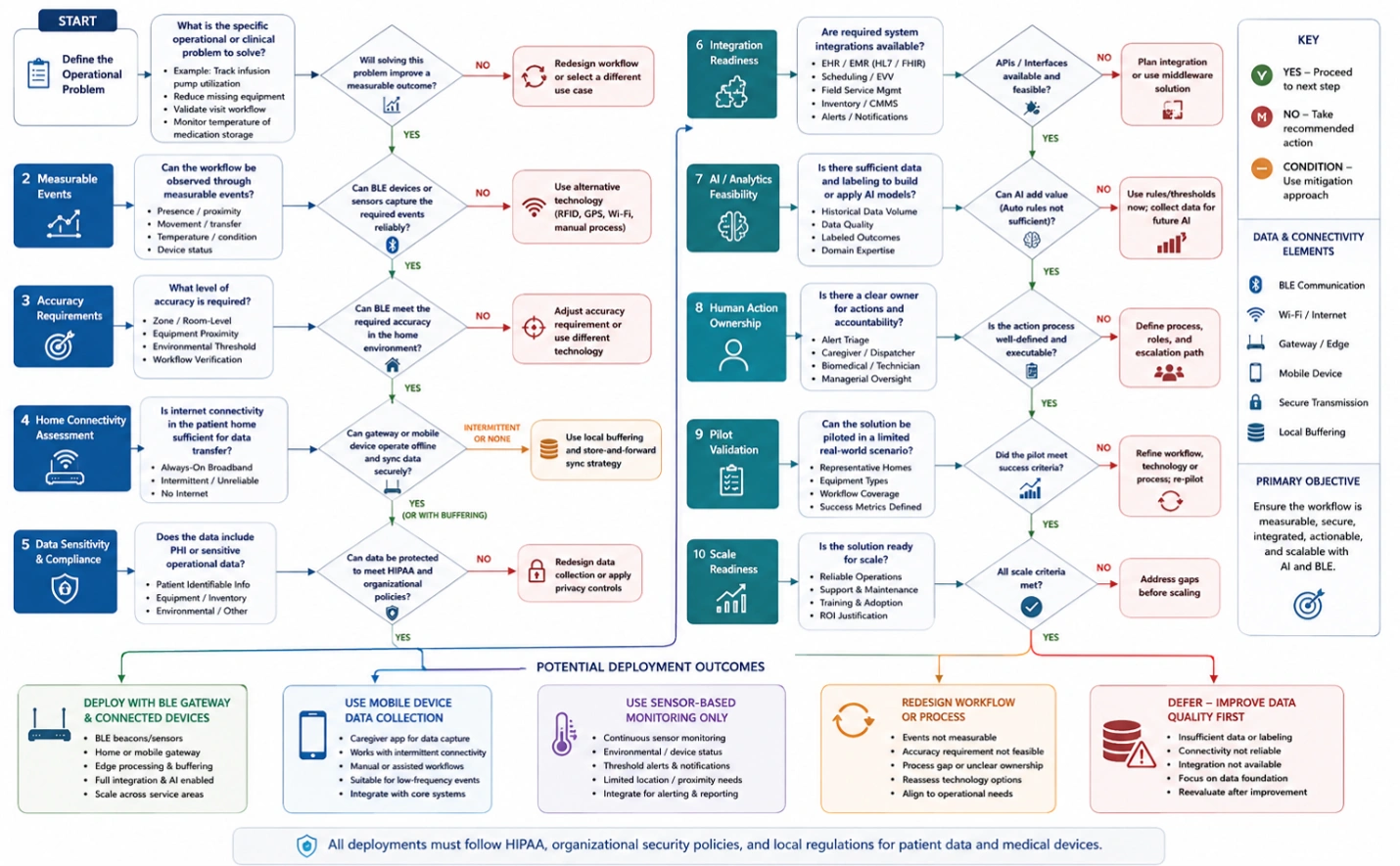
AI and BLE Deployment Decision Tree for Home Medical Services
This decision tree provides a technical framework for evaluating whether a home medical services workflow is suitable for AI and BLE. It assesses measurable events, BLE accuracy, home connectivity, data sensitivity, system integration, AI feasibility, human accountability, pilot results, and scalability before recommending an appropriate deployment approach.
Key Capabilities and Business Value of AI-Driven Home Medical Services
AI-enabled home medical services become valuable when connected data improves a measurable operational or care-delivery decision. BLE gateways, beacons, and sensors provide selected observations from patient residences, mobile equipment, supply containers, and field workflows, while AI converts those observations into predictions, classifications, anomaly alerts, and recommendations.
Better Visibility of Distributed Medical Assets
Home medical equipment frequently changes custody between distribution centers, delivery vehicles, patient homes, maintenance locations, and temporary storage areas. AI can correlate BLE observations with inventory records, delivery orders, maintenance records, and retrieval schedules to produce a more reliable operational picture.
This can help home medical service organizations:
- Identify equipment that has remained at a residence beyond the expected service period
- Detect discrepancies between recorded and observed equipment locations
- Prioritize recovery of high-value or high-demand devices
- Improve utilization of reusable equipment
- Reduce unnecessary replacement purchases
- Improve equipment availability for new patient assignments
The important engineering distinction is between visibility and certainty. BLE observations can provide evidence that an asset is within a detectable range, but they should not automatically be interpreted as precise room-level or geographic positioning.
Predictive Maintenance for Field Medical Equipment
Predictive maintenance can combine equipment usage history, service records, movement patterns, battery information, and sensor measurements to estimate which assets are more likely to require inspection or maintenance.
For example, a home medical provider could prioritize an infusion pump for inspection when its operational history, service interval, battery behavior, and field usage pattern indicate elevated maintenance risk. This is more useful than treating every device as equally urgent.
A mature implementation should distinguish predictive maintenance from simple maintenance scheduling. AI should identify statistically meaningful risk patterns and provide evidence that technicians can evaluate. Maintenance policies, manufacturer requirements, safety procedures, and biomedical engineering controls remain authoritative.
Smarter Inventory and Supply Forecasting
Home medical services must maintain supplies across geographically dispersed service areas. Demand can fluctuate with patient census, seasonal respiratory conditions, treatment duration, referral patterns, discharge rates, and equipment utilization.
AI forecasting can combine historical consumption with current patient-service activity and regional demand. BLE-enabled observations can provide an additional operational signal when physical supplies or equipment are difficult to reconcile through conventional inventory processes.
Potential outcomes include:
- More accurate regional inventory planning
- Earlier identification of supply shortages
- Reduced excess inventory
- Better allocation of reusable equipment
- Improved emergency replenishment planning
- More reliable preparation of field-service kits
Forecasting should account for data quality and unusual events. A sudden increase in demand caused by a temporary event should not automatically become a permanent forecast assumption.
Exception Management for Home Care Operations
Home medical service teams often spend significant time investigating exceptions. AI can prioritize these events according to operational impact instead of presenting every device event as an equal alert.
An exception engine can combine asset status, scheduled visits, delivery information, equipment availability, sensor conditions, and historical patterns to identify cases requiring human attention.
Examples include:
- A required device is not detected where a scheduled service workflow expects it
- Equipment remains at a residence after an expected retrieval
- A reusable asset moves through an unexpected sequence of locations
- A service kit appears incomplete before a field visit
- An environmental sensor reports an abnormal condition
- Equipment utilization differs substantially from the expected operational pattern
This approach reduces alert fatigue by directing attention toward events with a meaningful probability of requiring action.
AI Model Selection for Home Medical Service Workflows
Different home medical service problems require different analytical methods. Using a sophisticated model when a deterministic rule is sufficient can increase complexity without improving operational performance.
Rules and Thresholds
Rules remain appropriate for clear conditions such as a temperature exceeding an approved threshold, a scheduled retrieval date passing without an expected event, or a gateway becoming unavailable.
Rules are easier to validate and explain than machine learning models and should generally be used where the decision logic is deterministic.
Anomaly Detection
Anomaly detection is useful when normal behavior varies but unusual patterns are operationally meaningful. A model can learn typical equipment movement or service-event sequences and identify significant deviations.
This approach is particularly useful for distributed asset management because the organization may not have enough labeled examples of every possible failure condition to train a conventional supervised model.
Forecasting Models
Time-series models can forecast equipment demand, supply consumption, service volume, caregiver workload, and other operational variables.
Forecast quality should be measured using historical backtesting and should be monitored after deployment. Changes in referral patterns, geographic coverage, patient populations, reimbursement models, or operating procedures can cause model drift.
Optimization Models
Optimization can support caregiver scheduling, equipment allocation, delivery routing, technician dispatch, and service-area balancing.
The optimization model should incorporate operational constraints such as clinician qualifications, appointment windows, geographic restrictions, equipment dependencies, working hours, and service priority. AI-generated recommendations should remain subject to organizational policies and human review where appropriate.
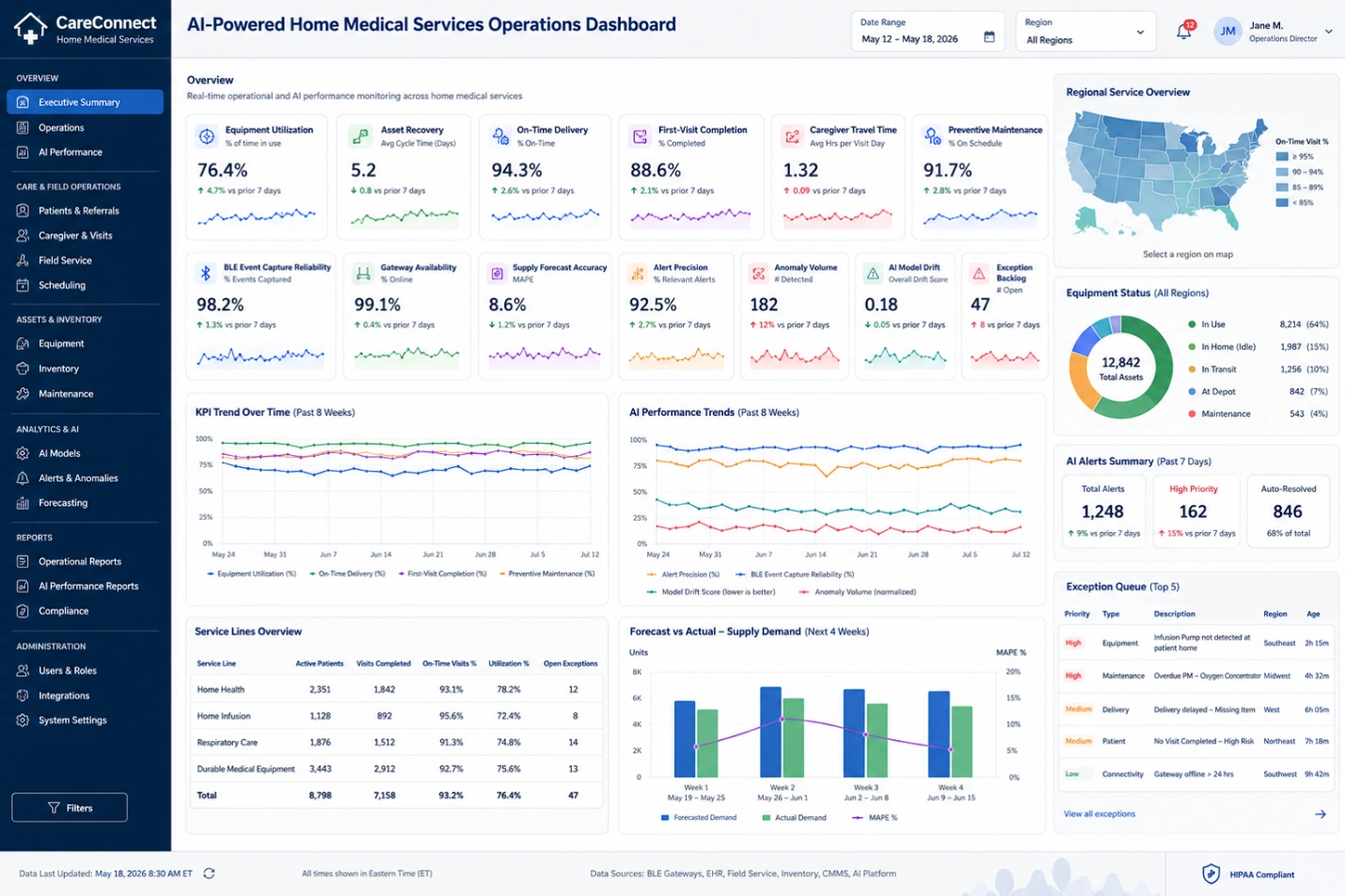
AI-Powered Home Medical Services Operations KPI Dashboard
This enterprise dashboard brings together home medical service KPIs, AI performance indicators, equipment status, regional service performance, supply forecasting, and operational exceptions. It enables healthcare operations leaders to monitor asset utilization, delivery performance, caregiver workload, BLE event reliability, gateway availability, predictive maintenance, AI alert quality, and unresolved service issues from a unified operational view.
Interoperability with Home Medical Service Systems
AI and BLE deployments should complement existing healthcare and operational software rather than create another isolated source of information.
Relevant systems can include:
- Electronic health records
- Electronic visit verification systems
- Home health scheduling software
- Remote patient monitoring software
- Field service management systems
- Computerized maintenance management systems
- Inventory management software
- Warehouse management systems
- Transportation and dispatch systems
- Billing and revenue-cycle systems
- Business intelligence and reporting systems
- Identity and access management systems
Healthcare interoperability may involve HL7 and FHIR interfaces where clinically relevant. Operational integrations may use REST APIs, secure message queues, webhooks, MQTT, or other supported interfaces.
A strong integration design establishes a clear system of record for each type of information. For example, the inventory system may remain authoritative for ownership and procurement status, while the BLE system provides observed equipment events. The AI service can correlate those datasets without replacing the underlying operational records.
This distinction prevents conflicting records and simplifies troubleshooting when an AI recommendation differs from an operational database.
Cybersecurity and Privacy for Connected Patient Homes
Home medical services introduce cybersecurity considerations that differ from those of controlled clinical facilities. Devices may operate in residences outside the organization’s physical premises, use consumer internet connections, and interact with mobile devices or gateways that are not continuously supervised by IT personnel.
Security controls should therefore cover the entire data path.
Device and Gateway Security
Device identity should be established during provisioning, with unique credentials or approved authentication mechanisms wherever supported. Gateways should receive only the permissions necessary for their assigned function.
Operational teams should maintain:
- Device inventories
- Firmware versions
- Gateway inventories
- Credential lifecycle records
- Configuration baselines
- Vulnerability information
- Replacement and decommissioning procedures
Lost or retired devices should be revoked from the trusted device population.
Data Protection
Patient-related information should be minimized at the BLE layer whenever possible. A BLE beacon generally does not need to broadcast personally identifiable information simply to identify a piece of equipment.
A preferred pattern uses pseudonymous device identifiers and performs authorized identity resolution within protected software.
Data should be protected during transmission and storage according to the organization’s security requirements and applicable healthcare privacy obligations. Access should be based on job function rather than broad access to all home medical service data.
Operational Resilience
Connectivity interruptions are normal in distributed home environments. A production system should define what happens when a gateway cannot reach its remote service.
Important mechanisms include:
- Local event buffering
- Timestamp preservation
- Retry logic
- Duplicate-event suppression
- Secure reconnection
- Gateway health monitoring
- Graceful degradation
- Remote diagnostics
- Backup procedures
- Recovery testing
AI decisions that require current data should also indicate when source data is stale or incomplete. This prevents an operations team from treating an outdated device observation as current information.
Implementation, Commissioning, and Scale-Up Strategy
A practical deployment should progress from workflow definition to controlled validation before broad rollout.
Planning and Requirements Engineering
The first phase should define the operational problem, required data, measurable outcome, stakeholders, and system constraints.
Technical teams should document:
- Assets to be monitored
- Required event types
- Required accuracy
- Expected BLE transmission frequency
- Gateway placement requirements
- Connectivity assumptions
- Battery expectations
- Integration interfaces
- Data retention requirements
- Security requirements
- AI decision criteria
- Human approval points
- KPI baselines
The requirements should be written around actual home medical workflows rather than around individual device specifications.
Pilot Deployment
A pilot should represent the variability of actual operations. Testing only one carefully controlled residence can produce misleading results.
A representative pilot can include different housing types, gateway placements, connectivity conditions, equipment categories, service workflows, and geographic operating conditions.
Testing should measure both technology performance and workflow impact. A BLE system that achieves excellent laboratory detection but requires caregivers to perform additional manual steps may produce little net operational value.
Commissioning and Validation
Commissioning should verify device identity, gateway connectivity, data transmission, software integration, alert behavior, security controls, and operational ownership.
Acceptance testing can include:
- BLE detection reliability
- Gateway coverage
- Event latency
- Data completeness
- Battery behavior
- Gateway outage recovery
- API integration
- AI alert precision
- AI alert recall
- User workflow acceptance
- Security control validation
AI models should not be considered production-ready simply because they perform well on historical data. Operational validation should include live or representative data and defined acceptance thresholds.
Scaling and Lifecycle Management
After pilot validation, deployment can expand by geographic region, asset class, service line, or operational workflow.
A scalable operating model should include device provisioning, installation, replacement, firmware management, gateway health monitoring, software updates, AI model monitoring, technical support, and periodic performance reviews.
GAO’s long-standing investment in R&D, product quality, and technical support is relevant when organizations need BLE hardware and connected systems that can be maintained beyond the initial deployment. GAO supports customers with hardware products and systems and provides remote or onsite technical assistance where required.
Key KPIs for AI and BLE Home Medical Services
A balanced KPI framework should measure care operations, asset performance, data quality, and AI effectiveness together.
| KPI Category | Representative KPI | Why It Matters |
|---|---|---|
| Asset Management | Equipment utilization rate | Measures productive use of reusable equipment |
| Asset Recovery | Retrieval cycle time | Shows how quickly equipment returns to available inventory |
| Service Delivery | On-time visit rate | Measures scheduling and field-service reliability |
| Equipment Readiness | Ready-to-deploy percentage | Shows whether equipment can support new assignments |
| Maintenance | Preventive maintenance completion | Indicates maintenance process reliability |
| Logistics | On-time equipment delivery | Measures fulfillment performance |
| Data Quality | BLE event completeness | Shows whether connected observations are sufficiently reliable |
| Infrastructure | Gateway availability | Measures continuity of data collection |
| AI Performance | Alert precision | Shows how many alerts are operationally meaningful |
| AI Performance | Alert recall | Measures detection of relevant events |
| Forecasting | Demand forecast accuracy | Supports inventory and workforce planning |
| Operations | Exception resolution time | Measures responsiveness to AI-identified issues |
The KPI set should be aligned with financial, operational, quality, and service objectives. Device counts alone are weak evidence of project success.
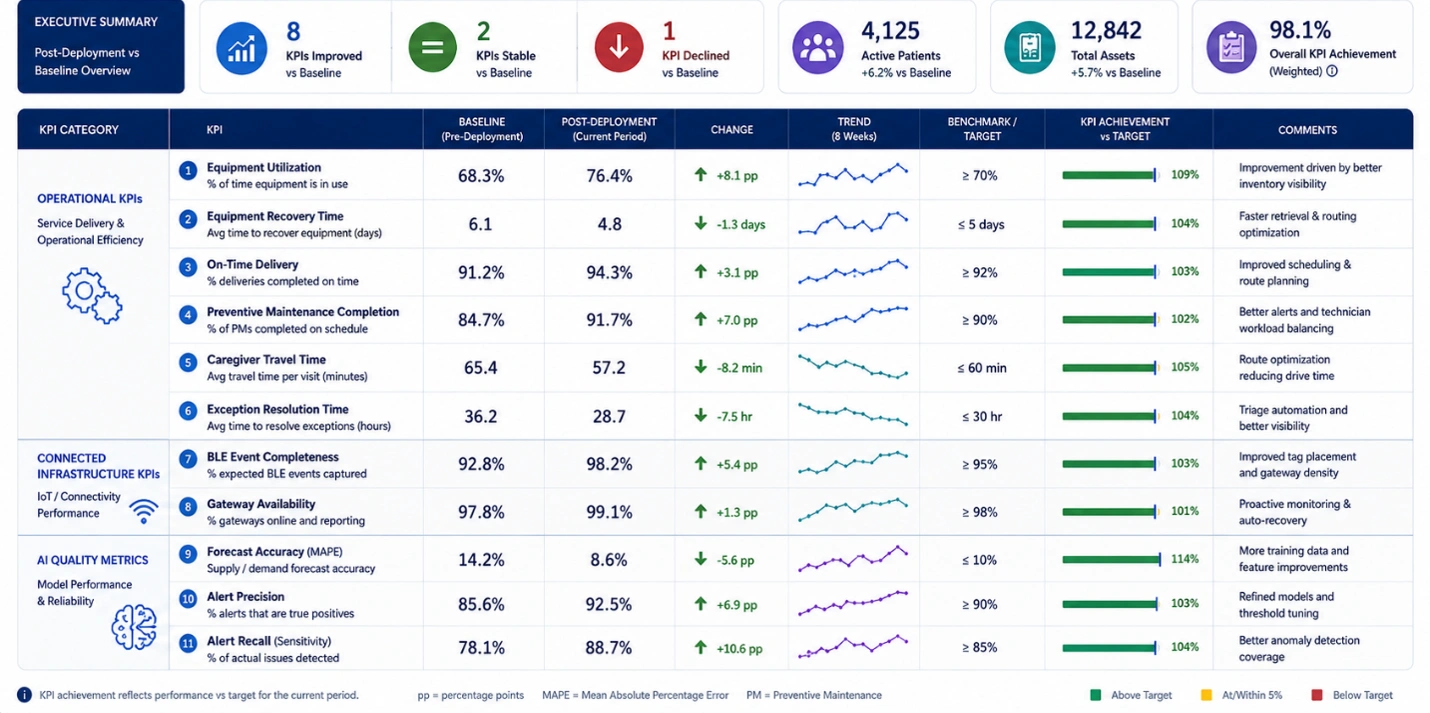
AI-Enabled Home Medical Services KPI Comparison Scorecard
This KPI scorecard compares baseline and post-deployment performance across operational efficiency, connected infrastructure, and AI model quality. It highlights equipment utilization, recovery time, delivery performance, caregiver travel, BLE event completeness, gateway availability, forecast accuracy, alert precision, and alert recall against defined targets.
Practical Recommendations for Home Medical Service Providers
The most effective AI-driven home medical service programs treat connected technology as part of an operational improvement program rather than as a standalone tracking initiative.
Recommended engineering practices include:
- Define the business or care-delivery decision before selecting BLE hardware
- Establish measurable baseline KPIs before deploying AI
- Select BLE gateways, beacons, and sensors according to actual residence and workflow conditions
- Validate radio performance in representative homes
- Use local buffering to accommodate intermittent connectivity
- Keep patient-identifying information out of BLE broadcasts whenever possible
- Integrate observations with existing operational systems rather than creating parallel records
- Use deterministic rules for straightforward conditions and AI where pattern recognition or prediction provides measurable value
- Require human ownership for operational exceptions and clinically significant decisions
- Monitor AI precision, recall, drift, and data quality after production deployment
- Design device provisioning, replacement, firmware, and gateway maintenance into the lifecycle plan
- Test cybersecurity and recovery procedures rather than treating them as documentation exercises
- Scale by validated workflow and service line instead of deploying connected devices indiscriminately
GAO’s experience supplying BLE, RFID, and IoT products and systems can help technical teams evaluate device selection, connectivity, data capture, and deployment requirements for home medical service applications.
Building a Reliable AI and IoT Foundation for Home Medical Services
AI-driven home medical services can improve asset visibility, equipment readiness, service coordination, maintenance planning, inventory forecasting, and exception management when the underlying data is reliable and operationally relevant. BLE gateways, beacons, and sensors provide one practical mechanism for collecting that data across distributed residences and field operations.
The strongest implementations connect the physical world to existing healthcare and operational software through validated events, controlled integrations, secure data handling, and measurable AI outcomes. Cloud, private server, and hybrid deployments can each be appropriate depending on connectivity, governance, integration, and data-management requirements.
Organizations evaluating these solutions can engage GAO to learn more about BLE gateways, beacons, sensors, IoT hardware, connected systems, technical engineering support, and deployment considerations for home medical service workflows.
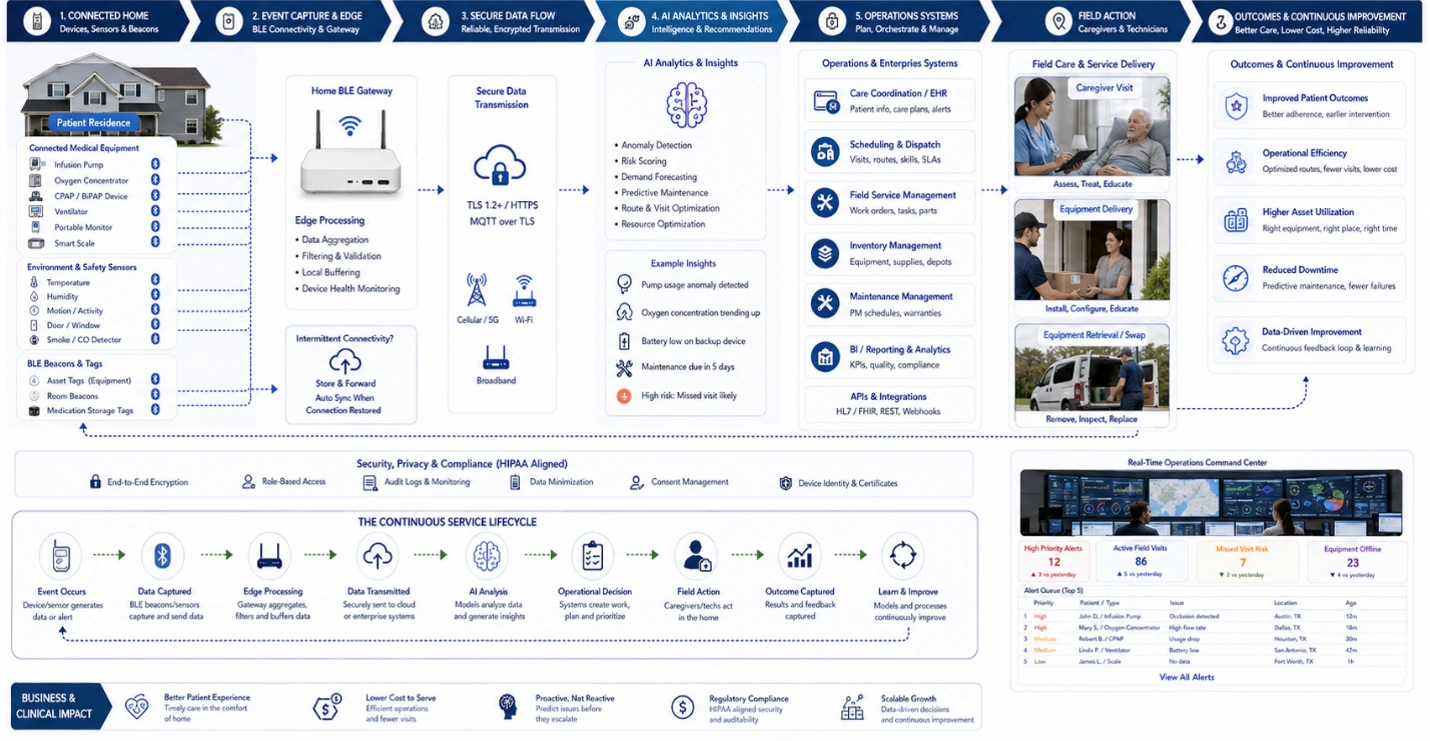
AI-Enabled Home Medical Services End-to-End Connected Care Workflow
This illustration maps the complete home medical service lifecycle from connected equipment, BLE beacons, sensors, and gateways through secure data transmission, AI analytics, operational systems, and field caregiver actions. It shows how AI-generated insights support scheduling, equipment management, predictive maintenance, care coordination, and continuous operational improvement.
Building the Future of AI and IoT with Aperture Venture Studio and GAO
For more than three decades, GAO Group has invested heavily in R&D for industrial BLE, RFID, IoT, and related technologies. Since generative AI became useful for practical applications, we have expanded our work across AI and IoT, including connected technologies relevant to home medical services. We have also developed Aperture Venture Studio to advance AI and IoT solutions for specialized application areas.
Aperture attracts AI and IoT technical experts, entrepreneurial and operational executives, investors, and leading companies. We have also developed Aperture Ventures Summit and TekSummit to discuss advanced AI and IoT topics and foster technical communities.
GAO, headquartered through its operations in New York City and Toronto, Canada, is ranked among the world’s leading B2B and B2G BLE and RFID suppliers. GAO, GAO Research, and GAO Tek form GAO Group. For three decades, the companies have served U.S. and Canadian customers, including Fortune 500 companies, R&D organizations, universities, and government agencies. GAO Group emphasizes product R&D, stringent quality assurance, and expert remote or onsite technical support.
Readers interested in contributing to this work are welcome to engage with us as:
- Advisors, co-founders, or employees
- Investors
- Customers
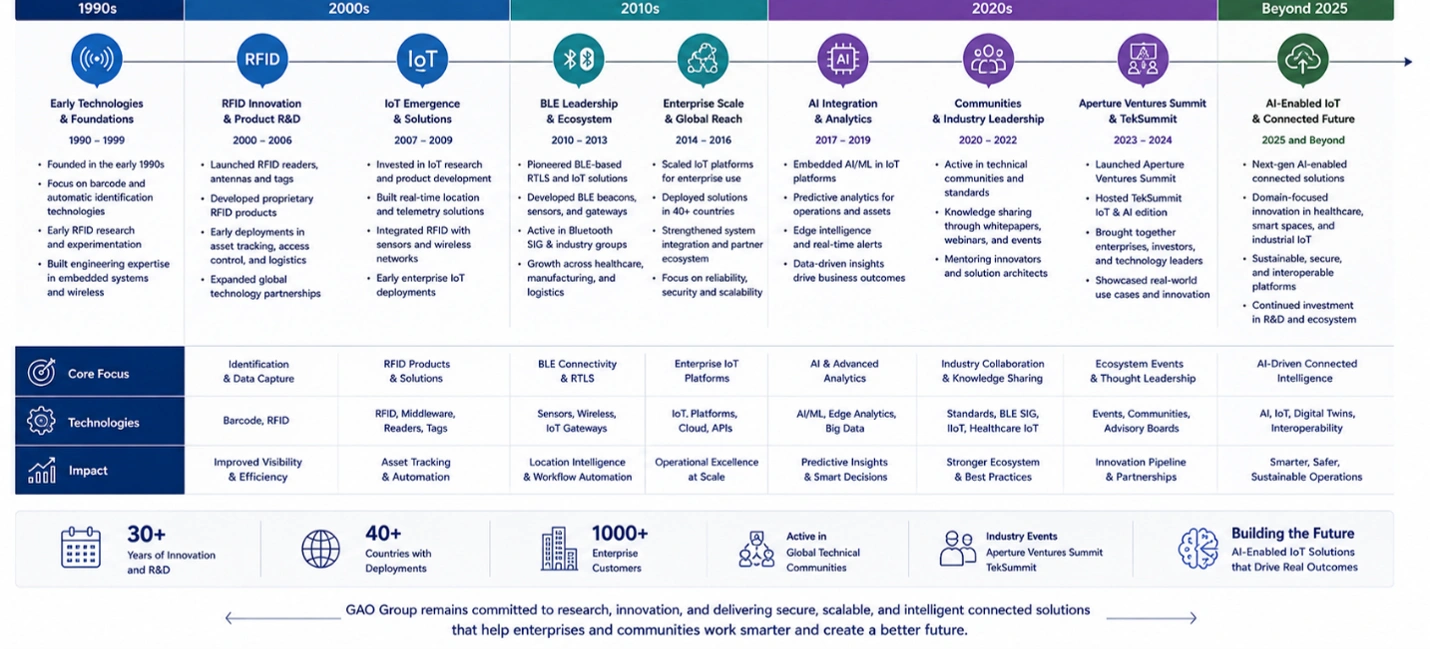
GAO Group 30+ Year Evolution from BLE and RFID to AI-Enabled IoT
This timeline illustrates GAO Group’s long-term progression across RFID, BLE, IoT, AI, and connected systems, highlighting technology development, enterprise deployments, technical communities, and industry events. It connects decades of R&D with the evolution toward AI-enabled connected solutions relevant to healthcare and other operational environments.