
AI and BLE for Hydrocarbon Production
AI-Driven Hydrocarbon Production Monitoring with BLE Connectivity
Hydrocarbon production is becoming increasingly data driven as operators seek higher production efficiency, lower operating costs, improved equipment reliability, enhanced worker safety, and stronger environmental compliance. Artificial Intelligence integrated with Bluetooth Low Energy (BLE) sensing enables continuous monitoring of wells, gathering systems, production facilities, processing equipment, pipelines, storage assets, and supporting infrastructure while transforming operational data into actionable engineering intelligence. Rather than relying solely on periodic inspections or reactive maintenance, production engineers can continuously evaluate equipment conditions, optimize production parameters, predict failures, and automate operational decisions using AI models supported by distributed BLE devices.
Modern hydrocarbon production environments generate large volumes of operational information from pumps, separators, compressors, valves, tanks, pipelines, rotating equipment, instrumentation, and environmental monitoring systems. AI converts these data streams into predictive recommendations that improve production performance while BLE sensors, gateways, and beacons provide efficient short-range wireless connectivity for mobile assets, maintenance activities, equipment monitoring, and worker location awareness. Together these technologies strengthen operational resilience, reduce unplanned downtime, improve asset utilization, and support safer production across upstream oil and gas operations. GAO has supported organizations across North America by supplying industrial BLE and IoT hardware that enables reliable data acquisition for demanding industrial environments.
AI-Enabled Upstream Hydrocarbon Production Monitoring with BLE Sensors, Edge Computing, and Enterprise AI Analytics
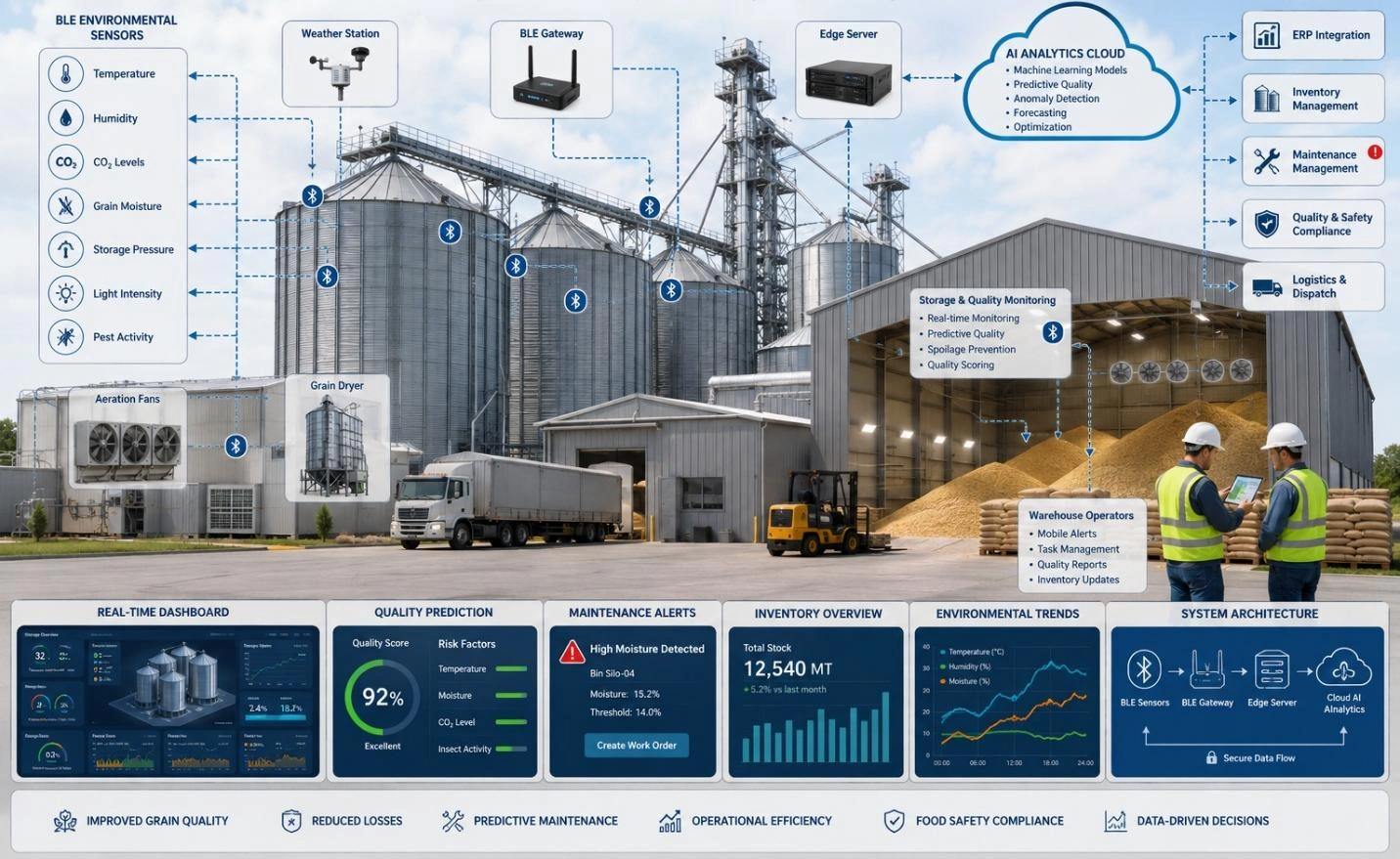
Understanding AI-Enabled Hydrocarbon Production with BLE Technology
Hydrocarbon production encompasses the extraction, gathering, separation, treatment, measurement, storage, and transportation of crude oil, natural gas, condensate, produced water, and associated hydrocarbons. Production facilities operate continuously under changing geological conditions, fluctuating production rates, varying reservoir pressures, and demanding environmental conditions. These operational characteristics require continuous monitoring, intelligent analytics, and rapid decision making.
Artificial Intelligence improves hydrocarbon production by learning from operational history, equipment behavior, geological characteristics, maintenance records, sensor measurements, and production performance. Machine learning models identify patterns that operators cannot easily recognize manually, allowing production engineers to forecast equipment failures, optimize artificial lift systems, reduce energy consumption, detect abnormal production behavior, and improve recovery efficiency.
BLE serves as a practical wireless communication layer for industrial sensing throughout production facilities. BLE sensors monitor vibration, temperature, humidity, pressure, corrosion indicators, equipment movement, valve position, rotating machinery condition, worker proximity, and environmental variables. BLE gateways aggregate sensor information before securely forwarding operational data to edge servers, private enterprise servers, or cloud-hosted software for AI analysis.
The combination of AI and BLE forms an Artificial Intelligence of Things (AIoT) solution where connected industrial assets continuously provide operational intelligence that supports automated decision making. Depending on operational requirements, AI inference may occur at the edge for low-latency production decisions or within centralized software for fleet-wide optimization across multiple production fields.
Hydrocarbon production organizations increasingly deploy these solutions because they improve:
- Artificial lift optimization
- Production forecasting accuracy
- Equipment reliability
- Compressor efficiency
- Pipeline integrity monitoring
- Production chemistry optimization
- Environmental compliance
- Methane emission monitoring
- Worker safety
- Energy efficiency
- Maintenance scheduling
- Production asset visibility
GAO has worked with organizations requiring industrial BLE hardware designed for demanding operational environments where equipment reliability, long service life, and dependable communications are critical.
AI Applications Across Hydrocarbon Production Operations
Hydrocarbon production contains numerous operational stages that benefit from AI supported by BLE-enabled sensing. Each production environment presents unique engineering challenges, operational risks, and optimization opportunities.
Wellhead Production Optimization
Production wells operate under continuously changing reservoir conditions. AI analyzes casing pressure, tubing pressure, flow rates, choke settings, production temperatures, vibration measurements, and historical production trends to recommend optimized operating conditions.
BLE devices installed around wellheads provide localized equipment monitoring while enabling maintenance personnel to collect inspection data using mobile devices without extensive wiring modifications.
Expected operational improvements include:
- Increased production efficiency
- Reduced well intervention frequency
- Earlier abnormal production detection
- Improved reservoir management
- Better artificial lift performance
Artificial Lift System Monitoring
Artificial lift systems such as electric submersible pumps, progressing cavity pumps, beam pumps, gas lift systems, and hydraulic lift systems represent major production assets.
AI continuously evaluates:
- Motor current signatures
- Pump efficiency
- Rod load variations
- Torque profiles
- Fluid production trends
- Vibration characteristics
- Pump intake pressures
- Electrical consumption
BLE vibration and temperature sensors installed near production equipment supply continuous operational measurements for predictive maintenance models.
Operational benefits include:
- Reduced pump failures
- Improved production uptime
- Lower maintenance costs
- Extended equipment life
- Better spare parts planning
Production Separation Facilities
Production separators continuously process mixtures of oil, gas, water, and solids. Maintaining optimal separator performance directly influences production quality and downstream processing efficiency.
AI models monitor:
- Separator pressure stability
- Liquid interface levels
- Flow balancing
- Gas production
- Water cut
- Chemical injection effectiveness
- Fouling development
BLE instrumentation assists maintenance teams in monitoring auxiliary equipment including motors, valves, instrumentation panels, and rotating equipment throughout separator facilities.
Compressor Station Intelligence
Gas compressor stations consume substantial operational energy while representing critical production infrastructure.
Artificial Intelligence optimizes:
- Compressor loading
- Fuel consumption
- Vibration behavior
- Bearing temperatures
- Lubrication conditions
- Surge avoidance
- Maintenance forecasting
BLE sensors installed on motors, bearings, lubrication systems, and cooling equipment improve condition monitoring without extensive communication wiring.
Tank Farm Operations
Storage facilities require continuous monitoring to prevent production losses, environmental incidents, and inventory inaccuracies.
AI supports:
- Inventory forecasting
- Leak prediction
- Tank integrity monitoring
- Corrosion analysis
- Temperature monitoring
- Vapor management
- Maintenance scheduling
BLE devices assist local sensing of:
- Hatch status
- Tank temperatures
- Structural vibration
- Access monitoring
- Worker safety
- Environmental conditions
Pipeline Production Monitoring
Gathering pipelines transport hydrocarbons between production assets and processing facilities.
AI assists operators by identifying:
- Flow anomalies
- Pressure losses
- Leak indicators
- Corrosion risks
- Blockage development
- Pigging optimization
- Maintenance priorities
BLE field devices improve localized equipment inspection while supporting maintenance documentation and mobile workforce operations.
AI-Supported Hydrocarbon Production Workflow with BLE Monitoring, Edge Computing, and Enterprise AI Analytics
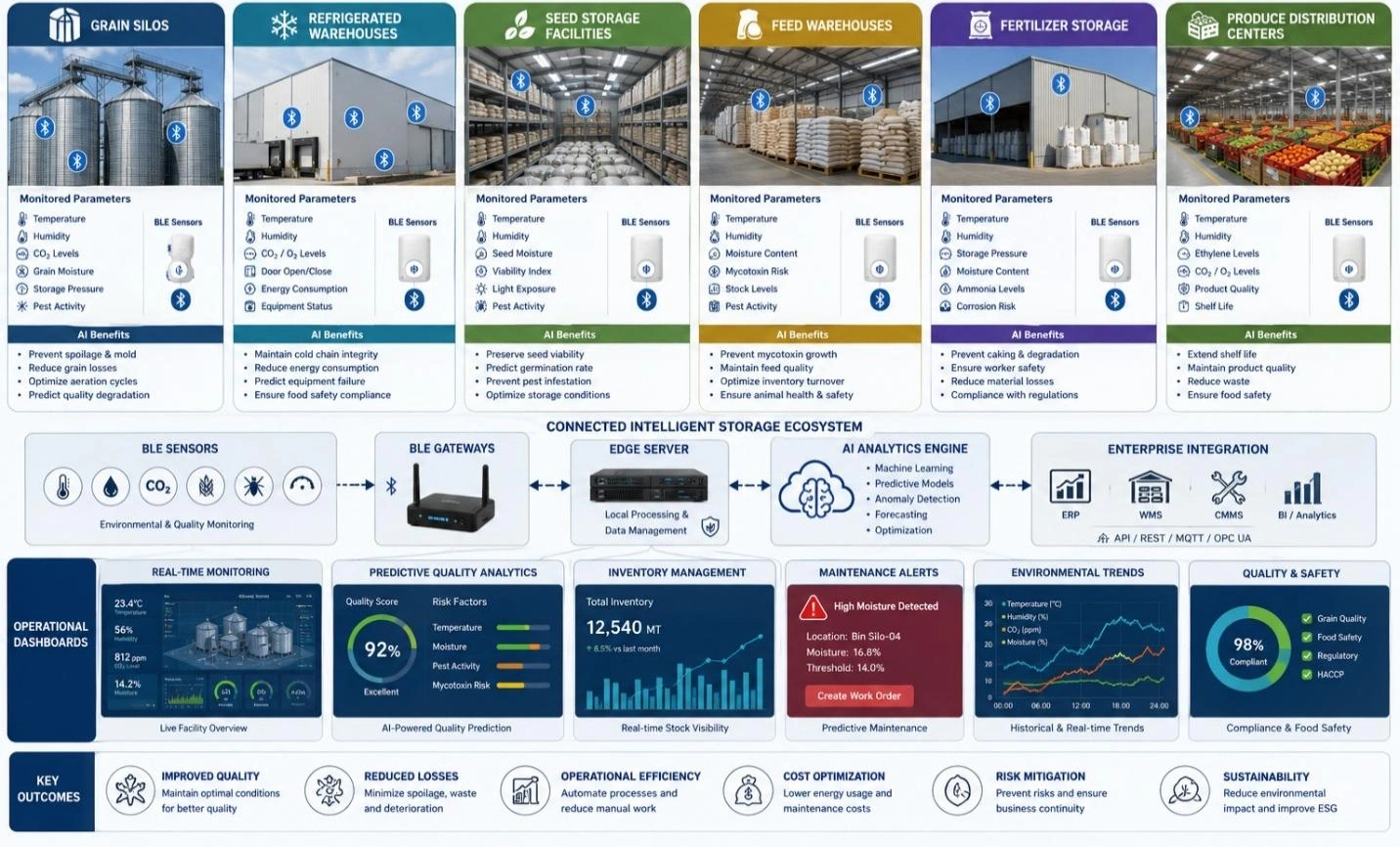
Operational Workflow for AI-Driven Hydrocarbon Production
Hydrocarbon production generates operational information continuously from thousands of physical assets distributed across extensive production fields. Effective AI implementation depends on a carefully designed operational workflow that transforms raw field measurements into production decisions.
Field Data Acquisition
Operational information originates from numerous production assets including:
- Wellheads
- Christmas trees
- Artificial lift systems
- Electric motors
- Compressors
- Pumps
- Heat exchangers
- Production separators
- Metering systems
- Pipelines
- Storage tanks
- Chemical injection units
- Flare systems
- Produced water handling equipment
- Environmental monitoring stations
BLE sensors continuously collect measurements including:
- Equipment vibration
- Surface temperature
- Bearing temperature
- Valve position
- Humidity
- Worker presence
- Equipment utilization
- Environmental conditions
- Structural movement
- Maintenance status
Traditional industrial instrumentation including pressure transmitters, flowmeters, level transmitters, analyzers, and PLC-controlled equipment complement BLE sensing to provide complete operational visibility.
Communication Infrastructure
BLE sensors transmit operational information to nearby industrial BLE gateways positioned throughout production facilities.
Gateways perform:
- Device authentication
- Sensor aggregation
- Local buffering
- Data filtering
- Time synchronization
- Edge preprocessing
- Secure forwarding
Communication beyond BLE typically uses industrial networking technologies appropriate for hydrocarbon production environments, including:
- Ethernet
- Industrial Wi-Fi
- Fiber optic networks
- LTE
- 5G
- Private wireless networks
- Satellite communications for remote production sites
- MQTT
- OPC UA
- Modbus TCP
- HTTPS REST APIs
Reliable communication design considers hazardous area classifications, electromagnetic interference, network redundancy, environmental exposure, and production continuity requirements.
Edge Processing and Intelligent Data Preparation
Edge servers positioned near production operations reduce latency while supporting real-time operational decisions.
Typical edge processing includes:
- Sensor validation
- Noise filtering
- Data normalization
- Event detection
- Anomaly screening
- Feature extraction
- Local AI inference
- Temporary storage
- Alarm prioritization
Edge AI enables immediate operational responses during abnormal production events without requiring continuous cloud connectivity.
AI Analytics and Operational Decision Support
Prepared production data enters AI software where multiple analytical models evaluate operational conditions simultaneously.
Common AI methods include:
- Time-series forecasting
- Predictive maintenance models
- Anomaly detection
- Reinforcement learning for production optimization
- Deep learning for equipment diagnostics
- Bayesian forecasting
- Remaining useful life estimation
- Production decline analysis
- Digital twin simulation support
These models produce engineering recommendations for production engineers, reliability teams, operations supervisors, maintenance planners, and asset managers.
End-to-End AIoT Data Flow Architecture for AI-Enabled Hydrocarbon Production Monitoring and Optimization
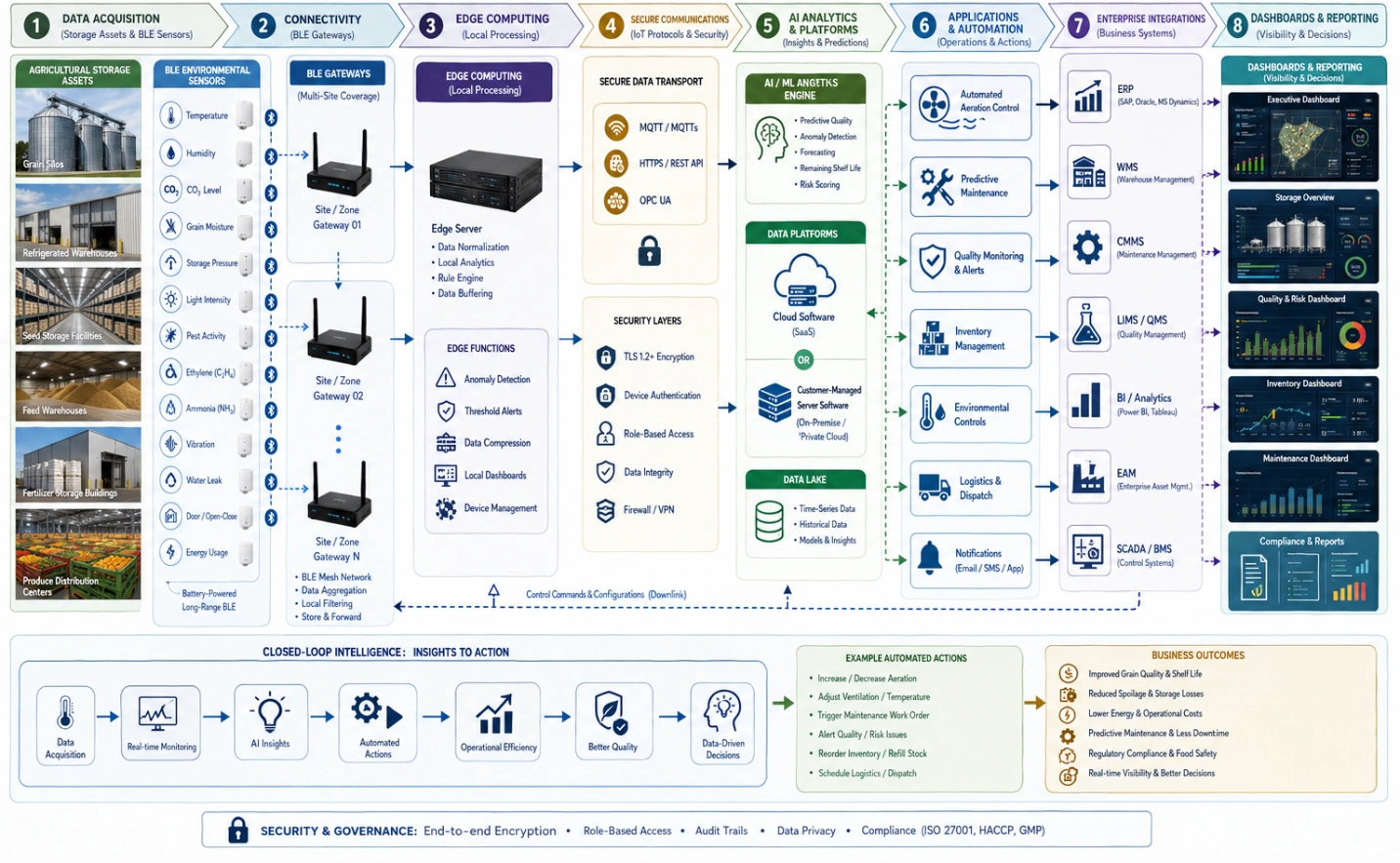
BLE Hardware, AI Software, Communication Infrastructure, and Deployment Models for Hydrocarbon Production
Successful AI-driven hydrocarbon production depends on selecting industrial-grade hardware, reliable communications, scalable AI software, and an appropriate deployment model. Rather than treating BLE as an isolated wireless technology, production organizations should view it as one component within a larger Industrial AIoT solution that supports continuous production optimization, asset reliability, safety, and regulatory compliance.
BLE Hardware Supporting Hydrocarbon Production
BLE hardware is typically deployed around production assets where wired instrumentation is costly, impractical, or intended to complement existing automation systems.
Typical hardware includes:
- Industrial BLE gateways
- Industrial BLE beacons
- BLE vibration sensors
- BLE temperature sensors
- BLE humidity sensors
- BLE proximity sensors
- BLE motion sensors
- BLE accelerometers
- BLE asset tags
- Intrinsically safe BLE devices for hazardous locations
- Rugged handheld maintenance terminals
- Industrial tablets
- Gateway antennas
- Edge computing appliances
Each component contributes to operational visibility by collecting localized equipment information and securely transmitting it to AI software for analysis.
AI Software Supporting Hydrocarbon Production
AI software combines operational technology (OT) data with engineering knowledge and historical production records to improve production performance.
Common software capabilities include:
- Predictive maintenance
- Equipment health scoring
- Remaining useful life estimation
- Production forecasting
- Reservoir performance analytics
- Artificial lift optimization
- Compressor performance analysis
- Tank inventory analytics
- Leak detection analytics
- Corrosion prediction
- Root cause analysis
- Workforce safety monitoring
- Alarm rationalization
- Production KPI dashboards
- Automated reporting
These capabilities allow production engineers to prioritize corrective actions using measurable operational risk rather than reactive maintenance practices.
Enterprise Software Integration
Hydrocarbon production facilities rarely operate in isolation. AI software typically exchanges operational information with existing business and operational systems.
Common integrations include:
- SCADA systems
- Distributed Control Systems (DCS)
- PLC networks
- Manufacturing Execution Systems (MES)
- Enterprise Resource Planning (ERP)
- Computerized Maintenance Management Systems (CMMS)
- Asset Performance Management (APM)
- Geographic Information Systems (GIS)
- Laboratory Information Management Systems (LIMS)
- Process historians
- Data lakes
- Business intelligence software
- Workforce management software
- Environmental reporting software
Integration allows AI recommendations to trigger maintenance work orders, production optimization tasks, inventory updates, compliance reporting, and executive dashboards.
GAO has supplied industrial BLE and IoT hardware that integrates with existing operational environments without requiring organizations to replace mature automation investments.
Communication Protocols
Reliable communication is essential for AI-driven production monitoring.
Frequently deployed protocols include:
- BLE
- MQTT
- OPC UA
- Modbus TCP
- EtherNet/IP
- PROFINET
- HTTPS REST APIs
- AMQP
- DDS
- TLS-encrypted TCP/IP
- IPv6
Protocol selection depends on production latency requirements, cybersecurity policies, interoperability objectives, and existing automation infrastructure.
Cloud Version
Cloud-hosted software is appropriate when organizations manage geographically distributed production fields and require centralized operational visibility.
Typical characteristics include:
- Multi-site production monitoring
- Fleet-wide equipment benchmarking
- Central AI model management
- Remote engineering collaboration
- Centralized cybersecurity updates
- Enterprise dashboard reporting
- Scalable computing resources
- Disaster recovery services
- Secure remote access
- Cross-regional production analytics
Cloud deployment is often selected by organizations operating numerous producing assets across multiple regions.
Server Version
Server deployments are frequently selected where operational control, cybersecurity, or regulatory requirements favor privately managed infrastructure.
Server software may operate on:
- Edge servers
- Customer-managed servers
- Regional production centers
- Private data centers
- Secure industrial computing facilities
Advantages include:
- Low-latency analytics
- Local AI inference
- Greater operational autonomy
- Enhanced data governance
- Reduced external network dependency
- Integration with existing OT environments
- Custom security policies
Many hydrocarbon producers adopt hybrid deployments where edge servers execute real-time AI while centralized software performs long-term production optimization and enterprise reporting.
AI-Enabled Hydrocarbon Production Deployment Comparison: Cloud Version vs. Server Version
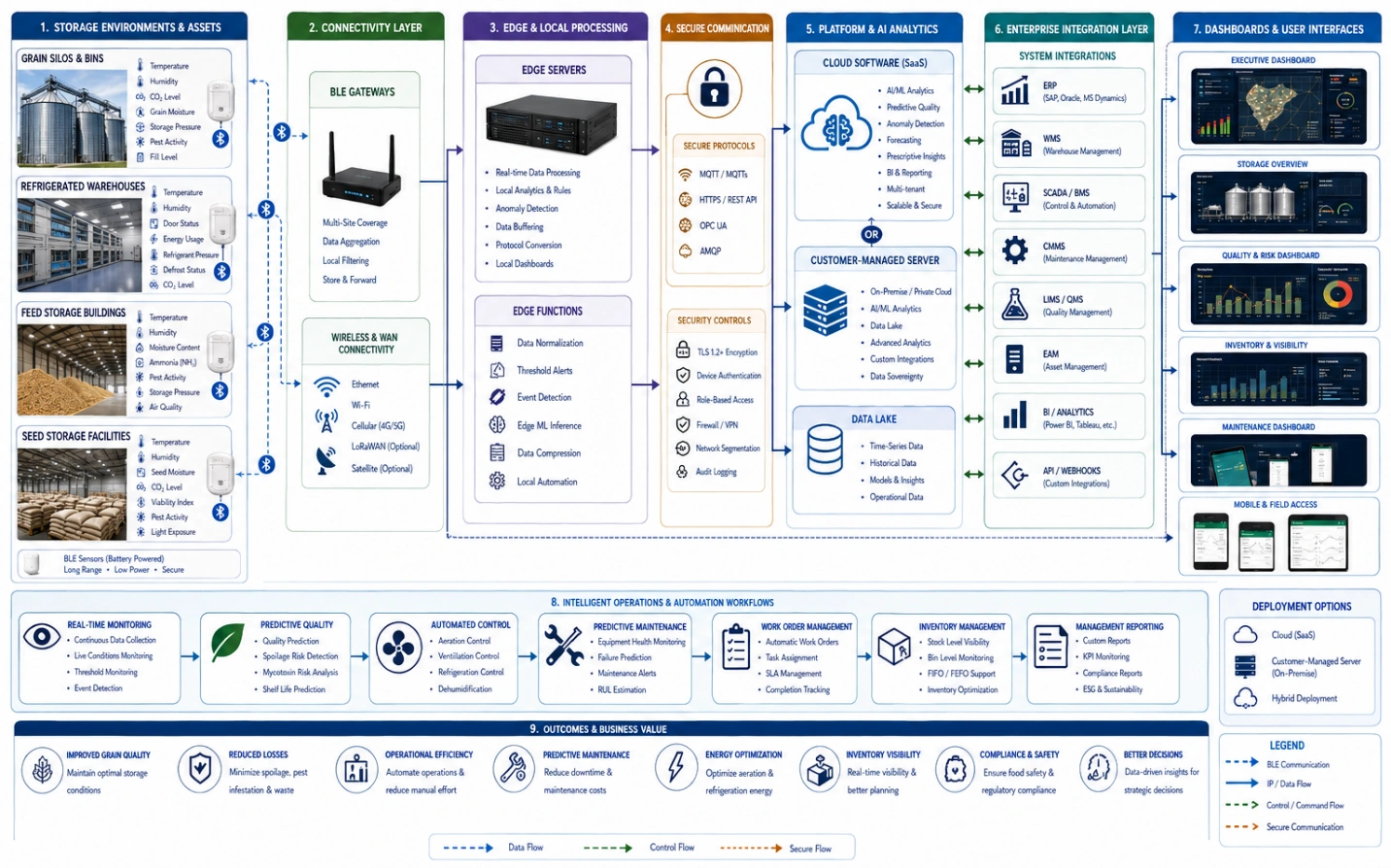
Cybersecurity and Engineering Design Considerations
Hydrocarbon production facilities operate critical infrastructure where cybersecurity directly affects operational continuity, worker safety, and environmental protection.
Recommended engineering practices include:
- Zero Trust network principles
- Multi-factor authentication
- Role-based access control
- End-to-end encryption
- Secure BLE pairing
- Digital certificate management
- Network segmentation between IT and OT
- Continuous vulnerability assessment
- Security Information and Event Management (SIEM)
- Secure firmware updates
- Device identity management
- Industrial firewalls
- Intrusion detection
- Backup and disaster recovery planning
- Continuous log monitoring
Engineering teams should also evaluate:
- Hazardous area classifications
- Intrinsically safe equipment requirements
- Wireless coverage planning
- Gateway redundancy
- Battery replacement strategies
- Environmental sealing
- Electromagnetic interference
- Equipment calibration
- Predictive maintenance validation
- AI model retraining frequency
Design decisions should balance production reliability, operational costs, maintainability, and future scalability.
Technical Capabilities and Operational Benefits
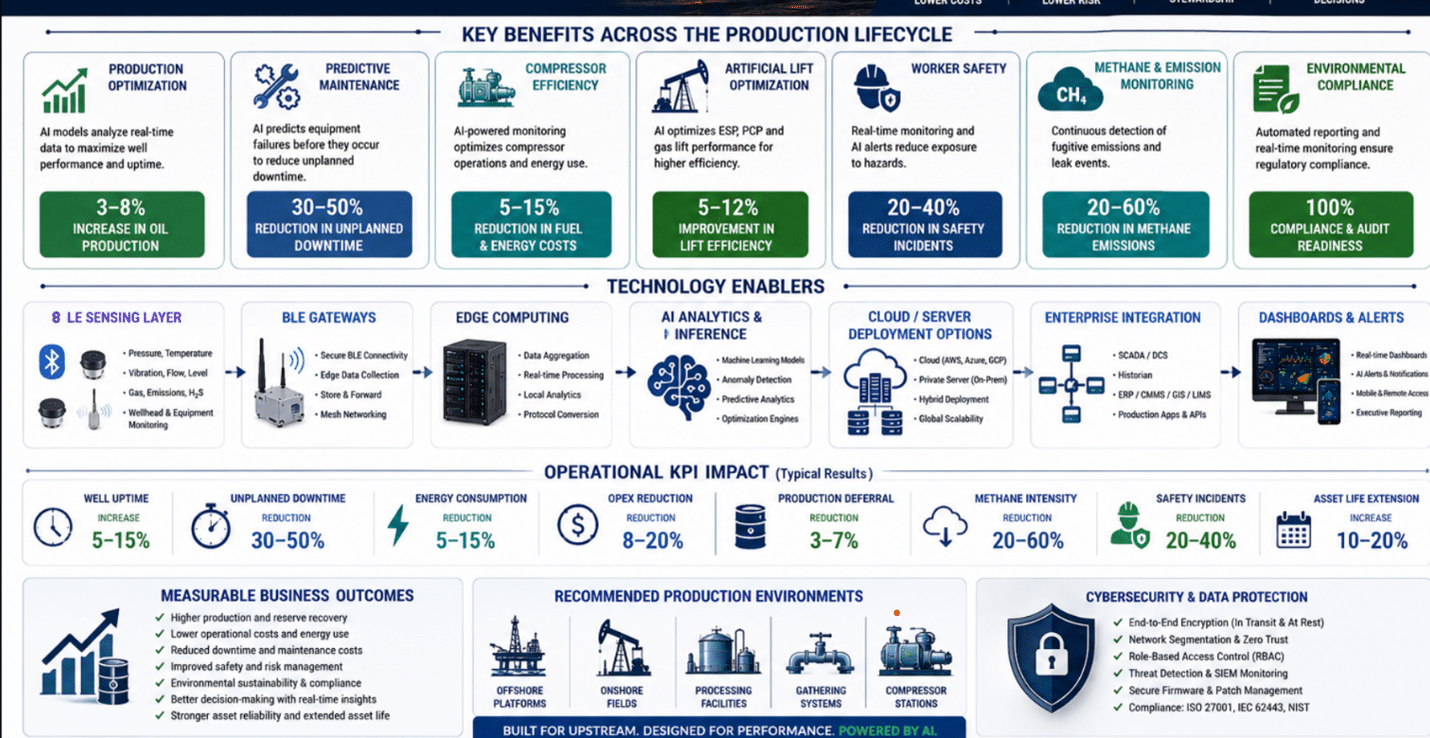
Combining AI with BLE-enabled sensing provides measurable improvements across hydrocarbon production operations because operational decisions are based on continuously updated field information rather than periodic manual observations.
Production Optimization
AI continuously evaluates production variables to recommend optimized operating conditions for wells, compressors, separators, and artificial lift systems.
Benefits include:
- Increased production rates
- Improved recovery efficiency
- Reduced production instability
- Better choke optimization
- Improved gas lift efficiency
Predictive Maintenance
Machine learning identifies equipment degradation before failures occur.
Expected improvements include:
- Lower unplanned downtime
- Extended equipment life
- Reduced emergency repairs
- Improved maintenance scheduling
- Better spare parts utilization
Equipment Reliability
Continuous condition monitoring improves reliability across:
- Compressors
- Pumps
- Motors
- Gearboxes
- Bearings
- Valves
- Production separators
- Heat exchangers
Engineering teams receive early warnings before operational failures develop into production interruptions.
Workforce Safety
AI assists safety teams through:
- Worker location awareness
- Lone worker monitoring
- Hazard exposure alerts
- Restricted-area notifications
- Emergency response coordination
- Maintenance risk assessment
BLE-enabled personnel monitoring supports faster incident response while reducing manual reporting.
Environmental Compliance
AI supports environmental management by monitoring:
- Methane emissions
- Produced water systems
- Tank integrity
- Pipeline leak indicators
- Air quality
- Flaring performance
- Spill risks
Early detection reduces environmental impact while supporting compliance with applicable regulatory reporting requirements.
Operational Visibility
Production managers obtain unified operational intelligence through dashboards showing:
- Production volumes
- Equipment availability
- Maintenance priorities
- Energy consumption
- Production efficiency
- Alarm status
- Asset utilization
- Environmental performance
- Safety indicators
This visibility enables more informed operational decisions across distributed production assets.
AI-Enabled Hydrocarbon Production Benefits: Executive Overview of Operational, Technical, and Business Performance
Implementation Recommendations for Hydrocarbon Production
Organizations planning AI-enabled hydrocarbon production initiatives should follow a structured implementation approach.
Recommended practices include:
- Identify production assets with the highest operational impact.
- Prioritize equipment that experiences frequent failures or significant maintenance costs.
- Perform wireless site surveys before installing BLE gateways.
- Define measurable KPIs before deploying AI models.
- Integrate operational data with existing SCADA, DCS, ERP, CMMS, and historian software.
- Validate AI recommendations using experienced production engineers before enabling automated actions.
- Establish cybersecurity requirements early in the project lifecycle.
- Develop procedures for sensor calibration, firmware updates, and lifecycle management.
- Continuously monitor AI model performance and retrain models as production conditions evolve.
- Plan future scalability to accommodate new wells, production facilities, and additional sensing technologies.
Typical KPIs include:
- Oil production rate
- Gas production rate
- Water cut
- Equipment availability
- Mean Time Between Failures (MTBF)
- Mean Time to Repair (MTTR)
- Overall Equipment Effectiveness (OEE)
- Compressor utilization
- Artificial lift efficiency
- Maintenance cost per barrel
- Energy consumption per barrel
- Methane emission rate
- Production downtime
- Safety incident frequency
- Environmental compliance performance
GAO, headquartered in New York City and Toronto, Canada, is recognized among the world’s leading B2B and B2G suppliers of BLE and RFID technologies. Together with its sister companies, GAO Research Inc. and GAO Tek Inc., GAO has supported Fortune 500 companies, leading research institutions, universities, and government organizations throughout the United States and Canada for more than three decades. This experience, combined with significant investment in research and development, rigorous quality assurance, and expert remote and onsite technical support, enables us to assist customers throughout planning, deployment, integration, commissioning, and long-term operation of industrial AIoT solutions.
Advancing Intelligent Hydrocarbon Production with AI and BLE
Artificial Intelligence supported by BLE-enabled sensing is transforming hydrocarbon production from reactive operations into predictive, data-driven decision making. Continuous monitoring of wells, production facilities, rotating equipment, storage assets, and environmental conditions enables production teams to optimize output, improve equipment reliability, strengthen worker safety, and support regulatory compliance. Successful implementation requires careful planning, reliable communications, secure system integration, and scalable AI software that aligns with operational objectives. By combining decades of industrial BLE and IoT expertise with practical engineering knowledge, GAO helps organizations implement dependable solutions that improve operational performance and prepare hydrocarbon production facilities for increasingly intelligent, connected operations. We invite you to explore GAO’s BLE, RFID, AIoT technologies, engineering expertise, and technical support services to learn how they can strengthen your hydrocarbon production initiatives.
Building the Future of Industrial AI and IoT with Aperture Venture Studio and GAO
For more than three decades, GAO Group of Companies has invested heavily in research and development of industrial BLE, RFID, and IoT technologies. As generative AI has demonstrated significant value for hydrocarbon production and other industrial operations, we have expanded our AIoT capabilities and established Aperture Venture Studio to accelerate the development and commercialization of advanced AI and IoT solutions for energy and other industrial sectors. Aperture has attracted leading AI and IoT experts, experienced business leaders, influential investors, and major industry participants. Through initiatives such as Aperture Ventures Summit and TekSummit, we continue to advance technical collaboration and knowledge sharing within the AI and IoT community. We welcome advisors, employees, investors, and customers to join us in shaping the future of intelligent industrial operations.