
AI-Driven Industrial Gas Production with BLE-Enabled Connected Operations
AI-Powered Industrial Gas Production Using BLE Connectivity
Industrial gas production depends on highly reliable cryogenic systems, air separation units (ASUs), hydrogen reformers, pressure swing adsorption (PSA) systems, compressors, pipelines, storage vessels, and filling facilities that operate continuously under strict safety and quality requirements. Artificial Intelligence combined with Bluetooth Low Energy (BLE) sensing enables industrial gas manufacturers to transform operational data into actionable intelligence by continuously monitoring production assets, personnel, environmental conditions, and material movement.
Rather than functioning as a standalone technology, BLE gateways, sensors, and beacons provide the real-time operational data required by AI models to predict equipment failures, optimize energy consumption, improve product purity, enhance worker safety, and increase production efficiency. AI analyzes thousands of operational variables simultaneously, helping engineers identify abnormal conditions long before conventional alarms activate.
GAO has supplied industrial BLE and IoT hardware to organizations across North America for decades, helping customers deploy connected monitoring systems that improve visibility into complex industrial operations while supporting long-term operational reliability.
AI-Enabled Industrial Gas Production Using BLE-Connected Assets
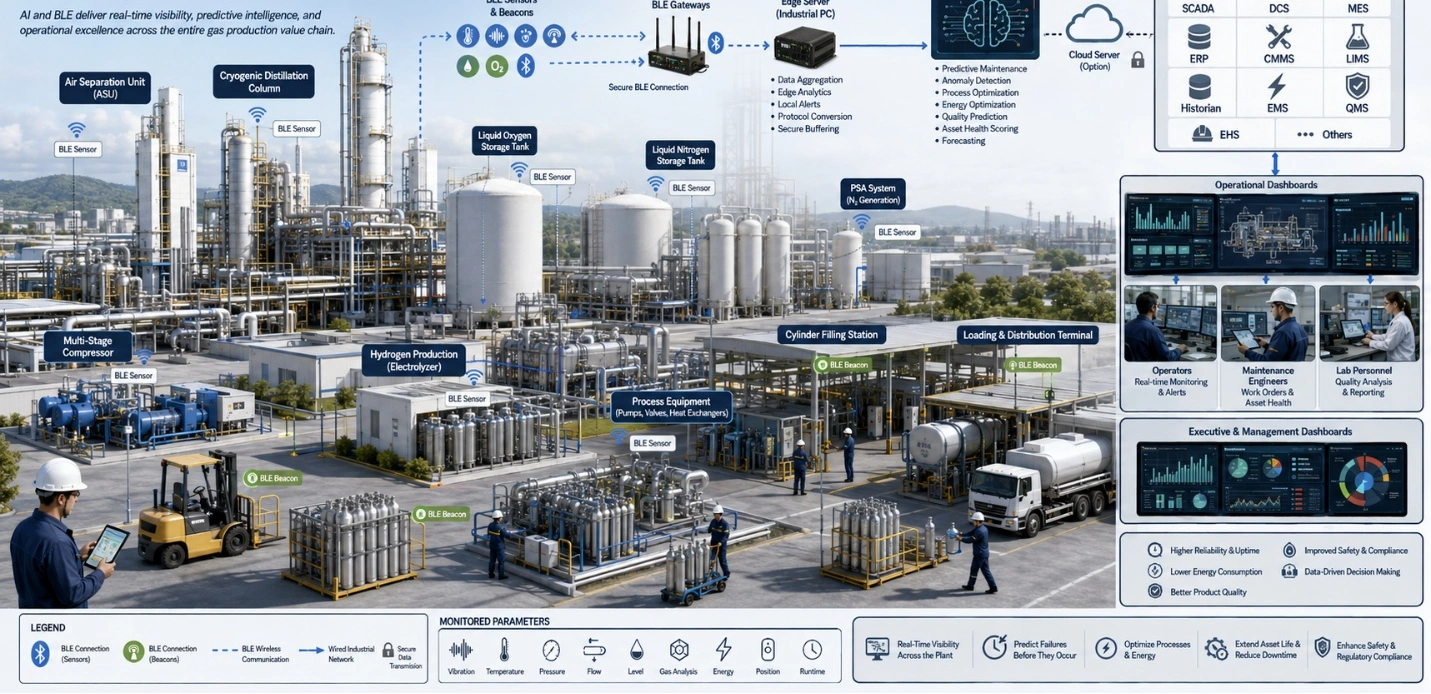
This illustration presents an AI-enabled industrial gas production facility where BLE sensors, BLE beacons, and BLE gateways continuously collect operational data from critical assets such as air separation units, cryogenic systems, compressors, hydrogen production equipment, storage tanks, and cylinder filling stations. The data flows through edge computing and AI analytics into SCADA, DCS, MES, ERP, CMMS, LIMS, and executive dashboards, enabling predictive maintenance, production optimization, improved safety, and data-driven operational decision-making.
Why Artificial Intelligence Is Transforming Industrial Gas Production
Industrial gas production facilities generate enormous volumes of operational information every second. Compressor vibration, cryogenic temperatures, oxygen purity, nitrogen concentration, hydrogen pressure, flow rates, compressor efficiency, valve positions, electrical consumption, dew point measurements, ambient conditions, leak detection sensors, and equipment status all contribute to operational performance.
Historically, much of this information remained isolated within distributed control systems (DCS), programmable logic controllers (PLCs), supervisory control and data acquisition (SCADA) software, or manual inspection records. Artificial Intelligence changes this approach by continuously learning relationships between operational variables and identifying patterns that human operators cannot easily recognize.
Examples include:
- Predicting compressor bearing degradation before vibration exceeds alarm thresholds.
- Detecting gradual efficiency losses within cryogenic heat exchangers.
- Identifying abnormal oxygen purity trends caused by fouled molecular sieves.
- Forecasting valve failures affecting pressure stability.
- Optimizing regeneration cycles within adsorption systems.
- Detecting small hydrogen leaks through correlated environmental measurements.
- Predicting cylinder filling bottlenecks before production delays occur.
- Recommending maintenance schedules based on equipment health rather than fixed service intervals.
BLE technology enables this intelligence by supplying frequent, low-power operational data from distributed assets throughout industrial gas production facilities.
Instead of reacting to equipment failures, production teams shift toward predictive operations where maintenance, production planning, safety management, and quality assurance become increasingly data driven.
Fundamental Concepts of AI-Enabled BLE Monitoring for Industrial Gas Production
Industrial gas production requires continuous monitoring across multiple production stages where equipment reliability directly influences product quality, safety, and production capacity.
Artificial Intelligence of Things (AIoT) combines artificial intelligence with connected industrial devices including BLE sensors, BLE gateways, industrial controllers, process instrumentation, edge computing, and production software.
Within industrial gas production, BLE primarily serves as the local wireless communication layer connecting field devices with AI software operating on edge servers or cloud-hosted systems.
The solution continuously captures operational information from production assets and transforms raw measurements into maintenance recommendations, production forecasts, anomaly detection alerts, energy optimization strategies, and operational decision support.
Typical monitored parameters include:
- Compressor vibration
- Motor temperature
- Bearing temperature
- Pipeline pressure
- Differential pressure
- Oxygen concentration
- Nitrogen purity
- Hydrogen purity
- Carbon dioxide concentration
- Cryogenic liquid level
- Tank pressure
- Valve position
- Pump operating condition
- Ambient humidity
- Ambient temperature
- Equipment runtime
- Electrical current
- Power consumption
- Rotational speed
- Acoustic emissions
Artificial intelligence converts these measurements into meaningful operational insights using machine learning, anomaly detection, predictive analytics, reinforcement learning, statistical forecasting, multivariable optimization, and edge inference.
The result is a continuously improving production environment where maintenance decisions become proactive instead of reactive.
From BLE Sensor Data to AI-Driven Operational Intelligence in Industrial Gas Production
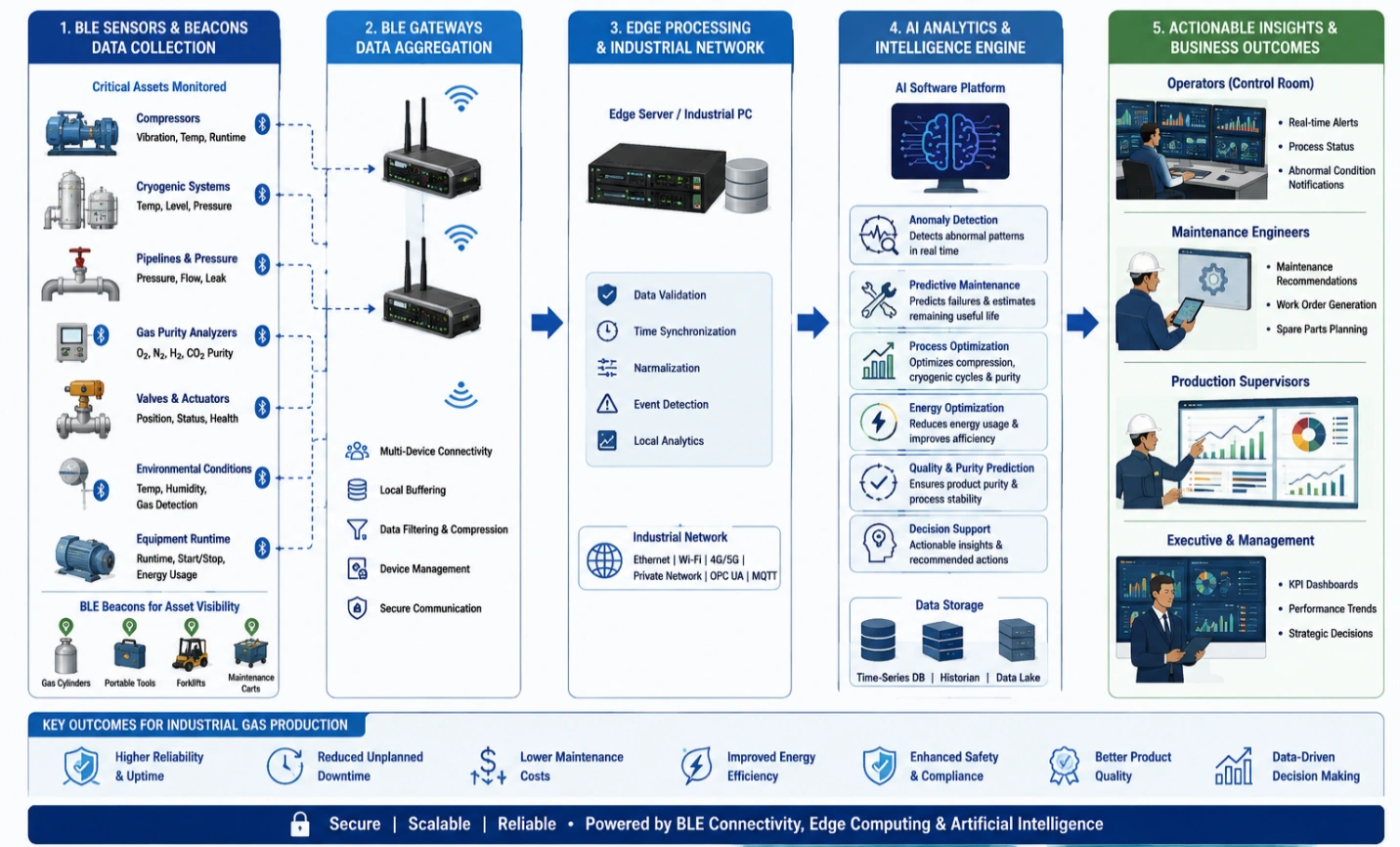
This infographic illustrates how BLE sensors continuously collect operational data from compressors, cryogenic systems, pipelines, gas purity analyzers, valves, and environmental monitoring devices across an industrial gas production facility. The information is transmitted through BLE gateways to edge servers and AI software, where advanced analytics generate predictive maintenance insights, process optimization recommendations, anomaly detection alerts, and decision support for operators, maintenance engineers, production supervisors, and executive management.
Industrial Gas Production Processes Benefiting from AI
Industrial gas production consists of interconnected manufacturing operations where disturbances within one process frequently affect downstream production capacity, product purity, and delivery schedules.
Artificial Intelligence improves operational performance throughout these processes.
Air Separation Units (ASU)
Cryogenic air separation facilities produce oxygen, nitrogen, and argon through compression, purification, cooling, liquefaction, and fractional distillation.
AI continuously evaluates compressor performance, refrigeration efficiency, molecular sieve condition, distillation stability, column pressures, and product purity to maximize production while minimizing energy consumption.
Pressure Swing Adsorption (PSA)
PSA systems depend upon precisely timed adsorption and regeneration cycles.
AI predicts adsorbent degradation, valve wear, pressure imbalance, and cycle optimization opportunities that improve nitrogen or oxygen production efficiency.
Hydrogen Production
Steam methane reformers, electrolyzers, and purification systems involve numerous process variables requiring continuous optimization.
Artificial intelligence identifies process instability, catalyst degradation, hydrogen leakage, reformer efficiency losses, and equipment health indicators before production quality declines.
Carbon Dioxide Recovery
Carbon dioxide capture systems require careful monitoring of compression, purification, liquefaction, and storage processes.
AI identifies fouling, refrigeration inefficiencies, compressor degradation, and purity deviations while optimizing energy utilization.
Cryogenic Storage
Cryogenic storage tanks require continuous monitoring of pressure, liquid level, boil-off rate, insulation performance, and transfer operations.
AI predicts abnormal boil-off losses, valve deterioration, insulation degradation, and pressure instability before operational disruptions occur.
Cylinder Filling Operations
Cylinder filling involves pressure verification, filling sequences, leak testing, labeling, and logistics.
AI improves scheduling, filling line utilization, operator productivity, and quality verification while reducing waiting time and operational bottlenecks.
Bulk Loading and Distribution
Loading bays supporting tanker trucks and bulk distribution require coordinated scheduling.
Artificial intelligence predicts loading delays, fleet congestion, equipment utilization, and delivery performance using operational history and real-time production status.
Operational Challenges Across Industrial Gas Production Facilities
Industrial gas production presents engineering challenges that extend beyond conventional manufacturing due to continuous operation, hazardous materials, cryogenic environments, and stringent purity requirements.
Common operational challenges include:
- Unexpected compressor failures causing production interruptions.
- Cryogenic equipment icing and insulation degradation.
- Air separation efficiency losses increasing energy consumption.
- Hydrogen leakage requiring rapid detection.
- Product purity deviations affecting customer specifications.
- Pressure instability within production systems.
- Valve failures reducing process reliability.
- Molecular sieve degradation.
- Compressor surge conditions.
- Equipment operating outside optimal efficiency ranges.
- Manual inspection of widely distributed production assets.
- Difficulty locating portable maintenance equipment.
- High electricity consumption associated with gas compression.
- Aging instrumentation.
- Limited visibility into equipment health between maintenance intervals.
- Safety compliance within hazardous production environments.
- Maintenance planning based on fixed schedules rather than actual equipment condition.
- Production interruptions caused by delayed spare parts availability.
Artificial Intelligence supported by BLE-connected sensing addresses these challenges by increasing operational visibility throughout the production lifecycle.
GAO has helped organizations implement industrial BLE monitoring hardware that enables engineers to capture operational information from distributed production assets while supporting scalable AI-driven monitoring initiatives.
Traditional vs. AI-Enabled Industrial Gas Production with BLE Monitoring
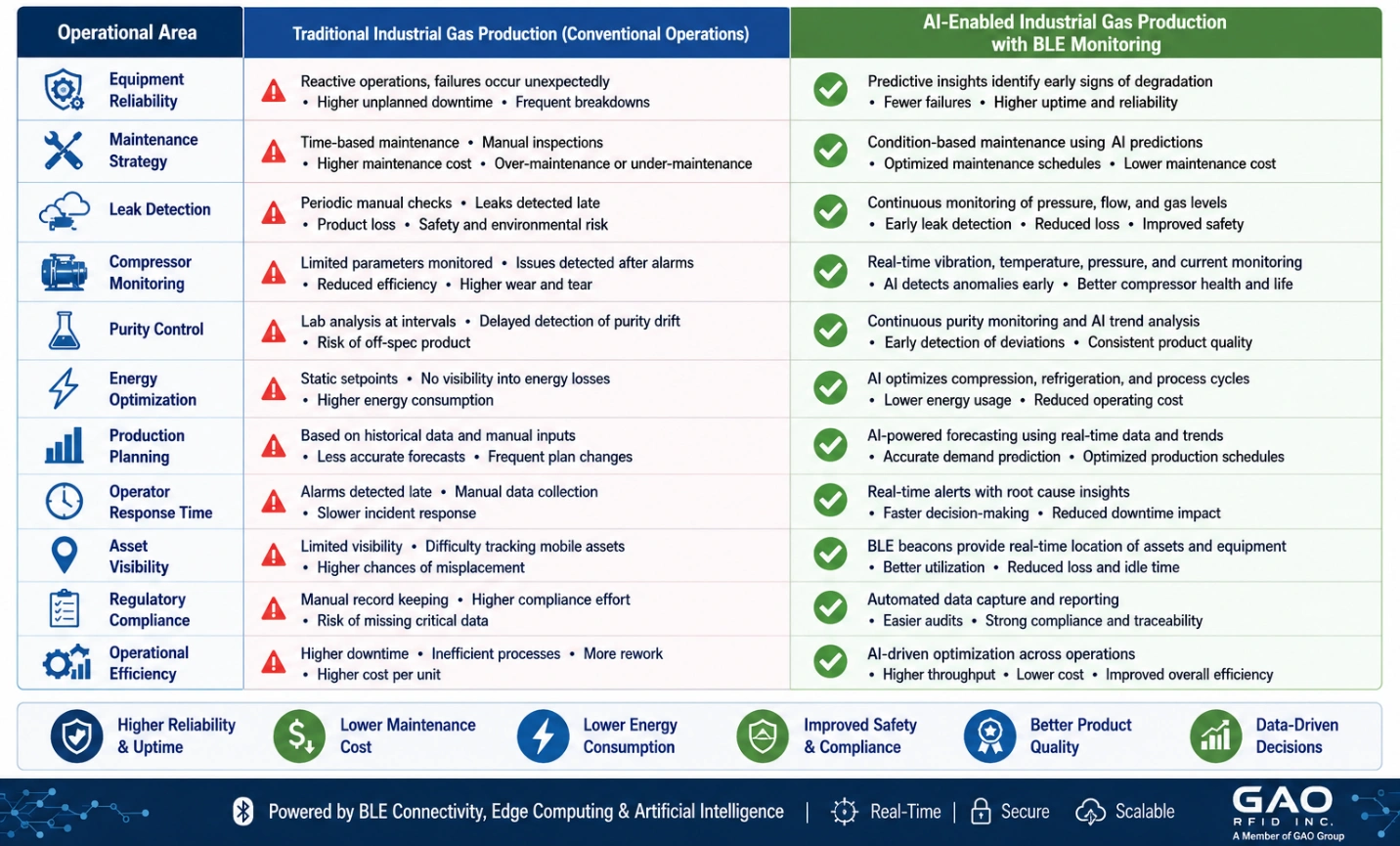
This comparison table contrasts conventional industrial gas production with AI-enabled operations supported by BLE-connected monitoring. It highlights improvements in equipment reliability, predictive maintenance, leak detection, compressor performance, product purity, energy optimization, production planning, asset visibility, regulatory compliance, operator response time, and overall operational efficiency.
AI Deployment Workflow for Industrial Gas Production
Artificial Intelligence within industrial gas production follows a structured operational workflow that transforms field measurements into production intelligence.
Operational Data Acquisition
BLE sensors installed on compressors, pumps, valves, cryogenic vessels, pipelines, vaporizers, filling manifolds, and storage systems continuously collect operational information including vibration, pressure, temperature, humidity, equipment runtime, liquid levels, valve position, and environmental conditions.
BLE beacons also enable location awareness for portable equipment, maintenance tools, gas cylinders, mobile inspection devices, and critical operational assets.
Wireless Communication
BLE gateways receive information from hundreds or thousands of connected BLE devices distributed throughout compressor buildings, cryogenic plants, filling stations, storage yards, maintenance workshops, and loading terminals.
The gateways securely transmit validated operational data to industrial networks using Ethernet, Wi-Fi, or cellular connectivity while supporting reliable communications in electrically noisy production environments.
Edge Processing
Industrial edge servers perform initial data validation, filtering, aggregation, normalization, timestamp synchronization, and local analytics before forwarding information to higher-level AI software. This approach reduces bandwidth usage, enables low-latency decision making, and supports continued operation during temporary network disruptions.
AI-Driven Operational Workflow for Industrial Gas Production Using BLE Connectivity
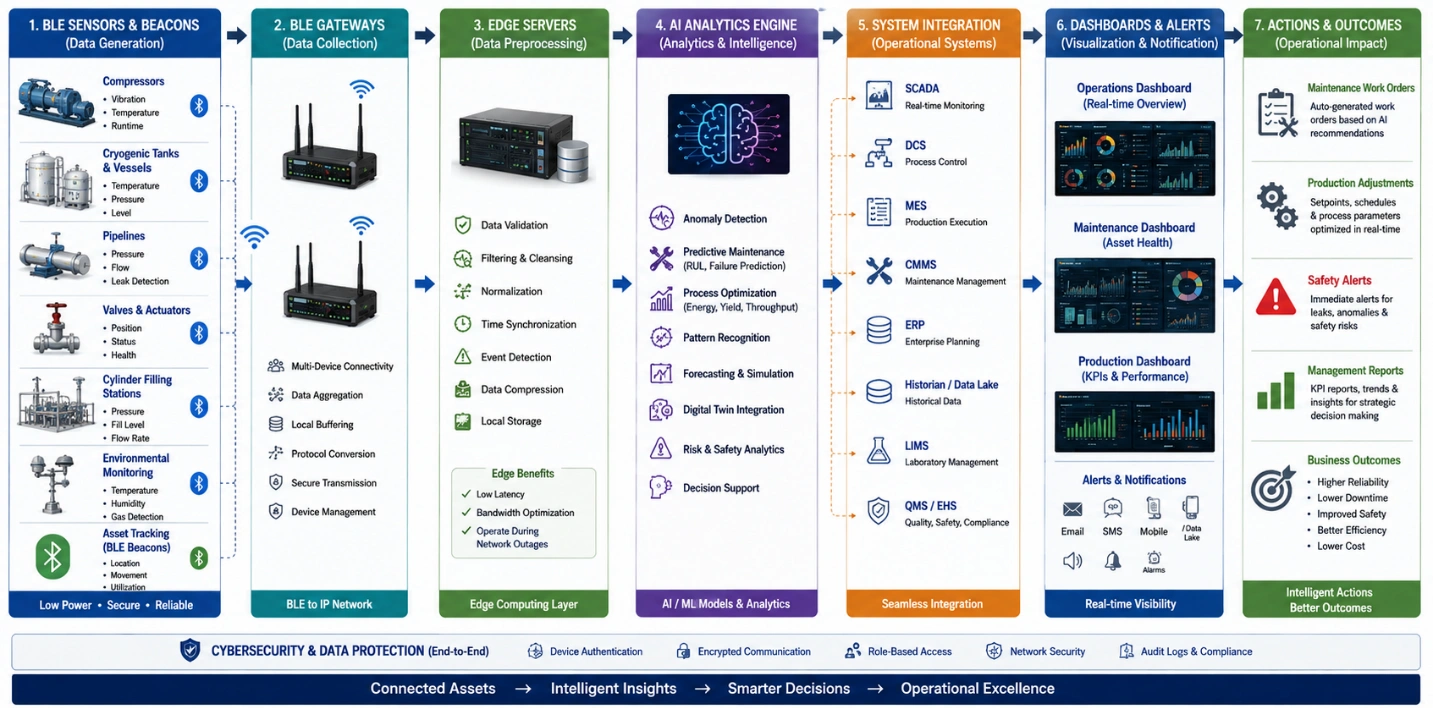
This workflow diagram illustrates the complete operational data flow for an AI-enabled industrial gas production facility. It shows how BLE sensors and beacons collect data from compressors, cryogenic tanks, pipelines, valves, cylinder filling stations, and environmental monitoring devices, which is then transmitted through BLE gateways to edge servers for preprocessing, analyzed by AI software, integrated with SCADA, DCS, MES, CMMS, ERP, and operational dashboards, and finally converted into maintenance work orders, production adjustments, safety alerts, management reports, and continuous operational improvements.
Enterprise Software Integration
After edge processing, validated operational data is exchanged with production and business software to provide a unified operational view. AI models continuously enrich operational information before distributing recommendations to engineering, maintenance, quality, and management teams.
Common software integrations within industrial gas production include:
- Distributed Control Systems (DCS)
- Supervisory Control and Data Acquisition (SCADA)
- Manufacturing Execution Systems (MES)
- Enterprise Resource Planning (ERP)
- Computerized Maintenance Management Systems (CMMS)
- Laboratory Information Management Systems (LIMS)
- Historian databases
- Energy Management Systems (EMS)
- Quality Management Systems (QMS)
- Asset Performance Management (APM)
- Environmental Health and Safety (EHS) software
This integration allows production schedules, maintenance work orders, laboratory results, inventory records, and equipment health information to remain synchronized across industrial gas production facilities.
AI Analytics and Operational Decision Making
Artificial intelligence continuously analyzes both real-time and historical production information using multiple analytical methods.
Typical AI capabilities include:
- Predictive maintenance
- Equipment health scoring
- Remaining useful life estimation
- Process anomaly detection
- Production optimization
- Product purity prediction
- Compressor efficiency optimization
- Leak probability estimation
- Energy consumption forecasting
- Predictive quality analytics
- Workforce safety monitoring
- Spare parts demand forecasting
These analytical outputs generate actionable recommendations such as maintenance scheduling, compressor load balancing, cryogenic process optimization, valve replacement planning, and production adjustments that improve plant reliability while minimizing unplanned downtime.
AI Software Integration Across Industrial Gas Production Operations
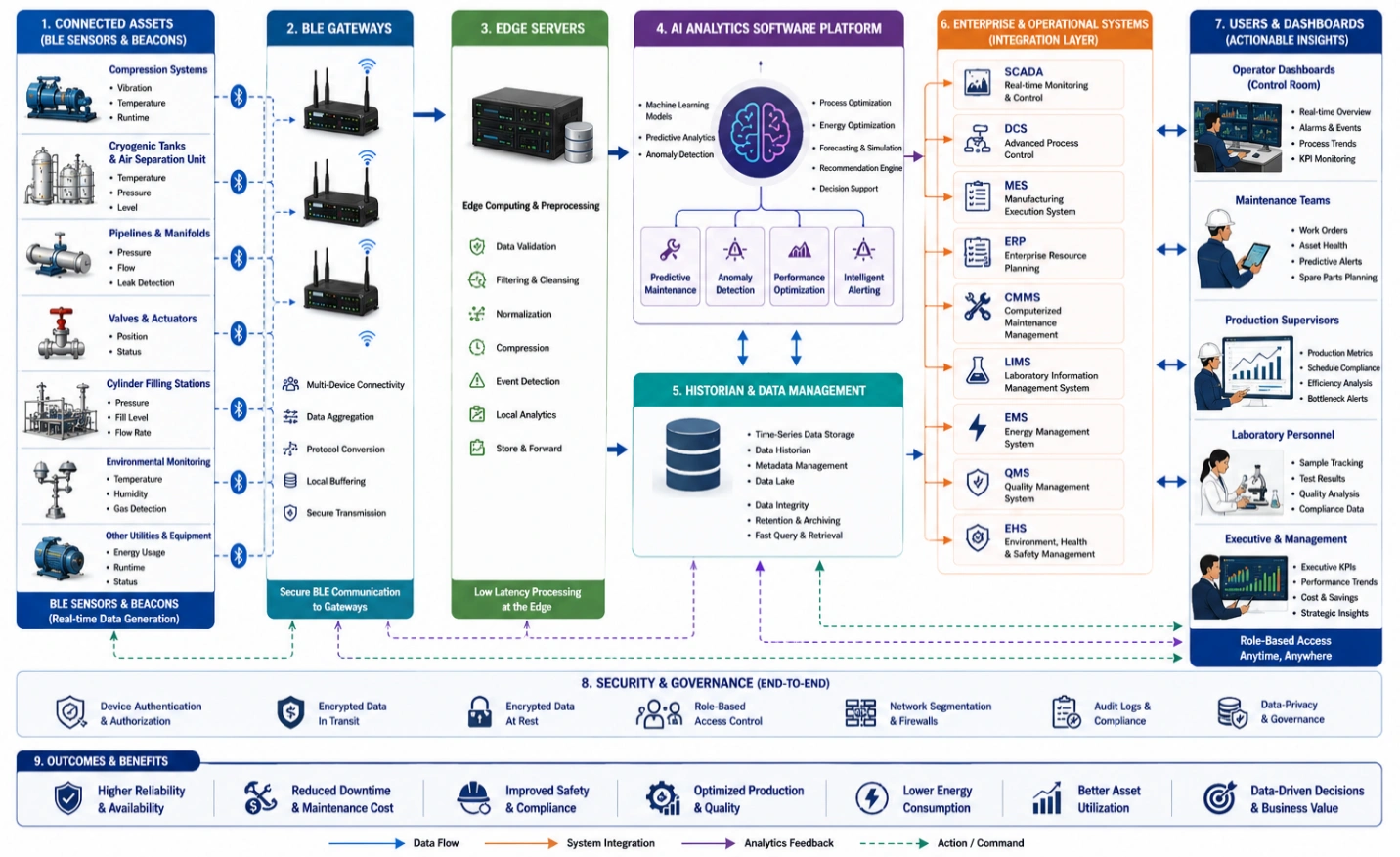
This block diagram illustrates how operational data collected by BLE sensors and transmitted through BLE gateways flows to edge servers for preprocessing before being analyzed by AI software and stored in historian databases. The AI insights are integrated with SCADA, DCS, MES, ERP, CMMS, LIMS, EMS, QMS, and EHS systems to provide real-time operational visibility, predictive maintenance recommendations, production optimization, laboratory reporting, and executive decision support across an industrial gas production facility.
BLE Infrastructure Supporting AI-Driven Industrial Gas Production
BLE serves as the field communication layer that enables AI software to receive reliable operational data from distributed assets across industrial gas production facilities. Rather than replacing existing industrial automation systems, BLE complements wired instrumentation by extending visibility to mobile assets, rotating equipment, remote utility areas, storage facilities, and locations where conventional wiring is costly or impractical.
BLE Sensors
BLE sensors monitor equipment and environmental conditions including:
- Compressor vibration
- Bearing temperature
- Surface temperature
- Motor current
- Pressure
- Differential pressure
- Cryogenic liquid level
- Ambient temperature
- Humidity
- Oxygen concentration
- Hydrogen concentration
- Carbon dioxide concentration
- Noise level
- Equipment runtime
- Shock events
- Door status
- Tank condition
BLE Beacons
BLE beacons provide location awareness for operational assets such as:
- Gas cylinders
- Cryogenic containers
- Portable analyzers
- Inspection instruments
- Forklifts
- Maintenance carts
- Mobile compressors
- Operator equipment
- Calibration devices
- Emergency response equipment
BLE Gateways
BLE gateways collect information from nearby BLE devices and securely transfer it to industrial networks. Typical gateway capabilities include:
- Multi-device connectivity
- Local buffering
- Device authentication
- Secure communication
- Edge data filtering
- Network redundancy
- Remote device management
- Industrial protocol support
- Time synchronization
- Firmware management
GAO supplies industrial BLE hardware designed to support demanding operating environments, enabling organizations to expand AI-enabled monitoring without extensive modifications to existing control systems.
Supporting Technologies, AI Models, Communication Protocols, and Deployment Options
A successful AI solution for industrial gas production depends on more than BLE connectivity. It requires coordinated hardware, software, communication standards, cybersecurity, and deployment strategies that support reliable, safe, and scalable operations.
Supporting Hardware
Typical hardware components include:
- Industrial edge servers
- Industrial computers
- PLCs
- DCS controllers
- SCADA workstations
- AI inference servers
- Industrial switches
- Network firewalls
- Environmental sensors
- Industrial gateways
- Redundant power supplies
- UPS systems
- Rugged operator tablets
AI Models
Industrial gas production commonly benefits from:
- Machine learning
- Deep learning
- Predictive analytics
- Time-series forecasting
- Reinforcement learning
- Anomaly detection
- Computer vision for equipment inspections
- Remaining useful life prediction
- Statistical process control models
- Multivariable optimization
- Digital twin-assisted simulations
Each model addresses a different operational objective, from predicting compressor failures to optimizing cryogenic distillation efficiency and minimizing energy consumption.
Communication Protocols
Industrial communication frequently includes:
- Bluetooth Low Energy (BLE)
- Ethernet
- Wi-Fi
- OPC UA
- Modbus TCP
- Modbus RTU
- MQTT
- HTTPS
- REST APIs
- BACnet where utility integration is required
- SNMP for network monitoring
- NTP for time synchronization
Cloud Version
A cloud-hosted deployment centralizes AI processing within managed cloud infrastructure while allowing production sites to transmit operational information through secure gateways. This approach is well suited for organizations operating multiple industrial gas plants, regional distribution centers, or geographically dispersed filling stations that require centralized monitoring, cross-site benchmarking, software updates, and consolidated reporting.
Benefits of cloud deployment include:
- Simplified software maintenance
- Centralized analytics
- Fleet-wide asset visibility
- Elastic computing resources
- Faster deployment of AI model updates
- Consolidated KPI reporting
- Remote engineering access
- Reduced local server administration
Cloud deployments are particularly effective when operational data from multiple facilities must be analyzed together to identify long-term trends, optimize energy usage, or standardize maintenance practices.
Server Version
A server-based deployment places AI software on customer-managed edge servers, private data centers, or dedicated industrial servers. This option is appropriate for facilities with strict cybersecurity policies, low-latency operational requirements, or regulatory obligations that limit external data transfer.
Benefits of server deployment include:
- Greater control over operational data
- Lower latency for real-time decision support
- Continued operation during internet outages
- Compliance with internal data governance policies
- Direct integration with existing plant software
- Flexible customization for specialized production processes
Many industrial gas producers adopt a hybrid approach, where edge servers perform time-critical analytics while selected operational information is synchronized with cloud software for enterprise reporting and long-term optimization.
Cybersecurity Considerations
Industrial AI deployments should incorporate:
- Device authentication
- Role-based access control
- Multi-factor authentication
- TLS-encrypted communications
- Secure firmware updates
- Network segmentation
- Continuous vulnerability assessment
- Security event monitoring
- Audit logging
- Backup and disaster recovery planning
These practices help protect production systems, operational data, and connected BLE devices from unauthorized access while supporting safe and reliable plant operations.
AI-Enabled BLE Solution for Industrial Gas Production
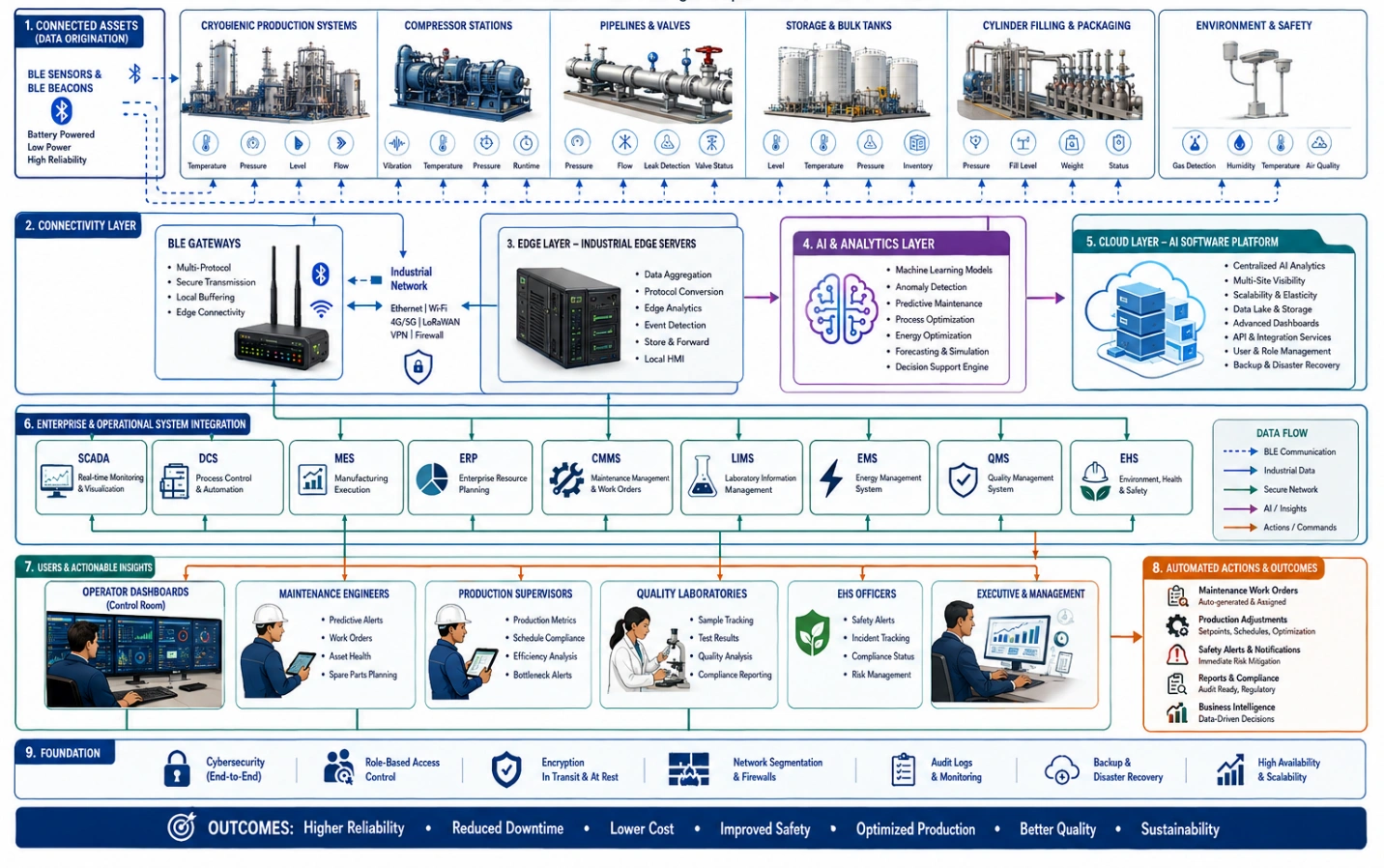
This solution diagram illustrates a complete AI-enabled BLE system for industrial gas production, showing how BLE sensors and beacons monitor cryogenic production systems, compressor stations, pipelines, storage facilities, cylinder filling operations, and environmental conditions. Operational data flows through BLE gateways, industrial edge servers, AI analytics, and cloud software before integrating with SCADA, DCS, MES, ERP, CMMS, LIMS, EMS, QMS, and EHS systems, delivering real-time insights to operators, maintenance engineers, quality laboratories, production supervisors, and executive management through secure industrial networks.
Operational Improvements and Business Value
Combining artificial intelligence with BLE-enabled monitoring delivers measurable improvements throughout industrial gas production.
Key technical and operational advantages include:
- Earlier identification of equipment degradation through continuous condition monitoring.
- Reduced unplanned downtime by predicting failures before production is interrupted.
- Improved compressor efficiency through AI-assisted operating recommendations.
- Enhanced product purity by identifying process deviations earlier.
- Lower maintenance costs through condition-based maintenance planning.
- Reduced energy consumption by optimizing compression and refrigeration cycles.
- Improved cryogenic storage reliability through continuous tank monitoring.
- Better workforce safety through environmental and equipment monitoring.
- Increased utilization of production assets.
- Faster response to abnormal operating conditions.
- Improved traceability for maintenance and compliance activities.
- More accurate production forecasting.
- Better inventory visibility for cylinders and portable assets.
- Increased operational consistency across multiple production facilities.
- Improved decision making using real-time operational intelligence.
These improvements contribute to stronger key performance indicators such as equipment availability, overall equipment effectiveness (OEE), energy intensity, production throughput, mean time between failures (MTBF), mean time to repair (MTTR), first-pass quality, and regulatory compliance.
GAO has supported organizations by providing industrial BLE hardware and connected monitoring solutions that enable reliable data acquisition for AI-driven operational improvement initiatives.
Implementation Recommendations
Organizations planning AI-enabled industrial gas production initiatives should consider a phased implementation strategy.
Recommended practices include:
- Assess critical production assets and operational priorities.
- Identify high-value monitoring opportunities.
- Select industrial-grade BLE hardware suitable for hazardous environments.
- Validate wireless coverage before full deployment.
- Integrate operational data with existing industrial software.
- Establish data quality validation procedures.
- Develop AI models using representative production data.
- Pilot the solution within a limited production area.
- Validate cybersecurity controls before plant-wide deployment.
- Train operators and maintenance personnel.
- Continuously refine AI models using operational feedback.
- Expand deployment incrementally across additional production units and facilities.
This staged approach reduces implementation risk while maximizing long-term operational value.
AI-Enabled Industrial Gas Production Implementation Roadmap
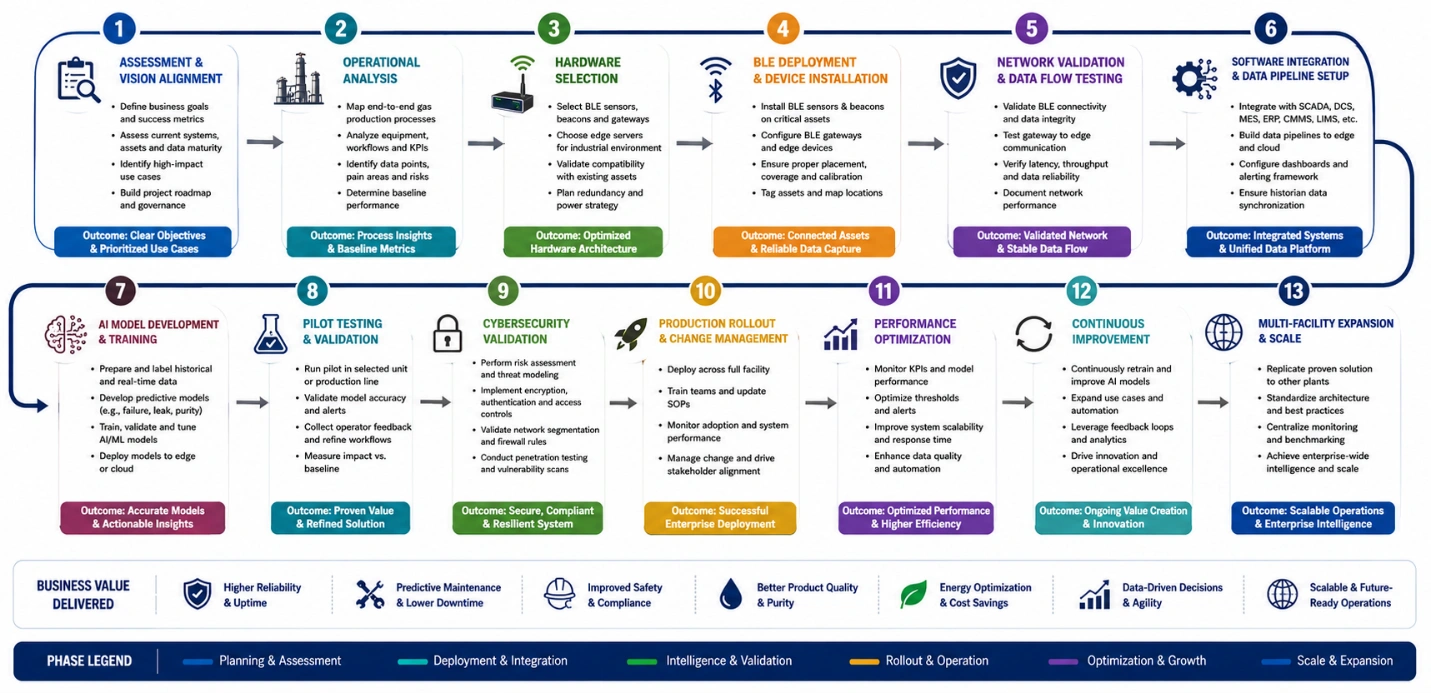
This implementation roadmap presents a phased deployment lifecycle for AI-enabled industrial gas production using BLE connectivity. It guides organizations from initial assessment and operational analysis through hardware selection, BLE deployment, network validation, software integration, AI model development, pilot testing, cybersecurity validation, production rollout, performance optimization, continuous improvement, and multi-facility expansion, illustrating a structured path toward intelligent, scalable, and secure industrial operations.
Advancing AI-Driven Industrial Gas Production with GAO
Artificial intelligence is reshaping industrial gas production by transforming operational data into predictive insights that improve reliability, efficiency, safety, and product quality. BLE-enabled sensing extends operational visibility across compressors, cryogenic systems, storage assets, distribution equipment, and mobile resources, providing the continuous data required for intelligent decision making.
Organizations that combine AI with connected industrial monitoring can reduce operational risk, improve maintenance planning, optimize energy consumption, and enhance production performance while maintaining compliance with demanding industry standards.
Headquartered in New York City and Toronto, Canada, GAO is recognized among the world’s leading B2B suppliers of BLE and RFID technologies. Together with GAO Research Inc. and GAO Tek Inc., we have supported Fortune 500 companies, leading research institutions, universities, and government organizations throughout the United States and Canada. Our long-term investment in research and development, rigorous quality assurance processes, and expert remote and onsite technical support enable customers to deploy dependable AI and IoT solutions tailored to demanding industrial environments.
Building the Future of Industrial AI and IoT with Aperture Venture Studio and GAO
For more than three decades, GAO Group of Companies has invested extensively in research and development for industrial BLE, RFID, and IoT technologies. As artificial intelligence has become increasingly valuable for industrial gas production and other process industries, we have expanded our AI and IoT capabilities and established Aperture Venture Studio to accelerate the development and growth of advanced AI and IoT solutions serving a wide range of industrial applications.
Aperture has attracted highly experienced AI researchers, IoT specialists, operational executives, industry leaders, and investors. Through initiatives such as the Aperture Ventures Summit and TekSummit, we continue to foster collaboration, technical knowledge sharing, and innovation across the AI and IoT community. We welcome opportunities to engage with advisors, employees, investors, and customers who share our vision for advancing intelligent industrial operations.