
AI and BLE for Integrated Resorts
AI-Driven Operations for Integrated Resorts
AI for integrated resorts combines artificial intelligence with connected sensors, operational data, guest-flow information, facility systems, security systems, and location-aware technologies to improve how large destination properties operate. Integrated resorts can apply AI to guest movement, room and facility utilization, casino and entertainment operations, workforce coordination, asset visibility, queue management, safety, maintenance, and service delivery. BLE gateways, BLE beacons, and BLE sensors can provide location and condition data that helps AI software interpret events across hotels, casinos, convention facilities, restaurants, retail areas, parking structures, spas, and entertainment venues. The resulting system can support faster operational decisions, predictive maintenance, occupancy intelligence, staff coordination, and more responsive guest services. For integrated resorts with large physical footprints and multiple operating departments, the combination of AI, IoT, and BLE can turn fragmented operational signals into actionable information without requiring every workflow to be manually monitored.
AIoT-Enabled Integrated Resort: Connected Hospitality, Gaming, Facilities & Intelligent Guest Operations
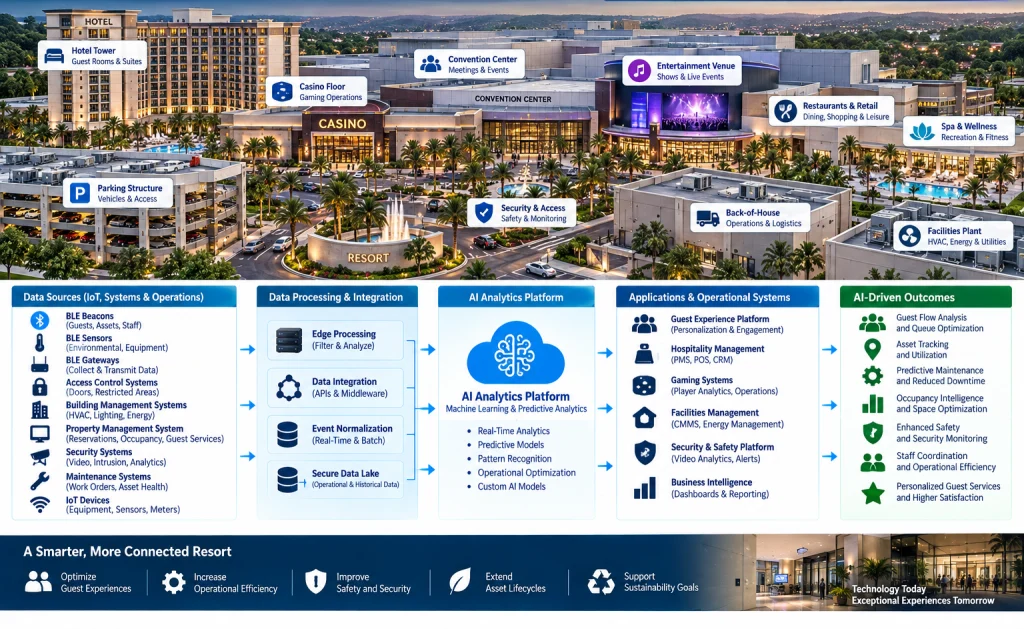
The visual shows how operational data from hotel, casino, convention, entertainment, dining, retail, spa, parking, security, and facilities environments connects to an AI analytics platform. Integrated systems support guest-flow analysis, asset tracking, predictive maintenance, occupancy intelligence, safety monitoring, staff coordination, and personalized guest services.
What AI Means for Integrated Resort Operations
Integrated resorts are unusually complex operating environments because several businesses function within one destination. A single property may combine lodging, gaming, food and beverage, retail, entertainment, meetings and conventions, transportation, parking, wellness, and large-scale facilities management.
AI becomes valuable when it connects operational data from these functions and identifies patterns that conventional dashboards may not reveal. Machine learning models can analyze historical and real-time information to identify unusual occupancy conditions, forecast demand, predict equipment failures, optimize staffing, and prioritize operational responses.
For example, an integrated resort may experience a sudden increase in pedestrian traffic between a convention hall and casino during an event transition. AI can combine occupancy signals, location events, historical traffic patterns, event schedules, and facility data to identify the condition and recommend additional service or security resources.
BLE contributes localized data to these AI workflows. BLE beacons can provide proximity references, BLE gateways can collect transmissions from tags and sensors, and BLE sensors can report environmental or equipment conditions. The technology is therefore best understood as a data acquisition layer supporting specific resort applications rather than as the primary business solution.
Where AI Creates Operational Value in Integrated Resorts
AI Guest Flow and Queue Management
Integrated resorts manage guest movement through hotel lobbies, casino entrances, restaurants, show venues, convention areas, elevators, parking facilities, and attractions. AI can analyze occupancy and movement patterns to identify congestion and predict where queues are likely to form.
Operational teams can use these insights to adjust staffing, open additional service points, redirect guests, or modify venue operations. BLE location events can supplement other data sources where proximity information is useful.
Relevant KPIs include:
- Average queue time
- Guest dwell time
- Lobby occupancy
- Venue utilization
- Service response time
- Guest throughput
- Peak-period congestion
- Average time between arrival and service
AI Hotel and Guest-Service Operations
Hotel operations generate large volumes of information across reservations, room status, housekeeping, engineering, front desk activity, guest requests, and facility usage.
AI can help predict housekeeping demand, prioritize room-service requests, identify unusual room-service delays, and improve coordination between front-office and back-of-house teams. Location information can also assist with locating mobile service equipment or authorized staff resources when operationally appropriate.
The objective is not simply to track people. The greater value comes from using operational signals to improve room readiness, service response, labor allocation, and guest experience.
AI Casino and Entertainment Operations
Casino floors and entertainment facilities have highly variable traffic patterns. AI can analyze historical demand, event schedules, occupancy information, service activity, and other operational signals to support staffing and facility decisions.
Entertainment venues can use similar methods for admission queues, crowd movement, VIP-area utilization, employee coordination, and post-event operational analysis.
Any implementation involving individuals should distinguish operational analytics from surveillance and should apply appropriate privacy controls, access restrictions, retention policies, and applicable gaming or privacy requirements.
AI Asset and Equipment Management
Integrated resorts operate substantial inventories of mobile and fixed assets, including housekeeping carts, maintenance equipment, wheelchairs, luggage carts, portable payment equipment, radios, tools, AV equipment, linens, food-service equipment, and engineering assets.
AI-assisted asset tracking can identify abnormal movement, prolonged inactivity, utilization patterns, and recurring shortages. BLE tags or sensors can supply location or status events to the software that performs this analysis.
The resulting information can help operations managers determine whether assets should be relocated, repaired, replaced, or purchased in greater quantities.
AI Facilities and Predictive Maintenance
Large resorts contain HVAC equipment, chillers, pumps, elevators, generators, electrical systems, refrigeration equipment, water systems, fire and life-safety infrastructure, kitchen equipment, laundry systems, and other building services.
AI can combine equipment telemetry, maintenance records, operating hours, environmental readings, alarms, and historical failures to estimate maintenance risk.
For example, a refrigeration sensor showing repeated temperature excursions may not immediately indicate a failure. AI can compare the pattern with compressor activity, ambient conditions, historical maintenance records, and other measurements to determine whether intervention is warranted.
Integrated Resort Workflows from Data Capture to AI Action
A practical AI solution for an integrated resort should be designed around an operational workflow rather than around an individual sensor or software component.
The workflow commonly follows these stages:
- Data acquisition: BLE sensors, beacons, gateways, building systems, property management systems, access-control systems, point-of-sale systems, maintenance software, event schedules, and other operational sources generate data.
- Communication: Wireless and wired networks transport relevant events. BLE is particularly useful for low-power proximity and sensor communications, while Wi-Fi, Ethernet, cellular connectivity, and other network technologies may carry aggregated data toward processing systems.
- Edge processing: Gateways or local computing resources can filter duplicate events, normalize sensor messages, perform basic rules, buffer data during network interruptions, and reduce unnecessary upstream traffic.
- Data integration: Middleware or integration services normalize information from different resort systems. Common integration methods include APIs, message queues, web services, database interfaces, and event-based data exchange.
- AI processing: Machine learning, anomaly detection, forecasting, classification, optimization, and other AI methods analyze operational data. Computer vision may also be used in appropriate areas where video analytics is justified and compliant with resort policies and applicable regulations.
- Operational analytics: Results can be presented through dashboards, alerts, reports, maintenance work queues, staffing recommendations, or other operational interfaces.
- Business action: Resort personnel can adjust staffing, dispatch maintenance, relocate equipment, manage queues, investigate anomalies, change service priorities, or initiate predefined automated actions.
- Feedback and optimization: Actual operational outcomes are compared with predictions and recommendations. Models and rules can then be tuned using validated historical data.
AIoT Resort Data Workflow: From Connected Operations to AI-Driven Insights & Continuous Improvement
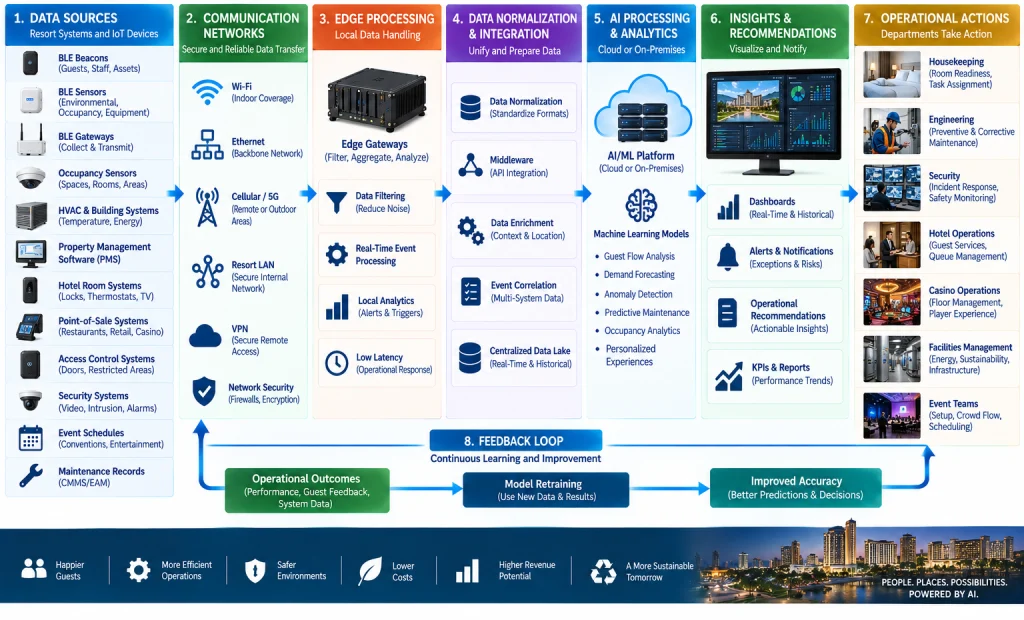
The visual maps resort operational data from BLE devices, occupancy sensors, HVAC, PMS, room, POS, access, security, event, and maintenance systems through secure networks and edge processing. Normalized data feeds AI and machine-learning analytics that generate dashboards, alerts, and recommendations for resort departments, with operational outcomes feeding back into continuous model improvement.
BLE Infrastructure Supporting AI Resort Solutions
BLE infrastructure is most useful when the integrated resort has a specific operational requirement for low-power wireless identification, proximity detection, location awareness, or sensor telemetry.
BLE beacons can periodically transmit identifiers or other configured information. Within a resort, they may support zone identification, proximity events, wayfinding-related applications, or location references for tagged resources.
BLE gateways receive BLE transmissions and forward relevant data to local or centralized software. Gateway placement requires attention to floor plans, wall construction, elevators, equipment rooms, metal structures, radio interference, coverage requirements, and expected tag density.
BLE sensors can provide information such as temperature, humidity, motion, door status, equipment conditions, or other measurable parameters. Their value increases when the resulting data is connected to an operational decision rather than merely collected.
BLE should not automatically be selected for every resort application. Wi-Fi, UWB, RFID, wired sensors, cellular IoT, building automation protocols, and other technologies may be more appropriate depending on accuracy, power, range, latency, environmental conditions, and integration requirements.
AI, Software and Communication Technologies for Resort Deployment
AI software can use several analytical methods depending on the operational problem:
- Predictive analytics for forecasting occupancy, demand, equipment conditions, and service requirements.
- Anomaly detection for identifying unusual equipment readings, movement patterns, or operational events.
- Machine learning classification for categorizing events and prioritizing operational responses.
- Time-series analysis for temperature, occupancy, energy, equipment, and demand data.
- Optimization models for staffing, resource allocation, queue management, and maintenance prioritization.
- Computer vision where video-based analytics are appropriate and privacy requirements are addressed.
- Edge AI where low latency, local processing, bandwidth reduction, or data-locality requirements justify computation close to the resort environment.
The software layer may integrate with property management systems, computerized maintenance management systems, building management systems, access-control software, security information systems, workforce management software, point-of-sale systems, event-management software, and business intelligence tools.
Security should be considered throughout the implementation. Relevant controls include encrypted communications where supported, network segmentation, gateway authentication, role-based access control, credential management, secure software updates, logging, monitoring, device inventory, data minimization, and defined retention policies.
Cloud Version and Server Version for Integrated Resorts
A Cloud Version can host AI analytics, centralized dashboards, data storage, device management, and application services within cloud infrastructure. This model can be appropriate for resort groups operating multiple properties because standardized software services can aggregate information across locations while reducing the need for each property to maintain extensive application infrastructure.
A Server Version can run software on edge servers, customer-managed servers, private data centers, or other privately hosted enterprise infrastructure. This approach can be useful when an integrated resort requires tighter control over operational data, local processing, network independence, specific integration requirements, or internal IT governance.
A hybrid deployment can also place latency-sensitive processing close to the resort while sending selected information to centralized infrastructure for long-term analytics and cross-property reporting.
GAO supplies BLE, RFID, and other IoT hardware products and systems that can serve as data acquisition components within these deployment models. Engineering decisions should be based on coverage, data volume, latency, integration requirements, cybersecurity controls, operational resilience, and the resort’s existing IT environment rather than selecting a deployment model solely on software preference.
Key AI Capabilities for Integrated Resort Operations
AI-enabled integrated resort systems can deliver value when operational data is converted into measurable decisions. The strongest implementations connect AI use cases to defined resort KPIs rather than deploying analytics without an operational owner.
Predictive Demand and Occupancy Intelligence
AI models can forecast guest arrivals, hotel occupancy, restaurant demand, convention attendance, casino traffic, entertainment attendance, and facility utilization. Historical occupancy, reservations, event calendars, seasonality, holidays, weather information, and real-time sensor data can be combined to improve forecasts.
Resort managers can use these predictions to prepare housekeeping capacity, food and beverage staffing, security coverage, parking operations, engineering resources, and guest-service personnel before demand peaks.
BLE location data can supplement these forecasts by identifying movement patterns or zone utilization where appropriate. BLE data should be aggregated or anonymized when individual-level identification is not required.
Predictive Maintenance and Facility Reliability
AI-assisted maintenance can move integrated resort engineering departments from reactive work toward condition-based intervention. Models can evaluate temperature, vibration, current, runtime, pressure, humidity, fault codes, and maintenance history to identify equipment behaving differently from its normal operating profile.
Applications include:
- Chiller and HVAC monitoring
- Refrigeration temperature analysis
- Elevator condition monitoring
- Pump and motor monitoring
- Laundry equipment monitoring
- Kitchen equipment monitoring
- Generator and electrical equipment monitoring
- Water-system condition monitoring
- Building environmental monitoring
The practical objective is to identify maintenance risks early enough for engineering teams to schedule intervention without unnecessarily replacing equipment or interrupting guest-facing operations.
AI-Assisted Workforce Coordination
Integrated resorts employ housekeeping personnel, engineering technicians, security officers, concierge teams, food and beverage employees, event personnel, transportation staff, and other specialized workers.
AI can analyze service requests, workload, location information, historical response times, room status, maintenance priorities, and event schedules to support workforce allocation.
BLE-enabled location information can help determine the nearest available authorized resource for selected operational tasks. For example, an engineering dispatch system could use location information to identify technicians within an appropriate zone before assigning a maintenance request.
Human supervisors should remain responsible for decisions involving staffing, employee performance, safety, and other sensitive employment matters.
Asset Tracking and Inventory Intelligence for Integrated Resorts
Asset visibility is a significant operational requirement because integrated resorts continuously move equipment between guest rooms, kitchens, laundry areas, loading docks, event spaces, maintenance shops, warehouses, and public areas.
AI-assisted asset management can combine location events with inventory records and usage history to identify:
- Frequently misplaced housekeeping equipment
- Underutilized maintenance tools
- Missing event-production equipment
- Mobile medical or accessibility equipment
- Linen and uniform movement
- Food-service equipment
- Portable technology equipment
- High-value engineering assets
- Spare parts and maintenance inventory
- Carts and other mobile operational resources
RFID and BLE can complement one another in these environments. RFID can be advantageous for inventory identification and high-volume item processing, while BLE can support location-aware monitoring and sensor-based information. The appropriate technology depends on read distance, item density, required location precision, environmental conditions, battery requirements, and workflow design.
GAO provides RFID and BLE hardware products and systems that can support these types of asset and inventory workflows. The engineering objective is to select the identification and sensing method according to the operational requirement rather than treating one wireless technology as suitable for every resort asset.
AIoT Resort Asset Intelligence: RFID, BLE & AI for Smart Inventory, Utilization & Operations
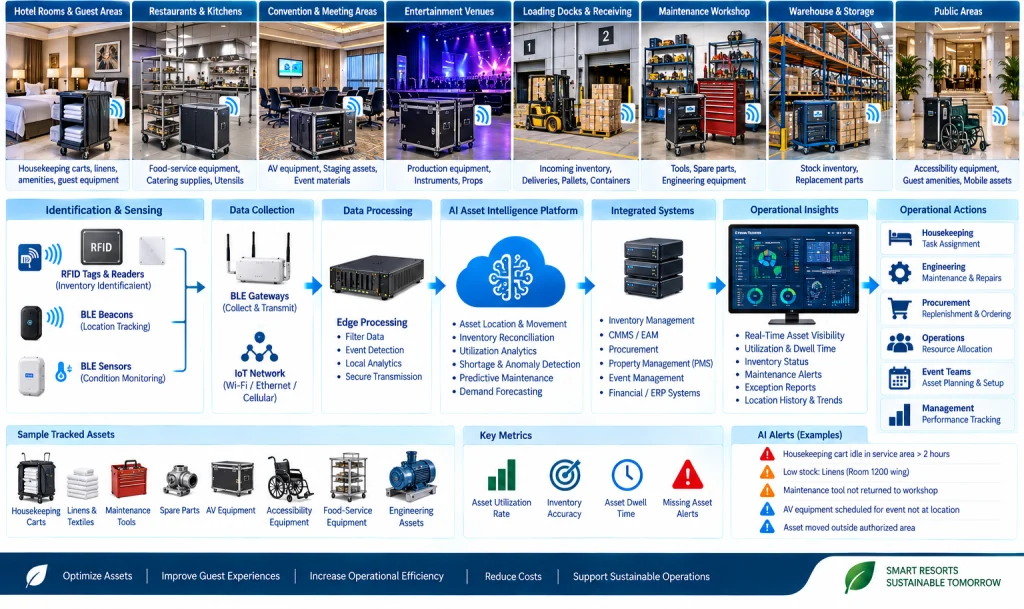
The visual illustrates how RFID, BLE, IoT sensors, and resort inventory data support intelligent asset management across hotel, dining, entertainment, convention, maintenance, storage, and service areas. AI analytics evaluate asset location, movement, utilization, shortages, and anomalies to support inventory, maintenance, procurement, housekeeping, and operational decisions.
Security, Privacy and Compliance Considerations
Integrated resorts can process sensitive operational and guest-related information, making cybersecurity and privacy engineering essential to AI and IoT deployment.
A resort solution should establish a clear distinction between equipment tracking, anonymous occupancy analytics, employee location monitoring, guest-related information, access control, and video surveillance. Each category can have different legal, operational, and retention requirements.
Relevant considerations include:
- Network segmentation between IoT devices, guest networks, corporate IT systems, payment environments, and security systems
- Strong authentication for gateways, servers, applications, and administrative accounts
- Role-based access controls for hotel operations, engineering, security, IT, and management users
- Encryption for data transmitted between devices, gateways, servers, and cloud services where supported
- Secure device provisioning and credential management
- Firmware and software update procedures
- Logging and security event monitoring
- Vulnerability management
- Data minimization and retention controls
- Physical protection of gateways and edge servers
- Backup and disaster-recovery procedures
- Defined procedures for compromised or malfunctioning IoT devices
U.S. integrated resorts may need to consider requirements and guidance associated with the Americans with Disabilities Act, state privacy laws, gaming regulations, PCI DSS where payment-card environments are involved, and applicable federal requirements. Canadian deployments may involve federal or provincial privacy requirements, accessibility obligations, gaming regulations, and payment-security requirements.
Security design should also consider standards and frameworks such as NIST Cybersecurity Framework guidance, NIST IoT-related publications, ISO/IEC 27001 where applicable, and PCI DSS for relevant payment environments. Gaming operations can require additional controls imposed by state or provincial gaming authorities.
Regulatory applicability depends on the property’s location, operating model, data practices, gaming activities, and system design. Compliance should therefore be reviewed with qualified legal, privacy, cybersecurity, and regulatory professionals before production deployment.
Engineering Design Considerations for BLE in Large Resorts
BLE deployment in a resort requires more than installing gateways until signal coverage appears sufficient. Large hotels and entertainment properties contain concrete structures, metal doors, elevators, mechanical rooms, kitchen equipment, dense guest populations, and other conditions that can influence radio performance.
A practical deployment process should include:
- Surveying floor plans and identifying operational zones
- Defining the required location granularity
- Determining whether zone-level or room-level visibility is actually necessary
- Mapping gateway locations against expected BLE transmission paths
- Evaluating radio interference and physical obstructions
- Testing performance in representative occupied areas
- Measuring battery expectations for tags and sensors
- Defining gateway power and network redundancy
- Establishing device naming and inventory conventions
- Testing roaming and handoff behavior where relevant
- Creating procedures for failed gateways and offline sensors
- Validating data accuracy before connecting AI automation
- Establishing maintenance and battery-replacement schedules
Location accuracy should be specified as a business requirement. A housekeeping cart may only require identification within a hotel floor or operational zone, whereas a specialized engineering asset could require more precise positioning.
The cost of higher positioning precision should be justified against the operational value it creates. More gateways, additional calibration, higher-frequency transmissions, or alternative positioning technologies can increase infrastructure and maintenance requirements.
Integrating AI with Existing Resort Software
Most integrated resorts already operate multiple software systems. A successful AI deployment should therefore complement existing applications rather than requiring unnecessary replacement of established systems.
Common integration targets include:
- Property management systems for reservations, room status, and hotel operations
- Computerized maintenance management systems for work orders and preventive maintenance
- Building management systems for HVAC and facility control
- Access-control systems for authorized entry events
- Security management systems
- Workforce management software
- Inventory and warehouse management software
- Point-of-sale systems
- Event and convention management software
- Business intelligence and reporting systems
- Energy management systems
- Procurement and purchasing software
APIs can provide structured data exchange between applications. Message brokers and event-driven interfaces can be useful when large numbers of IoT events must be processed continuously.
Data normalization is especially important. Different resort departments may use different identifiers for rooms, equipment, facilities, employees, and operational zones. A common data model can reduce duplicate records and improve AI model quality.
AI recommendations should also be connected to operational workflows. A predictive-maintenance alert has greater value when it can create or prioritize a work order, while an occupancy forecast becomes more useful when it informs staffing or service planning.
Deployment, Testing and Commissioning
Integrated resort AI projects should be commissioned in stages rather than immediately deploying every application across the entire property.
A practical implementation sequence includes:
- Define the operational problem and KPI
- Map the existing workflow
- Identify available data sources
- Select the required BLE, RFID, IoT, and network hardware
- Conduct a radio and physical site survey
- Establish cybersecurity and privacy requirements
- Configure gateways, sensors, tags, and software
- Connect selected enterprise systems
- Validate data quality and timestamps
- Test edge processing and network failure behavior
- Validate AI outputs against known operational conditions
- Conduct a controlled pilot
- Measure KPI improvements
- Correct coverage, integration, or model deficiencies
- Train operational and technical personnel
- Expand deployment in controlled phases
- Establish monitoring, maintenance, and model-review procedures
Testing should include normal operations as well as failure scenarios. Gateway outages, network interruptions, sensor battery depletion, duplicate events, missing data, incorrect asset associations, and unexpected occupancy conditions should all be considered.
AI model validation should use representative resort data rather than relying solely on laboratory or synthetic datasets. Models should also be monitored after deployment because guest behavior, event schedules, equipment conditions, and operational practices can change.
Scaling AI Across Multi-Property Resort Operations
A resort group operating multiple properties can use a standardized approach to extend validated applications across locations. However, identical configurations should not be assumed to work everywhere.
Hotels can differ in building construction, room layouts, network infrastructure, operating procedures, equipment inventories, regulatory requirements, and guest traffic patterns.
A scalable implementation should standardize:
- Device naming conventions
- Data models
- API specifications
- Cybersecurity controls
- User roles
- KPI definitions
- Device lifecycle procedures
- Software update procedures
- AI model monitoring
- Reporting formats
- Integration standards
Local configuration can then account for each property’s physical and operational characteristics.
GAO’s experience supplying hardware products and IoT systems to organizations can support the hardware and system-integration aspects of deployments where BLE, RFID, and related technologies are appropriate. Technical teams should still validate the specific site requirements through testing and commissioning.
Practical Recommendations for AI and BLE in Integrated Resorts
The most effective approach is to begin with an operational problem that can be measured.
Recommended practices include:
- Start with a defined resort workflow rather than a general request to “add AI.”
- Select KPIs before selecting hardware.
- Use BLE only where proximity, location, or sensor telemetry provides meaningful operational value.
- Combine BLE with RFID, Wi-Fi, UWB, wired sensors, or other technologies when the application requires different technical characteristics.
- Validate radio performance in the actual resort environment.
- Keep operational systems and guest networks appropriately segmented.
- Minimize collection of personally identifiable information when aggregated data can satisfy the use case.
- Establish data ownership, retention, and access policies before production deployment.
- Validate AI predictions against real operational outcomes.
- Maintain human oversight for safety-critical, employment-sensitive, security-sensitive, or guest-impacting decisions.
- Integrate AI outputs into existing resort workflows instead of creating disconnected dashboards.
- Pilot one measurable application before expanding to multiple departments.
- Establish device maintenance, battery replacement, software update, and cybersecurity procedures as part of the initial design.
- Reassess models periodically as occupancy patterns, facilities, technology, and resort operations change.
GAO Support for AI, BLE and IoT-Based Resort Solutions
AI can provide the analytical capability, but reliable physical data remains fundamental to useful resort intelligence. BLE gateways, BLE beacons, BLE sensors, RFID equipment, IoT devices, and supporting infrastructure provide the operational signals that software can analyze.
Headquartered in New York City and Toronto, Canada, GAO is ranked among the top 10 leading B2B and B2G BLE and RFID suppliers globally. Our hardware products and systems have supported organizations across the United States and Canada, including Fortune 500 companies, major R&D organizations, universities, and government agencies.
GAO is part of GAO Group together with GAO Research and GAO Tek. Across three decades, the group has invested heavily in R&D, product engineering, quality assurance, and technical support for RFID, BLE, and IoT technologies.
For integrated resorts, the appropriate solution may combine BLE location or sensing with RFID identification, IoT monitoring, AI analytics, enterprise software integration, and existing facility or security systems. The resulting implementation should be designed around measurable operational requirements rather than technology adoption alone.
Key Takeaways for AI-Enabled Integrated Resorts
AI can help integrated resorts manage complex hotel, casino, entertainment, convention, food and beverage, facilities, security, asset, and guest-service operations by turning operational data into forecasts, alerts, recommendations, and measurable actions.
BLE gateways, BLE beacons, and BLE sensors can supply location, proximity, environmental, and equipment information for applications where low-power wireless sensing is appropriate. RFID and other IoT technologies can complement BLE when identification, inventory processing, or different sensing requirements make another technology more suitable.
Successful implementation depends on more than selecting devices. Resort operators should define KPIs, map workflows, validate wireless coverage, integrate existing software, establish cybersecurity and privacy controls, test AI models with representative data, and measure operational outcomes throughout deployment.
GAO provides BLE, RFID, and IoT hardware products and systems that can be incorporated into these solutions. Organizations evaluating AI-enabled resort operations can learn more about relevant technologies, deployment considerations, and technical support through GAO’s technology resources and engineering expertise.
Integrated Resort AI Value Chain: From Connected Data to Intelligent Operational Outcomes
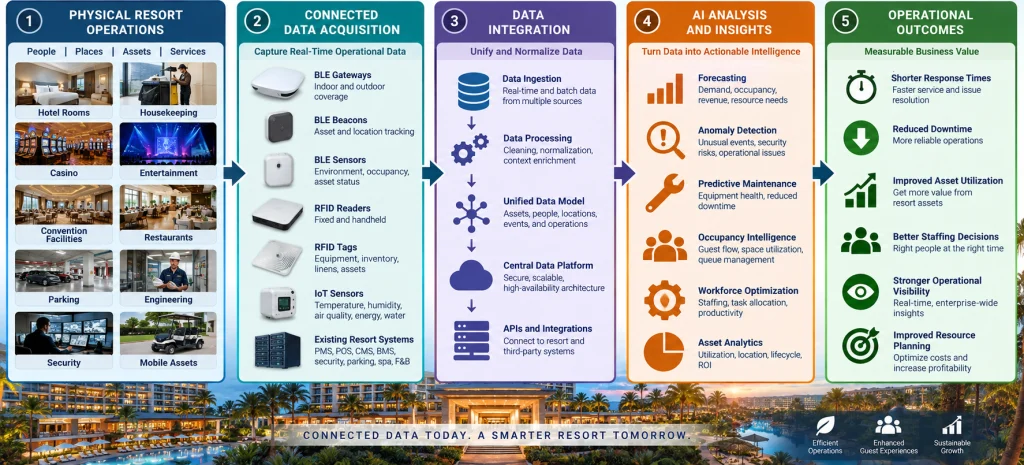
A five-stage enterprise infographic illustrates how integrated resort operations generate connected data through BLE, RFID, IoT sensors, and existing systems. The data is integrated into a central platform and analyzed by AI for forecasting, anomaly detection, predictive maintenance, occupancy intelligence, workforce optimization, and asset analytics, leading to measurable operational improvements.
Building the Future of Industrial AI and IoT with Aperture Venture Studio and GAO RFID Inc.
For more than three decades, GAO Group of Companies has invested heavily in R&D for industrial BLE, RFID, and IoT. As AI became increasingly useful for industrial and operational applications, we expanded our work in AIoT and founded Aperture Venture Studio to advance practical AI and IoT solutions relevant to complex environments such as integrated resorts.
Aperture brings together AI and IoT technical experts, entrepreneurial and operational executives, investors, and leading companies. Through Aperture Ventures Summit and TekSummit, advanced AI and IoT topics are discussed with technical and industry communities.
We welcome participation as advisors, co-founders or employees, investors, and customers.