
AI and BLE for Livestock Operations
How AI is Revolutionizing Livestock Operations with BLE System
AI is fundamentally changing livestock operations by transforming how producers monitor animal health, optimize herd productivity, reduce operational risks, and improve farm profitability. Rather than relying primarily on manual inspections and periodic measurements, modern livestock facilities increasingly use AI to analyze continuous data collected by Bluetooth Low Energy (BLE) sensors, BLE beacons, and BLE gateways distributed throughout barns, grazing areas, feeding stations, milking parlors, poultry houses, and livestock transportation systems.
BLE-enabled livestock monitoring allows AI systems to detect subtle behavioral and physiological changes long before they become visible to farm personnel. Continuous monitoring supports earlier disease detection, heat stress prediction, estrus identification, feed optimization, environmental management, and livestock traceability. AI converts thousands of daily sensor observations into actionable operational recommendations that improve animal welfare while reducing labor requirements and production losses.
Modern livestock operations increasingly view AI-driven BLE monitoring as a critical operational capability because it combines real-time sensing, predictive analytics, automation, and data-driven decision-making into a practical solution for commercial cattle, dairy, poultry, swine, sheep, and mixed livestock production. Drawing on decades of experience supplying industrial BLE and IoT hardware, GAO helps organizations deploy reliable sensing systems that support intelligent livestock management while integrating with existing agricultural software and operational processes.
AI-Driven BLE Livestock Monitoring Fundamentals
Livestock operations generate enormous volumes of operational information every day. Animal movement, feeding frequency, rumination, body temperature, heart rate, barn climate, water consumption, gate activity, equipment status, and pasture conditions all influence herd performance.
Artificial Intelligence of Things (AIoT) combines artificial intelligence with connected BLE sensing devices to continuously collect, analyze, and interpret these operational datasets. Instead of treating each measurement independently, machine learning identifies relationships between multiple variables that indicate emerging health conditions or operational inefficiencies.
BLE technology provides the communication layer that connects wearable livestock tags, environmental sensors, location beacons, and mobile inspection devices. AI supplies the intelligence needed to transform raw sensor readings into meaningful recommendations for livestock managers, veterinarians, nutritionists, breeding specialists, and farm operations personnel.
Common AI capabilities within livestock operations include:
- Predictive disease detection
- Estrus and breeding prediction
- Heat stress forecasting
- Feed conversion optimization
- Animal behavior classification
- Barn climate optimization
- Mortality risk prediction
- Automated anomaly detection
- Livestock location intelligence
- Predictive equipment maintenance
Together these capabilities enable more proactive herd management while improving operational consistency across large commercial livestock facilities
AI-Enabled BLE Livestock Monitoring and Intelligent Management Solution
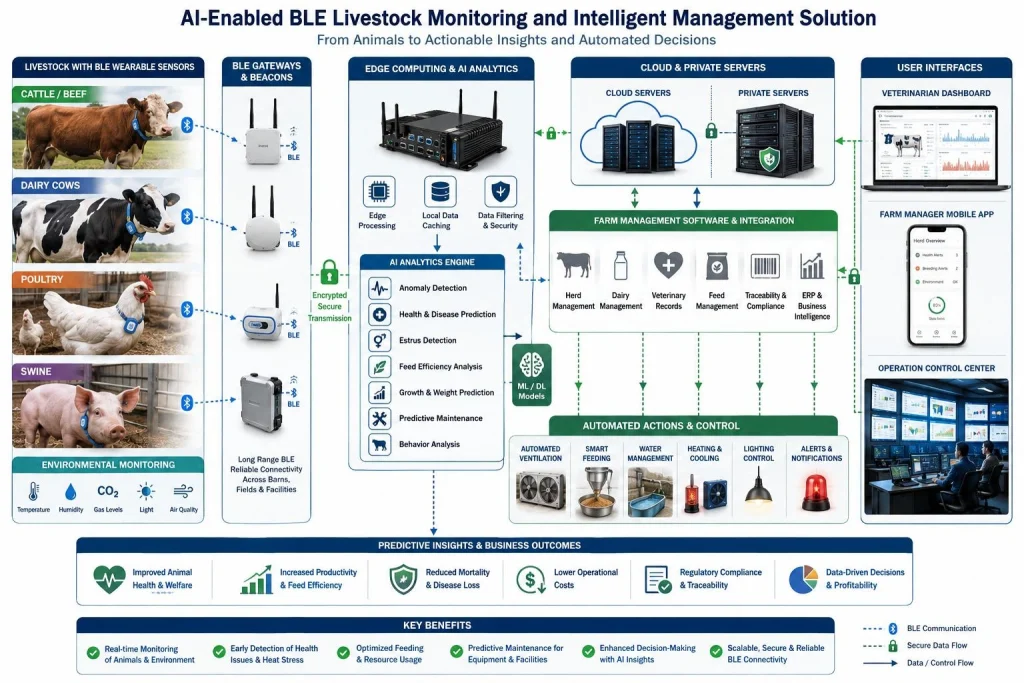
This illustration presents a complete AI-enabled BLE livestock monitoring solution for modern livestock operations. It shows how BLE wearable sensors on cattle, dairy cows, poultry, and swine transmit data through BLE gateways to edge computing, AI analytics, farm management software, cloud and private servers, enabling predictive health monitoring, environmental management, automated farm controls, and data-driven operational decisions.
Livestock Operations That Benefit Most from AI-Powered BLE Monitoring
Although AI-enabled BLE monitoring benefits nearly every livestock production environment, operational priorities differ considerably depending on species, production methods, regulatory requirements, and production objectives.
Dairy Operations
Dairy producers continuously monitor:
- Cow activity
- Rumination
- Body temperature
- Milking frequency
- Milk yield
- Feeding behavior
- Barn climate
- Water consumption
AI models correlate these datasets to identify mastitis risks, metabolic disorders, estrus cycles, lameness development, nutritional deficiencies, and heat stress before production declines become significant.
Beef Cattle Operations
Commercial beef operations often manage large grazing areas where manual animal observation is difficult.
BLE beacons positioned throughout grazing zones, watering stations, mineral feeders, and handling facilities provide location intelligence while wearable BLE tags continuously report movement patterns and activity levels.
AI detects abnormal inactivity, isolation behavior, injury indicators, grazing efficiency changes, and transportation stress that could affect herd performance.
Poultry Production
High-density poultry facilities require continuous environmental monitoring to maintain flock health.
AI evaluates:
- Air temperature
- Relative humidity
- Carbon dioxide
- Ammonia concentration
- Ventilation performance
- Bird activity
- Feed intake
- Water consumption
Predictive models identify ventilation failures, disease outbreaks, heat stress, and production abnormalities before mortality rates increase.
Swine Production
Swine operations benefit from continuous monitoring throughout breeding, gestation, farrowing, nursery, and finishing stages.
BLE sensing combined with AI assists with:
- Sow activity monitoring
- Piglet survival monitoring
- Feeding optimization
- Environmental control
- Respiratory disease detection
- Equipment monitoring
- Biosecurity compliance
Sheep and Goat Farming
Remote grazing operations frequently operate across extensive geographic areas.
BLE location sensing enables AI to identify:
- Missing livestock
- Predator activity
- Abnormal movement
- Fence breaches
- Water access problems
- Grazing distribution
These insights reduce livestock losses while improving pasture utilization.
Operational Challenges AI Addresses in BLE Livestock Operations
Livestock production involves biological variability, environmental uncertainty, and operational complexity. Traditional management methods frequently rely on scheduled inspections that may overlook early warning signs between observation periods.
AI supported by BLE sensing improves operational visibility across numerous challenges.
Disease Detection Delays
Clinical symptoms often appear only after diseases have progressed.
Continuous BLE monitoring enables AI to recognize subtle behavioral deviations associated with respiratory illness, digestive disorders, mastitis, ketosis, lameness, and infectious diseases significantly earlier than manual observation.
Labor Shortages
Large commercial livestock facilities frequently struggle to maintain sufficient skilled labor for continuous animal observation.
AI automatically prioritizes animals requiring immediate attention, allowing personnel to focus veterinary interventions where they provide the greatest value.
Environmental Variability
Temperature fluctuations, humidity, ammonia accumulation, inadequate ventilation, and water supply disruptions directly influence animal health.
BLE environmental sensors provide continuous measurements while AI predicts conditions likely to reduce productivity or compromise animal welfare.
Feed Inefficiency
Feed represents one of the largest operating costs in livestock production.
AI analyzes feed intake, body condition, activity patterns, weight gain, and environmental conditions to recommend nutritional adjustments that improve feed conversion efficiency.
Equipment Reliability
Milking systems, automatic feeders, water pumps, ventilation equipment, cooling systems, and manure handling equipment directly affect livestock welfare.
BLE vibration sensors, motor temperature sensors, and operational monitoring devices enable predictive maintenance before equipment failures interrupt production.
GAO has supported organizations deploying industrial BLE hardware that contributes to reliable monitoring of agricultural equipment and livestock environments, helping improve operational continuity across demanding production conditions.
AI-Driven BLE Livestock Monitoring Workflow: From Real-Time Data Collection to Automated Farm Operations
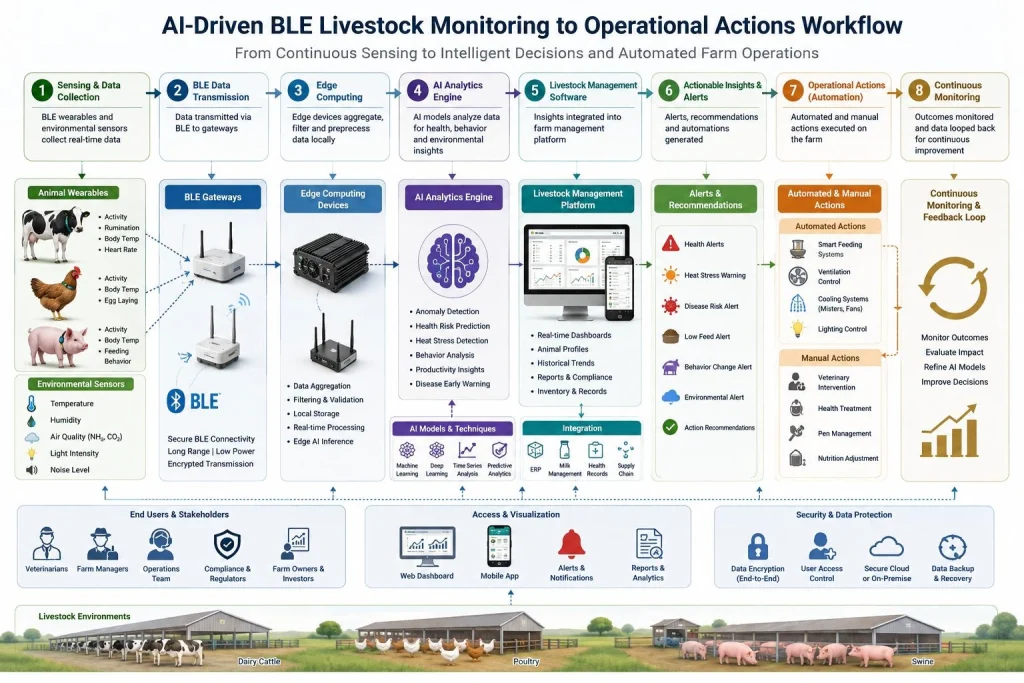
A workflow diagram illustrating how BLE-enabled livestock wearables and environmental sensors collect animal and barn data, transmit information through gateways and edge computing systems, apply AI analytics, and convert insights into automated farm management actions through software platforms, veterinary dashboards, and environmental controls.
Operational Workflow of AI-Driven BLE Livestock Monitoring
Successful livestock intelligence depends on a structured operational workflow that transforms continuous sensor observations into automated recommendations and operational decisions.
Livestock Data Acquisition
BLE wearable devices attached to cattle collars, ear tags, leg bands, poultry monitoring devices, and environmental sensing equipment continuously collect operational measurements including movement, activity levels, body temperature, rumination, feeding duration, location, environmental conditions, equipment status, and facility occupancy.
Sensor placement, battery management, enclosure protection, and calibration procedures significantly influence data quality and long-term reliability.
Wireless Communication
BLE gateways receive data from distributed sensors throughout barns, grazing areas, poultry houses, feed storage facilities, milking parlors, and livestock transport vehicles.
Gateways securely aggregate sensor traffic before forwarding operational information through Ethernet, Wi-Fi, cellular, or LPWAN connections depending on farm infrastructure, network coverage, and operational requirements.
Edge Processing
Edge computing devices located within livestock facilities perform preliminary filtering, data validation, timestamp synchronization, local analytics, and event prioritization before forwarding information to centralized software.
Local processing reduces communication latency while maintaining essential monitoring functions during temporary internet interruptions.
AI Analytics
Machine learning models evaluate historical and real-time operational datasets to detect abnormal behavior, forecast disease risks, identify productivity trends, optimize environmental controls, and prioritize management actions.
Multiple AI techniques may operate simultaneously, including supervised learning, anomaly detection, time-series forecasting, clustering, and reinforcement learning for adaptive environmental optimization.
Enterprise Software Integration and AI Deployment for BLE Livestock Operations
AI-driven livestock intelligence becomes significantly more valuable when operational data is integrated with business and production software used throughout the farm. Instead of functioning as isolated monitoring tools, BLE sensing systems should exchange information with herd management, veterinary, nutrition, maintenance, and business applications.
Common software integrations include:
- Herd management systems
- Dairy management software
- Livestock traceability systems
- Veterinary information systems
- Feed management software
- Environmental control software
- Farm ERP systems
- Maintenance management systems (CMMS)
- Geographic Information Systems (GIS)
- Business intelligence dashboards
Middleware validates, normalizes, timestamps, and securely exchanges information between BLE gateways, AI engines, enterprise software, and automated control systems. Standard interfaces such as REST APIs, MQTT, OPC UA, HTTPS, and secure database connectors simplify interoperability while reducing custom development.
Cloud Version
Cloud-hosted deployments are appropriate for livestock organizations operating multiple farms, geographically distributed ranches, contract growers, or regional production facilities.
Typical advantages include:
- Centralized herd visibility
- Simplified software updates
- Elastic computing resources for AI model training
- Fleet-wide benchmarking
- Disaster recovery
- Remote veterinary collaboration
- Multi-site performance analytics
Cloud-hosted software is especially beneficial when organizations require centralized reporting, regulatory documentation, and continuous AI model improvements across multiple production locations.
Server Version
Server deployments place software on customer-managed servers located within livestock facilities, private data centers, or privately hosted enterprise infrastructure.
Server deployments are preferred when organizations require:
- Low-latency AI processing
- Continuous operation during internet outages
- Local data governance
- Strict cybersecurity policies
- Integration with existing private operational systems
- Greater control over software maintenance
Many commercial livestock organizations adopt hybrid deployments where edge servers perform immediate analytics while cloud services support long-term historical analysis, AI model retraining, and multi-farm reporting.
Technical Components Supporting AI-Driven BLE Livestock Operations
Reliable livestock intelligence depends on coordinated hardware, communications, AI software, and cybersecurity working together as a complete operational solution.
BLE Hardware
BLE hardware may include:
- Livestock wearable sensors
- Ear tag sensors
- Smart collars
- Leg-mounted activity sensors
- Environmental monitoring sensors
- BLE gateways
- BLE beacons
- Mobile inspection devices
- Equipment condition sensors
- Battery monitoring devices
Each component contributes continuous operational visibility without requiring excessive power consumption.
AI Models
Common AI methods include:
- Time-series forecasting
- Supervised learning
- Unsupervised clustering
- Anomaly detection
- Deep learning
- Computer vision for livestock imaging
- Reinforcement learning
- Predictive maintenance models
- Behavioral analytics
- Classification algorithms
Different models often operate simultaneously to improve prediction accuracy.
Communication Infrastructure
Reliable livestock communications may combine:
- Bluetooth Low Energy
- Wi-Fi
- Ethernet
- Cellular LTE and 5G
- LPWAN
- MQTT messaging
- HTTPS
- OPC UA
- VPN connectivity
Network selection depends on livestock density, farm size, communication range, available infrastructure, and operational resilience requirements.
Cybersecurity
Agricultural IoT deployments increasingly require enterprise-grade security.
Recommended practices include:
- Device authentication
- Role-based access control
- Encryption during transmission
- Secure firmware updates
- Digital certificates
- Network segmentation
- Security logging
- Vulnerability assessments
- Backup and disaster recovery procedures
- Continuous monitoring
GAO has supplied industrial BLE and IoT hardware to organizations that require dependable communications, strong quality assurance, and expert technical support across demanding operational environments.
Cloud vs. Server Deployment Models for AI-Driven BLE Livestock Operations
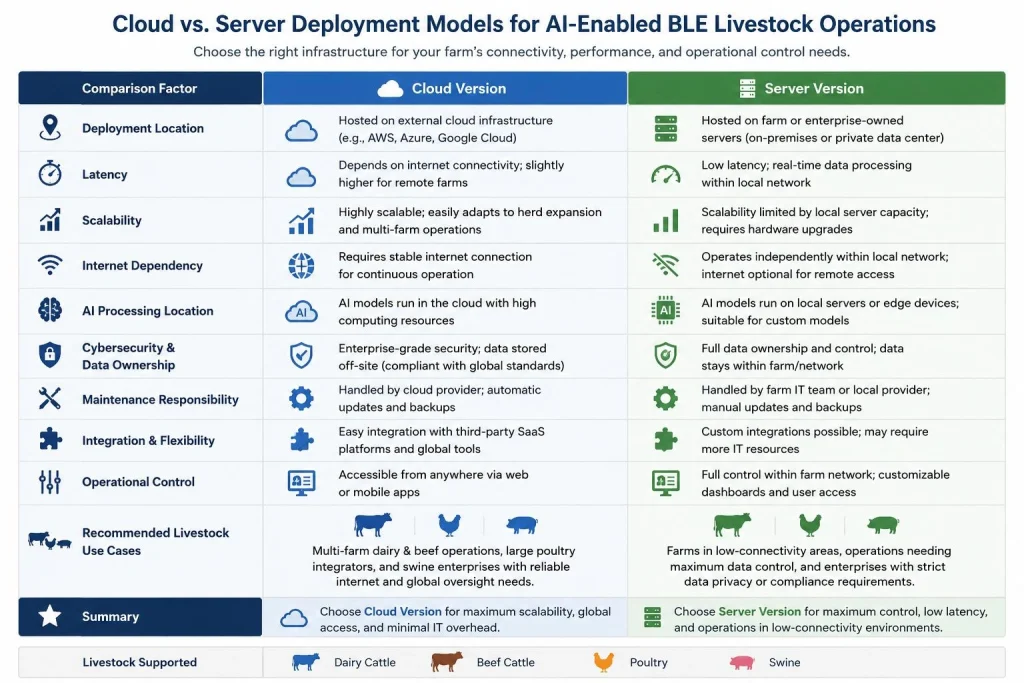
This comparison table highlights the differences between Cloud and Server deployment models for AI-enabled BLE livestock monitoring. It compares deployment location, latency, scalability, internet dependency, AI processing, cybersecurity, maintenance, integration flexibility, operational control, and recommended use cases across dairy, beef, poultry, and swine operations to help organizations select the most suitable infrastructure.
Operational Improvements Delivered by AI-Driven BLE Livestock Operations
Combining AI with BLE monitoring improves livestock production by converting continuous operational measurements into timely, evidence-based management actions.
Key operational improvements include:
- Earlier disease identification through behavioral analysis
- Improved estrus detection and breeding success
- Better feed conversion efficiency
- Reduced livestock mortality
- Faster identification of injured or isolated animals
- Improved environmental stability inside livestock housing
- Predictive maintenance for feeding, ventilation, and milking equipment
- Reduced manual inspection workloads
- Enhanced biosecurity monitoring
- Improved traceability across the livestock lifecycle
- Faster incident response
- Higher animal welfare standards
- Improved production consistency
- Better labor allocation
- Continuous operational visibility across multiple facilities
These improvements are achieved because AI continuously analyzes relationships among livestock behavior, environmental conditions, equipment performance, and production outcomes rather than evaluating isolated measurements.
Measurable Benefits of AI-Driven BLE Livestock Operations
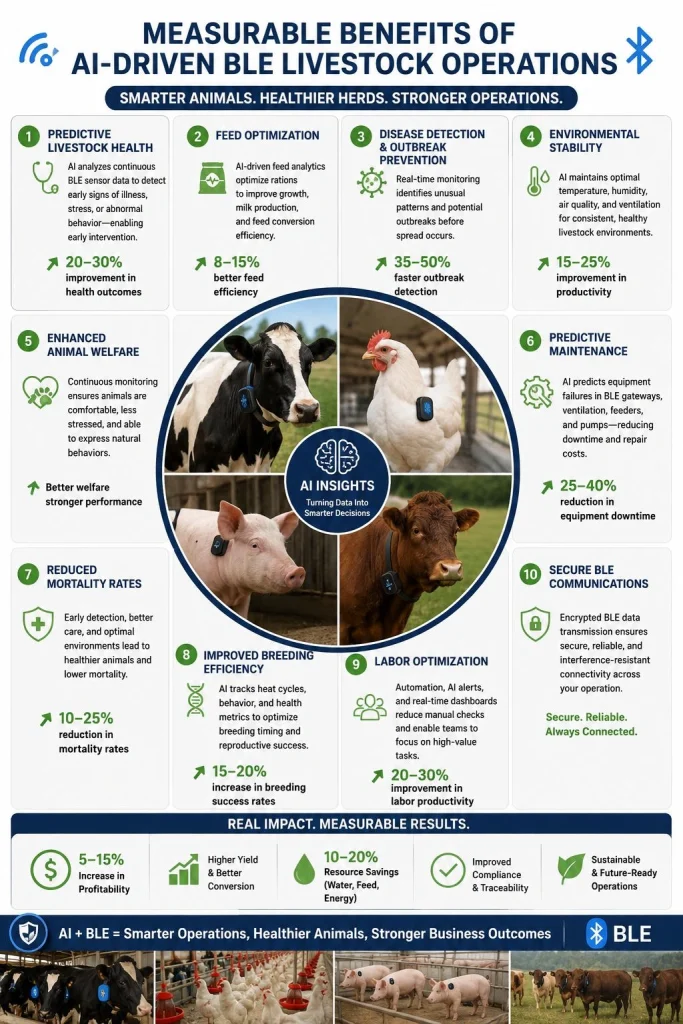
A professional enterprise infographic showcasing the measurable operational, financial, and animal welfare benefits of integrating Artificial Intelligence (AI) with Bluetooth Low Energy (BLE) livestock monitoring. The visual highlights predictive health monitoring, feed optimization, disease detection, environmental stability, animal welfare, predictive maintenance, reduced mortality, breeding efficiency, labor optimization, secure BLE communications, and overall business performance improvements across cattle, dairy, poultry, and swine operations.
Business Value and Scalability of AI-Driven BLE Livestock Monitoring
Commercial livestock operations require technology investments that produce measurable operational and financial outcomes. AI-enabled BLE monitoring supports both immediate operational improvements and long-term strategic planning.
Business benefits include:
- Lower veterinary treatment costs through earlier intervention
- Reduced feed waste
- Improved reproductive performance
- Increased milk yield and livestock productivity
- Better compliance with traceability and animal welfare requirements
- Lower equipment downtime
- Improved workforce productivity
- Enhanced decision-making using real-time operational intelligence
- Greater consistency across multiple livestock facilities
- Scalable monitoring as herd sizes increase
Scalability depends on standardized sensor deployment, reliable communications, software interoperability, cybersecurity governance, and continuous AI model refinement using operational data.
AI-Enabled BLE Livestock Monitoring System Architecture
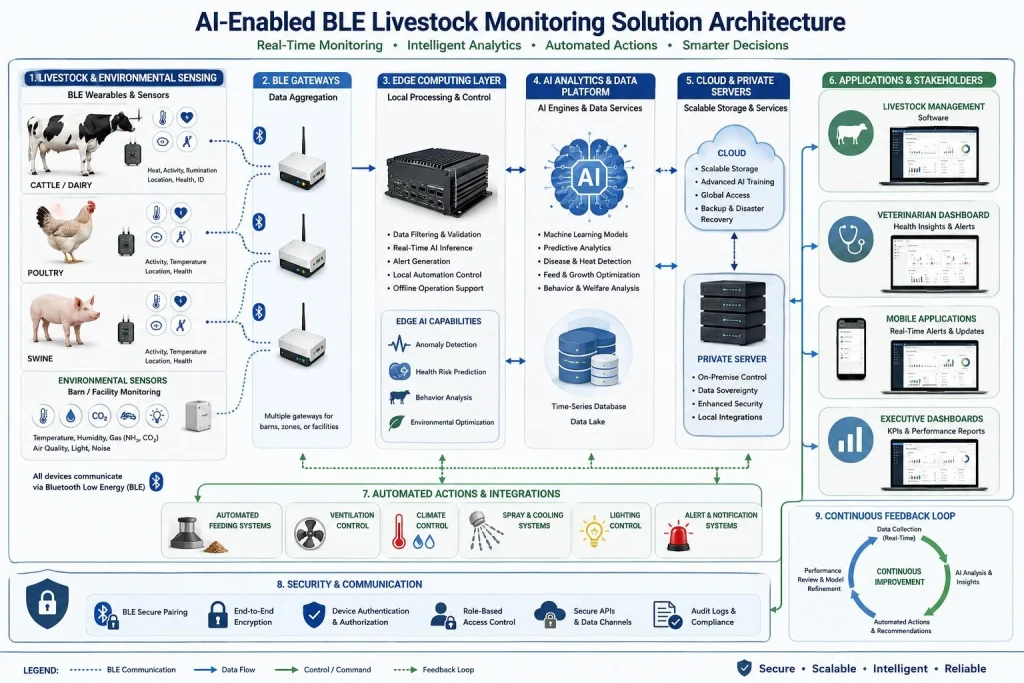
An enterprise architecture diagram illustrating the end-to-end AI-driven BLE livestock monitoring ecosystem, from animal sensors and BLE gateways to AI analytics, cloud/private servers, farm management platforms, automated controls, and operational dashboards.
Implementation Recommendations for AI-Driven BLE Livestock Operations
Successful implementations begin with clearly defined operational objectives rather than technology selection alone.
Recommended engineering practices include:
- Establish measurable livestock performance KPIs before deployment.
- Select BLE sensors appropriate for animal species, housing conditions, and environmental exposure.
- Design reliable wireless coverage for barns, grazing areas, feedlots, and transport facilities.
- Validate sensor calibration before production deployment.
- Integrate operational data with herd management and business software.
- Deploy cybersecurity controls throughout the solution lifecycle.
- Train farm personnel to interpret AI-generated recommendations.
- Continuously evaluate AI model performance using operational outcomes.
- Plan hardware maintenance schedules for batteries, gateways, and environmental sensors.
- Expand deployments incrementally after validating operational performance.
GAO works with organizations requiring industrial BLE hardware and technical expertise to support dependable AI-enabled livestock monitoring solutions that align with existing agricultural operations and long-term digital transformation initiatives.
Advancing Intelligent Livestock Operations Through AI and BLE
AI is transforming livestock operations by enabling continuous monitoring, predictive analytics, and data-driven management across dairy, beef, poultry, swine, and mixed livestock production. BLE sensors, gateways, and beacons provide the operational data required for AI to identify health risks, optimize environmental conditions, improve feeding strategies, and support predictive maintenance.
Organizations adopting these technologies gain improved animal welfare, operational efficiency, production consistency, and informed decision-making while reducing labor demands and production losses. Careful planning, secure communications, software integration, and scalable deployment strategies are essential for achieving long-term success.
With decades of experience supporting organizations throughout North America, GAO has supplied industrial BLE, RFID, and IoT hardware backed by extensive research and development, rigorous quality assurance, and expert technical support. Headquartered in New York City and Toronto, GAO has served Fortune 500 companies, leading research organizations, universities, and government agencies, helping customers implement dependable AI-enabled monitoring systems tailored to demanding operational environments. Readers seeking to modernize livestock monitoring are encouraged to explore GAO’s BLE and IoT solutions and consult with our engineering team for deployment guidance.
Building the Future of Industrial AI and IoT with Aperture Venture Studio and GAO
For more than three decades, GAO Group of Companies has invested heavily in research and development of industrial BLE, RFID, and IoT technologies. As generative AI has demonstrated its value across livestock operations and other agricultural applications, we have expanded our AI and IoT capabilities and established Aperture Venture Studio to accelerate the development and growth of advanced AI and IoT solutions for industries requiring intelligent automation and connected sensing. Aperture has attracted leading AI and IoT experts, experienced business executives, influential investors, and prominent organizations. Together with Aperture Ventures Summit and TekSummit, these initiatives have fostered vibrant technical communities focused on AI and IoT innovation. We welcome advisors, co-founders or employees, investors, and customers to engage with us in advancing the future of industrial AI and connected technologies.