
AI and BLE for Logistics Hubs
AI-Driven Logistics Hubs for Faster, More Visible Distribution
AI-driven logistics hubs combine AI warehouse management, AI asset tracking, computer vision, operational analytics, connected equipment, and real-time logistics data to coordinate the movement of freight through cross-dock facilities, distribution hubs, consolidation centers, sortation facilities, and transfer terminals. Logistics hubs handle high volumes of inbound trailers, pallets, totes, parcels, containers, roll cages, forklifts, dock equipment, and time-sensitive shipments. Their performance depends on accurately coordinating receiving, unloading, staging, sorting, consolidation, cross-docking, loading, and outbound dispatch.
BLE can provide an additional source of location and condition information for selected mobile assets, equipment, containers, and operational zones. BLE beacons can identify defined areas or tagged assets, BLE gateways can collect proximity and movement events, and BLE sensors can monitor conditions where required.
AI can combine these observations with WMS, TMS, transportation management, warehouse control, order management, yard management, ERP, fleet, shipment, and labor data. This allows logistics operators to identify congestion, predict dock delays, improve asset utilization, prioritize shipments, detect process exceptions, and coordinate freight movement. GAO provides BLE, RFID, and other IoT technology-based hardware products and systems that can support connected logistics hub operations.
How AI Improves Logistics Hub Operations
AI improves logistics hub management by converting large volumes of operational data into predictions, classifications, alerts, and recommended actions. Traditional logistics workflows often depend on scheduled arrivals, manual status updates, barcode scans, radio communications, and dispatcher decisions. These methods remain important, but AI can correlate more variables simultaneously.
AI applications for logistics hubs include:
- AI warehouse management for receiving, staging, sorting, and dispatch coordination
- AI asset tracking for carts, totes, roll cages, pallets, and handling equipment
- Dock congestion prediction based on arrival schedules and processing rates
- Shipment delay prediction using transportation and facility data
- Yard movement optimization
- Trailer and dock assignment recommendations
- Freight exception detection
- Labor demand forecasting
- Sortation workload prediction
- Equipment utilization analysis
- Empty-container and reusable-tote tracking
- Route and loading sequence optimization
- Identification of dwell-time anomalies
- Predictive maintenance for material-handling equipment
The primary value comes from connecting AI decisions to physical logistics activities. A predicted dock delay becomes useful when the system can recommend another dock, adjust a staging assignment, prioritize a shipment, or notify an operations supervisor.
BLE can contribute location context to these decisions. For example, the location of a tagged roll cage or outbound cart can help determine whether a shipment is still in staging or has reached a loading area.
Logistics Hub Workflows Supported by AI
Logistics hubs operate as interconnected physical workflows rather than isolated warehouse activities. AI can evaluate the relationship between inbound transportation, dock utilization, staging capacity, freight handling, sortation, outbound scheduling, and asset availability.
Inbound Arrival and Dock Assignment
Inbound operations begin before a vehicle reaches the dock. Appointment schedules, estimated arrival times, carrier information, shipment characteristics, unloading requirements, and available dock capacity all influence the receiving process.
AI can compare planned arrivals with actual transportation conditions to predict dock congestion. When several trailers are expected within a short period, the system can evaluate unloading capacity, labor availability, dock availability, shipment priority, and downstream sortation requirements.
BLE-enabled assets can provide additional physical information around dock areas. Tagged carts, roll cages, reusable containers, and selected handling equipment can generate proximity events when they enter or leave designated receiving zones.
This information can help logistics supervisors distinguish between planned dock activity and actual physical congestion.
Unloading, Staging, and Cross-Docking
Cross-docking depends on quickly moving freight from inbound receiving to the appropriate outbound flow without unnecessary storage. Delays can occur when freight is staged in the wrong location, an outbound trailer is unavailable, a handling asset cannot be located, or a shipment waits for additional consolidation.
AI can evaluate shipment priority, destination, departure schedules, freight volume, staging capacity, and handling requirements to recommend movement priorities.
BLE can support selected location workflows by identifying tagged carts, containers, and mobile handling assets as they move between dock doors, staging lanes, sortation areas, and outbound loading zones.
AI can then compare expected movement with observed movement. A container that remains in a staging zone longer than its expected processing window can be flagged for investigation.
Sortation and Shipment Consolidation
Sortation operations may involve conveyors, scanners, chutes, pallet-building areas, parcel handling equipment, and manual sorting stations. AI can analyze throughput, queue length, destination demand, labor availability, equipment status, and departure schedules.
Computer vision can support package identification or process monitoring where suitable cameras and processing systems are available. AI can also identify unusual accumulation at particular sortation points.
BLE is generally more suitable for selected reusable assets, equipment, containers, or zone-level movement than for replacing every item-level identification method. Barcode and RFID can remain important where precise shipment or package identification is required.
Outbound Loading and Dispatch
Outbound loading requires coordination between shipment availability, trailer assignments, dock availability, freight sequence, route schedules, and carrier departure times.
AI can prioritize loading tasks based on departure commitments and shipment characteristics. It can identify outbound loads at risk of missing scheduled departures and provide earlier warnings to operations teams.
BLE-enabled carts and roll cages can provide location events around staging and loading zones. These events can help validate whether physical assets associated with outbound operations have reached the expected area.
The resulting information can be integrated with transportation and warehouse software to improve dispatch visibility.
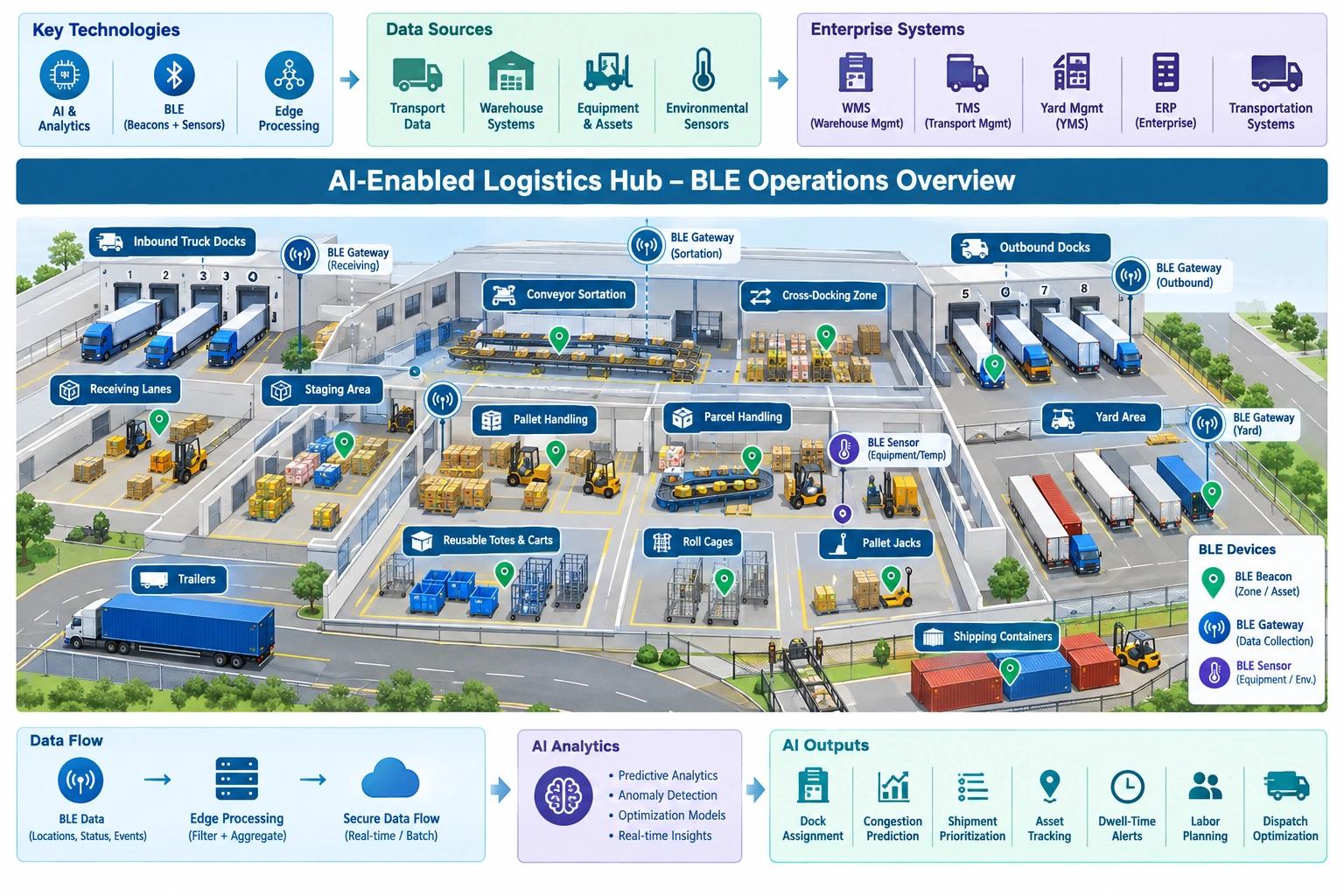
AI-Enabled Logistics Hub – BLE Operations Overview
An enterprise logistics hub showing BLE beacons, gateways, and sensors across receiving, staging, sortation, handling, yard, and outbound areas. Data flows through edge processing into AI analytics and enterprise systems. AI outputs include asset tracking, congestion prediction, shipment prioritization, dwell-time alerts, labor planning, and dispatch optimization.
AI Applications Across Logistics Hub Operations
AI applications become more valuable when they are connected to specific logistics hub constraints. A hub can process thousands of movements while operating under tight departure windows, limited dock capacity, fluctuating shipment volumes, and changing carrier schedules. AI can help operators prioritize the activities most likely to affect throughput and service performance.
AI Dock and Yard Management
Dock availability is a major operational constraint in busy logistics hubs. AI can evaluate scheduled arrivals, actual arrival times, unloading duration, trailer characteristics, labor availability, dock occupancy, and outbound requirements.
A predictive system can identify when a dock is likely to remain occupied longer than planned. Operations teams can then adjust assignments before congestion spreads to the yard or staging areas.
Yard management can also benefit from AI-based prioritization. The system can consider trailer dwell time, shipment urgency, departure commitments, dock availability, and yard position when recommending the next movement.
BLE can provide supplementary location information for selected yard and dock assets where fixed infrastructure or other identification technologies do not provide sufficient visibility.
AI Asset Tracking and Utilization
Logistics hubs rely on mobile assets such as pallet jacks, forklifts, carts, roll cages, dollies, reusable totes, pallet movers, and material-handling equipment. Assets may be distributed across receiving, staging, sortation, loading, maintenance, and yard areas.
AI asset tracking can identify utilization patterns, idle time, recurring congestion points, and asset shortages. The objective is not simply to determine where an asset is located but to understand whether its availability supports the current workflow.
BLE tags and gateways can provide location events for selected assets. AI can combine these events with work orders, movement transactions, operator activity, and shipment schedules to identify assets that are underutilized, misplaced, or unavailable when needed.
Predictive Throughput and Congestion Management
Logistics hub throughput depends on the interaction of docks, conveyors, staging areas, labor, handling equipment, and outbound schedules. A bottleneck in one area can quickly affect several downstream processes.
AI can analyze historical throughput and real-time operational information to identify developing congestion. Forecasts can account for shipment volume, arrival patterns, facility capacity, labor availability, and planned departures.
BLE location events can provide another operational signal when mobile assets contribute to congestion. For example, an unusually high concentration of tagged carts in a staging area can indicate that downstream processing is slower than expected.
Shipment Exception Detection
Shipment exceptions may include missing freight, unexpected dwell time, incorrect staging, delayed loading, incomplete consolidation, or movement through an unexpected area.
AI can establish expected workflow patterns and identify deviations. An exception engine can then correlate the event with transportation status, order information, warehouse transactions, and physical asset location.
Human operators can review the exception before corrective action is taken. This is important because a deviation does not always indicate an error. Operational conditions such as temporary dock closures or scheduled inspections may explain an unexpected movement.
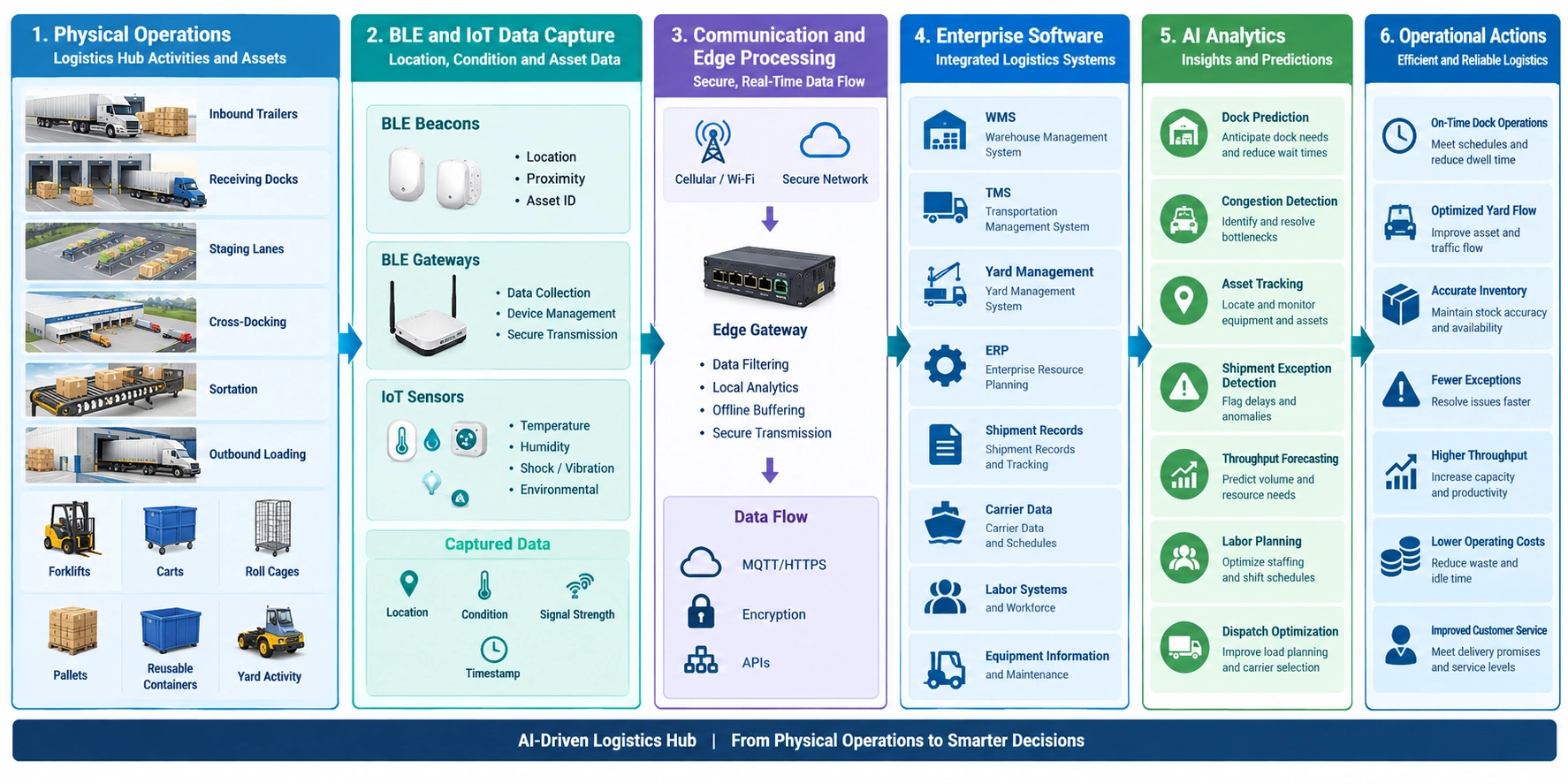
AI Logistics Hub Data Flow Diagram
This diagram illustrates how BLE and IoT data from logistics hub operations flows through edge processing, enterprise software, and AI analytics. It highlights AI applications such as dock prediction, congestion detection, asset tracking, shipment exception detection, throughput forecasting, labor planning, and dispatch optimization.
AI Labor and Handling Resource Planning
Logistics hubs often experience large variations in workload throughout the day. Arrival waves, carrier schedules, seasonal peaks, weather events, and promotional periods can change labor requirements rapidly.
AI can forecast workload by processing shipment volumes, historical throughput, scheduled arrivals, expected departures, task duration, and current facility conditions.
Recommendations can help supervisors allocate workers among receiving, sortation, staging, loading, and exception handling. The objective is to match available labor with predicted workload while maintaining service commitments.
BLE asset data can provide supporting information about the availability of carts, handling equipment, and other mobile resources. AI can use this information when evaluating whether a planned workload can be completed with currently available resources.
BLE Hardware and AI Software for Logistics Hubs
BLE hardware should be selected according to the logistics hub’s physical layout and the specific workflow being measured. BLE is particularly useful when zone-level visibility, mobile asset location, or condition monitoring provides actionable information.
BLE Beacons
BLE beacons transmit advertising packets that can be detected by compatible gateways. Logistics hubs can use beacons to identify fixed operational zones such as receiving areas, staging lanes, maintenance areas, controlled-access zones, or loading sections.
Beacons can also be attached to selected carts, roll cages, reusable containers, and other mobile assets. Configuration should consider advertising interval, transmission power, mounting position, battery requirements, and expected detection range.
BLE Gateways
BLE gateways collect signals from nearby BLE devices and forward relevant information to edge or enterprise software. Gateway placement should account for metal racks, trailers, conveyors, machinery, walls, vehicle traffic, and other conditions that can affect radio propagation.
A logistics hub may use gateways near dock doors, staging areas, sortation sections, maintenance zones, or outbound loading areas. The required gateway density depends on whether the application needs simple zone detection or more detailed location estimation.
GAO supplies BLE gateways and other IoT technology-based hardware products and systems that can be evaluated according to logistics hub coverage, connectivity, environmental, and integration requirements.
BLE Sensors
BLE sensors can monitor conditions relevant to logistics operations, such as temperature, humidity, vibration, or equipment status when supported by the selected device.
Condition monitoring can be useful for controlled shipments, sensitive freight areas, equipment rooms, or specific handling processes. Sensor selection should reflect the actual operational requirement rather than collecting measurements that do not lead to an actionable decision.
AI and Logistics Integration Software
AI software should connect BLE events with the systems already used to manage transportation and distribution operations.
Common integration points include:
- WMS for receiving, staging, inventory, and warehouse task management
- TMS for carrier, route, shipment, and transportation planning
- Yard management software for trailer and yard movement coordination
- ERP software for orders, procurement, inventory, and financial records
- Warehouse control software for conveyors and automated material handling
- Order management systems for shipment status and customer requirements
- Fleet management software for vehicles and mobile equipment
- Maintenance software for forklifts, conveyors, dock equipment, and other assets
- Business intelligence software for operational KPI reporting
- AI software for prediction, anomaly detection, classification, and optimization
BLE events should be normalized before being consumed by AI models. Device identifiers, asset identifiers, zone identifiers, timestamps, and location definitions need consistent mappings so that the AI system does not interpret infrastructure errors as operational events.
Cloud and Server Deployment for Logistics Hubs
AI and BLE systems can be deployed through cloud-hosted SaaS software, privately hosted server infrastructure, edge computing, or a hybrid configuration. Logistics organizations operating multiple hubs often need centralized analytics while individual facilities may require local processing for time-sensitive workflows.
Cloud Version
A cloud version uses cloud-hosted SaaS software to manage BLE device information, analytics, dashboards, AI models, reporting, and integrations. This model is useful for organizations that need visibility across multiple logistics hubs.
Centralized cloud analytics can compare throughput, dwell time, dock utilization, asset utilization, shipment exceptions, and other KPIs across facilities. AI models can also use broader historical datasets to identify patterns that are not visible within one hub.
BLE gateways can transmit selected events to cloud services through approved network connections. Security controls should include authenticated access, encrypted communications where appropriate, network controls, logging, and defined data-retention policies.
Server Version
A server version places software on edge servers, customer-managed servers, private data centers, factory servers, or other privately hosted enterprise infrastructure. This model can be appropriate where logistics operations require greater control over local data processing or where network connectivity to external cloud services is constrained.
Edge processing can filter BLE events locally and forward only relevant information to central systems. This can reduce unnecessary data transmission and support rapid local responses.
Private server deployment may also be appropriate when an organization has established IT infrastructure, internal cybersecurity requirements, or integration systems that must remain within controlled computing environments.
A hybrid model can combine local processing for dock, asset, and facility operations with cloud-based AI analytics for multi-site forecasting, reporting, and strategic optimization.
Engineering Considerations for AI-Enabled Logistics Hubs
AI-driven logistics hub operations require careful engineering because physical movement, transportation schedules, warehouse transactions, and digital events must remain synchronized. A useful system should distinguish between an actual operational exception and a temporary condition caused by network latency, device detection variation, or a planned workflow change.
BLE Coverage and Location Accuracy
BLE location performance depends on facility geometry, gateway placement, metal structures, trailers, conveyors, forklifts, walls, and other radio-frequency conditions. A logistics hub should therefore begin with an RF site assessment rather than assuming that a fixed gateway density will work across every facility.
Zone-level detection may be sufficient for many applications. A cart moving from receiving to staging, for example, may only need to be associated with the correct operational zone. More precise positioning requires additional engineering and should only be implemented when the business workflow benefits from it.
Important design variables include:
- Gateway mounting locations
- Beacon transmission power
- BLE advertising interval
- Antenna characteristics
- RF obstructions
- Detection thresholds
- Gateway density
- Battery requirements
- Asset mounting position
- Required location granularity
BLE should also be evaluated alongside barcode and RFID. Package-level identification, pallet identification, and shipment verification may require other technologies, while BLE can provide complementary visibility for reusable assets and mobile equipment.
Mobile Asset and Battery Management
BLE-enabled logistics assets can include carts, roll cages, reusable totes, dollies, equipment, and selected handling devices. These assets may move between hubs, carriers, maintenance areas, and customer locations.
Device management should maintain a reliable association between the BLE identifier and the physical asset. When a beacon is transferred from one cart to another, the digital record must be updated before the asset returns to operational service.
Battery and device management should cover:
- Battery status and replacement planning
- Device commissioning
- Asset-to-device association
- Firmware management
- Physical inspection
- Missing-device investigation
- Device replacement
- Decommissioning
- Configuration records
- Spare device inventory
A large logistics network should maintain standardized device naming and configuration practices so that asset records remain consistent between facilities.
Data Quality and Event Normalization
AI depends on accurate event data. Logistics hubs can generate thousands of operational events from WMS transactions, transportation systems, scanners, gateways, vehicle systems, yard software, conveyors, and connected equipment.
BLE events should be normalized before they are combined with transactional data. A location event should have a valid device identifier, asset association, timestamp, zone definition, and source gateway where applicable.
The system should also account for duplicate detections, delayed messages, gateway outages, missing events, and devices that temporarily leave the detection area.
AI models should not interpret every BLE event as a definitive movement transaction. Filtering and event correlation can reduce false operational signals and improve the quality of downstream analytics.
Integration with WMS, TMS, and Yard Management
A logistics hub usually depends on multiple software systems. WMS manages warehouse activities, TMS manages transportation workflows, yard management software coordinates trailers and yard positions, and ERP systems manage broader business transactions.
Integration allows AI to correlate these systems with physical observations.
For example, a TMS may indicate that a trailer is scheduled to depart soon, while WMS shows that some freight remains unprocessed. BLE data may indicate that the associated roll cages are still located in a staging zone. AI can combine these conditions and identify the shipment as a potential departure risk.
Integration methods may include:
- REST APIs
- MQTT messaging
- HTTPS
- Message queues
- Database interfaces
- Middleware
- Event-driven integration
- Enterprise integration services
The appropriate method depends on existing IT standards, latency requirements, cybersecurity policies, and the capabilities of the connected software.
AI Use Cases That Improve Logistics Hub Performance
AI use cases should be prioritized according to measurable logistics problems. A facility with recurring dock congestion may gain more value from predictive dock management than from broad asset tracking.
Predictive Dock Congestion
AI can analyze appointment schedules, estimated arrival times, unloading durations, dock availability, freight characteristics, labor capacity, and outbound schedules to predict congestion.
The system can identify periods when inbound demand is likely to exceed available processing capacity. Supervisors can then adjust dock assignments, labor allocation, or unloading priorities before congestion affects staging and yard operations.
BLE data can provide supplementary evidence about physical asset accumulation around receiving and dock areas.
Trailer Dwell and Yard Optimization
Trailer dwell time is an important logistics hub performance indicator. Long dwell can consume yard capacity, delay outbound schedules, and increase transportation costs.
AI can identify patterns associated with long dwell times by examining carrier schedules, appointment adherence, unloading duration, documentation delays, dock availability, and freight processing requirements.
BLE-enabled assets can help identify the physical progression of freight-related equipment through receiving, staging, and loading areas. When combined with transportation data, these events can help distinguish a transportation delay from an internal handling delay.
AI Shipment Prioritization
Not every shipment has the same operational urgency. Some loads may have strict departure windows, customer commitments, temperature requirements, downstream delivery dependencies, or transportation constraints.
AI can classify shipments according to risk and urgency. The system can recommend which loads should receive priority for receiving, sorting, staging, consolidation, or loading.
This approach allows supervisors to focus limited handling capacity on shipments most likely to affect service performance.
Asset Utilization Optimization
Logistics hubs frequently experience uneven distribution of carts, roll cages, pallets, pallet jacks, forklifts, and other handling resources.
AI can analyze location events, work orders, utilization history, task assignments, and shipment volumes to identify assets that remain idle while another area experiences a shortage.
BLE can provide the location information needed to support this analysis for selected assets. The AI system can then recommend redistribution or investigate recurring shortages.
Predictive Maintenance for Material-Handling Equipment
Conveyors, forklifts, pallet movers, dock equipment, sortation machinery, and other handling systems can affect hub throughput when they experience unexpected downtime.
AI can analyze maintenance records, operating hours, fault events, vibration measurements, temperature data, inspection results, and equipment utilization to identify potential maintenance requirements.
BLE sensors can provide selected condition measurements where appropriate. The resulting information can be integrated with CMMS or EAM software so that maintenance teams can prioritize inspections and work orders.
Cybersecurity and Data Protection for Connected Logistics Hubs
Connected logistics systems create data pathways between BLE devices, gateways, networks, edge servers, cloud services, WMS, TMS, yard systems, and other enterprise applications. Security should therefore be considered during system design rather than added after deployment.
Important controls include:
- Authenticated device onboarding
- Unique device identities
- Encrypted communications where appropriate
- Network segmentation
- Role-based access control
- API authentication
- Gateway hardening
- Firmware and software patching
- Security logging
- Monitoring for abnormal device behavior
- Backup and recovery procedures
- Controlled administrative access
- Defined data-retention policies
Physical security also matters. Gateways mounted near loading docks or accessible warehouse areas should be protected against tampering. Mobile BLE devices should be associated with asset records so that unexpected removal can be investigated.
AI systems require additional governance around model access, data quality, model updates, automated recommendations, and auditability. High-impact actions such as changing shipment priorities, reallocating critical resources, or modifying transportation decisions should retain appropriate human oversight.
Deployment Lifecycle for AI and BLE Logistics Hubs
A controlled deployment lifecycle helps logistics organizations move from a defined operational problem to a reliable production system.
Planning and Facility Assessment
Planning should begin with a measurable operational objective. Examples include reducing trailer dwell, improving dock visibility, locating reusable handling assets, improving staging control, or identifying shipment delays earlier.
The engineering team should document:
- Hub layout and operational zones
- Dock configuration
- Yard areas
- Sortation equipment
- Material-handling equipment
- Existing WMS and TMS software
- Yard management processes
- Network infrastructure
- BLE coverage requirements
- Cybersecurity requirements
- Integration interfaces
- KPI definitions
An RF assessment should identify potential obstructions and determine whether BLE is appropriate for each workflow.
Hardware Selection and Pilot Deployment
The pilot should use a representative operational area rather than attempting to instrument the entire logistics hub immediately.
Potential pilot applications include:
- Roll cage tracking
- Reusable tote tracking
- Cart movement
- Dock-zone visibility
- Staging-area monitoring
- Handling equipment location
- Equipment condition monitoring
Hardware should be selected based on environmental conditions, mounting requirements, power availability, battery life, network connectivity, and required location granularity.
GAO can support organizations evaluating BLE, RFID, and other IoT technology-based hardware products and systems according to specific logistics requirements.
Integration and System Testing
Testing should validate the complete information path from physical events to operational decisions.
A representative test should verify:
- BLE device detection
- Gateway communication
- Edge processing
- Cloud or server processing
- Event normalization
- Asset identity mapping
- WMS integration
- TMS integration
- Yard system integration
- AI model processing
- Alert generation
- Dashboard updates
- User notification
Exception testing should include gateway outages, network interruptions, missing devices, duplicate identifiers, delayed WMS transactions, incorrect asset mappings, and unexpected asset movement.
Commissioning and Optimization
Commissioning should confirm that the installed system performs according to the defined operational requirements.
RF configuration may need adjustment after real warehouse activity begins because trailers, forklifts, temporary storage, and changing freight volumes can affect radio conditions.
AI thresholds may also require tuning. An alert threshold that generates too many false positives can reduce operator trust, while a threshold that is too conservative can allow important exceptions to remain undetected.
Operations teams should participate in this optimization process because they understand the practical causes of delays and exceptions.
Scaling Across Logistics Hubs
Multi-site deployment requires common data definitions, device naming, integration standards, cybersecurity controls, and KPI structures. However, each hub should still receive a facility-specific engineering assessment.
Different facilities may have different dock configurations, conveyor systems, trailer volumes, network designs, carrier workflows, and asset populations.
A standardized implementation framework combined with local site engineering provides a more practical approach than forcing identical physical configurations across every logistics hub.
KPIs for AI-Driven Logistics Hub Management
Logistics hub AI systems should be evaluated against operational KPIs rather than device counts. Useful measures include:
- Dock utilization
- Trailer dwell time
- Yard dwell time
- Dock-to-stock cycle time
- Receiving cycle time
- Cross-dock cycle time
- Staging dwell time
- Shipment throughput
- Sortation throughput
- On-time departure rate
- On-time shipment rate
- Shipment exception rate
- Order fulfillment cycle time
- Loading cycle time
- Unloading cycle time
- Asset utilization
- Cart and roll-cage availability
- Equipment utilization
- Equipment downtime
- Labor productivity
- Labor utilization
- Forecast accuracy
- Congestion frequency
- Inventory accuracy where applicable
- BLE gateway availability
- BLE device availability
- Battery replacement frequency
- Missed movement events
- Exception resolution time
- Customer service-level attainment
The selected KPIs should directly correspond to the original business objective. A hub implementing AI primarily to reduce trailer dwell should emphasize dwell time, dock utilization, processing duration, and departure performance rather than treating BLE event counts as the main success measure.
Practical Benefits of AI and BLE for Logistics Hubs
AI and BLE can create measurable operational value when they are integrated into established logistics workflows. AI provides prediction and decision support, while BLE can provide physical-world information about selected assets, zones, and equipment.
Key benefits can include:
- Earlier detection of dock congestion
- Better visibility into selected mobile logistics assets
- More accurate shipment movement status
- Improved staging-area control
- Better utilization of carts, roll cages, and handling equipment
- Earlier identification of departure risks
- Improved labor planning
- More informed yard and dock decisions
- Better maintenance prioritization
- Faster investigation of operational exceptions
- Improved coordination between transportation and warehouse activities
- Greater visibility across multiple logistics hubs
These benefits depend on appropriate system design. BLE should be deployed where its location or condition information supports a defined operational decision, while AI should be trained and evaluated using reliable logistics data.
Implementation Recommendations for Logistics Hubs
A practical deployment should begin with an operational problem and then determine where BLE, AI, RFID, computer vision, or other technologies provide the most appropriate solution.
Recommended practices include:
- Define measurable logistics objectives before selecting hardware
- Identify the workflows responsible for major delays or bottlenecks
- Map physical assets to reliable digital identities
- Conduct an RF assessment before installing BLE gateways
- Use BLE selectively for zone, asset, and condition visibility
- Retain barcode or RFID where item-level identification is more appropriate
- Integrate physical events with WMS, TMS, and yard management systems
- Establish cybersecurity requirements before production deployment
- Validate AI outputs against actual logistics workflows
- Use human review for high-impact operational decisions
- Establish KPIs before starting the pilot
- Monitor BLE battery and device health
- Test network and gateway failure scenarios
- Establish device replacement and reassignment procedures
- Standardize data models before expanding to additional hubs
- Review AI model performance as shipment patterns and facility operations change
Maintenance should continue after commissioning. Facility layouts, carrier schedules, handling equipment, shipment volumes, and operational processes change over time. AI models and connected hardware should therefore be periodically reviewed against current logistics conditions.
Building More Responsive Logistics Hubs with GAO
GAO provides BLE, RFID, and other IoT technology-based hardware products and systems that organizations can evaluate for connected logistics operations. GAO’s headquarters are in New York City and Toronto, Canada, and the company is recognized among leading B2B and B2G BLE and RFID suppliers globally. Its technology portfolio can support organizations assessing connected asset visibility, facility monitoring, and logistics workflows according to their specific operational requirements.
Building the Future of Industrial AI and IoT with Aperture Venture Studio and GAO RFID Inc.
For more than three decades, GAO has invested heavily in R&D covering industrial BLE, RFID, and IoT technologies. As AI became increasingly useful for industrial applications, our work expanded toward connected AI and IoT solutions relevant to logistics hubs, including asset visibility, transportation coordination, and operational analytics. We have also supported technical communities through Aperture Venture Studio, Aperture Ventures Summit, and TekSummit, bringing together AI and IoT experts, executives, investors, and technology organizations. These activities help advance practical Industrial AI and IoT knowledge for connected logistics operations. We welcome participation from advisors, employees, investors, and customers.