
AI and BLE for Manufacturing Campuses
AI-Driven Asset, Equipment and Facility Intelligence for Manufacturing Campuses
Artificial Intelligence of Things (AIoT) is helping manufacturing campuses turn connected equipment, mobile assets, facility infrastructure, and operational data into actionable intelligence. AI-powered manufacturing solutions can combine machine learning, Edge AI, computer vision, sensor data, and BLE-enabled location and condition data to improve equipment utilization, maintenance planning, material movement, environmental monitoring, and worker safety. BLE gateways, beacons, and sensors provide practical data capture across production buildings, warehouses, maintenance shops, utilities areas, laboratories, loading zones, and outdoor campus spaces. GAO supplies BLE, RFID, and IoT hardware and systems that can support these connected manufacturing workflows. The resulting data can be integrated with manufacturing execution systems (MES), computerized maintenance management systems (CMMS), enterprise resource planning (ERP), building management systems (BMS), quality systems, and analytics software to help manufacturing teams make faster and more informed operational decisions.
AI + BLE Smart Manufacturing Campus: Connected Assets and Real-Time Operations
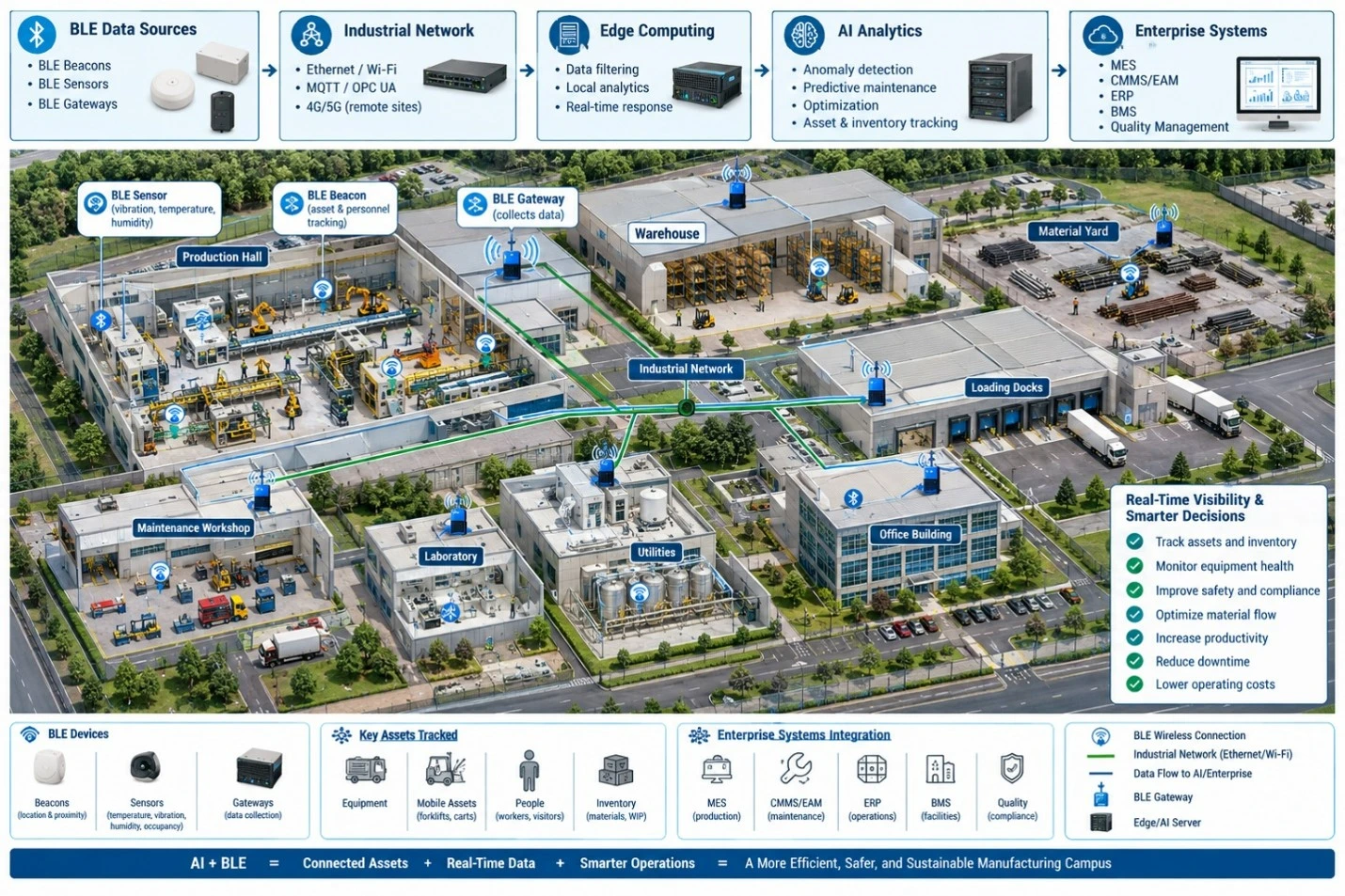
This enterprise visual illustrates how BLE beacons, sensors, and gateways connect a manufacturing campus through industrial networks and edge computing. AI analytics transforms real-time data into asset tracking, predictive maintenance, optimized material flow, improved safety, and smarter enterprise operations.
What AIoT Means for Manufacturing Campus Operations
AIoT combines artificial intelligence with IoT devices, sensors, connected equipment, and industrial systems. Manufacturing campuses are particularly suitable for AIoT because operations generate large volumes of time-dependent information from production machinery, material handling equipment, facility systems, maintenance activities, utilities, and personnel workflows.
AI can identify patterns that are difficult to detect through manual inspection or isolated equipment records. Machine learning models can evaluate equipment condition trends, anomaly detection algorithms can identify abnormal behavior, and computer vision can analyze production or safety conditions where cameras are appropriate. Edge AI can process time-sensitive information close to manufacturing equipment, while centralized software can perform longer-term analysis across multiple buildings or facilities.
BLE contributes a different type of operational visibility. Rather than replacing industrial control protocols, BLE can provide wireless identification, proximity, location, environmental measurements, and equipment condition data for assets that are difficult or expensive to connect through wired infrastructure.
For manufacturing campuses, the value comes from connecting these observations to actual operational decisions. A temperature excursion in a production-support area, an overdue maintenance cart, an idle mobile asset, an abnormal vibration reading, or an unauthorized movement of equipment can become an actionable event when the data is correlated with production schedules, maintenance records, asset ownership, and facility conditions.
Manufacturing Campus Applications for AI-Powered Operational Intelligence
AI Asset Tracking and Equipment Utilization
Manufacturing facilities contain tooling, carts, fixtures, calibration equipment, material-handling equipment, maintenance instruments, portable test equipment, spare parts containers, and other mobile assets. Manual searches consume technician and operator time, while spreadsheet-based asset records can become outdated when equipment moves between buildings.
AI-powered asset tracking can combine BLE location observations with historical movement data to identify utilization patterns, frequently relocated equipment, unusual movement, and assets that remain idle for extended periods. BLE beacons can identify mobile assets, while strategically positioned gateways collect proximity and location observations.
GAO hardware can support these deployments where wireless asset visibility is required across production buildings, warehouses, maintenance areas, and campus-wide operational zones.
Predictive Maintenance and Condition Monitoring
Predictive maintenance depends on reliable condition data and sufficient historical context. Manufacturing teams can use BLE sensors for selected applications involving vibration, temperature, humidity, equipment state, or other measurable conditions.
AI models can establish normal operating patterns and identify deviations that warrant inspection. A maintenance system can then correlate an anomaly with equipment history, previous work orders, operating hours, and spare-parts availability.
This approach is particularly useful for manufacturing support equipment, rotating machinery, motors, pumps, compressors, HVAC equipment, material-handling assets, and other equipment where wireless monitoring is technically appropriate.
The engineering decision should not be based solely on whether a BLE sensor can measure a parameter. Sensor accuracy, sampling frequency, battery life, mounting method, radio coverage, machine-generated vibration, metal interference, and the required response time all affect whether the collected data is suitable for predictive maintenance.
AI Inventory and Material Movement
Manufacturing campuses frequently move raw materials, work-in-process containers, finished goods, tooling, pallets, bins, and maintenance supplies between receiving areas, warehouses, production cells, staging locations, and shipping docks.
AI can analyze asset movement records to identify congestion, unusual dwell times, recurring delays, misplaced containers, and inefficient material routes. BLE identification can provide additional location observations for reusable containers and mobile equipment where continuous high-precision positioning is not required.
Integration with ERP, warehouse management software, MES, or material-control applications can turn location observations into operational events rather than isolated sensor records.
Worker Safety and Restricted-Area Awareness
Manufacturing campuses contain areas with different access requirements, operating hazards, vehicle traffic, machinery, high-temperature processes, electrical equipment, and controlled production environments.
BLE-enabled badges, tags, beacons, or wearable devices can support proximity-based safety workflows where appropriate. AI can correlate location-related events with equipment status, restricted-zone definitions, operating schedules, or other available data.
Safety applications require careful engineering. BLE proximity should not automatically be treated as a safety-rated control mechanism. Critical machine safeguarding, emergency stops, safety interlocks, and other functions should remain on appropriately certified safety systems. BLE and AI can instead provide supplementary awareness, notification, investigation, and operational analytics.
AI Manufacturing Campus Use-Case Map: BLE-Connected Operations and Intelligence
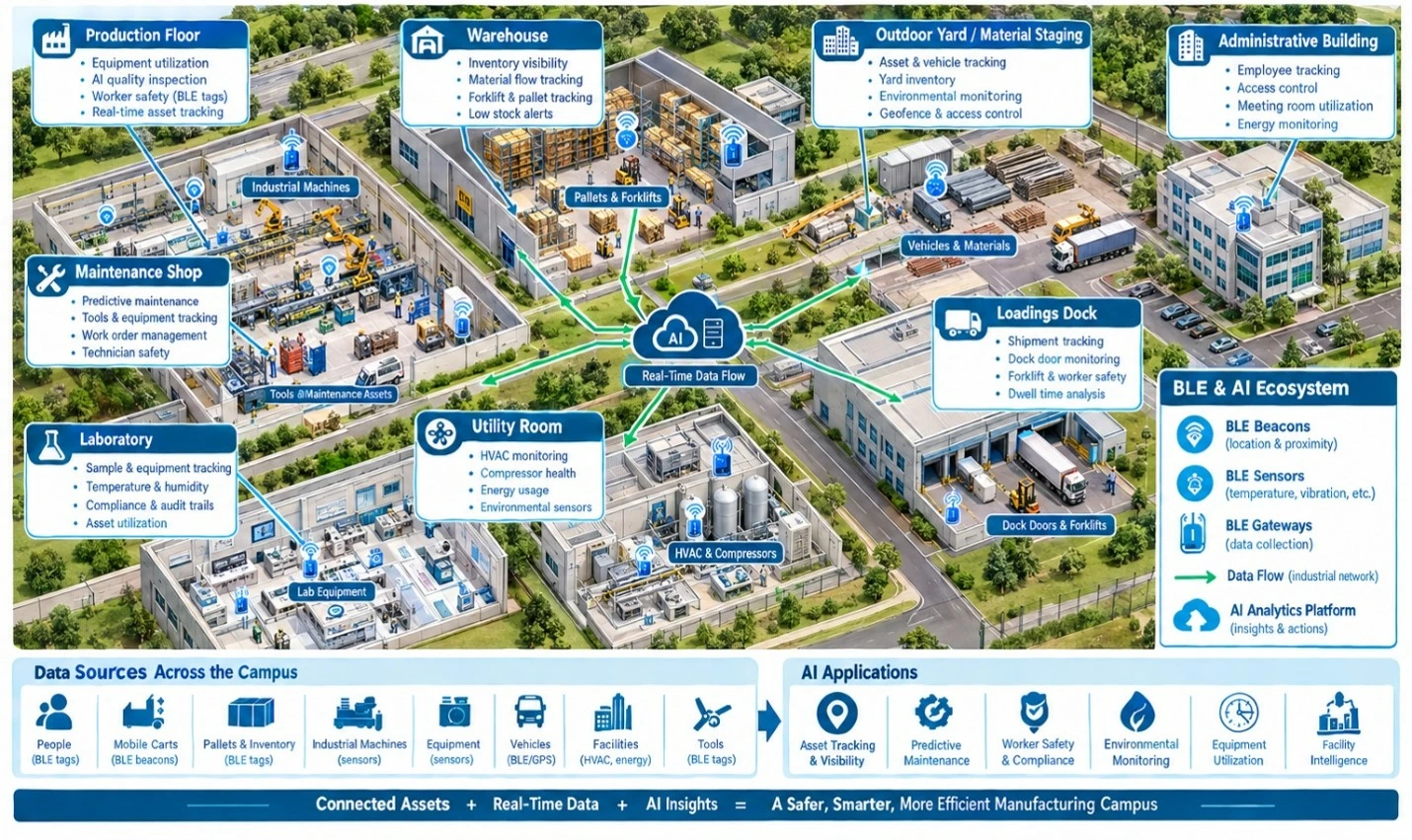
This annotated campus map shows how BLE beacons, sensors, and gateways connect production, warehouse, maintenance, laboratory, utility, loading, yard, and administrative areas to AI-driven applications such as asset tracking, predictive maintenance, worker safety, environmental monitoring, equipment utilization, and facility intelligence.
Manufacturing Workflows Improved by AI and BLE Data
A practical manufacturing-campus solution should follow the operational workflow rather than simply collecting wireless sensor data. The complete process generally begins with an operational event or measurable condition and ends with a maintenance, production, safety, inventory, or facility action.
Data Acquisition
BLE beacons can provide asset identity and location-related signals. BLE sensors can capture selected environmental or equipment conditions. Gateways collect these observations and forward them into the local or centralized processing environment.
Sensor selection should reflect the manufacturing process. Temperature monitoring near ovens or process equipment may require sensors rated for the actual thermal environment. Vibration monitoring on rotating machinery requires appropriate sensor placement and sampling characteristics. Humidity sensors used around production or storage areas need suitable environmental protection and calibration practices.
Wireless Communication and Gateway Processing
BLE gateways receive wireless observations from nearby devices and forward normalized data through Ethernet, Wi-Fi, cellular, or another suitable backhaul connection. Gateway placement requires consideration of building materials, machinery, metal structures, RF interference, antenna orientation, device density, and required coverage.
Manufacturing campuses often contain reinforced concrete, metal racks, production machinery, electrical equipment, and enclosed rooms. A radio survey and representative site testing can therefore be more reliable than assuming theoretical BLE range will translate directly into production coverage.
Edge Processing and AI Analysis
Edge computing can filter, aggregate, normalize, or temporarily store data before forwarding it to centralized software. This reduces unnecessary network traffic and can support faster local response for selected applications.
AI processing can occur at the edge, on a private manufacturing server, or in cloud infrastructure. The appropriate location depends on latency, data volume, cybersecurity requirements, connectivity, operational continuity, and the sensitivity of manufacturing information.
Enterprise Software Integration
Manufacturing intelligence becomes more useful when connected to existing systems. Common integration targets include:
- Manufacturing execution systems for production context and work-in-process information
- CMMS and enterprise asset management systems for maintenance planning and work orders
- ERP systems for inventory, purchasing, production planning, and asset records
- Warehouse management systems for material and container movements
- BMS software for HVAC, utilities, and facility conditions
- Quality management systems for production and quality-related events
- Industrial historians for time-series equipment data
- Identity and access management systems for controlled user access
- Business intelligence and analytics software for management reporting
APIs, MQTT, REST interfaces, message brokers, database connectors, OPC UA gateways, and other integration mechanisms may be appropriate depending on the existing manufacturing environment.
End-to-End AI Manufacturing Data Workflow: From BLE Assets to Business Action
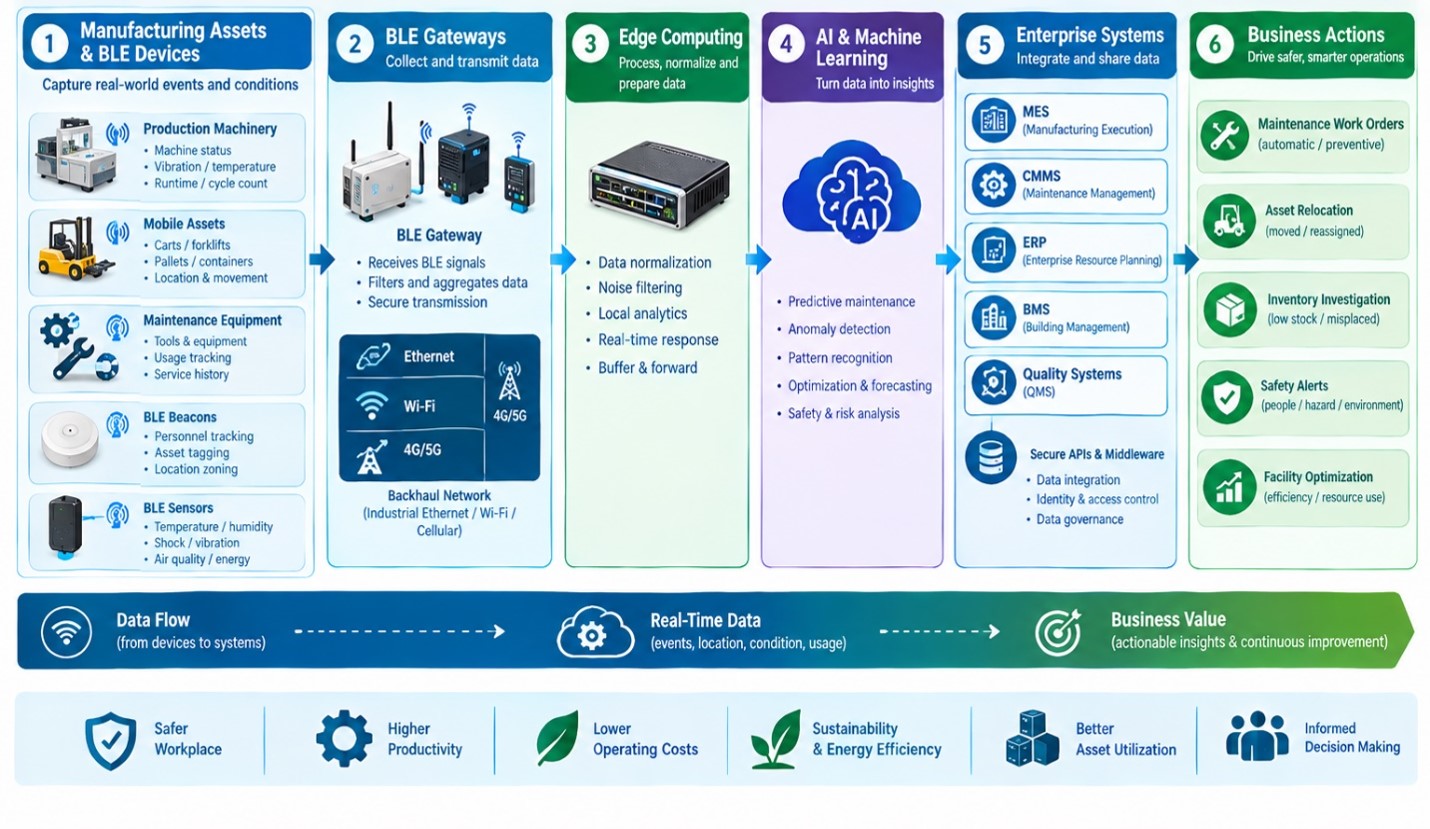
This workflow diagram illustrates how manufacturing assets, BLE beacons, and sensors feed data through BLE gateways, edge computing, AI/ML analytics, secure middleware, and enterprise systems. It connects real-time insights to maintenance work orders, asset relocation, inventory investigation, safety alerts, and facility optimization.
AI and BLE Solution Components for Manufacturing Campuses
Manufacturing campus deployments typically combine wireless hardware, industrial networking, edge computing, AI software, enterprise applications, and cybersecurity controls. BLE should be treated as one data-acquisition mechanism within the broader manufacturing solution rather than as the entire system.
BLE Beacons, Sensors and Gateways
BLE beacons are useful for identifying equipment, tools, carts, containers, and other mobile assets. BLE sensors extend this capability by measuring selected conditions such as temperature, humidity, vibration, occupancy, or equipment state.
BLE gateways act as the collection point between wireless devices and the manufacturing network. Gateway capabilities such as local buffering, device management, secure communications, protocol conversion, and remote configuration can become important when hundreds or thousands of devices are deployed across multiple buildings.
AI and Machine Learning
AI models can classify operational states, detect anomalies, estimate maintenance requirements, identify utilization patterns, and prioritize events. The appropriate model depends on the problem and available data.
Time-series machine learning can support equipment-condition analysis. Anomaly detection can identify deviations from established operating patterns. Classification models can categorize events. Computer vision can address visual inspection or safety observations when cameras are permitted and appropriate.
A strong implementation begins with measurable operational outcomes rather than selecting an AI model first. Data quality, labeling, baseline behavior, false-positive rates, and maintenance-team workflows generally determine whether an AI application produces useful results.
Communication and Industrial Networking
BLE communication typically handles short-range device connectivity, while gateways provide connectivity to the manufacturing network. Ethernet is often preferred for fixed gateway backhaul where cabling is practical. Wi-Fi or cellular connectivity can be appropriate for selected mobile or geographically distributed locations.
Network segmentation should separate IoT and operational traffic according to the organization’s cybersecurity requirements. Firewall rules, certificate-based authentication, encrypted transport, access controls, device identity, secure firmware management, and logging should be considered during initial design rather than added after deployment.
Cloud Version and Server Version
Cloud Version places the application software in managed cloud infrastructure. This model can be appropriate for manufacturing organizations that need centralized visibility across multiple facilities, remote administration, elastic computing resources, and simplified software infrastructure management. Connectivity dependency and corporate data-governance requirements should be evaluated before deployment.
Server Version deploys application software on customer-managed or privately hosted infrastructure, including manufacturing servers, private data centers, edge servers, or other controlled enterprise environments. This approach can be suitable where production data must remain within controlled infrastructure, connectivity is constrained, or local operational continuity is a priority.
GAO can support organizations evaluating BLE hardware and IoT system requirements around these deployment models, including applications requiring remote or onsite technical support.
Engineering Considerations Before Manufacturing Campus Deployment
Successful deployment requires more than installing BLE devices. Manufacturing engineers, facilities teams, IT personnel, maintenance managers, cybersecurity teams, and system integrators should jointly define the operational requirements.
Key considerations include:
- RF environment: Assess metal structures, machinery, storage racks, concrete walls, electrical equipment, and other factors affecting BLE propagation.
- Coverage requirements: Define whether the application needs room-level presence, zone-level location, gateway proximity, or higher-precision positioning.
- Asset density: Estimate the number of beacons and sensors per production area and evaluate gateway capacity.
- Battery management: Establish expected battery life, replacement intervals, spare-device policies, and maintenance responsibilities.
- Sensor suitability: Verify measurement range, accuracy, sampling frequency, environmental rating, mounting method, and calibration requirements.
- Data latency: Determine whether decisions can tolerate seconds or minutes of delay or require near-real-time processing.
- AI data quality: Establish baseline operating conditions, historical data requirements, labeling procedures, and anomaly-validation processes.
- System integration: Define identifiers and data relationships between physical assets, BLE devices, CMMS records, MES equipment IDs, ERP records, and other enterprise systems.
- Cybersecurity: Apply network segmentation, authentication, encryption, device lifecycle management, least-privilege access, logging, and secure software-update practices.
- Commissioning: Test coverage, gateway connectivity, device identity, sensor readings, data pipelines, AI events, integrations, and operational alerts before production acceptance.
BLE Site Engineering and Read-Zone Design for Manufacturing
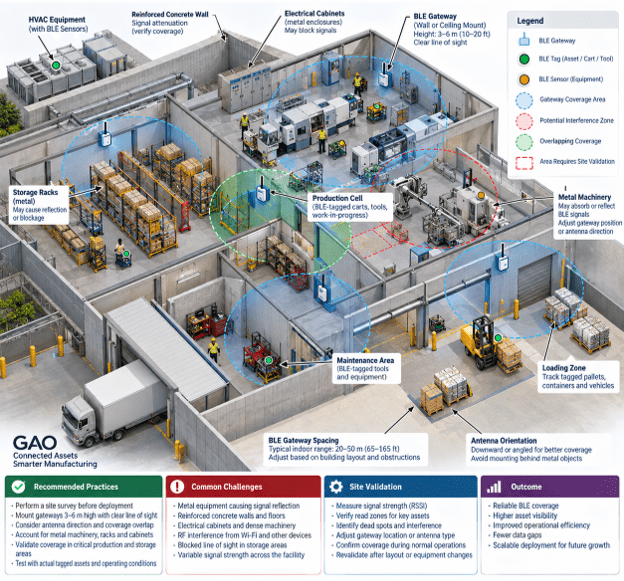
An engineering-style manufacturing facility diagram illustrates BLE gateway placement, overlapping read zones, tagged assets, sensors, and RF obstructions. Technical callouts highlight gateway spacing, antenna orientation, metal interference, reinforced concrete attenuation, site validation, and practices for reliable BLE coverage.
Operational Capabilities and Business Outcomes for Manufacturing Campuses
AI-powered manufacturing campus solutions become most valuable when location, condition, utilization, and operational data can be converted into measurable improvements. BLE gateways, beacons, and sensors provide frequent data from mobile and fixed assets, while AI models help identify patterns that would be difficult to detect through manual observation alone.
AI Asset Visibility and Utilization
Manufacturing campuses often contain thousands of assets distributed across production areas, warehouses, maintenance facilities, laboratories, offices, and outdoor yards. Tooling, fixtures, carts, containers, forklifts, calibration equipment, maintenance tools, and temporary production assets can move between locations throughout the day.
AI asset tracking can analyze BLE location and proximity data to identify:
- Asset location and movement history
- Frequently used and underused equipment
- Idle assets and unnecessary asset duplication
- Excessive movement between buildings
- Equipment waiting in staging areas
- Asset search and retrieval patterns
- Unauthorized or unexpected movement
- Utilization differences between shifts or production areas
Historical movement data can also help facility managers determine whether an asset should remain assigned to a particular building, be relocated closer to its point of use, or be shared between departments.
GAO supplies BLE gateways, beacons, sensors, RFID products, and related IoT hardware that can support these types of asset visibility and monitoring systems.
Predictive Maintenance Prioritization
Manufacturing maintenance teams must distinguish between normal equipment behavior and conditions that indicate a developing fault. AI can analyze sensor readings alongside equipment operating history, maintenance records, production schedules, and environmental conditions.
A predictive maintenance solution can help identify:
- Increasing vibration or temperature
- Abnormal operating patterns
- Repeated equipment anomalies
- Changes in equipment utilization
- Excessive operating hours
- Maintenance events associated with previous failures
- Assets approaching defined service thresholds
- Equipment requiring inspection before a scheduled production run
BLE sensors can provide supplementary condition data for motors, pumps, compressors, HVAC equipment, electrical equipment, storage systems, and other monitored assets. The AI layer can then rank alerts according to severity and operational impact rather than presenting every sensor event as an equally important notification.
Engineering teams should validate sensor placement, sampling frequency, environmental suitability, battery life, and mounting methods before relying on the resulting data for maintenance decisions.
Production Support and Material Flow Optimization
Material movement is closely connected with production efficiency. Raw materials, work-in-process containers, components, finished goods, pallets, bins, tools, and production fixtures may move repeatedly between warehouses, production buildings, inspection areas, and shipping zones.
AI inventory management and material-flow analytics can use BLE location data to identify:
- Material dwell time
- Repeated movement between locations
- Congested staging areas
- Delays between production steps
- Containers remaining in unexpected locations
- Frequently requested materials
- Inefficient material routes
- Excessive movement of production tools
- Bottlenecks around loading and receiving areas
Integration with ERP, WMS, and MES software can provide additional context. For example, a BLE location event can be compared with an expected production order or material transfer. This allows AI models to identify discrepancies between planned and actual movement.
Facility and Environmental Intelligence
Manufacturing campuses include more than production equipment. HVAC systems, electrical rooms, compressed-air systems, storage areas, laboratories, server rooms, offices, and utility spaces can all affect operating conditions.
BLE sensors can collect temperature, humidity, occupancy-related, equipment-condition, or other environmental data where appropriate. AI can analyze these readings to identify abnormal conditions and recurring patterns.
Potential applications include:
- HVAC performance monitoring
- Temperature and humidity deviation detection
- Environmental monitoring in storage areas
- Utility-room condition monitoring
- Equipment-room anomaly detection
- Energy-use pattern analysis
- Occupancy and space-utilization analysis
- Identification of recurring environmental problems
Environmental monitoring should use sensors appropriate to the required accuracy, range, calibration requirements, and operating conditions. BLE is an enabling communications technology, not a substitute for specialized instrumentation where regulated or high-accuracy measurement is required.
Safety, Security, and Compliance Support
AIoT can provide supplementary operational awareness for manufacturing campuses by combining location, environmental, equipment, and access-related information. BLE badges, tags, beacons, and sensors can help identify proximity to defined areas or equipment.
Possible applications include:
- Restricted-area awareness
- Worker or contractor location awareness
- Emergency muster support
- Equipment-zone monitoring
- Environmental hazard alerts
- Movement into designated maintenance areas
- Monitoring of temporary assets or equipment
- Supporting investigations through historical event data
These systems should not replace certified machine guarding, emergency-stop systems, fire protection systems, safety instrumented systems, or other safety-critical controls. Where a function affects personnel safety, the final control mechanism should meet the applicable safety requirements and use appropriately certified equipment.
Cybersecurity, Interoperability and Data Governance
Manufacturing campus IoT systems connect physical devices with operational technology, enterprise applications, networks, and sometimes cloud services. Security therefore needs to be considered from the sensor and gateway level through data processing, application access, and long-term data management.
Device Identity and Access
Each gateway, sensor, beacon, server, and connected application should have an appropriate identity and access-control mechanism.
Engineering and IT teams should consider:
- Unique device identification
- Role-based access control
- Strong administrator authentication
- Secure credential management
- Device inventory and ownership records
- Controlled configuration changes
- Firmware and software lifecycle management
- Removal of unused or retired devices
- Monitoring of administrative activity
Device inventories should remain synchronized with the physical deployment. A gateway or sensor that has been physically removed should not remain indefinitely registered as an active device.
Network Segmentation and Secure Transport
Manufacturing campuses commonly contain both IT and OT networks. BLE gateways may sit close to production equipment while forwarding information to servers, enterprise applications, or cloud services.
Network design may include:
- Segmented OT and IT networks
- Firewalls between security zones
- Controlled gateway communication
- Secure wireless and wired connections
- Encrypted data transmission
- Restricted management interfaces
- Monitoring of unusual network activity
- Controlled remote access
Frameworks and standards such as the NIST Cybersecurity Framework, NIST SP 800-82, IEC 62443, and ISO/IEC 27001 can provide useful reference points depending on the organization’s requirements and system scope.
Data Integrity, Retention and Auditability
AI models are only as reliable as the operational data provided to them. Missing timestamps, incorrect asset identifiers, duplicate events, sensor drift, gateway outages, and inconsistent location information can produce misleading conclusions.
Manufacturing teams should establish controls for:
- Timestamp accuracy
- Asset and device identifiers
- Sensor calibration records
- Data completeness
- Data-quality validation
- Event logging
- Historical retention
- Backup and recovery
- Audit trails
- Model and configuration versioning
Critical decisions should also preserve enough information to determine why an alert was generated and what underlying data contributed to it.
Interoperability with OT and IT
A manufacturing campus rarely operates from one software system. MES, ERP, WMS, CMMS/EAM, QMS, BMS, historians, identity systems, and business intelligence tools may all contain relevant information.
BLE and IoT data can be exchanged through appropriate interfaces such as:
- REST APIs
- MQTT
- Message brokers
- Database connectors
- OPC UA gateways
- Webhooks
- Industrial integration middleware
- Standard enterprise integration interfaces
The integration approach should be selected according to the existing environment rather than forcing a facility to replace established manufacturing software.
Manufacturing KPIs and AI Performance Measures
A manufacturing campus AIoT project should be evaluated using measurable operational outcomes rather than the number of installed devices alone. Baseline measurements should be established before deployment whenever possible.
Relevant KPIs include:
| KPI | How AIoT Can Help |
|---|---|
| Asset utilization | Identifies active, idle, and underused equipment |
| Asset search time | Shows whether location visibility reduces time spent finding equipment |
| Inventory accuracy | Compares expected and observed material locations |
| Unplanned downtime | Identifies abnormal equipment behavior before failures |
| MTTR | Provides technicians with equipment history and location information |
| MTBF | Supports analysis of recurring equipment failures |
| OEE | Combines availability, performance, and quality-related production measures |
| Maintenance schedule adherence | Tracks whether required maintenance is completed on time |
| Material dwell time | Identifies delays in staging and production movement |
| Gateway availability | Measures reliability of the wireless data collection layer |
| Sensor data completeness | Shows whether required operational data is consistently available |
| AI alert precision | Measures the proportion of alerts that correspond to meaningful conditions |
| Alert response time | Measures how quickly teams act after important events |
| Environmental deviation | Tracks temperature, humidity, or other monitored conditions against limits |
| Battery replacement rate | Measures the lifecycle burden of battery-powered devices |
| Unauthorized movement events | Supports asset-control and restricted-area monitoring |
AI performance should also be evaluated separately from hardware availability. A system can have excellent gateway uptime but still produce poor recommendations if the underlying asset associations, sensor data, or AI model assumptions are incorrect.
Implementation Lifecycle for Manufacturing Campuses
A phased implementation reduces technical and operational risk. The most effective starting point is usually a clearly defined business problem rather than a campus-wide hardware deployment.
Requirements and Site Survey
The first phase should document:
- Priority business problems
- Assets and equipment to be monitored
- Required location accuracy
- Environmental conditions
- Existing wireless infrastructure
- RF interference sources
- Metal structures and machinery
- Gateway mounting locations
- Battery replacement requirements
- Existing enterprise software
- Cybersecurity requirements
- Data ownership and retention requirements
A physical site survey is particularly important in manufacturing facilities because machinery, metal racks, walls, production equipment, and changing inventory can affect BLE signal behavior.
Pilot and Baseline
A pilot should normally focus on a defined building, production line, warehouse zone, maintenance process, or asset group.
Baseline measurements can include:
- Current asset search time
- Current equipment downtime
- Existing maintenance response
- Current inventory accuracy
- Material movement time
- Existing environmental deviations
- Current manual tracking effort
The pilot can then be evaluated against those baseline measurements.
Installation and Commissioning
Installation should verify gateway coverage, sensor placement, beacon identification, mounting stability, power availability, battery status, and network connectivity.
Commissioning should include:
- Device registration
- Asset-tag association
- Gateway connectivity tests
- Location validation
- Sensor validation
- Data timestamp verification
- Integration testing
- Alert testing
- Cybersecurity checks
- User acceptance testing
Actual physical conditions should be tested rather than assuming that theoretical RF coverage will match operating conditions.
Integration and AI Model Validation
AI models should be tested against real manufacturing events. Historical data can be useful, but production teams should also validate predictions and alerts during actual operations.
Validation questions include:
- Did the system identify known equipment conditions?
- Are alerts generated early enough to be useful?
- Are false positives manageable?
- Does the system understand asset and location relationships?
- Can maintenance personnel interpret the recommendations?
- Does the data integrate correctly with existing workflows?
Human feedback is particularly important during early deployment because production personnel understand operational conditions that may not be visible in sensor data.
Optimization and Scaling
Once the pilot demonstrates measurable value, deployment can expand to additional buildings, warehouses, maintenance areas, production processes, or asset categories.
Scaling should consider:
- Additional gateway density
- Device management
- Network capacity
- Data storage
- AI processing requirements
- User permissions
- Maintenance workload
- Battery replacement
- Software licensing
- Integration complexity
Scaling should preserve the validated engineering assumptions from the pilot while adapting them to different buildings and RF environments.
Maintenance and Lifecycle Management
BLE and IoT systems require ongoing management. Device batteries, firmware, sensor calibration, gateway health, network connectivity, software updates, and asset assignments can change over time.
A lifecycle program should therefore include:
- Device health monitoring
- Battery replacement schedules
- Firmware management
- Sensor calibration
- Gateway inspection
- Asset reassignment
- Security patching
- Data-quality checks
- AI model review
- Periodic KPI assessment
Manufacturing AIoT Deployment Lifecycle for Scalable Operations
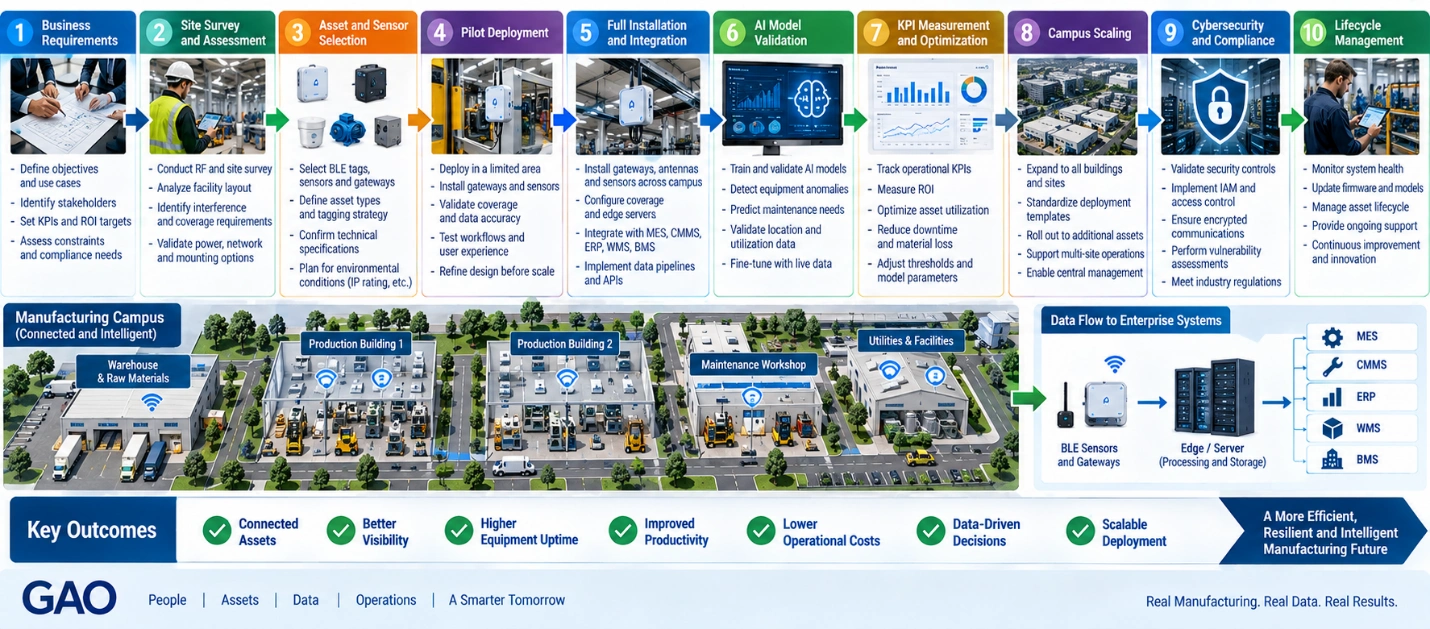
This lifecycle diagram maps the deployment of AI-enabled BLE and IoT across a manufacturing campus, from business requirements and site assessment through pilot deployment, enterprise integration, AI validation, KPI optimization, cybersecurity, scaling, and lifecycle management. A connected campus illustration and data-flow panel show how sensors and gateways feed edge or server infrastructure and integrate with MES, CMMS, ERP, WMS, and BMS systems.
Practical Recommendations for Manufacturing IT and Engineering Teams
A successful manufacturing campus deployment depends on matching the technology to a clearly defined operational requirement.
- Define the business problem before selecting devices.
- Identify the assets, equipment, people, materials, or environmental conditions that require visibility.
- Establish measurable baseline KPIs.
- Conduct an RF survey before finalizing gateway locations.
- Test BLE performance around metal equipment, racks, machinery, walls, and changing inventory.
- Select sensors according to the required measurement range, accuracy, sampling rate, environmental rating, and battery life.
- Determine whether processing should occur in the cloud, on a private server, at the edge, or through a hybrid model.
- Integrate asset identifiers with existing ERP, MES, WMS, CMMS/EAM, QMS, or BMS records.
- Validate AI recommendations against real operational events.
- Establish cybersecurity controls before connecting gateways to production networks.
- Design a maintenance process for batteries, firmware, sensors, gateways, and asset associations.
- Start with a measurable pilot before expanding across the entire manufacturing campus.
- Review KPI performance regularly and adjust device placement, data collection, and AI models as operating conditions change.
This approach helps prevent a common implementation problem: installing large numbers of connected devices without establishing how their data will improve a specific manufacturing workflow.
GAO Support for Manufacturing BLE, RFID and IoT Systems
GAO, headquartered in New York City and Toronto, Canada, is ranked among the top 10 leading B2B and B2G BLE/RFID suppliers globally. GAO provides BLE gateways, beacons, sensors, RFID products, and other IoT hardware and systems that can support asset tracking, equipment monitoring, facility intelligence, and industrial data collection.
For three decades, GAO Group companies have served customers across the United States and Canada, including Fortune 500 companies, leading R&D organizations, prestigious universities, and government agencies. GAO has invested heavily in research and development and maintains stringent quality assurance practices, with technical support available remotely or onsite for applicable projects.
Key Takeaways for AI-Powered Manufacturing Campus Operations
AI-powered manufacturing campus solutions can connect physical assets and operational environments with the data required for better decisions. BLE gateways, beacons, and sensors provide a practical wireless data layer for location, proximity, condition, and environmental information, while AI helps transform that information into operational insights.
Key considerations include:
- Start with measurable manufacturing problems such as asset search, downtime, material delays, or environmental deviations.
- Treat BLE as an enabling technology within a larger AIoT solution.
- Integrate location and sensor data with existing manufacturing software.
- Validate AI recommendations against real production conditions.
- Build cybersecurity, data governance, and device lifecycle management into the design.
- Use pilot deployments to establish measurable business value before campus-wide scaling.
- Select cloud, server, edge, or hybrid processing according to operational, security, connectivity, and data-management requirements.
Manufacturing organizations can use this approach to develop more informed asset management, maintenance, inventory, production-support, and facility-management processes without unnecessarily replacing their existing operational systems.
Building the Future of Industrial AI and IoT with Aperture Venture Studio and GAO RFID Inc.
For more than three decades, GAO Group of Companies has invested heavily in R&D of industrial BLE, RFID, and IoT technologies. As generative AI has become useful for industrial applications, we have continued developing AI and IoT technologies for manufacturing and other industries, with Aperture Venture Studio helping advance and scale practical solutions. Aperture brings together AI and IoT experts, operational leaders, investors, and leading companies. Through the Aperture Ventures Summit and TekSummit, we also encourage discussion of advanced industrial technologies and support active technical communities. We welcome Advisors, Employees, Investors, and Customers to participate.