
AI and BLE for Marine Engineering
AI-Driven Marine Engineering for Smarter Vessel Operations
AI for marine engineering combines artificial intelligence, machine learning, connected sensors, and operational data to help vessel operators and marine engineering teams monitor equipment, identify abnormal operating conditions, improve maintenance planning, track mobile assets, and make faster engineering decisions. BLE-enabled sensors, beacons, and gateways can provide localized data from machinery spaces, engine rooms, workshops, electrical rooms, storage areas, and other vessel or shore-based engineering environments.
The value of AI is not simply collecting more marine engineering data. The objective is to correlate equipment condition, maintenance history, operating parameters, asset location, environmental conditions, and engineering events to identify patterns that may otherwise be difficult to recognize. AI can support predictive maintenance, anomaly detection, condition monitoring, spare-parts management, tool tracking, environmental monitoring, and maintenance workflow optimization.
For marine engineering organizations, this approach can improve equipment visibility while reducing dependence on manual inspections and disconnected records. GAO provides BLE, RFID, and IoT hardware products and systems that can support data acquisition and asset visibility in demanding engineering environments.
Why AI Matters in Marine Engineering
Marine engineering involves interconnected systems where the condition of one component can influence the performance, reliability, or availability of other equipment. Main engines, auxiliary engines, generators, pumps, compressors, cooling systems, fuel systems, electrical equipment, propulsion machinery, and control systems all require regular inspection and maintenance.
AI can help engineering teams analyze operational and historical information across these systems.
Predictive Maintenance for Marine Machinery
Predictive maintenance uses equipment data and analytical models to identify changes that may indicate developing problems. Instead of relying only on fixed maintenance intervals, engineering teams can use condition-related information to prioritize inspections and maintenance activities.
Relevant AI applications include:
- Detecting unusual operating patterns in pumps, motors, compressors, and auxiliary machinery
- Identifying abnormal temperature or vibration trends
- Prioritizing machinery requiring engineering inspection
- Supporting maintenance scheduling based on equipment condition
- Correlating current equipment behavior with historical maintenance records
- Identifying recurring failure patterns across similar machinery
BLE sensors can contribute localized measurements where wireless installation is practical. BLE gateways collect the data and forward it to edge or server-based software for further processing.
AI-Based Equipment Condition Monitoring
Marine equipment can experience changing conditions due to load, temperature, operating hours, environmental exposure, and maintenance history. AI models can analyze multiple parameters instead of evaluating each measurement independently.
For example, an engineering system may correlate:
- Equipment temperature
- Vibration measurements
- Motor operating conditions
- Runtime or operating hours
- Maintenance history
- Alarm events
- Environmental conditions
- Equipment location
This combined information can help distinguish normal operating variation from patterns requiring investigation.
Marine Asset Tracking and Tool Management
Marine engineering operations involve many mobile assets, including maintenance tools, test instruments, portable equipment, spare components, and specialized service equipment. Searching for these assets manually can consume engineering time and delay maintenance activities.
BLE beacons attached to selected assets can provide identification and location information through nearby BLE gateways. AI software can then analyze asset movement and usage patterns to support:
- Tool availability monitoring
- Maintenance equipment tracking
- Portable instrument management
- Workshop asset visibility
- Spare-parts movement analysis
- Identification of frequently misplaced equipment
GAO’s BLE hardware can be incorporated into asset-tracking systems where localized wireless identification is appropriate.
Marine Engineering Applications for AI and BLE
Marine engineering deployments should begin with a clearly defined operational problem. BLE is most useful when it provides reliable data that can contribute to a specific engineering workflow rather than being deployed simply because wireless connectivity is available.
Engine Room Monitoring
Engine rooms contain critical machinery operating under changing loads and environmental conditions. AI can analyze sensor information to identify abnormal trends and help engineering personnel prioritize inspection.
Potential applications include:
- Machinery condition monitoring
- Temperature trend analysis
- Abnormal operating-condition detection
- Equipment runtime analysis
- Maintenance prioritization
- Local asset identification
BLE sensors may be installed on suitable equipment or in locations where wireless measurements are practical. Gateway placement should account for metal structures, machinery obstruction, electromagnetic conditions, vessel compartment layout, and required communication coverage.
Pumps, Motors, and Compressors
Pumps, motors, compressors, and related rotating equipment are common maintenance targets in marine engineering.
AI models can analyze measurements such as temperature, vibration, operating status, and historical maintenance events. The system can identify deviations from established operating patterns and generate engineering alerts for further inspection.
BLE-enabled monitoring can be useful where installing extensive wired instrumentation would be impractical or where additional localized measurements are required.
Electrical and Auxiliary Systems
Marine electrical systems include generators, switchboards, distribution equipment, battery systems, control panels, and other auxiliary equipment.
AI can support:
- Abnormal temperature detection
- Equipment condition analysis
- Maintenance prioritization
- Electrical asset identification
- Environmental monitoring around sensitive equipment
- Historical trend analysis
BLE sensors can provide supplementary environmental or equipment-related measurements, while gateways transmit information to the appropriate processing system.
Marine Workshops and Maintenance Areas
Shore-based marine workshops and onboard maintenance areas contain tools, components, test instruments, and work-in-progress equipment. AI-based asset management can analyze movement and utilization information to improve maintenance logistics.
BLE beacons can identify tagged tools and mobile equipment, while gateways provide location visibility. AI can use historical movement data to identify recurring bottlenecks, frequently moved equipment, or assets that remain unused for extended periods.
Spare Parts and Engineering Inventory
Marine operators need access to critical spare parts for scheduled and corrective maintenance. Poor inventory visibility can contribute to maintenance delays.
AI-supported inventory management can analyze:
- Spare-part consumption
- Equipment maintenance history
- Replenishment patterns
- Critical component availability
- Storage locations
- Maintenance schedules
BLE-enabled identification can supplement existing inventory systems by improving the visibility of selected mobile or high-value engineering assets.
AI-Enabled Marine Engineering Data-to-Decision Workflow
A workflow showing how BLE sensors, beacons, and gateways collect marine engineering data and connect it with edge processing, AI analytics, maintenance systems, dashboards, and engineering actions.
How AI and BLE Work Together in Marine Engineering
The relationship between AI and BLE is best understood as a data-to-decision chain. BLE provides a practical wireless mechanism for collecting localized information, while AI processes that information alongside other engineering data.
A typical marine engineering workflow can include the following stages:
- Data acquisition: BLE sensors collect relevant measurements, while BLE beacons identify equipment, tools, and other assets.
- Wireless communication: BLE gateways receive information from nearby devices.
- Edge processing: Local software can filter, validate, buffer, and normalize incoming data before transmission.
- Data integration: Marine engineering data can be combined with maintenance records, equipment databases, alarm information, and operational systems.
- AI analytics: Machine learning and anomaly-detection methods analyze historical and current information.
- Engineering insight: The system identifies abnormal patterns, maintenance priorities, asset movements, or operational trends.
- Business and engineering action: Engineering personnel review alerts and take appropriate inspection, maintenance, inventory, or operational actions.
This approach is particularly useful when AI needs information from multiple sources rather than relying on a single sensor.
Technical Components for AI-Enabled Marine Engineering
A marine engineering AI solution normally consists of several connected components. The exact design depends on the vessel, machinery, connectivity requirements, existing control systems, cybersecurity policies, and operational objectives.
BLE Sensors
BLE sensors can collect selected environmental or equipment-related information. Depending on the application, measurements may include temperature, humidity, motion, acceleration, or other supported parameters.
Marine engineering teams should select sensors according to:
- Required measurement range
- Sampling frequency
- Battery life
- Environmental protection requirements
- Installation location
- Mechanical attachment method
- Wireless coverage
- Maintenance requirements
Sensor selection should be based on the actual engineering measurement requirement rather than BLE capability alone.
BLE Beacons
BLE beacons primarily provide identification and proximity information. They can be attached to tools, portable instruments, maintenance equipment, spare components, or other assets where location visibility is useful.
Beacon deployment should consider asset movement patterns, gateway coverage, compartment layout, and the required location accuracy.
BLE Gateways
BLE gateways provide the connection between local BLE devices and the wider marine engineering software environment. They receive BLE transmissions and forward relevant information through available vessel or shore-based network infrastructure.
Gateway placement is an important engineering consideration because marine environments can contain steel structures, bulkheads, machinery, and other physical obstructions that influence wireless propagation.
Edge Computing
Edge computing can process marine engineering data closer to the source. Local processing can reduce unnecessary network traffic and allow selected analytics or data buffering functions to continue when external connectivity is limited.
This can be valuable for vessels operating with intermittent or bandwidth-constrained connections.
AI and Machine Learning
AI software can apply anomaly detection, classification, forecasting, predictive maintenance models, and statistical analysis to marine engineering data.
Model selection should reflect the available data quality and engineering objective. A complex model is not automatically better if sensor coverage, historical records, or labeled failure data are limited.
Integration with Marine Engineering Systems
AI-generated information becomes more useful when integrated with existing engineering workflows. Depending on the environment, integration may involve:
- Computerized Maintenance Management Systems
- Enterprise Asset Management systems
- Vessel management systems
- Inventory management software
- Maintenance work-order systems
- Equipment databases
- Historian systems
- Operational dashboards
- IoT data services
The integration layer should preserve equipment identifiers and timestamps so AI-generated insights can be associated with the correct vessel, machinery, asset, and maintenance event.
Cloud Version vs. Server Version for Marine Engineering
Cloud Version
A cloud-hosted software deployment can support centralized analysis across multiple vessels, shipyards, workshops, or maritime facilities. It is particularly useful when organizations want consolidated fleet-level analytics and centralized software management.
Potential advantages include:
- Centralized fleet analytics
- Easier multi-vessel data aggregation
- Remote software management
- Scalable storage and processing
- Fleet-wide performance comparison
However, marine connectivity can vary significantly by vessel location and operating conditions. Systems should therefore include local buffering or edge processing where continuous connectivity cannot be assumed.
Server Version
A server-based deployment can run on an onboard edge server, customer-managed infrastructure, private data center, or other privately hosted environment. It can be appropriate when operational data must remain under direct organizational control or when local processing is important.
Potential advantages include:
- Greater control over data location
- Reduced dependence on external connectivity
- Local processing and response
- Integration with private engineering systems
- Support for environments with strict data-management requirements
A hybrid approach can also combine onboard edge processing with centralized cloud or server analytics. This allows critical local functions to continue while selected information is synchronized when connectivity is available.
Marine Engineering Data Flow and AI Decision-Making
Marine engineering AI systems should treat data quality as a core engineering requirement. Sensor data must be associated with the correct equipment, location, vessel, timestamp, and operating context.
A practical data flow can therefore include:
- BLE sensors and beacons
- BLE gateways
- Data validation
- Local buffering
- Edge analytics
- Secure network communication
- Centralized or private data storage
- AI model processing
- Engineering dashboards
- Maintenance alerts
- Work-order or engineering actions
This structure helps transform raw wireless measurements into information that marine engineering teams can use within established maintenance and operational procedures.
For example, an AI system may identify an unusual temperature trend from a monitored auxiliary component. Instead of treating that measurement as an isolated alarm, the system can compare it with historical measurements, operating conditions, maintenance records, and related equipment behavior. The resulting insight can then be presented to an engineer for inspection or maintenance planning.
The objective is not to replace engineering judgment. AI should provide additional evidence that helps engineering personnel investigate conditions and prioritize work.
Operational Benefits of AI for Marine Engineering
AI-enabled marine engineering systems can provide value when data is connected to specific maintenance, asset-management, and operational decisions. The benefits depend on sensor quality, data availability, model performance, and how effectively engineering teams incorporate AI-generated information into established workflows.
Improved Machinery Reliability
AI-based condition monitoring can identify deviations before they become obvious through routine inspection. Earlier identification gives engineering personnel more time to investigate equipment and plan appropriate maintenance.
For critical machinery, this can support better maintenance prioritization and reduce the risk of unexpected equipment unavailability.
More Efficient Maintenance Planning
Maintenance teams often manage multiple pieces of equipment with different operating schedules and maintenance requirements. AI can analyze equipment condition, historical work orders, runtime information, and previous failures to help prioritize maintenance activities.
The resulting recommendations can support engineering planning without replacing established maintenance procedures or professional judgment.
Better Asset Visibility
BLE-based identification can provide visibility into the movement of engineering tools, portable instruments, maintenance equipment, and selected spare parts.
AI can further analyze asset movement to identify patterns such as frequently relocated equipment, unusual movement, or low utilization. This can help marine engineering teams improve equipment availability and reduce time spent searching for assets.
Faster Detection of Abnormal Conditions
AI can continuously evaluate incoming measurements and identify patterns that differ from expected behavior. This is particularly useful when multiple measurements need to be considered together.
For example, a gradual increase in temperature combined with changes in vibration may provide a stronger indication for investigation than either measurement considered independently.
Improved Engineering Decision Support
AI can consolidate information from sensors, maintenance records, asset systems, and operational databases into a more usable engineering view.
Rather than requiring engineers to manually compare information from multiple systems, an AI solution can highlight relevant trends and potential issues for review.
Key KPIs for AI-Enabled Marine Engineering
Marine engineering deployments should be evaluated using measurable operational indicators rather than simply counting connected sensors or gateways.
| KPI | Marine Engineering Relevance |
|---|---|
| Mean Time Between Failures (MTBF) | Measures equipment reliability over operating periods |
| Mean Time to Repair (MTTR) | Indicates the efficiency of corrective maintenance |
| Unplanned Maintenance Rate | Tracks maintenance caused by unexpected equipment conditions |
| Planned Maintenance Compliance | Measures completion of scheduled maintenance |
| Equipment Availability | Indicates the percentage of time critical equipment remains available |
| Predictive Alert Accuracy | Evaluates the usefulness of AI-generated maintenance alerts |
| False Alert Rate | Identifies unnecessary or low-value engineering alerts |
| Asset Search Time | Measures time required to locate tools and mobile equipment |
| Tool Utilization | Shows how effectively maintenance tools and instruments are being used |
| Spare-Part Availability | Measures availability of required engineering components |
| Sensor Data Availability | Indicates the reliability of the data collection system |
| Gateway Connectivity | Measures successful communication between BLE devices and gateways |
| Maintenance Response Time | Measures time between an engineering alert and investigation |
| Condition Monitoring Coverage | Indicates the proportion of targeted equipment being monitored |
A good deployment should establish baseline values before implementation and compare them with post-deployment performance.
Cybersecurity and Data Governance for Marine Engineering
Connecting marine equipment and engineering assets introduces additional cybersecurity considerations. BLE devices, gateways, edge computers, networks, and enterprise software should be treated as components of the overall operational environment.
Important controls can include:
- Device authentication and authorization
- Secure gateway configuration
- Encryption for data transmission
- Role-based access control
- Network segmentation
- Secure software updates
- Credential management
- Audit logging
- Monitoring of unusual network activity
- Backup and recovery procedures
- Controlled access to engineering dashboards
- Data retention policies
BLE should not be treated as an isolated security boundary. The security of the complete data path depends on the sensors, gateways, network, edge software, servers, cloud services, APIs, and connected engineering applications.
Marine environments also require consideration of physical access. Equipment installed in machinery spaces, workshops, and other accessible locations should be protected against unauthorized physical modification or removal.
Data Quality and Governance
AI results are only as useful as the information supplied to the analytical system. Marine engineering data should therefore be validated for:
- Correct equipment identification
- Accurate timestamps
- Sensor calibration
- Missing measurements
- Duplicate records
- Communication gaps
- Incorrect asset associations
- Abnormal readings caused by sensor faults
Data governance should also define who can access engineering information, how long data is retained, and which information is transmitted from vessels to centralized systems.
Integration with Marine Engineering Software
AI and BLE solutions should complement existing marine engineering systems rather than create isolated data silos.
Integration can connect wireless asset and condition information with systems used for maintenance, inventory, vessel management, and engineering operations.
CMMS and EAM Integration
Computerized Maintenance Management Systems and Enterprise Asset Management systems can provide equipment records, maintenance schedules, work orders, and service history.
AI-generated condition insights can be associated with the appropriate equipment record, allowing engineering personnel to investigate an issue within an existing maintenance workflow.
Inventory and Spare-Parts Integration
Asset identification and location information can complement inventory-management systems by providing additional visibility into selected engineering assets.
This can be particularly useful for high-value tools, portable test equipment, critical spares, and maintenance components.
Vessel and Operational Systems
Depending on the vessel and existing infrastructure, AI systems may exchange information with vessel-management software, equipment databases, historians, or other operational systems.
Integration should use stable identifiers and well-defined interfaces so information remains traceable from the original asset through the analytical system and back to the engineering workflow.
GAO’s experience supplying BLE, RFID, and IoT hardware products and systems can support organizations that need to connect physical assets with their existing digital engineering processes.
Deployment Lifecycle for Marine Engineering AI
A successful implementation should progress through controlled engineering stages rather than immediately deploying sensors throughout a vessel or fleet.
Planning and Site Assessment
Begin by identifying the operational problem, target equipment, required measurements, data sources, connectivity conditions, and expected engineering outcome.
A vessel survey should evaluate machinery-space layout, available network infrastructure, gateway mounting locations, wireless obstructions, environmental conditions, and power availability.
Hardware Selection
Select BLE sensors, beacons, and gateways based on the actual application.
Consider:
- Measurement requirements
- Environmental conditions
- Battery requirements
- Communication range
- Mounting method
- Equipment accessibility
- Maintenance requirements
- Required location accuracy
Pilot Deployment
A limited pilot should focus on a small number of representative assets. The pilot can validate wireless coverage, sensor performance, data quality, gateway placement, and engineering usefulness before larger deployment.
Commissioning and Testing
Testing should verify:
- BLE device communication
- Gateway connectivity
- Data timestamps
- Asset identification
- Sensor measurements
- Network reliability
- Edge processing
- AI data pipelines
- Dashboard behavior
- Alert delivery
- Integration with maintenance software
Optimization
After commissioning, engineering teams should review alert quality, sensor placement, battery performance, data gaps, and operational workflows.
AI models may require further tuning as more vessel-specific data becomes available.
Fleet or Facility Expansion
Once the pilot demonstrates measurable value, the solution can be extended to additional vessels, machinery groups, workshops, shipyards, or maintenance facilities.
A standardized device configuration and naming convention can simplify scaling across multiple locations.
Marine Engineering Technology Deployment Lifecycle
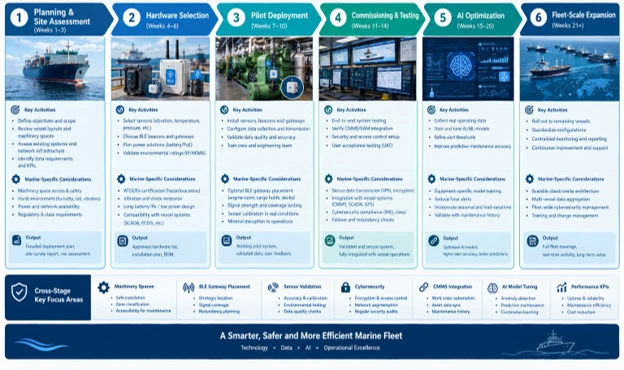
A six-stage roadmap for implementing AI and BLE in marine engineering, from vessel assessment and hardware selection to pilot testing, AI optimization, and fleet-wide deployment.
Practical Engineering Recommendations
Marine engineering organizations considering AI and BLE should focus first on measurable operational problems rather than technology deployment alone.
Recommended practices include:
- Start with equipment or workflows where better information can produce a measurable engineering benefit.
- Use pilot deployments to validate wireless coverage and data quality.
- Avoid assuming that every piece of machinery requires wireless monitoring.
- Combine BLE information with existing maintenance and operational data.
- Keep equipment identifiers consistent across sensors, gateways, databases, and maintenance software.
- Use edge processing where vessel connectivity is intermittent or expensive.
- Establish cybersecurity requirements before connecting gateways to operational networks.
- Define KPI baselines before deploying AI-based recommendations.
- Involve marine engineers and maintenance personnel during system design.
- Review AI alerts with engineering personnel before using them for maintenance decisions.
- Design the system so additional vessels and equipment can be incorporated without redesigning the complete solution.
The most effective deployments generally combine engineering knowledge with data analytics. AI should provide evidence and prioritization while qualified personnel remain responsible for interpreting conditions and deciding appropriate engineering actions.
GAO Support for Marine Engineering IoT Solutions
GAO is headquartered in New York City and Toronto, Canada, and is among the leading B2B and B2G suppliers of BLE and RFID technologies. GAO and its sister companies, GAO Research and GAO Tek, form the GAO Group, with operations based in New York City and Toronto.
For three decades, the GAO Group has served customers across the United States and Canada, including Fortune 500 companies, major research and development organizations, universities, and government agencies. Its work includes substantial research and development investment, stringent quality assurance processes, and technical support provided remotely or onsite.
For marine engineering applications, this experience is relevant when selecting BLE, RFID, and IoT hardware for asset visibility, condition monitoring, data acquisition, and connected engineering systems.
Key Takeaways for AI-Enabled Marine Engineering
AI can help marine engineering teams move from reactive monitoring toward more data-driven maintenance and operational decision-making. BLE sensors, beacons, and gateways can provide localized equipment, environmental, and asset information that becomes more valuable when correlated with maintenance and operational data.
Key considerations include:
- Define the marine engineering problem before selecting technology.
- Use BLE as an enabling data-collection technology rather than the objective itself.
- Combine sensor information with maintenance and equipment history.
- Use edge processing when vessel connectivity is limited.
- Select cloud, server, or hybrid deployment according to operational and data requirements.
- Integrate AI insights into existing engineering workflows.
- Measure performance using maintenance, reliability, asset, and data-quality KPIs.
- Build cybersecurity and data governance into the system from the beginning.
- Validate the solution through a controlled pilot before scaling.
Organizations exploring AI-enabled marine engineering can evaluate GAO’s BLE, RFID, and IoT hardware products and systems according to their specific vessel, workshop, maintenance, and asset-management requirements.
Building the Future of Industrial AI and IoT with Aperture Venture Studio and GAO RFID Inc.
For more than three decades, GAO Group of Companies has invested heavily in R&D for industrial BLE, RFID, and IoT technologies. As AI has become increasingly useful for industrial applications, we have continued developing AI-enabled IoT solutions and supporting technologies for areas such as marine engineering, asset monitoring, and connected operations.
We have also founded Aperture Venture Studio to support the development and scaling of next-generation AI and IoT solutions relevant to industries where connected physical assets and intelligent data analysis can create practical value.
Aperture has attracted AI and IoT technical experts, entrepreneurial and operational executives, investors, and leading companies. We have also developed Aperture Ventures Summit and TekSummit to discuss advanced AI and IoT topics.
These activities have helped build technical communities around AI and IoT. We welcome participation as:
- Advisors, co-founders, or employees
- Investors
- Customers