
AI and BLE for Maritime Cargo Operations
AI-Driven Maritime Cargo Operations for Port and Terminal Visibility
AI-driven maritime cargo operations combine cargo data, terminal events, equipment information, connected devices, operational records, and analytics to improve the movement of containers, bulk cargo, breakbulk freight, and other maritime shipments. Ports, container terminals, marine logistics providers, freight forwarders, and terminal operators can use AI to predict congestion, identify cargo exceptions, optimize equipment allocation, improve yard planning, and prioritize maintenance.
BLE gateways, BLE beacons, and BLE sensors can provide localized visibility for selected operational assets and equipment within terminals, warehouses, maintenance facilities, reefer areas, staging zones, and other controlled locations. AI can combine these observations with terminal operating systems, transportation management systems, vessel schedules, gate transactions, container records, crane activity, maintenance software, and enterprise data.
The resulting AIoT solution helps maritime cargo teams move from isolated operational events toward predictive decision-making. GAO supplies BLE, RFID, and other IoT technology-based hardware products and systems that can support these connected cargo workflows.
How AI Transforms Maritime Cargo Operations
Maritime cargo operations involve tightly coordinated processes between vessels, ports, container terminals, customs activities, truck gates, rail connections, warehouses, cranes, yard equipment, shipping lines, freight forwarders, and cargo owners. A delay in one process can affect multiple downstream activities.
AI can analyze these interconnected events to identify patterns that are difficult to detect through manual monitoring. Historical vessel calls, container dwell, gate transactions, yard density, crane productivity, equipment availability, weather conditions, cargo volumes, and appointment schedules can be analyzed together to predict operational constraints.
AI-enabled maritime cargo systems can support:
- Container demand forecasting and yard capacity planning.
- Vessel arrival and berth planning.
- Yard congestion prediction.
- Container dwell-time anomaly detection.
- Crane and material-handling equipment optimization.
- Reefer monitoring and exception management.
- Maintenance prioritization for terminal equipment.
- Cargo staging and retrieval optimization.
- Truck appointment and gate-flow analysis.
- Empty-container repositioning decisions.
- Asset utilization and recovery.
- Detection of unusual cargo or equipment movements.
BLE provides an additional source of localized operational information. It should be applied where proximity or zone-level visibility solves a defined problem rather than being treated as a universal replacement for container identification, GPS, RFID, optical recognition, or terminal transactions.
Maritime Cargo Workflows Supported by AI
Vessel Arrival and Berth Planning
AI can analyze vessel schedules, historical arrival patterns, berth availability, cargo volumes, crane requirements, weather conditions, and terminal constraints to support berth planning. Predictive analysis can help identify potential scheduling conflicts and allow terminal teams to prepare resources before vessel arrival.
Container Gate and Terminal Flow Management
AI can analyze truck appointments, gate transactions, arrival patterns, processing times, container movements, and yard conditions to identify congestion risks. This can support better gate-flow coordination and more efficient movement of containers between external transportation and terminal operations.
Container Yard Planning and Retrieval
AI-enabled yard planning can consider container dwell time, cargo destination, vessel schedules, container priority, yard density, equipment availability, and expected retrieval activity. This can help optimize container placement and reduce unnecessary handling movements.
Crane and Cargo Handling Operations
AI can analyze crane productivity, equipment availability, workload distribution, container movement requirements, and historical operating patterns. These insights can support resource allocation and help identify conditions that may affect cargo-handling performance.
Cargo Inspection and Customs Coordination
AI can help coordinate cargo inspection activities by combining container records, inspection requirements, cargo status, location information, and operational schedules. Exception identification can help teams prioritize cargo requiring additional review or intervention.
Reefer Cargo Monitoring
Connected environmental sensors can provide temperature and humidity information for refrigerated cargo areas and equipment. AI can analyze environmental data and operational events to identify abnormal conditions and prioritize response activities.
Port-to-Warehouse and Intermodal Cargo Coordination
AI can connect terminal events with warehouse, trucking, rail, and transportation information to provide broader visibility across intermodal cargo flows. This can help identify transfer delays, staging constraints, and downstream capacity issues.
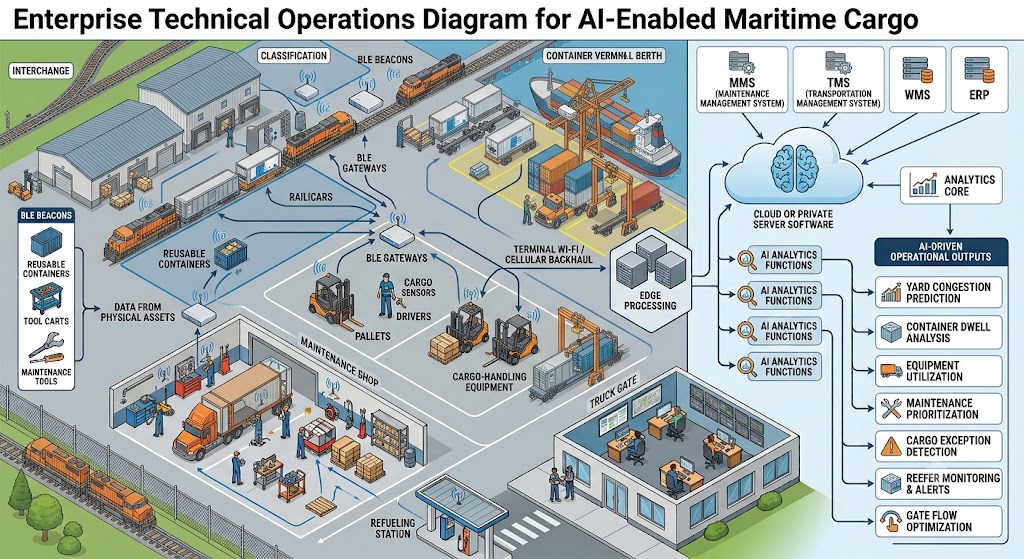
Enterprise Technical Operations Diagram for AI-Enabled Maritime Cargo
This isometric technical diagram details a container port environment and its digital twin infrastructure. Key operational assets—including container vessels, cranes, terminal tractors, and maintenance tools—are integrated with Bluetooth Low Energy (BLE) beacons and gateways for precise tracking. The resulting physical data feeds, alongside information from other port systems, flow through edge processing into a cloud-based AI core that drives outputs for yard congestion prediction, equipment utilization, reefer monitoring, and operational optimization.
AI Applications Across Maritime Cargo Operations
AI Container Demand Forecasting and Yard Capacity Planning
AI can analyze historical cargo volumes, vessel schedules, container flows, seasonal patterns, customer requirements, and yard utilization to forecast future container demand. These forecasts can support capacity planning and resource allocation across terminal operating areas.
AI Container Dwell and Congestion Management
AI can identify containers that remain in the terminal longer than expected and analyze the operational factors contributing to extended dwell. Yard density, retrieval schedules, gate activity, vessel plans, and container movements can be evaluated to identify congestion risks.
AI Equipment Utilization and Maintenance
AI can combine equipment operating information, maintenance records, utilization patterns, fault events, and asset location information to identify maintenance priorities. This can help terminal teams plan service activities and improve equipment availability.
AI Cargo Exception and Anomaly Detection
AI can compare expected cargo workflows with actual operational events to identify unusual movements, unexpected delays, missing events, or other exceptions. These insights can support faster investigation and resolution.
AI Empty-Container Management
AI can analyze empty-container inventories, historical demand, shipping schedules, repositioning requirements, and terminal capacity to support more efficient empty-container management. Predictive analysis can help identify potential imbalances before they affect operations.
AI Maritime Cargo Security and Loss Prevention
AI can analyze location events, access records, equipment movements, cargo transactions, and other operational information to identify unusual patterns. Combined with existing security systems, this can support investigation and response to potential cargo or equipment exceptions.
Maritime Cargo Data Flow and AI Decision Process
Data Acquisition
Data can be collected from BLE beacons, BLE sensors, BLE gateways, RFID systems, GPS devices, terminal systems, transportation systems, environmental sensors, equipment systems, and other operational sources. Each source contributes different information to the overall maritime cargo data environment.
Communication and Edge Processing
BLE gateways and other communication infrastructure can collect local device information and transfer it to edge processing systems. Edge processing can normalize events, filter unnecessary information, and support local operational requirements before data is transferred to enterprise or cloud platforms.
Middleware and Enterprise Software
Middleware can connect connected-device data with terminal operating systems, transportation management systems, warehouse management systems, enterprise resource planning systems, maintenance platforms, fleet systems, and other enterprise applications.
AI Analytics and Operational Action
AI analytics can process normalized operational data to identify patterns, predict potential constraints, detect anomalies, and generate decision-support information. Operational teams can then use these insights to adjust cargo flows, equipment allocation, maintenance priorities, and other activities.
BLE Hardware and AI Software for Maritime Cargo Operations
BLE Beacons for Selected Maritime Cargo Assets
BLE beacons can be attached to selected reusable assets, maintenance tools, equipment, carts, containers, or other operational objects where zone-level visibility is useful. Beacon deployment should be based on specific tracking requirements and the physical characteristics of the terminal environment.
BLE Gateways for Ports and Terminals
BLE gateways receive signals from nearby BLE devices and forward relevant information to edge or enterprise systems. Gateway placement can be designed around maintenance areas, warehouses, staging zones, reefer areas, truck lanes, and other controlled operational zones.
BLE Sensors for Maritime Cargo Environments
BLE sensors can provide environmental and operational measurements such as temperature, humidity, motion, or other supported conditions. These measurements can provide additional context for cargo, equipment, and facility monitoring.
AI, Middleware, and Maritime Cargo Software Integration
AI and middleware platforms can combine BLE observations with terminal transactions, cargo records, equipment information, vessel schedules, transportation data, and maintenance records. This integration creates a broader operational dataset for analytics and decision support.
Cloud and Server Deployment for Maritime Cargo AI
Cloud Version
A cloud-based deployment can provide centralized data processing, AI analytics, dashboards, device management, and integration capabilities across multiple maritime facilities. Cloud architecture can support scalable processing as the number of connected assets and operational data sources increases.
Server Version
A server-based deployment can process operational data within an organization’s controlled infrastructure. This approach may be appropriate where data residency, internal infrastructure, network architecture, or operational policies require local deployment.
Hybrid Deployment
A hybrid architecture can combine local edge or server processing with cloud-based analytics and centralized management. This approach can provide local resilience while supporting broader analytics and multi-terminal visibility.
Engineering Considerations for AI-Enabled Maritime Cargo Operations
BLE Coverage and Device Placement
Maritime terminals contain large metal structures, containers, cranes, vehicles, warehouses, and other physical obstacles that can affect wireless communication. BLE gateway placement and beacon positioning should therefore be validated through site surveys and radio coverage testing.
Asset Identity and Cargo Traceability
Connected-device data is most useful when each tracked asset has a controlled identity and relationship to enterprise master data. Asset identifiers, container records, equipment records, and location zones should be standardized before analytics and AI models are deployed.
Data Quality and Event Normalization
Operational systems may generate different event formats, timestamps, identifiers, and data frequencies. Edge and middleware systems should normalize these events so AI systems receive consistent and usable information.
Integration with Maritime Cargo Systems
AIoT solutions should be designed to work with existing terminal operating systems, transportation management systems, warehouse management systems, enterprise resource planning systems, CMMS/EAM platforms, reefer systems, fleet platforms, RFID systems, barcode systems, GPS, and computer vision where applicable.
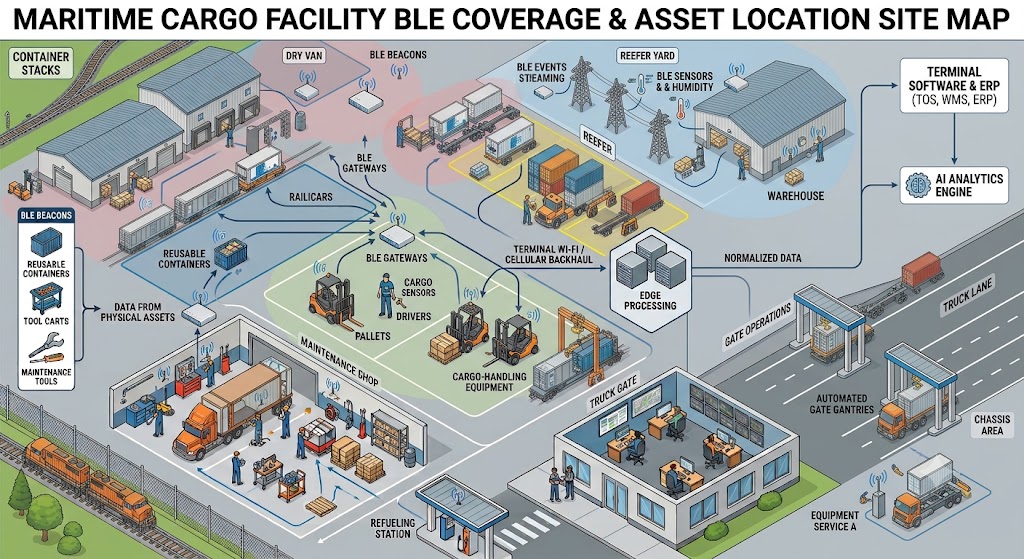
Maritime Cargo Facility BLE Coverage & Asset Location Site Map
This isometric site map illustrates how Bluetooth Low Energy (BLE) infrastructure can be selectively designed around key operational zones of a maritime cargo terminal, from the maintenance shop and warehouse to the reefer yard and truck lanes. BLE beacons track essential maintenance tools, tool carts, and service equipment, providing zone-level visibility. Environmental sensors also monitor humidity and temperature, streaming all events via BLE gateways to edge processing units for normalization before integration with terminal software and AI analytics engines.
AI Use Cases That Improve Maritime Cargo Performance
Predictive Vessel and Berth Planning
Predictive AI models can analyze vessel schedules, historical arrival patterns, berth availability, cargo volumes, weather information, and terminal constraints to identify potential scheduling issues and support better berth utilization.
AI Yard Congestion and Dwell Management
AI can analyze yard density, container dwell time, expected retrieval activity, gate transactions, and vessel schedules to identify congestion patterns and long-dwell risks. Terminal teams can use these insights to prioritize actions and improve yard flow.
Predictive Maintenance for Cargo-Handling Equipment
AI can combine equipment operating data, maintenance history, utilization, fault information, and location data to identify equipment that may require inspection or service. Predictive maintenance can help organizations prioritize maintenance resources based on operational conditions.
AI for Intermodal Fulfillment and Cargo Transfer
AI can analyze cargo movement between vessels, terminals, trucks, rail, and warehouses to identify transfer constraints. These insights can support better coordination across different transportation modes.
AI Reefer Exception Detection
AI can analyze temperature, humidity, alarm events, equipment status, and cargo location to identify abnormal reefer conditions. Exception prioritization can help teams respond to potential environmental issues more quickly.
AI Asset Utilization and Recovery
AI can analyze the location, movement, availability, and utilization of selected reusable operational assets. This can help identify underutilized equipment and improve recovery of tools, carts, and other mobile resources.
Cybersecurity and Data Protection for Maritime Cargo Operations
Connected maritime cargo environments should incorporate security controls across devices, gateways, networks, software platforms, integrations, and operational data. Key considerations include:
- Device authentication and controlled provisioning.
- Secure gateway configuration.
- Encrypted communications where supported.
- Network segmentation between operational and enterprise environments.
- Role-based access controls.
- Strong administrator authentication.
- Secure API integration.
- Software and firmware update procedures.
- Gateway and server logging.
- Asset inventory and device lifecycle management.
- Backup and disaster recovery procedures.
- Monitoring for abnormal device and network behavior.
- Data retention and access policies.
- Regular vulnerability assessment and security testing.
Deployment Lifecycle for Maritime Cargo Operations
Terminal Assessment and Planning
The deployment process begins with an assessment of terminal layouts, operational workflows, cargo processes, equipment, existing systems, network infrastructure, and specific visibility requirements. This assessment helps determine where connected technologies can provide useful operational information.
Hardware Selection and Pilot Deployment
BLE beacons, gateways, sensors, and other IoT devices should be selected according to environmental conditions, range requirements, battery requirements, mounting options, and data requirements. A pilot deployment can validate device performance before broader implementation.
Integration and System Testing
Connected-device data should be integrated with relevant terminal and enterprise systems. Testing should verify device communication, data quality, timestamps, asset identities, APIs, dashboards, AI outputs, and exception workflows.
Commissioning and Optimization
After system testing, the deployment can be commissioned in the target operational environment. Gateway positioning, device configuration, data processing, AI models, alerts, and operational workflows can be adjusted based on actual terminal conditions.
Scaling Across Terminals
Once the deployment is validated, standardized hardware configurations, data models, integration methods, cybersecurity controls, and operational procedures can support expansion to additional terminals and facilities.
KPIs for AI-Enabled Maritime Cargo Operations
- Vessel turnaround time.
- Berth utilization.
- Crane productivity.
- Container moves per hour.
- Yard density.
- Container dwell time.
- Long-dwell container percentage.
- Gate turnaround time.
- Truck processing time.
- Truck appointment adherence.
- Rail transfer cycle time.
- Cargo transfer completion time.
- Reefer exception response time.
- Reefer alarm resolution time.
- Equipment utilization.
- Equipment availability.
- Unplanned equipment downtime.
- Mean time between failures.
- Mean time to repair.
- Preventive maintenance compliance.
- Maintenance response time.
- Asset recovery time.
- Asset utilization rate.
- Empty container repositioning efficiency.
- Cargo exception resolution time.
- Inspection turnaround time.
- Inventory accuracy.
- Labor utilization.
- Energy consumption per cargo movement.
- Safety and security incident rates.
Practical Benefits of AI and BLE for Maritime Cargo Operations
AI and BLE can complement existing maritime cargo systems by providing additional operational context and analytical capabilities. AI can connect information from multiple systems, while BLE can provide localized visibility for selected assets, equipment, and environmental conditions.
- Better vessel and berth planning through predictive analysis.
- Improved yard capacity planning and congestion management.
- Earlier identification of long-dwell and abnormal cargo conditions.
- More effective crane and material-handling resource allocation.
- Reduced unplanned equipment downtime through predictive maintenance.
- Faster identification of reefer exceptions.
- Better visibility into selected reusable operational assets.
- Improved maintenance resource location and utilization.
- More efficient gate and truck-flow management.
- Improved coordination between terminal, warehouse, truck, and rail activities.
- More consistent operational reporting across facilities.
- Faster response to cargo and equipment exceptions.
- Improved use of historical operational data for planning.
BLE contributes most effectively where localized asset or environmental information is difficult to obtain through existing systems. AI then provides the broader analytical layer that connects those observations with cargo workflows and business decisions.
Implementation Recommendations for Maritime Cargo Operations
- Define specific cargo, yard, vessel, gate, equipment, reefer, or maintenance problems before selecting hardware.
- Establish baseline KPIs so improvements can be measured after deployment.
- Map existing TOS, TMS, WMS, ERP, CMMS/EAM, fleet, reefer, RFID, barcode, GPS, and computer vision data sources.
- Use BLE selectively for assets and zones where localized visibility creates operational value.
- Conduct radio coverage testing around containers, cranes, warehouses, vehicles, and metal structures.
- Establish controlled asset identities and master data before training AI models.
- Use edge processing where local resilience and low-latency decisions are important.
- Validate AI recommendations against actual terminal operating conditions.
- Maintain human approval for high-risk operational decisions.
- Design cybersecurity, access control, logging, and recovery procedures before production deployment.
- Pilot the solution in a representative operational area before expanding across the terminal.
- Measure operational improvements rather than focusing only on the number of connected devices.
- Establish device battery replacement, gateway maintenance, firmware management, and lifecycle procedures.
- Standardize integration and data models when expanding across multiple terminals.
Building More Responsive Maritime Cargo Operations with GAO
GAO supplies BLE, RFID, and other IoT technology-based hardware products and systems for organizations that need connected operational data. Our experience spans industrial sensing, wireless identification, asset monitoring, and IoT deployments supporting practical business workflows.
GAO is headquartered in New York City and Toronto, Canada, and has served U.S. and Canadian customers for approximately three decades, including Fortune 500 companies, leading R&D organizations, universities, and government agencies. Our substantial R&D investment supports continued development of BLE, RFID, and related IoT technologies.
For maritime cargo operations, our technology portfolio can support selected asset tracking, equipment monitoring, environmental sensing, identification, and data acquisition requirements. Deployment can be designed around existing terminal systems rather than requiring organizations to replace established cargo-management processes.
Our stringent quality assurance processes and remote and on-site technical support can help engineering and operations teams address device selection, deployment, integration, commissioning, troubleshooting, and system expansion.
Building the Future of Industrial AI and IoT with Aperture Venture Studio and GAO RFID Inc.
For more than three decades, GAO has invested heavily in industrial BLE, RFID, and IoT technologies. As AI became increasingly useful for industrial applications, we expanded our work to combine AI with connected technologies for transportation and logistics requirements. We have founded Aperture Venture Studio to support practical AI and IoT applications for maritime cargo operations, including cargo visibility, terminal operations, asset tracking, maintenance, reefer monitoring, and connected logistics workflows. Aperture brings together AI and IoT technical experts, operational executives, investors, and leading companies to advance practical applications through initiatives including the Aperture Ventures Summit and TekSummit.