
AI and BLE for Material Handling Equipment
What AI Means for Industrial Automation Equipment
AI for industrial automation equipment refers to the use of machine learning, Industrial AI, Edge AI, computer vision, and related analytical methods to interpret data generated by automation machinery and its operating environment. The AI system can use information from programmable logic controllers, industrial sensors, BLE devices, machine interfaces, maintenance records, production systems, and other data sources to identify conditions and recommend or initiate appropriate actions.
AIoT, or Artificial Intelligence of Things, combines artificial intelligence with IoT devices, sensors, connected equipment, and industrial systems. For industrial automation equipment, AIoT connects physical machine conditions with software-based analysis so that equipment data can contribute to maintenance, quality, operational, and engineering decisions.
BLE is an enabling technology within this broader solution. BLE sensors can provide wireless measurements from equipment components or surrounding conditions, while BLE beacons can identify equipment, tools, mobile assets, workstations, or service locations. BLE gateways collect nearby device data and forward it to edge software, servers, or cloud services.
The engineering objective should be to select the sensing and communication method according to the equipment and use case rather than forcing every application into the same connectivity model. BLE can be particularly useful where low-power wireless sensing, retrofit installation, equipment identification, or localized asset visibility is required.
AI and BLE Architecture for Industrial Automation Equipment
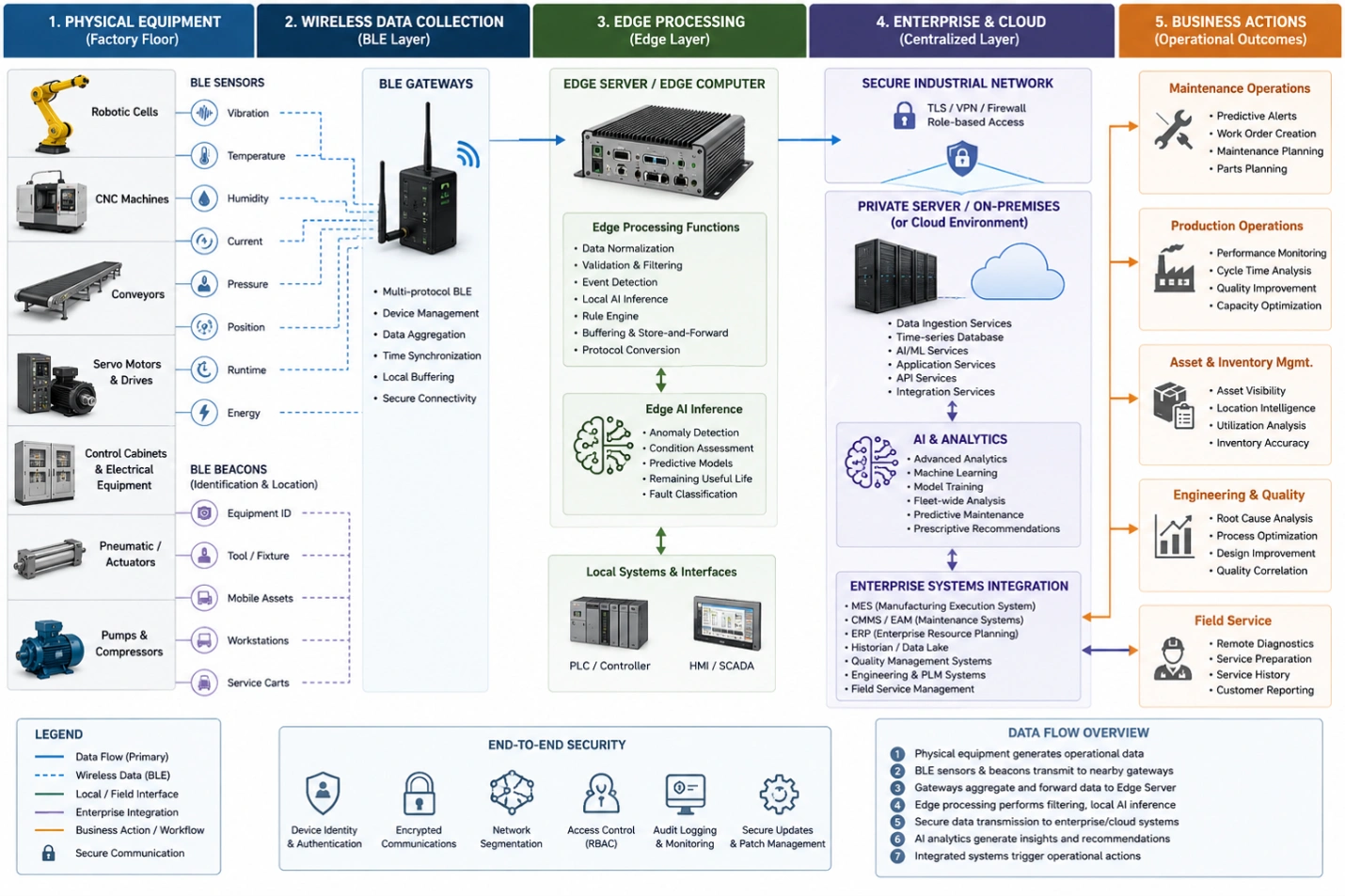
This industrial system diagram shows how robotic cells, CNC machines, conveyors, servo drives, and other automation equipment connect through BLE sensors, beacons, and gateways to edge processing, secure industrial networks, AI analytics, and enterprise software. It illustrates how equipment data supports predictive maintenance, production monitoring, asset management, engineering analysis, and field service decisions.
Where AI Delivers Value in Industrial Automation Equipment
Predictive Maintenance for Automation Machinery
Predictive maintenance is one of the most practical AI applications for industrial automation equipment. Machine learning models can analyze equipment condition indicators and historical maintenance records to identify patterns associated with developing faults.
Relevant equipment can include:
- Industrial robots and robotic cells
- Programmable automation systems
- CNC machines and machining centers
- Automated assembly equipment
- Conveyor systems and material-handling machinery
- Servo motors and servo drives
- Variable-frequency drives
- Pneumatic and electromechanical actuators
- Industrial pumps and compressors
- Control cabinets and electrical equipment
- Automated inspection machinery
- Packaging and labeling equipment
BLE vibration, temperature, or environmental sensors can supplement existing machine data when additional instrumentation is needed. The resulting data can be evaluated at the edge or transmitted to centralized software for model inference and historical analysis.
A useful predictive-maintenance system should distinguish between normal operating variation and genuine degradation. For example, vibration from a robotic actuator can vary with payload, motion profile, speed, and production cycle. A model that ignores these variables can generate excessive false alarms. Equipment context, operating state, and historical baseline data are therefore as important as the sensor measurement itself.
Condition Monitoring for Industrial Automation Equipment
Condition monitoring provides continuous visibility into equipment health without requiring maintenance personnel to perform every inspection manually. AI can establish operating baselines and identify deviations involving temperature, vibration, energy consumption, runtime, environmental conditions, or other measurable variables.
BLE sensors can be useful for retrofit condition monitoring because wireless devices can reduce installation effort on equipment where new wiring would interfere with production or require substantial electrical work. Battery-powered sensors can also support monitoring of rotating, mobile, or difficult-to-wire components, subject to the sensing requirements and installation environment.
GAO provides BLE, RFID, and IoT hardware products and systems that can be incorporated into industrial monitoring and asset-visibility solutions. Its experience serving organizations in the United States and Canada includes Fortune 500 companies, research organizations, universities, and government agencies, supported by R&D and quality-assurance activities.
Equipment Identification and Location Intelligence
Industrial automation equipment manufacturers often need accurate information about where machines, tools, fixtures, test equipment, spare assemblies, and mobile production assets are located. AI can combine asset identity, location events, maintenance history, utilization information, and production context to identify operational patterns.
BLE beacons can provide equipment or asset identity, while BLE gateways can capture proximity or location-related events. AI software can then identify unusual movements, prolonged inactivity, unexpected equipment relocation, or utilization patterns that may affect maintenance and production planning.
This capability is particularly useful for large manufacturing facilities containing multiple production cells, maintenance areas, warehouses, testing zones, engineering laboratories, and service locations. It can also support field-service organizations that need visibility into equipment movements and service histories.
AI-Assisted Quality and Process Monitoring
Industrial automation equipment frequently contributes directly to assembly, machining, inspection, packaging, testing, and material-handling processes. AI can analyze equipment and process data to identify relationships between machine conditions and quality outcomes.
Potential applications include:
- Detecting machine conditions associated with increased defect rates
- Identifying abnormal cycle-time behavior
- Correlating equipment temperature or vibration with process deviations
- Detecting unusual actuator or motor behavior
- Identifying production cycles that differ from established operating patterns
- Supporting root-cause analysis after quality events
- Prioritizing machines for engineering investigation
- Combining equipment data with inspection and production records
Computer vision can complement sensor-based AI when visual inspection is required. Machine learning can also combine time-series sensor data with structured production records, allowing engineers to investigate equipment behavior rather than examining individual sensor values in isolation.
Industrial Automation Equipment Workflow from Data Capture to AI Decisions
A production-ready AI solution requires more than sensors and a machine-learning model. The complete workflow begins with reliable data acquisition and ends with an operational action.
Equipment Data Acquisition
Data can originate from existing industrial control systems as well as newly installed sensors. Relevant sources may include PLC tags, machine controllers, industrial sensors, vibration sensors, temperature sensors, equipment runtime signals, maintenance records, and BLE devices.
BLE sensors can collect measurements at defined intervals or according to event-driven requirements. BLE beacons can provide identity or proximity information. BLE gateways receive wireless transmissions from devices within their coverage area and make the information available to downstream software.
Sensor placement requires engineering consideration. A vibration sensor attached to the wrong mechanical location can produce data that has little diagnostic value. Temperature measurements can also be misleading when a sensor is exposed to ambient conditions instead of the component whose thermal behavior is being evaluated. Installation location, sampling rate, mounting method, battery life, radio coverage, and environmental conditions should therefore be defined during system design.
Communication and Edge Processing
The BLE gateway forms the connection between local wireless devices and the industrial data environment. Depending on the deployment, gateway software can normalize incoming data, apply filtering, buffer measurements during network interruptions, and forward relevant information to edge or centralized systems.
Edge processing is valuable when industrial automation equipment requires low-latency decisions, local operation, reduced bandwidth consumption, or continued functionality during intermittent external connectivity. AI inference can be performed locally when the model and computing resources support the requirement.
Server and Cloud Data Processing
Centralized processing enables longer-term analysis across equipment fleets, production lines, facilities, and maintenance histories. A private server deployment can be appropriate when industrial automation equipment data must remain within customer-controlled infrastructure or when integration requirements favor existing factory and corporate systems.
Cloud-hosted processing can provide centralized access for geographically distributed facilities and service organizations. The appropriate choice depends on cybersecurity requirements, data governance, connectivity, latency, integration requirements, and the organization’s operational model.
AI Analytics and Operational Action
AI analytics can transform raw equipment observations into classifications, anomaly scores, predictions, maintenance recommendations, or other decision-support outputs. Those outputs should be connected to operational workflows rather than treated as isolated analytics.
A practical workflow may progress from:
- BLE sensor or industrial equipment data capture
- BLE gateway or industrial network communication
- Data validation and normalization
- Edge filtering or local inference
- Secure transmission to server or cloud software
- Historical data storage
- AI model inference and anomaly detection
- Equipment health or maintenance assessment
- Alert prioritization
- Maintenance work-order or engineering investigation
- Verification of corrective action
- Model and operating-baseline refinement
AI and BLE Workflow for Industrial Automation Equipment
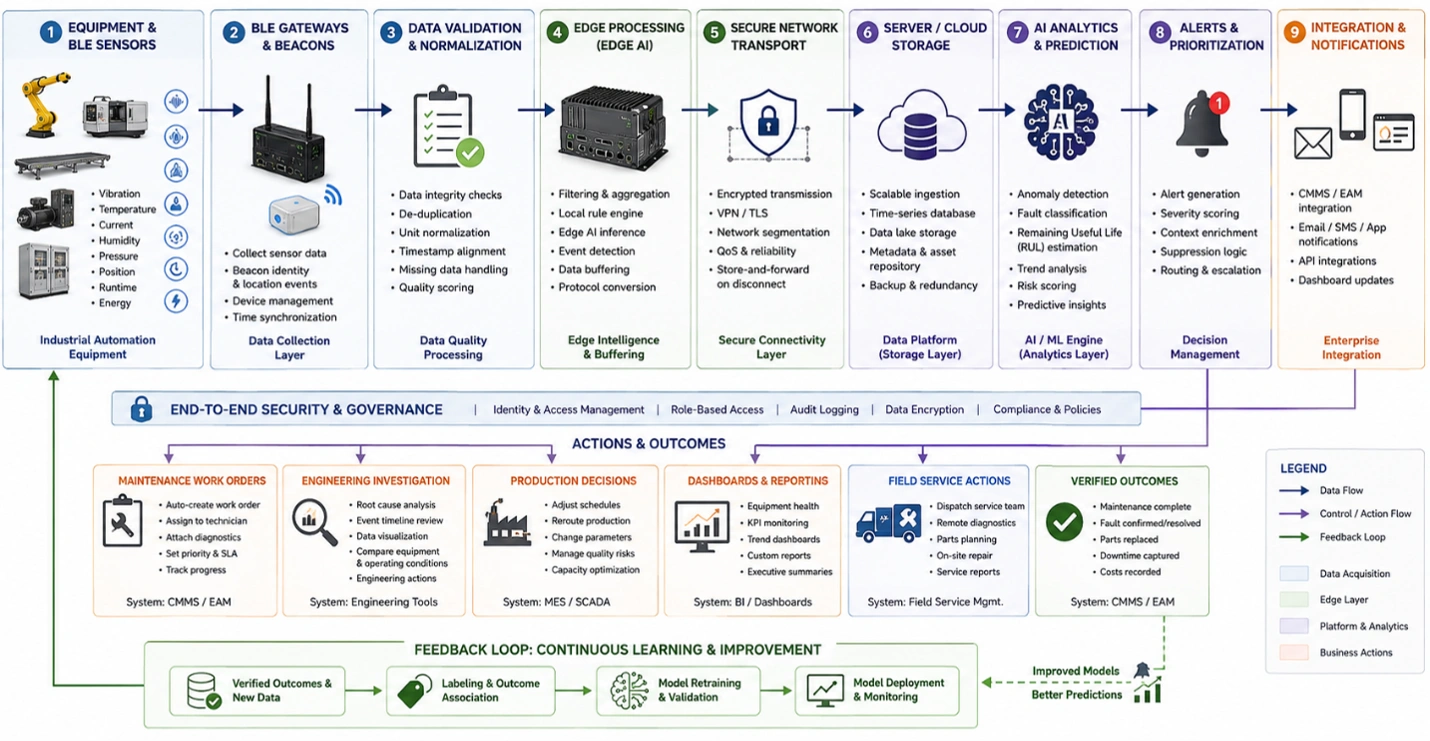
This workflow diagram shows how data from industrial automation equipment and BLE sensors moves through BLE gateways, data validation, edge processing, secure networking, server or cloud storage, and AI analytics. It connects AI insights to maintenance work orders, engineering investigations, production decisions, dashboards, and field-service actions, with verified outcomes feeding back into continuous model improvement.
AI Use Cases Across Industrial Automation Equipment Operations
Maintenance Engineering
Maintenance engineers can use AI-generated equipment-health indicators to prioritize inspections and planned interventions. Rather than treating every alarm equally, software can rank equipment according to anomaly severity, operating context, historical behavior, and maintenance consequences.
Production Engineering
Production engineers can use machine data to investigate cycle-time changes, recurring equipment-related quality issues, abnormal machine states, and differences between production cells. AI can help identify correlations that warrant engineering review.
Field Service
Connected industrial automation equipment can generate condition information that supports remote service teams. Historical equipment data can help service personnel understand operating conditions before arriving at a customer facility, improving preparation for troubleshooting and component replacement.
Asset and Equipment Management
BLE-based equipment identification and location data can support visibility into automation equipment, tools, fixtures, service equipment, and other operational assets. AI can analyze utilization and movement patterns to identify underused assets, unusual movements, or recurring operational bottlenecks.
AI Applications for Industrial Automation Equipment: Use Case Comparison
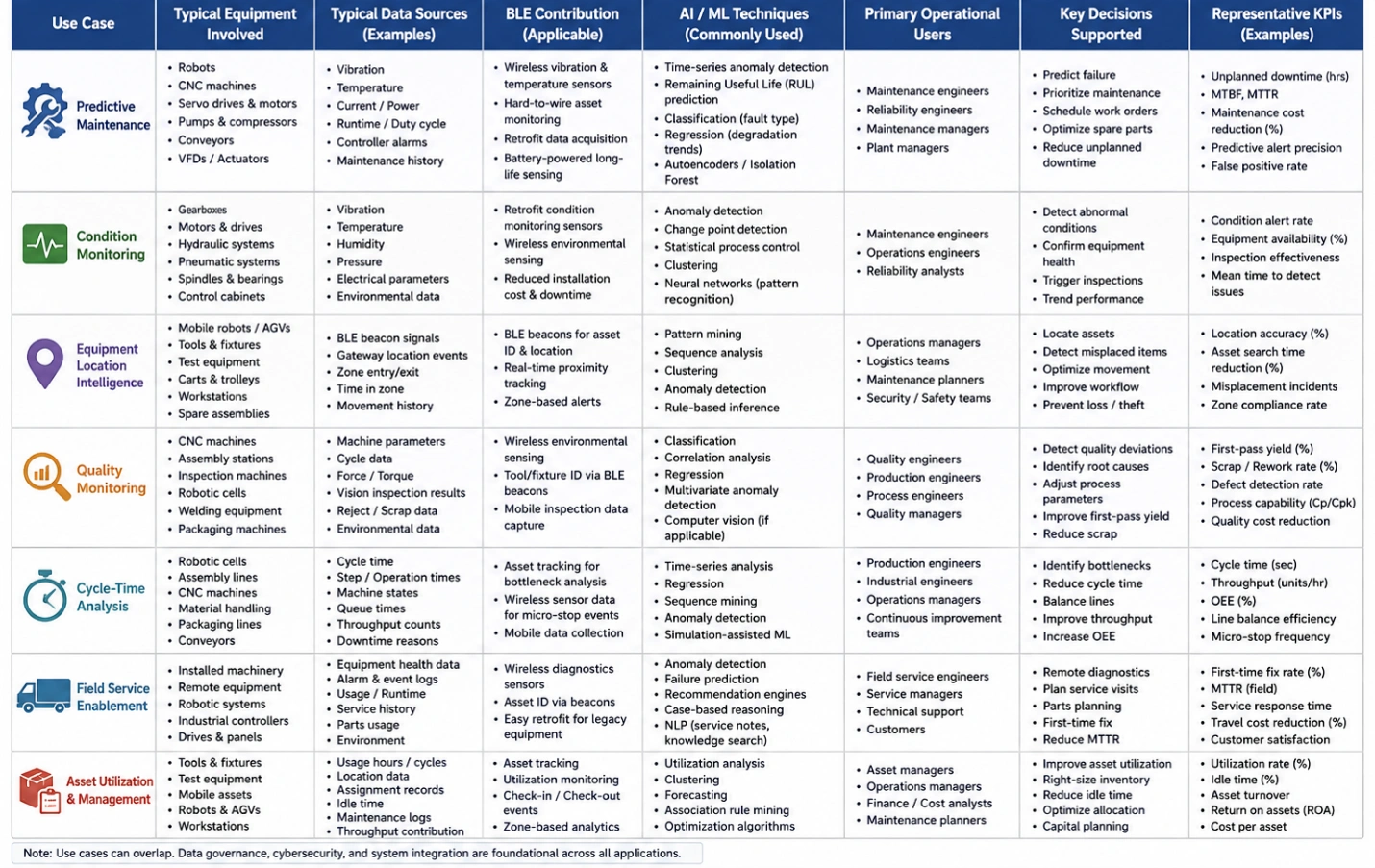
This comparison table maps seven AI applications for industrial automation equipment to their typical data sources, BLE contributions, AI and machine learning techniques, operational users, supported decisions, and representative KPIs. It highlights how predictive maintenance, condition monitoring, equipment location intelligence, quality monitoring, cycle-time analysis, field service, and asset utilization address distinct manufacturing needs.
Engineering Considerations for AI-Enabled Industrial Automation Equipment
Successful deployment depends on data quality, sensor selection, equipment context, network reliability, cybersecurity, and integration with existing industrial systems. AI should not be treated as a replacement for engineering controls or established maintenance procedures.
Important design considerations include:
- Define the operational decision before selecting sensors or AI models.
- Establish equipment-specific operating baselines rather than relying on generic thresholds.
- Determine whether existing PLC, SCADA, historian, MES, CMMS, or machine-controller data can supplement new BLE measurements.
- Select sensor locations based on the physical failure mode being monitored.
- Account for machine vibration, electromagnetic conditions, metal obstructions, temperature, dust, moisture, and other factory environmental factors when deploying BLE devices.
- Use gateway buffering or edge processing where network interruptions could otherwise result in lost equipment data.
- Validate AI alerts against maintenance findings and actual equipment conditions.
- Establish cybersecurity controls for gateways, servers, credentials, communications, software updates, and data access.
- Design the system so additional machines, production cells, and facilities can be incorporated without redesigning the entire data flow.
- Measure false positives and false negatives as carefully as detection rates because excessive alerts can reduce maintenance-team confidence.
GAO’s BLE, RFID, and IoT capabilities can support the hardware and data-acquisition requirements of these industrial automation equipment solutions, while the final system should be engineered around the customer’s equipment, production processes, data environment, and operational objectives.
AI-Enabled Industrial Automation Equipment Monitoring with BLE
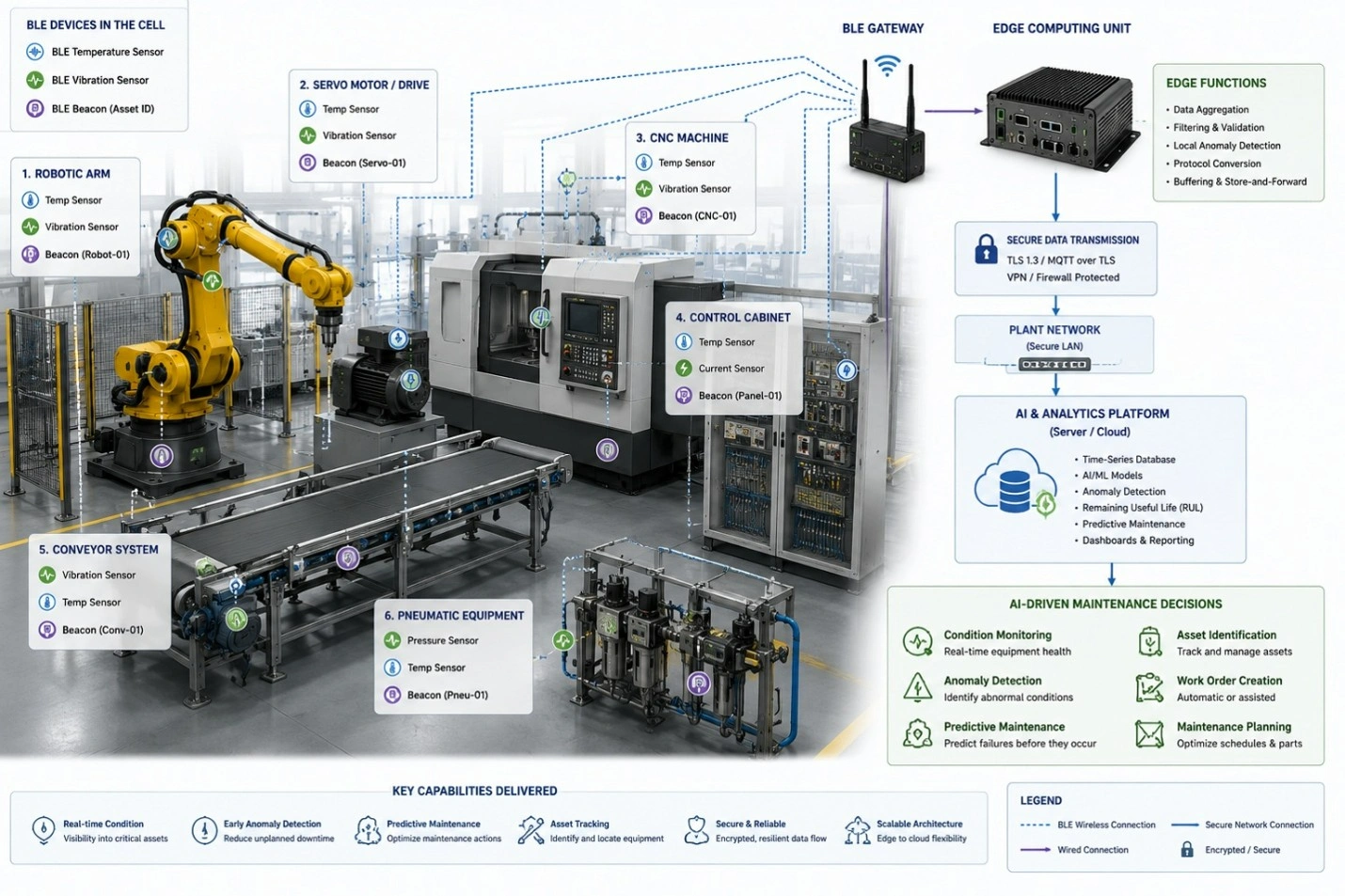
This illustration shows industrial automation equipment including a robotic arm, servo drive, CNC machine, conveyor, control cabinet, and pneumatic equipment equipped with BLE sensors and beacons. Data is collected through a BLE gateway and edge computing unit, then securely analyzed by AI software to support condition monitoring, anomaly detection, predictive maintenance, asset tracking, and maintenance planning.
BLE Hardware and AI Software for Industrial Automation Equipment
AI-enabled industrial automation equipment solutions typically combine sensing hardware, wireless connectivity, edge computing, centralized software, AI analytics, and integration with existing manufacturing systems. The exact combination depends on the equipment being monitored, the required sampling rate, plant connectivity, cybersecurity requirements, and the operational decision the system must support.
BLE Sensors and Beacons
BLE sensors can provide additional measurements from industrial automation equipment without requiring extensive new wiring. Depending on the application, sensors can monitor variables such as temperature, vibration, humidity, motion, or other equipment and environmental conditions supported by the selected device.
BLE beacons provide an identity mechanism for equipment, tools, fixtures, mobile machinery, and service assets. They can be particularly useful when physical asset identification needs to be associated with maintenance records, equipment utilization, or location events.
Sensor selection should follow the failure mode or operational question being investigated. For example, monitoring a servo motor for abnormal thermal behavior requires a suitable temperature measurement location, while detecting mechanical degradation may require vibration sensing at a mechanically meaningful mounting point.
BLE Gateways and Industrial Connectivity
BLE gateways receive wireless data from sensors and beacons and transfer it into the industrial automation equipment data environment. Gateway placement should consider BLE radio coverage, machinery layout, metal structures, production-cell boundaries, network availability, and maintenance access.
The gateway can also serve as an edge data-processing point. Functions may include device identification, data validation, timestamp handling, local buffering, protocol conversion, filtering, and forwarding to downstream software.
Industrial networks may incorporate Ethernet, Wi-Fi, cellular connectivity, or other plant-approved communication methods. The BLE layer should complement existing industrial communications rather than interfere with safety-related control networks.
Edge AI and Machine Learning
Edge AI can process equipment observations close to the production environment. This approach can reduce data transmission requirements and support rapid responses where centralized processing is not necessary or where external connectivity is intermittent.
Suitable AI methods depend on the application. Time-series anomaly detection can identify deviations from normal machine behavior. Classification models can distinguish operating conditions or fault categories when sufficiently labeled data exists. Regression models can estimate equipment parameters or remaining operating characteristics. Clustering and other unsupervised methods can help establish operating patterns when labeled failure data is limited.
Industrial AI models should be evaluated against actual equipment behavior. A model that performs well on historical laboratory data may behave differently after deployment because production loads, machine configurations, ambient conditions, maintenance practices, and operating schedules change.
Cloud Version
A cloud-hosted software deployment can centralize equipment data and AI analytics across multiple manufacturing facilities. It is useful when organizations need consolidated visibility into geographically distributed industrial automation equipment, remote service operations, or centralized analytics.
A cloud deployment should include secure device authentication, encrypted communications, role-based access, data retention controls, monitoring, and appropriate network segmentation. Edge processing can continue to handle time-sensitive functions while the cloud provides centralized historical analysis and management.
Server Version
A privately hosted server deployment can run software on factory servers, customer-managed infrastructure, private data centers, or other controlled enterprise computing environments. This approach can be appropriate when industrial automation equipment data must remain within customer-controlled infrastructure, when plant connectivity to external cloud services is restricted, or when integration with existing manufacturing software requires local deployment.
The Server Version does not necessarily mean a completely isolated facility. It can operate across privately controlled enterprise infrastructure connecting multiple locations according to the organization’s networking and security policies.
The choice between Cloud Version and Server Version should consider:
- Data governance and retention requirements
- Factory network connectivity
- Cybersecurity policies
- Latency requirements
- Integration with MES, SCADA, historians, CMMS, ERP, and maintenance systems
- Number of facilities and machines
- Remote-service requirements
- IT ownership and operational support
- AI model update procedures
- Disaster recovery and backup requirements
GAO’s role can include supplying the BLE, RFID, and IoT hardware required for data capture and connected equipment solutions, while deployment teams integrate those components into the customer’s broader industrial automation equipment environment.
AI-Enabled Industrial Automation: Cloud vs. Server Deployment Comparison
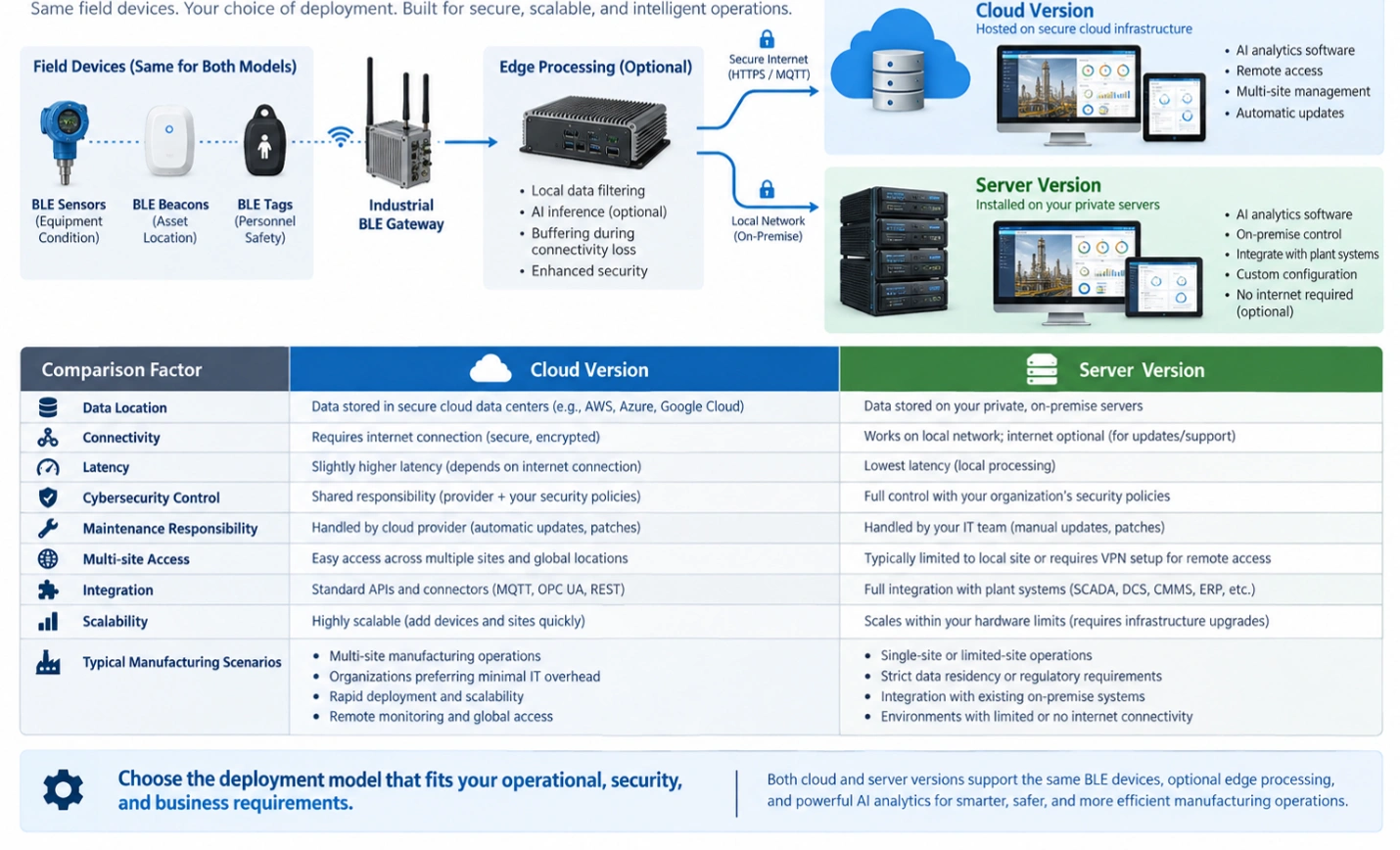
This visual compares cloud and on-premises server deployment models for AI-enabled industrial automation, showing how BLE sensors, beacons, tags, and industrial gateways connect through optional edge processing. It highlights key differences in data location, connectivity, latency, cybersecurity control, maintenance, multi-site access, integration, scalability, and typical manufacturing scenarios. The key takeaway is that both models support the same field devices and AI capabilities while offering different operational and IT advantages.
Integrating AI with Existing Industrial Automation Systems
AI should normally complement rather than replace established industrial control and manufacturing software. Integration design should identify which system remains authoritative for each type of information.
PLC and machine-controller systems can remain authoritative for control-state information. SCADA systems can continue to provide supervisory visibility. Historians can retain time-series operational data. MES systems can provide production context, while CMMS or EAM software can manage maintenance activities. ERP systems can contain broader business and asset records.
AI software can consume relevant information from these systems and return actionable outputs without creating a parallel source of truth.
Potential integration points include:
- PLC and industrial controller data
- SCADA systems
- Industrial historians
- MES and production tracking systems
- CMMS and EAM software
- ERP systems
- Quality-management systems
- Engineering databases
- Field-service software
- Maintenance work-order systems
- BLE gateways and IoT gateways
A practical implementation should establish data ownership, timestamp conventions, equipment identifiers, naming conventions, units of measurement, and failure-event definitions before model development begins.
Equipment Identity and Data Context
AI results become more useful when each measurement can be associated with the correct machine, component, production cell, operating condition, and time period. A temperature reading without equipment identity may have limited operational value.
BLE beacons can associate physical equipment or mobile assets with identifiers that software can map to equipment records. This enables the AI system to combine sensor observations with maintenance history, equipment specifications, production state, and service events.
Data Quality and Model Validation
Industrial data frequently contains missing measurements, communication gaps, sensor drift, maintenance-related changes, machine configuration changes, and inconsistent timestamps. These conditions should be addressed before AI outputs are used for maintenance or production decisions.
Validation should include:
- Sensor calibration and installation verification
- Gateway communication testing
- Timestamp and data-integrity checks
- Missing-data detection
- Baseline establishment
- Historical-event validation
- False-alarm analysis
- Model performance testing
- Operator and maintenance-team review
- Post-maintenance verification
AI should provide decision support appropriate to its confidence and validated operating range. Safety-critical machine control should remain governed by appropriately engineered control and safety systems rather than depending solely on a predictive AI output.
Cybersecurity for AI and BLE Industrial Automation Equipment
Connected industrial automation equipment introduces additional security considerations because wireless sensors, gateways, edge computers, servers, and AI software become part of the operational data path.
Security controls should include device authentication, credential management, encrypted communications where appropriate, network segmentation, controlled gateway access, software-update procedures, logging, monitoring, and role-based permissions.
BLE deployments should also account for radio coverage and physical access. Gateways should be installed in controlled locations and managed as networked computing devices rather than treated as passive receivers.
AI systems require additional protection around training data, model files, analytical outputs, application interfaces, and administrative accounts. Access to equipment-health information should be based on operational roles. Maintenance personnel may require detailed machine information, while management dashboards may only require aggregated performance indicators.
A strong industrial cybersecurity design should also consider what happens when communication fails. Equipment should continue to operate according to its existing control strategy, while gateways and edge systems can buffer noncritical measurements for later transmission where appropriate.
KPIs for AI-Enabled Industrial Automation Equipment
The effectiveness of an AI and BLE solution should be measured against operational outcomes rather than the number of connected devices. Relevant KPIs can include:
| KPI | What It Measures | Why It Matters |
|---|---|---|
| Unplanned downtime | Unexpected equipment stoppage | Indicates maintenance and reliability improvement |
| Mean time between failures | Interval between equipment failures | Measures equipment reliability |
| Mean time to repair | Time required to restore equipment | Shows maintenance responsiveness |
| Maintenance response time | Time from alert to maintenance action | Measures operational responsiveness |
| Predictive alert precision | Percentage of alerts that correspond to verified conditions | Indicates AI usefulness |
| False-positive rate | Alerts that do not correspond to actionable conditions | Indicates alert quality |
| Equipment availability | Percentage of planned time equipment is available | Links monitoring to production performance |
| OEE | Availability, performance, and quality | Connects equipment behavior with manufacturing performance |
| Cycle-time variance | Deviation from expected machine cycle time | Helps identify process and equipment abnormalities |
| Sensor data completeness | Percentage of expected measurements received | Measures data reliability |
| BLE gateway availability | Gateway operational availability | Indicates reliability of wireless data collection |
| Asset location accuracy | Accuracy of equipment or asset-location information | Supports equipment management and service workflows |
KPIs should be established before production deployment so that improvement can be demonstrated against a defined baseline.
Deployment Strategy for Industrial Automation Equipment AI
A phased deployment generally reduces technical and operational risk. The first stage should define a specific equipment problem with measurable business impact rather than attempting to instrument an entire manufacturing operation immediately.
Select the Equipment and Failure Mode
Choose equipment where an operational problem is already understood. Suitable candidates may include high-value robotic cells, critical CNC machinery, production bottlenecks, frequently failing motors, or equipment with expensive unplanned downtime.
The team should identify the failure modes, available machine data, maintenance history, existing instrumentation, and operational consequences before selecting additional BLE sensors.
Establish the Baseline
Measure current downtime, failure frequency, maintenance effort, alert performance, production losses, and relevant quality indicators. This baseline becomes the reference for evaluating the AI solution.
Install and Commission the Sensing System
Commissioning should verify sensor placement, device identity, gateway coverage, network connectivity, timestamps, data completeness, and environmental suitability. BLE devices should be tested under actual factory operating conditions rather than only in an office or laboratory environment.
Train and Validate AI Models
Historical data can be used where available, but models should also be evaluated against live operating conditions. Maintenance events should be captured so that predicted abnormalities can be compared with actual findings.
Integrate with Maintenance and Production Workflows
An AI alert becomes operationally valuable when the responsible team knows what action to take. Integration may include maintenance notifications, CMMS work orders, engineering investigations, production reviews, or service escalation.
Expand by Equipment Class
Once the first deployment demonstrates reliable data collection and useful predictions, the solution can expand to additional machines with similar characteristics. Equipment classes should not automatically share identical thresholds or models because different machine configurations and operating profiles may produce materially different data.
Practical Engineering Lessons for Industrial Automation Equipment
Several implementation principles are particularly important when combining AI with BLE-based industrial monitoring.
- Start with a measurable equipment problem rather than a technology inventory.
- Treat sensor placement as an engineering decision, not simply an installation task.
- Use machine operating state as context for AI analysis.
- Combine BLE data with PLC, SCADA, historian, MES, and maintenance records where those sources improve diagnostic accuracy.
- Keep safety functions independent from non-safety AI analytics unless the complete application has been engineered and validated for the applicable safety requirements.
- Design for communication outages, sensor replacement, battery maintenance, and gateway failure.
- Track model performance after deployment because machine behavior and production conditions can change.
- Establish a process for reviewing false positives and false negatives with maintenance engineers.
- Use equipment-specific baselines where machines have substantially different loads, configurations, or duty cycles.
- Preserve clear equipment identifiers so AI outputs can be tied to physical machinery and maintenance records.
- Consider lifecycle costs including sensor batteries, gateway maintenance, network infrastructure, software administration, and model maintenance.
- Validate cybersecurity controls before connecting new gateways or edge computers to production networks.
GAO can support organizations that require BLE, RFID, and IoT hardware for these connected industrial automation equipment applications. GAO’s headquarters in New York City and Toronto, Canada support its activities as a B2B and B2G supplier, with the broader GAO organization serving customers across the United States and Canada for approximately three decades.
Business Value of AI for Industrial Automation Equipment
The strongest business case for AI-enabled industrial automation equipment comes from connecting technical measurements to measurable manufacturing outcomes.
Predictive maintenance can reduce avoidable unplanned downtime by identifying developing equipment abnormalities earlier. Condition monitoring can reduce reliance on periodic manual inspection for suitable equipment. Equipment identification and location intelligence can reduce time spent searching for mobile assets, tools, fixtures, and service equipment. AI-assisted process analysis can help engineering teams investigate relationships between machine behavior and production quality.
For equipment manufacturers, connected monitoring can also strengthen service operations by providing additional information about deployed equipment. Service personnel can use historical operating information to investigate problems, prepare replacement parts, and prioritize service activity.
Scalability is another potential advantage. Once data models, equipment identifiers, gateway management procedures, cybersecurity controls, and integration patterns have been established, additional equipment can be incorporated using standardized engineering practices.
Building an AI and IoT Roadmap for Industrial Automation Equipment
A practical roadmap should connect the immediate equipment problem with longer-term manufacturing objectives.
A typical roadmap can include:
- Identify critical industrial automation equipment and operational bottlenecks.
- Map available machine, maintenance, quality, and production data.
- Identify gaps that require BLE sensors, beacons, or gateways.
- Define cybersecurity and network requirements.
- Select edge, Server Version, or Cloud Version processing according to operational requirements.
- Establish equipment-specific AI use cases and KPIs.
- Pilot the solution on a controlled equipment group.
- Validate predictions against actual maintenance findings.
- Integrate actionable results with maintenance and production workflows.
- Establish lifecycle procedures for sensors, gateways, software, and AI models.
- Expand validated use cases to additional equipment and facilities.
Conclusion: Turning Industrial Automation Equipment Data into Action
AI can make industrial automation equipment data more useful when machine measurements, equipment identity, operating context, and maintenance history are brought together. BLE sensors and gateways provide one practical method for collecting additional equipment and asset data, particularly for retrofit monitoring and wireless identification applications. The larger value comes from connecting those observations with Edge AI, machine learning, industrial software, maintenance workflows, and production engineering.
Organizations evaluating an AI-enabled industrial automation equipment project should begin with a defined operational problem, measurable KPIs, appropriate sensing, reliable data infrastructure, cybersecurity controls, and a validated maintenance or production workflow. GAO can provide BLE, RFID, and IoT hardware products and technical support that help organizations build these connected equipment solutions.
Building the Future of Industrial AI and IoT with Aperture Venture Studio and GAO RFID Inc.
For more than three decades, GAO Group of Companies has invested heavily in R&D covering industrial BLE, RFID, and IoT. As generative AI has become increasingly useful for industrial applications, we have continued developing AI and IoT technologies that connect intelligent software with real-world equipment, including BLE and RFID technologies. We have also established Aperture Venture Studio to support the development and scaling of AI and IoT solutions relevant to industrial automation equipment and other application areas.
Aperture brings together AI and IoT technical experts, experienced executives, investors, and leading companies. Through initiatives such as the Aperture Ventures Summit and TekSummit, advanced AI and IoT topics can be explored with technical and business communities.
We welcome you to engage with us as:
- Advisors, co-founders, or employees
- Investors
- Customers
GAO welcomes organizations seeking practical engineering expertise, BLE and RFID hardware, IoT systems, and technical support for AI-enabled industrial automation equipment.