
AI and BLE for Medical Campuses
AI-Driven Medical Campus Operations with BLE Location and Sensing
AI is changing how medical campuses manage mobile medical equipment, clinical assets, staff workflows, environmental conditions, patient movement, and facility operations. When AI applications receive reliable location and sensor data from BLE beacons, BLE gateways, and BLE sensors, healthcare organizations can move beyond basic asset visibility toward predictive and workflow-driven operations. A medical campus can use this combination to identify equipment availability, detect abnormal movement, predict operational bottlenecks, improve equipment utilization, and support faster responses to facility events. The resulting AIoT system can connect location and sensor data with clinical, facilities, inventory, maintenance, and enterprise software. For medical campuses, the value comes from converting continuously captured operational data into decisions that improve resource availability, workflow efficiency, safety, and service continuity without requiring every operational process to be manually monitored.
AI and BLE IoT for Medical Campus Operations
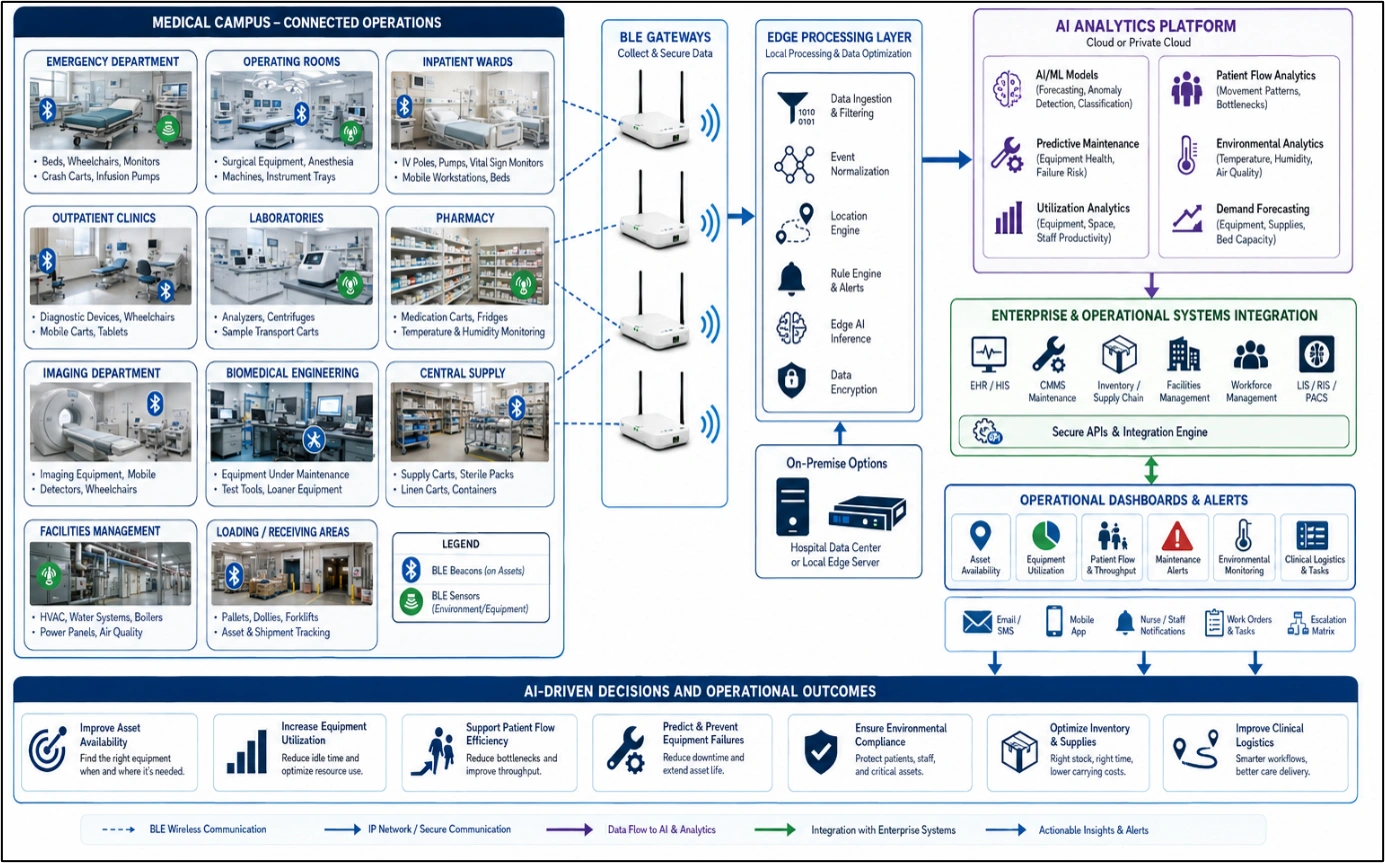
What AI Means for Medical Campus Operations
Artificial Intelligence of Things, commonly called AIoT or AI and IoT, combines artificial intelligence with IoT devices, sensors, connected equipment, and operational systems. In medical campuses, AIoT can combine machine learning, Edge AI, computer vision where appropriate, analytics, and connected sensing to interpret operational conditions and recommend or automate actions.
The objective is not simply to connect more devices. The objective is to create a reliable data path between physical healthcare operations and decisions made by clinical support, facilities, biomedical engineering, supply chain, and IT teams.
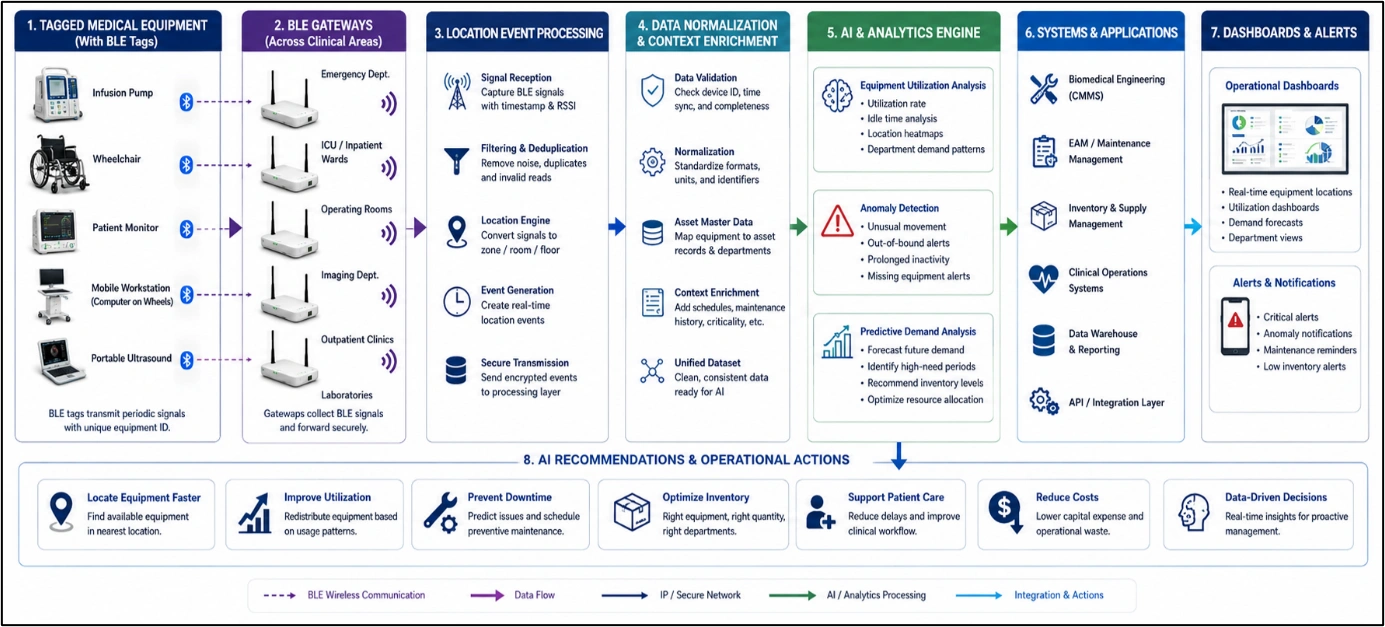
For example, a BLE-enabled medical equipment tracking system can provide the location history of infusion pumps, wheelchairs, patient monitors, mobile workstations, portable ultrasound equipment, or other tagged assets. AI software can analyze this information to identify utilization patterns, equipment shortages, unusual movement, prolonged idle periods, or recurring congestion.
The same principle applies to environmental and facility conditions. BLE sensors can capture selected temperature, humidity, occupancy, or equipment-related measurements. AI models can analyze those measurements alongside historical information, maintenance records, operational schedules, and other relevant data to identify abnormal conditions or predict potential problems.
The resulting solution can support several operational objectives:
- Improve the availability of mobile medical equipment.
- Reduce time spent searching for shared clinical assets.
- Identify underutilized or poorly distributed equipment.
- Support preventive and predictive maintenance programs.
- Detect abnormal asset movement or prolonged inactivity.
- Improve inventory and replenishment decisions.
- Support environmental monitoring in appropriate clinical and storage areas.
- Provide operational information to facilities and biomedical engineering teams.
- Identify workflow bottlenecks affecting medical campus operations.
- Supply structured operational data to downstream healthcare software.
GAO provides BLE, RFID, and IoT hardware products and systems that can serve as the physical data-collection layer for these applications. The engineering challenge is then to select appropriate sensors, gateway locations, communication methods, data-processing methods, and software integrations for the actual medical campus environment.
Medical Campus Use Cases for AI-Powered Asset and Workflow Management
AI Medical Equipment Tracking
Mobile medical equipment is frequently shared among departments. When staff cannot determine where an available device is located, time can be lost searching across patient-care areas, equipment rooms, corridors, procedure areas, and storage locations.
BLE asset tracking can provide location events that AI software analyzes over time. Instead of displaying only the current location of a tagged asset, the system can examine utilization patterns and identify recurring operational problems.
Relevant AI functions include:
- Predicting periods of high equipment demand.
- Identifying equipment that remains unused for unusually long periods.
- Detecting recurring movement patterns between departments.
- Identifying equipment that frequently leaves its assigned operational area.
- Supporting equipment redistribution based on historical demand.
- Generating alerts when selected assets enter or leave defined areas.
- Supporting biomedical engineering teams with equipment location history.
A key engineering consideration is location accuracy. Room-level visibility may be sufficient for some mobile equipment, while higher precision may be necessary for applications involving tightly controlled clinical workflows. Gateway placement, radio propagation, building materials, interference, beacon configuration, and tag orientation should therefore be evaluated during site commissioning rather than assumed from theoretical coverage.
AI-Supported Patient Flow and Operational Coordination
Patient movement through emergency departments, diagnostic services, procedure areas, clinics, and inpatient facilities can create complex operational patterns. AI can help analyze movement-related information when legally and operationally appropriate, while BLE technologies can provide location signals from designated devices, badges, equipment, or other approved assets.
Potential applications include:
- Identifying congestion around selected clinical areas.
- Measuring movement and dwell times for operational analysis.
- Detecting recurring workflow delays.
- Supporting capacity planning.
- Identifying bottlenecks between departments.
- Providing operational alerts when predefined conditions occur.
- Supporting facility managers with historical movement analysis.
Patient-related deployments require substantially stronger privacy, governance, consent, access-control, and data-retention considerations than ordinary equipment tracking. A medical campus should determine whether location data can be sufficiently anonymized, pseudonymized, aggregated, or otherwise controlled before AI analysis.
AI for Biomedical Equipment Utilization
Biomedical engineering departments need accurate information about equipment location, service status, utilization, and maintenance history. Combining asset identifiers with location events can improve the operational information available to biomedical engineering teams.
AI can analyze historical equipment activity to identify patterns such as:
- Frequent movement between departments.
- Unusually low utilization.
- Excessive demand for particular equipment categories.
- Repeated service events.
- Long periods outside expected operating areas.
- Equipment populations that may require redistribution or replacement planning.
This information can complement computerized maintenance management systems and other healthcare software. AI should support engineering decisions rather than replace required inspection, calibration, safety testing, or regulatory procedures.
AI-Enabled Clinical Supply and Inventory Operations
Medical campuses maintain large quantities of supplies across central stores, pharmacies, laboratories, procedure areas, operating rooms, nursing units, and other controlled locations. AI can analyze inventory movements and consumption patterns to improve replenishment planning.
BLE sensing and related IoT technologies can contribute location or environmental information for selected storage and logistics applications. AI can then combine those signals with inventory transactions, historical consumption, replenishment schedules, and other operational data.
Potential outcomes include:
- Better visibility into supply movement.
- Earlier identification of unusual consumption.
- Improved replenishment planning.
- Reduced manual inventory searches.
- Identification of recurring stock movement patterns.
- Improved allocation of shared supplies.
The technology should be selected according to the asset and process. BLE can be particularly useful for location and proximity-oriented applications, while RFID may be more appropriate for certain high-volume identification and inventory workflows.
Medical Equipment AI Tracking Workflow with BLE
Operational Challenges AI Can Address Across Medical Campuses
Medical campuses have operational characteristics that make connected AI systems technically demanding. Multiple buildings, reinforced walls, elevators, clinical equipment, restricted areas, high device density, and continuously changing workflows can affect wireless sensing and data quality.
Common challenges include:
- Staff spending excessive time locating mobile equipment.
- Equipment being concentrated in one department while another department experiences shortages.
- Limited visibility into actual equipment utilization.
- Incomplete maintenance-location information.
- Manual environmental monitoring in selected areas.
- Difficulty identifying recurring operational bottlenecks.
- Fragmented information across clinical, facilities, inventory, and maintenance systems.
- Wireless coverage variations between buildings and floors.
- Battery management for large numbers of battery-powered devices.
- Data governance requirements for patient-associated information.
- Cybersecurity risks created by connected devices and gateways.
- Integration challenges between IoT systems and existing healthcare software.
AI cannot compensate for poor source data indefinitely. A practical implementation should therefore establish reliable device identity, timestamp synchronization, location logic, gateway connectivity, data validation, and system monitoring before sophisticated AI models are introduced.
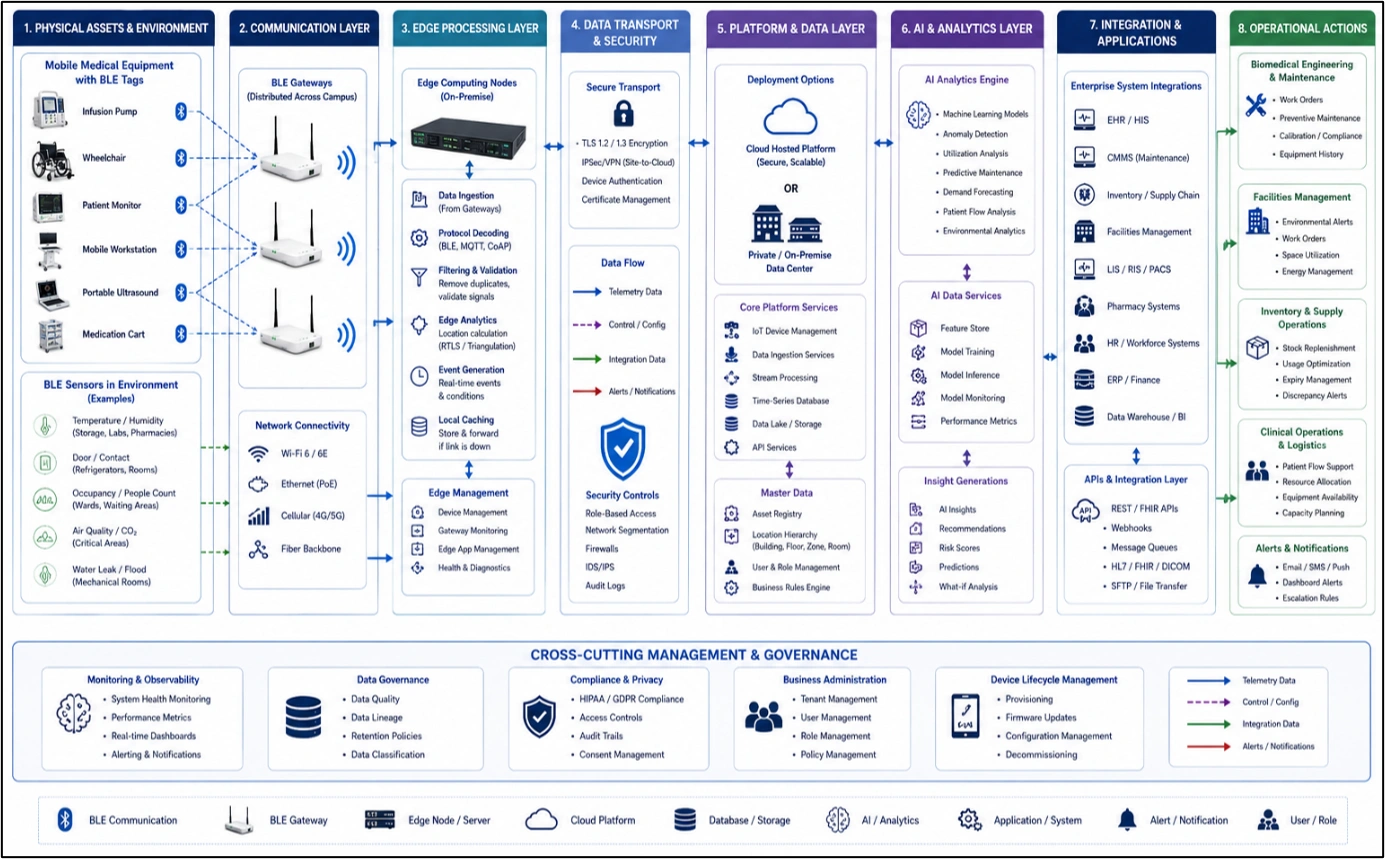
From BLE Signals to AI-Driven Medical Campus Decisions
A typical AI-enabled medical campus solution follows a multi-stage operational workflow.
Data Capture
BLE beacons and BLE sensors generate wireless signals or measurements associated with tagged equipment, selected locations, environmental conditions, or other approved operational objects.
Each device should have a controlled identity and configuration record. Battery status, transmission interval, sensor calibration where applicable, and device lifecycle information should also be monitored.
Gateway Collection and Communication
BLE gateways receive wireless signals and forward relevant data to an edge server, private server environment, or cloud-hosted software. Gateway placement should account for floor layouts, room construction, elevator shafts, equipment density, and areas where radio performance may be degraded.
Network connectivity can use Ethernet, Wi-Fi, cellular connectivity, or other appropriate IP-based communication methods depending on the building and deployment requirements.
Edge Processing and Data Normalization
Edge processing can reduce unnecessary network traffic and provide faster local processing. Gateway or edge software can filter duplicate observations, validate device identifiers, normalize timestamps, and transform raw wireless observations into structured events.
This stage is particularly useful when medical campus operations require rapid local response or when connectivity to external infrastructure is intermittent.
AI Analysis
AI software can analyze current events alongside historical operational records. Depending on the application, suitable methods may include anomaly detection, classification, forecasting, clustering, time-series analysis, optimization, and predictive modeling.
The appropriate model depends on the business problem. For example, forecasting equipment demand is different from detecting an abnormal movement pattern or identifying an unusual environmental measurement.
Healthcare Software Integration
Structured data can be transferred to relevant systems such as computerized maintenance management systems, inventory management software, facilities management software, workforce applications, operational dashboards, or other approved healthcare information systems.
Integration should be designed around clear data ownership and business processes. The IoT system should not become an isolated source of information that requires staff to manually duplicate events into existing software.
Operational Action
The final stage is a business or operational response. A biomedical engineer may receive an equipment-service notification. A facilities team may investigate an environmental anomaly. An inventory manager may adjust replenishment. A clinical operations team may investigate a recurring congestion pattern.
The objective is measurable operational improvement, not simply the production of another dashboard.
End-to-End AI and BLE Data Flow for Medical Campus Operations
Hardware, Software, and Deployment Choices for Medical Campuses
Medical campus deployments typically require more than BLE devices. A complete solution can include BLE tags and beacons, BLE sensors, gateways, networking equipment, edge computing resources, server or cloud software, databases, APIs, AI services, monitoring tools, and security controls.
BLE gateways collect wireless observations from multiple devices and provide an IP-connected path into the processing environment. BLE beacons can identify tagged assets or provide fixed reference points for location systems. BLE sensors can provide measurements relevant to approved environmental, equipment, or facility applications.
The software layer is responsible for device management, data collection, event processing, location logic, analytics, AI inference, alerting, reporting, and integration with existing medical campus systems.
GAO’s experience supplying hardware products and systems for organizations in the United States and Canada is relevant to deployments where device reliability, technical support, product selection, and system integration must be considered together. GAO also maintains stringent quality assurance processes and provides remote or onsite expert support for applicable deployments.
Cloud Version
A cloud-hosted deployment can centralize application software, databases, analytics, AI processing, monitoring, and remote administration. This model can be appropriate for medical organizations that require centralized management across multiple buildings or geographically distributed facilities.
Key considerations include:
- Healthcare data governance.
- Identity and access management.
- Encryption.
- Network connectivity.
- Data residency requirements.
- Integration with existing healthcare software.
- Cloud service availability.
- Operational responsibility between the healthcare organization and service provider.
Server Version
A Server Version can run on customer-managed edge servers, private data centers, facility servers, or other privately hosted enterprise infrastructure. This approach can be appropriate when the medical campus requires greater control over data processing, network boundaries, system integration, or operational availability.
A hybrid deployment can also place latency-sensitive processing closer to the medical campus while sending selected aggregated information to centralized infrastructure.
The correct choice depends on the medical organization’s cybersecurity requirements, IT policies, connectivity, data governance, AI-processing needs, and long-term support model rather than on a simple preference for cloud or private hosting.
Cloud vs. Server Deployment for AI-Enabled Medical Campus BLE Systems
Technical Capabilities and Operational Improvements
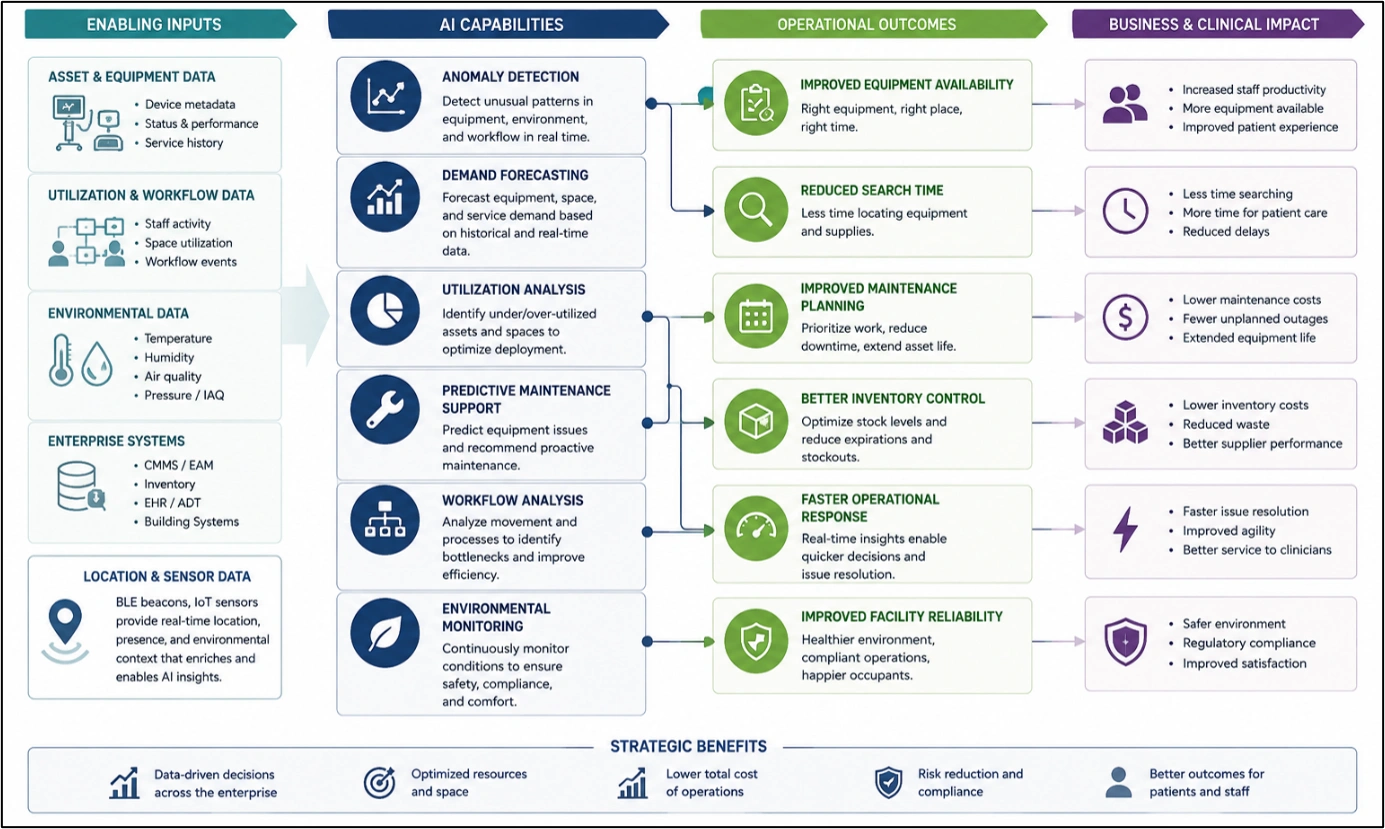
AI-enabled medical campus solutions become valuable when location, sensing, operational records, and AI analysis are connected to specific healthcare workflows. The resulting system can help medical organizations understand not only where equipment or other approved assets are located, but also how resources are used, where recurring delays occur, and which operating conditions require attention.
Intelligent Asset Utilization
AI can transform historical location events into equipment-utilization information. A medical campus can compare how frequently particular equipment categories move, where they spend most of their operating time, and which departments experience recurring shortages.
This supports decisions such as:
- Redistributing mobile equipment between departments.
- Identifying equipment that is consistently underutilized.
- Planning purchases using actual utilization patterns.
- Supporting capital replacement decisions.
- Identifying equipment categories that require additional inventory.
- Reducing unnecessary searches for shared clinical equipment.
The quality of these conclusions depends on the completeness and accuracy of the underlying location data. Asset identifiers should remain synchronized with equipment records, and changes such as equipment retirement, reassignment, repair, or replacement should be reflected promptly.
Predictive Maintenance Support
AI can analyze equipment location, movement patterns, service records, operating measurements, and historical failures when those data sources are available and appropriately integrated.
For example, a model could identify an unusual combination of repeated movement, abnormal sensor measurements, and maintenance history that warrants inspection. The AI output should be treated as a maintenance decision-support signal rather than an automatic replacement or repair instruction.
Biomedical engineering teams remain responsible for required inspection, calibration, testing, repair, and safety procedures.
Environmental Monitoring and Anomaly Detection
Selected medical campus environments require controlled conditions. Examples can include medication storage, laboratory areas, equipment rooms, specimen-related spaces, and other locations where environmental conditions affect operations.
BLE sensors can collect measurements such as temperature or humidity where technically appropriate. AI models can then establish normal operating patterns and identify deviations.
Useful functions include:
- Detecting abnormal temperature trends.
- Identifying repeated environmental excursions.
- Supporting escalation when measurements remain outside defined thresholds.
- Correlating environmental anomalies with equipment or facility events.
- Generating historical reports for engineering and operations teams.
Threshold-based alerts remain important. AI should complement established alarm limits rather than replace safety-critical controls.
Workflow Bottleneck Detection
Medical campus workflows involve multiple handoffs. A diagnostic process may involve registration, patient preparation, imaging, laboratory processing, reporting, and follow-up. Equipment and staff movement can also affect the timing of these processes.
AI can analyze aggregated operational events to identify recurring delays and unusual workflow patterns.
For example, historical data may reveal that a particular location experiences repeated congestion during specific periods or that equipment consistently remains unavailable after being moved to another department.
The operational response could involve scheduling changes, equipment redistribution, workflow redesign, or facilities intervention.
AI Medical Campus Benefits and Decision Map: From Smart Data to Operational Outcomes
Security and Data Governance for AI-Enabled Medical Campuses
Cybersecurity should be designed into the medical campus solution from the device layer through the application and AI-processing layers. Connected sensors and gateways introduce additional endpoints that must be identified, monitored, authenticated, and maintained.
Important controls can include:
- Unique device identities.
- Strong authentication for gateways and administrative users.
- Encrypted communication across untrusted network segments.
- Network segmentation between IoT devices and critical clinical systems.
- Role-based access control.
- Centralized logging and security monitoring.
- Controlled firmware and software updates.
- Asset inventory for connected devices.
- Credential lifecycle management.
- Secure API authentication.
- Data-retention controls.
- Audit trails for administrative and operational actions.
- Backup and recovery procedures.
A medical campus should also distinguish between operational IoT information and patient-associated information. A system tracking an infusion pump may primarily contain equipment identifiers and location events, whereas a system associating a person with a location introduces substantially greater privacy implications.
Data minimization is therefore an important engineering principle. The solution should collect the minimum information required for the operational objective, retain it for an appropriate period, and restrict access according to defined roles.
Where healthcare regulations or organizational policies apply, legal and compliance teams should determine the specific requirements for the deployment. Technical teams should then translate those requirements into access controls, encryption, retention, audit, network, and system-management controls.
Integrating AI, BLE, and Existing Medical Campus Systems
Integration determines whether an AI-enabled medical campus solution becomes part of normal operations or remains an isolated technology project.
Relevant systems may include:
- Computerized maintenance management systems.
- Facilities management software.
- Inventory management systems.
- Supply chain applications.
- Biomedical equipment databases.
- Laboratory information systems where appropriate.
- Pharmacy management systems where appropriate.
- Workforce management applications.
- Operational dashboards.
- Enterprise resource planning software.
- Security and access-control systems.
- Data warehouses and analytics systems.
APIs are generally preferable to manual data transfers when real-time or near-real-time information is required. Integration should define the source of truth for each important data element.
For example, the IoT system may be responsible for producing a current equipment-location event, while the biomedical equipment system remains authoritative for the equipment’s serial number, maintenance status, manufacturer information, and service history.
This separation prevents duplicate and conflicting records.
Interoperability and Data Normalization
Different systems may represent the same asset using different identifiers. A successful integration therefore requires a consistent identity-mapping strategy.
The integration layer should account for:
- Asset IDs.
- Serial numbers.
- Department identifiers.
- Building and floor identifiers.
- Location hierarchies.
- Device IDs.
- Event timestamps.
- Sensor units.
- Alert severity.
- Maintenance status.
- User or role identifiers where required.
Timestamp normalization is particularly important for AI analysis. If gateway observations use inconsistent time references, historical event ordering can become unreliable and produce misleading conclusions.
Engineering Considerations for BLE Deployment in Medical Campuses
BLE deployment should begin with a site survey rather than simply installing gateways according to theoretical radio range.
Medical campuses contain diverse construction materials and operational environments. Concrete walls, metal equipment, doors, elevators, medical devices, cabinets, and room layouts can affect wireless propagation.
Engineering teams should evaluate:
- Building floor plans.
- Room boundaries.
- Target location accuracy.
- Gateway mounting positions.
- BLE transmission intervals.
- Beacon power levels.
- Battery-life requirements.
- Expected device density.
- Wireless interference.
- Elevator and stairwell behavior.
- Restricted clinical areas.
- Network availability.
- Maintenance access.
- Device replacement procedures.
A pilot deployment should measure actual performance under normal operating conditions.
For asset tracking, useful test scenarios include equipment movement through corridors, entry into rooms, movement between floors, temporary storage, equipment maintenance, and removal from the medical campus.
The pilot should establish measurable performance criteria before scaling.
Potential KPIs include:
- Asset-location accuracy.
- Asset-location update latency.
- Percentage of successfully detected devices.
- Gateway availability.
- Battery replacement interval.
- False alert rate.
- Equipment search time.
- Equipment utilization rate.
- Maintenance response time.
- Environmental alert response time.
- Integration success rate.
- System uptime.
Scaling from a Pilot to a Multi-Building Medical Campus
A medical campus should avoid scaling solely by multiplying the number of devices used in a pilot. Larger deployments introduce additional operational and technical requirements.
A scalable implementation should define device provisioning, naming conventions, configuration management, firmware management, battery replacement, gateway monitoring, network addressing, user roles, data retention, and support procedures before large-scale rollout.
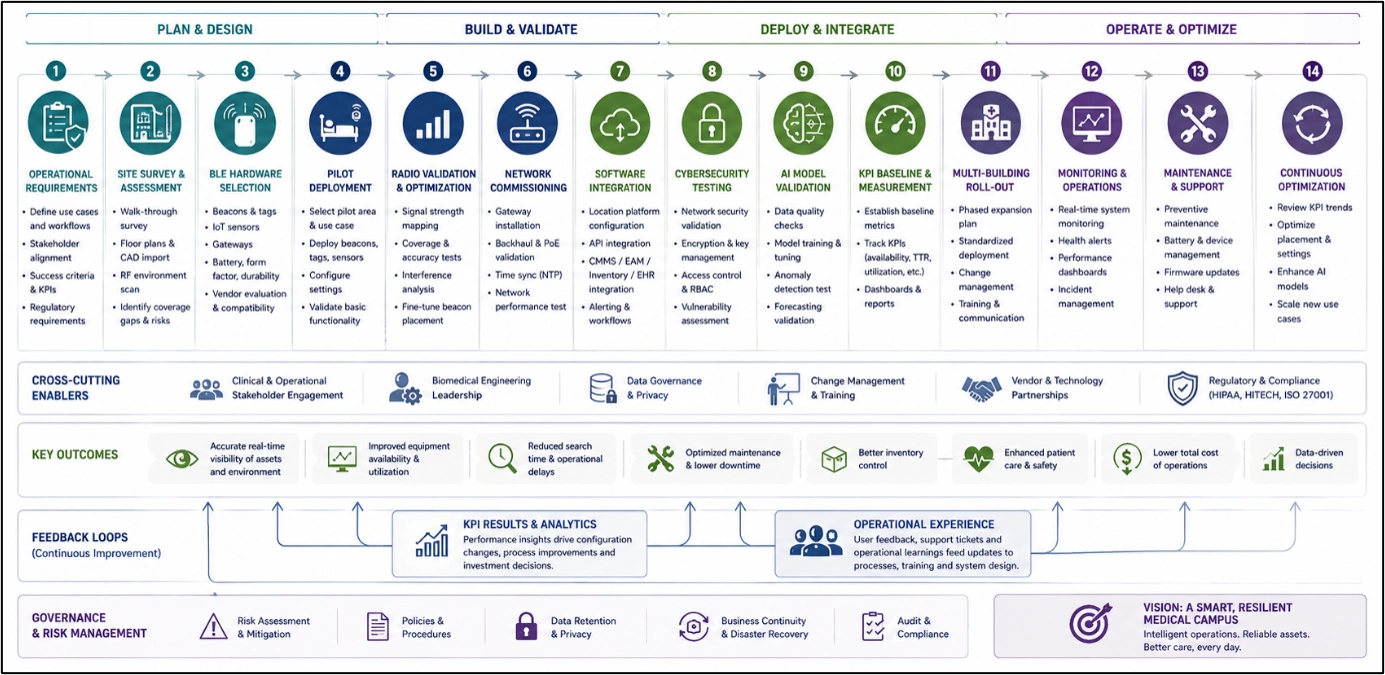
A practical deployment sequence can include:
- Define the operational problem and measurable KPI.
- Select the initial asset or workflow.
- Conduct a radio and network site survey.
- Select BLE tags, beacons, sensors, and gateways.
- Establish device identity and configuration standards.
- Deploy a controlled pilot area.
- Validate location and sensing performance.
- Integrate the required operational software.
- Test cybersecurity controls.
- Measure the agreed KPIs.
- Correct coverage and workflow problems.
- Expand to additional departments or buildings.
- Establish long-term maintenance and support procedures.
This approach reduces the risk of discovering fundamental coverage, integration, or data-quality problems after a campus-wide rollout.
Medical Campus BLE Deployment Lifecycle: From Planning to Continuous Optimization
AI Model Selection and Validation
AI model selection should follow the operational problem rather than the availability of a particular model.
For medical campus applications, different analytical approaches may be appropriate:
- Anomaly detection: Identifies unusual equipment movement, sensor behavior, or operational conditions.
- Time-series forecasting: Estimates future equipment demand or environmental trends.
- Classification: Categorizes operational events according to predefined patterns.
- Clustering: Identifies groups of similar equipment-use or movement behaviors.
- Optimization: Helps evaluate resource allocation or scheduling alternatives.
- Predictive modeling: Estimates the likelihood of selected operational events when sufficient historical data exists.
Model performance should be evaluated against real operational outcomes.
A model that produces technically impressive predictions but generates too many false alerts may increase workload rather than improve it. Medical campus AI systems therefore need performance metrics that reflect operational usefulness.
Human review should remain part of workflows where an incorrect recommendation could create material clinical, safety, maintenance, or operational consequences.
Practical Implementation Lessons for Medical Campus AIoT
Several engineering principles can improve the reliability of AI-enabled medical campus deployments.
- Start with a measurable operational problem rather than deploying sensors without a defined decision process.
- Establish asset and device identity before training analytical models.
- Treat wireless coverage as an engineering variable that requires field validation.
- Separate safety-critical alarms from experimental AI recommendations.
- Keep healthcare system ownership of authoritative records clear.
- Minimize patient-identifiable information where it is not operationally necessary.
- Design cybersecurity controls before connecting IoT devices to production networks.
- Monitor gateway health, battery levels, device connectivity, and data quality continuously.
- Validate AI models using real medical campus operating conditions.
- Measure false positives as carefully as successful detections.
- Build maintenance and device-replacement processes into the initial deployment plan.
- Scale only after the pilot demonstrates measurable operational value.
These principles help ensure that AI, BLE sensing, and connected medical-campus systems support actual workflows rather than adding another layer of disconnected technology.
GAO’s Role in Medical Campus IoT and AI Solutions
GAO supplies BLE, RFID, and other IoT hardware products and systems that can support healthcare-related tracking, identification, sensing, and connected operational applications. Our work can involve selecting appropriate wireless devices, gateways, sensors, and related equipment according to deployment requirements.
Headquartered in New York City and Toronto, Canada, GAO is recognized among the leading global B2B and B2G suppliers of BLE and RFID technologies. GAO and its sister companies, GAO Research and GAO Tek, operate as the GAO Group from these two cities.
For more than three decades, the GAO Group has served organizations throughout the United States and Canada, including Fortune 500 companies, R&D organizations, universities, and government agencies. Significant investment in research and development, quality assurance, and technical support has helped support deployments where product selection and engineering assistance are important considerations.
For medical campuses, this experience is relevant when BLE and IoT hardware must operate alongside existing networks, software, facilities, biomedical engineering processes, and operational requirements.
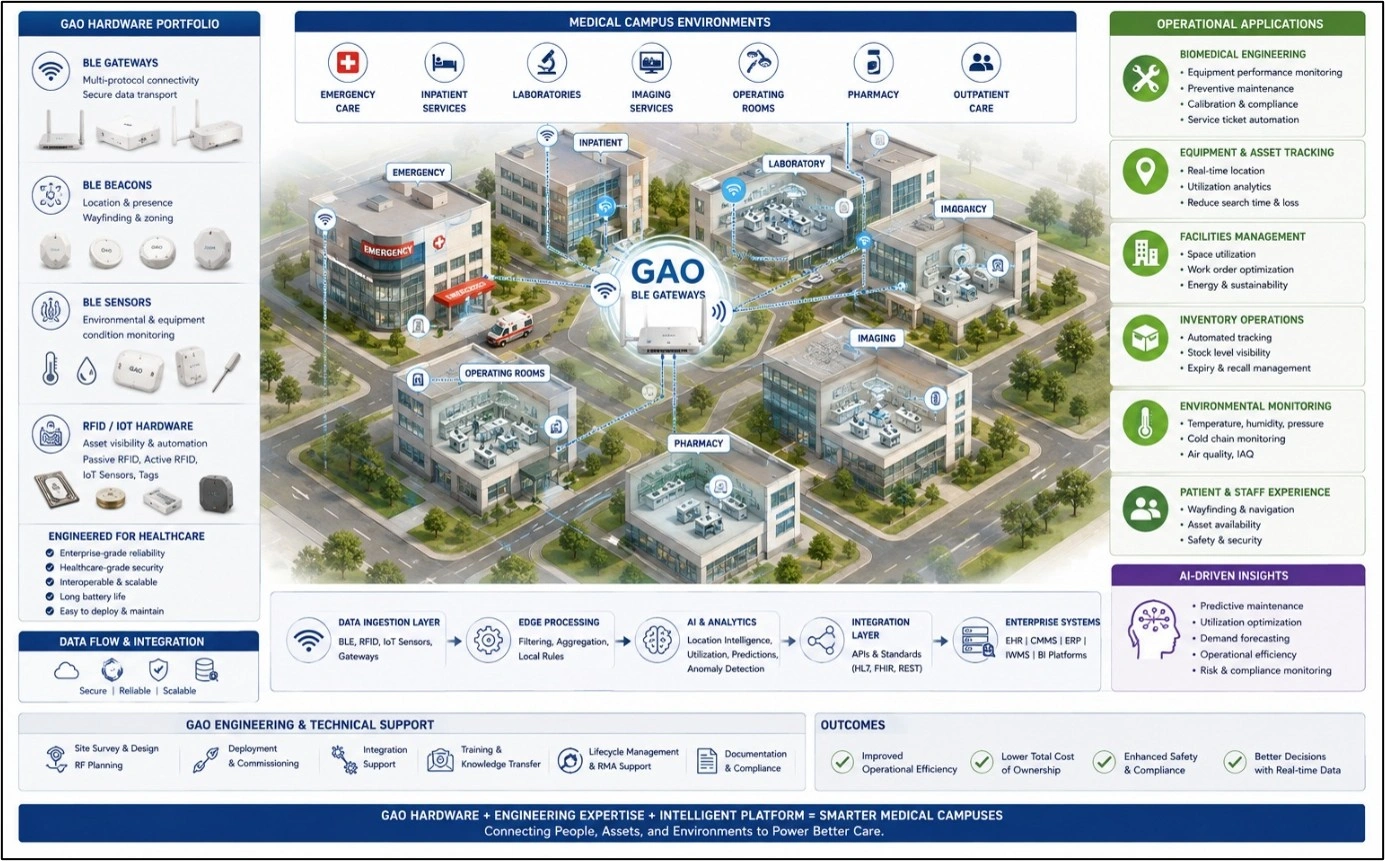
GAO Medical Campus Technology Integration: BLE, RFID, IoT, and Healthcare Systems
Key Takeaways for AI-Enabled Medical Campuses
AI can help medical campuses turn operational data into actionable information for equipment management, biomedical engineering, clinical logistics, facilities operations, environmental monitoring, inventory management, and workflow analysis.
BLE gateways, beacons, and sensors provide one practical source of location and sensing data, but their value depends on correct deployment, reliable networking, data governance, cybersecurity, and integration with existing healthcare software.
The most effective implementation strategy is to begin with a clearly defined operational problem, establish measurable KPIs, validate the physical deployment through a pilot, integrate the resulting data with existing workflows, and then scale after the technical and operational results have been demonstrated.
Medical organizations considering AIoT deployments can evaluate GAO’s BLE, RFID, and IoT products and systems according to their medical campus requirements and engage technical specialists for hardware selection, deployment planning, integration, and support.
Building the Future of Industrial AI and IoT with Aperture Venture Studio and GAO RFID Inc.
For more than three decades, GAO Group of Companies has invested heavily in R&D for industrial BLE, RFID, and IoT technologies. As AI has become increasingly useful for connected operational environments, we have expanded our work in AIoT and founded Aperture Venture Studio to support the development and scaling of AI and IoT solutions relevant to healthcare, medical campuses, and other industries.
Aperture has attracted AI and IoT technical experts, entrepreneurial and operational executives, investors, and leading companies. We have also developed Aperture Ventures Summit and TekSummit to facilitate discussion of advanced AI and IoT technologies.
We welcome participation as:
- Advisors, co-founders, or employees.
- Investors.
- Customers.