
AI for Mineral Processing Operations Using BLE
AI-Driven Mineral Processing Operations with BLE Asset Data
Artificial intelligence is increasingly being applied to mineral processing operations to improve equipment reliability, material tracking, process stability, quality control, energy management, and maintenance decisions. AI can analyze operating data from crushers, mills, conveyors, flotation cells, pumps, thickeners, screens, filters, and other processing assets to identify patterns that are difficult to detect through manual inspection alone. BLE provides a practical wireless layer for identifying, locating, and monitoring mobile assets, tools, maintenance equipment, personnel, containers, sample carriers, and selected sensor devices throughout processing facilities. BLE beacons, BLE sensors, and BLE gateways can provide location and condition data that complements PLC, SCADA, DCS, historian, laboratory, CMMS, and MES information. When these data sources are correlated, AI models can support predictive maintenance, asset utilization analysis, workflow optimization, anomaly detection, and operational decision-making across mineral processing operations.
Mineral Processing AI and BLE Operations Overview: Connected Plant Workflow and Analytics
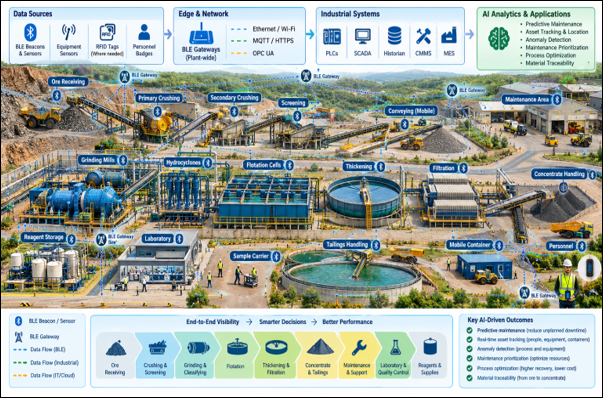
This visual illustrates how BLE beacons, sensors, and gateways connect mobile assets, equipment, personnel, and process areas across a mineral processing plant. It shows data integration with PLCs, SCADA, historians, CMMS, MES, and AI analytics to support predictive maintenance, asset tracking, anomaly detection, process optimization, and material traceability.
What AI Means for Modern Mineral Processing Operations
Mineral processing converts mined ore into concentrates, intermediate products, or other saleable mineral products through a sequence of physical and chemical processes. The operating environment contains large numbers of fixed and mobile assets, continuous material flows, variable ore characteristics, harsh environmental conditions, and significant energy and maintenance requirements. These characteristics create substantial volumes of operational data.
AI for mineral processing operations refers to the use of machine learning, computer vision, anomaly detection, predictive models, optimization algorithms, and related analytical methods to convert plant data into operational recommendations or automated responses.
Typical AI applications include:
- Predictive maintenance for crushers, grinding mills, pumps, conveyors, flotation equipment, thickener drives, and filtration equipment
- Computer vision for ore characteristics, conveyor material inspection, stockpile monitoring, belt condition assessment, and process quality analysis
- Anomaly detection for vibration, temperature, motor current, pressure, flow, density, level, and other process measurements
- Process optimization for grinding, classification, flotation, thickening, filtration, and reagent control
- Quality prediction using process conditions and laboratory measurements
- Energy optimization for comminution and material handling
- Production forecasting and throughput analysis
- Maintenance prioritization based on equipment condition and operational context
- Asset utilization analysis using location and movement information
- Material and sample traceability using BLE-enabled identification and location technologies
BLE is particularly useful where mineral processing operations need wireless identification or location information but do not require every asset to be connected directly to the plant control network. A BLE beacon can identify an asset or location, while a BLE sensor can provide selected condition measurements. BLE gateways collect nearby device information and transfer it to software for further processing.
The Bluetooth Core Specification defines technologies required for interoperable Bluetooth devices, while current Bluetooth specifications include capabilities relevant to low-power connected devices.
Mineral Processing Workflows Where AI and BLE Add Operational Value
AI deployment should begin with a clearly defined mineral processing problem rather than with wireless technology alone. BLE becomes valuable when location, identification, proximity, or selected sensor information can improve the context available to an AI model.
Crushing and Screening
Primary crushers, secondary crushers, cone crushers, jaw crushers, screens, feeders, and conveyors operate under changing ore conditions and mechanical loads. AI can correlate vibration, temperature, motor current, throughput, and maintenance history to identify abnormal operating patterns.
BLE can supplement this information by tracking mobile inspection devices, lubrication equipment, maintenance tools, replacement components, and selected portable sensors. Knowing where equipment or maintenance resources are located can help maintenance teams interpret work-order delays and asset availability.
Grinding and Classification
Grinding circuits are frequently major consumers of electrical energy. SAG mills, ball mills, rod mills, pumps, hydrocyclones, and associated drives require continuous monitoring.
AI models can examine operating variables such as mill load, power draw, feed characteristics, slurry density, pressure, flow, particle-size measurements, and historical production data. BLE can provide additional contextual information from mobile inspection equipment, sampling equipment, maintenance assets, or wireless condition-monitoring devices.
Flotation and Concentrate Recovery
Flotation performance depends on variables such as feed characteristics, particle size, reagent dosage, air flow, pulp density, pH, froth characteristics, and residence time. AI can identify relationships among these variables and assist operators with process optimization or early detection of abnormal conditions.
BLE is not a replacement for process instrumentation. Instead, it can provide supporting identification, location, and sensor information around flotation areas, laboratories, maintenance activities, chemical handling locations, and mobile equipment.
Thickening, Filtration, and Tailings Handling
Thickeners, clarifiers, vacuum filters, pressure filters, pumps, and tailings systems generate operational information related to flow, density, torque, pressure, moisture, and equipment condition.
AI can analyze these variables to identify deviations from normal operating conditions and support maintenance or process decisions. BLE tracking can provide information about portable instruments, maintenance tools, sample containers, inspection devices, and mobile equipment moving between process areas.
Maintenance and Mobile Asset Management
Maintenance activities are particularly suitable for BLE because many maintenance resources are mobile rather than permanently connected.
BLE-enabled tracking can help mineral processing sites locate:
- Torque tools and specialized maintenance equipment
- Portable vibration analyzers
- Calibration instruments
- Welding and fabrication equipment
- Spare motors and gearboxes
- Pumps and replacement components
- Lubrication equipment
- Sample containers and mobile laboratory equipment
- Inspection devices
- Maintenance carts
- Personnel and contractor badges where permitted by site policy
AI can combine location information with CMMS work orders, asset history, failure records, equipment criticality, and operating conditions. This can support maintenance scheduling and reduce time spent searching for equipment.
Physical Data Acquisition
Data can originate from fixed process instrumentation, PLCs, motor protection systems, vibration sensors, temperature sensors, pressure transmitters, flowmeters, density meters, cameras, laboratory systems, and equipment condition-monitoring devices.
BLE adds a wireless data source for assets and devices that are difficult or unnecessary to connect through traditional industrial wiring
BLE beacons may broadcast an asset identifier or location-related information. BLE sensors can measure selected parameters and transmit them wirelessly. BLE gateways receive these signals and forward them to higher-level software.
BLE Communication and Gateway Collection
BLE gateways should be positioned according to the physical characteristics of the processing facility rather than simply according to theoretical radio coverage. Thick concrete structures, steel equipment, enclosed rooms, electrical infrastructure, machinery, elevated conveyors, and process vessels can affect wireless propagation.
A site survey should therefore consider:
- Gateway mounting locations
- Required positioning accuracy
- Beacon transmission power
- Advertising interval
- Battery life
- RF interference
- Metal obstructions
- Equipment movement
- Environmental exposure
- Maintenance accessibility
- Network availability
Bluetooth Low Energy should be treated as a wireless data collection technology, not as a substitute for safety-rated industrial control communications. Time-critical control loops should remain on appropriate industrial control systems.
Edge Processing and Data Normalization
An edge computer or local server can receive BLE gateway data and combine it with selected plant information. Data normalization is important because equipment identifiers, timestamps, process tags, maintenance records, and BLE device identifiers may use different naming conventions.
A middleware layer can normalize these records before forwarding them to databases, historians, AI services, CMMS software, MES applications, or other approved systems.
AI Analytics
AI models can operate on historical and real-time data to identify patterns and generate predictions.
Relevant techniques include:
- Supervised machine learning for failure prediction and quality prediction
- Unsupervised learning for anomaly detection
- Time-series models for equipment and process behavior
- Computer vision models for visual inspection
- Regression models for process and quality prediction
- Classification models for asset or material categorization
- Optimization algorithms for operating parameter recommendations
- Remaining-useful-life models for selected equipment
- Data fusion methods combining process, maintenance, location, and inspection information
AI results should be evaluated against engineering measurements and operating procedures. A model predicting abnormal pump behavior, for example, should be compared with vibration, pressure, flow, temperature, maintenance history, and actual inspection findings before a maintenance decision is automated.
Mineral Processing AIoT Data Workflow: From BLE Sensors to AI-Driven Operations
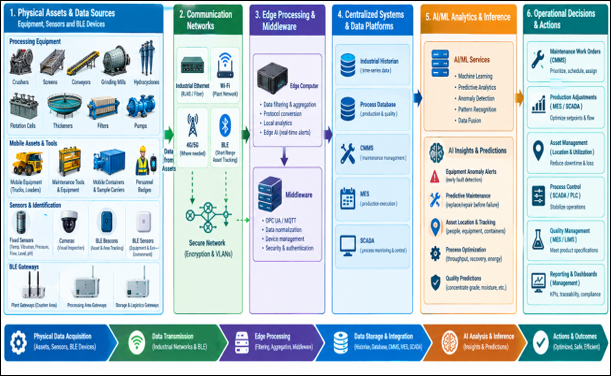
This workflow diagram illustrates the complete data path from mineral processing equipment, fixed sensors, cameras, BLE devices, and mobile assets through industrial networks, edge computing, middleware, and centralized systems. It shows how AI/ML converts operational data into anomaly alerts, predictive maintenance recommendations, asset tracking, process optimization, and quality predictions that support maintenance and production decisions.
BLE Hardware, AI Software, and Deployment Models for Mineral Processing
The hardware and software configuration should reflect the operating conditions and criticality of the mineral processing facility. BLE devices installed near crushers, mills, conveyors, flotation equipment, thickening areas, or outdoor stockpiles may experience dust, vibration, temperature changes, moisture, metal obstructions, and mechanical impact.
BLE Beacons
BLE beacons provide low-power wireless identification or location signals. They can be attached to maintenance tools, mobile equipment, containers, inspection instruments, spare parts, or other trackable objects.
Beacon selection should consider battery life, enclosure requirements, mounting method, transmission interval, radio performance, and maintenance access.
BLE Sensors
BLE sensors can extend wireless monitoring to selected parameters where conventional wired instrumentation is impractical or where supplementary measurements are useful.
Possible applications include monitoring equipment temperature, environmental conditions, vibration-related measurements, asset movement, or other parameters supported by the selected sensor hardware.
BLE Gateways
BLE gateways collect transmissions from nearby BLE devices and transfer the information to local or centralized software through an IP network or another supported communications interface.
Gateway placement is an engineering decision. A large mineral processing facility may require multiple gateways across crushing, grinding, flotation, concentrate handling, maintenance workshops, warehouses, and other areas.
Industrial Software Integration
AI and BLE information can be integrated with existing plant software rather than creating an isolated information stream.
Relevant systems may include:
- SCADA for supervisory monitoring
- DCS for process control
- PLC systems for equipment control
- Historian databases for time-series information
- CMMS for maintenance management
- MES for production information
- ERP software for materials, procurement, and financial processes
- Laboratory information systems for analytical results
- Inventory management software
- Industrial data historians and databases
- Maintenance dashboards and notification systems
GAO supplies BLE, RFID, and IoT hardware products and systems that can be incorporated into connected asset tracking and monitoring solutions. For mineral processing operations, these technologies can supplement existing industrial control and maintenance systems rather than requiring replacement of established plant automation.
Cloud Version
A cloud-hosted implementation can centralize BLE data, AI analytics, dashboards, and selected historical information across multiple mineral processing facilities. This approach can be useful when an organization operates geographically distributed processing sites and needs centralized analytics or standardized reporting.
Cloud deployment should account for network availability, data residency, cybersecurity requirements, latency, operating continuity, and the consequences of losing external connectivity. Process control should not depend on a remote cloud connection where latency or connectivity loss could affect safe plant operation.
Server Version
A server deployment can run software on an edge server, customer-managed server, private data center, plant server, or other privately hosted enterprise infrastructure. This approach can be appropriate where mineral processing operations require local data processing, stronger control over data location, integration with existing OT networks, or continued operation when external connectivity is unavailable.
A hybrid design can also be used. BLE gateway data can be processed locally for immediate asset tracking or anomaly detection while selected historical information is transferred to centralized servers for broader analytics.
Cybersecurity and Industrial Network Controls
BLE devices and gateways should be incorporated into the site’s cybersecurity model rather than treated as independent wireless accessories. Network segmentation, device authentication, access control, secure gateway configuration, patch management, logging, and controlled interfaces should be considered during system design.
ISA/IEC 62443 provides a widely used framework for securing industrial automation and control systems, including requirements and processes for maintaining electronically secure IACS environments.
IEC PAS 62443-1-6:2025 specifically addresses applying the 62443 series to Industrial Internet of Things environments, providing guidance relevant to asset owners and service providers implementing IIoT technologies.
For BLE-connected mineral processing systems, practical controls can include
- Network segmentation between wireless gateways and critical control networks
- Least-privilege access to gateway management interfaces
- Unique device identities and controlled provisioning
- Encryption where supported by the selected BLE implementation
- Secure software and firmware update procedures
- Centralized logging and monitoring
- Asset inventories covering BLE gateways, beacons, sensors, and servers
- Controlled API connections to CMMS, SCADA, MES, and other systems
- Defined incident-response procedures for compromised wireless devices
Bluetooth specifications provide the technical foundation for interoperable Bluetooth devices, while the industrial cybersecurity layer must be designed according to the specific OT environment and risk profile.
AI Applications That Improve Mineral Processing Performance
AI becomes operationally useful when it connects process measurements, equipment condition, maintenance history, material information, and asset-location data into decisions that operators and engineers can act upon. BLE contributes contextual information that conventional wired process instrumentation may not provide, particularly for mobile assets, inspection equipment, maintenance resources, and selected wireless sensors
Predictive Maintenance for Crushers, Mills, Pumps, and Conveyors
Predictive maintenance models can analyze vibration, temperature, motor current, lubrication information, operating load, runtime, alarm history, and maintenance records to identify changes associated with developing equipment faults.
BLE can add asset identity and location information to the maintenance workflow. A BLE beacon attached to a portable vibration analyzer, for example, can help identify where an inspection instrument is located. BLE sensors can provide supplementary measurements where appropriate, while gateways transfer the information into maintenance software.
AI can then correlate equipment condition with:
- Asset criticality
- Runtime and operating cycle
- Previous work orders
- Failure mode
- Spare-part availability
- Inspection result
- Current asset location
- Production schedules
This can help maintenance planners prioritize inspections and investigate abnormal equipment behavior before a failure interrupts mineral processing production.
AI Anomaly Detection for Process Equipment
Anomaly detection models establish patterns of normal behavior for equipment and process variables. Deviations can trigger investigation rather than relying solely on fixed alarm thresholds
For example, a pump may remain below a conventional temperature alarm while its temperature, vibration, discharge pressure, and power-consumption pattern gradually diverge from historical behavior. AI can identify the multivariable deviation and generate an alert for engineering review.
BLE location data can provide additional context when mobile equipment or inspection resources are involved.
Computer Vision for Ore and Process Monitoring
Computer vision can analyze images or video from cameras installed around conveyors, transfer points, stockpiles, crushers, and other processing areas.
Potential applications include:
- Particle-size estimation
- Ore classification
- Foreign-material detection
- Conveyor-belt monitoring
- Spillage detection
- Stockpile observation
- Froth-image analysis
- Equipment inspection
- PPE compliance monitoring where permitted by site policy
Vision systems normally require adequate lighting, suitable camera positioning, reliable image acquisition, and representative training data. Dust, water spray, vibration, changing illumination, and material variability should be considered during commissioning.
BLE can complement computer vision by providing asset identifiers or location information. This is useful when an AI-generated maintenance alert needs to be associated with the specific inspection or maintenance asset involved.
AI Process Optimization
Mineral processing optimization can involve large numbers of interacting variables. AI models can learn relationships among feed characteristics, operating conditions, energy consumption, reagent usage, recovery, throughput, and product quality.
Applications can include:
- Grinding circuit optimization
- Mill-load prediction
- Flotation optimization
- Reagent dosage recommendation
- Thickener performance analysis
- Filter-performance prediction
- Throughput forecasting
- Energy-per-ton optimization
- Recovery prediction
AI recommendations should normally remain subject to process-engineering constraints, operator procedures, control-system limits, and appropriate human approval before closed-loop automation is introduced.
BLE-Enabled Asset Tracking for Mineral Processing Maintenance
Asset tracking is one of the clearest areas where BLE can provide information that is difficult to obtain from conventional process instrumentation.
A mineral processing site can have maintenance equipment distributed across workshops, warehouses, crushing areas, grinding circuits, flotation plants, laboratories, and outdoor operating areas. Searching for a specialized tool or inspection device can consume maintenance time without directly contributing to equipment availability.
BLE-enabled tracking can establish location or proximity information for selected assets. Gateway data can then be associated with CMMS records and maintenance workflows.
For example, a maintenance work order may identify a required vibration analyzer. A BLE beacon associated with that instrument can provide the last detected gateway location. The maintenance team can use this information alongside the work order rather than manually searching multiple maintenance areas.
BLE tracking can also support:
- Maintenance-tool utilization analysis
- Inspection-equipment availability
- Portable-instrument management
- Mobile equipment location
- Spare-component movement
- Sample-container tracking
- Workshop inventory visibilit
- Contractor equipment management
- Maintenance workflow analysis
Location data should be interpreted according to the actual positioning capability of the deployed system. Gateway-based presence detection, proximity estimation, and more precise positioning are different technical functions and should not be represented as equivalent.
BLE Asset Tracking Workflow for Mineral Processing Maintenance
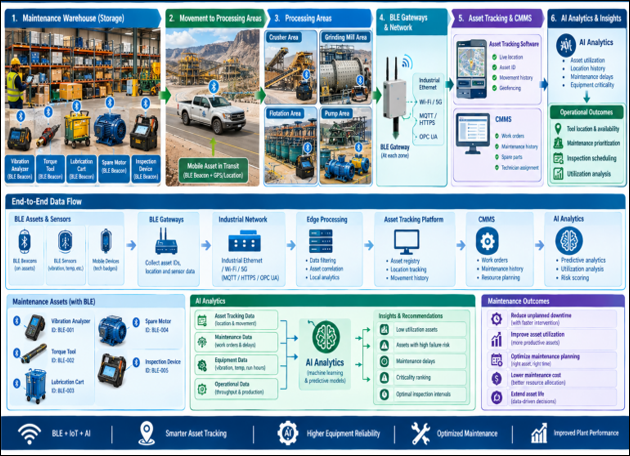
This workflow illustrates how BLE-tagged maintenance assets move from the warehouse to crusher, grinding mill, flotation, and pump areas while gateways capture asset location and identification data. The data flows through industrial networks into asset-tracking software and CMMS, where AI analyzes utilization, location history, maintenance delays, and equipment criticality to support maintenance prioritization and scheduling.
Technical Benefits of Combining AI With BLE Data
The value of AI-enabled BLE systems comes from combining wireless asset information with process, maintenance, and operational data.
Better Maintenance Context
A predictive-maintenance model becomes more useful when equipment condition is connected with asset identity, location, maintenance history, and inspection activity.
Reduced Search and Waiting Time
BLE location information can reduce the time technicians spend locating selected tools, instruments, mobile assets, and other trackable resources.
Improved Asset Utilization
Historical BLE location data can reveal whether expensive inspection instruments or specialized maintenance equipment are frequently idle, repeatedly moved between areas, or unavailable when needed.
Stronger AI Data Context
AI models often require contextual information to distinguish between normal and abnormal conditions. BLE can supply location, proximity, movement, or device identity that complements time-series process data.
Scalable Wireless Monitoring
BLE devices can be deployed selectively rather than wiring every mobile asset. This can make wireless monitoring practical for equipment where permanent instrumentation is unnecessary or difficult to install.
Improved Traceability
BLE identification can associate selected tools, containers, samples, or mobile equipment with processing areas and workflows. Where formal material traceability requires stronger identification controls, BLE can be combined with RFID, barcode systems, laboratory systems, or other identification technologies.
GAO provides BLE and RFID hardware and systems that organizations can use for wireless identification, asset monitoring, and connected operational applications. The appropriate technology should be selected according to required range, positioning accuracy, environmental conditions, data frequency, battery requirements, and integration needs.
Mineral Processing KPIs for AI and BLE Systems
AI projects should be evaluated using operational measurements rather than AI model metrics alone. A model with high classification accuracy may have limited operational value if its recommendations do not improve equipment or process performance.
Relevant KPIs include:
- Ore throughput in tonnes per hour
- Recovery percentage
- Concentrate grade
- Tailings grade
- Product moisture
- Grinding energy consumption per tonne
- Specific energy consumption
- Equipment availability
- Mean time between failures
- Mean time to repair
- Unplanned downtime
- Maintenance schedule compliance
- Predictive-maintenance alert precision
- False-alert rate
- Detection lead time
- Pump availability
- Conveyor availability
- Crusher utilization
- Mill utilization
- Flotation recovery
- Reagent consumption per tonne
- Water consumption per tonne
- Filter throughput
- Thickener performance
- Mobile-asset utilization
- Maintenance-tool search time
- BLE gateway availability
- BLE device battery life
- Asset-location data completeness
Engineering Design and Deployment Considerations
Successful implementation requires coordination between process engineering, instrumentation, OT networking, IT, maintenance, cybersecurity, and operations personnel.
Begin With a Defined Operational Problem
A deployment should identify a measurable problem before selecting BLE hardware or an AI model.
Suitable starting questions include:
Which maintenance assets are difficult to locate?
Which equipment failures create significant production losses?
Which process variables are difficult to interpret using conventional thresholds?
Which mobile assets require location visibility?
Which inspection activities generate useful but underused data?
Which process stages have sufficient historical data for AI modeling?
Conduct an RF and Site Survey
Mineral processing facilities contain substantial quantities of steel, electrical equipment, vessels, structural supports, conveyors, pipes, and enclosed machinery. These can affect BLE signal propagation.
The survey should evaluate gateway placement, radio coverage, mounting positions, interference, environmental conditions, device density, battery replacement access, and network connectivity.
Separate Monitoring From Safety-Critical Control
BLE and AI monitoring systems should not automatically be treated as safety systems. Safety functions require appropriate risk assessment, instrumentation, control logic, redundancy, validation, and applicable functional-safety requirements.
AI-generated recommendations should initially be treated as advisory unless a specific automated function has undergone the necessary engineering validation and risk assessment.
Establish Data Governance
AI performance depends on reliable data. Engineering teams should establish consistent asset identifiers, timestamps, units, tag names, maintenance codes, failure classifications, and operating states.
Data-quality checks should address:
- Missing measurements
- Incorrect timestamps
- Sensor drift
- Duplicate asset identifiers
- Gateway communication loss
- Battery depletion
- Invalid process values
- Maintenance-record inconsistencies
- Changes in equipment configuration
Test Before Scaling
A pilot should cover a representative processing area and a clearly defined operational problem. Testing should include BLE coverage, gateway reliability, data transmission, software integration, AI inference, alert handling, cybersecurity controls, and operator acceptance.
Scaling should follow only after the pilot demonstrates reliable technical performance and meaningful operational value.
Mineral Processing AI and BLE Deployment Lifecycle
A practical deployment can follow a controlled sequence:
Planning: Define the operational problem, critical assets, required measurements, stakeholders, KPIs, and integration requirements.
Site assessment: Survey processing areas, RF conditions, environmental factors, network infrastructure, equipment locations, and maintenance workflows.
Data assessment: Identify available PLC, SCADA, historian, CMMS, MES, laboratory, camera, and BLE data.
Hardware selection: Select appropriate BLE beacons, BLE sensors, gateways, mounting systems, batteries, and protective enclosures.
System design: Define gateway locations, network segmentation, data flows, software interfaces, server or cloud deployment, and cybersecurity controls.
Installation: Mount BLE devices and gateways according to the approved engineering design.
Commissioning: Verify device identification, signal reception, gateway communication, timestamps, asset mapping, and software integration.
AI model development: Train or configure models using representative operating data and validated engineering labels.
Testing: Compare AI outputs against inspections, maintenance records, laboratory measurements, and established process conditions.
Operational deployment: Introduce alerts and recommendations into maintenance and production workflows.
Optimization: Tune thresholds, model parameters, gateway locations, device intervals, and workflows using operational feedback.
Expansion: Extend the system to additional processing areas, assets, or facilities after performance has been demonstrated.
Lifecycle maintenance: Maintain BLE batteries, gateway firmware, software, AI models, network security, asset inventories, and integration interfaces.
Scaling AI and BLE Across Mineral Processing Facilities
A multi-site deployment requires standardization without ignoring differences between plants. Ore characteristics, equipment manufacturers, plant layouts, network infrastructure, maintenance practices, and operating procedures can differ substantially between facilities.
A scalable implementation should standardize:
- Asset identification conventions
- BLE device configuration
- Gateway naming
- Data schemas
- API interfaces
- Cybersecurity requirements
- Software versions
- AI model-management procedures
- KPI definitions
- Maintenance workflows
- Device commissioning procedures
Local engineering teams should retain control over site-specific RF conditions, equipment configurations, operating constraints, and process-control requirements.
AI models also require lifecycle management. A model trained using one ore body or processing configuration may not perform identically after major changes in feed composition, equipment configuration, operating strategy, or instrumentation. Model drift should therefore be monitored as part of normal system maintenance.
Interoperability With Industrial Systems
AI and BLE should fit into the existing mineral processing information environment.
Common integration paths include:
- BLE gateway to local server
- Gateway to database
- Gateway to middleware
- PLC to SCADA
- SCADA to historian
- Historian to AI analytics
- AI analytics to maintenance software
- AI analytics to production dashboards
- CMMS to ERP
- Laboratory information to process-quality analytics
Industrial communications may include Ethernet-based networks and established industrial protocols such as OPC UA, Modbus TCP, MQTT, and vendor-specific interfaces, depending on the existing plant environment.
OPC UA is particularly relevant for structured industrial data exchange because it supports interoperability between industrial systems while providing mechanisms for security and information modeling
Protocol selection should be based on existing control-system capabilities, cybersecurity requirements, latency, data volume, vendor support, and the intended integration boundary.
Practical Implementation Lessons for Mineral Processing Operations
Several engineering principles can reduce deployment risk.
Do not install BLE gateways solely according to theoretical radio range. Validate coverage under actual plant conditions.
Do not use BLE as a replacement for wired safety or critical process-control instrumentation.
Do not train AI models solely on clean laboratory data if the model will operate against noisy plant data.
Associate AI alerts with actual equipment IDs, process areas, timestamps, and operating states.
Integrate maintenance predictions with CMMS workflows rather than creating an independent alert stream.
Measure false positives as carefully as successful detections.
Include battery replacement and device inspection in the maintenance plan for BLE equipment.
Design for gateway failure and network outages.
Keep critical plant-control functions locally available when cloud connectivity is unavailable.
Validate AI recommendations with process engineers and experienced operators before increasing automation.
Reassess AI models after major process, equipment, instrumentation, or ore-feed changes.
Maintain a complete inventory of BLE devices, gateways, software versions, network addresses, and associated assets.
These practices help ensure that AI and BLE solve measurable mineral processing problems rather than becoming disconnected technology demonstrations.
GAO Support for AI-Enabled Mineral Processing Solutions
GAO has supplied hardware products and systems based on BLE, RFID, and IoT technologies to organizations requiring wireless identification, sensing, tracking, and monitoring capabilities. Headquartered in New York City and Toronto, Canada, GAO serves customers across North American technology and industrial markets.
GAO and its sister companies, GAO Research Inc. and GAO Tek Inc., form the GAO Group, with operations based in New York City and Toronto, Canada. For three decades, the group has served organizations in the United States and Canada, including Fortune 500 companies, research and development organizations, universities, and government agencies.
GAO has invested substantially in research and development and maintains quality-assurance processes intended to support reliable technology deployment. Remote and onsite technical support can also be relevant when BLE gateways, sensors, RFID equipment, networking components, and associated software must operate within demanding industrial environments.
For mineral processing organizations evaluating AI-driven maintenance, asset tracking, process monitoring, or operational analytics, the practical starting point is to define the process problem, identify the data required to address it, and then select the appropriate combination of BLE, RFID, industrial sensors, cameras, servers, AI software, and enterprise-system interfaces.
Key Takeaways for AI and BLE in Mineral Processing Operations
AI can support mineral processing operations by analyzing equipment, process, maintenance, quality, and production information to identify abnormal conditions, predict equipment behavior, optimize operating parameters, and improve maintenance decisions.
BLE provides a complementary wireless mechanism for identifying and locating selected mobile assets and collecting data from suitable wireless sensors. Its value increases when BLE information is correlated with SCADA, PLC, historian, CMMS, MES, laboratory, and AI data.
A practical implementation should therefore focus on measurable operating problems, validated data, appropriate wireless engineering, cybersecurity, controlled AI deployment, and integration with established mineral processing workflows.
Organizations evaluating these technologies can work with GAO to examine BLE beacons, BLE sensors, gateways, RFID equipment, IoT hardware, and related technical systems for specific mineral processing requirements.
Building the Future of Industrial AI and IoT with Aperture Venture Studio and GAO RFID Inc.
For mineral processing operations, the convergence of AI, BLE, RFID, and industrial IoT requires sustained research, engineering expertise, and collaboration among technology specialists and industrial organizations. For more than three decades, GAO Group of Companies has invested heavily in R&D involving industrial BLE, RFID, and IoT technologies. As generative AI became increasingly useful for industrial applications, we expanded our work across AI and IoT systems and founded Aperture Venture Studio to build, launch, and scale advanced AI and IoT capabilities relevant to industrial operations such as mineral processing. Aperture brings together technical experts, operational executives, investors, and leading companies, while the Aperture Ventures Summit and TekSummit provide forums for discussing advanced AI and IoT topics. We welcome you to join us as advisors, co-founders or employees, investors, or customers.