
AI and BLE for Mining Machinery Manufacturing
AI-Powered BLE Solutions for Mining Machinery Manufacturing
Mining machinery manufacturing is undergoing rapid digital transformation as artificial intelligence and Bluetooth Low Energy (BLE) technologies enable manufacturers to improve production visibility, equipment reliability, quality assurance, workforce safety, and operational efficiency. AI-powered BLE solutions allow manufacturers of haul trucks, hydraulic excavators, draglines, rotary drills, continuous miners, wheel loaders, crushers, conveyors, underground mining vehicles, and mineral processing equipment to capture real-time operational data, automate manufacturing workflows, and make intelligent production decisions based on continuously evolving conditions.
Rather than functioning solely as a wireless communication technology, BLE Gateways, BLE Beacons, and BLE Sensors serve as essential data acquisition components within an Artificial Intelligence of Things (AIoT) solution. AI continuously analyzes production data collected from connected manufacturing assets to predict machine failures, optimize work-in-progress movement, improve production scheduling, monitor tooling utilization, reduce downtime, and support data-driven decision-making across the manufacturing lifecycle.
For more than three decades, GAO has supplied BLE, RFID, and Industrial IoT hardware products and systems to organizations across North America. Through extensive engineering expertise, product quality, and technical support, we have helped manufacturers implement reliable industrial identification, sensing, and connectivity solutions that support increasingly intelligent manufacturing environments.
AI-Enabled BLE Deployment in a Modern Mining Machinery Manufacturing Facility
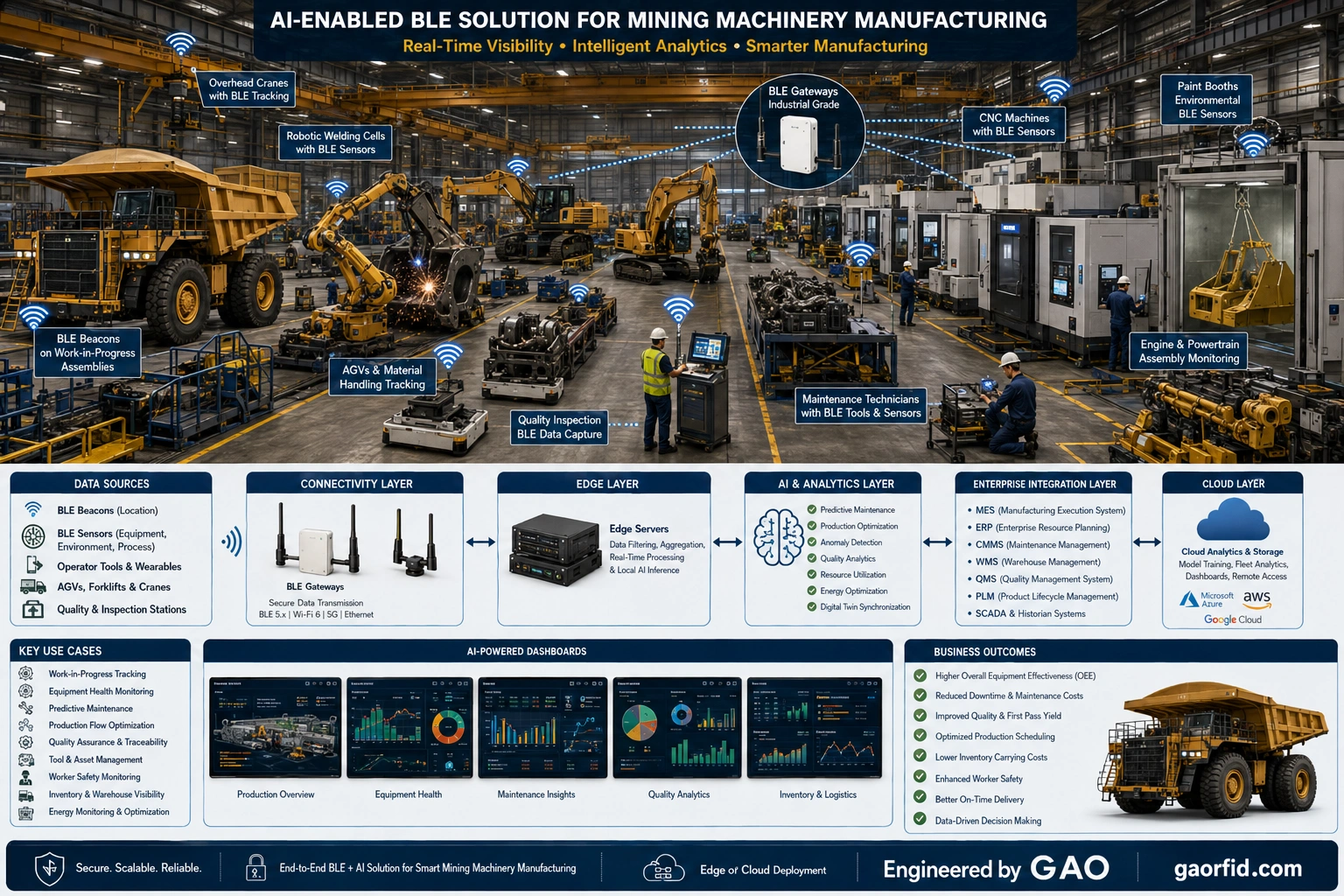
This enterprise illustration showcases a modern mining machinery manufacturing facility where AI-enabled BLE technologies provide real-time visibility across production operations. BLE Beacons track work-in-progress assemblies, BLE Sensors monitor CNC machines, robotic welding cells, paint booths, and engine assembly lines, while BLE Gateways collect operational data for edge servers and AI analytics. The illustration also demonstrates integration with Manufacturing Execution Systems (MES), ERP software, cloud services, and industrial networking to support predictive maintenance, production optimization, quality assurance, and intelligent manufacturing decision-making.
Transforming Mining Machinery Manufacturing with AI-Driven BLE Intelligence
Mining machinery manufacturing differs significantly from most industrial equipment production because products are exceptionally large, highly engineered, customized, and assembled through numerous manufacturing stages involving thousands of components. Production facilities typically manufacture equipment designed to operate continuously under severe environmental conditions, requiring rigorous quality control, precise component traceability, and coordinated production scheduling.
Artificial intelligence significantly enhances BLE-enabled manufacturing by converting location information, machine telemetry, environmental measurements, production status, equipment health, and operator activity into actionable manufacturing intelligence. BLE devices continuously collect operational information while AI identifies production bottlenecks, predicts maintenance requirements, improves inventory availability, optimizes material movement, and enhances production planning.
Unlike traditional manufacturing monitoring systems that primarily provide historical reporting, AI continuously learns production behavior across fabrication shops, machining centers, welding operations, paint facilities, final assembly, testing areas, logistics centers, and spare parts warehouses. Manufacturing managers receive predictive recommendations rather than simply reviewing completed production reports.
Modern mining machinery manufacturers frequently integrate AI-enabled BLE systems with:
- Manufacturing Execution Systems (MES)
- Enterprise Resource Planning (ERP)
- Product Lifecycle Management (PLM)
- Computerized Maintenance Management Systems (CMMS)
- Warehouse Management Systems (WMS)
- Quality Management Systems (QMS)
- Supply Chain Management (SCM)
- Supervisory Control and Data Acquisition (SCADA)
- Industrial Human Machine Interfaces (HMI)
- Industrial historians
- Digital twin software
- Business intelligence dashboards
These integrated systems improve production coordination while supporting intelligent manufacturing throughout the factory.
Operational Challenges in Mining Machinery Manufacturing
Mining machinery manufacturers operate some of the most complex production facilities within industrial equipment manufacturing. Large fabricated structures, long production cycles, specialized machining processes, custom engineering requirements, and extensive supply chains create operational challenges that directly affect production efficiency, quality, and delivery schedules.
Common operational challenges include:
- Limited visibility of work-in-progress assemblies
- Delayed component availability
- Unplanned equipment downtime
- Welding quality inconsistencies
- CNC machine utilization inefficiencies
- Tooling misplacement
- Production scheduling conflicts
- Overhead crane availability
- Assembly bottlenecks
- Material handling delays
- Excess inventory
- Inaccurate asset location information
- Quality inspection delays
- Supplier delivery variability
- Energy consumption fluctuations
- Worker safety monitoring limitations
- Manual production reporting
- Long commissioning cycles
- Equipment traceability challenges
Large mining equipment often requires weeks or months to complete manufacturing. Minor disruptions during machining, fabrication, painting, assembly, or testing can significantly affect production schedules and delivery commitments.
AI continuously evaluates BLE-generated operational information to identify emerging manufacturing issues before they disrupt production. Production supervisors can proactively rebalance workloads, adjust staffing, prioritize materials, schedule maintenance, or reallocate manufacturing resources based on predictive recommendations rather than reactive decision-making.
Manufacturers implementing AI-enabled BLE solutions frequently achieve improvements in:
- Overall Equipment Effectiveness (OEE)
- First Pass Yield (FPY)
- Machine availability
- Production throughput
- Assembly efficiency
- Inventory accuracy
- Tool utilization
- Production scheduling
- Quality consistency
- Maintenance planning
- Workforce productivity
- Energy efficiency
These improvements become increasingly valuable as manufacturers produce more customized mining machinery with shorter delivery timelines.
Operational Challenges in Mining Machinery Manufacturing Before AI-Enabled BLE Implementation
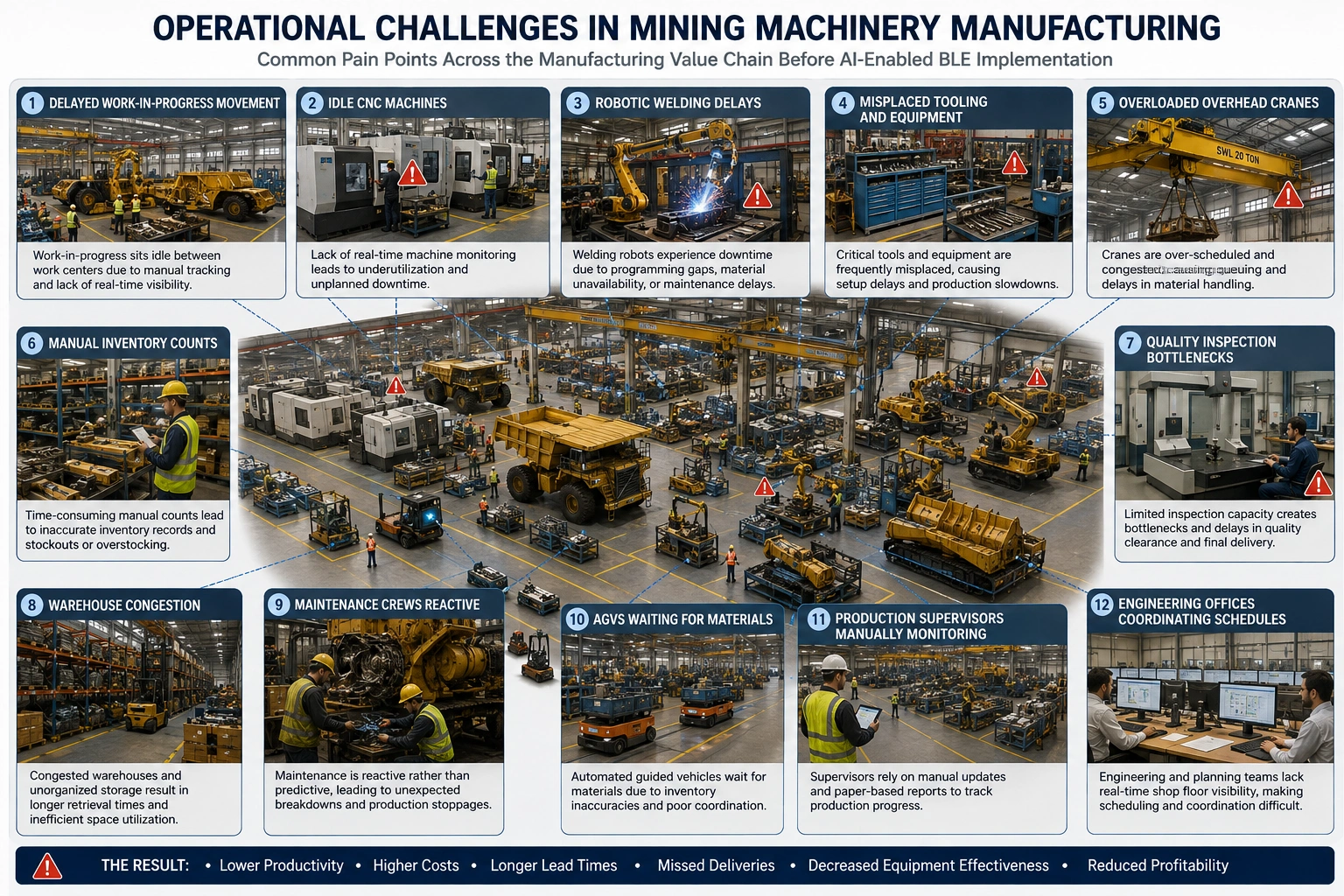
This infographic illustrates the major operational inefficiencies commonly encountered in mining machinery manufacturing facilities before the deployment of AI-enabled Bluetooth Low Energy (BLE) solutions. It highlights delayed work-in-progress movement, idle CNC machines, robotic welding delays, misplaced tooling, overloaded overhead cranes, manual inventory counts, quality inspection bottlenecks, warehouse congestion, reactive maintenance practices, AGVs waiting for materials, manual production monitoring, and engineering scheduling challenges that reduce productivity, increase costs, and limit operational visibility.
AI Applications Across Mining Machinery Manufacturing Operations
AI-enabled BLE solutions support nearly every manufacturing stage, improving coordination among engineering, production, maintenance, logistics, quality assurance, procurement, and executive management.
Intelligent Work-in-Progress Tracking
BLE Beacons attached to fabricated frames, hydraulic systems, engines, transmissions, operator cabins, boom assemblies, buckets, crushers, and other major subassemblies provide continuous visibility throughout production.
AI analyzes movement history to identify:
- Assembly delays
- Material shortages
- Production bottlenecks
- Excess handling
- Idle production time
- Workstation congestion
Production planners can dynamically adjust manufacturing schedules before delays affect downstream operations.
Predictive Maintenance for Manufacturing Equipment
Mining machinery production depends on numerous high-value manufacturing assets including:
- CNC machining centers
- Horizontal boring mills
- Vertical turning lathes
- Laser cutting systems
- Plasma cutting machines
- Robotic welding cells
- Heat treatment furnaces
- Paint booths
- Hydraulic test benches
- Coordinate Measuring Machines (CMMs)
- Industrial compressors
- Overhead cranes
BLE Sensors continuously monitor vibration, temperature, humidity, current consumption, operating cycles, and equipment runtime.
AI models identify abnormal operating conditions that indicate developing mechanical problems, enabling maintenance teams to intervene before failures interrupt production.
Intelligent Tooling Management
Large mining machinery manufacturers manage thousands of specialized fixtures, cutting tools, welding jigs, lifting fixtures, torque tools, calibration equipment, gauges, and portable testing instruments.
BLE Beacons provide continuous location visibility while AI analyzes tooling utilization patterns to:
- Reduce search time
- Improve calibration scheduling
- Increase utilization
- Prevent unnecessary purchases
- Detect misplaced tooling
- Optimize inventory levels
Maintenance and production teams spend less time locating equipment and more time supporting manufacturing operations.
AI-Assisted Quality Assurance
Quality requirements for mining machinery are exceptionally demanding because equipment operates under high loads, abrasive environments, and continuous duty cycles.
BLE-enabled quality stations automatically associate inspection results with specific components while AI analyzes production history to identify quality trends involving:
- Weld integrity
- Machining tolerances
- Hydraulic assembly
- Paint quality
- Torque verification
- Component traceability
- Dimensional inspection
- Functional testing
Manufacturing engineers receive predictive quality insights that help reduce rework and improve production consistency.
Intelligent Material Flow Optimization
Large fabricated structures frequently require multiple crane lifts, AGV movements, forklift transfers, and warehouse operations before reaching final assembly.
AI analyzes BLE location data to optimize:
- Material routing
- AGV scheduling
- Crane utilization
- Warehouse storage
- Loading sequences
- Assembly staging
- Receiving operations
- Shipping preparation
These improvements reduce unnecessary movement while improving production throughput.
AI-Enabled BLE Deployment Across a Mining Machinery Manufacturing Facility
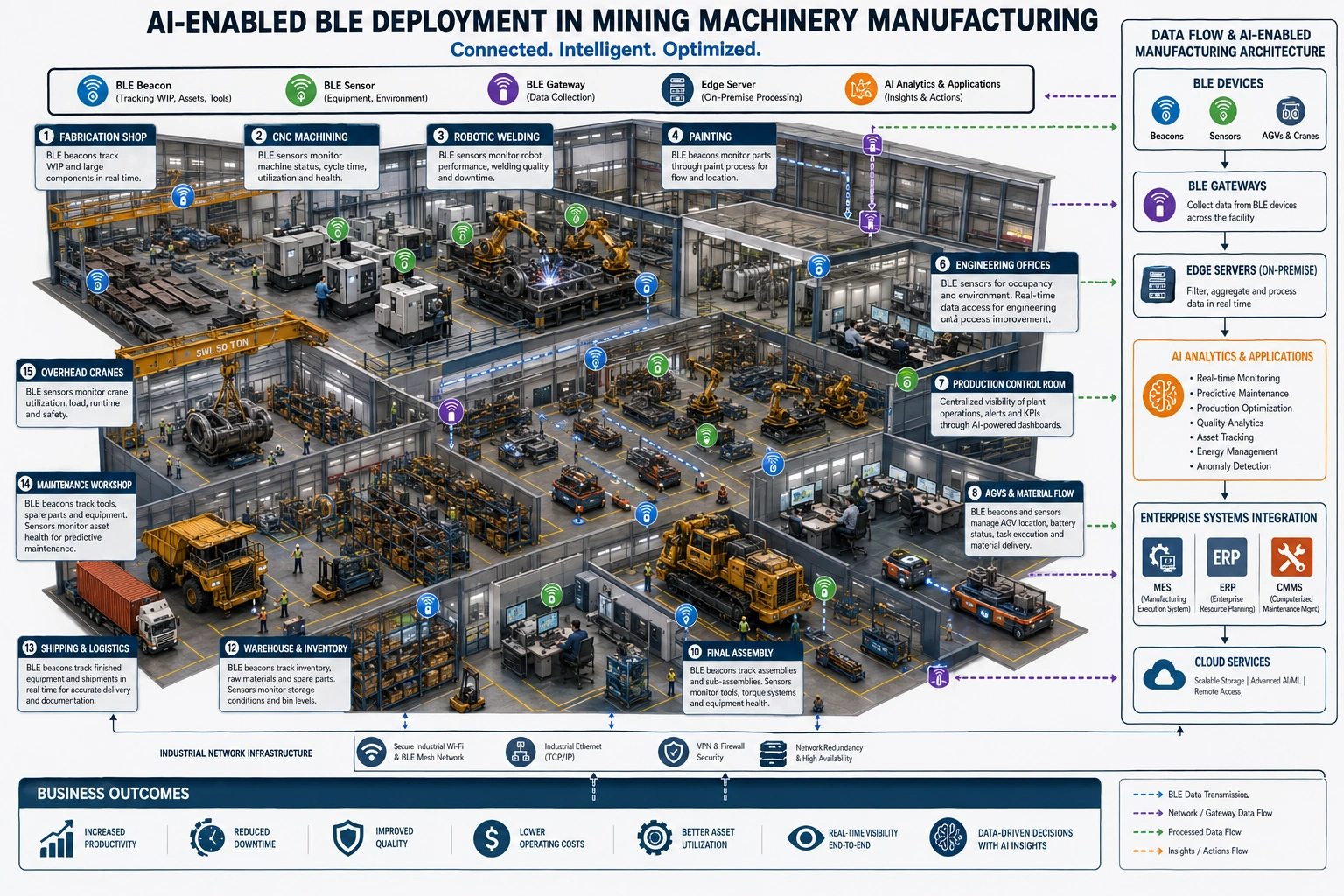
This cutaway illustration demonstrates a comprehensive AI-enabled Bluetooth Low Energy (BLE) deployment throughout a mining machinery manufacturing facility. It shows BLE beacons attached to work-in-progress assemblies, BLE sensors monitoring manufacturing equipment, BLE gateways collecting operational data, AGVs and overhead cranes connected to the BLE network, edge servers processing real-time information, AI analytics dashboards generating manufacturing insights, and integration with ERP, MES, CMMS, industrial networking, and cloud services. Data flow arrows illustrate how BLE-generated data supports AI-driven production optimization, predictive maintenance, asset tracking, quality management, warehouse operations, and enterprise-wide decision-making.
Operational Workflow from BLE Data Acquisition to AI Manufacturing Intelligence
Mining machinery manufacturing generates continuous streams of production, equipment, inventory, quality, and workforce data. AI transforms BLE observations into actionable manufacturing intelligence through multiple coordinated processing stages.
Mining machinery manufacturing generates continuous streams of production, equipment, inventory, workforce, and environmental data throughout fabrication, machining, welding, painting, assembly, testing, and shipping operations. AI transforms BLE-generated operational data into manufacturing intelligence through multiple coordinated processing stages that support production planning, maintenance, quality assurance, logistics, and executive decision-making.
A typical AI-enabled BLE operational workflow includes:
- BLE Beacons attached to work-in-progress assemblies, production fixtures, tooling, AGVs, overhead cranes, forklifts, and finished equipment continuously transmit location and status information.
- BLE Sensors installed on CNC machining centers, robotic welding systems, compressors, hydraulic test benches, paint booths, environmental monitoring devices, and utility systems collect equipment health and operating data.
- BLE Gateways positioned throughout fabrication shops, machining cells, assembly lines, warehouses, maintenance facilities, and testing areas receive BLE transmissions.
- Edge computing servers validate, aggregate, timestamp, and preprocess BLE data while performing low-latency analytics for production-critical operations.
- AI models analyze production flow, equipment condition, quality metrics, operator activity, and inventory movement to identify production bottlenecks, maintenance requirements, quality risks, and material shortages.
- Manufacturing Execution Systems coordinate production scheduling while integrating AI recommendations with ERP, PLM, CMMS, WMS, and Quality Management Systems.
- Business intelligence software consolidates operational KPIs, production forecasts, equipment performance, workforce productivity, and quality metrics into executive dashboards.
- Automated workflows generate maintenance work orders, inventory replenishment requests, production scheduling adjustments, and operational alerts.
- Manufacturing managers use AI-generated recommendations to optimize production efficiency, improve quality, reduce downtime, and increase Overall Equipment Effectiveness (OEE).
Rather than simply monitoring production activities, AI continuously supports intelligent decision-making across the complete manufacturing lifecycle.
AI-Enabled BLE Operational Workflow for Mining Machinery Manufacturing
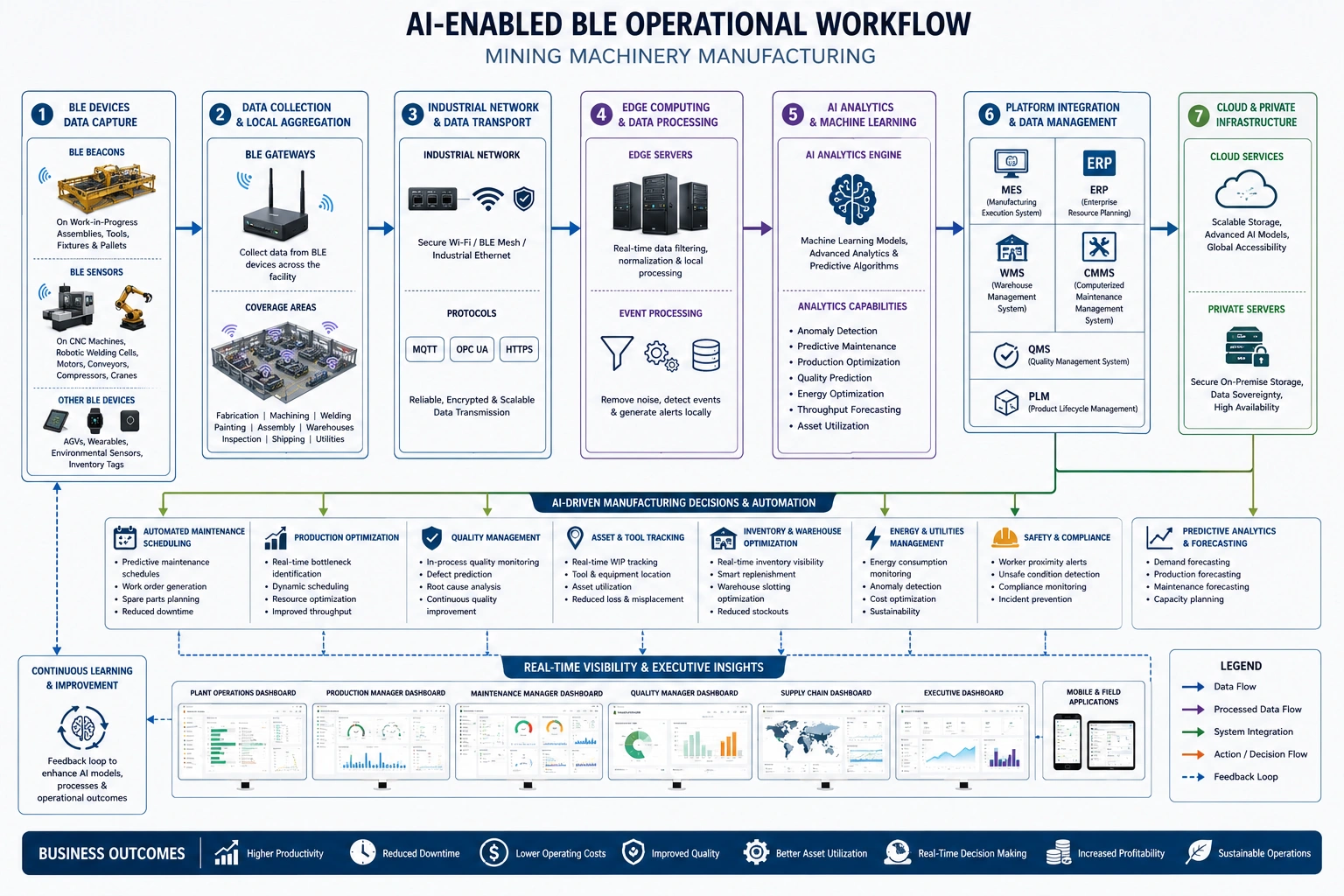
This workflow diagram illustrates the complete AI-enabled Bluetooth Low Energy (BLE) operational process for a mining machinery manufacturing facility. It shows how BLE beacons and sensors collect real-time production data, which flows through BLE gateways, industrial networks, edge servers, AI analytics, Manufacturing Execution Systems (MES), Enterprise Resource Planning (ERP), Warehouse Management Systems (WMS), Computerized Maintenance Management Systems (CMMS), cloud and private servers, and executive dashboards to enable predictive maintenance, production optimization, quality management, asset tracking, inventory optimization, and data-driven manufacturing decisions.
Technologies Supporting AI-Powered BLE Solutions for Mining Machinery Manufacturing
Successful AI-enabled BLE deployments depend on coordinated integration among BLE infrastructure, industrial automation, AI software, manufacturing systems, and communication networks. Rather than operating independently, these technologies collectively provide continuous production visibility, intelligent analytics, and operational decision support.
BLE Hardware
Mining machinery manufacturing facilities commonly deploy:
- BLE Beacons attached to work-in-progress assemblies, production fixtures, tooling, lifting devices, pallets, containers, AGVs, forklifts, and finished machinery.
- BLE Sensors monitoring vibration, temperature, humidity, machine runtime, electrical current, hydraulic pressure, and environmental conditions.
- BLE Gateways installed throughout fabrication areas, machining cells, assembly lines, warehouses, testing facilities, and maintenance workshops.
- Industrial tablets and handheld devices used by maintenance technicians, inspectors, warehouse operators, and production supervisors.
- Industrial IoT gateways connecting BLE infrastructure with manufacturing software and industrial communication networks.
GAO has supplied BLE hardware and Industrial IoT solutions to organizations requiring reliable wireless sensing, positioning, and operational visibility across demanding manufacturing environments.
AI Software
Artificial intelligence transforms BLE observations into actionable manufacturing intelligence using multiple analytical techniques.
Common AI capabilities include:
- Machine learning for production forecasting.
- Predictive maintenance modeling.
- Time-series analytics for equipment health monitoring.
- Anomaly detection for manufacturing abnormalities.
- Computer vision integrated with BLE-enabled production tracking.
- Predictive quality analytics.
- Workforce productivity optimization.
- Energy consumption forecasting.
- Production scheduling optimization.
- Digital twin synchronization.
These capabilities enable production teams to optimize manufacturing operations continuously rather than relying solely on historical reporting.
Communication Infrastructure
Reliable communications are essential for manufacturing facilities containing heavy machinery, steel fabrication, robotic systems, and large production buildings.
Supporting communication infrastructure typically includes:
- Bluetooth Low Energy
- Industrial Ethernet
- Fiber optic backbone
- Wi-Fi 6 and Wi-Fi 7
- Private 5G
- OPC UA
- MQTT
- Modbus TCP
- REST APIs
- HTTPS
- VLAN segmentation
- Secure VPN connectivity
These communication technologies enable dependable information exchange between manufacturing equipment, enterprise software, AI systems, and executive reporting tools.
Cloud Version
Cloud-hosted software is appropriate for manufacturers operating multiple production facilities or requiring centralized manufacturing analytics.
Typical capabilities include:
- Centralized production reporting.
- AI model management.
- Multi-factory benchmarking.
- Fleet-wide equipment analytics.
- Software updates.
- Disaster recovery.
- Scalable computing resources.
- Remote engineering support.
Cloud deployments simplify enterprise-wide manufacturing intelligence while reducing infrastructure management.
Server Version
Many mining machinery manufacturers require privately managed server deployments because of production latency requirements, intellectual property protection, cybersecurity policies, or integration with factory automation systems.
Typical capabilities include:
- Edge AI processing.
- Customer-managed servers.
- Factory server rooms.
- Private data centers.
- Low-latency production analytics.
- Local MES integration.
- Enhanced operational control.
- Hybrid cloud support.
This deployment model provides manufacturers with greater flexibility while supporting high-performance production environments.
Cybersecurity Considerations
Because manufacturing facilities contain valuable production data, engineering information, and operational technology, cybersecurity should be incorporated throughout deployment planning.
Recommended practices include:
- Role-based access control.
- Multi-factor authentication.
- Device authentication.
- Secure BLE communications.
- Network segmentation.
- Encrypted APIs.
- Continuous vulnerability management.
- Security logging.
- Backup and disaster recovery.
- Routine software updates.
- Compliance with organizational cybersecurity policies.
Benefits of AI-Driven BLE for Mining Machinery Manufacturing
AI-enabled BLE solutions improve manufacturing performance by combining real-time operational visibility with predictive analytics and intelligent automation.
Operational Benefits
- Improved work-in-progress visibility.
- Reduced production bottlenecks.
- Better equipment utilization.
- Increased Overall Equipment Effectiveness (OEE).
- Faster production scheduling.
- Improved warehouse coordination.
- Reduced manufacturing delays.
- Better tooling availability.
- Enhanced quality management.
- Increased manufacturing throughput.
Maintenance Benefits
- Reduced unplanned downtime.
- Predictive maintenance scheduling.
- Longer equipment service life.
- Improved spare parts planning.
- Better maintenance workforce utilization.
- Reduced emergency repairs.
Business Benefits
- Lower manufacturing costs.
- Improved on-time delivery.
- Higher production capacity.
- Better inventory accuracy.
- Reduced capital expenditure.
- Improved workforce productivity.
- Increased customer satisfaction.
- Better executive decision-making through predictive analytics.
Manufacturers realize these benefits by integrating AI, BLE, manufacturing software, and operational processes into a unified intelligent manufacturing solution.
Traditional vs. AI-Enabled BLE Mining Machinery Manufacturing Operations
| Operational Area | Traditional Manufacturing | AI-Enabled BLE Manufacturing |
|---|---|---|
| Work-in-Progress (WIP) Tracking | Manual updates, barcode scans, limited visibility | Real-time BLE beacon tracking with live production visibility |
| Equipment Monitoring | Periodic manual inspections and operator reporting | Continuous BLE sensor monitoring with real-time equipment health data |
| Predictive Maintenance | Reactive or scheduled maintenance after failures | AI predicts equipment failures and automatically schedules maintenance |
| Tooling Management | Manual tool searches and paper-based records | BLE-enabled tool tracking with real-time location monitoring |
| Production Scheduling | Static schedules with manual adjustments | AI dynamically optimizes production schedules using live factory data |
| Quality Assurance | Manual inspections and delayed defect identification | AI-assisted quality monitoring with early defect detection and predictive analytics |
| Inventory Visibility | Periodic manual inventory counts | Continuous real-time inventory visibility using BLE asset tracking |
| Workforce Productivity | Time spent on manual tracking and reporting | Automated data collection allows employees to focus on value-added activities |
| Equipment Utilization | Limited visibility into machine usage and downtime | AI continuously optimizes equipment utilization and identifies idle assets |
| Reporting | Manual report preparation with delayed information | Automated dashboards providing real-time operational KPIs |
| Operational Decision-Making | Decisions based on historical reports and manual observations | AI-driven decisions based on real-time manufacturing intelligence |
This comparison table highlights the differences between traditional mining machinery manufacturing operations and AI-enabled Bluetooth Low Energy (BLE) manufacturing. It demonstrates how AI-powered BLE technologies improve work-in-progress tracking, equipment monitoring, predictive maintenance, tooling management, production scheduling, quality assurance, inventory visibility, workforce productivity, equipment utilization, reporting, and operational decision-making through real-time data, automation, and intelligent analytics.
Engineering Best Practices for AI-Enabled BLE Deployments
Mining machinery manufacturers should establish clear production objectives before deploying AI-enabled BLE solutions.
Recommended engineering practices include:
- Perform comprehensive wireless site surveys throughout fabrication, machining, assembly, and warehouse operations.
- Identify RF interference sources caused by heavy steel structures, cranes, welding operations, and industrial equipment.
- Select BLE devices designed for demanding industrial environments.
- Define measurable KPIs before implementation.
- Validate interoperability with MES, ERP, PLM, WMS, CMMS, and Quality Management Systems.
- Pilot the solution within selected production areas before factory-wide deployment.
- Establish preventive maintenance schedules for BLE infrastructure.
- Continuously retrain AI models using updated production data.
- Conduct routine cybersecurity assessments.
- Train engineering, maintenance, production, warehouse, and quality teams on system operation and data interpretation.
GAO has supported manufacturers throughout North America by supplying industrial BLE hardware, engineering expertise, and technical support for intelligent manufacturing projects requiring reliable wireless sensing and Industrial IoT connectivity.
Transforming Mining Machinery Manufacturing with AI-Enabled BLE
Artificial intelligence combined with BLE technologies is redefining how mining machinery manufacturers monitor production, manage assets, optimize equipment utilization, improve quality, and enhance operational efficiency. By integrating BLE Beacons, BLE Sensors, BLE Gateways, Industrial IoT connectivity, edge computing, and AI analytics, manufacturers gain real-time visibility into manufacturing operations while improving production planning, predictive maintenance, inventory management, workforce productivity, and executive decision-making.
As mining equipment continues to become more advanced and customer requirements become increasingly specialized, AI-enabled BLE solutions will play an increasingly important role in improving manufacturing agility, operational resilience, product quality, and long-term competitiveness. Organizations that integrate AI with connected manufacturing systems and continuously refine operational intelligence will be better positioned to deliver reliable, high-quality mining equipment while improving production efficiency and profitability.
End-to-End AI-Enabled BLE Lifecycle for Mining Machinery Manufacturing
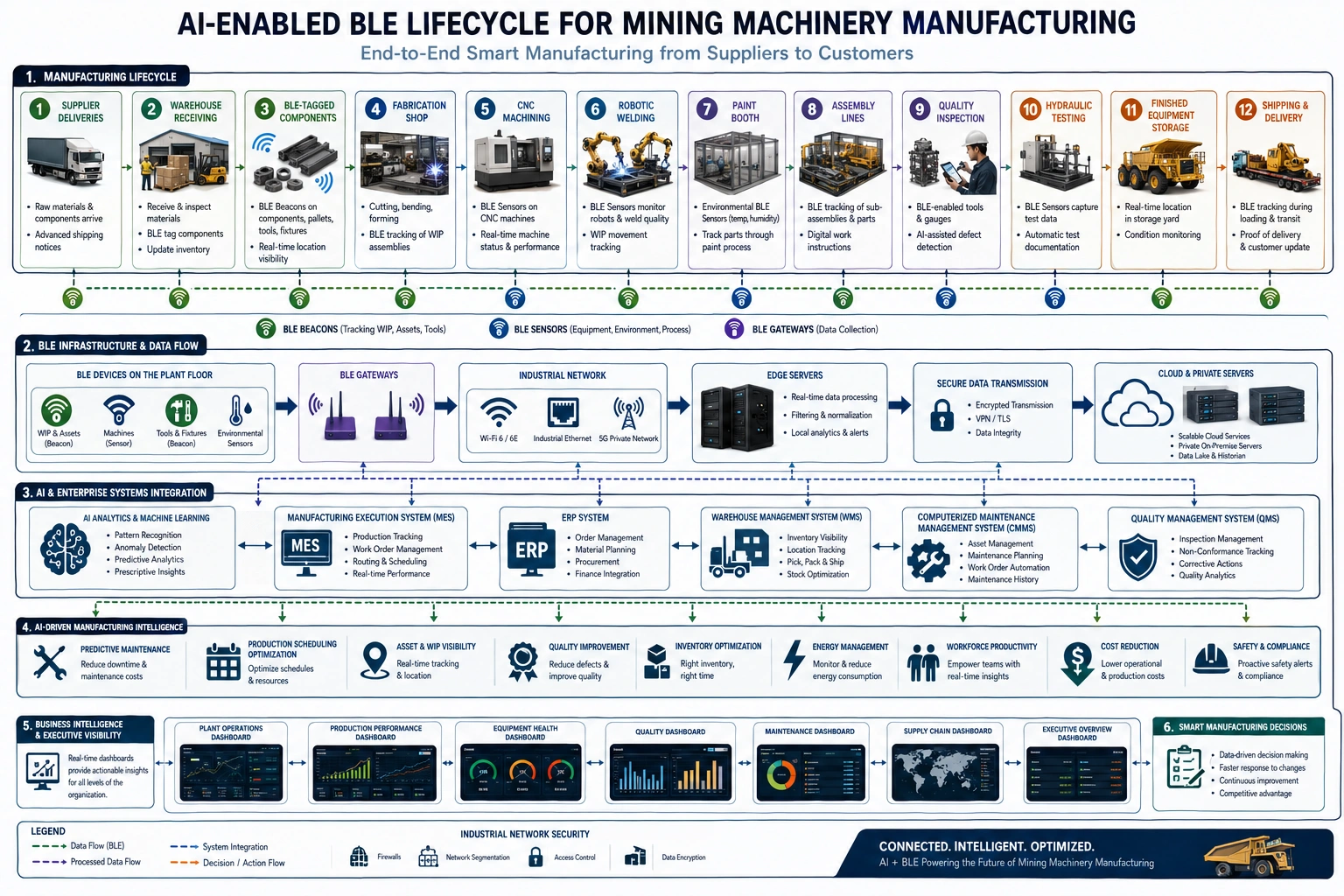
This enterprise infographic summarizes the complete AI-enabled Bluetooth Low Energy (BLE) lifecycle for mining machinery manufacturing, from supplier deliveries to finished equipment shipment. It illustrates how BLE beacons, BLE sensors, BLE gateways, industrial networking, edge servers, AI analytics, Manufacturing Execution Systems (MES), Enterprise Resource Planning (ERP), Warehouse Management Systems (WMS), Computerized Maintenance Management Systems (CMMS), business intelligence dashboards, cloud services, and private servers work together to enable predictive maintenance, production scheduling optimization, quality management, asset tracking, executive reporting, and data-driven manufacturing decisions.
Building the Future of Industrial AI and IoT with Aperture Venture Studio and GAO RFID Inc.
For more than three decades, GAO Group of Companies has invested heavily in research and development of industrial BLE, RFID, and IoT technologies that support demanding manufacturing environments, including mining machinery manufacturing. As Artificial Intelligence of Things solutions become increasingly important for intelligent factories, we have expanded our work in AI-enabled BLE and Industrial IoT technologies while establishing Aperture Venture Studio to accelerate the development and commercialization of advanced AI and IoT solutions for industrial manufacturing. Aperture has attracted experienced AI and IoT technical experts, operational leaders, investors, and industry collaborators. Through initiatives such as Aperture Ventures Summit and TekSummit, we continue advancing technical collaboration and knowledge sharing in Industrial AI and IoT. We welcome advisors, employees, investors, and customers to work with GAO as we continue supporting the future of intelligent manufacturing.