
AI and BLE for Municipal Operations
AI-Driven Municipal Operations with BLE-Based Asset Visibility and Service Optimization
Municipal operations are responsible for maintaining public infrastructure, managing field assets, coordinating public works crews, operating municipal fleets, supporting sanitation services, maintaining parks and recreation facilities, and ensuring efficient delivery of citizen services. AI-powered municipal operations use connected sensors, location-aware systems, operational analytics, and automated decision support to improve service quality, resource utilization, and infrastructure reliability.
Within municipal operations, BLE beacons, BLE sensors, and BLE gateways serve as important data collection technologies that help municipalities monitor equipment, vehicles, facilities, workforce activities, and infrastructure assets. AI systems analyze this operational data to identify inefficiencies, predict maintenance requirements, optimize field operations, and improve municipal service delivery.
As cities face growing demands for infrastructure maintenance, workforce productivity, sustainability initiatives, and budget efficiency, AI-powered municipal operations provide practical tools for improving operational visibility and decision-making. Municipal departments can leverage real-time operational intelligence to reduce downtime, improve asset utilization, enhance public safety, and optimize maintenance scheduling.
Organizations across North America increasingly deploy AIoT solutions that combine artificial intelligence with connected municipal assets. Through decades of experience supplying BLE, RFID, and IoT hardware products and systems, GAO has helped organizations improve operational visibility and asset management across numerous public sector environments.
Fundamental Concepts of AI-Powered Municipal Operations
Municipal operations involve numerous interconnected activities across public works, transportation services, water management, waste collection, facility maintenance, emergency preparedness, parks management, and utility coordination.
AI-powered municipal operations typically combine:
- Asset tracking and utilization monitoring
- Fleet performance management
- Public works scheduling optimization
- Infrastructure condition assessment
- Predictive maintenance analysis
- Workforce productivity monitoring
- Energy consumption optimization
- Citizen service performance analytics
- Environmental monitoring
- Resource allocation optimization
BLE technology supports these applications by enabling location awareness and operational data collection from municipal assets distributed across roads, facilities, parks, maintenance yards, utility systems, and vehicle fleets.
AI models transform operational information into actionable recommendations for supervisors, maintenance managers, public works directors, transportation coordinators, and municipal administrators.
Integrated Municipal Operations: Field Data to AI-Driven Decision Support
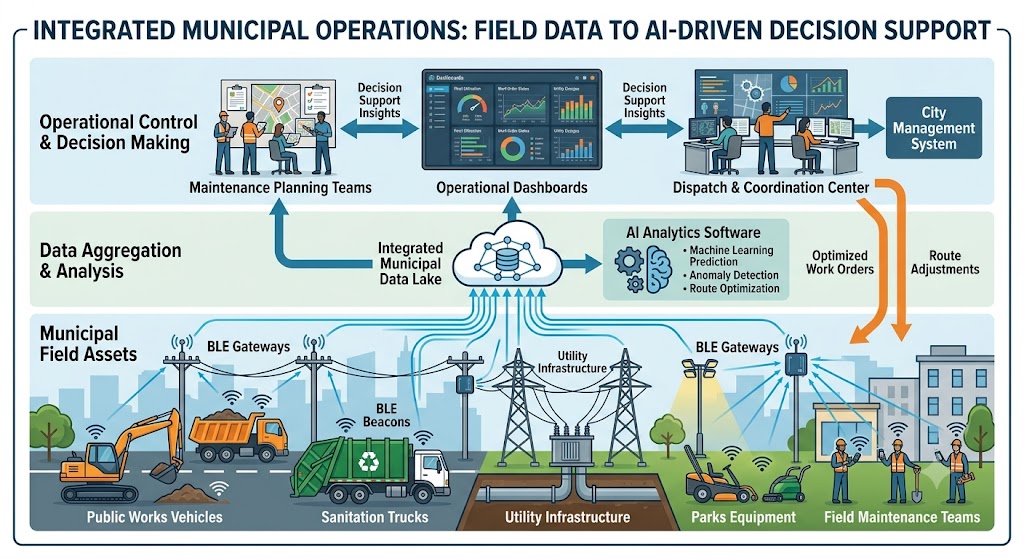
A professional infographic overview diagram illustrating how data from diverse municipal field assets—public works vehicles, sanitation trucks, utility infrastructure, parks equipment, and field maintenance teams—flows via Bluetooth Low Energy (BLE) sensor networks to a centralized cloud platform for AI analytics. The diagram shows the cyclical process from data acquisition in the field to real-time operational control, maintenance planning, and dispatch in the city management office, closing the loop with optimized work orders and route adjustments.
Municipal Operations Applications Enabled by AI and BLE
Public Works Asset Management
Public works departments manage extensive inventories of equipment, tools, spare parts, traffic control devices, generators, pumps, trailers, and maintenance assets.
AI systems help:
- Predict equipment failures
- Identify underutilized assets
- Optimize equipment allocation
- Improve maintenance planning
- Reduce equipment downtime
BLE-based location tracking improves visibility of assets deployed across multiple worksites and maintenance facilities.
Municipal Fleet Operations
Municipal fleets often include:
- Snowplows
- Street sweepers
- Refuse trucks
- Utility service vehicles
- Construction equipment
- Emergency support vehicles
- Parks maintenance vehicles
AI-powered fleet management systems analyze:
- Vehicle utilization
- Route efficiency
- Fuel consumption
- Driver behavior
- Maintenance schedules
- Fleet availability
Operational managers can make faster decisions regarding fleet allocation and service delivery.
Smart Facility Management
Municipal governments operate:
- City halls
- Libraries
- Recreation centers
- Community centers
- Public works buildings
- Maintenance depots
- Water treatment facilities
AI systems use occupancy, environmental, and asset data to optimize:
- HVAC operations
- Lighting systems
- Facility maintenance
- Energy consumption
- Space utilization
BLE-enabled monitoring provides location and utilization information that supports facility optimization initiatives.
Parks and Recreation Operations
Municipal parks departments manage:
- Grounds maintenance equipment
- Irrigation systems
- Recreational facilities
- Sports complexes
- Community event infrastructure
AI-powered monitoring improves:
- Equipment deployment
- Facility utilization
- Maintenance scheduling
- Irrigation efficiency
- Resource planning
Utility and Infrastructure Maintenance
Municipal infrastructure assets include:
- Water distribution systems
- Stormwater systems
- Wastewater facilities
- Traffic signal equipment
- Street lighting systems
- Pump stations
AI-assisted maintenance solutions help identify anomalies, predict failures, prioritize repairs, and optimize maintenance resources.
Municipal Operations Use Case Matrix: AI & BLE Integration
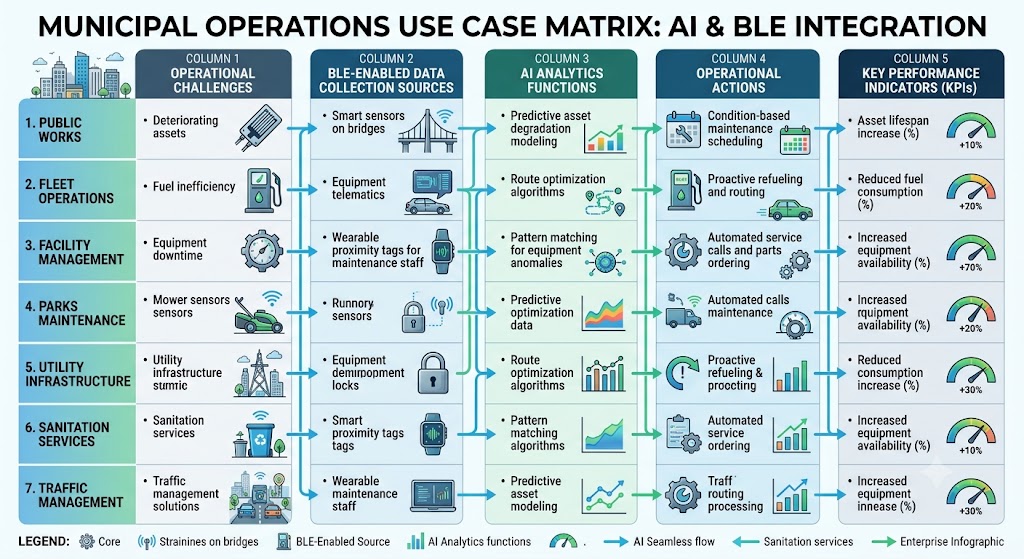
An enterprise-grade matrix mapping seven municipal service domains—public works, fleet operations, facility management, parks maintenance, utility infrastructure, sanitation services, and traffic management—to their respective BLE data sources, AI analytics functions, operational actions, and measurable performance KPIs.
Operational Workflow from Data Acquisition to AI-Driven Municipal Decision Making
Municipal AI solutions depend on continuous operational visibility across diverse assets and service areas.
Data Collection Layer
Data originates from:
- Municipal vehicles
- Maintenance equipment
- Utility assets
- Facility systems
- Environmental sensors
- Workforce activity records
- Work order systems
- Citizen service requests
BLE sensors and beacons provide proximity, movement, location, and utilization information from municipal assets.
Communication Infrastructure
Collected information is transmitted through:
- BLE gateways
- Wi-Fi networks
- Cellular communications
- Municipal fiber networks
- Private wireless systems
- Edge computing devices
Communication redundancy is often necessary because municipal assets operate across geographically dispersed locations.
Edge Processing
Edge systems perform:
- Data filtering
- Event correlation
- Device health monitoring
- Anomaly detection
- Temporary storage
- Operational alert generation
Edge processing reduces latency for critical municipal operations.
Enterprise Software Integration
Operational information integrates with:
- Computerized Maintenance Management Systems (CMMS)
- Enterprise Asset Management (EAM) software
- Geographic Information Systems (GIS)
- Fleet Management Systems
- Public Works Management Software
- Utility Management Systems
- ERP software
- Workforce Management Systems
Integration enables cross-functional operational visibility across municipal departments.
AI Analytics and Decision Support
AI engines process historical and real-time operational information to:
- Forecast maintenance needs
- Predict equipment failures
- Optimize workforce schedules
- Improve route planning
- Identify service bottlenecks
- Improve asset utilization
The resulting recommendations support municipal service delivery improvements while reducing operational costs.
Technology Components Supporting Municipal AI Solutions
Municipal AI deployments require coordinated integration of sensing technologies, communications infrastructure, analytics software, operational systems, and cybersecurity controls.
BLE Hardware Components
Key BLE infrastructure commonly includes:
- BLE beacons attached to municipal equipment
- BLE sensors monitoring environmental conditions
- BLE gateways deployed across facilities
- Vehicle-mounted communication devices
- Mobile workforce devices
- Rugged field monitoring equipment
These devices generate operational awareness across municipal assets and infrastructure.
AI Models Used in Municipal Operations
Common AI techniques include:
- Predictive maintenance models
- Route optimization algorithms
- Demand forecasting models
- Anomaly detection systems
- Resource allocation optimization
- Computer vision inspection systems
- Workforce scheduling optimization
Communication Protocols and Data Transport
Municipal deployments frequently utilize:
- Bluetooth Low Energy
- MQTT
- HTTPS
- REST APIs
- OPC UA
- Modbus
- BACnet
- Cellular IoT communications
Cloud and Server Deployment Models for Municipal Operations
Municipal organizations often operate a combination of centralized administrative facilities, remote field assets, utility infrastructure, maintenance yards, transportation systems, and public service facilities. Selecting the proper deployment model depends on operational requirements, cybersecurity policies, regulatory obligations, and available IT resources.
Cloud Version for Municipal Operations
Cloud-hosted deployments are commonly used when municipalities require centralized management across multiple departments and geographic locations.
Benefits include:
- Centralized visibility across municipal operations
- Faster deployment of analytics software
- Simplified software updates
- Improved scalability for growing cities
- Multi-department data sharing
- Remote access for field supervisors and administrators
- Simplified disaster recovery capabilities
Cloud deployments are often suitable for:
- Fleet management
- Public works coordination
- Parks and recreation operations
- Municipal asset tracking
- Citizen service analytics
- Energy management initiatives
Server Version for Municipal Operations
Server-based deployments operate on customer-managed infrastructure such as municipal data centers, utility control centers, transportation management facilities, or private government cloud environments.
Advantages include:
- Greater control over operational data
- Support for government cybersecurity policies
- Reduced dependence on internet connectivity
- Local processing of sensitive infrastructure information
- Integration with existing municipal IT systems
Server deployments are frequently selected for:
- Utility infrastructure operations
- Water treatment facilities
- Traffic management centers
- Critical municipal infrastructure
- Public safety support systems
- Government-regulated environments
Cybersecurity and Data Protection
Municipal operations increasingly face cybersecurity challenges involving connected infrastructure and operational technology environments.
Recommended security controls include:
- Device authentication
- Role-based access controls
- Network segmentation
- Encrypted communications
- Secure firmware management
- Security event monitoring
- Vulnerability assessments
- Multi-factor authentication
- Asset inventory management
GAO has supplied BLE, RFID, and IoT hardware products and systems supporting secure operational environments across numerous public sector and municipal applications.
Technical Capabilities and Operational Benefits of AI-Powered Municipal Operations
AI-powered municipal operations create measurable improvements by transforming operational data into actionable intelligence that supports better planning, resource utilization, and service delivery.
Predictive Maintenance and Asset Reliability
Municipal assets often include:
- Snow removal equipment
- Refuse collection vehicles
- Water pumps
- Traffic signal controllers
- Street lighting systems
- HVAC equipment
- Public works machinery
AI models identify performance degradation before failures occur.
Benefits include:
- Reduced downtime
- Lower maintenance costs
- Improved service continuity
- Better spare parts planning
- Extended asset life
Municipal Fleet Optimization
Fleet utilization significantly affects operating budgets.
AI-driven analysis supports:
- Route optimization
- Fuel consumption reduction
- Vehicle lifecycle planning
- Maintenance scheduling
- Fleet availability improvement
Operational managers gain visibility into fleet performance across departments.
Workforce Productivity Improvement
Municipal workforce management benefits from:
- Optimized crew scheduling
- Work order prioritization
- Resource allocation recommendations
- Service demand forecasting
- Mobile workforce coordination
AI systems reduce administrative overhead while improving service responsiveness.
Infrastructure Condition Monitoring
Roadways, bridges, drainage systems, public facilities, and utility assets require continuous maintenance.
AI analytics help:
- Identify deterioration trends
- Prioritize repairs
- Forecast maintenance budgets
- Improve inspection efficiency
- Reduce infrastructure risks
Public Service Performance Enhancement
Municipal service delivery can be measured through:
- Response times
- Work order completion rates
- Asset availability
- Service reliability
- Citizen satisfaction metrics
AI-powered analytics improve operational transparency and support data-driven decision making.
Sustainability and Resource Optimization
Municipal governments increasingly pursue sustainability objectives.
AI-enabled monitoring supports:
- Energy efficiency improvements
- Water conservation initiatives
- Fleet emissions reduction
- Waste collection optimization
- Resource utilization improvements
These initiatives help municipalities achieve operational and environmental objectives simultaneously.
Engineering Considerations and Deployment Best Practices
Successful municipal AI implementations require careful planning and operational alignment.
Asset Inventory and Data Quality
Before deployment, municipalities should establish:
- Comprehensive asset inventories
- Asset identification standards
- Maintenance histories
- Location management procedures
- Data governance policies
High-quality operational data improves AI model accuracy.
Infrastructure Planning
Implementation teams should evaluate:
- Facility coverage requirements
- Outdoor communication requirements
- Utility infrastructure connectivity
- Mobile workforce operations
- Vehicle communication capabilities
Coverage planning is particularly important for geographically distributed municipal assets.
System Integration Planning
Municipal organizations often operate numerous legacy systems.
Integration planning should address:
- CMMS connectivity
- GIS integration
- ERP interoperability
- Fleet software integration
- Utility management software interfaces
- Data synchronization requirements
Scalability Considerations
Many municipalities begin with targeted deployments before expanding citywide.
Expansion strategies often include:
- Department-by-department deployment
- Facility-by-facility implementation
- Incremental infrastructure upgrades
- Progressive AI model enhancement
Organizations can achieve faster adoption while minimizing operational disruption.
Key Takeaways for AI-Powered Municipal Operations
AI-powered municipal operations combine advanced analytics, operational intelligence, and connected infrastructure data to improve public service delivery, asset management, workforce productivity, and infrastructure reliability.
Key implementation priorities include:
- Establishing reliable operational data collection
- Improving municipal asset visibility
- Integrating operational software systems
- Deploying predictive maintenance capabilities
- Optimizing workforce and fleet operations
- Strengthening cybersecurity controls
- Building scalable municipal data management strategies
For municipalities seeking to modernize public works, fleet management, infrastructure maintenance, facility operations, and citizen service delivery, AI-enabled solutions supported by BLE technologies provide practical tools for improving operational performance and long-term sustainability.
With decades of experience serving organizations across the United States and Canada, including government agencies, universities, research organizations, and Fortune 500 companies, GAO continues to supply BLE, RFID, and IoT hardware products and systems that support modern municipal operations and digital transformation initiatives.
Building the Future of Industrial AI and IoT with Aperture Venture Studio and GAO RFID Inc.
For more than three decades, GAO Group of Companies has invested heavily in research and development of industrial BLE, RFID, and IoT technologies. As AI becomes increasingly valuable for municipal operations, infrastructure management, public works optimization, and connected government services, we have expanded our focus on AIoT solutions that combine artificial intelligence with connected operational systems. We have also established Aperture Venture Studio to help accelerate the advancement of AI and IoT technologies supporting real-world operational challenges across public sector and infrastructure environments.
Aperture has attracted leading AI and IoT technical experts, experienced operational executives, influential investors, and major technology organizations.
We have also developed highly successful Aperture Ventures Summit and TekSummit programs focused on advanced AI and IoT topics.
These initiatives have helped build strong technical communities and collaborative innovation networks across AI and IoT domains.
We welcome participation as:
- Advisors, Co-founders, or Employees
- Investors
- Customers