
AI and BLE for Nuclear Energy Operations
AI-Driven Nuclear Energy Operations with Connected BLE Data
AI and BLE can support nuclear energy operations by creating a controlled data layer for assets, personnel, environmental conditions, maintenance activities, and equipment status. BLE gateways, beacons, and sensors can capture proximity, location, temperature, vibration, humidity, occupancy, and other operational signals, while AI converts these observations into anomaly detection, predictive maintenance, inspection support, workflow optimization, and decision support. The value is greatest when BLE data is integrated with existing plant systems rather than treated as an isolated tracking application. Nuclear facilities require particularly careful separation between monitoring solutions and safety-related instrumentation and control functions. U.S. nuclear cybersecurity requirements also protect digital systems associated with safety, security, and emergency preparedness functions, while the NRC is actively evaluating AI applications and regulatory considerations. (Nuclear Regulatory Commission)
AIoT Architecture for Nuclear Power Plant BLE Monitoring
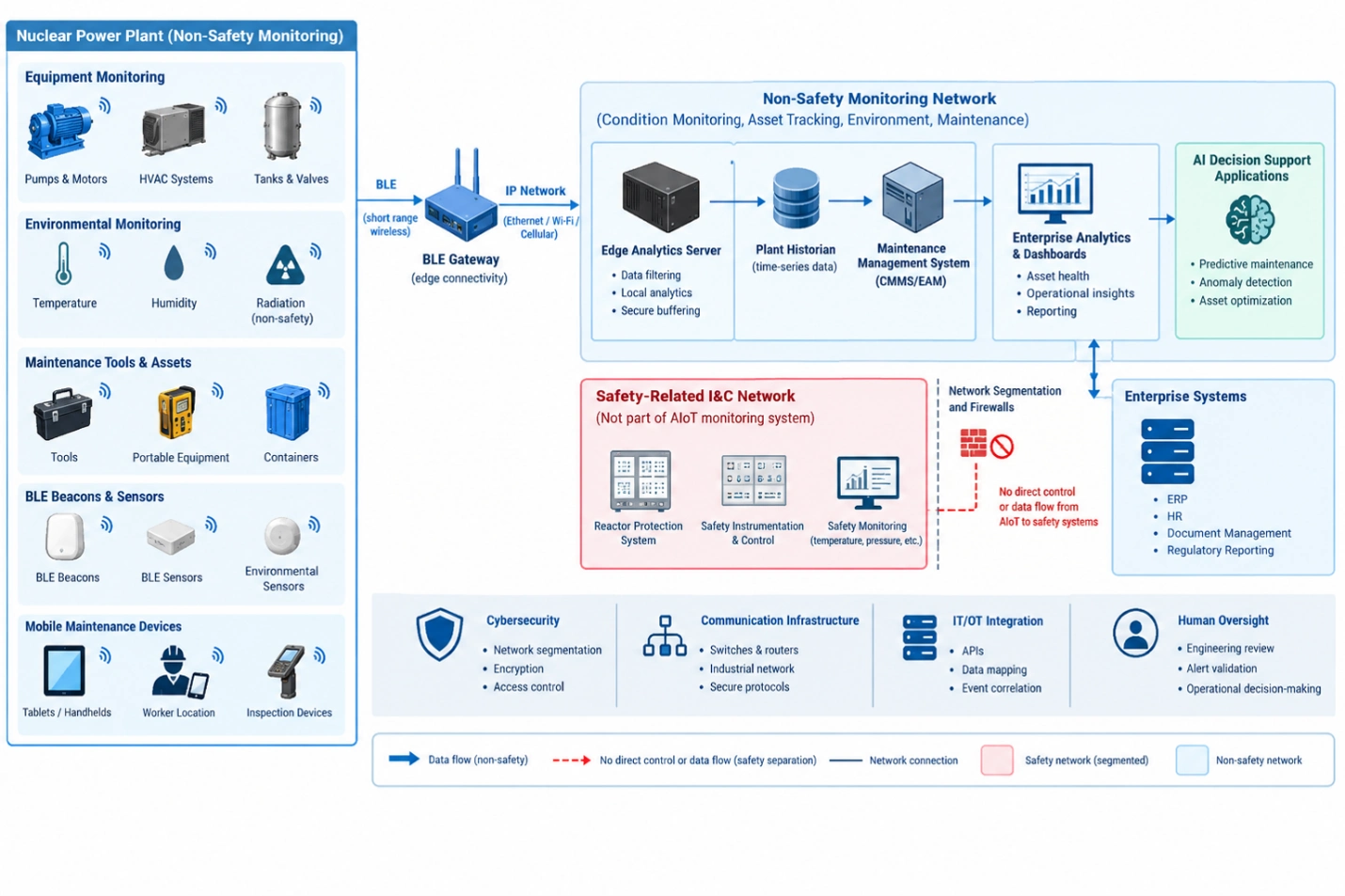
This diagram illustrates how BLE sensors, beacons, mobile devices, and gateways feed non-safety nuclear plant monitoring data into edge analytics, plant historians, CMMS/EAM systems, enterprise analytics, and AI decision-support applications. It also shows network segmentation and separation from safety-related instrumentation and control systems.
What AI Means for Nuclear Energy Operations
AI in nuclear energy operations is most useful when it augments established engineering processes rather than replacing licensed operator judgment, safety analysis, or approved protection functions. The NRC describes AI applications under consideration across nuclear activities, including machine learning for inspection planning, AI/ML for characterizing cybersecurity states, and natural language processing for regulatory-document analysis. (Nuclear Regulatory Commission)
For nuclear facilities, the relevant concept is AIoT, or Artificial Intelligence of Things. AIoT combines artificial intelligence with IoT devices, sensors, connected equipment, and industrial systems. Depending on the application, this can include Industrial AI, Edge AI, machine learning, computer vision, and, in autonomous applications, Physical AI.
A practical nuclear AIoT solution therefore begins with an operational question:
- Which equipment is showing abnormal behavior?
- Which maintenance activity is approaching a failure-prone condition?
- Where is a mobile tool, inspection instrument, or controlled asset?
- Which environmental condition has departed from its expected operating envelope?
- Which inspection, work-order, or maintenance record contains an emerging pattern?
- Which operational observations should be escalated to engineering personnel?
BLE is an enabling sensing and identification technology within these workflows. It is not a substitute for qualified nuclear instrumentation.
The distinction matters because nuclear plants contain multiple classes of systems with different safety significance, qualification requirements, cybersecurity controls, availability requirements, and engineering change processes. The NRC identifies instrumentation and control systems as critical to providing operators with plant information and controlling safety systems. (Nuclear Regulatory Commission)
Consequently, a BLE-enabled AI solution should normally be designed around monitoring, asset intelligence, maintenance, logistics, worker-location awareness, environmental observation, and decision support, unless a specific nuclear safety case establishes otherwise.
GAO supplies BLE gateways, beacons, sensors, RFID hardware, and IoT systems that can provide the physical data-collection layer for these applications. GAO’s published product portfolio specifically includes BLE gateways and beacons alongside RFID and IoT hardware. (GAO RFID)
Nuclear Energy Applications Where AI Creates Operational Value
AI-Assisted Predictive Maintenance
Nuclear power plants contain large populations of pumps, motors, valves, fans, heat exchangers, electrical cabinets, HVAC equipment, battery systems, auxiliary systems, and rotating machinery. Maintenance organizations must distinguish normal equipment variation from degradation that warrants inspection.
BLE vibration, temperature, acoustic, or other condition-monitoring sensors can supplement existing maintenance measurements. AI models can establish equipment-specific baselines and identify deviations rather than relying solely on fixed thresholds.
Useful applications include:
- Early identification of abnormal vibration patterns on balance-of-plant rotating equipment
- Temperature trend monitoring around electrical and mechanical equipment
- Correlation of equipment condition with maintenance history
- Detection of repeated anomalies following maintenance activities
- Maintenance prioritization using condition, criticality, age, and historical failure information
- Identification of assets requiring engineering review before planned outages
The AI output should generally be an engineering recommendation or alert, not an autonomous command to safety-related equipment.
AI for Nuclear Asset and Tool Tracking
Nuclear maintenance involves specialized tools, calibrated instruments, lifting equipment, temporary equipment, radiation-protection equipment, spare parts, and work packages. Knowing whether an item is available, staged, checked out, or returned can affect outage productivity and material-control processes.
BLE beacons attached to suitable non-safety assets can provide proximity and location observations through strategically positioned gateways. AI can then identify unusual movement patterns, predict staging requirements, and correlate asset movement with work orders.
This creates a stronger operational relationship between:
asset identity → location → work order → technician → maintenance activity → inspection record
The result is more useful than simply displaying a point on a map because the system can place asset movement into the context of nuclear maintenance workflows.
AI-Assisted Worker and Maintenance Workflow Awareness
Personnel-location technologies require especially careful treatment in nuclear environments. A useful application is not indiscriminate worker surveillance, but operational awareness associated with authorized work activities.
BLE badges or wearable devices can potentially support:
- Personnel presence confirmation in designated work areas
- Muster and accountability support
- Technician-to-work-order association
- Maintenance-zone occupancy analysis
- Restricted-area access workflows
- Tool-to-technician association
- Identification of prolonged presence in an expected work zone
- Workflow analysis during planned outages
AI can correlate location events with approved work schedules and identify exceptions for human review.
For radiation-controlled areas, BLE should not be assumed to replace radiation protection instrumentation, dosimetry, access controls, or radiological protection procedures. Instead, it can provide complementary operational context.
AI for Environmental and Equipment Condition Monitoring
BLE sensors can capture selected environmental parameters in locations where installing wired instrumentation is impractical. Nuclear facilities can have extensive auxiliary spaces, cable areas, warehouses, maintenance rooms, electrical rooms, temporary work areas, and equipment storage locations.
Potential AI applications include:
- Environmental anomaly detection
- Temperature and humidity trend analysis
- Equipment-room condition monitoring
- Detection of unexpected environmental changes
- Correlation between environmental conditions and equipment anomalies
- Alert prioritization based on equipment criticality
- Monitoring temporary equipment during outage activities
Sensor selection must account for temperature range, battery behavior, electromagnetic environment, enclosure requirements, calibration, maintenance accessibility, and any nuclear qualification or site-specific restrictions.
From Nuclear Plant Data Capture to AI-Assisted Decisions
A practical nuclear AIoT workflow consists of several controlled stages.
Data Acquisition
BLE sensors and beacons generate observations such as:
- Device identity
- Timestamp
- Received signal strength
- Gateway identity
- Proximity
- Temperature
- Humidity
- Vibration
- Battery status
- Equipment condition parameters
- Personnel or tool identifiers where authorized
The sensor layer should collect only information necessary for the operational objective.
BLE Gateway and Edge Collection
BLE gateways aggregate nearby devices and forward normalized records into an edge computing environment. Gateway placement should account for equipment-room geometry, shielding, metallic structures, electromagnetic conditions, RF congestion, maintenance accessibility, and gateway redundancy.
A nuclear deployment should not assume that theoretical BLE range will translate directly into reliable plant coverage. A site survey and RF validation are important before committing to gateway quantities or sensor placement.
GAO provides BLE gateways and related BLE hardware that can be incorporated into customized IoT and tracking systems. GAO also describes site-survey and system-customization services for RFID and BLE deployments. (GAO RFID)
Edge Processing
Edge processing is particularly valuable where plant connectivity is restricted or where operational decisions need low latency.
An edge server can perform:
- Device authentication
- Data normalization
- Timestamp validation
- Duplicate-event removal
- Sensor-health checks
- Local buffering
- Threshold evaluation
- Feature extraction
- Preliminary anomaly detection
- Store-and-forward synchronization
Edge processing also reduces unnecessary transmission of raw sensor data across controlled network boundaries.
AI Analytics
AI models can operate on historical and streaming data.
Depending on the problem, suitable methods include:
- Statistical process monitoring
- Time-series anomaly detection
- Supervised classification
- Unsupervised clustering
- Remaining-useful-life estimation
- Predictive maintenance models
- Bayesian inference
- Natural language processing
- Computer vision
- Multivariate correlation analysis
Model selection should follow the engineering question rather than the availability of a fashionable AI technique. A transparent statistical model may be more appropriate than a complex neural network when engineers need to understand why an alert was generated.
Enterprise and Nuclear Software Integration
AI-generated findings become operationally useful when connected to systems already used by plant personnel.
Relevant integrations can include:
- Computerized maintenance management systems
- Enterprise asset management systems
- Work management systems
- Plant historians
- Laboratory information systems
- Document management systems
- Inventory systems
- Access-control systems
- Outage management software
- Engineering databases
- Condition-monitoring databases
- Security information and event management systems
Integration should preserve authoritative system ownership. A BLE system should not become an unofficial parallel database for equipment status when the plant’s maintenance system is the authoritative record.
Nuclear Energy AIoT Workflow from BLE Data to Maintenance Action
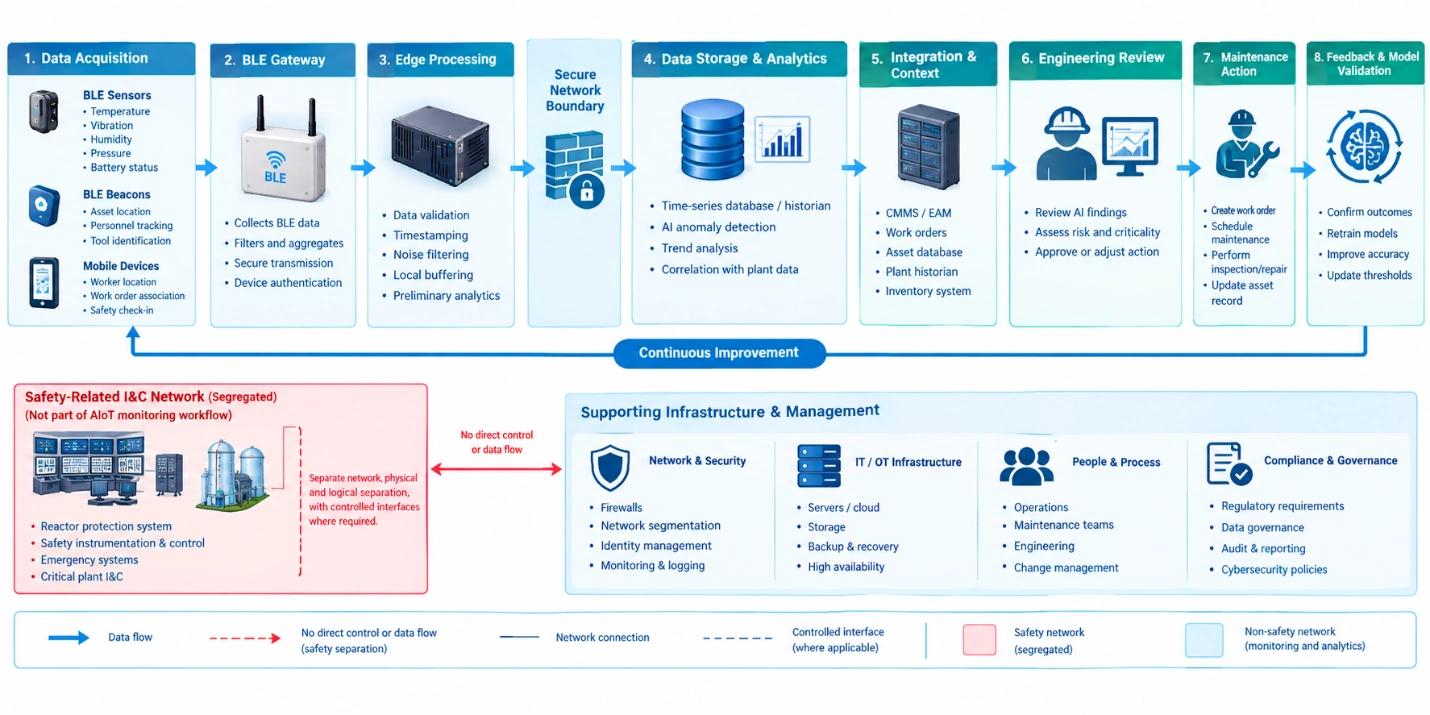
This workflow illustrates how BLE sensor and beacon data moves through gateways, edge processing, secure network boundaries, AI analytics, CMMS/EAM integration, engineering review, and approved maintenance actions. A feedback loop supports model validation, while safety-related instrumentation and control systems remain segregated from the AIoT monitoring workflow.
BLE Hardware, AI Software, and Deployment Choices
BLE should be selected according to the nuclear operational requirement, not simply because it is a low-power wireless technology. NIST’s Bluetooth security guidance addresses Bluetooth security capabilities and recommendations for organizations deploying Bluetooth technologies. (NIST Computer Security Resource Center)
BLE Sensors
BLE sensors provide the physical measurement layer. Nuclear use cases may involve temperature, humidity, vibration, contact state, motion, occupancy, or other measurements depending on the sensor’s specifications.
Important selection criteria include:
- Measurement accuracy and repeatability
- Battery life under the actual sampling configuration
- Operating temperature
- Enclosure and ingress protection
- Electromagnetic compatibility
- Calibration requirements
- Sensor mounting method
- Maintenance accessibility
- RF performance in the target location
- Site-specific qualification requirements
BLE Beacons
BLE beacons can identify people, tools, containers, mobile equipment, inspection instruments, and other authorized assets. Beacon deployment should consider attachment integrity, battery replacement, contamination controls, cleaning procedures, environmental exposure, and whether the tagged object is suitable for wireless identification.
BLE Gateways
Gateways bridge the short-range BLE layer and the site’s IP-connected computing environment. Their engineering role includes device discovery, local filtering, timestamping, buffering, data forwarding, and potentially edge analytics.
Gateway redundancy is valuable for operationally important monitoring because a single gateway failure should not silently eliminate visibility of a critical monitoring zone.
AI and Data Software
The software layer should support:
- Device registry
- Asset identity
- Sensor configuration
- Time-series storage
- Event processing
- Rules and alerts
- AI model execution
- Model version control
- Audit logging
- API integration
- Role-based access
- Dashboarding
- Data retention policies
AI models should be validated against representative plant data and monitored for drift. A model trained on one equipment population should not automatically be assumed valid for another equipment type, plant design, sensor configuration, or operating regime.
Cloud Version and Server Version
A Cloud Version can be appropriate for non-safety operational analytics where site policy permits data to leave the facility’s controlled environment. Cloud-hosted processing can simplify centralized analytics across multiple facilities, provide elastic compute capacity, and support enterprise-level reporting.
A Server Version can run on customer-managed edge servers, private data centers, plant servers, or other privately hosted infrastructure. This approach can be preferable when nuclear cybersecurity policy, data sovereignty, network segmentation, latency, or operational independence limits external connectivity.
The NRC notes that digital systems associated with nuclear safety, security, and emergency preparedness functions are subject to cybersecurity protection requirements, and operating nuclear plants commonly isolate important systems from external communications. (Nuclear Regulatory Commission)
For that reason, deployment selection should begin with the plant’s cybersecurity boundary and system classification rather than with a generic cloud-versus-server preference.
Nuclear Cybersecurity and Wireless Engineering Considerations
Wireless connectivity introduces a distinct security and reliability boundary that must be engineered into the solution from the beginning. IEC 62645:2019 establishes cybersecurity requirements and guidance for programmable digital systems associated with nuclear plant instrumentation, control, and electrical power systems. IEC TR 63486:2024 further addresses cybersecurity risk-management approaches for nuclear I&C and electrical power systems. (IEC Webstore)
A BLE monitoring deployment should therefore consider:
- Asset inventory and device identity
- Strong authentication
- Secure pairing and key management
- Encryption
- Gateway hardening
- Network segmentation
- Least-privilege access
- Firmware lifecycle management
- Secure update procedures
- Audit logging
- Detection of unauthorized devices
- RF interference assessment
- Gateway failure detection
- Data integrity checks
- Time synchronization
- Incident-response procedures
- Controlled interfaces into plant networks
BLE telemetry should also be treated as potentially imperfect operational data. RF propagation can change when equipment, shielding, doors, temporary structures, or maintenance activities alter the physical environment. AI models should therefore incorporate data-quality checks rather than interpreting every missing or abnormal packet as equipment failure.
BLE Cybersecurity Defense-in-Depth for Nuclear Energy Operations
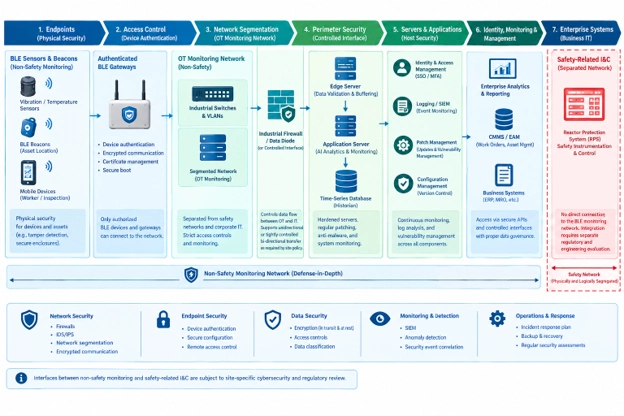
This diagram illustrates layered cybersecurity controls for BLE-enabled nuclear energy monitoring, from BLE sensors and authenticated gateways through segmented OT networks, controlled interfaces, hardened servers, identity management, security monitoring, and enterprise systems. A separate safety-related I&C network emphasizes physical and logical separation and the need for site-specific cybersecurity and regulatory review.
Engineering Deployment for Nuclear Energy AIoT
A successful AI-enabled BLE deployment in nuclear energy operations should be treated as an engineered operational system rather than as a collection of wireless sensors. The implementation lifecycle should connect the plant’s operational objectives, equipment criticality, cybersecurity requirements, RF conditions, data governance, AI validation, and maintenance processes.
Planning and Site Assessment
The planning phase should define the operational problem before selecting BLE hardware or AI software. A nuclear facility can begin by identifying equipment populations, maintenance workflows, outage activities, environmental monitoring zones, controlled areas, and existing data sources.
A site assessment should document:
- Equipment locations and criticality
- Existing instrumentation and condition-monitoring systems
- BLE coverage requirements
- Radio-frequency interference sources
- Metallic structures and shielding
- Gateway mounting locations
- Network availability
- Edge-server locations
- Cybersecurity zones and conduits
- Environmental conditions
- Battery replacement constraints
- Required data retention
- Existing CMMS, EAM, historian, and work-management interfaces
The assessment should also establish whether the proposed BLE system is strictly for non-safety monitoring or whether any interface could affect a safety-related, security-related, or emergency-preparedness function. That determination has major consequences for qualification, cybersecurity, configuration control, testing, documentation, and regulatory review.
Hardware Selection and Commissioning
Hardware selection should be based on the actual operating environment. A sensor that performs adequately in a warehouse may not provide the required reliability in a reinforced concrete equipment building, turbine auxiliary area, electrical room, or shielded plant space.
Commissioning should verify:
- Sensor identity and configuration
- Gateway connectivity
- RF coverage
- Packet reception reliability
- Timestamp accuracy
- Measurement accuracy
- Battery status
- Data persistence during network interruptions
- Edge buffering
- Alarm behavior
- API connectivity
- Cybersecurity controls
- Asset-to-sensor association
- Correct mapping between physical equipment and software records
A controlled commissioning procedure should generate baseline data before AI models are trusted for operational use.
GAO has supplied RFID, BLE, and IoT hardware and systems to organizations in the United States and Canada, including Fortune 500 companies, research organizations, universities, and government agencies. GAO’s engineering support includes product customization and deployment assistance, which can be relevant when nuclear facilities require site-specific hardware and integration arrangements.
Testing and AI Model Validation
AI validation should be separated from ordinary software acceptance testing. The question is not simply whether the application functions, but whether the model produces useful results under realistic operating conditions.
Testing can include:
- Historical-data replay
- Normal-operation baseline testing
- Known-fault datasets
- Sensor-failure simulation
- Missing-data testing
- Communication-loss testing
- False-positive analysis
- False-negative analysis
- Equipment-specific threshold validation
- Model drift monitoring
- Human review of generated alerts
- Cybersecurity testing
- Failover testing
- Disaster-recovery testing
A predictive-maintenance model should not be accepted merely because it produces a high statistical accuracy score. Nuclear maintenance teams need to know whether an alert occurs early enough to support an actionable work-management decision and whether the alert remains reliable when operating conditions change.
Integration and Operational Handover
The final stage is integration with the personnel and processes that will act on the information.
For example:
BLE sensor → condition event → AI anomaly → equipment context → engineering review → maintenance recommendation → CMMS work order → inspection → maintenance result → model feedback
This feedback loop is important. Maintenance results provide evidence about whether an AI alert was meaningful. Over time, the facility can use validated outcomes to improve model performance while retaining appropriate engineering oversight.
Operational Benefits of AI-Enabled BLE Monitoring
Earlier Detection of Equipment Anomalies
AI can identify gradual changes that fixed thresholds may miss. A pump’s vibration or temperature can remain below a conventional alarm limit while its statistical behavior changes relative to its historical operating pattern.
When BLE sensing provides additional condition data, AI can compare current observations with equipment-specific baselines and identify deviations for engineering review.
Better Maintenance Prioritization
Maintenance organizations often have more inspection and work candidates than available labor windows. AI can help prioritize candidates by combining condition data with:
- Equipment criticality
- Failure history
- Maintenance history
- Operating hours
- Recent interventions
- Sensor anomalies
- Work-order status
- Outage schedules
The resulting recommendation can help engineers focus attention on equipment where additional investigation is justified.
Improved Outage Logistics
Refueling outages create concentrated movement of personnel, tools, components, temporary equipment, and work packages. BLE asset identification can provide location events while AI can analyze movement and workflow patterns.
Potential outcomes include:
- Faster identification of misplaced tools
- Better staging of maintenance equipment
- Reduced time spent searching for mobile assets
- Improved visibility of temporary equipment
- Identification of workflow bottlenecks
- More accurate outage logistics analysis
These benefits come from connecting asset observations to actual work activities rather than from location tracking alone.
Stronger Environmental Awareness
AI can correlate environmental observations with equipment condition and operational history.
For example, repeated temperature excursions in an equipment room can be evaluated alongside equipment alarms, HVAC status, maintenance records, and historical trends. This provides engineering teams with more context than a standalone temperature alarm.
Improved Data Quality and Operational Visibility
A major benefit of AIoT is the ability to detect bad data before it becomes a misleading operational signal.
AI and statistical analytics can identify:
- Sensors reporting improbable values
- Intermittent communication
- Stale measurements
- Abnormal battery behavior
- Repeated gateway dropouts
- Sensor drift
- Duplicate events
- Unexpected changes in measurement distributions
Data-quality analytics should be considered part of the operational solution, not an optional analytics feature.
AI Predictive Maintenance Decision Tree for Nuclear Power Plants
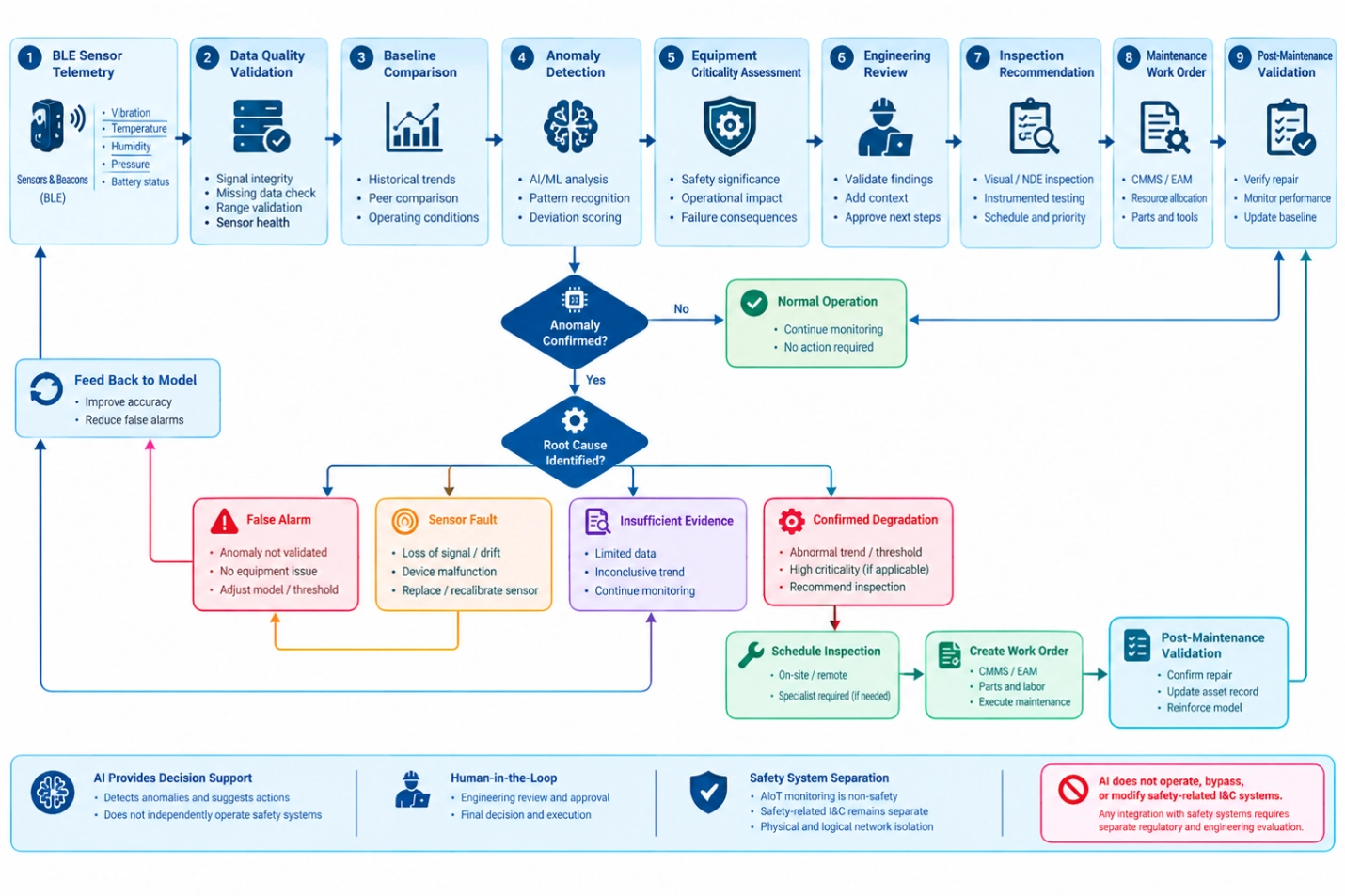
This decision tree shows how BLE sensor telemetry moves through data-quality validation, baseline comparison, AI anomaly detection, equipment criticality assessment, engineering review, inspection, maintenance work orders, and post-maintenance validation. It also distinguishes false alarms, sensor faults, insufficient evidence, and confirmed degradation while emphasizing human oversight and separation from safety-related I&C systems.
Nuclear Energy KPIs for AI and BLE Deployments
Performance should be measured using operational outcomes rather than the number of installed sensors or generated AI alerts.
| KPI | What to Measure | Why It Matters |
|---|---|---|
| Asset-location accuracy | Difference between reported and verified location | Determines whether tracking supports maintenance logistics |
| BLE data availability | Percentage of expected observations received | Indicates sensing reliability |
| Gateway availability | Gateway uptime and communication continuity | Identifies infrastructure weaknesses |
| Sensor battery life | Actual versus expected service interval | Determines maintenance burden |
| Anomaly detection precision | Percentage of alerts validated as meaningful | Controls engineering workload |
| False-alert rate | Unproductive AI alerts per monitoring period | Measures model usefulness |
| Detection lead time | Time between anomaly identification and confirmed issue | Indicates predictive value |
| Mean time to investigate | Time from alert to engineering review | Measures workflow responsiveness |
| Maintenance search time | Time spent locating tools or equipment | Quantifies logistics improvement |
| Work-order correlation | AI events correctly associated with work orders | Measures system integration quality |
| Data-quality exception rate | Invalid or incomplete observations | Indicates sensor and gateway health |
| Model drift rate | Change in model performance over time | Supports lifecycle management |
| Network interruption recovery | Time required to restore synchronized data | Measures resilience |
| Cybersecurity event rate | Unauthorized or anomalous device events | Supports security monitoring |
| Human-review acceptance rate | Alerts considered actionable by engineers | Measures operational relevance |
For nuclear operations, KPI interpretation should remain consistent with plant procedures and safety classifications. A reduction in maintenance search time, for example, is operationally useful but should not be confused with evidence that a safety function has become more reliable.
Supporting Technologies for Nuclear AIoT
BLE is only one component of a broader connected-data solution.
RFID
RFID can complement BLE where longer-range identification, checkpoint verification, inventory control, or automated portal-based identification is more appropriate.
Potential nuclear applications include:
- Maintenance inventory
- Spare-part identification
- Tool-control workflows
- Container tracking
- Component identification
- Warehouse management
- Calibration-equipment records
BLE is generally more useful when continuous or periodic wireless location and sensing are required, while RFID can be useful for controlled identification events.
Industrial Networking
Depending on the plant’s approved network design, BLE gateways can interface with Ethernet, Wi-Fi, cellular or other IP-connected infrastructure. The appropriate communications method depends on coverage, cybersecurity segmentation, latency, availability, and site policy.
Historians and Time-Series Databases
Plant historians and time-series databases provide important historical context. Combining BLE-derived condition data with existing operational measurements can improve anomaly detection because AI can distinguish equipment behavior from environmental or operating-condition changes.
CMMS and EAM Systems
CMMS and EAM integration connects sensor observations with maintenance execution. The integration should preserve equipment identifiers, work-order relationships, maintenance history, inspection results, and asset hierarchy.
Computer Vision
Computer vision can complement BLE by analyzing equipment images, inspection photographs, thermal imagery, or video where authorized. For example, image models can identify visual anomalies while BLE provides asset identity and location context.
This combination can create a richer inspection record:
equipment identity + location + image + sensor condition + maintenance history
Natural Language Processing
Nuclear organizations maintain large volumes of technical documents, operating procedures, inspection reports, maintenance records, engineering evaluations, and regulatory material.
NLP and retrieval-augmented AI can help authorized personnel locate relevant information, classify documents, summarize maintenance history, and identify relationships between equipment observations and historical records. Outputs should remain traceable to source documents and controlled information.
Implementation Recommendations for Nuclear Energy Operations
A technically sound deployment should follow several practical principles.
- Start with a narrowly defined operational problem such as predictive maintenance, outage asset tracking, or environmental monitoring.
- Establish equipment criticality and system classification before installing wireless devices.
- Keep non-safety monitoring functions logically separated from safety-related instrumentation and control functions.
- Conduct an RF site survey before determining gateway quantities and locations.
- Validate BLE performance with representative structures, equipment, shielding, and operating conditions.
- Use asset identifiers that align with existing plant equipment hierarchies.
- Build data-quality monitoring into the gateway and edge software.
- Prefer edge processing where network restrictions or latency make continuous external connectivity unsuitable.
- Use cloud analytics only where the facility’s cybersecurity, data-governance, and connectivity requirements permit it.
- Maintain a clear human-review step for AI-generated engineering recommendations.
- Validate AI models against representative historical and operating data.
- Establish model-change control, versioning, auditability, and performance monitoring.
- Test sensor, gateway, network, server, and AI failure modes independently.
- Document battery replacement, calibration, firmware updates, and device retirement procedures.
- Integrate validated events with CMMS, EAM, historians, and work-management systems rather than creating disconnected databases.
- Treat cybersecurity as part of system engineering from the initial design phase.
- Reassess model performance after equipment modification, sensor replacement, major maintenance, or changes in operating regime.
GAO can support this lifecycle through BLE gateways, beacons, sensors, RFID products, IoT hardware, and customized systems. GAO’s customer base includes organizations requiring specialized technology procurement, integration, and technical support, with the GAO Group maintaining R&D and quality-assurance activities in New York City and Toronto, Canada.
GAO Engineering Perspective on Nuclear AIoT
Nuclear energy operations require technology decisions that account for reliability, cybersecurity, maintainability, interoperability, and regulatory context simultaneously. AI can provide substantial value when it transforms large volumes of equipment, environmental, location, maintenance, and inspection data into actionable engineering information.
BLE is particularly useful as an enabling data-collection technology for selected non-safety monitoring and operational workflows. Its greatest value comes from integration with AI analytics, plant historians, CMMS/EAM software, asset databases, and controlled operational processes.
GAO, headquartered in New York City and Toronto, Canada, is ranked among the top 10 leading B2B and B2G BLE and RFID suppliers globally. GAO, together with GAO Research Inc. and GAO Tek Inc., forms GAO Group. Across three decades, the companies have invested substantially in R&D, supported customers across the United States and Canada, and maintained stringent quality-assurance processes with remote and onsite technical support.
For nuclear organizations evaluating AI-enabled BLE systems, the appropriate next step is a requirements-driven assessment covering the target equipment, data sources, RF environment, cybersecurity boundary, integration requirements, AI objectives, and operational acceptance criteria. GAO can provide relevant BLE, RFID, and IoT hardware and technical assistance for organizations developing such systems.
AI-Enabled BLE Reference System for Nuclear Energy Operations
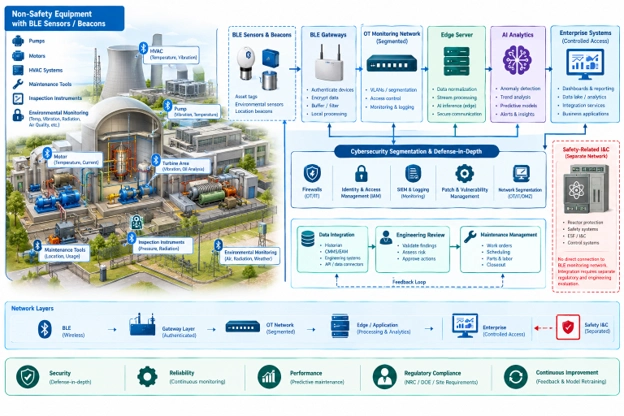
This reference illustration shows how BLE sensors and beacons attached to non-safety equipment can feed data through authenticated gateways, segmented OT networks, edge servers, AI analytics, and controlled enterprise systems. It connects predictive maintenance, engineering review, and maintenance management workflows while showing cybersecurity controls and the separation of safety-related instrumentation and control systems.
Building the Future of Industrial AI and IoT with Aperture Venture Studio and GAO RFID Inc.
For nuclear energy operations, GAO’s long-standing R&D in industrial BLE, RFID, and IoT supports the development of AIoT solutions for asset monitoring, maintenance, environmental sensing, and operational intelligence. We have also established Aperture Venture Studio to help advance AI and IoT technologies relevant to demanding industrial applications, including connected energy operations. Aperture brings together AI and IoT technical experts, executives, investors, and technology companies. Through the Aperture Ventures Summit and TekSummit, we facilitate discussion of advanced AI and IoT technologies. We welcome advisors, co-founders, employees, investors, and customers to participate in these initiatives.