
AI and BLE for Offshore Energy Operations
Intelligent Offshore Energy Operations Powered by AI and BLE
Artificial Intelligence combined with Bluetooth Low Energy (BLE) technologies is transforming offshore energy operations by enabling intelligent monitoring, predictive decision-making, workforce safety, and real-time operational visibility across offshore production assets. BLE gateways, beacons, and sensors continuously collect operational data from personnel, equipment, and environmental conditions while AI analyzes large volumes of information to identify anomalies, optimize maintenance schedules, improve production efficiency, and reduce operational risks.
Within offshore energy facilities such as fixed platforms, floating production systems, offshore wind farms, subsea production systems, drilling rigs, FPSOs, and offshore substations, AI-driven BLE solutions help organizations improve asset integrity, reduce unplanned shutdowns, enhance personnel accountability, and support regulatory compliance. These intelligent Industrial AI and IoT solutions allow operators to transition from reactive operations to predictive and data-driven decision-making while maintaining safe, reliable, and efficient offshore production under challenging marine environments.
GAO has supported organizations throughout North America by supplying industrial BLE hardware and IoT systems for demanding operational environments. Drawing on decades of experience serving Fortune 500 companies, government agencies, research institutions, and industrial organizations, we help customers deploy reliable wireless sensing technologies that support modern offshore digital transformation initiatives.
AI-Enabled BLE Monitoring System for Offshore Energy Operations with Edge Intelligence and Digital Twin Analytics
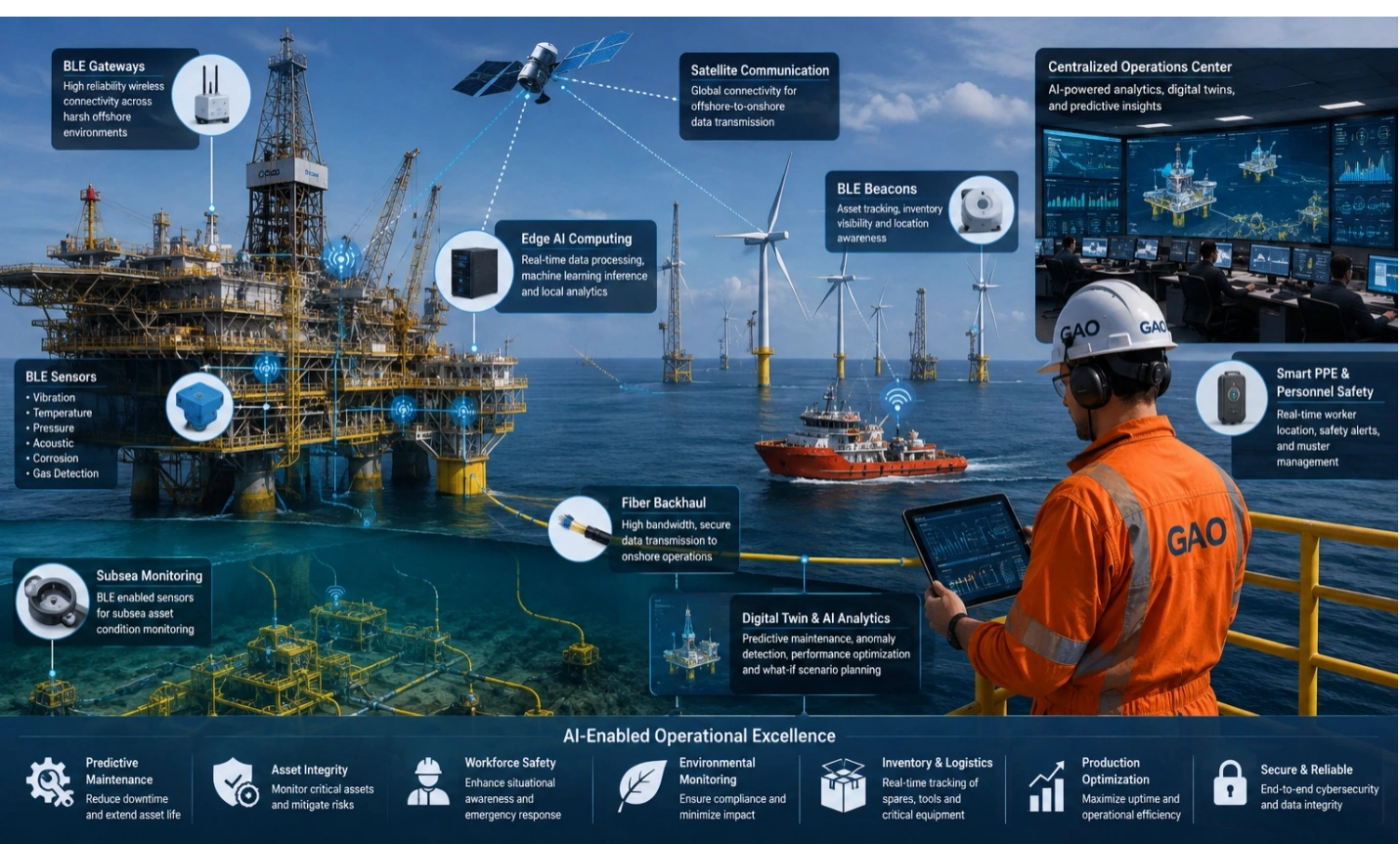
This illustration depicts a comprehensive AI-enabled BLE monitoring solution for offshore energy operations, integrating offshore oil and gas platforms, offshore wind farms, subsea infrastructure, BLE gateways, BLE beacons, BLE sensors, edge AI computing, satellite communications, and centralized digital twin analytics. It demonstrates how real-time operational data flows securely from field assets to AI-powered analytics, enabling predictive maintenance, workforce safety, asset integrity management, environmental monitoring, and production optimization across offshore energy facilities.
Understanding AI-Driven BLE Solutions in Offshore Energy
Offshore energy operations demand continuous monitoring of geographically distributed assets operating under harsh environmental conditions characterized by saltwater corrosion, high humidity, vibration, explosive atmospheres, severe weather, and limited accessibility. Production interruptions often require expensive marine logistics, specialized maintenance crews, and planned shutdowns, making predictive operations significantly more valuable than reactive maintenance.
Artificial Intelligence of Things (AIoT), commonly known as AI and IoT, combines artificial intelligence with connected industrial devices, sensors, communication networks, and operational systems. Within offshore energy facilities, AI processes operational information gathered from BLE-enabled devices to identify hidden operational patterns, forecast equipment failures, optimize maintenance planning, improve workforce safety, and enhance production efficiency.
BLE technologies provide energy-efficient wireless connectivity for field devices distributed throughout offshore facilities. BLE gateways aggregate information from BLE beacons and BLE sensors before securely forwarding operational data to edge servers or cloud software where AI models perform advanced analytics.
Rather than replacing existing operational technology, BLE-based AI solutions complement established industrial control systems including:
- Distributed Control Systems (DCS)
- Supervisory Control and Data Acquisition (SCADA)
- Emergency Shutdown Systems (ESD)
- Fire and Gas Detection Systems
- Process Safety Systems
- Condition Monitoring Systems
- Computerized Maintenance Management Systems (CMMS)
- Enterprise Asset Management (EAM)
- Asset Performance Management (APM)
- Manufacturing Execution Systems where applicable
- Geographic Information Systems
- Digital Twin software
- Enterprise Resource Planning (ERP)
This layered approach allows offshore operators to modernize existing facilities without extensive replacement of proven operational infrastructure.
GAO supplies industrial BLE hardware that integrates with existing operational technology environments, helping offshore organizations expand wireless sensing capabilities while preserving prior investments in industrial automation systems.
Offshore Energy Applications Where AI and BLE Deliver Measurable Value
Offshore energy encompasses numerous specialized operating environments, each presenting unique engineering challenges. AI-powered BLE systems support operational improvements across multiple offshore asset classes.
Offshore Oil and Gas Production Platforms
Production platforms contain thousands of rotating assets, pressure vessels, valves, pumps, separators, compressors, flare systems, pipelines, and utility systems operating continuously.
AI combined with BLE monitoring supports:
- Rotating equipment condition monitoring
- Corrosion risk identification
- Valve inspection optimization
- Compressor health analysis
- Pump vibration monitoring
- Hydrocarbon leak detection support
- Utility equipment monitoring
- Remote inspection scheduling
- Shutdown planning optimization
- Production performance analysis
Floating Production Storage and Offloading Facilities (FPSOs)
FPSOs integrate production processing, crude storage, marine loading, and vessel operations within highly dynamic offshore environments.
AI-assisted BLE deployments improve:
- Cargo tank environmental monitoring
- Marine equipment utilization
- Structural health monitoring
- Maintenance coordination
- Workforce location awareness
- Confined space monitoring
- Deck equipment tracking
- Critical spare inventory visibility
- Emergency response coordination
Offshore Wind Farms
Modern offshore wind farms consist of hundreds of geographically distributed turbines operating under continuously changing environmental conditions.
AI-enabled BLE solutions assist with:
- Turbine component health monitoring
- Blade inspection planning
- Tower access management
- Technician safety monitoring
- Weather-aware maintenance scheduling
- Electrical substation monitoring
- Spare component logistics
- Marine vessel coordination
- Predictive gearbox maintenance
- Generator performance optimization
Offshore Drilling Operations
Mobile offshore drilling units require continuous monitoring of critical drilling systems while maintaining strict operational safety.
BLE-enabled AI solutions support:
- Drilling equipment utilization
- Mud pump condition monitoring
- Blowout preventer inspection planning
- Pipe handling equipment tracking
- Drill floor personnel safety
- Hazardous area monitoring
- Maintenance work order prioritization
- Mobile equipment location
- Temporary equipment management
Subsea Production Systems
Subsea infrastructure operates with limited direct accessibility, making predictive maintenance essential.
AI assists offshore operators through:
- Subsea asset integrity analysis
- Umbilical condition assessment
- Flow assurance monitoring
- Pipeline health analysis
- Remote intervention planning
- Inspection prioritization
- ROV mission optimization
- Long-term degradation forecasting
AI-Enabled BLE Use Cases Across Offshore Energy Facilities: Comparative Analysis of Platforms, FPSOs, Wind Farms, Drilling Rigs, and Subsea Systems
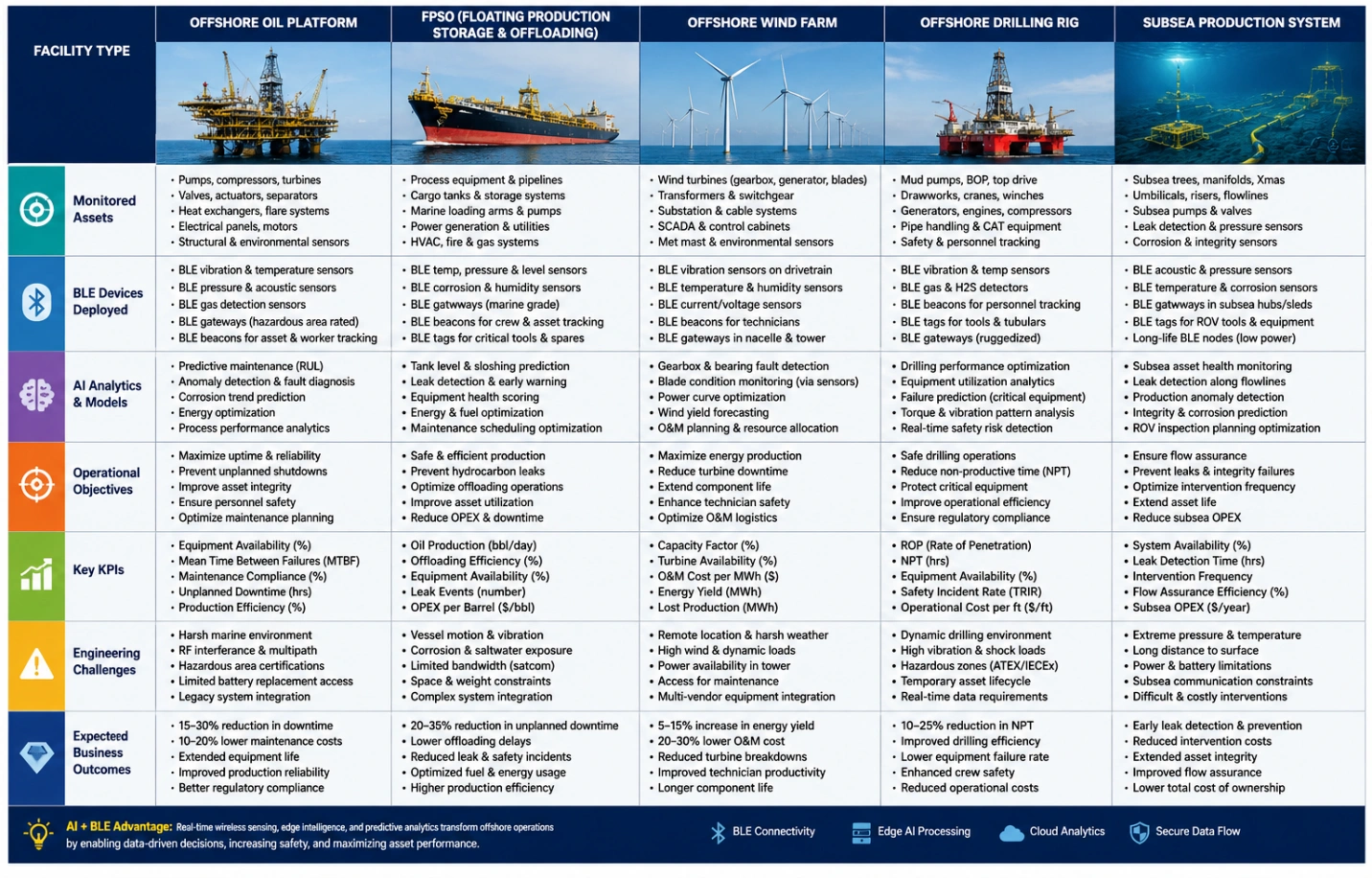
This comparison table presents how AI-enabled BLE solutions are deployed across major offshore energy facilities, including offshore oil platforms, FPSOs, offshore wind farms, drilling rigs, and subsea production systems. It compares monitored assets, BLE devices, AI analytics, operational objectives, KPIs, engineering challenges, and expected business outcomes, enabling engineering, operations, and digital transformation teams to evaluate the most appropriate monitoring strategies for each offshore environment.
End-to-End Offshore Energy Operational Workflow Using AI and BLE
Effective offshore AI deployments require coordinated data movement from field sensing through intelligent operational decision-making. A well-designed solution minimizes communication latency, maximizes data quality, and integrates with existing operational software.
Operational Data Acquisition
BLE sensors collect operational information from numerous offshore assets, including:
- Electric motors
- Compressors
- Gas turbines
- Diesel generators
- Hydraulic systems
- Heat exchangers
- Pumps
- Pressure transmitters
- Flow meters
- Offshore cranes
- Lifeboats
- Fire suppression equipment
- HVAC systems
- Switchgear
- Electrical panels
- Pipeline valves
- Environmental monitoring stations
- Personnel safety equipment
Collected measurements may include:
- Temperature
- Vibration
- Humidity
- Pressure
- Equipment runtime
- Battery condition
- Tilt
- Motion
- Occupancy
- Acoustic signatures
- Gas concentration
- Environmental exposure
Personnel may also carry BLE-enabled identification beacons supporting workforce accountability during routine operations and emergency evacuations.
Secure Wireless Communication
BLE gateways installed throughout offshore facilities receive data from nearby sensors and transmit aggregated information through redundant communication infrastructure such as:
- Industrial Ethernet
- Fiber optic networks
- Offshore Wi-Fi
- Private LTE
- 5G where available
- Microwave links
- Satellite communications
Careful radio frequency planning is essential because offshore environments contain extensive steel structures, confined compartments, rotating machinery, and electromagnetic interference that can affect wireless propagation. Gateway placement, antenna orientation, and redundancy should be engineered to maintain reliable coverage in production modules, accommodation blocks, utility areas, helidecks, and marine loading zones.
Edge Processing and AI Inference
Edge servers located on offshore facilities perform initial data validation, filtering, normalization, and AI inference before forwarding selected information to centralized software. Executing AI models close to operational assets reduces communication bandwidth requirements and enables rapid responses for time-sensitive events such as abnormal vibration, gas detection, or equipment overheating.
Common AI methods include:
- Predictive maintenance models
- Time-series forecasting
- Anomaly detection
- Remaining useful life estimation
- Equipment health scoring
- Failure probability analysis
- Reinforcement learning for maintenance optimization
- Computer vision for visual inspections
- Sensor fusion
- Bayesian inference
- Graph neural networks for asset relationships
Edge processing also improves operational resilience when satellite connectivity is constrained, allowing local analytics and alerting to continue until synchronization with centralized systems is restored.
AI-Enabled BLE Data Flow for Offshore Energy Operations: From Field Sensors to Intelligent Business Decisions
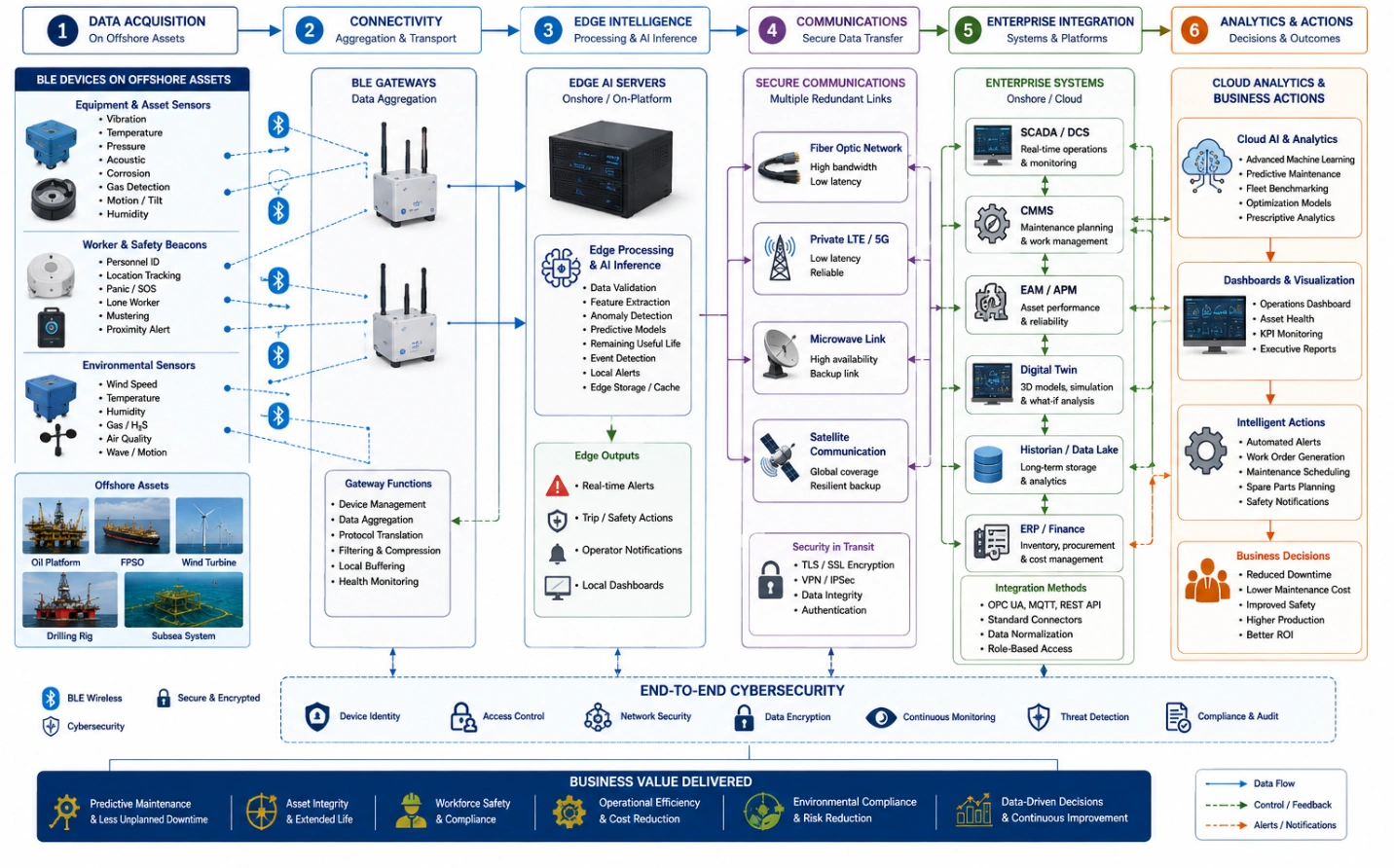
This workflow diagram illustrates the complete operational data flow of an AI-enabled BLE solution for offshore energy facilities. It shows how BLE sensors, BLE beacons, and BLE gateways collect operational data from offshore assets, which is processed by edge AI servers, securely transmitted through fiber, private LTE, and satellite networks, integrated with SCADA, CMMS, EAM, Digital Twin, ERP, and cloud analytics, and transformed into predictive maintenance insights, automated alerts, maintenance work orders, and business decisions. The diagram highlights the role of end-to-end cybersecurity and enterprise system integration in delivering reliable, intelligent offshore operations.
Core Technologies Behind AI-Enabled BLE Solutions for Offshore Energy
Delivering dependable AI-enabled monitoring in offshore energy requires coordinated integration of industrial hardware, communications, AI software, cybersecurity controls, and operational systems designed for continuous operation in harsh marine environments. Rather than relying on a single technology, successful deployments combine BLE devices with edge computing, resilient communications, industrial software, and secure data management to support reliable operational intelligence.
BLE Hardware Components for Offshore Monitoring
BLE gateways serve as the communication bridge between field devices and higher-level operational systems. Strategically installed across production modules, accommodation areas, utility systems, and offshore substations, they collect data from numerous BLE endpoints while managing device authentication, buffering, and secure forwarding.
BLE beacons primarily support workforce accountability, mobile asset identification, emergency mustering, inspection route verification, and tool tracking. Their low power consumption enables long service life, reducing maintenance requirements in difficult-to-access offshore locations.
BLE sensors continuously measure equipment condition and environmental parameters such as vibration, temperature, humidity, pressure, tilt, and gas presence. These data streams provide the foundation for AI models that assess equipment health, detect emerging anomalies, and prioritize maintenance activities.
Cloud Software and Server Software Deployment Models
Selecting the appropriate deployment model depends on offshore communication availability, cybersecurity requirements, operational latency, regulatory obligations, and existing operational technology.
Cloud-Hosted Software
Cloud-hosted software is appropriate for offshore operators managing multiple geographically distributed assets that require centralized monitoring, fleet-wide analytics, and corporate reporting. BLE gateways transmit operational data through secure offshore communications to cloud environments where AI models process large volumes of historical and real-time information.
Typical cloud capabilities include:
- Fleet-wide asset health monitoring
- Enterprise KPI dashboards
- Long-term predictive maintenance analysis
- AI model training using historical operational data
- Cross-facility benchmarking
- Corporate ESG reporting
- Remote engineering support
- Digital twin synchronization
- Predictive spare parts forecasting
- Executive operational reporting
Cloud-hosted software is particularly valuable for organizations operating multiple offshore platforms, FPSOs, offshore wind farms, or regional production assets where centralized visibility improves operational planning.
Customer-Managed Server Software
Many offshore operators deploy software on customer-managed servers located within offshore control rooms, onshore operations centers, private data centers, or hybrid edge computing environments. This approach supports organizations requiring low-latency analytics, greater operational autonomy, or compliance with internal cybersecurity and data governance policies.
Server-based deployments commonly provide:
- Local AI inference during communication outages
- High-speed integration with SCADA and DCS
- Reduced dependence on satellite bandwidth
- Private operational data management
- Custom AI model deployment
- Local historian integration
- Enhanced control over software updates
- Support for classified or highly sensitive operational environments
Many offshore energy organizations adopt a hybrid approach in which edge servers perform immediate analytics while selected operational data is synchronized with centralized cloud software for enterprise reporting and long-term optimization.
Supporting Software and Communication Technologies
Successful AI-enabled BLE deployments integrate with numerous industrial software systems and communication standards, including:
- SCADA
- Distributed Control Systems
- Enterprise Asset Management
- Computerized Maintenance Management Systems
- Asset Performance Management
- PI System historians
- Digital Twin software
- GIS software
- ERP systems
- Business Intelligence software
Common communication protocols include:
- MQTT
- OPC UA
- Modbus TCP
- EtherNet/IP
- PROFINET
- HTTPS
- REST APIs
- AMQP
Cybersecurity mechanisms typically include:
- Mutual device authentication
- TLS encryption
- Certificate-based identity management
- Role-based access control
- Secure firmware updates
- Network segmentation
- Zero Trust principles
- Security event logging
- Multi-factor authentication
- Continuous vulnerability monitoring
GAO provides industrial BLE gateways, BLE beacons, BLE sensors, and related IoT hardware designed to integrate with established industrial software while supporting secure communications and long-term operational reliability in demanding offshore environments.
AI-Enabled BLE Solution Block Diagram for Offshore Energy: Edge Computing, Enterprise Software, and Secure Data Flow
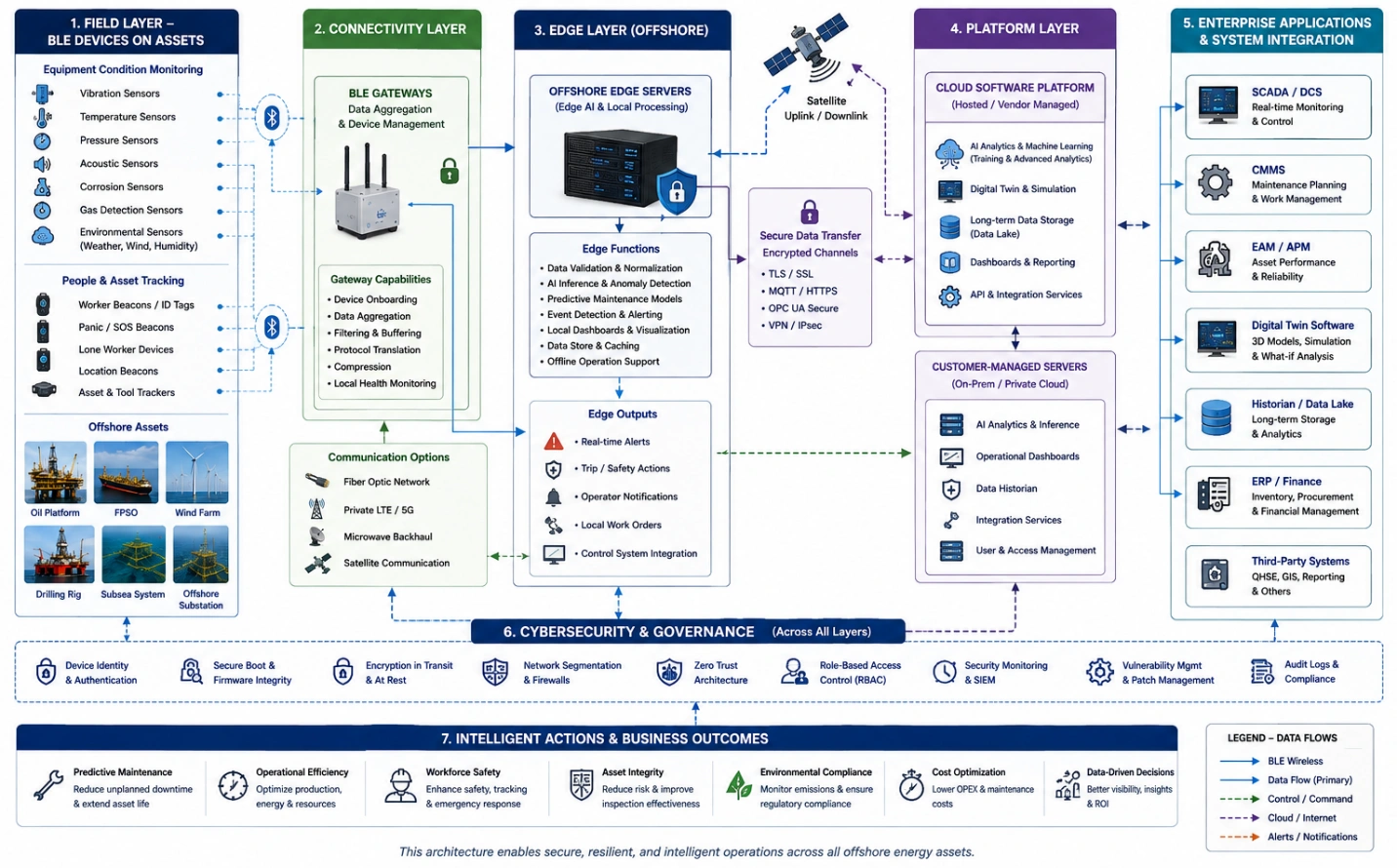
This block diagram illustrates the complete AI-enabled BLE solution for offshore energy operations, showing how BLE sensors, BLE beacons, and BLE gateways collect operational data from offshore assets and deliver it to offshore edge servers for AI inference and local processing. The diagram also demonstrates secure communications to cloud software or customer-managed server software, integration with SCADA, CMMS, EAM, Digital Twin software, ERP, and historian systems, along with layered cybersecurity controls that enable predictive maintenance, asset integrity management, workforce safety, regulatory compliance, and data-driven operational decisions.
Technical Capabilities and Operational Benefits of AI-Driven BLE Solutions for Offshore Energy
AI-enabled BLE systems provide measurable operational improvements across offshore energy production by transforming distributed sensor data into actionable intelligence. Rather than simply reporting current conditions, AI continuously evaluates trends, correlates multiple data sources, and recommends operational actions that improve safety, reliability, and production efficiency.
Predictive Maintenance
Predictive maintenance is one of the most valuable applications for offshore energy facilities, where equipment failures often require specialized vessels, helicopter transport, and scheduled production shutdowns.
AI models evaluate vibration signatures, temperature trends, pressure variations, equipment runtime, and historical maintenance records to estimate remaining useful life for critical assets such as compressors, pumps, turbines, generators, and rotating machinery. Maintenance teams can intervene before failures occur, reducing emergency repairs and minimizing production losses.
Workforce Safety and Personnel Accountability
BLE-enabled identification beacons support personnel location awareness, restricted area management, emergency mustering, lone-worker protection, and contractor accountability. AI enhances these capabilities by identifying unusual movement patterns, detecting occupancy anomalies, and supporting faster emergency response coordination during incidents.
Asset Integrity Management
Corrosion, fatigue, vibration, and harsh marine conditions continuously affect offshore infrastructure. AI correlates data from BLE sensors with inspection records, environmental conditions, and historical degradation trends to prioritize inspections and recommend maintenance activities that extend equipment life while reducing unnecessary interventions.
Operational Efficiency
Continuous AI analysis identifies opportunities to optimize equipment utilization, maintenance scheduling, energy consumption, and workforce deployment. Offshore operators gain improved visibility into equipment performance, enabling better planning and more efficient allocation of maintenance resources.
Logistics and Inventory Optimization
BLE tracking of critical spare parts, portable tools, inspection equipment, and emergency resources improves inventory visibility across offshore facilities. AI forecasts spare part demand based on equipment condition, maintenance history, and production schedules, reducing excess inventory while minimizing the risk of stock shortages.
Environmental Monitoring and Regulatory Compliance
BLE environmental sensors monitor parameters such as gas concentration, ambient conditions, and equipment emissions. AI analyzes long-term trends to identify deviations from normal operating conditions, supporting environmental compliance, incident investigation, and operational reporting.
Operational improvements commonly include:
- Reduced unplanned downtime
- Improved maintenance planning accuracy
- Higher equipment availability
- Faster fault detection
- Enhanced worker safety
- Better emergency preparedness
- Improved asset utilization
- Lower maintenance costs
- More efficient inspection planning
- Increased operational visibility
- Better inventory control
- Improved production reliability
AI-Enabled BLE Benefits for Offshore Energy: Measurable Operational Improvements and Business Impact
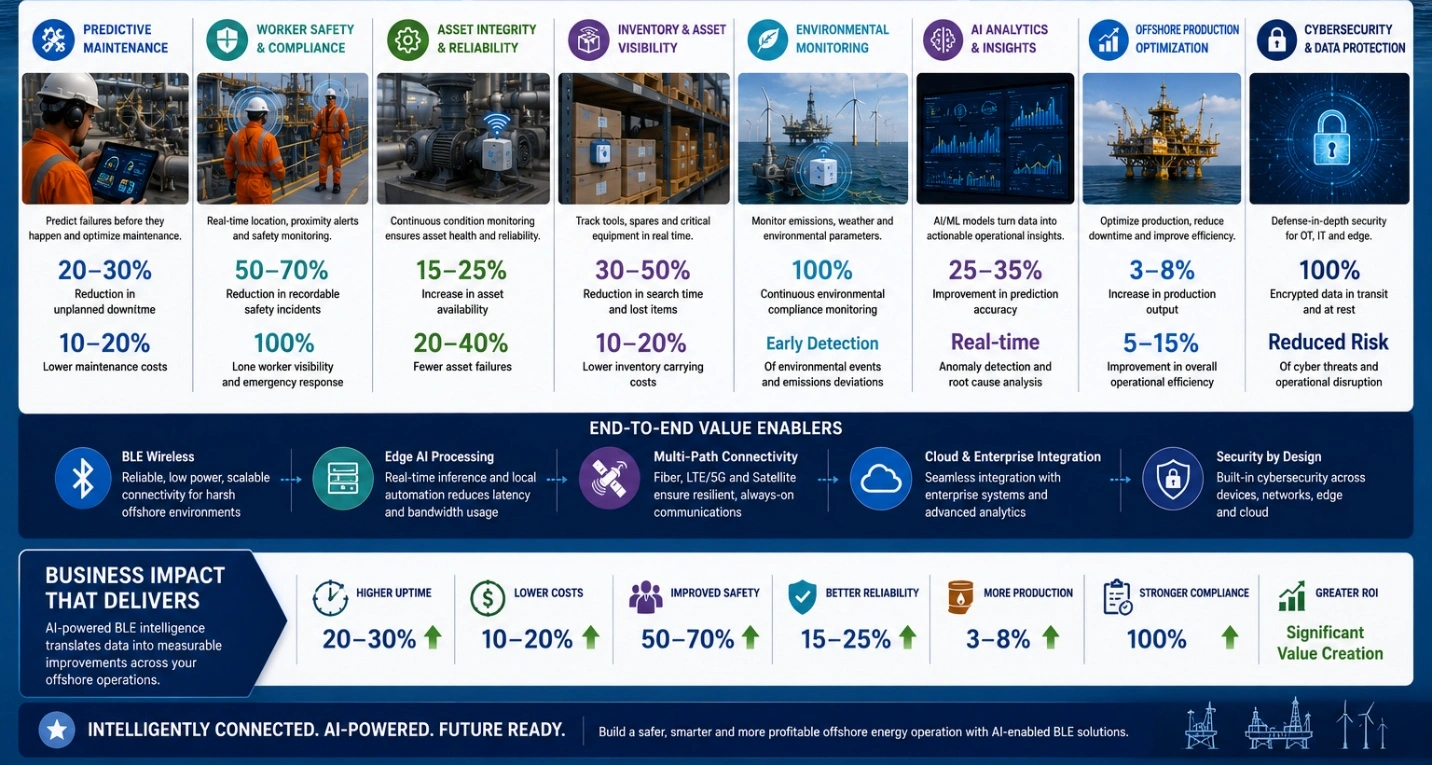
This executive infographic summarizes the measurable operational improvements achieved by combining AI with BLE technologies in offshore energy operations. It highlights key capabilities including predictive maintenance, worker safety, asset integrity, inventory visibility, environmental monitoring, AI-driven analytics, offshore production optimization, and cybersecurity, while illustrating representative performance improvements and business outcomes. The infographic demonstrates how intelligent BLE sensing, edge AI, secure communications, and enterprise software integration improve reliability, reduce downtime, strengthen regulatory compliance, and increase operational efficiency across offshore energy assets.
Engineering Best Practices for Offshore BLE and AI Deployments
Successful offshore deployments require more than selecting appropriate hardware. Long-term reliability depends on careful planning, environmental suitability, cybersecurity, interoperability, and ongoing operational optimization.
Recommended engineering practices include:
- Conduct comprehensive radio frequency surveys before gateway installation to account for steel structures, enclosed compartments, and electromagnetic interference.
- Select BLE hardware certified for offshore environmental conditions, including appropriate ingress protection, corrosion resistance, hazardous area classifications, and operating temperature ranges.
- Design redundant communication paths using fiber, microwave, private LTE, or satellite links to maintain operational continuity during network disruptions.
- Prioritize edge AI processing for latency-sensitive applications such as equipment health monitoring and safety alerts.
- Integrate BLE data with existing SCADA, DCS, CMMS, EAM, and historian software rather than creating isolated monitoring systems.
- Implement lifecycle management procedures for BLE devices, including battery replacement schedules, firmware updates, calibration, and configuration management.
- Apply Zero Trust cybersecurity principles across connected devices, communications, software, and user access.
- Validate AI models using representative offshore operating conditions and periodically retrain models as equipment ages or operational profiles change.
- Establish governance for data quality, model performance, and change management to ensure AI recommendations remain accurate and trustworthy.
These practices help maximize return on investment while supporting safe, resilient, and scalable offshore operations.
Why Offshore Energy Organizations Choose GAO
Organizations implementing Industrial AI and IoT solutions require dependable hardware, engineering expertise, and long-term technical support. Headquartered in New York City and Toronto, Canada, GAO is ranked among the world’s leading B2B and public-sector suppliers of BLE and RFID technologies. Through decades of investment in industrial research and development, we have supplied wireless identification, sensing, and IoT solutions to organizations across the United States and Canada.
Our experience includes supporting Fortune 500 companies, leading research institutions, prestigious universities, and government agencies with industrial hardware, quality assurance processes, and expert remote and onsite technical assistance. This experience helps offshore energy operators deploy BLE-based monitoring systems that integrate with existing operational environments while meeting demanding reliability and cybersecurity expectations.
Key Takeaways for AI-Enabled Offshore Energy Operations
Artificial Intelligence supported by BLE technologies enables offshore energy organizations to move beyond condition monitoring toward predictive, data-driven operations. By combining low-power wireless sensing, edge intelligence, secure communications, and advanced AI analytics, operators gain improved visibility into equipment health, workforce safety, asset integrity, logistics, and environmental performance.
Successful implementation requires thoughtful planning across communications, cybersecurity, software integration, lifecycle management, and AI model governance. Organizations should begin with clearly defined operational objectives, identify high-value assets, validate wireless coverage, and integrate new monitoring capabilities with existing operational systems.
GAO continues to help offshore energy organizations deploy industrial BLE hardware and IoT solutions that support reliable monitoring, operational efficiency, and long-term digital transformation. Our engineering teams can assist with hardware selection, deployment planning, integration guidance, and technical support tailored to demanding offshore environments.
Building the Future of Industrial AI and IoT with Aperture Venture Studio and GAO
For more than three decades, GAO Group of Companies has invested extensively in research and development for industrial BLE, RFID, and IoT technologies that support demanding sectors such as offshore energy. As generative AI demonstrated its value for industrial operations, we expanded our work in AI, BLE, RFID, and Industrial IoT solutions while establishing Aperture Venture Studio to accelerate the development and commercialization of advanced AI and industrial IoT innovations for critical infrastructure and energy applications.
Aperture has attracted experienced AI researchers, IoT engineers, operational leaders, respected investors, and technology organizations committed to advancing intelligent industrial systems. Through initiatives such as Aperture Ventures Summit and TekSummit, we foster collaboration on emerging topics in Industrial AI, connected sensing, intelligent automation, and digital transformation.
These initiatives have strengthened technical communities and collaborative networks dedicated to advancing AI and IoT across critical industries. We welcome opportunities to engage with:
- Advisors, co-founders, and technical professionals
- Investors
- Customers seeking advanced industrial AI and IoT solutions