
AI and BLE for Offshore Marine Services
AI-Enabled BLE for Offshore Marine Operations
Offshore marine services operate across vessels, offshore platforms, supply bases, subsea work sites, and other environments where equipment, personnel, and operational conditions change continuously. AI-powered asset tracking, condition monitoring, maintenance optimization, personnel visibility, and logistics coordination can help offshore operators turn continuously collected field data into actionable decisions. BLE Gateways, BLE Beacons, and BLE Sensors provide a practical data-capture layer for equipment, tools, containers, safety assets, and selected personnel-location applications. AI software can then correlate BLE observations with maintenance records, vessel schedules, work orders, environmental measurements, and other operational data. The resulting system can improve asset utilization, reduce search time, identify abnormal equipment conditions, support maintenance planning, and strengthen operational visibility. For offshore marine services, the engineering challenge is not simply deploying BLE devices. Reliable results depend on radio planning, gateway placement, marine environmental conditions, battery management, data integration, cybersecurity, and AI models that are trained against meaningful operational events.
Offshore Marine Services AI and BLE System Architecture
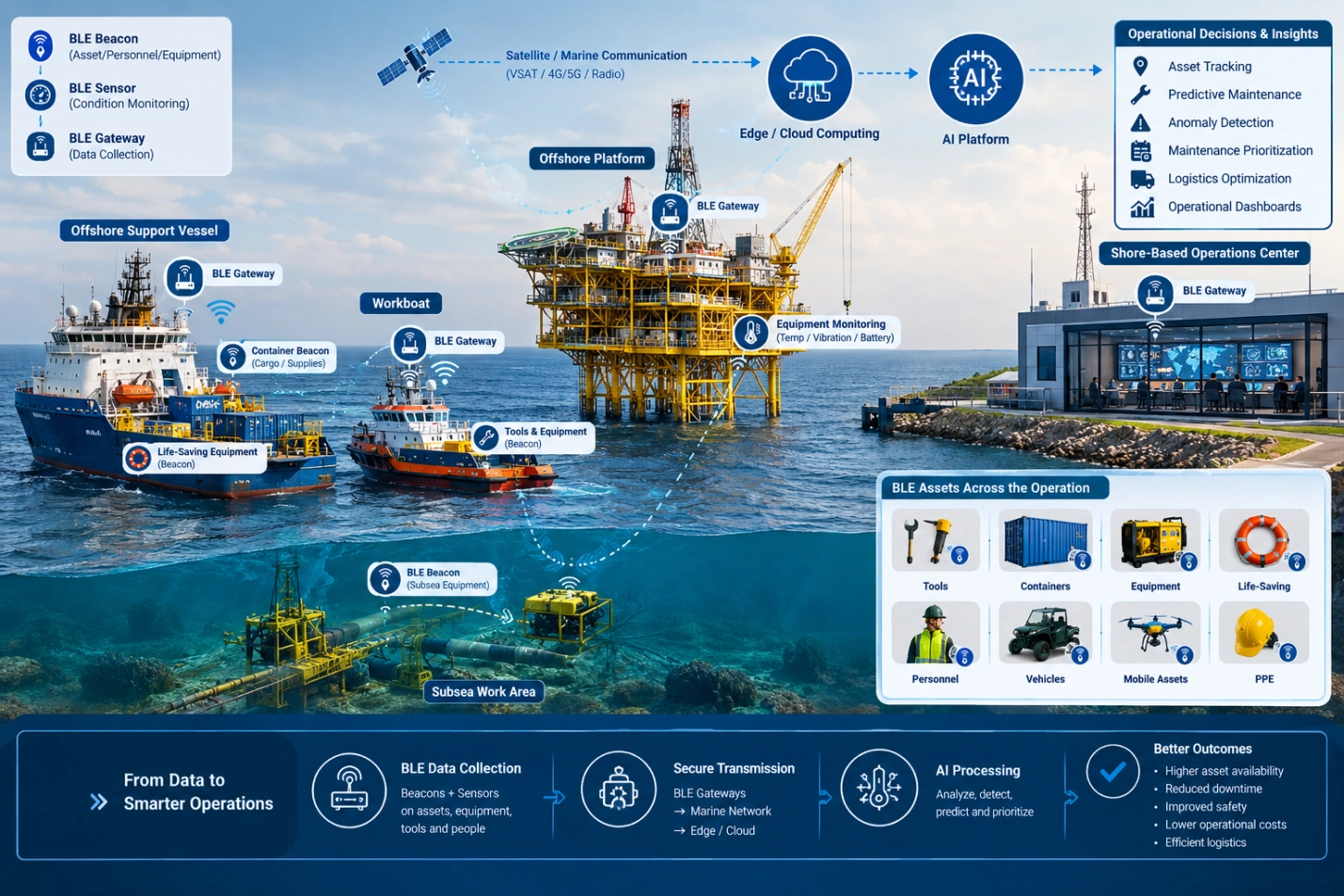
This visual illustrates how BLE beacons, sensors, and gateways collect asset and equipment data across offshore vessels, platforms, subsea work areas, and marine operations. The data flows through marine communications to edge/cloud computing and AI systems that support asset tracking, predictive maintenance, anomaly detection, logistics optimization, and operational decision-making.
What AI-Powered Offshore Marine Services Enable
AI changes offshore marine services by moving operational decisions beyond manually maintained status reports and isolated equipment records. Instead of treating vessel movements, asset locations, equipment conditions, maintenance events, and logistics information as separate datasets, AI can identify relationships across them.
BLE provides a low-power wireless identification and sensing mechanism for selected offshore assets. A BLE Beacon can transmit an identifier associated with a tool, spare-parts container, portable equipment item, safety asset, or other tracked object. A BLE Sensor can additionally capture measurements such as temperature, humidity, vibration, motion, or other supported parameters. BLE Gateways receive these transmissions and forward observations to local or remote software.
AI applications can use this information alongside computerized maintenance management systems (CMMS), enterprise asset management (EAM) records, vessel management systems, inventory systems, work-order databases, inspection records, and operational telemetry.
For offshore marine services, this combination is particularly valuable where personnel must locate equipment quickly, equipment moves between vessels and shore facilities, maintenance activities depend on asset availability, or operating conditions make manual inspection and inventory reconciliation expensive.
GAO provides BLE, RFID, and IoT hardware products and systems that can support organizations implementing asset visibility and connected operational processes. Its broader engineering work includes serving organizations in the United States and Canada, including Fortune 500 companies, R&D organizations, universities, and government agencies.
Offshore Marine Services Applications for AI and BLE
AI Asset Tracking for Offshore Vessels and Workboats
Offshore support vessels, crew transfer vessels, construction vessels, survey vessels, tugboats, and specialized workboats carry large quantities of mobile equipment. Tools, lifting accessories, portable instruments, spare parts, containers, and maintenance equipment can move between vessel decks, workshops, storage rooms, quayside facilities, and offshore work areas.
BLE Beacons attached to selected assets provide identification data that BLE Gateways can collect as assets move through monitored areas. AI software can analyze historical location observations to identify utilization patterns, prolonged inactivity, unusual movements, or recurring equipment-search events.
Operational improvements can include:
- Faster location of high-value tools and portable equipment
- Better visibility of equipment transferred between vessels and shore facilities
- Identification of underutilized or repeatedly relocated assets
- Improved reconciliation between physical assets and EAM or inventory records
- Reduced dependence on manually maintained location spreadsheets
- Better planning of equipment staging before offshore missions
The engineering design should account for metal structures, enclosed compartments, machinery spaces, deck layouts, bulkheads, and other factors that can influence BLE signal propagation.
AI-Driven Predictive Maintenance for Marine Equipment
Marine propulsion systems, pumps, compressors, generators, winches, cranes, hydraulic systems, HVAC equipment, and auxiliary machinery require planned inspection and maintenance. Conventional maintenance schedules often depend heavily on operating hours, manufacturer recommendations, inspection intervals, and historical work orders.
BLE Sensors can supplement these records by capturing condition-related measurements from suitable equipment. Depending on the sensor design and application, measurements can include temperature, vibration, motion, or other equipment-state indicators.
AI models can establish expected operating patterns and identify deviations. A maintenance system can then prioritize inspection or work orders based on observed conditions rather than relying only on fixed calendar intervals.
Relevant AI techniques may include:
- Time-series anomaly detection
- Classification of known equipment conditions
- Regression for condition or remaining-life estimation
- Clustering for identifying operating patterns
- Forecasting for maintenance demand
- Rules combined with machine learning for safety-critical workflows
The AI output should remain traceable to the underlying sensor observations and maintenance history. Offshore maintenance decisions should not rely on an opaque model without appropriate engineering validation.
AI Inventory and Spare-Parts Visibility
Offshore operations frequently depend on spare parts, consumables, tools, and mission-specific equipment being available at the correct vessel or facility before mobilization.
BLE identification can provide additional visibility for selected mobile inventory items and containers. AI can combine location observations with work orders, maintenance schedules, vessel assignments, and historical consumption.
This can help identify:
- Spare parts that are staged at the wrong location
- Equipment required for upcoming maintenance work
- Frequently consumed components
- Repeated emergency transfers
- Slow-moving equipment
- Missing or misplaced mission-critical items
The result is better preparation for offshore mobilization and fewer avoidable delays caused by unavailable equipment.
AI Safety Asset Visibility
Offshore marine services depend on safety-critical equipment including emergency response equipment, portable gas-monitoring devices, firefighting equipment, life-saving appliances, rescue equipment, and selected personal protective equipment.
BLE Beacons can provide identification and location observations for appropriate non-safety-critical tracking applications. BLE Sensors can support condition monitoring where the sensing hardware is suitable for the environment.
AI can analyze inspection and movement records to identify assets that have unusual movement patterns, missed inspection events, prolonged inactivity, or other predefined risk indicators.
For safety-critical applications, BLE and AI should complement rather than replace required inspection, certification, maintenance, and regulatory procedures.
Offshore Marine Operational Workflow from BLE Data to AI Decisions
A practical AI and BLE deployment begins with physical data capture and ends with an operational action. The complete workflow should therefore be designed around the decision that the offshore team needs to make, rather than around the wireless technology alone.
Asset and Condition Data Acquisition
BLE Beacons periodically transmit identification packets from tagged assets. BLE Sensors transmit both device identity and supported sensor measurements. The appropriate transmission interval depends on the required location resolution, battery-life target, movement frequency, and operating environment.
Typical monitored objects can include:
- Portable maintenance tools
- Survey and inspection equipment
- Spare-parts containers
- Portable pumps
- Compressors
- Winch-related equipment
- Marine maintenance equipment
- Containers and mobile storage units
- Selected safety-support assets
- Temperature-sensitive equipment or materials
- Portable environmental monitoring equipment
BLE Gateway Collection
BLE Gateways are positioned where they can receive transmissions from monitored areas. Offshore deployment requires consideration of vessel compartmentation, deck construction, steel bulkheads, machinery interference, gateway power availability, physical protection, and maintenance access.
A gateway may collect observations from multiple BLE devices and forward normalized records to downstream software using an appropriate IP-based or wireless backhaul.
Gateway placement should be validated through an actual site survey rather than assumed from theoretical radio range.
Edge Processing and Data Normalization
An edge computer or gateway-side service can perform initial filtering, buffering, timestamp validation, device authentication, and data normalization.
Edge processing becomes particularly useful when offshore connectivity is intermittent or expensive. Local buffering can prevent temporary communication loss from becoming permanent data loss.
A normalized record can include information such as:
- BLE device identifier
- Gateway identifier
- Received signal information
- Timestamp
- Sensor measurement
- Battery status
- Location zone
- Device status
- Data-quality indicators
Cloud or Private Server Processing
The normalized data can be transferred to cloud-hosted software or privately managed server infrastructure. The appropriate model depends on connectivity, cybersecurity requirements, data governance, integration constraints, and the operator’s IT policies.
Cloud deployment can simplify centralized monitoring across multiple vessels, offshore installations, ports, and shore facilities. A privately hosted server can provide greater control where operational policies require customer-managed infrastructure or where connectivity constraints favor local processing.
AI Analytics and Operational Decisions
AI software can combine BLE observations with operational records to produce higher-value information.
Examples include:
- Predicting equipment-condition anomalies
- Identifying abnormal asset movement
- Forecasting maintenance requirements
- Prioritizing inspection tasks
- Detecting repeated equipment shortages
- Estimating asset utilization
- Identifying mobilization risks
- Supporting spare-parts planning
- Detecting deviations from expected operational patterns
The output should be presented as an operational recommendation, alert, priority, or workflow trigger rather than as an unexplained numerical prediction.
Integration with Offshore Business Systems
AI and BLE data becomes significantly more useful when integrated with systems already used by offshore organizations.
Potential integration targets include:
- Enterprise asset management systems
- CMMS software
- Inventory management systems
- Maintenance work-order systems
- Vessel management software
- Procurement systems
- Warehouse management systems
- Workforce management systems
- Safety management systems
- Inspection databases
- Operational dashboards
- Data warehouses and analytics systems
API-based integration, message brokers, database connectors, or middleware can be selected according to the existing IT environment.
Business Action and Feedback
The final stage is an operational response. A maintenance supervisor may prioritize an inspection. A logistics coordinator may stage equipment for vessel mobilization. An operations manager may investigate abnormal asset utilization. A shore-based planner may arrange a spare-part transfer.
Feedback from these actions should return to the data system. Confirmed maintenance events, inspection outcomes, asset movements, and false alarms can become training and validation data for future AI model improvements.
Offshore Marine AI and BLE Workflow for Intelligent Asset Operations
This workflow diagram illustrates the complete data journey from BLE beacons and sensors on offshore assets through gateways, edge processing, secure communication, AI analytics, and enterprise-system integration. It shows how processed BLE data supports operational decisions including maintenance prioritization, asset retrieval, spare-parts staging, anomaly investigation, and mobilization planning, with human oversight throughout the workflow.
Engineering Considerations for Offshore BLE Deployment
Offshore BLE deployment requires more than selecting beacons and gateways with adequate nominal range. Vessel construction and offshore infrastructure can create complex radio conditions. Steel bulkheads, machinery, enclosed spaces, equipment racks, deck structures, and moving assets can produce attenuation, reflection, and changing signal conditions.
A reliable implementation should evaluate:
- Required location accuracy by operational zone
- BLE advertising interval and transmit power
- Beacon battery chemistry and replacement interval
- Sensor measurement frequency
- Gateway density and placement
- RF interference and coexistence
- Physical protection against impact, water, salt exposure, and vibration
- Gateway power availability
- Network backhaul availability
- Local data buffering
- Device provisioning and authentication
- Cybersecurity controls
- Firmware management
- Calibration and sensor validation
- Maintenance access
- Asset-tag attachment methods
- Data retention requirements
- Integration with existing offshore software
Environmental requirements are particularly important. Hardware selected for an offshore location should be evaluated against the actual temperature, humidity, salt exposure, vibration, ingress, mechanical-impact, and hazardous-area requirements of the installation. Product suitability should be verified against the relevant site classification and regulatory requirements before deployment.
The most useful KPI is also application-specific. A system designed to reduce tool-search time should measure retrieval time and successful asset-location events. A predictive-maintenance deployment should measure validated anomaly detection, maintenance lead time, unplanned downtime, and false-alert rates. A logistics application should measure equipment availability at mobilization, transfer frequency, and inventory reconciliation accuracy.
GAO’s experience supplying BLE, RFID, and IoT hardware and systems can support organizations evaluating the hardware, sensing, identification, and connectivity components required for these offshore applications.
BLE Hardware and Software Stack for Offshore Marine Services
A dependable offshore AI solution requires the BLE hardware, network infrastructure, data processing software, and AI functions to be selected as one operational system. BLE Gateways, BLE Beacons, and BLE Sensors perform different functions and should not be treated as interchangeable devices.
BLE Beacons for Offshore Asset Identification
BLE Beacons are appropriate where the primary requirement is identifying and locating mobile or semi-mobile assets. A beacon periodically broadcasts an identifier that can be associated with an asset record in operational software.
Typical applications include:
- Portable tools used by marine maintenance teams
- Survey and inspection instruments
- Equipment cases
- Spare-parts containers
- Portable pumps and auxiliary equipment
- Maintenance kits
- Containers moved between vessels and shore facilities
- Selected emergency and safety-support assets
- Rental or contractor equipment
Beacon configuration requires a balance between transmission interval, radio power, location responsiveness, and battery life. An asset that moves frequently may require more frequent advertisements than an asset stored for long periods. Excessively aggressive transmission settings can increase battery consumption without producing meaningful operational value.
Attachment method also matters. A beacon should remain physically associated with the asset through vibration, handling, weather exposure, cleaning, and repeated transportation.
BLE Sensors for Condition and Environmental Monitoring
BLE Sensors extend identification into measurement. Depending on the selected device, they can provide information such as temperature, humidity, vibration, motion, door state, acceleration, or other supported measurements.
Offshore applications can include monitoring:
- Temperature-sensitive equipment
- Portable machinery
- Equipment storage conditions
- Refrigerated or controlled environments
- Vibration-sensitive equipment
- Access or movement states
- Battery-powered field equipment
- Environmental conditions around selected operational assets
Sensor selection should be based on the actual measurement requirement rather than simply choosing the device with the largest specification sheet. Measurement range, accuracy, sampling interval, calibration, battery life, enclosure, mounting method, and environmental suitability all affect data quality.
BLE Gateways for Vessel and Offshore Data Collection
BLE Gateways form the collection point between low-power BLE devices and the IP-connected operational environment. A gateway can receive transmissions from multiple beacons and sensors within its effective coverage area and forward observations to local or remote software.
A vessel may require separate gateway coverage for:
- Machinery spaces
- Workshops
- Tool rooms
- Storage areas
- Cargo-handling areas
- Accommodation-support areas
- Exterior decks
- Equipment staging zones
The number and location of gateways should be determined through a coverage study and field validation. Metal construction can cause multipath effects and signal attenuation, while vessel movement can change the surrounding RF environment.
Communication and Data Transport
BLE handles local wireless communication between tags, sensors, and gateways. The gateway-to-server connection can use the network infrastructure available at the vessel or offshore facility.
Depending on the installation, the upstream connection may involve:
- Ethernet
- Wi-Fi
- Cellular connectivity
- Private wireless networks
- Satellite communications
- Vessel network infrastructure
- Offshore facility network connections
- Secure VPN connections
MQTT, HTTPS, REST APIs, TCP/IP, and other application-layer mechanisms can be considered for transferring data between gateways, edge services, and backend software. The appropriate protocol depends on message volume, latency requirements, connectivity stability, security policy, and the receiving software.
Satellite connectivity deserves particular consideration. An offshore system should not assume continuous high-bandwidth connectivity. Local buffering and store-and-forward operation can preserve data during communication interruptions.
AI Methods for Offshore Marine Asset and Maintenance Data
AI should be selected according to the operational decision being improved. A simple threshold or deterministic rule can be more appropriate than machine learning when the engineering condition is well understood and the acceptable limits are clearly defined.
Anomaly Detection
Anomaly detection can identify behavior that differs from an established operating baseline.
For example, a BLE Sensor attached to suitable equipment could provide a temperature or vibration time series. An AI model could identify a sustained deviation from the equipment’s normal operating pattern and create an inspection recommendation.
Useful methods may include:
- Statistical process monitoring
- Isolation-based methods
- Autoencoder models
- Time-series forecasting
- Change-point detection
- Clustering
- Hybrid rule and machine-learning models
Model performance should be evaluated using actual operational events rather than synthetic examples alone.
Predictive Maintenance
Predictive maintenance models can combine sensor measurements with equipment age, operating history, maintenance events, failure records, work orders, inspection results, and operating conditions.
A useful maintenance model should answer a practical question such as:
Which equipment should the maintenance team inspect first, and why?
The system can provide a risk score or maintenance priority supported by observable variables. Maintenance personnel can then validate the recommendation before taking action.
Asset Utilization Analytics
Historical BLE location observations can reveal how often an asset is used, where it spends time, and how frequently it is transferred.
AI can identify patterns such as:
- Equipment that remains unused for extended periods
- Assets repeatedly moved between vessels
- Tools frequently required at particular work sites
- Equipment with unusually high utilization
- Assets associated with repeated retrieval events
- Equipment that frequently appears outside its expected operating zone
These insights can support fleet equipment planning and procurement decisions.
Cloud Version and Server Version for Offshore Operations
Cloud Version
A cloud-hosted deployment places centralized software and analytics within managed cloud infrastructure. Offshore gateways transmit data through available connectivity to cloud services, where the information can be stored, processed, analyzed, and presented through authorized applications.
Cloud deployment is appropriate when an organization needs centralized visibility across many vessels, offshore installations, warehouses, and shore facilities.
Advantages can include:
- Centralized data management
- Easier multi-vessel visibility
- Elastic computing resources
- Centralized AI model deployment
- Remote software administration
- Simplified access for distributed operational teams
- Integration with cloud-based business applications
Connectivity must remain a core design consideration. Offshore systems should retain sufficient local functionality to continue collecting and buffering data when communication with the cloud is temporarily unavailable.
Server Version
A Server Version places the software on customer-managed servers, edge servers, private data centers, vessel servers, offshore facility servers, or other privately hosted infrastructure.
This model can be useful when an operator requires greater control over data processing, network routing, software hosting, or integration with existing privately managed systems.
It can also support environments where offshore connectivity is constrained and operational data needs to remain locally available.
A private deployment requires the customer to address:
- Server capacity
- Operating-system maintenance
- Database management
- Backup procedures
- Network security
- Software patching
- User access control
- Disaster recovery
- AI model lifecycle management
A hybrid implementation can combine local server or edge processing with centralized cloud analytics. This approach can provide local resilience while still allowing shore-based teams to access aggregated information.
Cybersecurity and Data Protection for Offshore BLE Systems
Connecting physical equipment to operational software introduces cybersecurity considerations at every layer.
The BLE device layer should use appropriate device identity, controlled provisioning, secure configuration, and lifecycle management. Gateway security should include hardened credentials, controlled administrative access, software updates, network segmentation, and monitoring.
The IP-connected portion of the system should be designed around the operator’s existing cybersecurity requirements.
Important controls include:
- Device authentication
- Encrypted communications where supported and appropriate
- Secure gateway configuration
- Role-based access control
- Network segmentation
- VPN or equivalent protected remote connectivity
- Credential rotation
- Firmware and software patch management
- Audit logging
- Backup and recovery
- Data retention controls
- Security monitoring
- Controlled API access
Offshore operators should also distinguish between operational technology (OT) networks and general IT networks. BLE tracking data may ultimately support operational decisions, but that does not mean every BLE gateway should have unrestricted access to critical vessel or facility control networks.
A segmented design can limit the impact of a compromised device or gateway. Integration should expose only the data and services required for the business workflow.
Safety-critical systems require additional engineering review. AI recommendations and BLE observations should not bypass established marine safety procedures, emergency systems, equipment certification, or mandatory inspection processes.
Integration with Offshore Marine Enterprise Systems
The business value of AI-generated insight increases when operational data can move into the systems where decisions are already made.
EAM and CMMS Integration
BLE asset observations can be associated with equipment records in EAM or CMMS software. When an asset’s location or condition changes, the information can support maintenance planning.
For example, an equipment record may contain:
- Asset identity
- Vessel assignment
- Current operational zone
- Maintenance status
- Sensor observations
- Inspection history
- Work-order history
- Next scheduled maintenance
- Condition alerts
This creates a stronger relationship between physical assets and their digital maintenance records.
Inventory and Logistics Integration
Asset-location data can also support inventory and logistics workflows. A spare-parts container identified by a BLE Beacon can be associated with a vessel assignment or mobilization order.
AI can compare planned equipment requirements with observed availability and identify discrepancies before departure.
This is particularly useful during offshore campaign preparation, where equipment must often be assembled, inspected, transported, loaded, and staged within limited preparation windows.
Vessel Management and Operations Integration
Vessel management software can contain information about vessel schedules, voyages, work assignments, and operational status. Combining these records with BLE asset observations can help determine whether required equipment is physically available for a planned activity.
A practical integration should define:
- Source system
- Data owner
- Data exchange method
- Update frequency
- Asset identifiers
- Error handling
- Data retention
- Security permissions
- Ownership of generated alerts
This prevents the BLE system from becoming another isolated source of operational information.
Offshore Enterprise Integration Diagram for AI, BLE, and Marine Operations
This enterprise integration diagram illustrates how BLE-enabled offshore assets and sensors connect through gateways, edge processing, secure networks, AI services, and enterprise applications. It shows integration with EAM, CMMS, inventory, vessel management, logistics, inspection databases, and operational dashboards, demonstrating how asset data and AI outputs support maintenance, logistics, HSE, and operational decisions.
Operational and Business Benefits of AI-Powered Offshore Asset Visibility
Combining AI with BLE-enabled data collection can improve several measurable aspects of offshore marine operations.
Reduced Asset Search Time
Personnel can spend significant time locating portable tools and equipment when assets move between storage areas, vessels, workshops, and work sites. BLE location observations provide a searchable source of recent asset visibility.
The appropriate KPI is not simply the number of tags installed. It is the change in average asset-retrieval time and the percentage of successful location requests.
Improved Maintenance Prioritization
Sensor information combined with maintenance history can help teams distinguish normal operating variation from conditions that justify inspection.
Useful KPIs include:
- Unplanned equipment downtime
- Mean time between failures
- Mean time to repair
- Preventive versus corrective maintenance ratio
- Validated anomaly rate
- False-alert rate
- Maintenance lead time
Better Mobilization Readiness
Offshore missions can be delayed when required equipment is missing, incorrectly staged, or assigned to another vessel.
AI can compare planned requirements against observed asset locations and identify potential shortages before mobilization.
Relevant KPIs include:
- Equipment availability at departure
- Mobilization preparation time
- Missing-item rate
- Emergency equipment transfers
- Equipment staging accuracy
Higher Asset Utilization
Historical location data can reveal whether expensive portable equipment is heavily used, rarely used, or repeatedly transferred.
This supports more informed decisions about fleet sizing, equipment procurement, rental, redistribution, and maintenance resources.
Stronger Operational Visibility
A unified view of physical asset observations and operational records can reduce dependence on manual status updates.
The objective is not simply to create more data. The objective is to make the right operational information available to the person responsible for the next decision.
KPIs for Measuring an Offshore AI and BLE Deployment
A deployment should establish baseline measurements before installation wherever practical. This makes it possible to determine whether the technology is producing operational value.
| Operational Area | Example KPI | Measurement Objective |
|---|---|---|
| Asset tracking | Average asset retrieval time | Measure reduction in time spent locating equipment |
| Asset visibility | Successful location-request rate | Measure tracking reliability |
| Maintenance | Unplanned downtime | Measure operational impact of maintenance improvements |
| Maintenance | False-alert rate | Evaluate AI recommendation quality |
| Mobilization | Equipment readiness rate | Measure availability before offshore departure |
| Logistics | Emergency equipment transfers | Identify avoidable logistics events |
| Inventory | Reconciliation accuracy | Compare digital records with physical availability |
| Utilization | Asset utilization rate | Identify underused and heavily used equipment |
| Connectivity | Gateway data-loss rate | Evaluate communications resilience |
| Battery management | Average beacon/sensor service life | Assess maintenance burden |
| AI performance | Precision and recall for validated events | Evaluate model effectiveness |
| Operations | Average decision-response time | Measure speed from alert to action |
The KPI framework should match the business problem. A location-tracking project should not be judged primarily by predictive-maintenance metrics, and a condition-monitoring project should not be judged solely by the number of tracked assets.
Implementation Recommendations for Offshore Marine Services
A phased deployment generally provides better engineering control than attempting to instrument every vessel and asset simultaneously.
Start with a Defined Operational Problem
Select a problem with measurable operational impact, such as tool-search time, equipment staging, spare-parts visibility, or condition monitoring.
Define the expected business outcome before selecting hardware.
Survey the Offshore Environment
Document vessel layouts, equipment locations, steel structures, gateway power sources, communication availability, environmental exposure, and areas requiring coverage.
A radio survey and pilot installation can reveal coverage issues that are difficult to predict from device specifications alone.
Establish Asset and Data Models
Define how physical assets will be represented in software.
Each tracked asset should have a consistent identity that can be associated with BLE device information and existing EAM, CMMS, or inventory records.
Validate Data Quality Before Training AI
AI should not be deployed on poorly structured or unreliable sensor data.
Before model development, evaluate:
- Missing observations
- Duplicate records
- Timestamp accuracy
- Gateway identification
- Sensor calibration
- Battery-related gaps
- Location ambiguity
- Communication interruptions
- Incorrect asset associations
Reliable data engineering is a prerequisite for reliable AI analytics.
Keep Humans in the Operational Loop
Maintenance supervisors, vessel engineers, logistics coordinators, and operations personnel should be able to review AI recommendations and provide feedback.
This feedback can distinguish a genuine operational event from a false positive and improve subsequent model development.
Design for Offshore Connectivity Failures
The system should assume that connectivity can become unavailable temporarily.
Local buffering, retry logic, timestamp preservation, health monitoring, and controlled synchronization should be incorporated into the deployment.
Plan Lifecycle Management
BLE devices are field assets themselves and require lifecycle management.
The implementation plan should cover:
- Device provisioning
- Asset association
- Battery replacement
- Firmware updates
- Sensor calibration
- Gateway maintenance
- Device retirement
- Spare-device management
- Configuration backups
- Security credential management
GAO can support organizations evaluating BLE, RFID, and IoT hardware and systems for applications where asset identification, wireless sensing, and connected operational workflows are required.
Offshore AI and BLE Implementation Roadmap for Marine Services
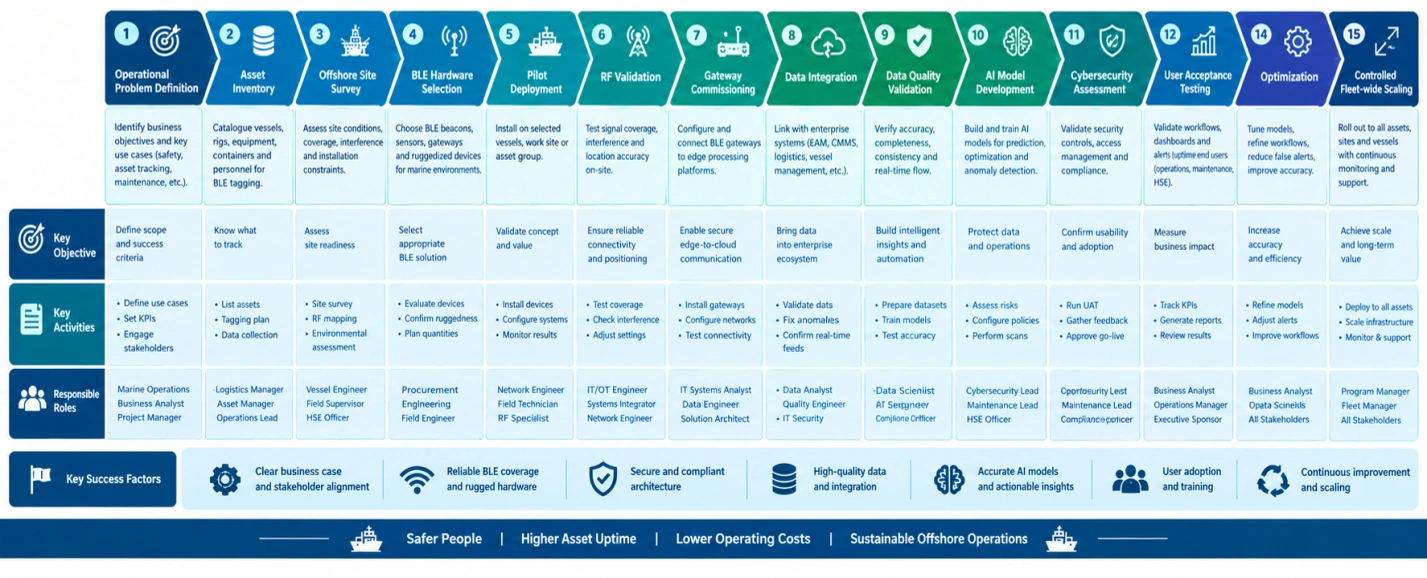
This implementation roadmap presents a structured lifecycle for deploying AI-enabled BLE solutions across offshore marine operations. It covers operational problem definition, asset inventory, site surveying, hardware selection, pilot deployment, RF validation, gateway commissioning, data integration, AI development, cybersecurity assessment, user testing, KPI measurement, optimization, and controlled fleet-wide scaling.
Why GAO for Offshore BLE and IoT Solutions
GAO supplies BLE, RFID, and IoT hardware products and systems for organizations requiring practical identification, sensing, tracking, and connected-data capabilities. Its work spans applications where wireless hardware must operate as part of a larger operational solution rather than as an isolated device.
GAO RFID Inc. is headquartered in New York City and Toronto, Canada, and is positioned among the leading B2B and B2G BLE and RFID suppliers globally. Together with GAO Research Inc. and GAO Tek Inc., it forms GAO Group, with operations based in New York City and Toronto.
For three decades, GAO Group has served customers across the United States and Canada, including Fortune 500 companies, leading R&D organizations, prestigious universities, and government agencies. Its work includes substantial investment in R&D, quality assurance processes, and technical support delivered remotely or onsite.
For offshore marine services, this background is relevant when selecting BLE Gateways, BLE Beacons, BLE Sensors, RFID equipment, and related IoT components that must ultimately integrate into a broader operational process.
Key Takeaways for AI-Powered Offshore Marine Services
AI can turn BLE-generated asset and sensor observations into operational insight for offshore marine services. The strongest use cases begin with measurable problems such as asset-search delays, maintenance uncertainty, equipment staging, spare-parts visibility, and limited utilization data.
BLE Beacons provide low-power asset identification, BLE Sensors add condition and environmental observations, and BLE Gateways connect field devices with edge, cloud, or privately hosted software. AI can then correlate this information with EAM, CMMS, inventory, vessel management, maintenance, and logistics records.
Successful deployment depends on RF planning, environmental suitability, reliable data collection, cybersecurity, system integration, connectivity resilience, and continuous KPI measurement. Offshore operators should validate the complete workflow through a controlled pilot before scaling across vessels or facilities.
GAO’s BLE, RFID, and IoT products and technical capabilities can help organizations evaluate the hardware and system components required for these connected offshore applications.
Building the Future of Industrial AI and IoT with Aperture Venture Studio and GAO RFID Inc.
For more than three decades, GAO Group of Companies has invested heavily in R&D of industrial BLE, RFID, and IoT. As generative AI has become increasingly useful for industrial applications, we have continued developing AI and IoT technologies that connect identification, sensing, data, and operational intelligence. We have also founded Aperture Venture Studio to advance AI and IoT solutions relevant to areas such as offshore marine services and other industries.
Aperture has attracted AI and IoT technical experts, entrepreneurial and operational executives, influential investors, and leading companies. We have also developed the Aperture Ventures Summit and TekSummit to facilitate discussion of advanced AI and IoT topics.
These activities contribute to technical communities focused on practical AI and IoT applications. We welcome participation from:
- Advisors, co-founders, or employees
- Investors
- Customers
For organizations exploring AI-powered asset tracking, predictive maintenance, BLE sensing, or IoT systems for offshore marine services, GAO welcomes opportunities to discuss technical requirements, hardware selection, system integration, and deployment considerations.