
AI-Driven Personal Hygiene Products Manufacturing with BLE
AI-Driven Personal Hygiene Products Manufacturing with BLE
Personal Hygiene Products Manufacturing includes the production of diapers, feminine hygiene products, adult incontinence products, wipes, tissues, sanitary pads, tampons, absorbent hygiene products, and related consumer products. These operations depend on high-speed converting equipment, precise material handling, controlled production processes, quality inspection, packaging, warehousing, and reliable shipment preparation. AI can analyze production and equipment data to identify process abnormalities, predict maintenance requirements, optimize material flow, and improve quality decisions. BLE provides an enabling layer for selected asset identification, location monitoring, temperature and environmental sensing, and movement visibility.
AIoT combines artificial intelligence with IoT devices, sensors, connected equipment, and industrial systems. For personal hygiene products manufacturing, an AIoT solution can connect BLE sensors, BLE beacons, gateways, production equipment, MES, ERP, WMS, QMS, CMMS, and analytics software. The resulting data can help manufacturers understand where materials and mobile assets are located, detect unusual production behavior, identify equipment risks, and coordinate production, maintenance, quality, and warehouse activities.
AI-Driven Personal Hygiene Products Manufacturing with BLE
AI-driven personal hygiene products manufacturing uses artificial intelligence to analyze production, equipment, material, quality, and warehouse information and convert that information into operational decisions. BLE acts primarily as an enabling technology for collecting location, identification, temperature, environmental, and asset-related data where those measurements are appropriate.
Personal hygiene products facilities commonly operate high-speed production lines involving pulp preparation, fluff processing, absorbent-core formation, nonwoven handling, adhesive application, elastic insertion, cutting, folding, sealing, inspection, packaging, and palletizing. Production interruptions can result from material shortages, equipment wear, changeover delays, web-handling problems, adhesive issues, packaging-material shortages, or downstream congestion.
BLE beacons can identify selected mobile assets such as material carts, roll-handling equipment, reusable containers, maintenance tools, pallets, and production support equipment. BLE sensors can monitor selected environmental conditions or equipment-related parameters. BLE gateways collect device information and transmit it to edge processing systems, cloud software, or privately hosted servers.
AI can combine BLE information with production records and data from MES, ERP, WMS, QMS, CMMS, laboratory systems, machine controllers, inspection systems, and other manufacturing software. This allows manufacturers to analyze physical movement together with production status and business records.
GAO provides BLE, RFID, and IoT hardware products and systems that can support connected-data requirements in manufacturing environments. The appropriate solution depends on the personal hygiene product, production process, equipment layout, material-handling workflow, and required operational measurements.
AI Applications for Personal Hygiene Products Manufacturing
AI applications for personal hygiene products manufacturing should focus on measurable production and business problems. High-speed converting operations create large volumes of production data, while the movement of raw materials, rolls, packaging components, tools, and finished goods creates additional opportunities for AI-based analysis.
Production Line Monitoring and Anomaly Detection
Personal hygiene products are often manufactured on continuous or high-speed converting lines where relatively small process deviations can affect throughput, product quality, or waste. AI can establish expected operating patterns from production rates, machine states, downtime events, material changes, inspection results, and historical production records.
AI-based anomaly detection can help identify:
- Unusual production-cycle behavior
- Unexpected reductions in line throughput
- Extended equipment idle periods
- Repeated micro-stoppages
- Abnormal material movement
- Packaging-line delays
- Unusual production-zone activity
- Repeated process deviations associated with specific machines or shifts
BLE location information can add physical context to these events when mobile assets, material carts, tools, or containers are part of the workflow.
Raw Material and Roll Inventory Visibility
Personal hygiene products manufacturing depends on materials such as fluff pulp, superabsorbent polymers, nonwoven fabrics, tissue, films, adhesives, elastic materials, release paper, packaging films, cartons, labels, and other components. Large rolls and material containers can occupy substantial warehouse and production-floor space.
AI can analyze inventory records together with physical movement information to identify material-location discrepancies and staging delays.
Potential applications include:
- Locating material carts and selected mobile assets
- Monitoring roll movement between storage and production
- Identifying materials waiting too long in staging areas
- Detecting unexpected movement between zones
- Improving production-readiness checks
- Supporting inventory reconciliation
- Reducing time spent searching for production materials
BLE beacons can provide identification for suitable mobile materials and handling assets, while WMS and ERP systems retain the formal inventory and transaction records.
Predictive Maintenance for Converting Equipment
Personal hygiene products manufacturing uses specialized equipment such as forming systems, absorbent-core machines, nonwoven unwinders, laminators, adhesive applicators, cutters, folding systems, sealing equipment, conveyors, packaging machines, and palletizing systems.
Unexpected failure of a critical machine can stop an entire production line or create significant downstream disruption. AI-based predictive maintenance can combine equipment operating data, maintenance history, production schedules, downtime records, and failure information to identify abnormal patterns.
Predictive maintenance can support:
- Early identification of equipment degradation
- Maintenance-priority decisions
- Planned intervention before critical failures
- Reduced unplanned downtime
- Improved maintenance scheduling
- Better spare-parts planning
- Higher equipment availability
BLE sensors can supplement existing industrial instrumentation for appropriate monitoring requirements, but critical machine-control measurements should continue to use instrumentation designed for those control functions.
Quality and Defect Risk Detection
Personal hygiene products require consistent dimensions, absorbency characteristics, material placement, sealing, packaging integrity, and other product-specific quality attributes. AI can correlate production conditions, machine states, material information, inspection results, and historical quality records to identify patterns associated with defects.
Computer vision and machine-learning models can support inspection applications, while BLE can provide supporting information about asset location, material movement, or environmental conditions.
AI can help quality teams:
- Detect unusual production conditions
- Identify recurring defect patterns
- Correlate defects with equipment or material conditions
- Support root-cause investigations
- Prioritize quality events
- Improve traceability of production activities
Packaging and Finished-Goods Flow Optimization
Packaging operations can become a bottleneck when production output exceeds downstream capacity. Finished products may move through inspection, packaging, palletizing, staging, warehouse storage, and shipment preparation.
AI can analyze production rates, packaging-line performance, finished-goods dwell time, warehouse capacity, and order requirements to identify congestion.
BLE tracking can provide additional location information for selected pallets, carts, reusable containers, and mobile handling assets.
Applications include:
- Detecting packaging-line congestion
- Identifying finished-goods dwell-time increases
- Monitoring movement between production and warehouse zones
- Improving order staging
- Supporting shipment preparation
- Identifying recurring warehouse bottlenecks
Personal Hygiene Products Manufacturing AI and BLE Operations Overview
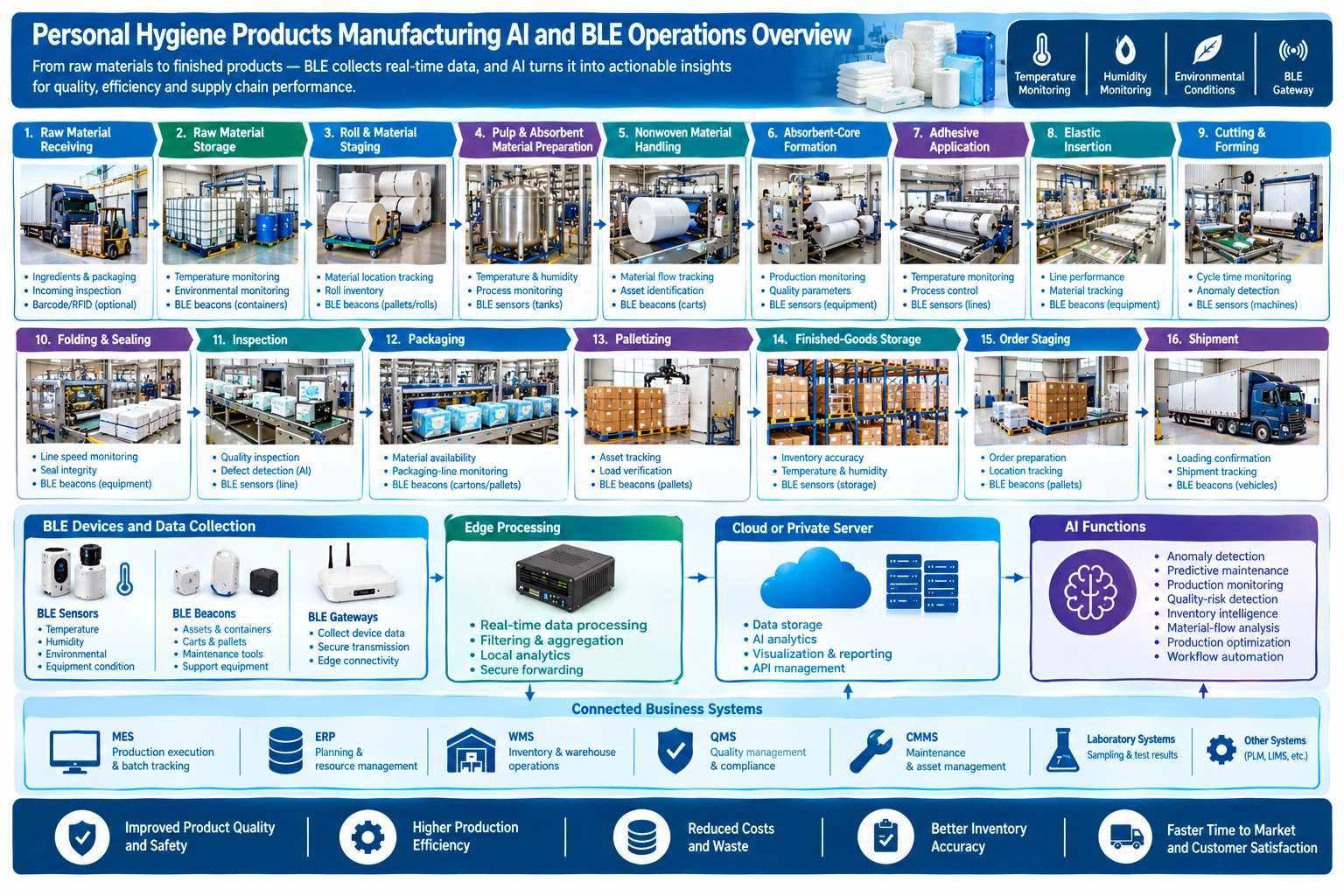
A professional infographic showing personal hygiene products manufacturing from raw material receiving through shipment. It illustrates BLE sensors, beacons, and gateways feeding edge processing, cloud or private server systems, AI functions, and connected manufacturing software.
Personal Hygiene Products Manufacturing Workflows Supported by AI
AI becomes more useful when connected to complete production and material workflows rather than isolated sensor readings. A complete AIoT workflow can move from data acquisition through communication infrastructure, edge processing, cloud or server deployment, middleware, enterprise software integration, analytics, automation, and operational action.
Raw Material Receiving and Storage
Manufacturers receive diverse raw materials and packaging components that must be inspected, recorded, stored, and released for production. Inventory systems establish the official material record, while connected identification can provide additional physical-location visibility for selected assets and containers.
AI can identify unusual receiving-to-storage dwell times, staging congestion, repeated material-location discrepancies, or inventory conditions that may affect production readiness.
Material Staging and Production Preparation
Production preparation may require specific rolls, absorbent materials, films, nonwovens, adhesives, elastic materials, packaging components, and other inputs to be delivered to the correct production line.
AI can compare production schedules with material availability and movement information to identify potential shortages before they interrupt production.
BLE-enabled identification can help locate selected carts, containers, mobile handling equipment, and production-support assets.
Absorbent-Core and Product Formation
Absorbent-core formation and product assembly involve coordinated material feeding, forming, cutting, bonding, and other converting operations. AI can analyze production parameters, equipment events, material conditions, and quality information to detect unusual behavior.
Physical asset-location information can provide additional context when equipment, tools, or mobile production resources move between manufacturing areas.
Inspection, Packaging, and Palletizing
Inspection and packaging connect product manufacturing with warehouse operations. AI can correlate inspection results, production rates, packaging performance, and equipment events to identify potential quality or throughput problems.
BLE identification can help track selected mobile assets and pallets as they move through packaging and staging areas.
Finished-Goods Storage and Shipment Preparation
Finished products may remain in staging areas before shipment depending on customer orders, warehouse capacity, quality-release status, and transportation schedules. AI can analyze finished-goods dwell time and order requirements to identify bottlenecks.
Integration with WMS and ERP systems can provide business context, while BLE location information can improve visibility into selected physical assets and staging resources.
Personal Hygiene Products Manufacturing Operational Challenge and AI Solution Matrix
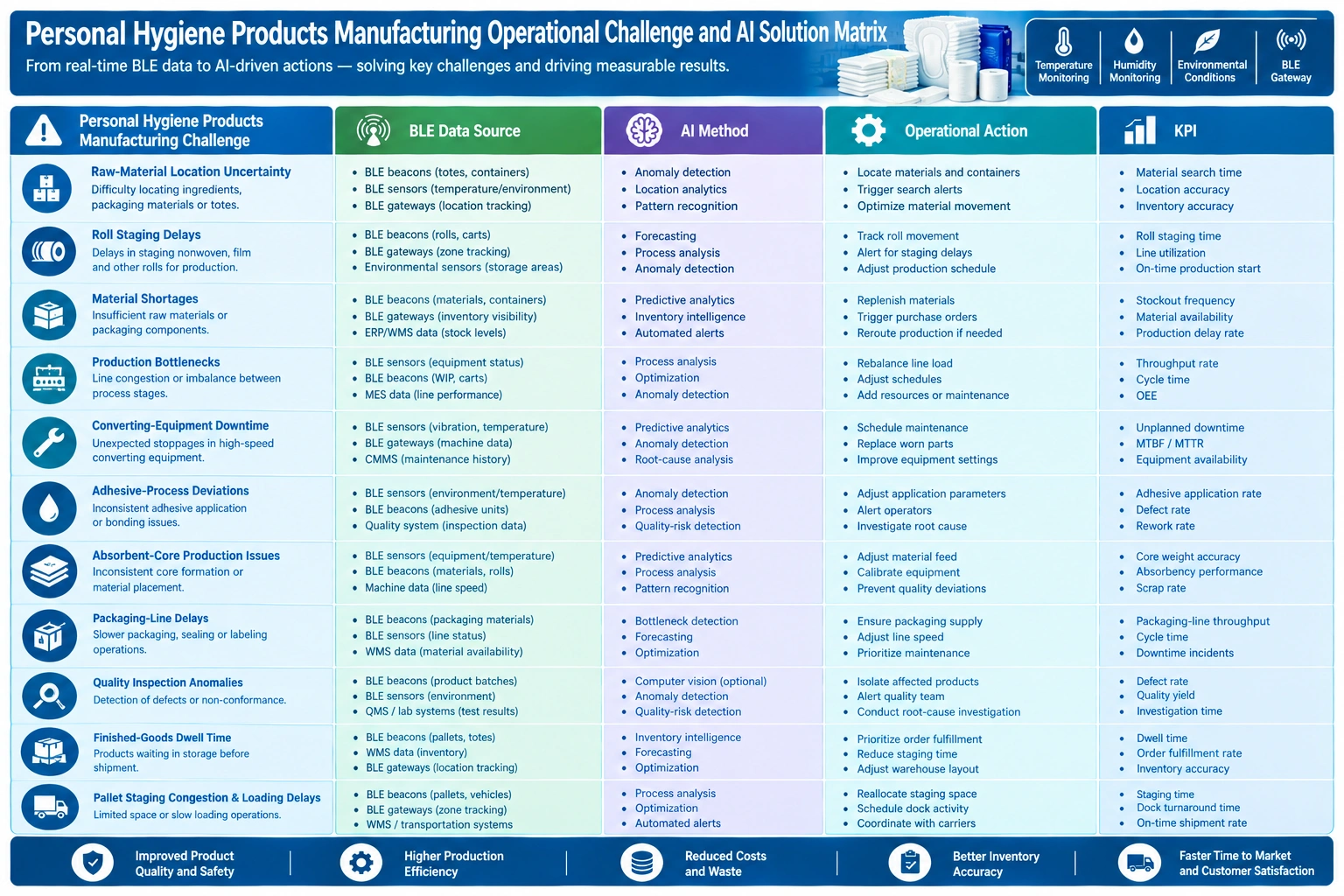
A detailed matrix maps personal hygiene products manufacturing challenges to BLE data sources, AI methods, operational actions, and KPIs. It covers material tracking, production bottlenecks, equipment downtime, quality issues, packaging, finished goods, and loading operations.
Technical Capabilities for AI-Driven Personal Hygiene Products Manufacturing
AI-driven manufacturing systems can combine production, equipment, material, quality, location, and warehouse data to improve decisions across personal hygiene products operations. BLE contributes selected real-time identification and sensing information, while AI, manufacturing software, and existing industrial systems provide the analytical and operational context.
AI-Based Anomaly Detection
Anomaly detection establishes expected patterns for production lines, material movement, equipment operation, warehouse activity, and selected environmental conditions. The system can compare current conditions against historical behavior, production targets, configured thresholds, or expected process sequences.
Applications include:
- Detecting unusual converting-line throughput
- Identifying repeated micro-stoppages
- Detecting abnormal material dwell times
- Identifying unexpected movement of mobile production assets
- Flagging unusual packaging-line behavior
- Detecting environmental deviations in monitored areas
- Identifying recurring production conditions associated with quality events
AI-based detection is most useful when alerts are linked to a specific operational response. Production personnel may investigate a line anomaly, maintenance teams may inspect equipment, and warehouse personnel may locate delayed materials.
Predictive Maintenance and Equipment Performance
Predictive maintenance uses historical equipment behavior, maintenance records, production loads, downtime events, and condition data to estimate the likelihood of equipment problems.
For personal hygiene products manufacturing, this can apply to high-speed converting equipment, unwinders, cutters, adhesive systems, conveyors, folding equipment, packaging machines, compressors, HVAC equipment, and palletizing systems.
AI can help maintenance teams prioritize equipment according to failure risk and production impact. BLE sensors can supplement existing machine data for appropriate monitoring points, while CMMS records provide maintenance history and work-order context.
Production Optimization
AI can evaluate production schedules, equipment availability, material readiness, changeover requirements, line capacity, maintenance constraints, and historical throughput.
Optimization can support decisions involving:
- Production-line scheduling
- Material staging
- Changeover sequencing
- Packaging capacity
- Equipment utilization
- Maintenance timing
- Finished-goods staging
- Order priorities
For example, a production planning system can identify that a scheduled run may be delayed because required nonwoven material or packaging components have not reached the appropriate staging area. Location information from connected devices can provide additional physical evidence for the planning decision.
Intelligent Inventory and Material Management
Inventory intelligence combines transactional records with physical movement information. AI can identify discrepancies between expected and observed material locations and detect patterns that contribute to shortages or production interruptions.
For personal hygiene products manufacturing, relevant materials can include pulp, superabsorbent polymer, nonwoven rolls, films, adhesives, elastic materials, release materials, packaging films, cartons, labels, and other production inputs.
AI can help identify:
- Materials approaching production demand without confirmed staging
- Repeated inventory-location discrepancies
- Excessive staging time
- Underutilized material-handling assets
- Finished-goods accumulation
- Warehouse congestion
- Recurring material-search activities
GAO can provide BLE and RFID hardware products and systems that support selected identification and data-collection requirements for these workflows.
AI-Assisted Quality Investigation
Quality teams can use AI to correlate production conditions, material lots, equipment events, inspection results, and process history. This can reduce the time required to identify relationships between production conditions and quality deviations.
For example, an investigation into a recurring product defect may consider production-line events, material changes, equipment downtime, inspection results, and batch or work-order information. BLE data can provide supporting physical-location information where relevant.
The objective is to assist qualified quality personnel rather than replace established quality procedures or release decisions.
BLE Deployment and Engineering Considerations
A successful BLE deployment for personal hygiene products manufacturing begins with the operational requirement. Engineers should determine whether the application requires identification, zone-level location, environmental monitoring, equipment monitoring, or another measurement before selecting the appropriate BLE device.
The manufacturing environment can contain metal converting equipment, material rolls, conveyors, storage racks, production partitions, and high equipment density. These factors can influence radio propagation and location accuracy.
Sensor Selection and Environmental Protection
BLE sensors should be selected according to the required measurement range, accuracy, sampling interval, battery life, environmental exposure, and installation method.
Potential considerations include:
- Temperature and humidity requirements
- Cleaning and sanitation exposure
- Dust and airborne fiber exposure
- Chemical exposure
- Enclosure requirements
- Battery replacement access
- Calibration requirements
- Measurement frequency
- Radio performance around metal equipment
BLE should not automatically replace dedicated industrial instrumentation. Critical machine-control and safety measurements should use equipment designed and validated for those functions.
Gateway Placement and Coverage
BLE gateways collect information from nearby sensors and beacons and transfer it to processing or enterprise systems. Gateway placement should be based on the actual facility layout and required coverage.
A site assessment should consider:
- Production-line configuration
- Metal equipment and structures
- Warehouse racks
- Material storage areas
- Gateway backhaul
- Required location precision
- Asset movement paths
- Areas with high device density
- Network redundancy requirements
Edge processing can reduce response time and provide local buffering when network connectivity to centralized software is unavailable.
Device Identity and Data Quality
AI analysis requires consistent and trustworthy data. Every tracked device should have a defined identity and relationship to the physical asset, material container, equipment, or location it represents.
Data-management procedures should address:
- Device registration
- Asset-to-device association
- Gateway identification
- Time synchronization
- Sensor calibration
- Missing data
- Duplicate records
- Battery-related communication gaps
- Zone definitions
- Historical data retention
Poor device identity management can produce misleading AI results even when the underlying BLE hardware is operating correctly.
Battery and Device Maintenance
Battery-powered BLE sensors and beacons require planned maintenance. Device inventories should record battery condition, installation location, asset association, and replacement history where applicable.
Transmission frequency, temperature, environmental exposure, and device configuration can affect battery life. Monitoring battery status and maintaining replacement procedures helps prevent unexplained data gaps.
Cloud and Server Deployment for Personal Hygiene Products Manufacturing
The uploaded requirements call for consideration of both Cloud Version and Server Version deployments. Cloud software can provide centralized analytics and multi-site reporting, while privately hosted server software can provide greater control over local data processing and infrastructure.
Cloud Version
A cloud-hosted deployment can collect information from multiple personal hygiene products manufacturing facilities and provide centralized analytics, dashboards, reporting, and model management.
Cloud deployment can be appropriate when:
- Multiple plants require centralized analysis
- Reliable network connectivity is available
- Corporate IT manages cloud infrastructure
- Centralized reporting is important
- Integration with cloud-based business software is required
Edge processing can remain at the manufacturing site for low-latency events or temporary network outages.
Server Version
A Server Version can run on customer-managed servers, factory servers, private data centers, or other privately hosted enterprise infrastructure. This model can be appropriate when the manufacturer requires greater control over operational data, local processing, or integration with existing manufacturing networks.
Potential advantages include:
- Local data processing
- Reduced dependence on external connectivity
- Customer-controlled data storage
- Integration with private manufacturing networks
- Site-specific access controls
- Local operational dashboards
A hybrid deployment can combine local processing with centralized cloud or private-server analytics when both local responsiveness and multi-site visibility are required.
Manufacturing Software Integration
AI and BLE solutions deliver greater operational value when connected with the software already used to manage production, inventory, maintenance, and quality.
MES Integration
MES provides production execution information such as work orders, machine status, production quantities, line performance, and production events.
BLE location information can add physical context to MES records. AI can correlate material movement, production events, equipment status, and cycle times to identify bottlenecks and abnormal production behavior.
ERP and WMS Integration
ERP and WMS systems provide material, inventory, order, warehouse, and business information. AI can compare planned material requirements with inventory status and physical movement.
Integration can support:
- Raw material availability
- Production staging
- Packaging-component management
- Inventory reconciliation
- Finished-goods location
- Order staging
- Shipment preparation
CMMS Integration
CMMS systems contain preventive-maintenance schedules, work orders, equipment histories, technician activities, and spare-parts information.
AI can correlate this information with equipment operating patterns to prioritize maintenance. A useful workflow can progress from anomaly detection to maintenance review, work-order creation, repair, verification, and KPI measurement.
QMS and Laboratory Integration
QMS and laboratory systems can contain inspection results, deviations, test information, quality-release records, and investigation data.
Connecting these records with production and material information allows AI to identify potential relationships between operating conditions and quality events while preserving the source information required for formal investigations.
Security and Interoperability for AI and BLE Systems
Security should cover the complete data path from BLE devices and gateways through processing software, manufacturing networks, enterprise applications, and user interfaces.
Important controls can include:
- Device authentication
- Access control
- Network segmentation
- Secure gateway configuration
- Encrypted communications where supported
- Administrative privilege management
- Event logging
- Software and firmware update procedures
- Device inventory management
- Incident response procedures
Interoperability is equally important. BLE information may need to interact with MES, ERP, WMS, CMMS, QMS, databases, middleware, APIs, and other manufacturing systems. Data mappings should clearly define device IDs, asset IDs, timestamps, locations, production orders, material lots, and event types.
AI outputs should remain traceable to the source data used for analysis. This is particularly important when analytical results influence maintenance, production, inventory, or quality decisions.
KPIs for AI-Enabled Personal Hygiene Products Manufacturing
Manufacturers should measure AI initiatives using operational outcomes rather than simply counting installed sensors or connected assets.
Relevant KPIs include:
- Overall equipment effectiveness
- Unplanned downtime
- Mean time between failures
- Mean time to repair
- Production throughput
- Production schedule adherence
- Line utilization
- Micro-stoppage frequency
- Changeover time
- Material staging time
- Material search time
- Inventory accuracy
- Material-location accuracy
- Roll-handling cycle time
- Packaging-line throughput
- Finished-goods dwell time
- Warehouse congestion
- Order staging time
- On-time shipment rate
- Quality deviation rate
- Defect rate
- Rework rate
- Scrap and material waste
- Maintenance response time
- Preventive-maintenance compliance
Baseline measurements should be established before deployment. After implementation, the same KPI definitions should be retained so that manufacturers can determine whether the AI-enabled workflow has produced measurable improvement.
Implementation Recommendations for Personal Hygiene Products Manufacturers
A phased implementation can reduce technical risk and make business value easier to measure.
Manufacturers should:
- Select a specific production or material-flow problem with measurable impact
- Establish baseline KPIs before deployment
- Survey the facility for BLE coverage and radio behavior
- Identify suitable sensors, beacons, and gateways
- Define device and asset identities
- Validate gateway coverage in actual operating conditions
- Integrate collected data with the appropriate manufacturing software
- Verify data quality before deploying AI models
- Test alerts with production, maintenance, warehouse, and quality personnel
- Establish cybersecurity and device-management procedures
- Monitor battery condition and device availability
- Measure KPI changes after implementation
- Expand to additional workflows only after validating the initial use case
A practical starting point could be mobile-asset tracking, material staging, packaging-line visibility, or equipment-maintenance support. The selected use case should have a clearly defined operational owner and measurable business outcome.
GAO’s BLE, RFID, and IoT hardware products and systems can support organizations evaluating connected manufacturing requirements, including device selection, deployment, integration, and technical support.
Scaling AI and BLE Across Personal Hygiene Products Manufacturing
After validating an initial use case, manufacturers can expand connected monitoring to additional converting lines, warehouses, packaging areas, maintenance operations, and facilities.
Scaling requires consistent data definitions and engineering practices across sites. Device naming, asset identifiers, gateway configurations, zone definitions, security policies, and KPI calculations should remain consistent enough to support reliable comparison.
Each facility should still receive an individual engineering assessment. Production layouts, equipment density, construction materials, network conditions, product types, and operating procedures can differ significantly between plants.
AI models should also be monitored over time. Changes in product specifications, raw materials, production equipment, packaging formats, line speeds, or facility layouts can alter the data patterns used by analytical models. Periodic model evaluation and data-quality monitoring help maintain reliable results.
GAO’s experience serving organizations across the United States and Canada, including Fortune 500 companies, leading R&D organizations, universities, and government agencies, supports the practical engineering approach required for connected manufacturing deployments. GAO has invested substantially in R&D and maintains quality-assurance and technical-support processes for its technology products and systems.
Key Takeaways for AI-Driven Personal Hygiene Products Manufacturing
AI can improve personal hygiene products manufacturing by connecting production information, equipment conditions, material movement, quality data, inventory records, and warehouse activity. The strongest applications address measurable problems such as converting-line downtime, material staging delays, inventory uncertainty, quality deviations, packaging bottlenecks, and finished-goods congestion.
BLE provides an enabling data layer for appropriate location, identification, environmental, and asset-monitoring applications. Its value increases when BLE information is integrated with MES, ERP, WMS, CMMS, QMS, laboratory systems, and AI analytics.
Successful deployment requires a complete engineering lifecycle covering planning, device selection, site assessment, deployment, commissioning, integration, testing, cybersecurity, maintenance, optimization, and scalability. The uploaded requirements specifically emphasize these lifecycle considerations and practical implementation lessons.
GAO provides BLE, RFID, and IoT hardware products and systems for organizations seeking practical connected-data solutions. Manufacturers can evaluate GAO’s technology products, engineering expertise, and technical support according to their specific personal hygiene products manufacturing requirements.
Building the Future of Industrial AI and IoT with GAO
For more than three decades, GAO and its related companies have invested heavily in industrial BLE, RFID, IoT, and AI technologies. These capabilities support applications relevant to personal hygiene products manufacturing, including connected sensing, asset identification, production visibility, material tracking, and AI-assisted operational analysis.
GAO’s broader technical activities also include collaboration and knowledge-sharing around industrial AI and IoT. Through these efforts, engineers, technology professionals, and organizations can explore practical applications of AI, BLE, RFID, and connected manufacturing systems. GAO welcomes organizations interested in its technology solutions, engineering expertise, products, and technical support for personal hygiene products manufacturing.