
AI-Powered Polymer Manufacturing with BLE Solutions from GAO
Intelligent Polymer Manufacturing Using AI and BLE Technologies
Artificial intelligence is transforming polymer manufacturing by enabling continuous production intelligence, predictive decision-making, and automated process optimization. Bluetooth Low Energy (BLE) technologies, including BLE gateways, BLE beacons, and BLE sensors, provide the real-time operational data required for AI models to understand manufacturing conditions, monitor assets, and optimize production processes across polymer plants. Together, AI and BLE create a connected manufacturing environment where machinery, production lines, raw materials, utilities, and personnel become measurable and continuously analysable.
Polymer manufacturing involves highly sensitive processes such as polymerization, extrusion, compounding, pelletizing, blending, drying, cooling, packaging, and quality testing. Small variations in temperature, pressure, vibration, humidity, residence time, or material composition can significantly affect product quality and production efficiency.
AI-Enabled BLE Monitoring System for Polymer Manufacturing Operations
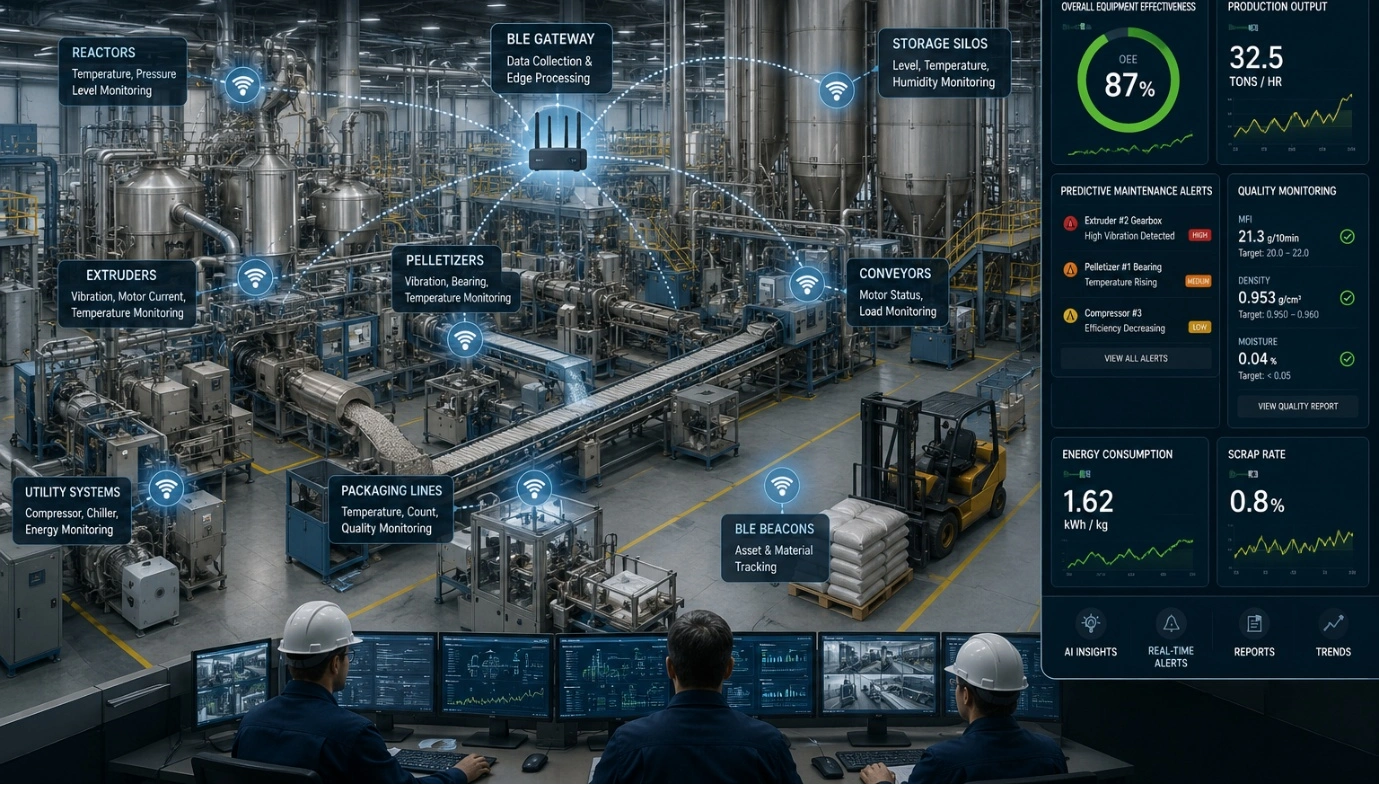
This illustration depicts a modern polymer manufacturing facility equipped with BLE sensors, BLE gateways, and AI-driven monitoring systems. It demonstrates how real-time operational data from reactors, extruders, pelletizers, storage silos, conveyors, packaging lines, and utility systems is analyzed through an AI dashboard to improve equipment reliability, product quality, predictive maintenance, and energy efficiency.
Understanding AI-Driven BLE Solutions for Polymer Manufacturing
BLE serves as the wireless sensing layer that continuously captures operational data throughout polymer production facilities. BLE gateways aggregate information from distributed BLE sensors and transmit it to edge servers, private manufacturing servers, or cloud-hosted software where artificial intelligence analyzes production conditions.
Unlike conventional monitoring systems that rely primarily on programmable logic controllers (PLCs) and supervisory control and data acquisition (SCADA) systems, BLE enables wireless monitoring of mobile assets, rotating equipment, temporary production stations, storage locations, maintenance tools, and difficult-to-wire environments without major infrastructure modifications.
Artificial intelligence transforms this continuously collected operational information into actionable manufacturing intelligence by:
- Detecting abnormal machine behavior before failures occur.
- Predicting polymer quality deviations.
- Optimizing extrusion parameters.
- Identifying excessive energy consumption.
- Forecasting equipment maintenance.
- Improving production scheduling.
- Monitoring environmental conditions affecting polymer stability.
- Tracking production assets throughout manufacturing facilities.
- Identifying process bottlenecks.
- Supporting operator decision-making using predictive analytics.
This combination is particularly valuable for polymer manufacturers producing engineering plastics, thermoplastics, thermosets, elastomers, specialty polymers, masterbatch compounds, recycled polymers, and polymer composites where process consistency directly affects mechanical properties and product performance.
Why AI Matters in Modern Polymer Manufacturing
Polymer manufacturing facilities operate thousands of continuously changing process variables.
Examples include:
- Melt temperature
- Barrel temperature profile
- Reactor pressure
- Feedstock composition
- Resin moisture content
- Screw speed
- Extruder torque
- Cooling water temperature
- Pellet moisture
- Line speed
- Material flow rate
- Hopper levels
- Dryer efficiency
- Vibration signatures
- Motor current
- Ambient humidity
- Energy consumption
- VOC emissions
Traditional automation systems monitor these variables independently. Artificial intelligence correlates them simultaneously, identifying complex relationships that are impossible for operators to detect manually.
For example, AI may determine that a slight increase in extruder motor vibration combined with increasing gearbox temperature and declining screw efficiency predicts bearing failure several weeks before conventional alarm thresholds are exceeded.
Similarly, AI may discover that minor fluctuations in polymer melt viscosity during humid weather consistently produce lower tensile strength in finished pellets, enabling proactive production adjustments.
These insights allow production teams to reduce scrap rates, improve throughput, maintain tighter quality tolerances, and extend equipment life.
GAO helps polymer manufacturers implement BLE-enabled sensing infrastructure that provides the reliable operational data required for these advanced AI applications.
AI Applications Across Polymer Manufacturing Operations
Artificial intelligence supported by BLE technologies can improve nearly every stage of polymer manufacturing operations.
Raw Material Receiving and Storage
BLE sensors monitor warehouse temperature, humidity, storage conditions, silo levels, resin inventory, and material movement.
AI analyzes inventory trends, predicts material shortages, identifies improper storage conditions, and recommends replenishment schedules before production disruptions occur.
Polymerization Process Monitoring
Polymerization reactors require extremely precise operating conditions.
BLE sensors monitor:
- Reactor temperature
- Pressure
- Agitator vibration
- Cooling performance
- Pump health
- Valve position
- Chemical transfer equipment
AI models identify abnormal reaction conditions, predict catalyst efficiency changes, detect fouling, and recommend process optimization before off-specification material is produced.
Extrusion and Compounding
Extrusion lines represent one of the most data-intensive areas within polymer manufacturing.
BLE-enabled monitoring supports:
- Screw motor vibration
- Gearbox temperature
- Barrel heating zones
- Melt pressure
- Motor current
- Bearing condition
- Material feed consistency
AI continuously evaluates these variables to optimize throughput while minimizing energy consumption, material degradation, and dimensional variation.
Pelletizing Operations
BLE sensors monitor cutter performance, pellet cooler efficiency, conveyor vibration, pellet moisture, packaging conditions, and downstream material handling.
Artificial intelligence predicts cutter blade wear, identifies cooling inefficiencies, and recommends maintenance scheduling before production quality declines.
Packaging and Warehouse Management
BLE beacons enable location tracking of pallets, finished polymer batches, packaging equipment, forklifts, reusable containers, and shipping assets.
AI analyzes logistics efficiency, warehouse utilization, shipping delays, and inventory movement patterns to improve overall material flow.
AI-Enabled BLE Workflow for Polymer Manufacturing Operations
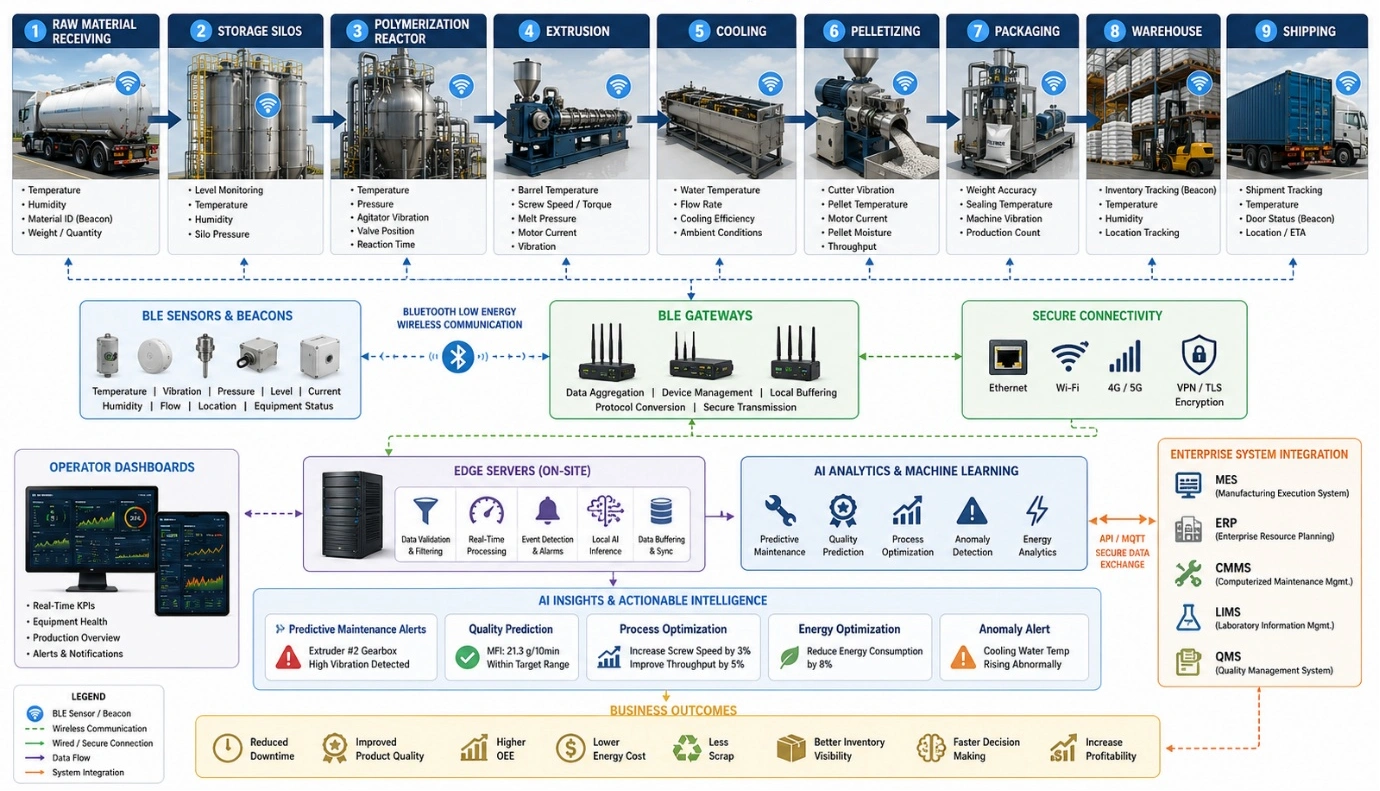
This workflow diagram illustrates the complete polymer manufacturing lifecycle, from raw material receiving to shipping, while demonstrating how BLE sensors, BLE beacons, and BLE gateways collect operational data at every production stage. The data flows through edge servers and AI analytics software to generate predictive maintenance alerts, quality predictions, process optimization recommendations, and enterprise software updates for systems such as MES, ERP, CMMS, LIMS, and QMS.
Operational Workflow for AI-Enabled BLE Monitoring in Polymer Manufacturing
Successful deployment begins with comprehensive operational data acquisition across production assets.
Data Acquisition Layer
Industrial BLE sensors continuously capture operational measurements from production equipment, utilities, and environmental systems.
Common monitored assets include:
- Polymerization reactors
- Extruders
- Twin-screw compounders
- Mixers
- Feed hoppers
- Dryers
- Chillers
- Cooling towers
- Air compressors
- Pumps
- Gearboxes
- Electric motors
- Dust collection systems
- Material handling conveyors
- Packaging machines
- Utility distribution systems
BLE beacons provide wireless identification for:
- Resin containers
- Intermediate bulk containers (IBCs)
- Finished product pallets
- Mobile maintenance equipment
- Forklifts
- Production tooling
- Quality inspection equipment
- Laboratory samples
Wireless Communication
BLE gateways receive wireless transmissions from nearby BLE devices.
Depending on production facility requirements, gateways forward collected information using:
- Ethernet
- Industrial Wi-Fi
- 5G
- Private LTE
- Fiber Ethernet
- Industrial VPN connections
Communication reliability is improved through gateway redundancy, overlapping wireless coverage, adaptive transmission intervals, and encrypted communication channels.
Edge Processing
Many polymer manufacturing facilities require immediate response times for production-critical events.
Edge servers located near production equipment perform:
- Sensor validation
- Noise filtering
- Data normalization
- Event detection
- Local anomaly detection
- Temporary buffering
- Rule-based automation
Edge processing reduces network traffic while enabling millisecond-level response for operational alarms.
AI Analytics
Validated operational data is processed using machine learning algorithms.
Typical AI functions include:
- Predictive maintenance
- Remaining useful life estimation
- Process optimization
- Energy optimization
- Product quality prediction
- Root cause analysis
- Production forecasting
- Asset health scoring
- Anomaly detection
- Process drift detection
These AI models continuously improve as additional production cycles increase training data quality.
Industrial AI Data Flow for BLE-Enabled Polymer Manufacturing
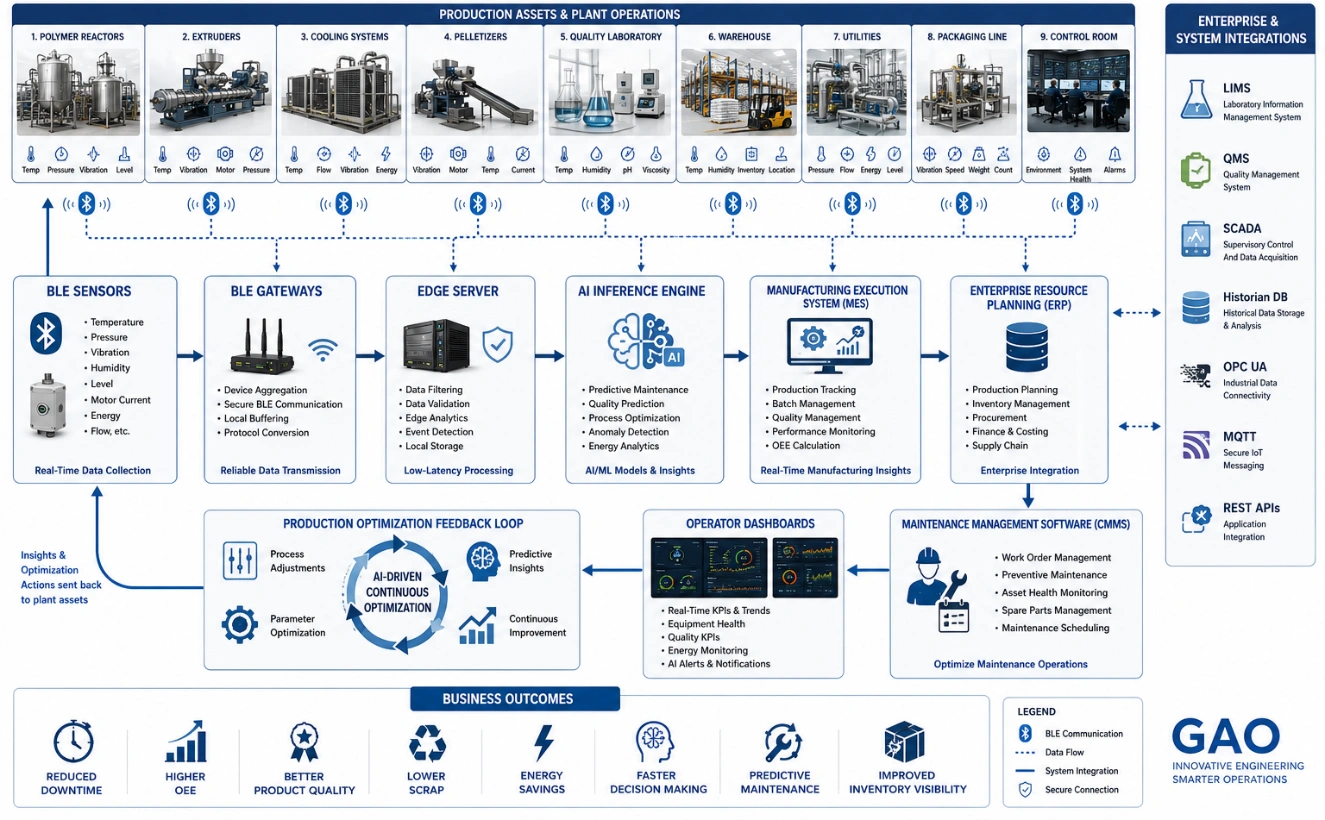
This block diagram illustrates the complete AI-enabled industrial data flow for polymer manufacturing. BLE sensors capture operational data from production assets, BLE gateways aggregate and securely transmit the information to edge servers and AI inference engines, and the resulting insights integrate with MES, ERP, operator dashboards, and maintenance management software to drive predictive maintenance, quality optimization, and continuous production improvement.
Integrating AI, BLE, and Manufacturing Software for Polymer Production
Operational data becomes significantly more valuable when integrated with existing manufacturing software rather than remaining isolated within individual monitoring systems. BLE gateways act as secure data aggregation points, enabling sensor information to flow into production, maintenance, quality, and business applications.
Common software integrations include:
- Manufacturing Execution Systems (MES) for production scheduling, batch genealogy, work order execution, and production traceability.
- Enterprise Resource Planning (ERP) software for inventory visibility, procurement planning, production costing, and supply chain coordination.
- Computerized Maintenance Management Systems (CMMS) for predictive work orders, spare parts planning, technician scheduling, and asset lifecycle management.
- Laboratory Information Management Systems (LIMS) for correlating process conditions with polymer quality testing, viscosity measurements, melt flow index (MFI), tensile strength, density, and other laboratory results.
- Quality Management Systems (QMS) to support statistical process control (SPC), nonconformance management, corrective actions, and continuous improvement initiatives.
By combining operational technology (OT) data with information technology (IT) systems, polymer manufacturers create a unified view of production performance, asset health, and product quality. This integration enables AI models to deliver more accurate predictions by correlating equipment behavior, production parameters, maintenance history, and laboratory measurements across the entire manufacturing process.
BLE Infrastructure, AI Software, Security, and Deployment Models for Polymer Manufacturing
A successful AI-enabled polymer manufacturing solution depends on more than wireless sensors. Reliable performance requires carefully selected BLE hardware, industrial networking, AI software, cybersecurity controls, and deployment strategies that match production requirements. Every component contributes to maintaining continuous visibility into production processes while supporting scalable analytics and operational resilience.
BLE Hardware Components
BLE technologies provide the data acquisition foundation for AI-driven polymer manufacturing.
BLE Sensors
Industrial BLE sensors monitor equipment and environmental conditions such as:
- Temperature
- Pressure
- Vibration
- Motor current
- Bearing condition
- Relative humidity
- Differential pressure
- Tank levels
- Flow rate
- Compressed air performance
- Energy consumption
- Leak detection
BLE Beacons
BLE beacons provide location intelligence for mobile and stationary assets including:
- Resin containers
- Intermediate bulk containers (IBCs)
- Catalyst drums
- Finished goods pallets
- Forklifts
- Maintenance tools
- Portable testing equipment
- Laboratory samples
- Production molds
- Mobile operator carts
BLE Gateways
BLE gateways collect wireless sensor information and forward it to enterprise software using Ethernet, industrial Wi-Fi, cellular, or fiber connectivity. Industrial gateways deployed throughout extrusion halls, reactor areas, packaging zones, warehouses, and utility rooms help ensure reliable wireless coverage while minimizing communication latency.
For facilities operating multiple production buildings, gateway clustering and redundant communication paths improve availability during maintenance or network interruptions.
GAO supplies industrial BLE gateways, BLE sensors, and BLE beacons designed for demanding manufacturing environments where reliability, long service life, and simplified deployment are critical.
AI Models Used in Polymer Manufacturing
Artificial intelligence converts operational data into actionable manufacturing intelligence through several complementary analytical methods.
Predictive Maintenance Models
Machine learning analyzes vibration, temperature, current consumption, and historical maintenance records to estimate remaining useful life for motors, gearboxes, pumps, compressors, pelletizers, and extrusion equipment.
Anomaly Detection
Unsupervised learning identifies previously unseen operating conditions that differ from established production behavior, allowing operators to investigate process deviations before quality problems occur.
Quality Prediction Models
Regression and deep learning models correlate production parameters with laboratory measurements including:
- Melt Flow Index (MFI)
- Density
- Tensile strength
- Flexural strength
- Impact resistance
- Moisture content
- Color consistency
- Surface finish
Quality prediction reduces laboratory turnaround delays by forecasting product characteristics during production.
Production Optimization
Reinforcement learning and optimization algorithms recommend operating parameter adjustments that maximize throughput while minimizing energy consumption and raw material waste.
Computer Vision
Vision AI supports automated inspection of pellets, films, molded products, and packaging by identifying contamination, discoloration, dimensional defects, surface imperfections, and packaging inconsistencies.
Communication Protocols Supporting Polymer Manufacturing
BLE operates alongside numerous industrial communication technologies rather than replacing existing automation infrastructure.
Frequently integrated communication standards include:
- Bluetooth Low Energy (BLE)
- OPC UA
- MQTT
- Modbus TCP
- Modbus RTU
- EtherNet/IP
- PROFINET
- PROFIBUS
- EtherCAT
- BACnet
- REST APIs
- HTTPS
- AMQP
Using standardized communication methods simplifies interoperability between AI software, production systems, laboratory software, maintenance applications, and business systems.
Cloud Software Deployment
Cloud-hosted AI software is well suited for polymer manufacturers operating multiple production facilities or geographically distributed operations.
Typical cloud capabilities include:
- Centralized production dashboards
- Fleet-wide equipment monitoring
- Cross-facility benchmarking
- AI model training
- Long-term historical storage
- Enterprise reporting
- Remote engineering access
- Corporate sustainability reporting
Cloud deployments simplify software updates and allow computationally intensive AI models to scale without requiring significant local computing resources.
Cloud software is generally preferred when organizations require:
- Multi-site visibility
- Corporate analytics
- Remote support
- High computing scalability
- Long-term production analytics
- Cross-plant performance comparisons
Because cloud deployments depend on reliable connectivity, production-critical control functions should remain independent of cloud availability.
Server Software Deployment
Many polymer manufacturers prefer privately managed server deployments to satisfy operational, cybersecurity, regulatory, or performance requirements.
Server deployments may reside within:
- Factory edge servers
- Corporate data centers
- Private cloud infrastructure
- Customer-managed virtualization environments
- Industrial computing clusters
Server-based deployments provide several advantages:
- Low-latency analytics
- Local AI inference
- Reduced external network dependency
- Greater control of operational data
- Simplified compliance with internal security policies
- Integration with existing manufacturing infrastructure
Edge servers frequently execute AI inference close to production equipment while synchronizing selected information with centralized reporting systems.
For facilities operating continuously, server deployments reduce dependence on external internet connectivity and support uninterrupted production monitoring.
Hybrid Deployment
Many polymer manufacturers choose hybrid deployments that combine private servers with cloud analytics.
A common implementation includes:
- BLE sensors collecting production data.
- BLE gateways forwarding information to local edge servers.
- Edge servers executing real-time AI inference.
- Cloud software storing long-term production history.
- Corporate dashboards analyzing performance across multiple manufacturing sites.
Hybrid deployment provides operational resilience while supporting enterprise-wide analytics.
Cybersecurity Considerations
Protecting manufacturing systems is essential because production interruptions directly affect output, quality, and safety.
Recommended security measures include:
- BLE device authentication
- AES encryption
- TLS-secured communications
- Certificate management
- Role-based access control (RBAC)
- Multi-factor authentication
- Network segmentation
- Secure gateway firmware updates
- Continuous vulnerability monitoring
- Device inventory management
- Security Information and Event Management (SIEM) integration
- Zero Trust access principles
Operational technology (OT) and information technology (IT) networks should be logically segmented while allowing secure data exchange through monitored gateways.
GAO supports customers by providing BLE hardware designed with enterprise security considerations, robust quality assurance processes, and expert technical assistance for deployment and lifecycle management.
Comparison of Cloud, Server, and Hybrid Deployment Models for AI-Enabled Polymer Manufacturing
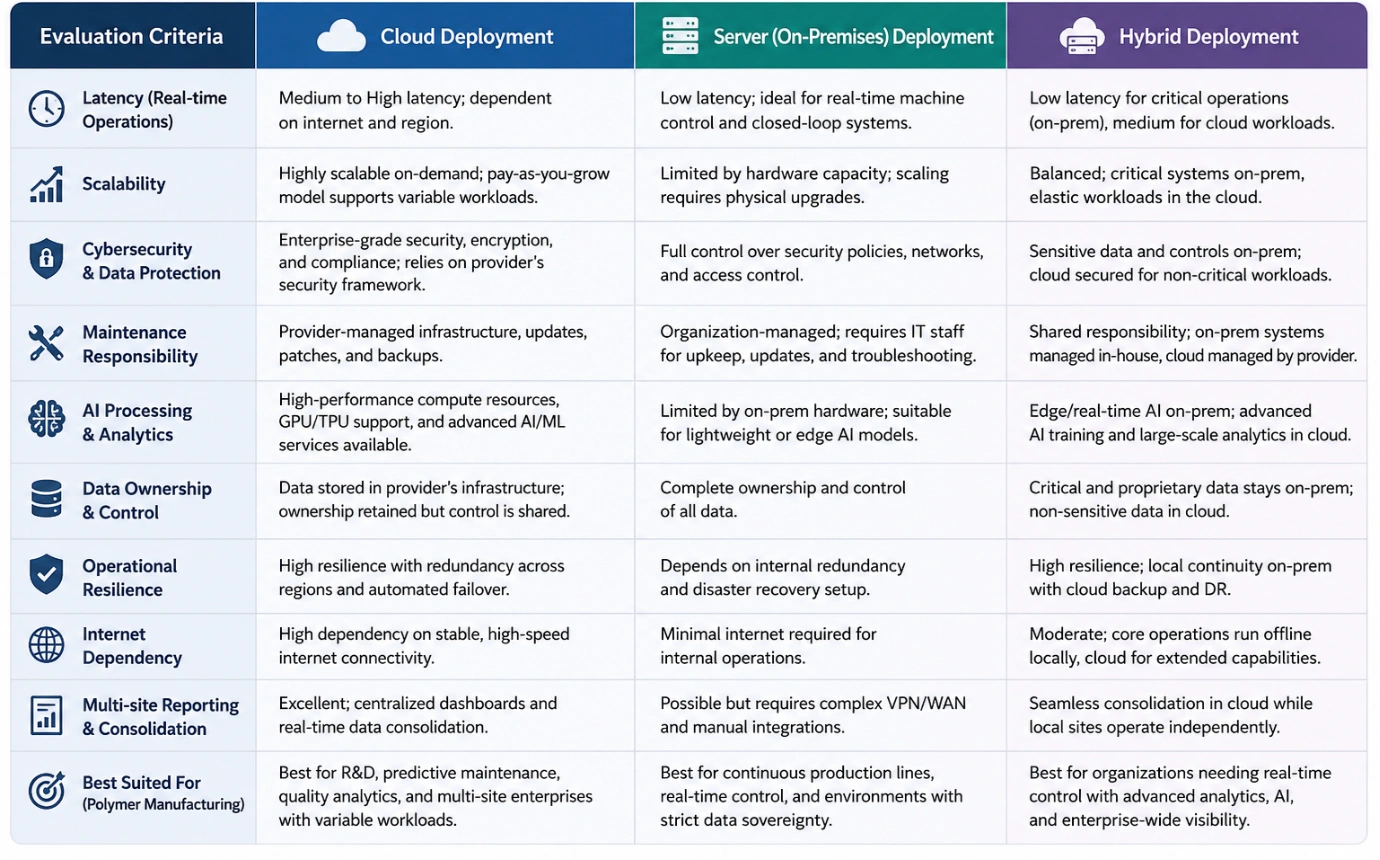
This comparison table evaluates Cloud, Server (On-Premises), and Hybrid deployment models for AI-enabled polymer manufacturing across key operational criteria, including latency, scalability, cybersecurity, AI processing, data ownership, operational resilience, internet dependency, multi-site reporting, and recommended industrial applications.
Business Value and Technical Advantages
Combining AI with BLE technologies delivers measurable improvements across polymer manufacturing operations because decisions are based on continuously collected production data rather than periodic inspections or reactive maintenance.
Key technical and operational benefits include:
- Earlier identification of equipment degradation through predictive maintenance.
- Reduced unplanned downtime for reactors, extruders, pelletizers, pumps, and compressors.
- Improved Overall Equipment Effectiveness (OEE).
- Lower scrap generation through continuous process optimization.
- Reduced off-specification polymer production.
- Better consistency in melt flow index, density, tensile strength, and dimensional stability.
- Enhanced traceability of raw materials, work-in-progress, and finished goods.
- More accurate production forecasting.
- Lower energy consumption through AI-assisted process tuning.
- Improved maintenance planning and spare parts utilization.
- Faster root cause analysis following production deviations.
- Increased operator awareness using real-time dashboards and intelligent alerts.
- Greater visibility into warehouse inventory and logistics.
- Improved regulatory reporting and audit readiness.
- Better utilization of manufacturing assets across multiple production facilities.
Beyond these measurable improvements, AI systems continuously learn from historical production data, allowing manufacturers to refine operating practices over time and respond more effectively to changing feedstock characteristics, equipment aging, and customer quality requirements.
Measurable Improvements Enabled by AI-Supported BLE Monitoring in Polymer Manufacturing
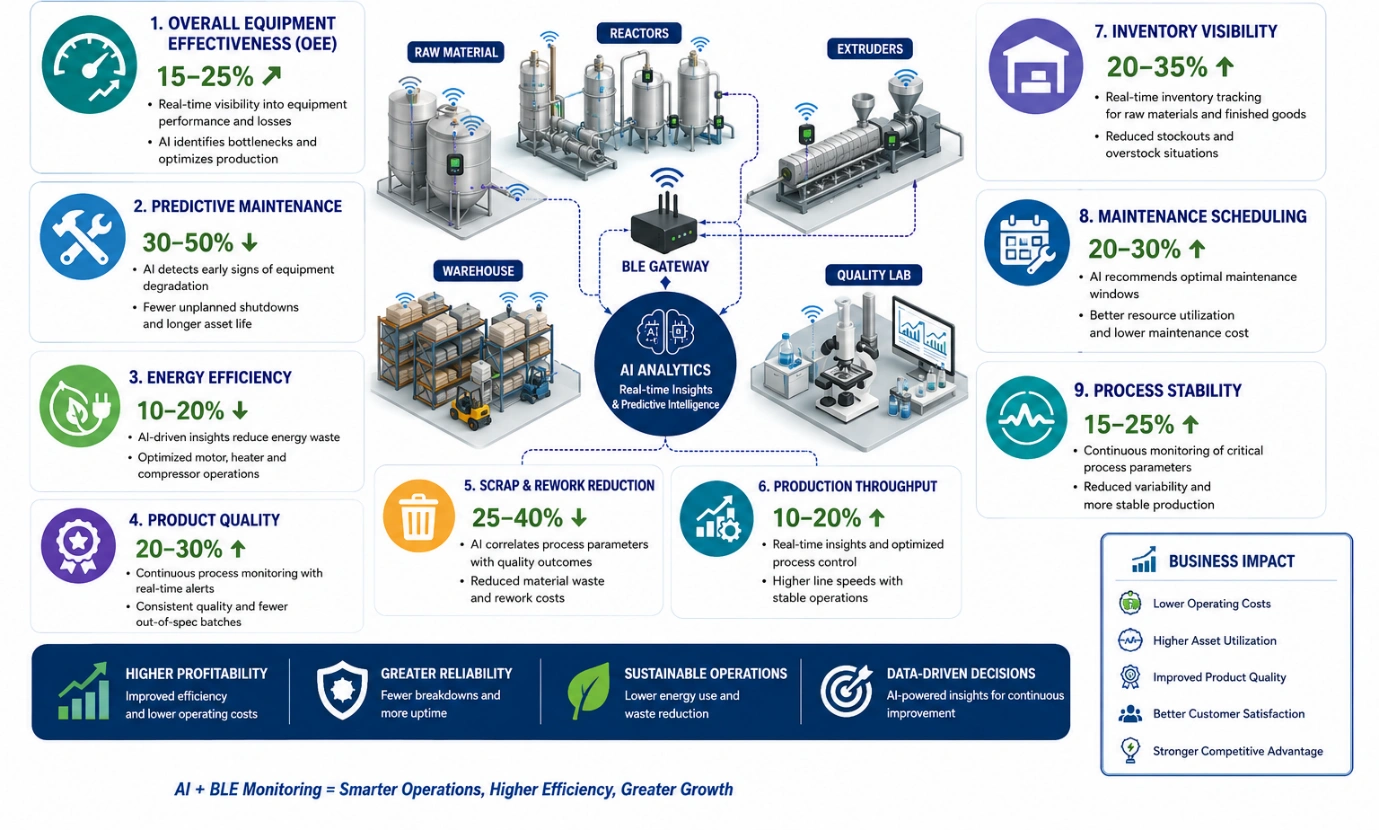
This enterprise infographic illustrates the measurable operational improvements achieved through AI-supported Bluetooth Low Energy (BLE) monitoring in polymer manufacturing. It highlights enhanced Overall Equipment Effectiveness (OEE), predictive maintenance, energy efficiency, product quality, scrap reduction, production throughput, inventory visibility, maintenance scheduling, and process stability while demonstrating connectivity between wireless sensors, BLE gateways, AI analytics, and critical production assets.
Engineering Best Practices for Successful Implementation
Successful AI-enabled BLE deployments in polymer manufacturing require careful planning throughout the project lifecycle.
Recommended practices include:
- Define measurable objectives before hardware selection, such as reducing downtime, improving product consistency, or lowering energy consumption.
- Identify critical assets based on production impact rather than monitoring every machine initially.
- Perform wireless site surveys to determine BLE gateway placement and coverage.
- Select industrial-grade BLE devices suitable for temperature, dust, vibration, and chemical exposure.
- Standardize data models across production lines to simplify AI training.
- Integrate operational data with MES, ERP, CMMS, LIMS, and QMS software.
- Establish cybersecurity policies before commissioning production systems.
- Validate AI recommendations against process engineering expertise during early deployment phases.
- Continuously retrain AI models as equipment, formulations, and operating conditions evolve.
- Measure project success using KPIs such as OEE, First Pass Yield (FPY), Mean Time Between Failures (MTBF), Mean Time to Repair (MTTR), energy intensity, scrap rate, and maintenance cost per production unit.
For more than three decades, GAO has served organizations throughout the United States and Canada, including Fortune 500 companies, leading research organizations, prestigious universities, and government agencies. Headquartered in New York City and Toronto, Canada, GAO is recognized among the world’s leading B2B suppliers of BLE and RFID technologies. Together with its sister companies, GAO Research and GAO Tek, we continue investing in industrial IoT research, rigorous quality assurance, and expert remote and onsite technical support.
Advancing Polymer Manufacturing with AI and BLE
Artificial intelligence is reshaping polymer manufacturing by converting operational data into predictive insights that improve production quality, equipment reliability, and resource utilization. BLE gateways, BLE sensors, and BLE beacons provide the wireless visibility necessary to monitor manufacturing assets, environmental conditions, material movement, and production equipment throughout the facility.
When integrated with manufacturing software, maintenance systems, quality management applications, and advanced AI models, BLE-enabled data supports predictive maintenance, production optimization, quality forecasting, inventory visibility, and intelligent operational decision-making. Organizations adopting these technologies can improve manufacturing performance while reducing downtime, waste, and operating costs.
GAO continues to help polymer manufacturers deploy industrial BLE and IoT solutions that support reliable data acquisition, scalable AI initiatives, and long-term operational excellence. Our engineering expertise, comprehensive hardware portfolio, and technical support enable organizations to implement practical AI-enabled manufacturing solutions with confidence.
Enterprise AI-Enabled BLE Solution Architecture for Polymer Manufacturing
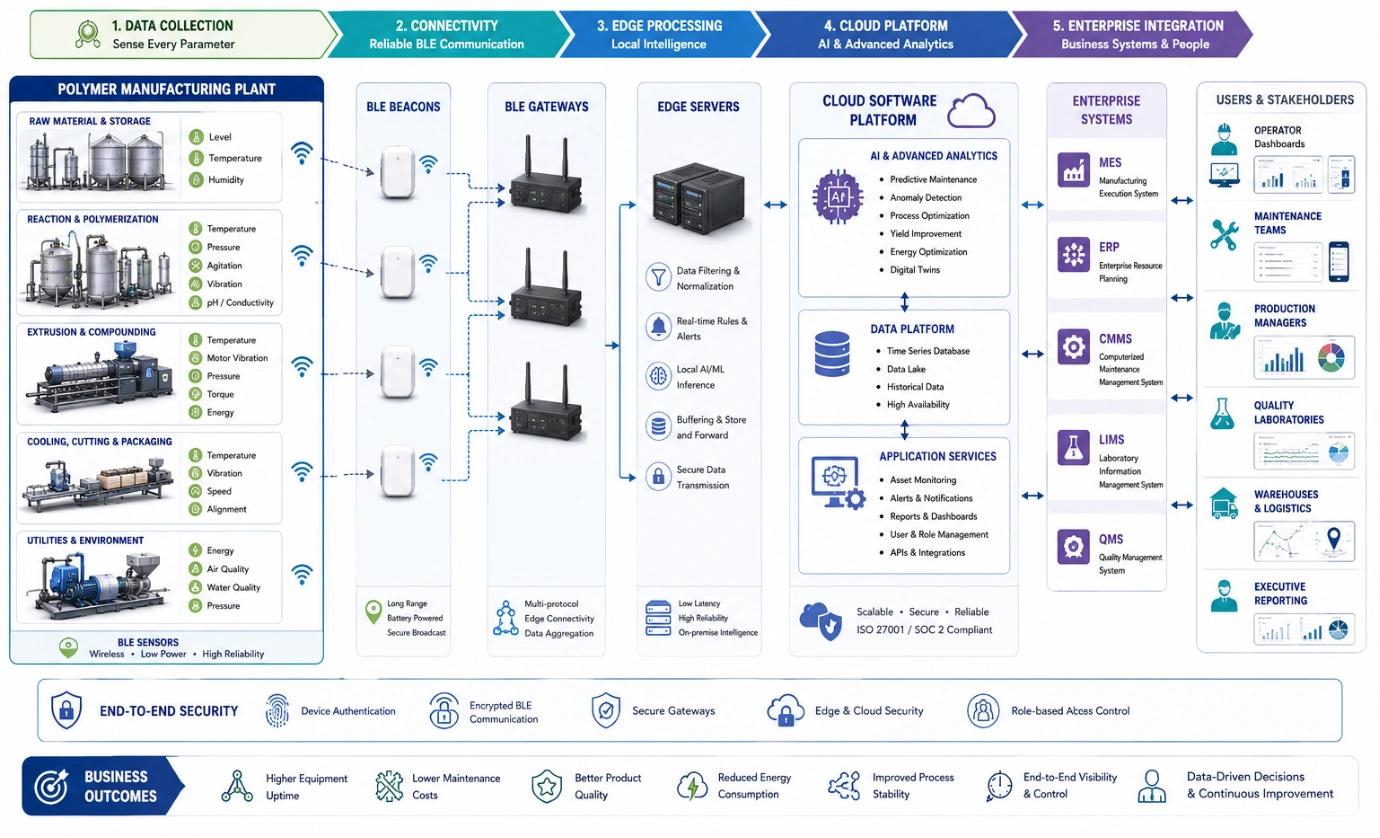
This solution diagram illustrates the complete AI-enabled Bluetooth Low Energy (BLE) architecture for a modern polymer manufacturing facility. It demonstrates how BLE sensors, BLE beacons, gateways, edge servers, cloud software, AI analytics, and enterprise systems—including MES, ERP, CMMS, LIMS, and QMS—integrate to provide real-time monitoring, predictive analytics, operational intelligence, and enterprise-wide decision support for production, maintenance, quality, warehousing, and executive management.
Building the Future of Industrial AI and IoT with Aperture Venture Studio and GAO RFID Inc.
For more than three decades, GAO Group of Companies has invested extensively in research and development for industrial BLE, RFID, and IoT technologies. As generative AI demonstrated its value across industrial manufacturing, we expanded our focus on integrating AI with BLE, RFID, and connected sensing solutions for advanced production environments such as polymer manufacturing. To further accelerate innovation in industrial intelligence, we founded Aperture Venture Studio to help develop, commercialize, and advance AI and IoT solutions that address evolving manufacturing challenges across multiple industries.
Aperture has attracted distinguished AI researchers, IoT engineers, experienced business leaders, respected investors, and industry collaborators. We also organize the highly regarded Aperture Ventures Summit and TekSummit, where experts exchange knowledge on emerging AI and industrial IoT technologies. These initiatives have fostered strong technical communities dedicated to advancing industrial digital transformation.
We welcome you to join us as:
- Advisors, Co-founders, or Employees
- Investors
- Customers seeking advanced AI, BLE, RFID, and industrial IoT solutions from GAO and its affiliated organizations