
AI and BLE for Precious Metals Mining
AI-Driven Asset Tracking and Mine Operations with BLE
AI-enabled asset tracking, worker location monitoring, equipment condition monitoring, and operational analytics can help precious metals mining companies improve visibility across underground mines, open-pit operations, processing plants, maintenance areas, and material-handling facilities. BLE gateways, beacons, and sensors provide a practical wireless data layer for identifying equipment, locating mobile assets, capturing operating conditions, and feeding time-series information into AI software.
For precious metals mining, the value comes from connecting AI analytics with operational data generated close to the orebody, mobile equipment, fixed processing assets, maintenance activities, and workforce movements. AI can identify abnormal equipment behavior, detect utilization patterns, predict maintenance requirements, analyze asset movements, and support production decisions. BLE is particularly useful where low-power sensing and proximity-based identification are required, while gateways can forward field data to edge computers, servers, or cloud systems. GAO supplies BLE gateways, beacons, sensors, and related IoT hardware that can support these connected mining applications.
What AI and BLE Mean for Precious Metals Mining
AI for precious metals mining refers to software methods that analyze operational, equipment, environmental, maintenance, production, and location data to identify patterns and support decisions. Depending on the application, mining companies can use machine learning, anomaly detection, predictive analytics, time-series models, classification models, computer vision, optimization algorithms, and natural-language interfaces.
BLE acts as an enabling data-acquisition technology rather than the intelligence itself. BLE beacons can identify tagged mobile equipment, tools, containers, personnel devices, or designated zones. BLE sensors can collect measurements such as temperature, vibration, humidity, pressure, motion, or other application-specific parameters. BLE gateways receive nearby BLE transmissions and forward relevant information into mining software.
This relationship is important because AI models require sufficiently reliable operational data. A predictive-maintenance model cannot provide useful results when equipment identifiers, timestamps, operating states, or sensor readings are missing or inconsistent. BLE can therefore contribute to the data foundation required for AI-driven mining analytics.
Bluetooth LE supports broadcast-based communication as well as connection-oriented communication, making it suitable for different proximity, identification, and sensor-monitoring scenarios. Bluetooth specifications define the communication procedures and device interoperability requirements, while specific profiles and services determine how devices exchange application data. Current Bluetooth specifications also provide capabilities relevant to positioning and low-power industrial sensing.
Precious Metals Mining Applications for AI-Enabled BLE
Relevant applications depend on the mine type, operating environment, regulatory requirements, radio propagation conditions, and existing mine-management systems.
- Underground equipment tracking for loaders, drilling equipment, utility vehicles, pumps, generators, ventilation equipment, and maintenance tools
- Personnel and contractor proximity monitoring in designated operational zones
- AI-assisted equipment utilization analysis using BLE location events and machine operating data
- Predictive maintenance for selected mobile and fixed assets using BLE sensor measurements alongside existing condition-monitoring data
- Tool and maintenance-equipment tracking across workshops, underground headings, shafts, and surface facilities
- Battery-powered equipment monitoring where low-power wireless sensing is advantageous
- Material and container tracking across mine logistics and processing-support operations
- Monitoring of environmental conditions in selected areas where BLE sensor deployment is technically suitable
- Location-assisted maintenance workflows that associate technicians, equipment, work orders, and physical operating zones
- AI analysis of equipment movement patterns to identify excessive idle time, inefficient dispatch behavior, or abnormal utilization
- Processing-area asset monitoring for pumps, motors, conveyors, instrumentation enclosures, and other selected equipment
- Inventory visibility for maintenance parts and high-value tools
BLE should not automatically be treated as a replacement for every mining communication technology. Underground mine environments can contain rock attenuation, metal structures, electrical equipment, water, dust, machinery, and changing radio paths. Engineering teams should therefore evaluate BLE alongside Wi-Fi, private cellular, industrial Ethernet, LoRaWAN where appropriate, conventional mine telemetry, GPS/GNSS on the surface, RFID, and other communication technologies.
Precious Metals Mining AI and BLE Operational Workflow
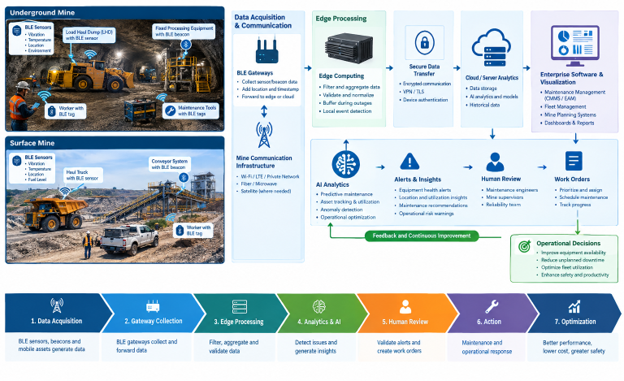
This workflow illustrates how BLE sensors, beacons, and gateways collect data from underground and surface mining assets and transmit it through mine communication infrastructure to edge computing, secure data transfer, and cloud or server analytics. AI analytics generate equipment, asset-tracking, and operational insights that mining personnel review before initiating maintenance work orders and operational actions.
Precious Metals Mining Workflows That Benefit from AI and BLE
A useful deployment begins with the mining workflow rather than with the wireless hardware. The engineering question is not simply where BLE gateways can be installed. The more important question is which operational decision becomes more reliable when asset identity, location, condition, or movement data becomes available.
Mine Development and Underground Production
Underground precious metals mining can involve drilling, blasting, mucking, ground support, hauling, ventilation, dewatering, scaling, inspection, and maintenance. These activities produce continuously changing relationships between people, machines, work areas, and production schedules.
BLE-enabled identification can associate mobile equipment and tools with specific operational zones. AI software can then analyze movement histories, utilization patterns, delays, and maintenance events.
For example, a loader equipped with a BLE beacon can generate proximity events when it enters designated underground zones. BLE gateways positioned at selected access points or operational areas can capture those events. When combined with fleet-management or maintenance records, the resulting data can help identify utilization patterns such as extended idle periods, unexpected movements, or unusually long equipment dwell times.
Drilling and Ground Support Operations
Production drills, development drills, bolters, scaling equipment, pumps, and supporting tools can be difficult to track manually across large mining operations.
AI analysis can combine equipment identity and location information with maintenance records, operating hours, inspection results, and production schedules. BLE can contribute the physical-location component required to associate an asset with the correct heading, stope, workshop, or staging area.
Such a system can support:
- Equipment utilization analysis
- Maintenance scheduling
- Work-order verification
- Tool accountability
- Equipment movement history
- Delay analysis
- Asset availability reporting
- Maintenance technician dispatch
The AI output should remain a decision-support mechanism. Mine supervisors, maintenance personnel, engineers, and safety professionals retain responsibility for interpreting alerts and determining appropriate operational action.
Haulage, Loading, and Mobile Equipment
Mobile mining equipment generates valuable operational information because its movement directly affects production efficiency and maintenance requirements. Loaders, haul trucks, service vehicles, utility vehicles, water trucks, and other equipment can be represented by BLE identifiers while machine telemetry supplies complementary operating information.
AI models can examine relationships between location, utilization, maintenance history, operating hours, and production activity. This can help identify recurring delays or abnormal utilization patterns.
A practical deployment may combine BLE location events with:
- Fleet-management records
- Engine-hour data
- Fuel or energy consumption
- Maintenance work orders
- Operator-reported defects
- Equipment availability
- Shift information
- Production data
- Mine dispatch information
BLE does not independently determine whether a haul cycle is productive or whether equipment requires maintenance. Its value increases when its location and identification data are correlated with other operational sources.
Processing Plants and Surface Facilities
Precious metals mining continues beyond extraction. Crushing, grinding, milling, classification, flotation, leaching, thickening, filtration, smelting or refining processes, water treatment, reagent handling, laboratories, maintenance workshops, and material storage can all generate operational data.
BLE sensors can be considered for selected equipment and environmental monitoring applications where their technical specifications and installation conditions are appropriate. BLE asset identification can also help track mobile maintenance equipment, portable instruments, containers, and selected high-value items.
AI software can correlate asset conditions with maintenance records and operating conditions. For example, an AI model may identify that a pump or motor exhibits a recurring temperature or vibration pattern before maintenance personnel receive a conventional failure indication.
This approach is most useful when the BLE data is combined with established condition-monitoring instrumentation rather than treated as the sole source of engineering information.
AI-Enabled Precious Metals Mining Asset Monitoring with BLE
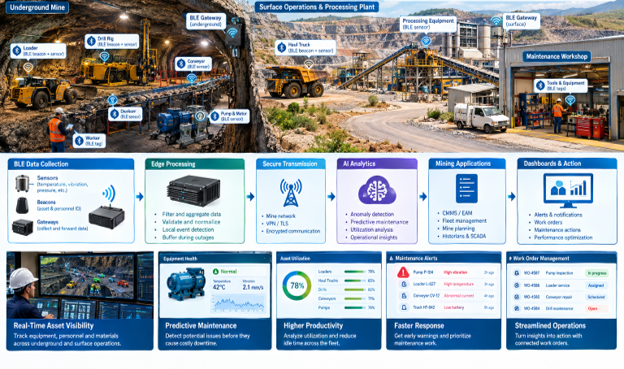
This technical illustration shows BLE sensors, beacons, and gateways monitoring underground mining equipment, surface haul trucks, processing equipment, pumps, motors, conveyors, workers, and maintenance tools. The data flows through edge processing and secure transmission into AI analytics that support predictive maintenance, asset utilization, alerts, dashboards, and mining work-order management.
AI and BLE Deployment Architecture for Precious Metals Mining
A mining deployment should separate the physical sensing layer, wireless communication layer, data-processing layer, AI software, and operational systems. This separation makes it easier to identify where a failure occurs and helps engineering teams scale the solution without redesigning the entire system.
BLE Beacons and Sensors
BLE beacons provide identification or presence information through wireless advertisements. Depending on the selected hardware, beacons can be attached to mobile equipment, tools, containers, personnel devices, or defined locations.
BLE sensors add measurement capabilities. Typical industrial measurements may include temperature, vibration, humidity, motion, pressure, battery status, or other parameters supported by the selected sensor.
For precious metals mining, device selection should consider:
- Operating temperature
- Water and dust exposure
- Mechanical shock and vibration
- Battery life
- Enclosure protection
- Mounting method
- Maintenance accessibility
- Radio performance
- Required transmission interval
- Sensor accuracy
- Calibration requirements
- Hazardous-location requirements where applicable
- Electromagnetic interference
- Underground propagation conditions
GAO provides BLE gateways and related BLE hardware that can be selected according to application and deployment requirements. GAO’s BLE gateway portfolio includes industrial-grade, outdoor, battery-powered, PoE-powered, compact, and cloud-supported categories, allowing engineers to evaluate gateway characteristics against the physical mining environment.
BLE Gateways and Edge Data Collection
BLE gateways provide the connection between local BLE devices and upstream mining software. A gateway can scan nearby BLE advertisements or establish supported BLE connections, process incoming information, and forward relevant data through the available mine communication network.
Gateway placement is particularly important underground. Engineers should account for tunnel geometry, roadway intersections, rock composition, machinery obstruction, metal structures, water, equipment movement, gateway mounting height, power availability, and network backhaul.
A gateway deployment should also define what happens when upstream connectivity is temporarily unavailable. Local buffering, timestamp preservation, retransmission logic, device health monitoring, and gateway heartbeat mechanisms can prevent temporary communication interruptions from becoming permanent data gaps.
Edge Computing, Servers, and Cloud Processing
Edge computing can process selected mining data close to the BLE gateways or operational area. This can reduce unnecessary data transmission and support faster local event processing.
A privately hosted server can provide centralized processing within a mining company’s own data center, control facility, regional computing environment, or other customer-managed infrastructure. This approach can be appropriate when operational data governance, network independence, latency, or integration requirements make private hosting preferable.
Cloud-hosted software can provide centralized analytics across multiple mines, processing facilities, maintenance locations, or geographic regions. Cloud deployment can also simplify centralized model management and cross-site analysis when reliable connectivity and appropriate data governance are available.
A hybrid deployment can combine the three approaches:
- BLE devices capture local asset and condition data
- Gateways collect and normalize BLE information
- Edge systems perform time-sensitive processing
- Private servers store or process operationally sensitive information
- Cloud services perform broader analytics and multi-site reporting
- AI software produces alerts, predictions, anomaly scores, and operational insights
- Mine personnel validate and act on the resulting information
The correct choice depends on network availability, cybersecurity requirements, data governance, latency, operational continuity, mine topology, existing IT infrastructure, and the required AI workload.
Middleware and Mining Software Integration
Middleware converts raw device information into usable operational data. It can normalize device identifiers, timestamps, gateway information, sensor readings, location zones, battery status, and event types before delivering data to other software.
Integration targets may include:
- Computerized maintenance management systems
- Enterprise asset management systems
- Fleet management systems
- Mine dispatch systems
- Mine planning software
- SCADA systems
- Historians
- Laboratory information systems
- Enterprise resource planning systems
- Business intelligence software
- Data warehouses
- AI and machine-learning services
REST APIs, MQTT, HTTPS, TCP/IP, database interfaces, OPC UA, and other integration mechanisms may be appropriate depending on the existing mining IT and OT environment.
Precious Metals Mining AI, BLE, Edge, Cloud and Server Data Flow
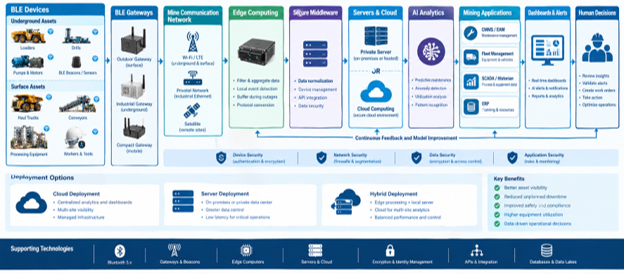
This block diagram illustrates the end-to-end flow of data from BLE sensors and beacons on underground and surface mining assets through BLE gateways, mine communication networks, edge computing, secure middleware, private servers or cloud computing, and AI analytics. It also shows integration with CMMS/EAM, fleet management, SCADA/historian, ERP, dashboards, alerts, and human decision-making, with cybersecurity controls spanning the solution.
Engineering Considerations for BLE in Precious Metals Mining
Wireless deployment underground requires more engineering validation than simply calculating theoretical radio range. BLE performance can change substantially when equipment, vehicles, personnel, ventilation infrastructure, rock surfaces, water, and metallic structures alter the radio environment.
Radio Coverage and Asset Mobility
A fixed gateway position may provide adequate coverage during one operating condition and reduced coverage after equipment, infrastructure, or mine development changes. Engineers should therefore perform site surveys and validate coverage under realistic operating conditions.
Moving assets also create intermittent connectivity. The system should distinguish between an asset genuinely leaving a monitored zone and a temporary communication gap.
AI analytics can help identify recurring communication gaps by analyzing gateway connectivity, timestamp intervals, signal characteristics where available, battery status, and asset movement history. This makes network reliability itself a measurable operational variable.
Data Quality and AI Model Reliability
AI accuracy depends heavily on data quality. Mining data can contain missing timestamps, duplicate events, incorrectly assigned asset identifiers, stale device information, sensor drift, gateway outages, and inconsistent maintenance records.
A reliable implementation should establish:
- Unique asset identifiers
- Consistent timestamps
- Asset-to-device mapping
- Gateway identification
- Zone definitions
- Sensor calibration procedures
- Data-quality rules
- Missing-data handling
- Device health monitoring
- Historical data retention
- AI model validation procedures
AI models should also be evaluated against actual mining operating conditions rather than relying solely on laboratory or generic industrial datasets.
Cybersecurity and Operational Technology
BLE-connected mining devices become part of a larger information environment. Security controls should therefore extend beyond the BLE device itself.
Relevant controls may include:
- Device authentication
- Secure provisioning
- Access control
- Encrypted communications where supported and appropriate
- Gateway hardening
- Network segmentation
- Firewall controls
- Secure API authentication
- Credential management
- Software patch management
- Logging and monitoring
- Backup and recovery procedures
- Role-based access control
- Incident-response procedures
Bluetooth specifications include security mechanisms within the protocol stack, but the overall security posture also depends on gateway configuration, network design, server security, application controls, identity management, and operational procedures.
Mining operators should additionally evaluate whether specific BLE equipment is suitable for the intended hazardous or regulated operating environment. Wireless approval, enclosure requirements, intrinsic-safety considerations, and site-specific electrical classifications must be addressed through engineering and regulatory review rather than assumed from the fact that a device uses BLE.
GAO BLE Solutions for Precious Metals Mining
GAO supports organizations that require BLE, RFID, and IoT hardware products and systems for asset identification, wireless sensing, tracking, and connected operational applications. For precious metals mining, BLE hardware can serve as a data-acquisition layer connecting physical mining assets with software used for maintenance, asset management, operational analytics, and AI-assisted decision support.
Headquartered in New York City and Toronto, Canada, GAO is positioned as a major B2B and B2G supplier of BLE and RFID technologies. GAO and its sister companies have served organizations across the United States and Canada for three decades, including Fortune 500 companies, research and development organizations, universities, and government agencies.
GAO’s engineering approach is relevant to mining deployments where hardware selection must be matched to physical operating conditions, communication requirements, integration needs, and lifecycle support. Product selection should be based on the actual mine environment, including whether equipment will operate underground, outdoors, within processing facilities, or in maintenance and logistics areas.
AI-Driven Improvements in Precious Metals Mining Operations
Combining AI analytics with BLE-generated asset, location, and condition data can turn isolated observations into operational insights. The practical value depends on connecting those insights to established mining workflows, maintenance processes, production planning, and engineering decisions.
Predictive Maintenance for Mining Equipment
Predictive maintenance is one of the most practical AI applications when BLE sensors can provide relevant condition data from equipment that is difficult or costly to monitor continuously.
For selected pumps, motors, fans, compressors, conveyors, generators, and mobile equipment, BLE sensors may capture temperature, vibration, motion, or other parameters. AI models can establish normal operating patterns and identify deviations that warrant inspection.
The resulting workflow can connect:
- BLE sensor measurements
- Equipment identification
- Asset location
- Operating hours
- Historical maintenance records
- Failure history
- Inspection results
- Spare-parts records
- Technician observations
- AI anomaly scores
- Maintenance work orders
This can help maintenance teams prioritize inspection and schedule work based on observed equipment behavior rather than relying exclusively on fixed intervals.
AI predictions should not be treated as proof of impending mechanical failure. Mining engineers and maintenance personnel should validate alerts against equipment specifications, operating conditions, inspection findings, and established maintenance procedures.
AI Asset Utilization and Fleet Visibility
Asset utilization is particularly important when expensive mining equipment spends significant time moving between production areas, staging zones, workshops, and maintenance facilities.
BLE location events can establish where an asset has been detected and when. AI software can analyze those events together with fleet-management information to identify recurring patterns.
Useful measures can include:
- Operating versus idle time
- Time spent in maintenance areas
- Equipment availability
- Utilization by shift
- Movement between work zones
- Average dwell time
- Unauthorized or unexpected movement
- Equipment allocation by operational area
- Maintenance-related downtime
- Communication availability
This information can support mine supervisors and fleet managers when reviewing equipment allocation and operational delays.
AI-Assisted Maintenance Logistics
Maintenance efficiency can be affected by the time required to locate equipment, tools, technicians, spare parts, and replacement components.
BLE tags can associate physical objects with digital identities. Gateways can capture proximity events, while AI software can analyze movement histories and recurring maintenance patterns.
For example, a maintenance system could associate a work order for a pump with the pump’s current zone, relevant maintenance tools, previous service history, and technician assignment. This does not automate the maintenance decision. Instead, it reduces information gaps that can slow down the technician’s work.
Worker and Equipment Proximity Awareness
Precious metals mining involves interactions between people and heavy equipment in underground headings, haulage routes, workshops, processing facilities, and other controlled areas.
BLE can support proximity-awareness applications by detecting tagged devices within defined zones or estimating relative proximity where the selected hardware and system design support it.
AI can analyze repeated proximity events to identify operational patterns that warrant further review. For example, recurring congestion around maintenance areas or repeated interactions between mobile equipment and pedestrian zones may indicate a need for operational review.
BLE should not be presented as a sole safety authorization mechanism. Critical personnel-protection functions should use appropriately certified and engineered safety systems designed for the applicable mining environment.
AI, BLE and Mining Data Integration
AI becomes more useful when BLE information is combined with existing mining data rather than isolated in a separate application.
A mature deployment can connect physical observations to operational records through a controlled data flow.
Data Acquisition
BLE beacons and sensors generate identification, proximity, condition, and status information. Gateway devices collect these wireless transmissions and associate them with gateway identifiers, timestamps, and configured locations.
The resulting data can include:
- Asset ID
- BLE device ID
- Gateway ID
- Timestamp
- Zone
- Signal information where supported
- Sensor measurement
- Battery status
- Device status
- Event type
Data-quality validation should occur before information is passed to AI models.
Edge Processing and Data Normalization
Edge computing can perform filtering, aggregation, buffering, protocol conversion, and event detection before information moves upstream.
For a mine with intermittent network connectivity, local buffering can be particularly valuable. A gateway or edge computer can retain data temporarily and forward it when the connection becomes available.
This design also reduces unnecessary transmission of repetitive raw observations. Instead of sending every low-value event to a central system, edge software may aggregate readings or generate defined events according to the application requirements.
AI Analytics
AI software receives normalized information and combines it with historical or contextual datasets.
Potential AI methods include:
- Time-series anomaly detection
- Predictive-maintenance models
- Classification models
- Regression models
- Clustering
- Forecasting
- Pattern recognition
- Optimization algorithms
- Rule-based event correlation
- Computer vision when camera systems are separately deployed
- Natural-language interfaces for querying operational information
The selected model should correspond to the mining problem. A vibration anomaly problem does not require the same model as fleet-utilization forecasting or asset-location analysis.
Human Decision-Making
AI outputs should be presented in a form that mining personnel can interpret and validate. An anomaly score without equipment context may have limited operational value.
A useful alert can include:
- Asset identity
- Current or last known location
- Observed condition
- Historical baseline
- Severity or confidence indicator
- Relevant maintenance history
- Supporting sensor trend
- Recommended inspection workflow
- Associated work order
- Timestamp
This approach keeps AI as decision support while preserving engineering accountability.
Cloud, Server and Hybrid Deployment Options
Precious metals mining operations have different connectivity, cybersecurity, data-governance, and operational-continuity requirements. Cloud and privately hosted deployments should therefore be evaluated against the mine’s actual infrastructure.
Cloud Version
A cloud-hosted deployment can centralize AI analytics, device information, dashboards, historical data, and multi-site reporting.
Cloud deployment can be appropriate when:
- Reliable network connectivity is available
- Multiple mines require centralized visibility
- Cross-site analytics are important
- Centralized AI model management is required
- The organization already uses cloud infrastructure
- IT teams prefer managed computing resources
Cloud systems should still account for connectivity interruptions. Critical local workflows should not depend exclusively on continuous cloud connectivity unless the mining operation has explicitly engineered that dependency.
Server Version
A server deployment places software on customer-managed infrastructure, which can include mine-site servers, regional data centers, private data centers, industrial computing environments, or other privately hosted enterprise infrastructure.
This model can be appropriate where:
- Operational data must remain within controlled infrastructure
- Network connectivity is constrained
- Local processing is important
- Existing IT policies favor private hosting
- Integration with internal mining systems requires local connectivity
- The mine requires greater control over software and data location
A server deployment is not necessarily limited to a traditional corporate office or on-premises data center. A suitably engineered private server can be located close to mining operations when environmental, power, network, and maintenance requirements are satisfied.
Hybrid Deployment
Hybrid deployment can combine local and centralized processing.
For example, underground BLE gateways can send information to an edge computer. The edge system can buffer and filter data, while a private server performs operational analytics and a cloud service provides multi-site reporting.
This approach can balance local availability with centralized analytics, but it introduces additional integration and cybersecurity requirements. Engineers should clearly define data ownership, synchronization, failover behavior, authentication, and responsibilities for each layer.
Precious Metals Mining KPIs for AI and BLE Programs
AI and BLE deployments should be evaluated using operational outcomes rather than the number of connected devices.
Relevant metrics can include:
- Equipment availability
- Equipment utilization
- Mean time between failures
- Mean time to repair
- Unplanned downtime
- Planned versus unplanned maintenance
- Maintenance response time
- Asset location accuracy
- Asset search time
- Tool recovery time
- Gateway availability
- BLE device battery life
- Sensor data completeness
- Data transmission success rate
- AI alert precision
- False-alert rate
- Predictive-maintenance lead time
- Maintenance work-order closure time
- Fleet idle time
- Equipment dwell time
- Production delay associated with equipment availability
- Cost of unplanned equipment intervention
- Network coverage reliability
The KPI baseline should be established before deployment. Without a baseline, an organization may struggle to determine whether AI-enabled monitoring has produced measurable improvement.
Implementation Lifecycle for Precious Metals Mining
A successful AI and BLE deployment should proceed through controlled engineering stages rather than beginning with a mine-wide rollout.
Planning and Use-Case Definition
Start with a specific operational problem.
Examples include excessive equipment search time, limited visibility of mobile assets, recurring pump failures, poor tool accountability, or insufficient data about equipment utilization.
Define the expected operational decision, required data, responsible personnel, target KPI, and acceptable latency.
Site Survey and Hardware Selection
Evaluate the physical environment before selecting BLE hardware.
The survey should document:
- Underground geometry
- Gateway mounting points
- Radio obstructions
- Metal structures
- Water exposure
- Dust
- Temperature
- Vibration
- Power availability
- Network backhaul
- Equipment movement
- Maintenance access
- Hazardous-area classifications where applicable
Hardware should then be selected based on the actual deployment conditions.
Pilot Deployment
A pilot should cover a representative operational area rather than an artificially easy environment.
For example, an underground pilot could include active headings, equipment movement, changing radio paths, maintenance activity, and temporary network interruptions.
The pilot should measure technical and operational KPIs before expansion.
Commissioning and Testing
Commissioning should verify device identity, gateway connectivity, data timestamps, sensor measurements, asset mappings, network behavior, and application integration.
Testing should include failure scenarios such as:
- Gateway outage
- Network interruption
- Device battery depletion
- Incorrect asset mapping
- Duplicate device IDs
- Missing sensor data
- Server interruption
- Cloud connectivity loss
- Sensor drift
- Unexpected equipment relocation
The system should have defined behavior for each relevant failure condition.
Integration and Operational Adoption
After technical validation, integrate the solution into existing maintenance and operational processes.
A predictive-maintenance alert should have a defined path into inspection and work-order procedures. An asset-location event should have a clear operational purpose rather than simply accumulating historical data.
Training should cover mine supervisors, maintenance technicians, reliability engineers, IT personnel, OT personnel, and other affected roles.
Optimization and Mine-Wide Expansion
Expansion should occur after the pilot demonstrates reliable device performance, useful data quality, operational adoption, and measurable KPI improvement.
AI models may require retraining as mining conditions change. Mine development can alter radio propagation, equipment fleets can change, and operating procedures can evolve.
Continuous monitoring should therefore cover both the physical BLE system and AI performance.
Precious Metals Mining AI and BLE Implementation Roadmap
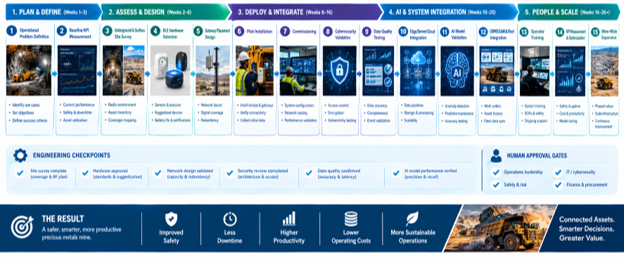
This roadmap illustrates a 15-stage implementation lifecycle for AI and BLE in precious metals mining, from operational problem definition and KPI baselining through site surveys, hardware selection, pilot deployment, cybersecurity validation, AI integration, training, optimization, and mine-wide expansion. Engineering checkpoints and human approval gates highlight the validation required before progressing between deployment stages.
Practical Engineering Recommendations for Precious Metals Mining
Several implementation principles can reduce technical and operational risk.
- Define the mining decision before selecting BLE hardware.
- Establish measurable baseline KPIs before introducing AI analytics.
- Treat BLE location data as one operational data source rather than assuming it represents complete equipment state.
- Validate radio performance in active underground and surface conditions.
- Use edge buffering where intermittent connectivity could cause unacceptable data loss.
- Maintain authoritative mappings between BLE device IDs and mining asset IDs.
- Integrate asset data with CMMS, EAM, fleet-management, historian, SCADA, and other relevant systems rather than creating isolated datasets.
- Separate AI recommendations from safety-critical control functions.
- Establish cybersecurity controls across BLE devices, gateways, networks, servers, APIs, and cloud services.
- Monitor battery condition and device health as part of routine maintenance.
- Revalidate AI models when equipment, operating conditions, mine geometry, or maintenance practices materially change.
- Expand only after pilot results demonstrate reliable technical performance and meaningful operational value.
GAO can support these deployments with BLE gateways, beacons, sensors, RFID products, and related IoT hardware and systems. GAO also provides remote and onsite technical support and maintains stringent quality-assurance processes for its products and systems.
Key Takeaways for AI and BLE in Precious Metals Mining
AI-enabled asset tracking, predictive maintenance, equipment-utilization analysis, maintenance logistics, and operational monitoring can provide practical value to precious metals mining when supported by reliable field data.
BLE contributes low-power wireless identification, proximity, and sensing capabilities that can connect selected underground and surface assets to higher-level mining software. Its effectiveness depends on correct gateway placement, radio engineering, device selection, data quality, cybersecurity, and integration with existing mining systems.
The most appropriate deployment may use cloud computing, private servers, edge processing, or a combination of these approaches. The choice should reflect connectivity, latency, data governance, cybersecurity, operational continuity, and existing IT and OT requirements.
GAO has invested heavily in research and development of BLE, RFID, and IoT technologies and has supplied hardware products and systems to organizations across the United States and Canada. For precious metals mining applications, this experience can support engineering teams evaluating connected asset tracking, wireless sensing, and AI-enabled operational data collection.
Building the Future of Industrial AI and IoT with Aperture Venture Studio and GAO RFID Inc.
For more than three decades, GAO Group of Companies has invested heavily in research and development of industrial BLE, RFID, and IoT technologies. As generative AI became increasingly useful for industrial applications, we expanded our work in AI-enabled IoT solutions, including technologies that combine BLE and RFID with industrial data systems. We have also established Aperture Venture Studio to advance AI and IoT initiatives relevant to connected industrial operations such as precious metals mining, asset tracking, wireless sensing, and intelligent maintenance.
Aperture has attracted AI and IoT technical experts, entrepreneurial and operational executives, investors, and leading companies. We have also developed the Aperture Ventures Summit and TekSummit to facilitate discussions on advanced AI and IoT topics.
These activities have helped build technical communities and collaborative networks around industrial AI and IoT. We welcome qualified participants to join us as:
- Advisors, co-founders, or employees
- Investors
- Customers