
AI-Driven Prepared Food Manufacturing with BLE
AI-Driven Prepared Food Manufacturing with BLE
Prepared food manufacturing depends on tightly controlled production, ingredient handling, temperature management, sanitation, packaging, cold storage, and order fulfillment. AI can turn operational data from BLE beacons, BLE sensors, gateways, production equipment, and connected workflows into actionable information for these processes. BLE provides practical data acquisition for monitoring mobile assets, refrigerated areas, work-in-process materials, containers, tools, and environmental conditions, while AI analyzes the resulting data to identify abnormal conditions, predict operational risks, and support faster decisions.
AI-driven prepared food manufacturing can apply machine learning, edge AI, anomaly detection, forecasting, optimization, and rules-based automation to production and logistics data. BLE sensors can provide temperature, humidity, location, movement, and equipment-condition information, while BLE gateways collect and forward data to manufacturing software. The resulting system can connect production-floor activity with MES, ERP, WMS, quality management, maintenance, and cold-chain workflows.
AI and BLE Operations Overview for Prepared Food Manufacturing
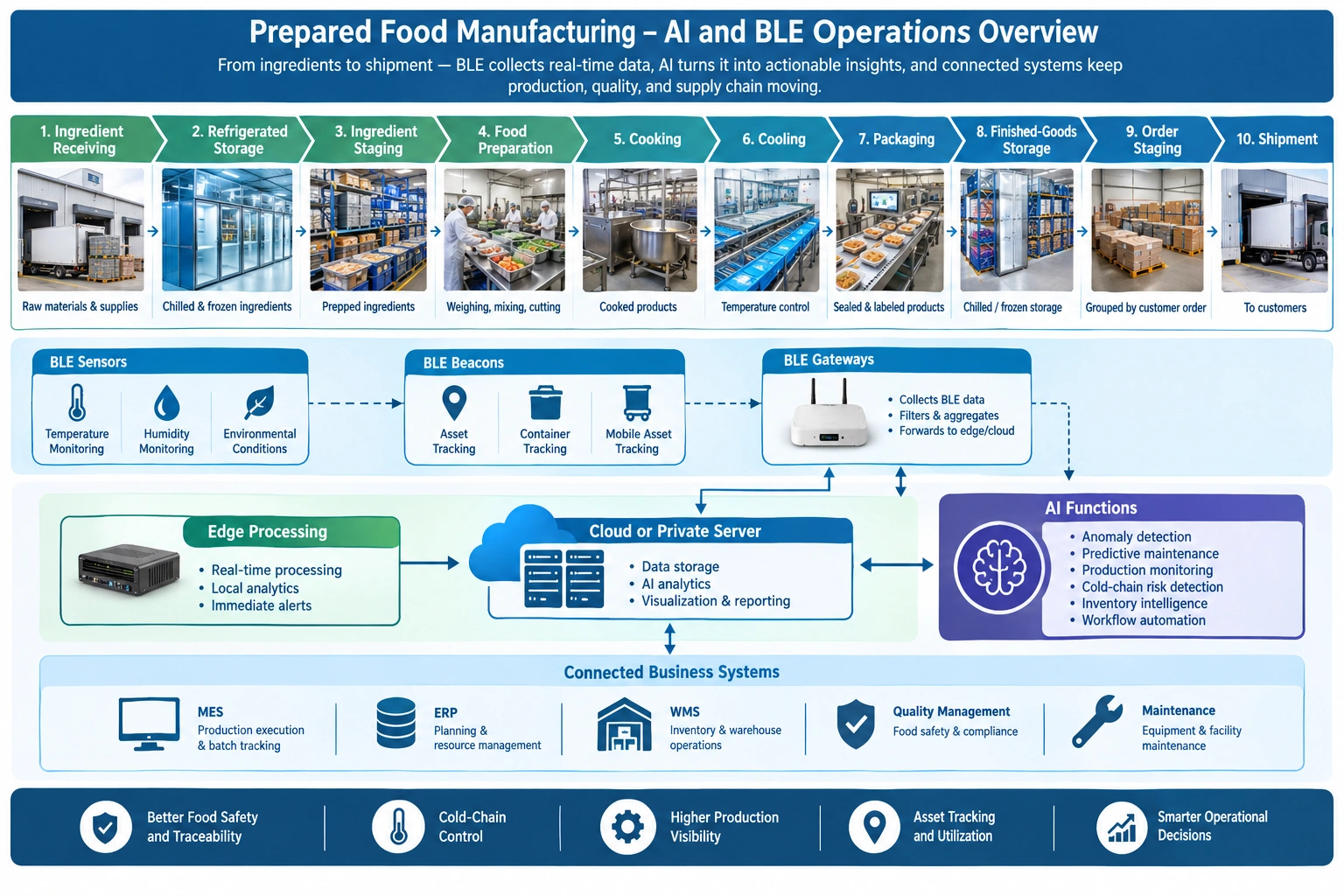
This diagram shows how BLE sensors, beacons, and gateways collect real-time manufacturing data across prepared food production. AI analyzes the data for cold-chain risk, production monitoring, predictive maintenance, inventory intelligence, and workflow automation, while connecting with MES, ERP, WMS, quality, and maintenance systems.
How AI and BLE Improve Prepared Food Manufacturing
AI and BLE address a recurring challenge in prepared food manufacturing: production decisions often depend on conditions that change continuously across rooms, lines, storage areas, and material-handling routes. A temperature excursion, delayed ingredient movement, misplaced container, abnormal equipment condition, or extended dwell time can affect food quality, production schedules, labor utilization, and order fulfillment.
BLE provides a relatively low-power wireless method for collecting data from sensors and identifying tagged assets. AI adds analytical capabilities that can interpret those observations against production schedules, process conditions, historical behavior, quality requirements, and operational rules. The combination therefore supports more than simple location tracking.
Production and Process Visibility
Prepared food plants commonly move ingredients, work-in-process containers, racks, carts, trays, utensils, packaging materials, and finished products between defined process areas. BLE location data can help establish where mobile resources are located and how long they remain in particular zones.
AI can analyze these movements to identify unusual dwell times, recurring production bottlenecks, congestion, and deviations from expected process sequences. For example, extended movement time between cooking and cooling can be treated as an operational exception when it exceeds a configured process threshold.
GAO can support these applications by supplying BLE hardware and IoT systems that collect operational data for integration with production and facility workflows.
Cold-Chain and Temperature Risk Detection
Temperature control is particularly important for prepared foods because refrigerated ingredients, cooked products, chilled work-in-process, and finished foods may require controlled handling during multiple stages.
BLE temperature sensors can collect readings from refrigerators, freezers, cold rooms, refrigerated staging areas, transport containers, and other temperature-sensitive locations. Gateways transmit measurements to software where AI models and rule-based analytics can evaluate temperature trends.
AI can distinguish a short-lived fluctuation from a developing temperature problem by considering historical patterns, duration, rate of change, equipment behavior, and operating conditions. This can support earlier intervention before a condition becomes a larger quality or food-safety event.
Asset and Container Tracking
Reusable containers, ingredient bins, carts, racks, trays, and other mobile assets can become difficult to locate in a busy prepared food facility. Manual searches consume labor and can interrupt production.
BLE beacons can associate digital identities with these assets, while gateways installed in production rooms, storage areas, corridors, docks, and other zones provide location observations. AI analytics can use historical movement patterns to identify misplaced assets, abnormal dwell time, or repeated circulation problems.
The resulting information can help operations teams improve asset availability without requiring every movement to be recorded manually.
Predictive Maintenance for Food Production Equipment
Prepared food manufacturing relies on equipment such as mixers, slicers, conveyors, pumps, ovens, chillers, refrigeration equipment, packaging machines, filling systems, labeling equipment, and inspection systems. Unexpected downtime can disrupt production sequences and increase waste.
BLE-enabled sensing can supplement equipment data by collecting relevant environmental or condition information around machinery. Where appropriate sensor data is available, AI models can identify deviations from normal operating behavior and provide maintenance teams with earlier indications of developing problems.
The strongest implementations combine BLE observations with existing PLC, SCADA, CMMS, and equipment telemetry rather than attempting to replace established industrial control systems.
Prepared Food Manufacturing Operational Challenges and AI Solution Matrix
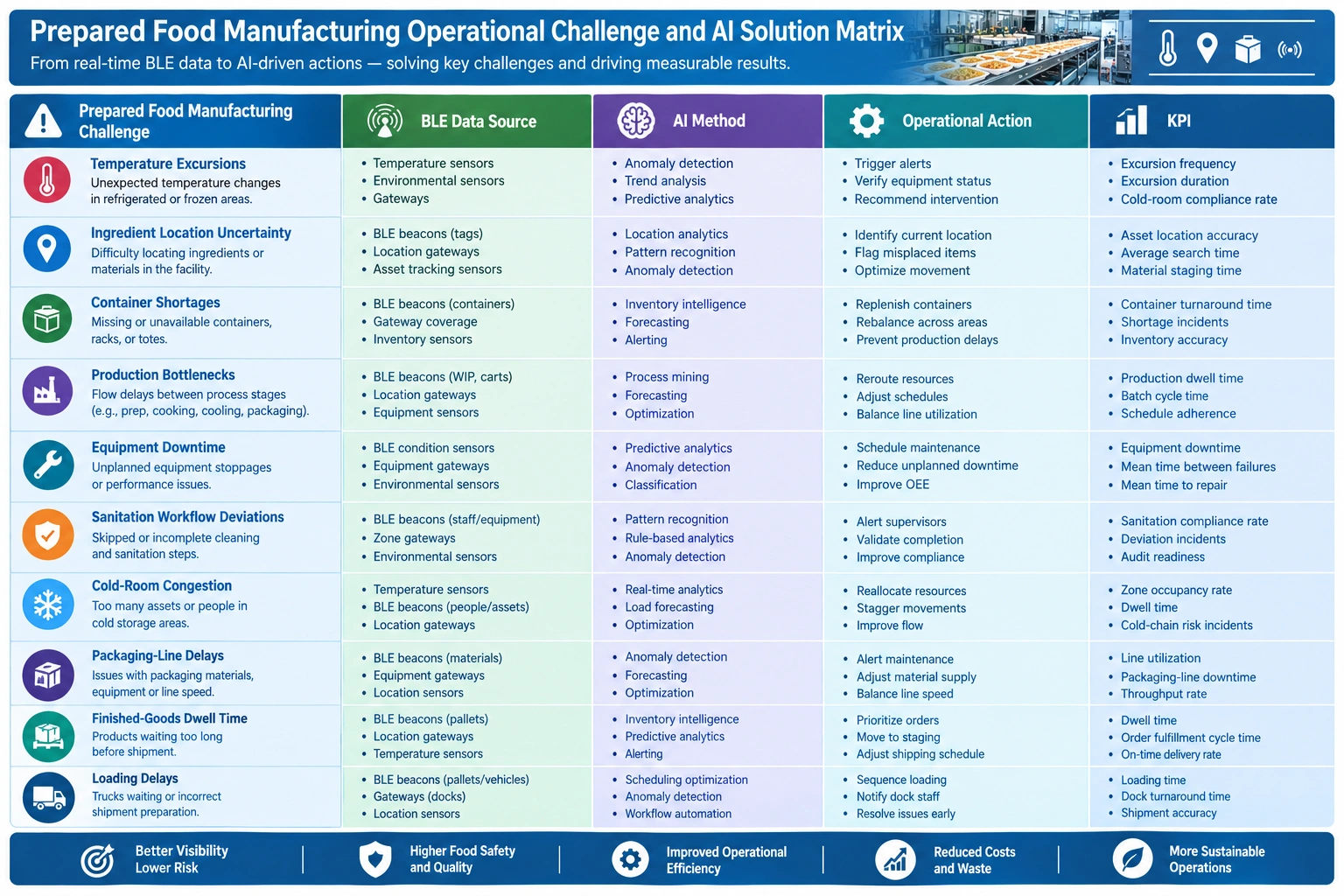
This matrix maps prepared food manufacturing challenges to BLE data sources, AI methods, operational actions, and measurable KPIs. It highlights applications including temperature monitoring, bottleneck detection, predictive maintenance, sanitation workflow control, and loading optimization.
Prepared Food Manufacturing Workflows Supported by AI
AI and BLE can be applied across multiple connected workflows rather than as an isolated tracking project. The most useful deployments begin with a defined operational problem and identify the data required to make a better decision.
Receiving and Ingredient Staging
Receiving operations may involve refrigerated ingredients, frozen materials, packaging supplies, and other inputs requiring controlled storage. BLE sensors can monitor temperature-sensitive receiving conditions, while beacons can identify containers and mobile handling equipment.
AI can correlate arrival information, storage conditions, location observations, and production requirements. This can help identify delayed staging, unusual dwell times, and potential cold-chain exceptions.
Preparation and Batch Movement
Prepared food production often includes weighing, mixing, cutting, portioning, cooking, cooling, and intermediate staging. Containers and batches may move between several process zones.
BLE observations can provide additional visibility into these movements. AI can compare actual movement sequences with expected production workflows and highlight unusual process behavior.
This information can complement MES records rather than replacing production-control systems.
Cooking, Cooling, and Chilled Storage
Cooking and cooling represent critical process transitions. Temperature, elapsed time, equipment state, and material movement can all influence downstream quality.
BLE temperature sensing can provide supplementary environmental information, while AI can analyze trends and detect deviations. A solution can generate alerts when a monitored condition crosses a threshold or when a developing trend indicates increased risk.
Packaging and Finished-Goods Handling
Packaging operations depend on coordinated material supply, equipment availability, labor, and finished-product movement. BLE tracking can provide visibility into carts, racks, packaging materials, and finished-goods staging.
AI can analyze queue lengths, dwell times, movement patterns, and production schedules to identify constraints that may affect shipment readiness.
Cold Storage and Order Staging
Finished prepared foods may pass through refrigerated or frozen storage before shipment. Location and environmental visibility can help operations personnel determine where products and handling assets are located.
AI can use dwell-time and temperature information to identify exceptions and prioritize operational responses. Integration with WMS and order-management processes can further connect physical conditions with shipment priorities.
AI-Enabled Prepared Food Manufacturing: Technical Capabilities and Business Value
AI becomes most valuable in prepared food manufacturing when operational data is converted into decisions that improve food handling, production continuity, asset utilization, and order fulfillment. BLE provides supporting data from temperature-sensitive environments, mobile assets, containers, and selected equipment conditions. AI then adds interpretation through anomaly detection, forecasting, classification, optimization, and predictive analytics.
The resulting solution can help production, quality, maintenance, warehouse, and operations teams respond to changing conditions with better operational context rather than relying exclusively on manual inspections and periodic data collection.
Key AI Capabilities for Prepared Food Manufacturing
Anomaly Detection for Production and Cold-Chain Conditions
Anomaly detection can identify operating conditions that differ from expected patterns. Prepared food manufacturers can apply this approach to temperature trends, asset movement, equipment conditions, production dwell times, and cold-storage activity.
A simple threshold can identify a temperature above a defined limit, while an AI model can evaluate the rate of temperature change, duration, historical behavior, room conditions, and other available data. This distinction can reduce unnecessary alerts while helping personnel identify developing problems.
Predictive Analytics for Equipment and Operations
Predictive analytics can use historical and current data to estimate future operating conditions. For prepared food production, applications may include equipment condition monitoring, refrigeration performance, production delays, material requirements, and finished-goods movement.
BLE data can supplement existing PLC, SCADA, CMMS, and equipment telemetry. Combining these data sources can give maintenance and operations teams more context when determining whether an observed condition requires inspection or intervention.
AI-Based Production Optimization
Production schedules can be affected by equipment availability, ingredient readiness, sanitation activities, labor constraints, cooling capacity, packaging capacity, and order priorities.
AI can analyze these variables to identify potential bottlenecks and support scheduling decisions. BLE location information can add visibility into the physical movement of carts, containers, racks, and other resources that influence production flow.
Intelligent Inventory and Material Visibility
Prepared food manufacturing requires coordinated movement of ingredients, packaging materials, work-in-process items, and finished goods.
BLE identification and location data can supplement inventory records by providing information about the physical position and movement of selected assets. AI can analyze historical movement and consumption patterns to identify unusual material behavior, potential shortages, or staging delays.
Automated Operational Alerts
AI-generated events can be connected to operational workflows. Examples include temperature alerts, prolonged asset dwell time, unexpected movement, equipment-condition anomalies, and production-area exceptions.
Alert design should account for escalation levels and operational ownership. A temperature exception affecting a refrigerated finished-product area may require a different response from a low-priority asset-location anomaly.
Engineering Considerations for BLE Deployment in Food Manufacturing
Prepared food manufacturing facilities create specific engineering requirements for wireless sensing. Stainless-steel surfaces, refrigeration rooms, insulated panels, production machinery, washdown operations, and dense equipment layouts can affect radio propagation and device placement.
Sensor Selection and Environmental Protection
BLE sensors should be selected according to their intended location and operating conditions. Temperature range, humidity exposure, cleaning chemicals, washdown requirements, enclosure protection, mounting method, battery life, and maintenance access should be evaluated before deployment.
Sensors installed in refrigerated or frozen areas may require batteries and electronics rated for the expected environmental conditions. Devices used near food-processing areas should also be evaluated against applicable facility hygiene and equipment requirements.
Gateway Placement
Gateway locations should provide sufficient BLE coverage while maintaining reliable network connectivity. A gateway should not simply be positioned according to room dimensions because metal equipment, refrigeration structures, racks, walls, and machinery can affect signal behavior.
A site survey followed by a representative pilot can establish practical coverage and identify locations requiring additional gateways.
Asset Identity and Data Quality
Every monitored asset should have a consistent digital identity. The system should associate the BLE beacon or sensor identifier with information such as asset type, production area, ownership, status, and maintenance records where applicable.
Time synchronization and data validation are equally important. AI analytics depend on accurate timestamps and reliable associations between sensor observations and physical assets or zones.
Battery and Device Maintenance
Battery-powered BLE devices require a maintenance strategy. Battery replacement intervals should be estimated from transmission frequency, sensor configuration, temperature conditions, and device characteristics.
A device-health process should identify low-battery conditions before sensors stop reporting. Maintenance teams can then schedule replacement during planned sanitation or maintenance windows rather than discovering failed devices during production.
Security and Integration for AI and BLE Systems
Security should cover the complete data path from BLE devices through gateways, networks, software, and connected manufacturing systems.
Recommended controls include:
- Device identity management and controlled provisioning
- Authentication between gateways and backend systems
- Encryption for protected data communications
- Network segmentation between IoT infrastructure and critical control networks
- Role-based access for operations, maintenance, quality, and IT personnel
- Secure gateway configuration and software maintenance
- Logging of device and user activity
- Monitoring for abnormal network or device behavior
- Controlled API access to MES, ERP, WMS, CMMS, QMS, and other systems
- Defined procedures for device replacement and credential revocation
BLE monitoring systems should generally complement rather than directly interfere with safety-critical industrial control functions. Integration boundaries should be clearly defined during system design.
GAO can provide BLE and IoT hardware systems that serve as the data-collection layer for prepared food manufacturing applications, allowing system integrators and customers to incorporate wireless monitoring into broader production and facility systems.
Integrating AI and BLE with Manufacturing Software
A successful implementation requires more than collecting sensor measurements. Data must be connected to the operational systems that already manage production and logistics.
MES Integration
MES can provide production orders, process information, batch context, and manufacturing status. BLE observations can add physical location and environmental information to this production context.
For example, a batch-related container can be associated with a production process and its movement between preparation, cooking, cooling, and packaging areas can be analyzed against the expected workflow.
WMS and Inventory Integration
WMS manages warehouse and storage activities, while BLE can provide additional physical visibility for selected containers, racks, carts, and temperature-sensitive assets.
AI can use these observations to identify storage dwell-time anomalies and potential staging constraints.
CMMS and Maintenance Integration
When AI detects a potential equipment anomaly, the result can be routed to a CMMS for inspection or maintenance planning. The maintenance record can then become part of the historical dataset used for future analysis.
This creates a feedback loop between equipment observations, maintenance actions, and subsequent equipment behavior.
QMS Integration
Quality teams can benefit from traceable environmental and process information. BLE temperature observations and location events can provide supporting evidence for investigating excursions, handling deviations, or process anomalies.
The precise data retained should be determined by the manufacturer’s quality procedures and applicable regulatory requirements.
Cloud and Private Server Deployment Decisions
The choice between cloud-hosted and privately hosted software should be based on operational requirements rather than a universal preference.
A Cloud Version can be appropriate when prepared food manufacturers need centralized visibility across multiple facilities, remote analytics, centralized software management, and consolidated operational reporting.
A Server Version can be appropriate when a facility requires privately controlled infrastructure, local processing, specific data-governance arrangements, or continued operation within controlled plant networks.
A hybrid implementation can place time-sensitive processing close to the production environment while using centralized infrastructure for historical analytics, reporting, and cross-facility analysis.
The engineering decision should consider network availability, latency requirements, cybersecurity policies, data retention, integration interfaces, IT ownership, maintenance responsibilities, and the required availability of local functions.
KPIs for Measuring AI-Enabled Prepared Food Manufacturing
The success of an AI and BLE implementation should be evaluated using measurable operational outcomes rather than device counts alone.
Relevant KPIs can include:
- Temperature excursion frequency
- Temperature excursion duration
- Cold-room compliance rate
- Asset location accuracy
- Average asset search time
- Container turnaround time
- Production dwell time
- Batch movement cycle time
- Equipment downtime
- Mean time between failures
- Mean time to repair
- Refrigeration equipment exception rate
- Production schedule adherence
- Packaging-line utilization
- Finished-goods dwell time
- Inventory accuracy
- Material staging time
- Order fulfillment cycle time
- Alert response time
- False-alert rate
- BLE device availability
- Gateway availability
- Sensor battery life
- Data completeness
- AI prediction accuracy
KPIs should be established before deployment so that baseline performance can be compared with results after commissioning.
Implementation Recommendations for Prepared Food Manufacturers
A phased implementation generally reduces technical and operational risk.
- Begin with one clearly defined problem such as cold-chain monitoring, mobile-container visibility, or equipment-condition monitoring.
- Map the physical workflow before selecting sensor and gateway locations.
- Identify which production, quality, warehouse, and maintenance decisions the collected data will support.
- Establish asset and location naming conventions before large-scale deployment.
- Conduct a BLE radio survey in representative production, refrigeration, storage, and loading areas.
- Pilot the selected sensors and gateways under actual operating and cleaning conditions.
- Validate data accuracy and timestamp consistency before training AI models.
- Integrate with existing MES, WMS, CMMS, QMS, or ERP systems where the integration provides operational value.
- Establish cybersecurity controls before connecting the system to production networks.
- Define alert ownership, escalation rules, and response procedures.
- Measure baseline KPIs before introducing AI-driven recommendations.
- Start with explainable AI and clear operational rules for safety- or quality-sensitive workflows.
- Expand deployment after the initial use case demonstrates reliable data quality and measurable operational improvement.
Scaling AI and BLE Across Prepared Food Manufacturing Facilities
Once a pilot has demonstrated reliable performance, manufacturers can extend the solution to additional production rooms, cold-storage areas, packaging lines, warehouses, and distribution activities.
Scaling should preserve consistent device naming, asset identifiers, location models, data schemas, cybersecurity controls, and integration methods. Multi-site deployments benefit from standardized engineering practices while still allowing individual facilities to account for differences in production equipment, building construction, network topology, refrigeration requirements, and operating procedures.
GAO’s experience supplying BLE, RFID, and IoT hardware products and systems can support organizations that need to expand wireless sensing from a focused production use case into broader prepared food manufacturing operations.
Key Takeaways for AI-Driven Prepared Food Manufacturing
AI and BLE can provide prepared food manufacturers with additional operational visibility across production, cold-chain handling, asset movement, equipment monitoring, and finished-goods logistics. BLE sensors and beacons supply field-level observations, while gateways, software, AI analytics, and manufacturing-system integrations turn those observations into operational information.
The strongest deployments focus on measurable problems, reliable data acquisition, appropriate integration boundaries, cybersecurity, and clear operational ownership. Manufacturers should validate the physical environment, establish baseline KPIs, pilot the solution, and expand only after data quality and business value have been demonstrated.
GAO provides BLE, RFID, and IoT hardware products and systems that can support these types of industrial monitoring and tracking requirements. Organizations evaluating AI-driven prepared food manufacturing applications can use these capabilities as part of a broader engineering program focused on traceability, process visibility, cold-chain control, maintenance, and operational efficiency.
Building the Future of Industrial AI and IoT with Aperture Venture Studio and GAO RFID Inc.
For more than three decades, GAO Group of Companies has invested heavily in R&D for industrial BLE, RFID, and IoT. As AI has become increasingly useful for industrial applications, we have continued developing AI and IoT technologies that can address practical manufacturing requirements, including prepared food production, cold-chain monitoring, asset tracking, and operational intelligence. We have also founded Aperture Venture Studio to support the development and scaling of AI and IoT solutions relevant to industries such as food production and processing.
Aperture has attracted AI and IoT technical experts, entrepreneurial and operational executives, influential investors, and leading companies. We have also developed Aperture Ventures Summit and TekSummit to discuss advanced topics in AI and IoT.
As a result, we have built diversified technical communities around AI and IoT.
We welcome you to join us as:
- Advisors, Co-founders, or Employees
- Investors
- Customers