
AI and BLE for Public Safety Organizations
AI-Powered Operational Intelligence for Public Safety Organizations
Public Safety Organizations increasingly rely on real-time situational awareness, personnel accountability, incident command coordination, emergency response optimization, and resource visibility to protect communities and respond effectively to critical incidents. AI-powered operational intelligence supported by BLE-enabled location awareness is transforming how law enforcement agencies, fire departments, emergency medical services (EMS), emergency management agencies, public safety communications centers, and disaster response organizations operate.
AI solutions analyze data collected from responders, emergency vehicles, protective equipment, communications systems, command centers, and field operations to provide actionable intelligence. BLE beacons, BLE gateways, and BLE sensors serve as important data acquisition technologies that help monitor personnel movement, equipment availability, asset utilization, facility occupancy, and emergency response activities.
For Public Safety Organizations, AI-driven decision support improves response coordination, resource deployment, responder safety, incident management, emergency preparedness, and operational efficiency. The combination of AI, IoT, edge analytics, and connected public safety assets enables faster decisions, improved accountability, and enhanced mission readiness across complex emergency environments.
GAO has supported organizations by supplying BLE-enabled hardware systems and IoT solutions that improve asset visibility, operational awareness, and personnel accountability across mission-critical environments.
Understanding AI-Driven Public Safety Operations
Public Safety Organizations operate in highly dynamic environments where information must be collected, analyzed, and acted upon within seconds. Emergency incidents often involve multiple agencies, numerous responders, rapidly changing conditions, and significant risks to both personnel and civilians.
Artificial Intelligence enhances public safety operations by identifying patterns, detecting anomalies, forecasting risks, and providing decision support during routine operations and emergency incidents.
AI technologies commonly used in Public Safety Organizations include:
- Machine learning
- Predictive analytics
- Edge AI
- Computer vision
- Natural language processing
- Geographic intelligence analytics
- Resource optimization algorithms
- Incident forecasting models
- Behavioral pattern analysis
- Real-time situational intelligence systems
BLE technology supports these AI capabilities by providing reliable proximity awareness, indoor positioning, personnel visibility, equipment tracking, and facility monitoring.
Key objectives include:
- Improving emergency response times
- Enhancing responder accountability
- Increasing incident command visibility
- Improving personnel safety
- Optimizing resource allocation
- Strengthening emergency preparedness
- Improving interagency coordination
- Enhancing facility security
- Supporting disaster response operations
- Improving operational readiness
Public safety agencies increasingly use AIoT solutions to transform operational data into actionable intelligence that supports faster and more informed decisions.
Public Safety AI & BLE Operational Ecosystem
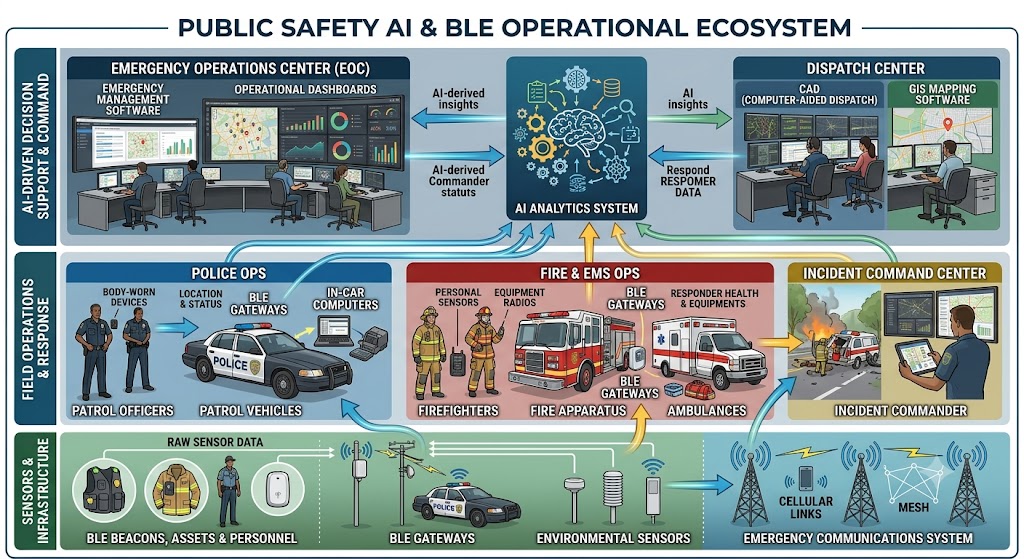
A comprehensive professional operations overview diagram in an enterprise-grade infographic style, illustrating the logical data flow from diverse public safety field assets (personnel, vehicles, sensors) via Bluetooth Low Energy (BLE) infrastructure into a central AI analytics system and its derived decision support for command centers and incident management.
Core Public Safety Applications Enabled by AI and BLE
Personnel Accountability and Responder Safety
Personnel accountability remains a critical requirement during emergency operations.
AI systems can analyze:
- Responder location information
- Team movement patterns
- Muster status
- Entry and exit activities
- Personnel deployment records
- Safety compliance data
This visibility improves responder protection during active incidents and disaster response operations.
Emergency Incident Command Intelligence
Incident commanders require accurate information regarding personnel, equipment, operational zones, hazards, and resource availability.
AI systems support:
- Incident prioritization
- Resource recommendations
- Operational risk assessments
- Personnel allocation decisions
- Multi-agency coordination
- Situation awareness improvements
Emergency Vehicle Fleet Management
Public Safety Organizations operate diverse vehicle fleets including:
- Patrol vehicles
- Fire engines
- Ladder trucks
- Rescue units
- Ambulances
- Mobile command vehicles
- Hazardous materials response vehicles
- Search and rescue vehicles
AI analytics help optimize vehicle utilization, maintenance scheduling, dispatch readiness, and deployment planning.
Critical Equipment Tracking
Emergency operations depend on the availability of mission-critical assets.
Common assets include:
- Self-contained breathing apparatus
- Portable radios
- Thermal imaging cameras
- Medical kits
- Automated external defibrillators
- Hazmat equipment
- Rescue tools
- Protective gear
- Mobile communications equipment
AI-enabled tracking systems improve asset visibility and reduce equipment loss.
Emergency Preparedness and Disaster Response
Emergency management agencies continuously evaluate preparedness levels.
AI supports:
- Resource forecasting
- Disaster readiness assessments
- Supply availability monitoring
- Emergency planning
- Evacuation preparation
- Incident trend analysis
These capabilities improve readiness before major emergencies occur.
Integrated Public Safety AI Use Case Matrix
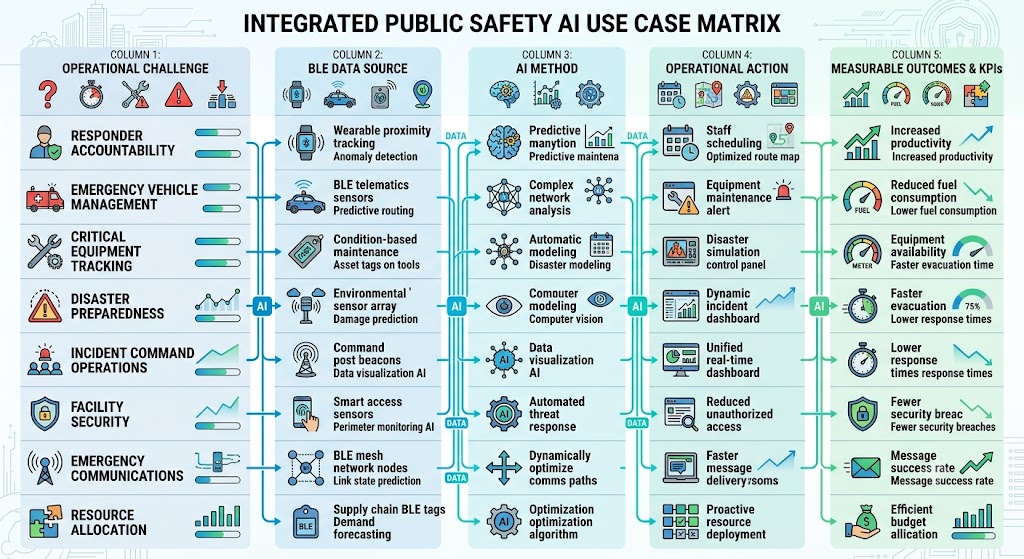
An enterprise-grade solution matrix mapping eight critical public safety functions to BLE data sources, AI analytical methods, operational actions, and key performance outcomes.
Operational Challenges Across Public Safety Organizations
Public Safety Organizations face unique operational challenges that directly affect emergency response effectiveness and personnel safety.
Common challenges include:
- Limited real-time visibility of personnel
- Incident command coordination complexity
- Equipment accountability gaps
- Resource deployment inefficiencies
- Multi-agency communication challenges
- Emergency vehicle readiness issues
- Facility access management concerns
- Training compliance tracking difficulties
- Disaster preparedness limitations
- Asset availability uncertainty
- Emergency response delays
- Personnel safety monitoring requirements
These challenges become increasingly significant during:
- Active emergency incidents
- Wildfire responses
- Hazardous materials events
- Search and rescue missions
- Mass casualty incidents
- Severe weather emergencies
- Urban disaster operations
- Large public events
- Infrastructure emergencies
- Homeland security incidents
AI-powered operational intelligence helps agencies identify risks earlier, improve resource allocation, and support more effective incident management.
GAO has helped organizations improve operational visibility by supplying BLE-enabled asset tracking systems, personnel monitoring solutions, and connected infrastructure technologies.
Public Safety Operational Workflow from Data Collection to AI Decision Support
Effective AI deployment in Public Safety Organizations requires a structured operational workflow that converts field data into actionable intelligence.
Data Acquisition Layer
Public safety operations generate data from multiple sources:
- Personnel tracking devices
- BLE-enabled responder identification devices
- Emergency vehicles
- Body-worn technologies
- Fixed facility sensors
- Access control systems
- Communications systems
- Dispatch systems
- GIS systems
- Emergency management software
- Surveillance systems
- Environmental monitoring sensors
These data sources provide continuous operational awareness across facilities and field environments.
Communications and Edge Processing
BLE gateways positioned throughout:
- Public safety headquarters
- Fire stations
- Police facilities
- Emergency operations centers
- Training facilities
- Equipment storage facilities
- Emergency shelters
collect operational data and transfer information to processing systems.
Edge computing systems may perform:
- Data filtering
- Event detection
- Occupancy monitoring
- Personnel accountability verification
- Local anomaly detection
- Communications management
This approach supports rapid operational awareness even when network connectivity is constrained.
Data Integration and Operational Intelligence
Collected information is integrated with:
- Computer-aided dispatch systems
- Records management systems
- Emergency management software
- Workforce management systems
- Asset management systems
- GIS applications
- Public safety communications systems
- Incident management software
Unified operational datasets enable advanced analytics and AI-driven decision support.
Technology Components Supporting AI-Powered Public Safety Operations
Successful deployment of AI-powered public safety solutions requires coordinated integration of connected devices, communications infrastructure, operational software, analytics systems, cybersecurity controls, and command center technologies. Public Safety Organizations often operate across fixed facilities, mobile response units, emergency operations centers, dispatch centers, and disaster response environments, making interoperability and reliability critical design considerations.
BLE Hardware Infrastructure for Public Safety Operations
BLE technology supports visibility and accountability across personnel, assets, vehicles, and facilities.
Common hardware components include:
- BLE beacons attached to emergency equipment
- BLE-enabled responder identification devices
- BLE sensors monitoring environmental conditions
- BLE gateways installed in stations, command centers, and emergency facilities
- Mobile gateway devices deployed in emergency vehicles
- Portable responder tracking devices
- Asset tracking tags for mission-critical equipment
- Facility occupancy monitoring devices
These components provide location awareness and operational visibility that support emergency response activities.
AI Software and Analytics Systems
AI software converts operational data into actionable intelligence.
Common AI capabilities include:
- Incident prediction models
- Resource optimization algorithms
- Personnel accountability analytics
- Emergency response forecasting
- Equipment utilization analysis
- Vehicle readiness assessment
- Workforce deployment optimization
- Risk assessment models
- Situational awareness analytics
- Emergency preparedness evaluation
Machine learning models continuously improve using historical incident data, dispatch records, operational metrics, and response outcomes.
Public Safety Software Integration
AI systems commonly integrate with:
- Computer-Aided Dispatch (CAD) systems
- Records Management Systems (RMS)
- Emergency Management Information Systems
- Public Safety Answering Point (PSAP) software
- Geographic Information Systems (GIS)
- Asset Management Systems
- Workforce Management Software
- Facility Management Systems
- Incident Command Software
- Emergency Notification Systems
Integration improves information sharing and operational coordination across agencies.
Communications Infrastructure
Reliable communications are essential during emergency operations.
Common communications technologies include:
- BLE communications
- Wi-Fi networks
- Public safety LTE networks
- First responder broadband networks
- Cellular communications
- Satellite communications
- Private radio networks
- Emergency communications systems
Redundant communication pathways help maintain operational continuity during disasters and large-scale emergencies.
Cloud Deployment Model
Cloud-hosted deployments are commonly used when agencies require:
- Multi-site operational visibility
- Centralized reporting
- Regional coordination capabilities
- Rapid deployment
- Scalable analytics processing
- Disaster recovery capabilities
Cloud environments are particularly beneficial for agencies operating across multiple jurisdictions.
Server Deployment Model
Privately hosted server deployments may be preferred when organizations require:
- Greater control over sensitive operational data
- Compliance with government security policies
- Isolated operational environments
- Dedicated processing resources
- Integration with existing agency infrastructure
Many law enforcement agencies, emergency operations centers, and critical infrastructure protection organizations utilize privately managed server environments.
Security and Compliance Considerations
Public Safety Organizations manage highly sensitive operational information.
Recommended security controls include:
- Device authentication
- Encrypted communications
- Role-based access control
- Multi-factor authentication
- Audit logging
- Security monitoring
- Network segmentation
- Incident response procedures
Operational environments should align with applicable government cybersecurity frameworks and public sector security requirements.
Operational Benefits of AI-Powered Public Safety Intelligence
Enhanced Responder Safety
AI-driven situational awareness improves visibility into personnel status, location, and deployment activities.
Benefits include:
- Improved responder accountability
- Faster emergency notifications
- Better personnel monitoring
- Enhanced incident safety management
- Improved evacuation accountability
Faster Emergency Response
AI assists dispatchers and incident commanders by analyzing operational information in real time.
Benefits include:
- Improved dispatch efficiency
- Reduced response times
- Faster resource deployment
- Improved incident prioritization
- Enhanced command decision support
Improved Resource Allocation
Resource optimization models help agencies deploy personnel and equipment more effectively.
Benefits include:
- Better fleet utilization
- Improved staffing allocation
- Reduced equipment shortages
- Improved mutual aid coordination
- Better preparedness planning
Increased Operational Visibility
Command personnel gain comprehensive awareness of operational activities across facilities and field operations.
Benefits include:
- Improved situation awareness
- Better operational coordination
- Enhanced interagency collaboration
- Improved reporting accuracy
- Faster decision-making
Strengthened Asset Accountability
Mission-critical assets remain visible throughout their operational lifecycle.
Benefits include:
- Reduced equipment loss
- Improved inventory visibility
- Faster equipment retrieval
- Improved maintenance planning
- Enhanced operational readiness
Better Disaster Preparedness
AI supports long-term planning and preparedness initiatives.
Benefits include:
- Improved emergency planning
- Better resource forecasting
- Enhanced resilience planning
- Improved risk management
- Stronger continuity of operations planning
GAO has supplied BLE-enabled tracking systems, IoT hardware, and connected monitoring solutions that support public safety asset visibility, operational awareness, and emergency response readiness.
Implementation Considerations for Public Safety Organizations
Public Safety Organizations should begin deployments by evaluating operational requirements, response workflows, infrastructure readiness, cybersecurity requirements, and interoperability objectives.
Recommended implementation practices include:
- Define operational goals and KPIs
- Identify high-value public safety use cases
- Assess communications coverage requirements
- Establish asset identification standards
- Evaluate cybersecurity requirements
- Integrate existing public safety software systems
- Conduct pilot deployments before full implementation
- Validate AI model performance using operational data
- Develop responder training programs
- Establish continuous improvement processes
Operational success depends on combining technology deployment with process improvement, governance policies, and stakeholder engagement.
Public safety agencies should also evaluate:
- Data retention requirements
- Evidence management policies
- Privacy considerations
- Chain-of-custody procedures
- Regulatory compliance obligations
- Interagency information-sharing requirements
Careful planning improves long-term operational effectiveness and system sustainability.
Advancing Public Safety Operations Through AI-Powered Intelligence
AI-powered public safety solutions help organizations improve responder safety, operational visibility, emergency response effectiveness, resource allocation, and disaster preparedness. By combining AI, IoT technologies, connected devices, and advanced analytics, Public Safety Organizations can transform operational data into actionable intelligence that supports mission-critical decision-making.
Successful deployments require strong cybersecurity controls, reliable communications infrastructure, software integration, operational governance, and continuous performance measurement. Agencies that align AI initiatives with operational objectives can achieve meaningful improvements in emergency response operations, personnel accountability, and public safety outcomes.
Organizations seeking to improve public safety operations can learn more about GAO’s BLE-enabled hardware solutions, technical expertise, IoT systems, and implementation support services designed for mission-critical environments.
Building the Future of Industrial AI and IoT with Aperture Venture Studio and GAO RFID Inc.
For more than three decades, GAO Group of Companies has invested heavily in research and development involving BLE, RFID, IoT, and connected monitoring technologies. As AI-powered public safety operations continue to evolve, we have expanded our focus on AI and IoT solutions that support responder safety, operational intelligence, emergency preparedness, and mission-critical decision-making.
We have founded Aperture Venture Studio to help accelerate innovation in AI and IoT technologies that address complex operational challenges across public safety and other critical sectors.
Aperture has attracted leading AI and IoT experts, operational leaders, technology innovators, and investors. Through initiatives such as Aperture Ventures Summit and TekSummit, we continue advancing discussions around emerging AI and IoT technologies.
Headquartered in New York City and Toronto, GAO serves customers throughout the United States and Canada, including Fortune 500 organizations, research institutions, universities, and government agencies. We welcome participation from:
- Advisors and technical experts
- Employees and industry professionals
- Investors
- Customers seeking advanced AI and IoT solutions