
AI and BLE for Real-Time Location Systems
AI-Powered Real-Time Location Systems with BLE
AI-powered Real-Time Location Systems combine continuous location data with artificial intelligence to identify where assets, equipment, personnel, and other tracked objects are located and to determine what that location data means operationally. BLE beacons, BLE sensors, and BLE gateways provide the underlying location and telemetry signals, while AI and machine learning can convert those signals into event detection, utilization analysis, workflow insights, anomaly identification, and predictive decisions.
For warehouses, hospitals, manufacturing facilities, laboratories, construction sites, and other location-sensitive environments, RTLS can provide more than a map showing the current position of an asset. AI can analyze movement patterns, dwell times, zone transitions, utilization rates, congestion, abnormal routes, and recurring operational events. This creates a basis for improving asset availability, reducing search time, identifying process bottlenecks, and supporting safety procedures.
GAO supplies BLE, RFID, and IoT hardware products and systems that can support location-aware applications, including BLE beacons, gateways, sensors, and related infrastructure. The practical value of an AI-enabled RTLS depends on how accurately location data is captured, how reliably it is transmitted, how location events are interpreted, and how effectively the resulting information is connected to operational software.
AI-Powered BLE Real-Time Location System for Industrial Operations
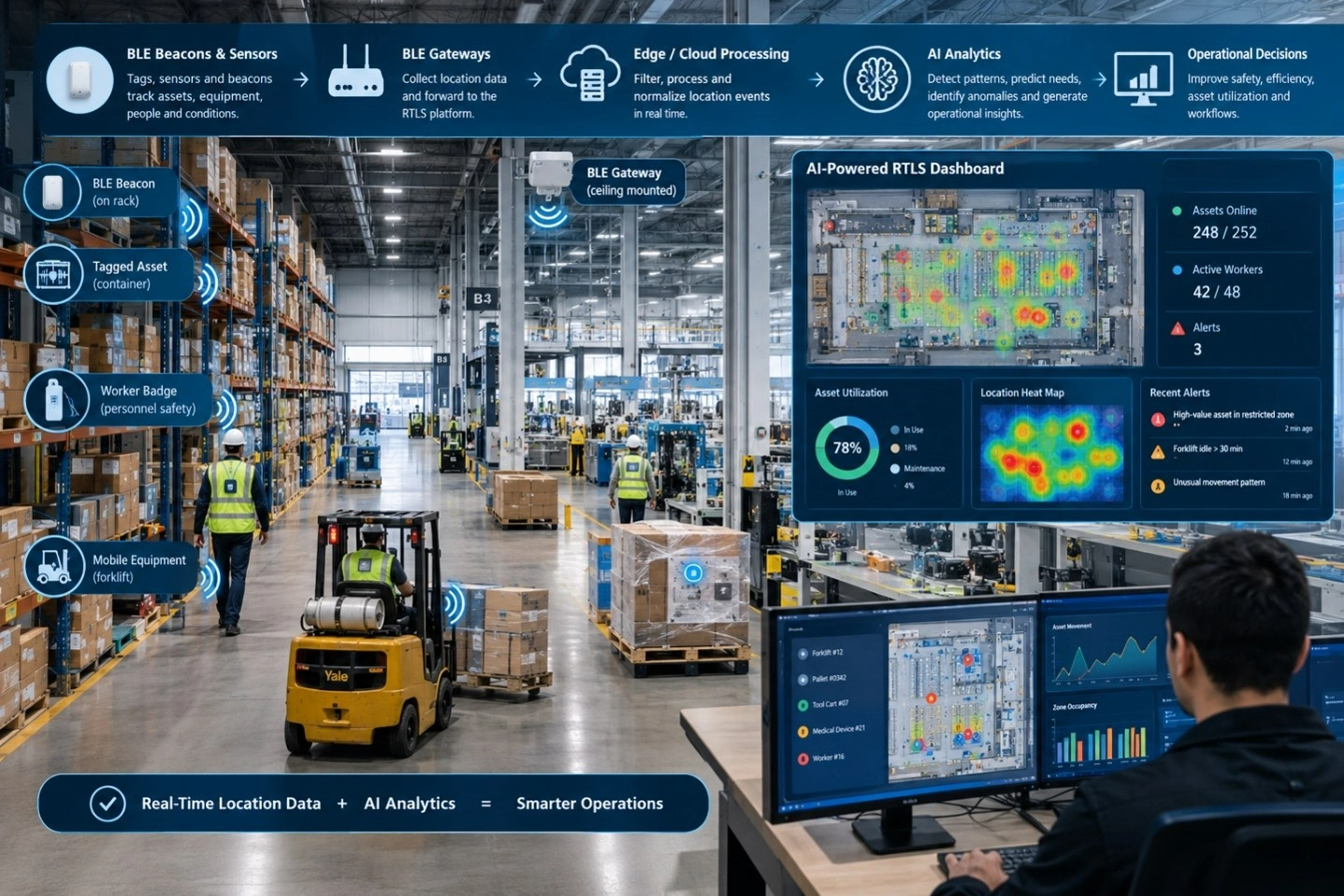
This illustrates an AI-enabled RTLS deployment in a modern industrial warehouse, showing BLE beacons, sensors, gateways, tracked assets, and workers generating real-time location data. An AI-powered dashboard analyzes asset utilization, location patterns, zone activity, and operational alerts to support safer and more efficient operations.
How AI Changes Real-Time Location Systems
Traditional RTLS implementations primarily answer location questions such as where an asset is, when it entered a zone, and how long it remained there. AI extends this capability by analyzing historical and real-time location events to identify patterns and generate operational insights.
A BLE-based RTLS typically begins with radio signals or sensor events generated by tracked objects. BLE gateways receive those signals and forward location-related data to RTLS software. Depending on the implementation, location can be estimated using received signal strength, proximity detection, angle-related techniques, or other positioning methods. The resulting location events can then be associated with facility maps, zones, assets, work orders, production processes, and operational schedules.
AI can operate on this information to detect patterns that are difficult to identify through simple rules.
Examples include:
- Detecting unusual movement patterns for high-value equipment
- Identifying excessive asset dwell time in staging areas
- Predicting potential equipment availability problems from utilization patterns
- Detecting abnormal traffic around restricted or congested zones
- Identifying repeated workflow delays based on location sequences
- Estimating asset utilization from historical movement records
- Detecting unexpected zone transitions
- Prioritizing operational alerts based on historical patterns
- Identifying recurring bottlenecks in material movement
- Supporting predictive maintenance when BLE sensor telemetry is combined with equipment condition data
The important engineering distinction is that AI does not replace the location infrastructure. It depends on the quality, frequency, timestamp accuracy, spatial resolution, and contextual relevance of the underlying RTLS data.
GAO’s BLE hardware can therefore serve as part of the data acquisition layer for RTLS solutions where location information needs to be collected across distributed operational areas.
BLE RTLS Data Flow Diagram: Location Tracking, AI Analytics, and Enterprise Integration
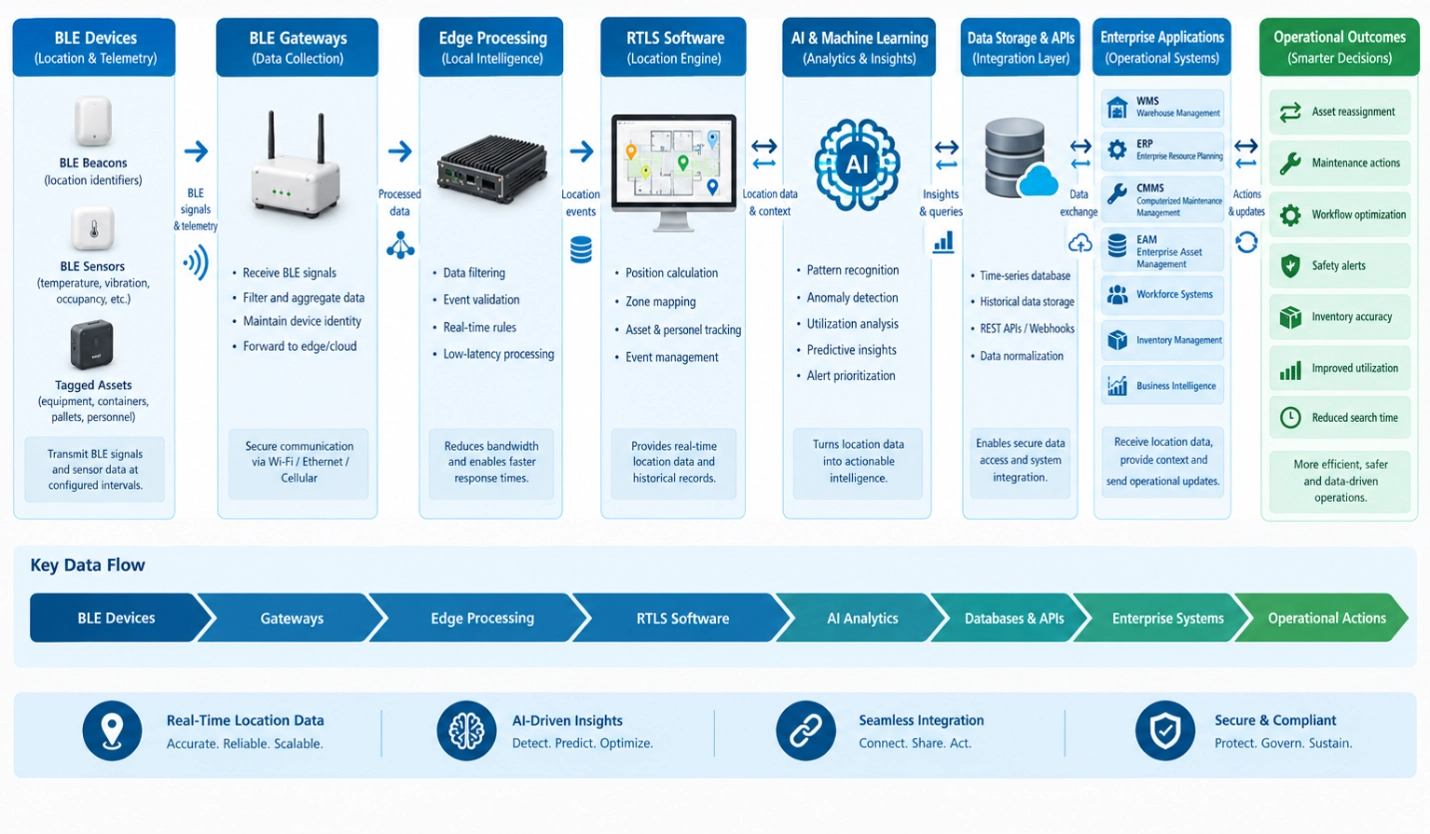
This visual illustrates how BLE beacons and sensors transmit location and telemetry data through gateways into edge processing, RTLS software, AI/ML analytics, databases, APIs, and enterprise applications. It highlights the end-to-end flow from real-time location signals to actionable operational insights.
RTLS Applications Where AI Creates the Most Value
AI-enabled RTLS is particularly useful when location data is closely connected to operational workflows rather than treated as an isolated visualization.
Asset Tracking and Equipment Utilization
Large facilities often contain mobile equipment that moves between storage, production, maintenance, staging, and operational areas. Examples include tools, carts, containers, instruments, material-handling equipment, medical equipment, and specialized machinery.
An RTLS can associate BLE identifiers with these assets and maintain a location history. AI can analyze that history to identify utilization patterns and determine whether equipment is spending excessive time idle, repeatedly being moved between particular zones, or frequently becoming unavailable during periods of high demand.
This can support:
- Asset utilization analysis
- Equipment availability planning
- Search-time reduction
- Asset allocation
- Maintenance scheduling
- Identification of underutilized equipment
- Detection of abnormal movement
The operational objective is not simply to display asset coordinates. The objective is to connect location events with asset-management decisions.
Warehouse and Material Movement
Warehouses depend on predictable movement between receiving, put-away, storage, picking, staging, and shipping areas. Delays can occur when carts, containers, forklifts, pallets, or other material-handling assets remain in the wrong location.
BLE-enabled RTLS can provide movement events while AI analyzes those events against expected workflows.
For example, a system can learn typical movement durations between warehouse zones and identify unusually long dwell periods. This can help operations teams investigate congestion, staging delays, misplaced assets, or inefficient material routes.
AI can also combine RTLS information with warehouse management system data to distinguish normal operational variation from potentially significant exceptions.
Healthcare and Medical Equipment Location
Hospitals and healthcare facilities contain mobile equipment that can move rapidly between patient rooms, treatment areas, storage rooms, diagnostic departments, and sterilization areas. Finding equipment manually can consume staff time and may delay clinical workflows.
BLE-based RTLS can associate tagged equipment with facility zones. AI can analyze equipment movement and utilization to identify frequently requested equipment, recurring shortages, unusual movement patterns, and inefficient distribution.
Potential applications include:
- Medical equipment location
- Equipment utilization monitoring
- Asset availability analysis
- Department-level demand analysis
- Workflow bottleneck detection
- Movement history for operational investigations
Healthcare deployments require careful attention to privacy, access control, network security, device management, and facility-specific operational requirements.
Manufacturing and Production Operations
Manufacturing facilities can use RTLS to monitor the movement of tools, work-in-process materials, containers, mobile equipment, and other production assets.
AI can analyze the sequence and duration of location events across production zones. If a work-in-process asset normally moves through several stations within defined time ranges, deviations can become operational signals.
Potential applications include:
- Work-in-process tracking
- Tool location and utilization
- Production workflow monitoring
- Material movement analysis
- Bottleneck identification
- Zone-level congestion analysis
- Abnormal process detection
The value increases when RTLS events are correlated with manufacturing execution system data, production schedules, maintenance records, or quality information.
The AI-Enabled RTLS Operational Workflow
An effective AI-enabled RTLS follows a connected chain from physical activity to operational decision-making.
Data acquisition: BLE beacons, BLE sensors, and tagged assets generate identifiers, telemetry, or location-related signals.
Communication: BLE gateways receive wireless signals from the monitored area and transmit relevant information to edge or server-based RTLS software.
Location processing: RTLS software converts received signals into location events, proximity states, zone transitions, or estimated positions according to the selected positioning method.
Data normalization: Location events are associated with asset IDs, timestamps, zones, facility maps, equipment records, and other operational context.
Edge processing: Where latency, network availability, or bandwidth requirements justify local processing, edge systems can filter, aggregate, validate, or pre-process incoming events before forwarding them.
Central processing: Cloud-hosted or privately hosted software can maintain historical location data and provide centralized analytics across facilities.
AI analysis: Machine learning and other AI methods can identify anomalies, recurring patterns, utilization trends, workflow deviations, and predictive indicators.
Enterprise integration: APIs or middleware can exchange relevant events with systems such as WMS, ERP, EAM, CMMS, MES, inventory systems, workforce management software, and business intelligence tools.
Operational action: Insights can trigger alerts, work orders, asset reassignment, workflow investigations, inventory actions, maintenance activities, or other business processes.
AI-Powered BLE RTLS End-to-End Workflow
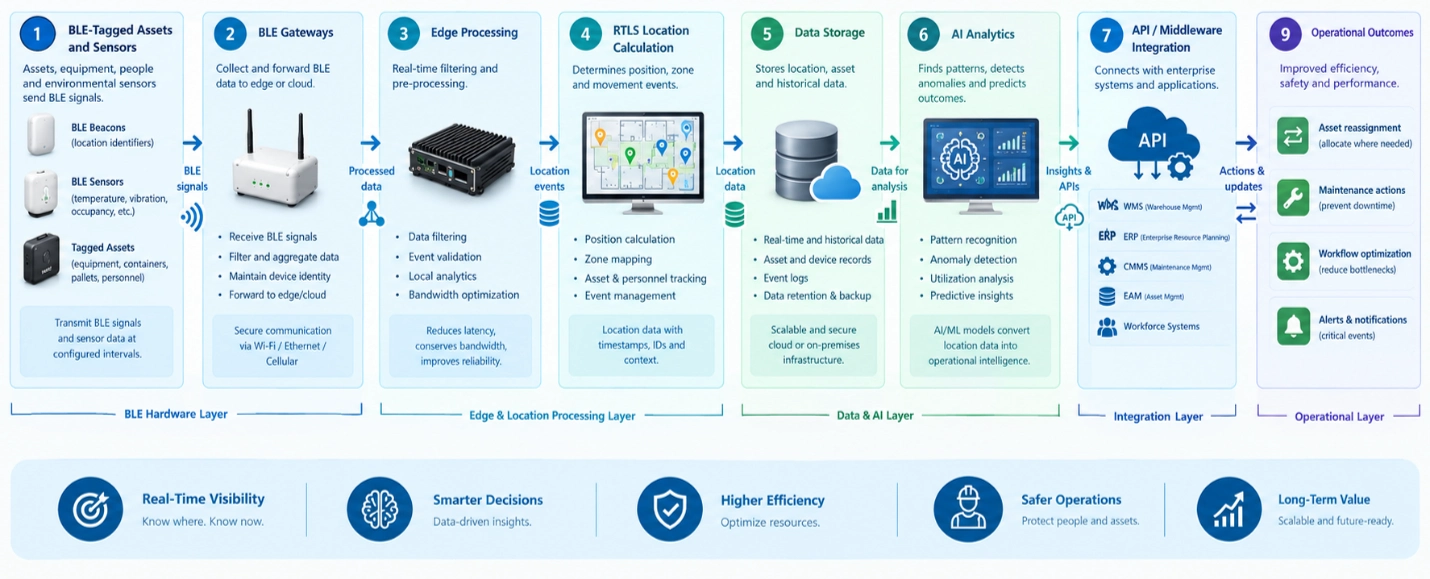
This workflow diagram illustrates the complete AI-enabled RTLS data path, from BLE-tagged assets and sensors through gateways, edge processing, location calculation, data storage, AI analytics, API and middleware integration, and enterprise systems. It shows how location data is transformed into operational actions such as asset reassignment, maintenance, workflow optimization, and alerts.
AI, BLE Gateways, Beacons, and Sensors in RTLS
BLE is an enabling technology within the broader RTLS solution. Different BLE components perform different functions and should be selected according to the positioning method, facility layout, asset characteristics, battery requirements, and required location accuracy.
BLE Beacons
BLE beacons can transmit identifiers at configured intervals so that nearby gateways or receivers can detect their presence. In RTLS applications, a beacon can be associated with an asset, equipment item, room, zone, container, or other tracked object.
Beacon configuration affects battery life, detection behavior, and data density. Deployment planning should consider mounting location, obstruction, radio propagation, interference, environmental conditions, and the required detection frequency.
BLE Sensors
BLE sensors can provide information beyond identity or presence. Depending on the device, sensor data may include environmental or equipment-related measurements. Combining location with sensor telemetry can provide additional context for AI analysis.
For example, an asset’s location history can be correlated with temperature, vibration, occupancy, or other available measurements where the selected sensor supports those parameters.
BLE Gateways
BLE gateways form an important connection between BLE devices and the RTLS software environment. Gateway placement influences coverage, signal reception, location resolution, network reliability, and system scalability.
A deployment should therefore treat gateway placement as an engineering exercise rather than simply installing gateways at convenient network locations.
Factors include:
- Facility dimensions
- Wall and equipment obstructions
- Radio interference
- Ceiling height
- Metal structures
- Required location granularity
- Gateway network connectivity
- Power availability
- Environmental conditions
- Maintenance accessibility
GAO provides BLE gateways, beacons, sensors, and related IoT products that can be incorporated into location-based monitoring solutions according to application requirements.
Cloud and Server Deployment Models for RTLS
RTLS software can be deployed using cloud-hosted or privately hosted server environments. The appropriate model depends on operational requirements, network design, security policies, data governance, integration requirements, and the number of monitored facilities.
Cloud Version
A cloud-hosted RTLS solution can centralize data processing, dashboards, analytics, device management, and application access within cloud infrastructure.
This model can be appropriate when:
- Multiple facilities require centralized visibility
- Remote access is important
- Centralized software maintenance is preferred
- Rapid deployment across locations is required
- Cloud-based analytics and storage are acceptable
- IT teams prefer externally managed infrastructure
Network reliability remains important because BLE gateways must transmit relevant information to the cloud environment. Local buffering or edge processing can help address temporary connectivity interruptions when supported by the selected system.
Server Version
A Server Version can be deployed on customer-managed edge servers, private data centers, factory servers, or other privately hosted enterprise infrastructure. It is not limited to traditional on-premises environments.
This approach can be appropriate when organizations require greater control over data location, network boundaries, software integration, or internal security policies.
Server-based deployment may also be useful where RTLS must continue operating within a controlled facility network or where integration with privately hosted operational systems is a major requirement.
Both deployment models should be evaluated against latency, connectivity, cybersecurity, backup, disaster recovery, software maintenance, data retention, and integration requirements rather than selected solely on infrastructure preference.
Engineering Considerations Before Deploying AI-Enabled RTLS
AI performance is constrained by the quality of the location data supplied to it. A deployment should therefore establish measurable engineering requirements before selecting hardware or AI models.
Key considerations include:
- Required positioning accuracy and zone resolution
- Update frequency for tracked assets
- Number of BLE tags and sensors
- Number and placement of BLE gateways
- Expected radio interference
- Building construction and material composition
- Network availability
- Power requirements
- Battery replacement intervals
- Data retention requirements
- Integration interfaces
- Cybersecurity controls
- Device authentication
- Access permissions
- Time synchronization
- Asset identity management
- AI model training data
- False-positive and false-negative tolerance
- Alert latency
- System availability requirements
- Expansion requirements for additional facilities
A useful implementation principle is to validate location accuracy and event reliability in representative operating conditions before scaling the deployment. A system that performs well in an empty test area may behave differently when metal racks, machinery, people, walls, vehicles, and other radio-interacting objects are present.
AI should also be introduced with a measurable operational objective. For example, an organization may evaluate whether AI reduces asset search time, identifies workflow deviations earlier, improves equipment utilization, or reduces unnecessary movement. Clear KPIs make it easier to determine whether the RTLS implementation is producing operational value.
Technical and Operational Capabilities of AI-Enabled RTLS
Combining AI with real-time location data changes RTLS from a primarily visibility-oriented system into a decision-support capability for location-sensitive operations. The most useful implementations connect location events with asset identity, operational context, historical records, and defined business rules.
Intelligent Location Event Detection
AI can evaluate sequences of location events instead of treating every zone transition as an isolated event. This makes it possible to identify patterns such as unexpected movement, excessive dwell time, repeated transfers, unusual routing, and deviations from established workflows.
For example, an asset moving between a production area and a maintenance zone may follow a predictable sequence. If the asset remains in an intermediate zone substantially longer than normal, an analytics system can flag the event for investigation.
Asset Utilization Intelligence
Location histories provide a practical basis for calculating how frequently equipment is used and where it spends its time.
AI can identify:
- High-utilization assets requiring closer availability planning
- Underutilized equipment
- Repeated movement between departments
- Excessive idle periods
- Locations where equipment frequently accumulates
- Demand patterns across operating shifts
- Assets that may require reassignment
These insights can support equipment allocation decisions without relying entirely on manual inventory checks.
Predictive and Anomaly Analytics
Historical RTLS data can establish normal operational patterns. Machine learning models can then identify observations that differ significantly from those patterns.
An anomaly does not necessarily mean that an equipment failure or operational incident has occurred. It represents a deviation requiring contextual evaluation.
This distinction is important when designing AI alerts. Excessive alerts can create alert fatigue, while overly restrictive thresholds can cause important events to be missed. AI models should therefore be evaluated using operationally meaningful performance measures rather than model accuracy alone.
Workflow Optimization
RTLS can expose how physical movement affects operational processes. AI can analyze movement sequences, dwell times, zone congestion, and asset availability to identify recurring process inefficiencies.
For example, repeated delays between staging and production areas may indicate a material-flow problem. Location data alone can reveal the delay, while integration with production or warehouse records can help establish its operational cause.
Context-Aware Alerts
Rule-based alerts often treat every event equally. AI can help prioritize events based on historical patterns, asset criticality, location, time, and operational context.
A high-value production tool entering an unauthorized zone may therefore receive a different priority from a low-criticality asset making the same movement.
The objective is to provide operations teams with fewer, more meaningful alerts.
AI-Enabled BLE RTLS Deployment Decision Tree
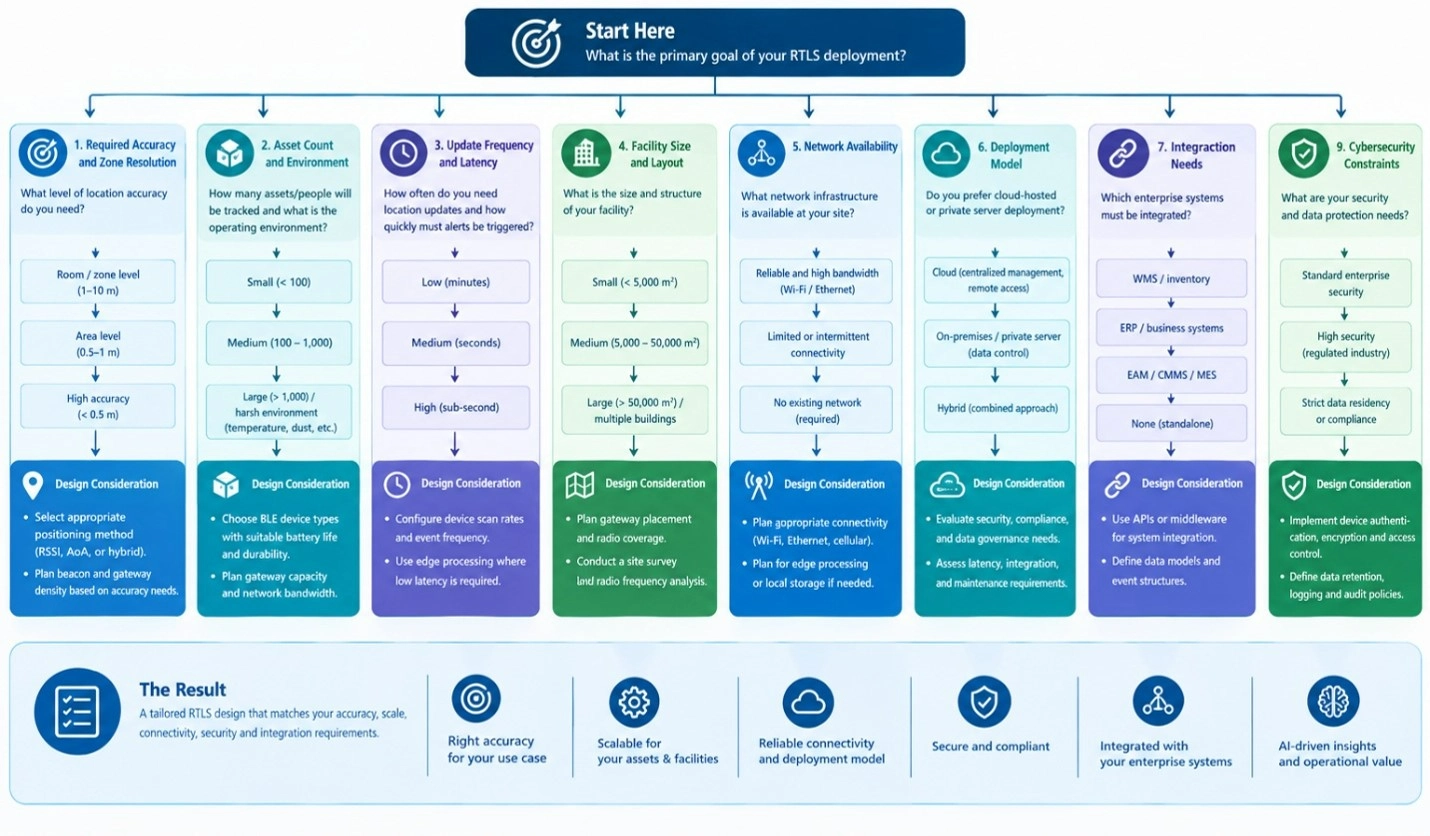
This decision tree guides technical teams through key RTLS design considerations, including location accuracy, asset scale, update frequency, facility layout, network availability, deployment model, enterprise integration, AI requirements, and cybersecurity. Each decision leads to practical design considerations for building a reliable, scalable, and secure RTLS deployment.
RTLS Performance, Scalability, and Business Value
The value of an AI-enabled RTLS should be evaluated through measurable operational outcomes. Location visibility is useful, but measurable improvements in asset availability, workflow performance, safety processes, and resource utilization provide stronger evidence of effectiveness.
Location Accuracy and Event Reliability
Location accuracy depends on the positioning method, BLE deployment, physical environment, gateway density, signal conditions, and system configuration.
A zone-level application may only require reliable identification of the current room or operational area. Other applications may require substantially finer location resolution.
Requirements should therefore define the actual operational question being answered rather than specifying an arbitrary accuracy target.
Scalability Across Assets and Facilities
A successful pilot may involve dozens or hundreds of tracked objects, while production deployments can require significantly larger device populations.
Scaling requires consideration of:
- BLE beacon population
- BLE gateway capacity
- Message frequency
- Network bandwidth
- Data storage
- Location-event processing
- API traffic
- Database performance
- Device provisioning
- Battery management
- Software monitoring
- AI processing requirements
Multi-site deployments also require consistent asset identification, facility maps, zone definitions, user permissions, and integration practices.
GAO’s experience supplying BLE and IoT hardware for organizations in the United States and Canada supports the hardware side of deployments where reliable device availability and technical support are important considerations. GAO Group has served Fortune 500 companies, research organizations, universities, and government agencies for three decades, with R&D and quality-assurance activities supporting its technology products and systems.
Operational KPIs for AI-Enabled RTLS
Useful KPIs should be connected to the original operational problem.
Relevant measurements can include:
- Mean asset search time
- Asset utilization rate
- Asset availability rate
- Average dwell time by zone
- Average movement duration
- Number of unauthorized zone events
- Number of misplaced assets
- Workflow cycle time
- Equipment idle time
- Asset recovery time
- Location-event detection rate
- Alert precision
- Alert response time
- Gateway availability
- BLE device battery life
- Location data completeness
- RTLS system availability
- Number of manual location checks
- Material movement time
- Maintenance response time
These metrics can establish a baseline before deployment and provide a basis for measuring improvement afterward.
Integrating RTLS with Enterprise Software
RTLS becomes more valuable when location information is connected to systems that already manage operational processes.
WMS Integration
Warehouse management systems can provide information about inventory, orders, storage locations, and warehouse activities. RTLS can add physical movement information to this data.
A combined system can help distinguish between what the WMS expects to happen and what is physically occurring.
EAM and CMMS Integration
Enterprise asset management and computerized maintenance management systems can use location information to improve equipment-related workflows.
An RTLS can provide the current or recent location of an asset associated with a maintenance request. This can reduce manual searching and help maintenance personnel determine where equipment is located before responding.
Location history can also provide additional context for equipment utilization and movement.
MES Integration
Manufacturing execution systems can provide production context that helps interpret RTLS events.
For example, movement of a work-in-process container may be normal when associated with a production order but anomalous when it occurs outside the expected production sequence.
Combining MES records with location events allows AI models to evaluate physical movement in relation to production activity.
ERP and Business Intelligence Integration
ERP systems contain business and resource information that can provide additional context for location data. Business intelligence tools can then combine RTLS information with operational and financial data for broader analysis.
API-based integration, event messaging, middleware, and standardized data models can help avoid isolated RTLS deployments that produce location information without connecting it to business workflows.
Cybersecurity and Data Governance for AI-Enabled RTLS
RTLS deployments introduce connected devices, gateways, networks, software services, APIs, databases, and user interfaces. Security must therefore be considered across the complete system rather than only at the BLE device level.
Important controls include:
- Device identity management
- Strong authentication
- Access control based on operational roles
- Secure gateway configuration
- Network segmentation
- Encrypted communications where supported
- Secure API authentication
- Software patch management
- Logging and audit trails
- Monitoring for unusual device behavior
- Controlled administrative access
- Data retention policies
- Backup and recovery procedures
AI introduces additional considerations. Historical location data can reveal operational patterns, asset movements, facility activity, and workflow behavior. Access to this information should therefore be controlled according to legitimate operational requirements.
Organizations should also determine which RTLS information needs to be retained, how long it should remain available, and which systems or personnel can access historical movement records.
AI Model Selection and Implementation Strategy
Not every RTLS deployment requires a complex AI model. A practical implementation should begin with the operational decision that needs improvement.
Rule-based logic may be sufficient for straightforward zone-entry alerts. Statistical analysis can address utilization and dwell-time patterns. Machine learning can become useful when large historical datasets contain recurring patterns that are difficult to model through fixed rules.
Possible approaches include:
- Classification models for event categorization
- Anomaly detection for unusual movement
- Clustering for identifying recurring asset behavior
- Time-series models for utilization and movement trends
- Predictive models for operational forecasting
- Optimization methods for resource allocation
- Natural-language interfaces for querying RTLS information
Edge AI can be appropriate where low latency or local processing is important. Cloud-based AI can provide centralized processing when organizations need to analyze information across multiple facilities.
Model performance should be monitored after deployment. Changes in facility layouts, asset populations, operating schedules, gateway locations, or workflow procedures can affect the data distribution on which an AI model depends.
Implementation Roadmap for AI-Powered RTLS
A technically sound RTLS project should progress from operational requirements to controlled deployment rather than beginning with hardware installation alone.
Define the Operational Problem
Identify the process that requires better location intelligence.
Examples include asset search, equipment utilization, material flow, workflow monitoring, or zone-based safety procedures.
Establish Location Requirements
Define whether the application requires room-level, zone-level, or finer positioning. Establish acceptable latency and update frequency.
Survey the Facility
Evaluate physical construction, equipment density, metal structures, network connectivity, power availability, interference sources, and gateway mounting locations.
A radio survey or controlled site test can help validate assumptions before full deployment.
Select and Configure BLE Hardware
Choose BLE beacons, BLE sensors, and BLE gateways according to the required operating range, battery life, environmental conditions, sensing requirements, gateway connectivity, and positioning method.
GAO can support this stage by providing BLE and IoT hardware products and technical assistance appropriate to the deployment requirements.
Commission the RTLS
Configure assets, zones, facility maps, gateway identities, device parameters, user permissions, and software integrations.
Commissioning should include functional testing and location validation under realistic operating conditions.
Establish the Data Pipeline
Validate that location events are being captured with the required timestamps, identifiers, location states, and telemetry fields. Check data completeness before using the information to train or evaluate AI models.
Introduce AI Analytics
Begin with a clearly defined use case and measurable KPI. Compare AI-generated insights against established operational baselines.
Integrate with Operational Workflows
Connect relevant events to WMS, MES, EAM, CMMS, ERP, or other systems where automation or decision support is required.
Optimize and Scale
Monitor gateway performance, battery status, data quality, alert behavior, model performance, and operational KPIs. Expand the system only after the initial deployment demonstrates reliable performance.
Practical Recommendations for AI and BLE RTLS Deployments
Several engineering principles can improve the reliability and long-term usefulness of an RTLS deployment.
- Start with a defined operational problem rather than deploying location technology without a measurable objective.
- Establish the required location granularity before selecting positioning methods and hardware.
- Conduct site testing under realistic operating conditions.
- Treat gateway placement as an engineering design decision.
- Validate location-event quality before training or deploying AI models.
- Maintain consistent asset identities across RTLS and enterprise systems.
- Separate operational alerts from informational analytics.
- Use AI where pattern recognition or prediction provides value beyond deterministic rules.
- Design cybersecurity controls across devices, gateways, networks, applications, and APIs.
- Establish battery-management procedures for large BLE beacon populations.
- Measure business outcomes using baseline and post-deployment KPIs.
- Design the system so additional assets, zones, and facilities can be added without redesigning the complete deployment.
- Revalidate AI models when operational processes or facility conditions change.
- Provide technical documentation for device configuration, gateway placement, integrations, maintenance, and troubleshooting.
Turning Location Data into Operational Intelligence
AI-powered RTLS can help organizations understand not only where assets and equipment are located, but also how those assets move, how efficiently they are used, and where operational patterns require attention. BLE beacons, sensors, and gateways provide an adaptable data-acquisition layer, while RTLS software, AI analytics, enterprise integrations, and secure infrastructure turn location events into actionable information.
Successful implementation requires careful site engineering, reliable data capture, appropriate AI methods, cybersecurity, interoperability, and measurable KPIs. GAO’s BLE, RFID, and IoT products and technical expertise can support organizations evaluating these requirements.
For organizations planning an AI-enabled RTLS deployment, learning more about GAO’s BLE hardware, IoT systems, engineering support, and location-oriented technologies can provide a useful starting point for evaluating the technical options available for specific operational environments.
Why AI-Enabled RTLS Matters for Location-Based Operations
AI gives RTLS a path from passive location visibility toward active operational intelligence. BLE beacons, sensors, and gateways provide the physical data required to observe movement, while RTLS software organizes that information into location events. AI can then identify patterns, detect anomalies, estimate utilization, prioritize events, and support operational decisions.
The strongest deployments connect these capabilities to established workflows. Warehouse operations can use movement intelligence alongside WMS data. Manufacturing facilities can relate asset movement to MES processes. Maintenance teams can connect equipment location to EAM or CMMS records. Healthcare facilities can use equipment location and utilization information to support resource planning.
The implementation priority should remain data quality, measurable operational outcomes, integration, security, and maintainability. AI is most effective when it is built on reliable location information and connected to decisions that matter.
GAO provides BLE, RFID, and IoT hardware products and systems that can form part of these location-aware deployments. Organizations evaluating AI-powered RTLS can engage with GAO to examine appropriate hardware, system configurations, integration requirements, and technical support options for their operating environment.
Building the Future of Industrial AI and IoT with Aperture Venture Studio and GAO RFID Inc.
For more than three decades, GAO Group of Companies has invested heavily in R&D involving industrial BLE, RFID, and IoT technologies. As AI has become increasingly useful for industrial applications, we have expanded our work across AI and IoT solutions, including technologies that support real-time location, asset intelligence, and connected operations. We have also founded Aperture Venture Studio with a focus relevant to developing and scaling AI and IoT solutions for applications such as intelligent location systems.
Aperture has attracted AI and IoT technical experts, entrepreneurial and operational executives, investors, and leading companies. Our Aperture Ventures Summit and TekSummit provide forums for discussing advanced AI and IoT topics.
These activities have helped build technical communities around AI and IoT. We welcome participation from:
- Advisors, co-founders, or employees
- Investors
- Customers