
AI and BLE for Recycling Operations
AI-Driven Recycling Operations with Connected BLE Monitoring
AI-driven recycling operations combine machine learning, computer vision, operational analytics, connected sensors, and automated decision support to improve how recyclable materials, containers, vehicles, equipment, and personnel-related workflows are monitored. BLE beacons, gateways, and sensors provide a practical source of location, condition, movement, and event data that can feed these AI applications.
For recycling facilities, the value is not simply knowing where an asset is. AI can correlate asset movement, material throughput, equipment condition, contamination observations, collection activity, and operational events to identify inefficiencies and recommend corrective actions. A recycling transfer station, material recovery facility (MRF), scrap processing operation, organics facility, or e-waste processor can use this information to improve equipment utilization, reduce unplanned downtime, strengthen chain-of-custody records, and optimize material handling. GAO supplies BLE, RFID, and other IoT hardware products and systems that can support these connected recycling workflows, including environments where industrial equipment and mobile assets must be monitored continuously.
AIoT-Powered Recycling Operations: From Smart Collection to Intelligent Optimization
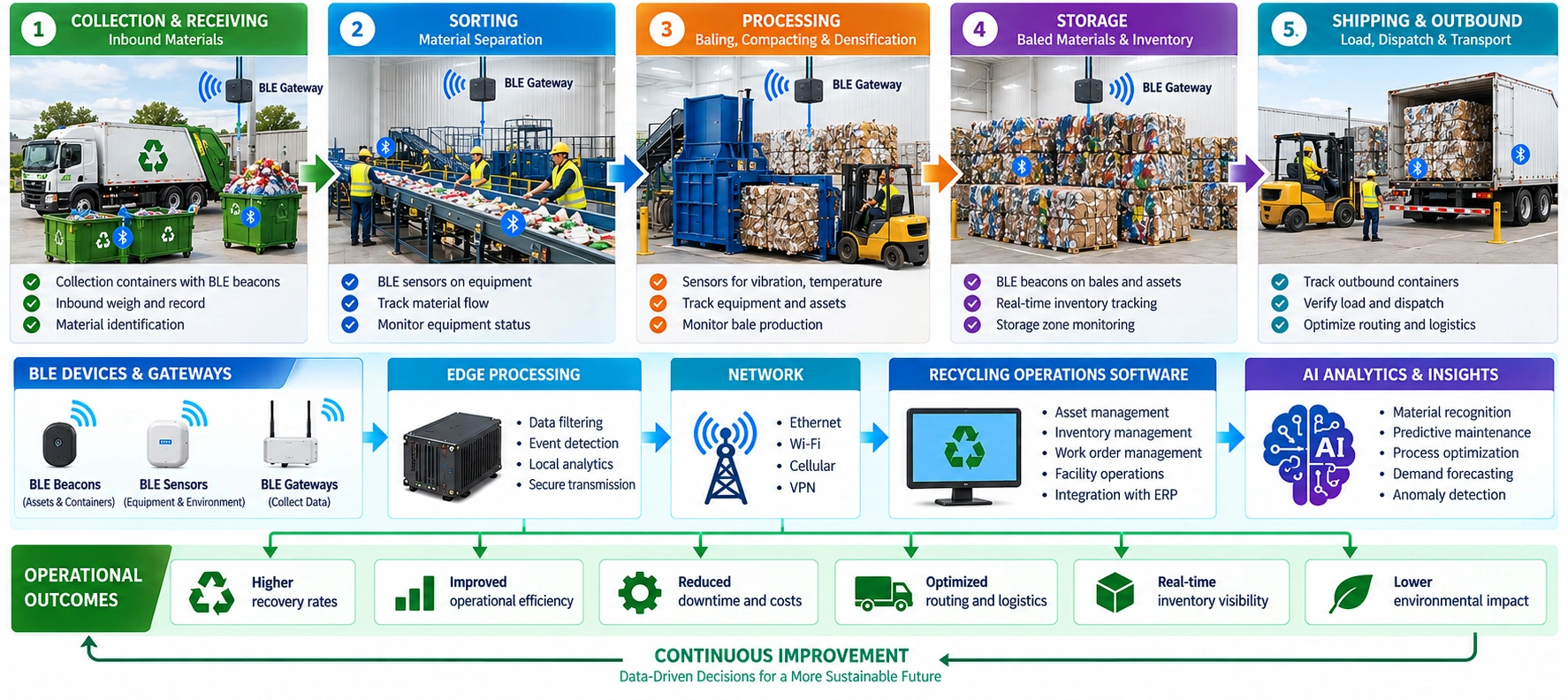
The visual presents a clear AI-enabled recycling workflow across collection, sorting, processing, storage, and outbound shipping. BLE devices and gateways transmit operational data through edge processing and recycling software to AI analytics, supporting predictive maintenance, optimized logistics, inventory visibility, improved efficiency, and continuous improvement.
What AI Means for Modern Recycling Operations
Artificial Intelligence of Things, commonly called AIoT or AI and IoT, combines artificial intelligence with IoT devices, sensors, connected equipment, and industrial systems. Recycling operations can apply this model to convert large volumes of operational events into predictions, classifications, alerts, and recommended actions.
Traditional recycling management often depends on manual inspections, equipment logs, spreadsheets, radio communication, weighbridge records, fleet systems, and operator observations. These sources remain important, but they can provide incomplete visibility when materials and mobile equipment move continuously between collection, receiving, sorting, processing, storage, and outbound shipping areas.
AI adds analytical capabilities to this operational data.
Relevant AI applications include:
- Predictive maintenance for balers, conveyors, compactors, shredders, screens, optical sorting equipment, and other processing machinery
- AI-assisted contamination detection using computer vision at sorting points
- Material-flow analysis to identify bottlenecks between receiving, sorting, processing, and baling
- Dynamic asset utilization analysis for forklifts, carts, containers, roll-off bins, and material-handling equipment
- AI-supported collection and container servicing decisions based on historical fill levels, location, demand, and service patterns
- Anomaly detection for unusual equipment movement, prolonged idle time, unexpected dwell time, or process interruptions
- Automated operational alerts when assets enter restricted zones or remain outside expected operating areas
- Forecasting of recyclable material volumes and processing requirements
- Maintenance prioritization based on equipment condition, usage patterns, and operational criticality
- AI-assisted scheduling of processing, loading, maintenance, and material movements
BLE provides one of the data acquisition mechanisms for these applications. A BLE beacon can identify an asset or operating zone, while BLE sensors can provide measurements such as temperature, vibration, humidity, or equipment-state information. BLE gateways collect nearby transmissions and forward relevant data to edge or server-based software.
The AI layer then turns these observations into operational intelligence rather than treating every sensor event as an isolated data point.
Recycling Applications Where AI Creates Operational Value
AI-Based Asset Tracking for Recycling Facilities
Recycling facilities commonly operate large numbers of mobile and semi-mobile assets. Roll-off containers, reusable bins, carts, pallets, cages, forklifts, maintenance tools, batteries, mobile compactors, and specialized handling equipment can move between receiving areas, processing lines, storage zones, maintenance shops, and loading areas.
AI-based asset tracking can analyze historical movement patterns to identify assets that are underutilized, misplaced, unnecessarily transported, or repeatedly delayed at particular process stages.
BLE beacons attached to suitable assets can provide recurring identification events, while gateways positioned at facility zones establish approximate location. For higher location precision, BLE solutions can be combined with technologies such as BLE Angle of Arrival, RFID, UWB, GPS, barcode systems, or existing industrial sensors where the operational requirement justifies additional infrastructure.
GAO can provide connected hardware that supports these asset-monitoring requirements, while system integrators can connect the resulting data to recycling management and maintenance software.
AI for Material Receiving and Yard Operations
The receiving yard is one of the most variable areas of a recycling operation. Incoming loads can include mixed recyclables, cardboard, plastics, metals, glass, electronics, organics, construction materials, or specialized waste streams depending on the facility.
AI can analyze arrival patterns, processing demand, historical material volumes, container availability, and equipment utilization to support receiving and yard decisions.
BLE-enabled monitoring can add visibility into the physical movement of reusable containers and equipment. For example, a facility can identify when a particular container enters the receiving area, determine how long it remains there, and correlate that dwell time with weighbridge or material-processing records.
This can help operations teams distinguish between a material-processing bottleneck and a yard-management problem.
AI Predictive Maintenance for Recycling Equipment
Unexpected downtime can have a disproportionate impact on recycling facilities because a failure on one critical machine can interrupt upstream and downstream processes.
Balers, conveyors, shredders, compactors, optical sorters, screens, crushers, magnets, air classifiers, and related equipment can generate operational signals that are useful for predictive maintenance.
BLE sensors can supplement existing programmable logic controller (PLC), supervisory control and data acquisition (SCADA), vibration-monitoring, or machine-condition systems where appropriate. AI models can analyze temperature, vibration, runtime, maintenance history, cycle counts, and abnormal operating patterns.
The objective is not simply to generate another maintenance alert. A useful system should estimate whether an abnormal condition is likely to affect production, identify the equipment involved, rank the event by operational criticality, and provide maintenance personnel with actionable information.
AI-Assisted Container and Bin Management
Container management is a major operational consideration for recycling collection and processing. Containers can become unavailable because they are misplaced, full, awaiting transportation, undergoing cleaning, or undergoing repair.
AI can combine historical servicing patterns with location and utilization information to improve container allocation.
BLE beacons can identify reusable containers without requiring line-of-sight scanning at every movement point. Gateways installed around yards, loading areas, warehouses, and processing zones can capture proximity events. AI software can then identify unusual dwell times, repeated movement patterns, or demand changes.
For collection operations, this information can complement fleet management, route optimization, dispatch, and customer-service systems.
AIoT-Enabled Material Recovery Facility: BLE Asset Tracking, Equipment Intelligence & Operational Visibility
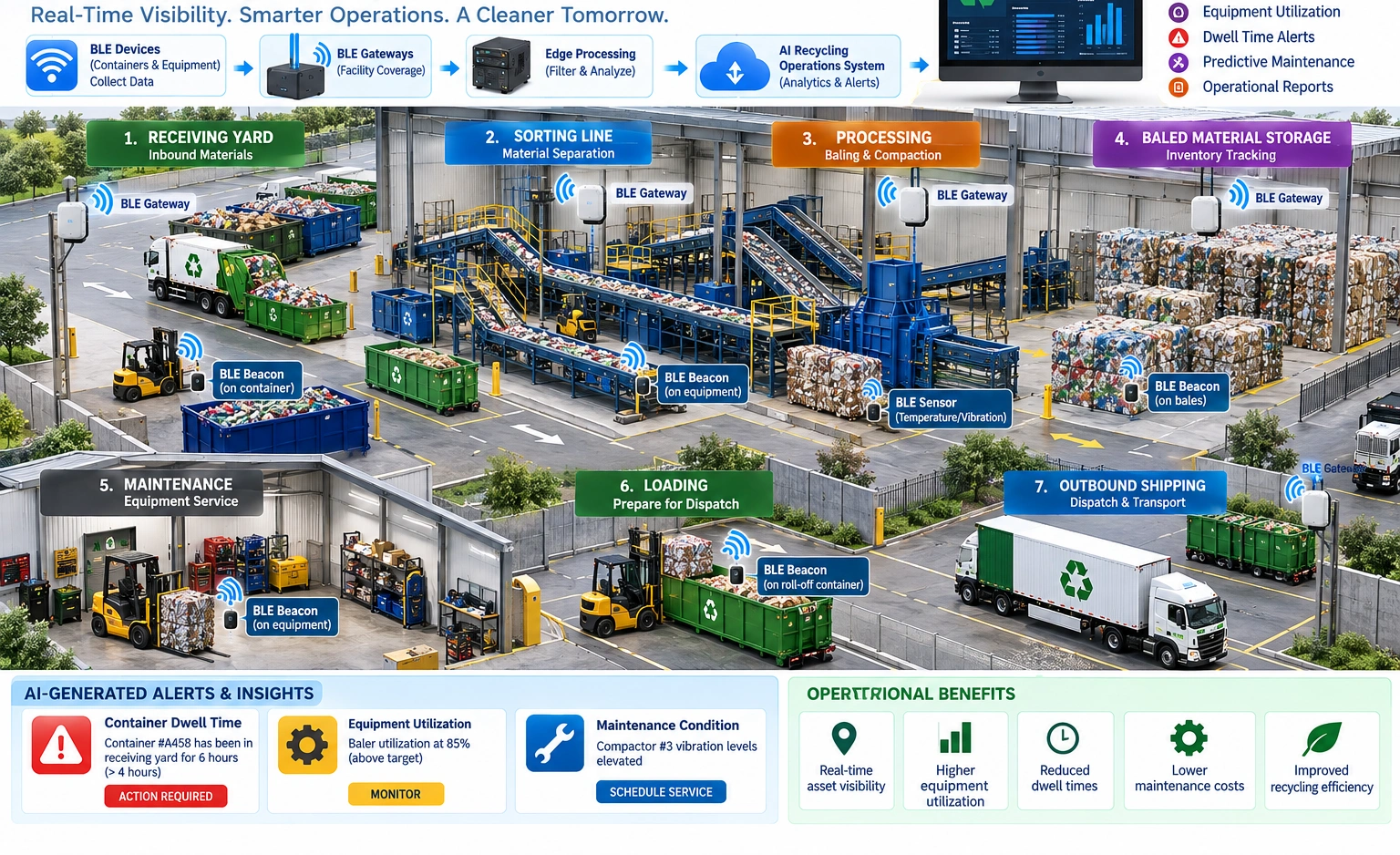
The visual shows a connected material recovery facility where BLE beacons, sensors, and gateways track containers, equipment, baled materials, and outbound assets across seven operational zones. Data flows through edge processing to an AI recycling operations system, providing real-time dashboards and alerts for dwell time, equipment utilization, and predictive maintenance.
Recycling Operations Workflow from Data Capture to AI Decisions
A practical AIoT recycling solution normally begins with physical events occurring in the facility or collection network. These events may involve an asset entering a zone, a container being serviced, equipment operating outside its normal pattern, or a sensor reporting an abnormal condition.
The resulting workflow can include:
- Data acquisition: BLE beacons identify containers, equipment, tools, and other tagged assets. BLE sensors capture applicable environmental or equipment-condition measurements.
- Local communication: BLE gateways receive transmissions from nearby devices and provide connectivity to the facility network.
- Edge processing: Local software can filter duplicate events, validate device identifiers, aggregate sensor readings, and continue selected functions when external connectivity is unavailable.
- Data transport: Processed events can move through Ethernet, Wi-Fi, cellular, or other approved communication infrastructure depending on facility conditions.
- Middleware: Integration software normalizes device events and connects them with asset records, work orders, material records, fleet information, and operational events.
- AI analytics: Machine-learning models detect anomalies, predict equipment conditions, estimate demand, analyze dwell time, and identify operational patterns.
- Operational software: Results can be presented through recycling management, maintenance management, fleet management, warehouse, SCADA, or business intelligence software.
- Business action: Supervisors and operators can receive alerts, maintenance recommendations, asset-location information, scheduling recommendations, or process-performance reports.
- Feedback: Completed maintenance, asset movements, processing outcomes, and operator-confirmed events become additional data for analytics and model improvement.
This closed operational loop is important because recycling facilities generate continuous physical activity. A useful AI system must connect analytical results to what operators can actually do.
Data Quality Is Critical to AI Recycling Applications
AI predictions are only as useful as the operational data supporting them. Recycling facilities should establish consistent asset identifiers, zone definitions, equipment hierarchies, event timestamps, maintenance records, and material categories before deploying sophisticated analytics.
BLE deployments should also account for radio-frequency interference, metal structures, machinery, dense equipment areas, gateway placement, battery life, beacon mounting, and facility layout changes. Metal balers, containers, conveyors, and industrial structures can affect radio propagation, so site surveys and commissioning tests are important.
The same principle applies to AI models. A predictive-maintenance model trained using incomplete maintenance histories may produce misleading recommendations. Likewise, an asset-tracking system with poorly maintained asset records may show technically correct location events against incorrect business records.
BLE Hardware, Software and Deployment Design for Recycling Facilities
BLE is most effective when selected according to the operational requirement rather than treated as a standalone tracking technology. Recycling operations may use BLE beacons for asset identity, BLE sensors for condition monitoring, and BLE gateways for collecting data across processing and storage areas.
A typical solution can include:
- BLE beacons: Small battery-powered identifiers attached to containers, carts, tools, mobile equipment, or other assets.
- BLE sensors: Devices that transmit measurements such as temperature, humidity, vibration, motion, or other supported conditions.
- BLE gateways: Fixed receivers installed around recycling yards, processing buildings, maintenance areas, warehouses, and loading zones.
- Edge computing: Local processing for filtering, event normalization, buffering, and low-latency operational decisions.
- AI software: Machine-learning, anomaly-detection, forecasting, computer-vision, or predictive-maintenance functions.
- Integration middleware: Interfaces connecting sensor events with maintenance management, fleet systems, recycling management software, SCADA, PLC-related systems, or databases.
- Operational databases: Structured records containing equipment, containers, zones, work orders, sensor observations, and historical events.
- Dashboards and alerts: Interfaces that present actionable information to maintenance supervisors, yard managers, dispatchers, and operations personnel.
- Cybersecurity controls: Device authentication, encrypted communications where supported, network segmentation, access control, credential management, secure software updates, logging, and monitoring.
For recycling facilities with reliable internet connectivity and a preference for centralized software management, a Cloud Version can host the AI and analytics software within cloud infrastructure. This model is useful when multiple recycling facilities, collection depots, or regional operations need centralized visibility.
A Server Version can run software on customer-managed servers, private data centers, facility servers, or other privately hosted infrastructure. This approach can be appropriate where recycling operators require greater control over data location, network connectivity, integration with existing operational systems, or local processing requirements.
A hybrid approach can also be appropriate. Time-sensitive event processing can occur locally while historical data and higher-level analytics are synchronized with centralized software.
The correct deployment model should therefore be determined by connectivity, latency, cybersecurity requirements, data governance, integration constraints, facility scale, and the operating model of the recycling organization.
AI Capabilities That Improve Recycling Operations
Combining AI with connected operational data can improve recycling performance when analytics are tied to measurable process conditions. The strongest applications typically focus on material flow, equipment reliability, asset utilization, container availability, contamination, worker safety, and transportation efficiency.
Predictive Maintenance and Equipment Reliability
AI predictive maintenance can identify equipment behavior that differs from established operating patterns. A model can compare vibration, temperature, runtime, motor activity, cycle counts, maintenance history, and production conditions to identify developing abnormalities.
For recycling operations, this is particularly relevant to:
- Balers and baling systems
- Conveyor drives and motors
- Shredders and granulators
- Compactors
- Screens and separators
- Crushers
- Magnetic separation equipment
- Air classification systems
- Optical sorting equipment
- Forklifts and other mobile handling equipment
BLE sensors can supplement existing machine-condition monitoring where additional wireless sensing is practical. AI can then rank maintenance conditions according to severity and equipment criticality instead of generating identical alerts for every abnormal reading.
A maintenance supervisor could, for example, receive an alert that a conveyor drive has developed a vibration pattern associated with previous failures. The system can associate the condition with operating hours and maintenance history, allowing the team to inspect the equipment during a planned maintenance window rather than waiting for a production interruption.
GAO’s connected hardware can support these monitoring scenarios where BLE-based sensing is appropriate for the physical environment.
AI-Based Contamination Detection
Contamination is one of the most important quality challenges in many recycling streams. Paper, plastics, metals, glass, organics, hazardous materials, and non-recyclable items can enter a stream that requires a particular material specification.
Computer vision and machine-learning models can analyze images from sorting points to identify visible contamination patterns. AI results can be combined with material-flow information to identify where contamination is increasing and whether the issue is associated with a particular incoming stream, collection route, supplier, process stage, or operating condition.
BLE does not perform the visual classification itself. Instead, connected BLE events can provide supporting operational context. For example, asset and zone events can help correlate a contamination observation with the processing line, container, or operational period involved.
This distinction is important when designing AIoT recycling systems: computer vision, machine learning, BLE sensing, RFID identification, PLC data, and operational databases can perform different functions while contributing to one decision process.
AI-Powered Recycling Quality Control: Computer Vision, BLE Tracking & Contamination Intelligence
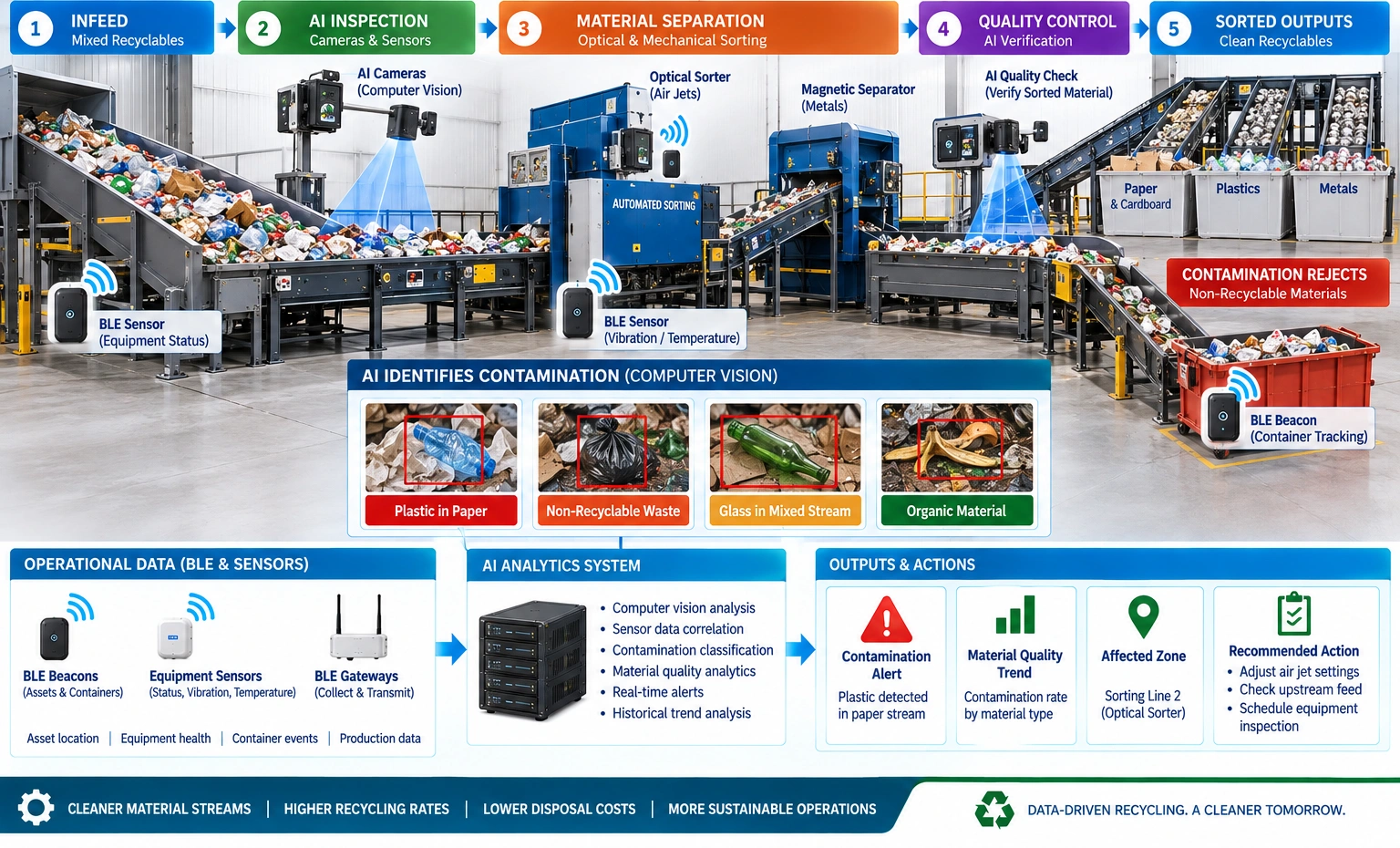
The visual illustrates how mixed recyclables move through computer-vision inspection, automated separation, and AI-based quality control in a material recovery facility. Camera data and BLE-enabled operational events feed AI analytics that identify contamination, track affected processing zones, monitor material-quality trends, and recommend corrective actions.
AI Optimization of Material Flow
Material flow through a recycling facility is rarely constant. Incoming loads, equipment availability, material composition, storage capacity, staffing, maintenance events, and outbound shipment schedules can all affect throughput.
AI can analyze historical and real-time process data to identify bottlenecks and forecast processing requirements.
Useful variables include:
- Tons received by material category
- Conveyor throughput
- Equipment runtime
- Equipment downtime
- Baler cycle counts
- Material dwell time
- Container movements
- Storage capacity
- Outbound shipment schedules
- Maintenance events
- Contamination rates
- Shift-level production patterns
BLE location events can provide additional evidence of how containers and mobile equipment move through the facility. When combined with production data, AI can distinguish between equipment-related delays and material-handling delays.
The practical objective is to help supervisors determine where intervention will have the greatest operational effect.
Safety, Security and Controlled Movement
Recycling facilities contain moving machinery, heavy vehicles, compactors, balers, conveyors, forklifts, loading equipment, and restricted maintenance areas. AIoT systems can provide additional operational awareness, although they should complement rather than replace established safety procedures, engineering controls, and regulatory requirements.
BLE-based proximity and zone monitoring can help identify whether tagged equipment enters an unexpected area or whether an asset remains in a restricted zone for an unusual period.
Potential applications include:
- Restricted-area asset monitoring
- Forklift and mobile-equipment zone awareness
- Maintenance-area access event monitoring
- Unusual movement detection
- Container movement verification
- Equipment utilization monitoring
- Automated exception alerts
- Historical investigation of operational events
Where worker safety is involved, organizations should carefully evaluate whether BLE is appropriate for the required accuracy and safety integrity level. A general asset-location system should not automatically be treated as a certified safety system.
Cybersecurity is equally important. Connected gateways and sensors introduce additional network endpoints, so recycling operators should use appropriate network segmentation, authentication, credential management, software-update procedures, logging, and access controls.
Integrating AI and BLE with Recycling Management Systems
AI-generated information becomes considerably more useful when it is connected to the software already used by recycling organizations.
Relevant systems may include:
- Computerized maintenance management systems (CMMS)
- Enterprise asset management (EAM) software
- Fleet management systems
- Route optimization software
- Weighbridge and scale-management systems
- Recycling management software
- Warehouse management systems
- SCADA systems
- PLC-connected control systems
- Manufacturing or material-processing databases
- Business intelligence and reporting software
- Environmental compliance systems
- ERP systems
Integration should begin with clearly defined business events rather than simply exposing raw sensor readings.
For example, the useful business event may be “container remained in processing zone for 45 minutes beyond expected dwell time”, rather than hundreds of individual BLE advertisements.
Middleware can aggregate device messages, associate them with asset IDs, apply timestamps, map gateway events to facility zones, and pass normalized information to business applications.
APIs, database connectors, message brokers, webhooks, or other integration mechanisms can be selected according to the existing software environment.
Recycling Operations KPIs for AI-Based Optimization
AI deployments should be evaluated against operational measurements rather than the number of connected devices installed.
Useful recycling KPIs include:
- Tons processed per hour
- Material recovery rate
- Contamination rate
- Equipment availability
- Mean time between failures (MTBF)
- Mean time to repair (MTTR)
- Unplanned downtime
- Preventive-maintenance compliance
- Equipment utilization
- Container utilization
- Container turnaround time
- Asset dwell time
- Yard congestion
- Truck turnaround time
- Collection route efficiency
- Fuel consumption
- Energy consumption per ton processed
- Baler throughput
- Sorting accuracy
- Material yield
- Inventory accuracy
- Storage capacity utilization
- Missed collection rate
- Maintenance response time
- AI alert precision
- AI false-alert rate
- Sensor availability
- Gateway availability
- Data completeness
- Exception-resolution time
The most useful KPI set depends on the facility’s operating model. A material recovery facility may prioritize throughput, recovery rate, contamination, equipment availability, and downtime, while a recycling collection organization may focus more heavily on container utilization, route efficiency, turnaround time, and fleet performance.
Engineering Considerations for BLE Deployment in Recycling Facilities
Recycling environments require more careful BLE deployment planning than a typical office environment.
Metal containers, heavy machinery, electrical equipment, enclosed processing areas, concrete structures, and constantly moving vehicles can affect wireless propagation. Gateway placement should therefore be based on the actual facility rather than a theoretical coverage calculation.
Hardware Selection
BLE hardware should be selected according to:
- Required transmission range
- Battery life
- Environmental rating
- Temperature tolerance
- Mounting method
- Vibration exposure
- Impact risk
- Waterproofing requirements
- Maintenance accessibility
- Sensor requirements
- Gateway connectivity
- Required location precision
Asset-mounted devices should also be selected according to the physical characteristics of the asset. A beacon mounted to a reusable plastic container has different requirements from one mounted near a metal baler or mobile processing machine.
Commissioning and Testing
A successful deployment should include a structured commissioning process.
- Establish an asset register and unique identifiers
- Define facility zones
- Determine gateway locations through site assessment
- Install and label devices
- Verify beacon transmission
- Test gateway reception
- Validate zone detection
- Confirm timestamps and asset associations
- Test network connectivity
- Validate data integration
- Compare digital events with physical movements
- Test alert thresholds
- Evaluate battery performance
- Document installation and maintenance procedures
Operational acceptance testing should involve the people who will use the system. A technically valid BLE event is not necessarily a useful business event.
Scaling AI-Based Recycling Operations
Scaling should occur after the initial use case has demonstrated measurable operational value.
A practical rollout can begin with one facility zone or one asset category, such as reusable containers or critical processing equipment. Once data quality and integration are validated, additional equipment, zones, facilities, and AI use cases can be introduced.
Multi-site recycling organizations can use centralized analytics to compare:
- Equipment reliability between facilities
- Processing throughput
- Contamination trends
- Container utilization
- Maintenance performance
- Asset dwell times
- Collection efficiency
- Operational exceptions
Standardized asset identifiers and data models become increasingly important as deployments expand.
GAO’s experience supplying BLE, RFID, and IoT hardware products and systems can support organizations that need connected sensing across different operating environments. GAO has served customers in the United States and Canada for three decades, including Fortune 500 companies, research and development organizations, universities, and government agencies. Its headquarters are in New York City and Toronto, Canada, and the company’s BLE and RFID activities are positioned among the leading global B2B and B2G suppliers.
AI Recycling Operations Lifecycle: From Site Assessment to Intelligent Scaling & Continuous Optimization
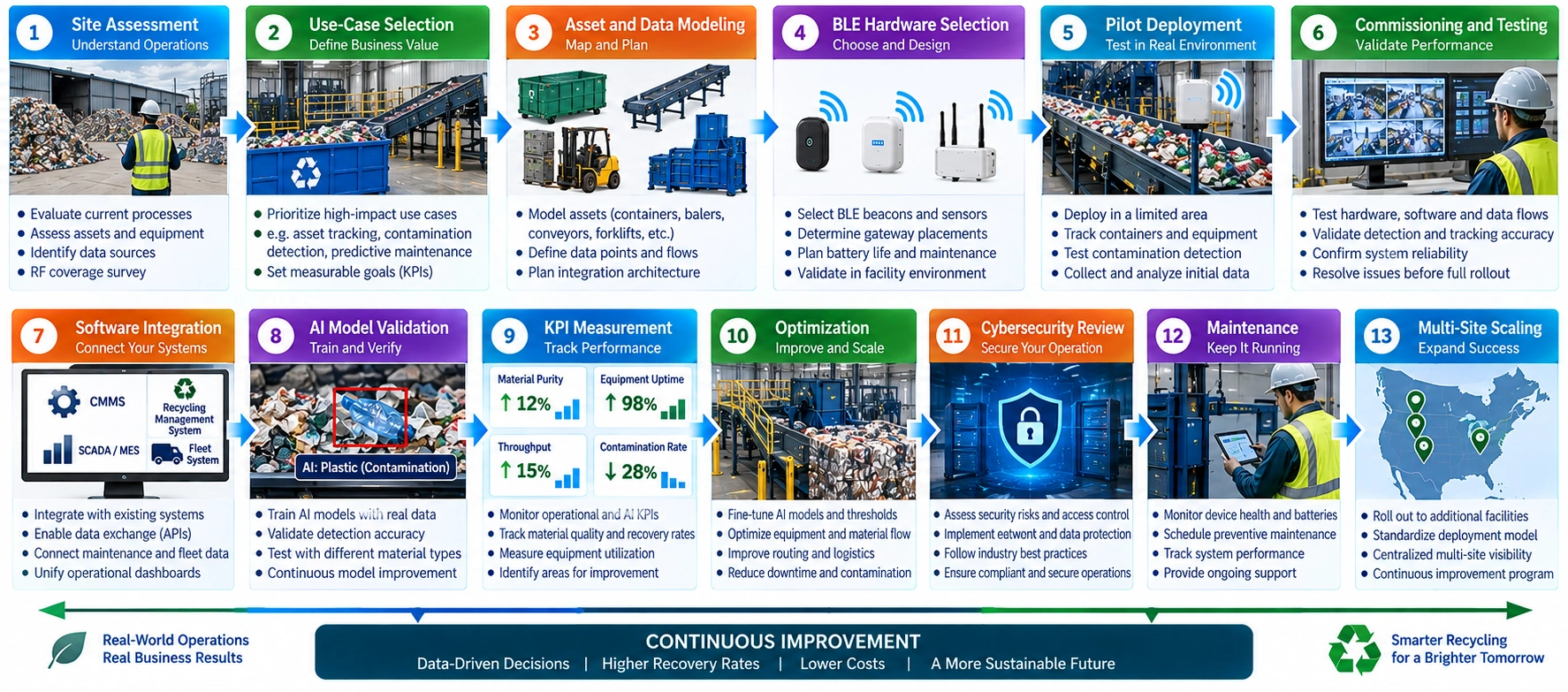
The visual presents a 13-stage lifecycle for implementing AI-driven recycling operations, progressing from site assessment and use-case selection through BLE deployment, system integration, AI validation, and KPI measurement. It also highlights optimization, cybersecurity, ongoing maintenance, and multi-site scaling as part of continuous operational improvement.
Practical Recommendations for AI and BLE Recycling Deployments
Organizations evaluating AI-driven recycling operations should first identify a measurable operational problem and then determine which data is required to solve it.
A sound implementation approach includes:
- Define the operational objective before selecting hardware
- Establish asset and equipment master data
- Identify the recycling process events that matter to decision-makers
- Determine whether BLE, RFID, computer vision, existing machine sensors, or a combination provides the appropriate data
- Conduct an RF and physical site assessment
- Select gateway locations based on actual facility conditions
- Define cloud, server, or hybrid processing requirements
- Integrate AI results with existing operational software
- Establish cybersecurity and access-control requirements
- Validate data quality before training complex AI models
- Establish baseline KPIs before deployment
- Measure AI alert accuracy and false-positive rates
- Involve maintenance, yard, fleet, processing, IT, and operations teams in acceptance testing
- Start with a controlled pilot before expanding across facilities
- Establish battery replacement, device inspection, gateway maintenance, and software-update procedures
- Reassess AI models as equipment, processes, material streams, and facility layouts change
The most effective AIoT recycling deployments are therefore operational projects rather than simply sensor installations. The objective is to create reliable connections between physical recycling activities, trustworthy data, AI analysis, and decisions that improve measurable performance.
Key Takeaways for AI-Enabled Recycling Operations
AI can help recycling organizations move from reactive operational management toward data-supported decisions covering equipment reliability, material flow, contamination, container management, fleet activity, and facility performance. BLE beacons, sensors, and gateways can provide useful identification, location, and condition data when deployed according to the physical characteristics of recycling environments.
The technical priorities should be data quality, appropriate sensing, reliable connectivity, software integration, cybersecurity, AI validation, and measurable KPIs. Cloud, server, and hybrid deployments can each be appropriate depending on connectivity, data governance, latency, integration, and operational requirements.
GAO provides BLE, RFID, and IoT hardware products and systems that can be incorporated into recycling tracking, monitoring, and automation projects. Readers evaluating an AI-driven recycling solution can explore the relevant technologies, define their operational requirements, and work with qualified engineering teams to determine appropriate hardware, software, integration, and deployment approaches.
Building the Future of Industrial AI and IoT with Aperture Venture Studio and GAO RFID Inc.
For more than three decades, GAO Group of Companies has invested heavily in R&D for industrial BLE, RFID, and IoT. As AI became increasingly useful for industrial applications, we expanded our work across AIoT, edge intelligence, and connected operational systems. We also established Aperture Venture Studio to support the development and scaling of AI and IoT solutions relevant to applications such as recycling operations, connected asset management, and industrial automation.
Aperture brings together AI and IoT technical experts, entrepreneurial and operational executives, investors, and leading companies. Through initiatives including the Aperture Ventures Summit and TekSummit, we facilitate discussions on advanced AI and IoT technologies.
We welcome participation as:
- Advisors, co-founders, or employees
- Investors
- Customers