
AI and BLE for Refining Operations
AI-Driven Refining Operations Using BLE for Intelligent, Safe, and Efficient Energy Production
Refining operations are becoming increasingly data-driven as refineries pursue higher process reliability, lower operating costs, improved safety, reduced emissions, and better asset utilization. Artificial Intelligence of Things (AIoT), which combines artificial intelligence with connected industrial devices and sensors, enables continuous operational intelligence across refinery units by transforming large volumes of operational data into actionable recommendations. Within refining operations, BLE gateways, BLE beacons, and BLE sensors provide cost-effective location awareness, equipment monitoring, environmental sensing, and workforce visibility that complement existing industrial control systems rather than replacing them.
When integrated with AI models, BLE-based sensing supports predictive maintenance, operational optimization, contractor safety, turnaround management, inspection automation, and real-time situational awareness throughout crude distillation units, catalytic cracking units, hydro-processing facilities, utilities, tank farms, and loading terminals. The combination of AI and BLE helps refinery personnel identify developing equipment degradation, optimize maintenance schedules, improve emergency response, and reduce unplanned shutdowns while maintaining compliance with stringent safety and environmental requirements.
Organizations implementing intelligent refinery solutions require reliable industrial IoT hardware, integration expertise, and long-term technical support. Headquartered in New York City and Toronto, GAO has supplied BLE, RFID, and industrial IoT hardware to organizations throughout North America for decades, supporting industrial deployments requiring dependable engineering assistance and rigorous quality assurance.
AI-Driven BLE-Enabled Refining Operations with Predictive Maintenance and Industrial IoT Monitoring
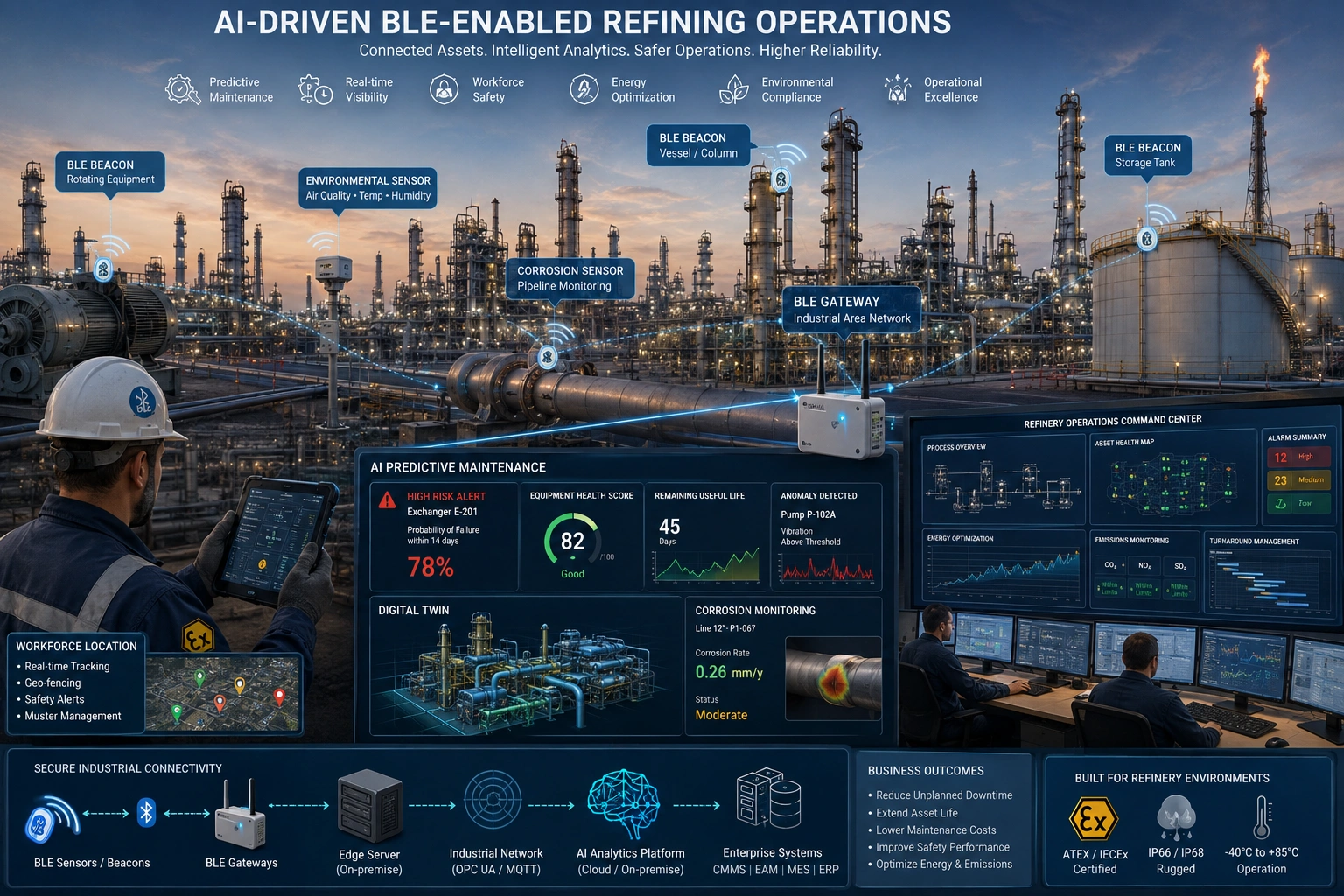
Understanding AI and BLE in Modern Refining Operations
Petroleum refining converts crude oil into transportation fuels, petrochemical feedstocks, lubricants, specialty products, asphalt, and numerous industrial chemicals through interconnected mechanical, thermal, catalytic, and chemical processes. These operations involve thousands of rotating assets, pressure vessels, heat exchangers, pipelines, valves, pumps, compressors, reactors, furnaces, storage tanks, instrumentation devices, and safety systems operating continuously under demanding conditions.
Modern refineries already generate enormous amounts of operational information from Distributed Control Systems (DCS), Supervisory Control and Data Acquisition (SCADA), programmable logic controllers (PLCs), vibration monitoring systems, laboratory information management systems (LIMS), process historians, emissions monitoring systems, and enterprise software. AI expands the value of these existing data sources by discovering complex operational patterns that conventional rule-based monitoring often cannot identify.
BLE technology contributes an additional layer of contextual operational data. BLE gateways aggregate information from strategically deployed BLE beacons and BLE sensors attached to mobile assets, inspection equipment, portable instruments, safety devices, valves, rotating machinery, and personnel protective equipment. AI algorithms correlate BLE-generated operational context with process variables, maintenance records, laboratory measurements, inspection reports, and historical failure data to improve operational decision-making.
Rather than functioning as isolated monitoring components, BLE devices become part of a comprehensive industrial AI solution that enhances predictive analytics, maintenance planning, workforce coordination, and refinery operational intelligence.
GAO has assisted organizations implementing industrial BLE hardware by providing products that integrate with existing industrial communication environments while supporting long operational lifecycles expected within refining facilities.
Operational Challenges Driving AI Adoption in Refining Operations
Refining operations present highly specialized operational challenges requiring continuous monitoring across thousands of interconnected assets.
Rotating Equipment Reliability
Critical rotating equipment includes:
- Process pumps
- Centrifugal compressors
- Gas compressors
- Steam turbines
- Air compressors
- Cooling tower fans
- Blowers
- Electric motors
- Vacuum pumps
Unexpected failures frequently result in production losses measured in hundreds of thousands of dollars per day. AI models continuously evaluate vibration trends, temperature behavior, maintenance history, lubrication conditions, operating loads, and BLE sensor observations to identify degradation before catastrophic failure occurs.
Corrosion and Asset Integrity Management
Corrosion mechanisms remain one of the most significant operational concerns within refining operations, including:
- Sulfidation corrosion
- Naphthenic acid corrosion
- Chloride stress corrosion cracking
- Hydrogen attack
- High-temperature oxidation
- Erosion corrosion
- Under insulation corrosion (CUI)
BLE-enabled inspection workflows improve traceability by verifying inspector location, inspection sequence, and equipment identification while AI prioritizes assets exhibiting elevated degradation risk.
Process Safety Management
Process safety depends upon continuous awareness of equipment condition and operational status across:
- Distillation columns
- Reactor systems
- Pressure relief devices
- Fired heaters
- Heat exchangers
- Pipelines
- Hydrogen systems
- Flare systems
- Storage facilities
AI correlates BLE-generated workforce location information with process alarms, hazardous gas measurements, maintenance permits, and confined-space activities to improve operational awareness during routine operations and emergency situations.
Turnaround Planning
Major refinery turnarounds require coordinating thousands of maintenance activities involving contractors, inspectors, equipment, replacement components, cranes, scaffolding, and specialized testing instruments.
BLE beacons attached to critical tools, inspection instruments, temporary equipment, and mobile assets allow AI scheduling systems to optimize workforce coordination, reduce search time, minimize idle labor, and improve project execution efficiency.
Environmental Compliance
Environmental performance requires continuous monitoring of:
- Fugitive emissions
- VOC releases
- Tank emissions
- Wastewater systems
- Cooling water
- Flare operation
- Energy consumption
- Steam generation
- Fuel gas systems
AI combines environmental sensor information with BLE-enabled equipment location awareness to identify abnormal operating conditions that may affect emissions performance.
AI and BLE Solutions for Refinery Operational Challenges: Predictive Maintenance, Safety, and Asset Intelligence
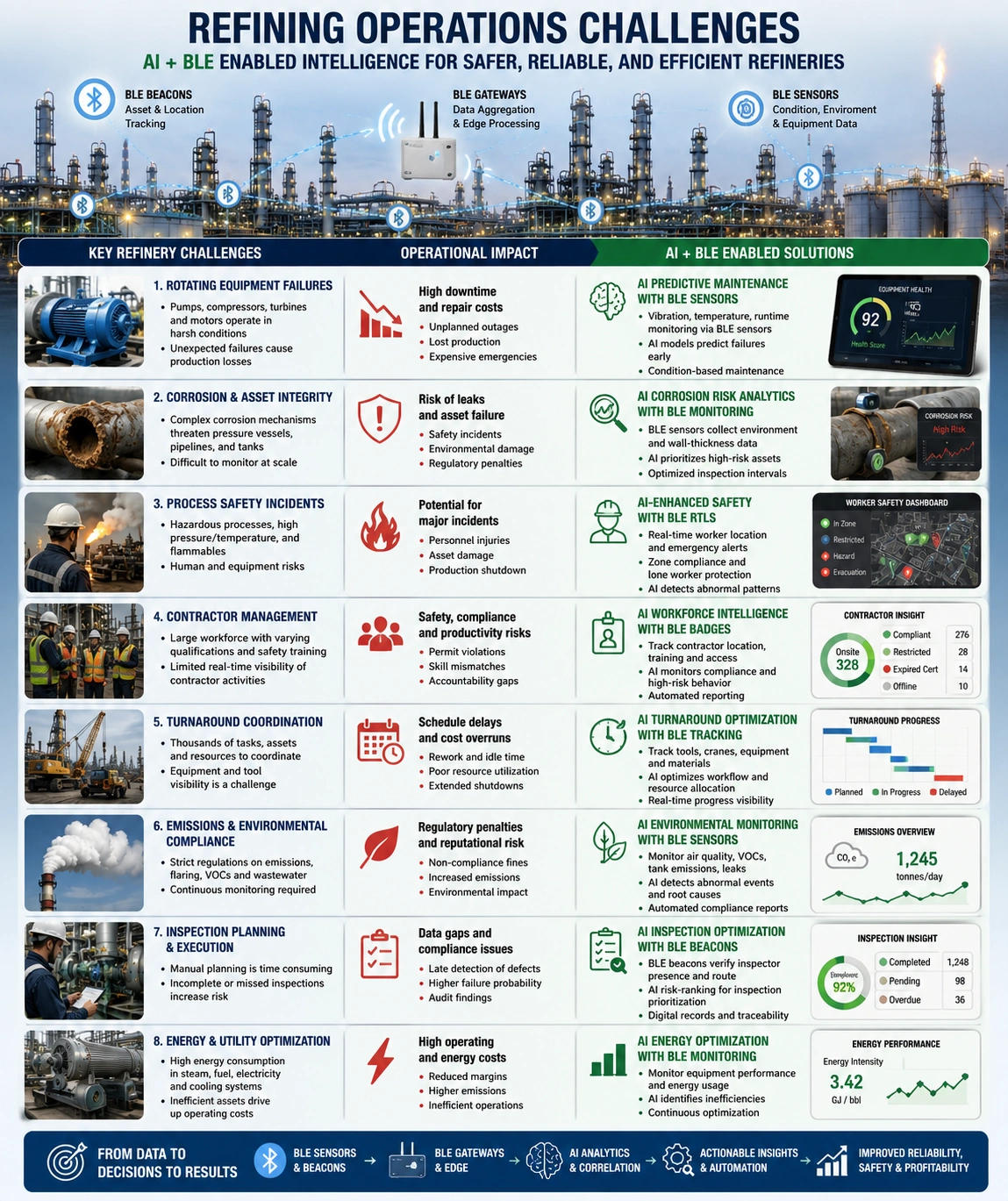
High-Value AI Applications Enabled by BLE Across Refining Operations
BLE technology enables AI systems to capture operational context that significantly enhances refinery decision-making.
Predictive Maintenance
AI evaluates multiple operational variables including:
- Equipment vibration
- Bearing temperature
- Lubrication history
- Maintenance records
- Operational runtime
- Equipment location
- Historical failures
- Environmental conditions
BLE sensors continuously contribute localized operational measurements that improve prediction accuracy for rotating equipment maintenance.
Intelligent Workforce Safety
BLE-enabled personnel awareness supports AI applications that monitor:
- Lone worker protection
- Contractor accountability
- Restricted area access
- Emergency evacuation
- Heat stress exposure
- Fatigue management
- Confined-space operations
AI automatically identifies abnormal workforce movement patterns requiring supervisory attention.
Asset Tracking
Refineries manage thousands of mobile assets including:
- Gas detectors
- Inspection cameras
- Calibration equipment
- Pressure gauges
- Valve actuators
- Portable analyzers
- Maintenance tools
- Welding equipment
- Temporary instrumentation
BLE beacons enable continuous visibility while AI predicts equipment demand, utilization rates, calibration schedules, and replacement planning.
Intelligent Inspection Management
Inspection activities become significantly more efficient through AI-assisted scheduling.
BLE confirms inspector presence at designated assets while AI recommends inspection intervals using:
- Historical degradation
- Failure probability
- Operating conditions
- Risk ranking
- Corrosion models
- Regulatory inspection history
Energy Optimization
Energy represents one of the largest operational costs within refining.
AI analyzes:
- Steam usage
- Fired heater efficiency
- Heat exchanger performance
- Utility systems
- Pump efficiency
- Compressor loading
- Process throughput
BLE-enabled localized equipment monitoring provides supplemental operational context that improves energy optimization models.
Inventory and Tank Farm Intelligence
Tank farms require accurate visibility into:
- Tank utilization
- Pump operations
- Transfer activities
- Valve status
- Mobile equipment
- Maintenance operations
BLE gateways collect location information that AI combines with inventory software to improve logistics and reduce operational delays.
Conventional vs. AI-Assisted BLE-Enabled Refinery Operations Comparison for Predictive Maintenance and Operational Excellence
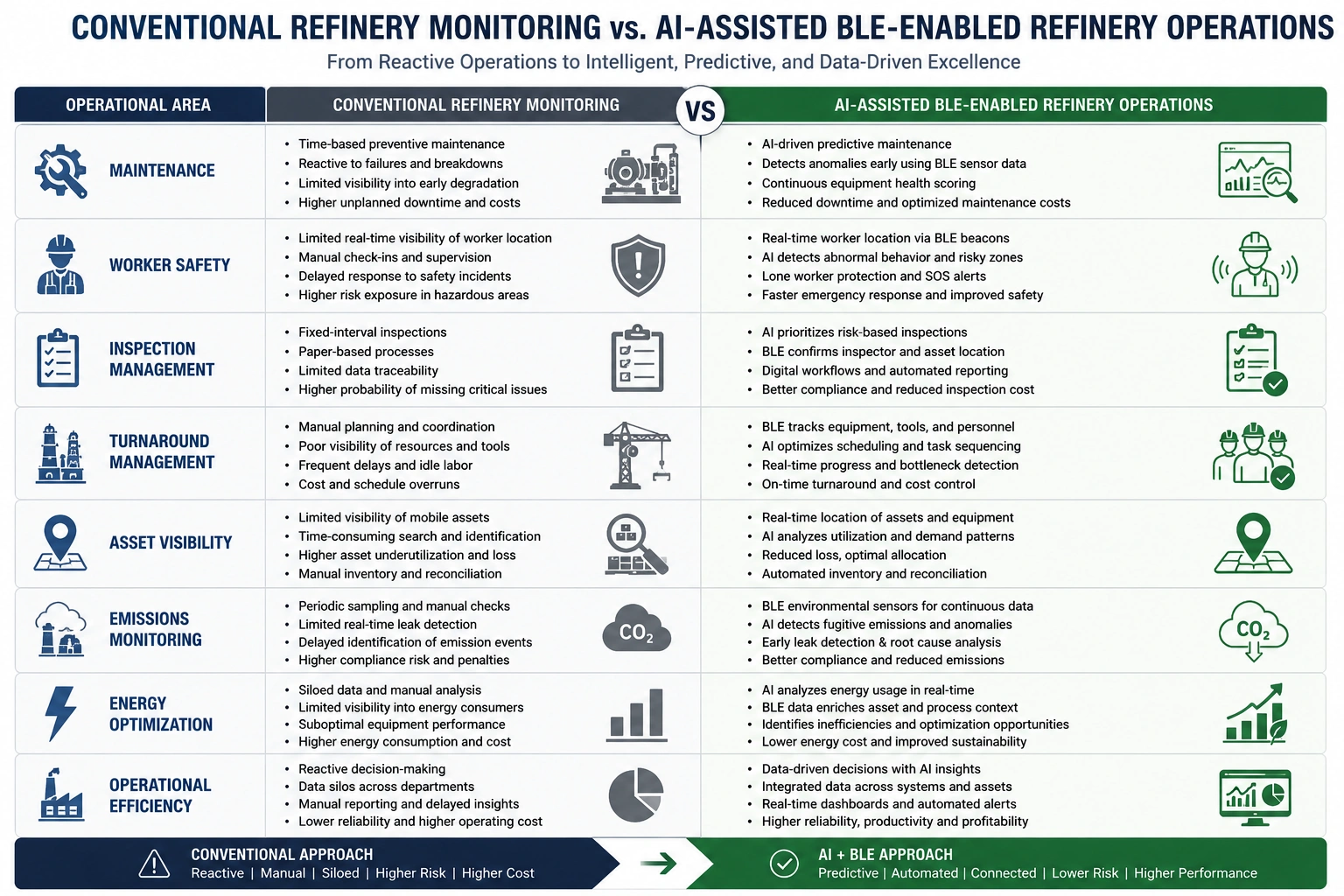
Operational Workflow from BLE Data Acquisition to AI-Driven Refinery Decisions
Successful AI deployments within refining operations depend upon reliable information flowing through multiple operational layers rather than isolated monitoring devices.
Step 1: Industrial Data Acquisition
Operational information originates from multiple sources including BLE sensors, BLE beacons, industrial gateways, DCS controllers, SCADA systems, PLCs, vibration monitors, corrosion probes, weather stations, gas detection systems, laboratory analyzers, infrared inspection devices, thermal cameras, operator handheld terminals, and process historians. BLE devices contribute contextual data such as equipment proximity, mobile asset location, inspection confirmation, environmental conditions, and personnel movement, complementing traditional process instrumentation.
Step 2: Industrial Communication and Edge Processing
BLE gateways securely aggregate nearby beacon and sensor data before forwarding filtered information through industrial Ethernet, Wi-Fi, or cellular backhaul to edge servers or centralized software. Edge processing reduces unnecessary network traffic by validating data quality, filtering duplicate observations, timestamping events, and performing first-level anomaly detection. This localized processing is especially valuable during refinery turnarounds or in remote tank farms where bandwidth and latency constraints exist.
AI-Driven BLE Workflow for Refining Operations: From Industrial Data Collection to Intelligent Operational Decisions
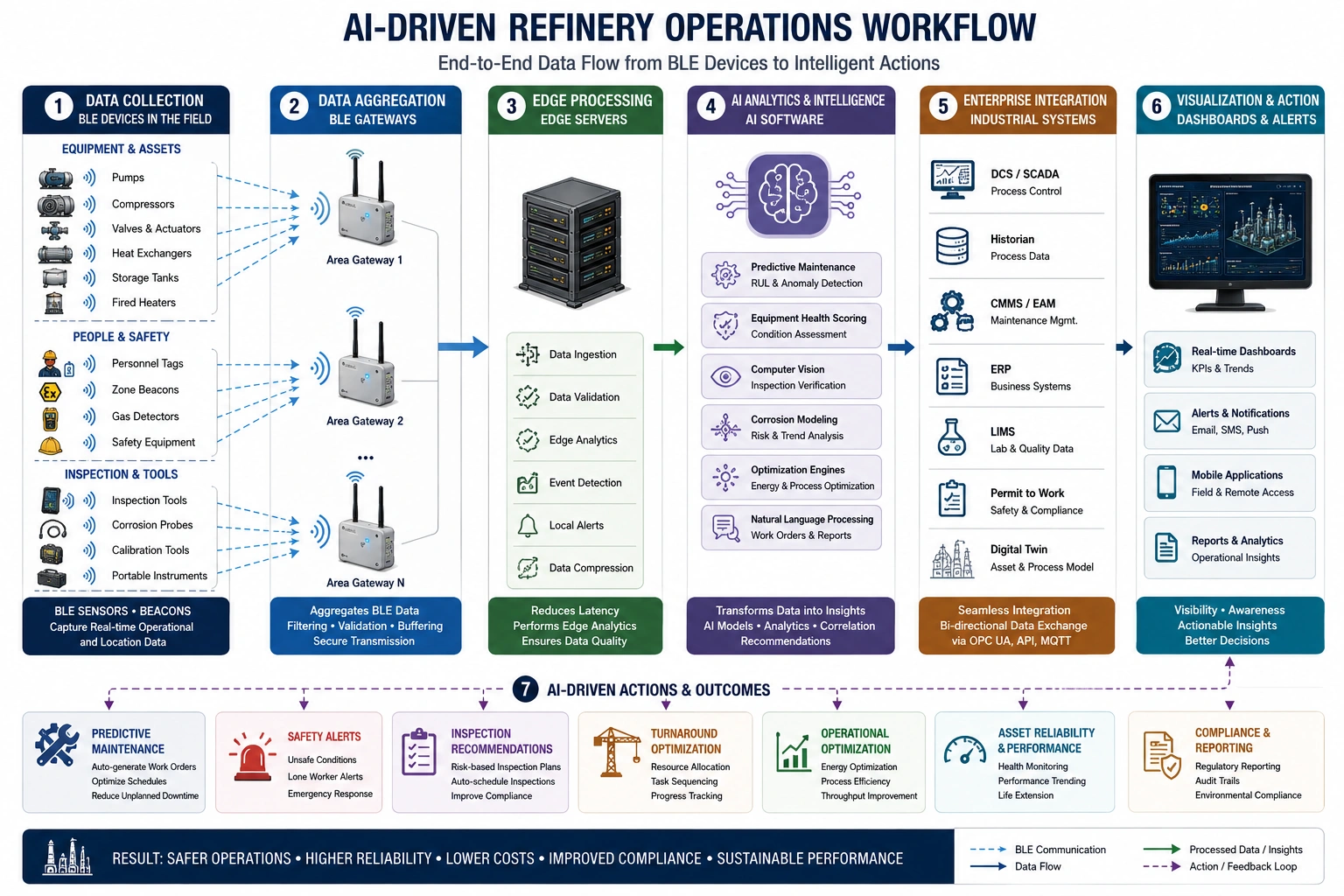
Step 3: AI Analytics and Operational Intelligence
Edge servers or centralized AI software correlate BLE observations with process data, maintenance history, inspection records, laboratory results, and historical operational events. Multiple AI techniques may operate simultaneously depending on the refinery application.
Typical AI methods include:
- Time-series forecasting for equipment health
- Anomaly detection for abnormal operating conditions
- Machine learning classification for equipment fault diagnosis
- Remaining Useful Life (RUL) prediction
- Computer vision for inspection verification
- Optimization algorithms for energy efficiency
- Graph analytics for asset dependency analysis
- Natural language processing for maintenance work orders and inspection reports
Rather than generating isolated alarms, AI produces prioritized recommendations that consider production schedules, safety constraints, equipment criticality, maintenance resources, and process operating windows.
Step 4: Enterprise Software Integration
Operational intelligence becomes significantly more valuable when integrated with refinery business systems. Common integrations include:
- Distributed Control Systems (DCS)
- Supervisory Control and Data Acquisition (SCADA)
- Programmable Logic Controllers (PLCs)
- Manufacturing Execution Systems (MES)
- Enterprise Asset Management (EAM)
- Computerized Maintenance Management Systems (CMMS)
- Enterprise Resource Planning (ERP)
- Laboratory Information Management Systems (LIMS)
- Industrial historians
- Permit-to-work systems
- Digital twin software
- Reliability and Integrity Management software
BLE-generated contextual information helps these systems associate maintenance events, inspections, equipment location, contractor activities, and asset utilization with operational data, enabling more informed scheduling and maintenance decisions.
Step 5: Automated Business Actions
AI recommendations ultimately drive operational improvements through automated or human-approved actions, including:
- Creating predictive maintenance work orders
- Prioritizing corrosion inspections
- Adjusting preventive maintenance schedules
- Alerting supervisors to abnormal workforce movement
- Identifying misplaced maintenance equipment
- Optimizing turnaround task sequencing
- Detecting abnormal equipment utilization
- Improving spare parts planning
- Supporting regulatory reporting
- Recommending energy optimization opportunities
This continuous feedback cycle transforms refinery operations from reactive maintenance toward predictive and condition-based operations.
GAO has supplied industrial BLE hardware that supports these intelligent operational workflows, helping organizations integrate connected sensing technologies into existing refinery environments without disrupting established operational processes.
AI-Enabled Refinery Decision Pipeline with BLE Sensors, Edge Computing, and Enterprise System Integration
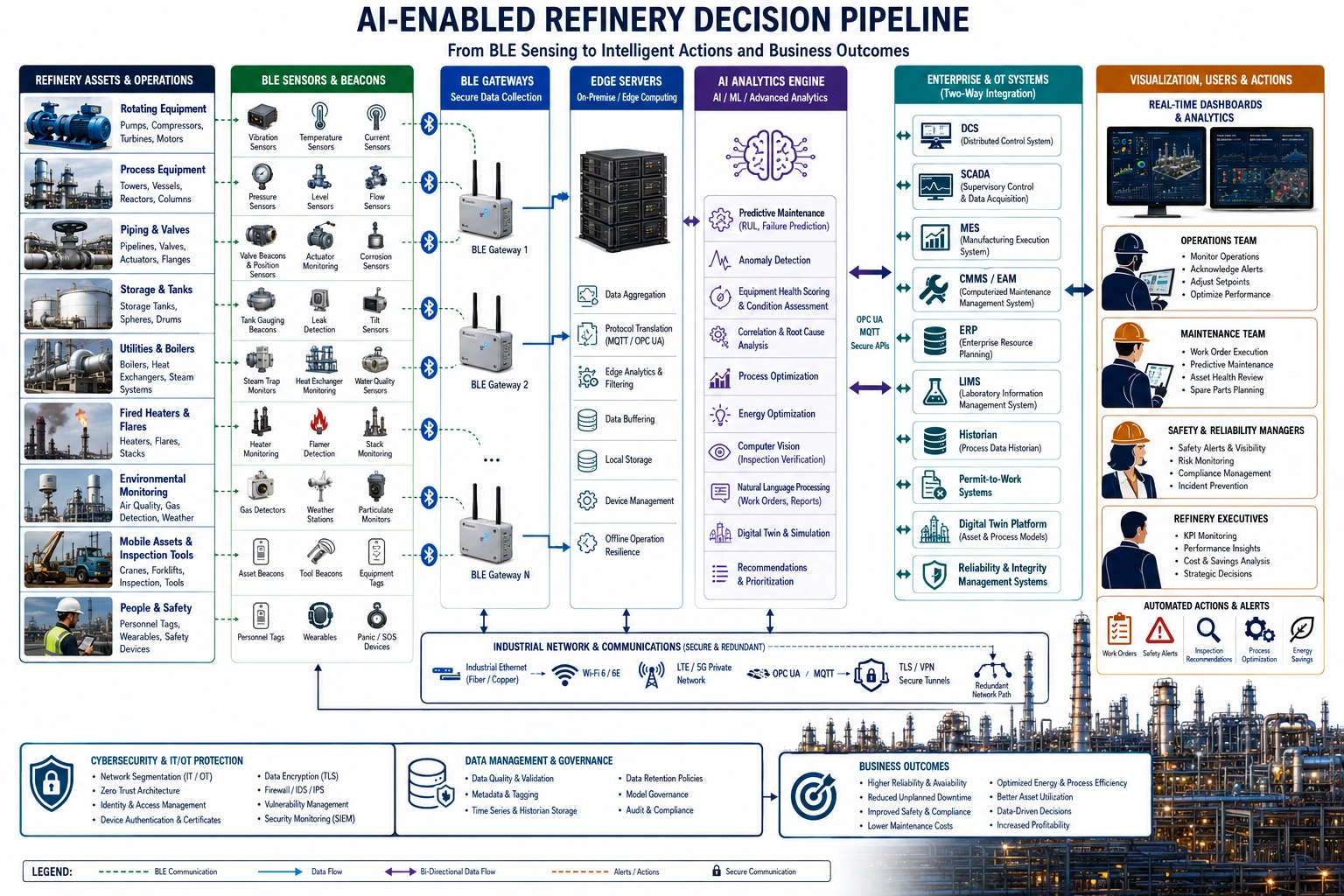
BLE Infrastructure, AI Software, Communication Protocols, and Deployment Models for Refining Operations
BLE serves as a contextual sensing layer that complements existing refinery instrumentation. BLE beacons identify mobile assets, inspection checkpoints, emergency equipment, and personnel locations. BLE sensors monitor localized conditions such as vibration, temperature, humidity, and equipment status where traditional wired instrumentation may be impractical. BLE gateways aggregate nearby device communications and forward validated information to edge servers or centralized software using industrial Ethernet, Wi-Fi, LTE/5G, or fiber networks.
Supporting communication protocols commonly include Bluetooth Low Energy, MQTT, OPC UA, Modbus TCP, HTTPS, REST APIs, SNMP, and secure VPN connectivity. These standards enable interoperability between industrial devices and refinery operational software while minimizing custom integration effort.
AI software may include predictive maintenance engines, anomaly detection models, digital twin software, asset performance management applications, computer vision systems, and optimization algorithms. These solutions often process data using Python-based machine learning frameworks, industrial analytics software, SQL databases, time-series databases, and containerized software running on Linux or Windows Server environments.
Cloud-hosted software is appropriate when refinery organizations require centralized monitoring across multiple refinery sites, enterprise-wide reporting, AI model training using aggregated operational data, disaster recovery, and scalable computing resources. Cloud deployments also simplify software updates and support collaboration between reliability engineers, corporate maintenance teams, and operations personnel located at different facilities.
Server-hosted deployments are preferred where operational latency, cybersecurity requirements, regulatory restrictions, or business continuity considerations require refinery data to remain within privately managed infrastructure. Edge servers installed within refinery networks continue operating during external network disruptions while providing rapid response for operational monitoring and AI inference. Many refinery organizations adopt hybrid deployments, where edge servers perform local analytics while selected operational summaries are securely synchronized with centralized cloud software.
Cybersecurity remains a primary engineering consideration throughout deployment. Recommended controls include:
- Network segmentation between operational technology (OT) and information technology (IT)
- Zero Trust access principles
- Role-based access control
- Multi-factor authentication
- Certificate-based device authentication
- TLS-encrypted communications
- Secure firmware management
- Continuous vulnerability monitoring
- Security Information and Event Management (SIEM) integration
- Asset inventory management
- Device lifecycle management
These measures help protect refinery operations while maintaining the availability and integrity of operational data.
Technical Capabilities and Business Value of AI-Enabled BLE Solutions for Refining Operations
Combining AI with BLE-enabled sensing delivers measurable technical and operational improvements throughout refinery operations.
Improved Equipment Reliability
Continuous monitoring enables earlier identification of equipment degradation, reducing unplanned shutdowns and extending asset service life through condition-based maintenance.
Enhanced Process Safety
Real-time awareness of workforce location, contractor activities, hazardous area occupancy, and equipment status supports safer refinery operations and faster emergency response.
Better Asset Visibility
BLE-based location awareness improves utilization of portable equipment, inspection tools, calibration instruments, and emergency response assets while reducing search time.
More Efficient Turnarounds
AI-assisted scheduling supported by BLE asset visibility helps coordinate maintenance teams, contractors, equipment staging, inspection sequencing, and temporary infrastructure deployment.
Reduced Maintenance Costs
Maintenance resources are allocated according to actual equipment condition rather than fixed maintenance intervals, reducing unnecessary maintenance while improving equipment availability.
Improved Regulatory Compliance
Inspection traceability, equipment history, environmental monitoring, and maintenance documentation become easier to verify during regulatory audits and integrity assessments.
Greater Energy Efficiency
AI identifies opportunities to optimize steam systems, compressor loading, fired heater performance, utility consumption, and heat recovery, reducing operating expenses and emissions.
Scalability
BLE deployments can expand incrementally across refinery process units, utilities, marine terminals, storage facilities, and pipeline operations without requiring extensive rewiring.
GAO has supported organizations implementing industrial BLE hardware and related IoT systems by supplying dependable products backed by remote and onsite technical support, helping customers deploy scalable refinery monitoring solutions.
Engineering Best Practices for Successful Refinery Deployments
Successful AI-enabled BLE implementations require careful planning across operational, networking, and maintenance disciplines.
Recommended practices include:
- Perform radio frequency site surveys before installing BLE gateways.
- Select intrinsically safe devices for hazardous classified areas where applicable.
- Define equipment criticality before training predictive maintenance models.
- Integrate AI recommendations into existing maintenance workflows rather than creating parallel processes.
- Validate AI models using historical refinery operating data before production deployment.
- Establish data governance policies covering sensor calibration, data retention, and model validation.
- Design redundant communication paths for mission-critical operational areas.
- Continuously review cybersecurity controls as devices and software are added.
- Develop key performance indicators aligned with refinery operational objectives.
- Train maintenance, operations, inspection, and reliability personnel on interpreting AI recommendations.
Typical refinery KPIs include:
- Overall Equipment Effectiveness (OEE)
- Mean Time Between Failures (MTBF)
- Mean Time To Repair (MTTR)
- Asset Availability
- Process Unit Utilization
- Turnaround Schedule Adherence
- Energy Intensity Index
- Steam Consumption
- Flaring Rate
- Maintenance Cost per Barrel
- Inspection Compliance Rate
- Safety Incident Frequency
- Equipment Health Index
- Corrosion Risk Score
Why Refining Organizations Choose GAO for Industrial BLE and AIoT Solutions
Organizations implementing intelligent refining operations require dependable technology suppliers with long-term engineering experience. Headquartered in New York City and Toronto, Canada, GAO is recognized among the world’s leading B2B suppliers of BLE and RFID technologies. Together with our sister companies, GAO Research Inc. and GAO Tek Inc., we have supported customers throughout the United States and Canada for more than three decades, including Fortune 500 companies, leading research institutions, prestigious universities, and U.S. and Canadian government agencies.
Our continued investment in industrial BLE, RFID, and IoT research, combined with stringent quality assurance processes and expert remote and onsite technical support, enables us to help refining organizations deploy reliable connected sensing solutions that integrate with existing operational systems while supporting long-term operational performance.
Advancing AI-Driven Refining Operations with BLE
AI-supported refining operations are evolving toward predictive, data-informed decision making that improves reliability, operational efficiency, worker safety, environmental performance, and asset utilization. BLE gateways, BLE beacons, and BLE sensors provide valuable contextual operational information that enhances AI models when combined with existing refinery instrumentation, operational software, and maintenance systems.
Organizations planning new AIoT initiatives should begin with clearly defined operational objectives, prioritize high-value use cases such as predictive maintenance and workforce safety, integrate connected sensing into existing refinery software, and continuously validate AI performance against measurable business outcomes. With decades of experience supplying industrial BLE, RFID, and IoT technologies, GAO helps customers implement dependable solutions that support long-term operational excellence across refining operations.
Building the Future of Industrial AI and IoT with Aperture Venture Studio and GAO RFID Inc.
For more than three decades, GAO Group of Companies has invested extensively in research and development of industrial BLE, RFID, and IoT technologies. As generative AI has demonstrated its value in refining operations and other industrial environments, we have expanded our AI and IoT capabilities while establishing Aperture Venture Studio to accelerate the development and growth of advanced AI and industrial IoT solutions for sectors such as refining operations within the energy industry.
Aperture has attracted leading AI and IoT technical experts, experienced operational executives, influential investors, and established technology organizations. Through initiatives such as the Aperture Ventures Summit and TekSummit, we foster collaboration on advanced AI and IoT topics while strengthening technical communities and industry partnerships. We welcome advisors, industry professionals, investors, and customers who share our vision of advancing intelligent industrial operations through practical, reliable AI and IoT innovation.