
AI and BLE for Regional Distribution Networks
AI-Driven Regional Distribution Networks for Faster, More Predictable Fulfillment
AI-driven regional distribution networks use operational data, connected equipment, shipment events, asset locations, and BLE-based identification to improve how distribution facilities receive, stage, sort, consolidate, load, and dispatch goods. AI can analyze dock activity, trailer movements, staging dwell, material-handling equipment utilization, shipment priorities, and asset availability to identify congestion and exceptions before they disrupt outbound schedules.
BLE gateways, beacons, and sensors provide a practical identification and telemetry layer for assets and equipment that move throughout regional distribution facilities. When these signals are combined with warehouse management systems, transportation management systems, yard management software, enterprise resource planning systems, and AI analytics, regional distribution networks can move from periodic status updates toward continuous operational awareness.
For regional operators managing multiple facilities, the objective is not simply to locate an asset. The larger goal is to understand how asset location, shipment status, labor availability, dock capacity, trailer dwell, and facility conditions affect throughput and service performance.
How AI Improves Regional Distribution Network Operations
Regional distribution networks often operate under changing inbound schedules, variable order volumes, carrier arrival patterns, labor constraints, and strict departure windows. A small delay at receiving can propagate through staging, sortation, consolidation, outbound loading, and transportation dispatch.
AI helps distribution managers interpret these relationships rather than treating each operational event independently. Time-series forecasting can estimate workload by shift or time window, while anomaly detection can identify unusual staging dwell, prolonged trailer occupancy, unexpected asset movements, or deviations from normal processing patterns.
AI-enabled regional distribution management can support:
- Predictive dock assignment based on expected arrivals, shipment priority, dock availability, and handling requirements
- Yard congestion prediction using trailer movements, appointment schedules, dwell history, and dock utilization
- AI asset tracking for carts, roll cages, pallets, totes, forklifts, pallet jacks, and other mobile resources
- Shipment exception detection based on deviations from expected movement sequences
- Labor planning based on predicted receiving, picking, sortation, consolidation, and loading workloads
- Asset utilization analysis to identify underused or unavailable handling equipment
- Predictive maintenance for material-handling equipment and dock equipment
- Staging optimization based on destination, route, departure time, shipment priority, and available space
- Cross-docking decisions that reduce unnecessary storage and handling
- Regional facility performance analysis using normalized operational data across multiple locations
GAO provides BLE, RFID, and other IoT technology-based hardware products and systems that can support these operational visibility requirements. The appropriate combination depends on facility layout, asset types, required location granularity, integration requirements, and operating conditions.
AI-Enabled Regional Distribution Network: BLE Asset Tracking and Intelligent Operations
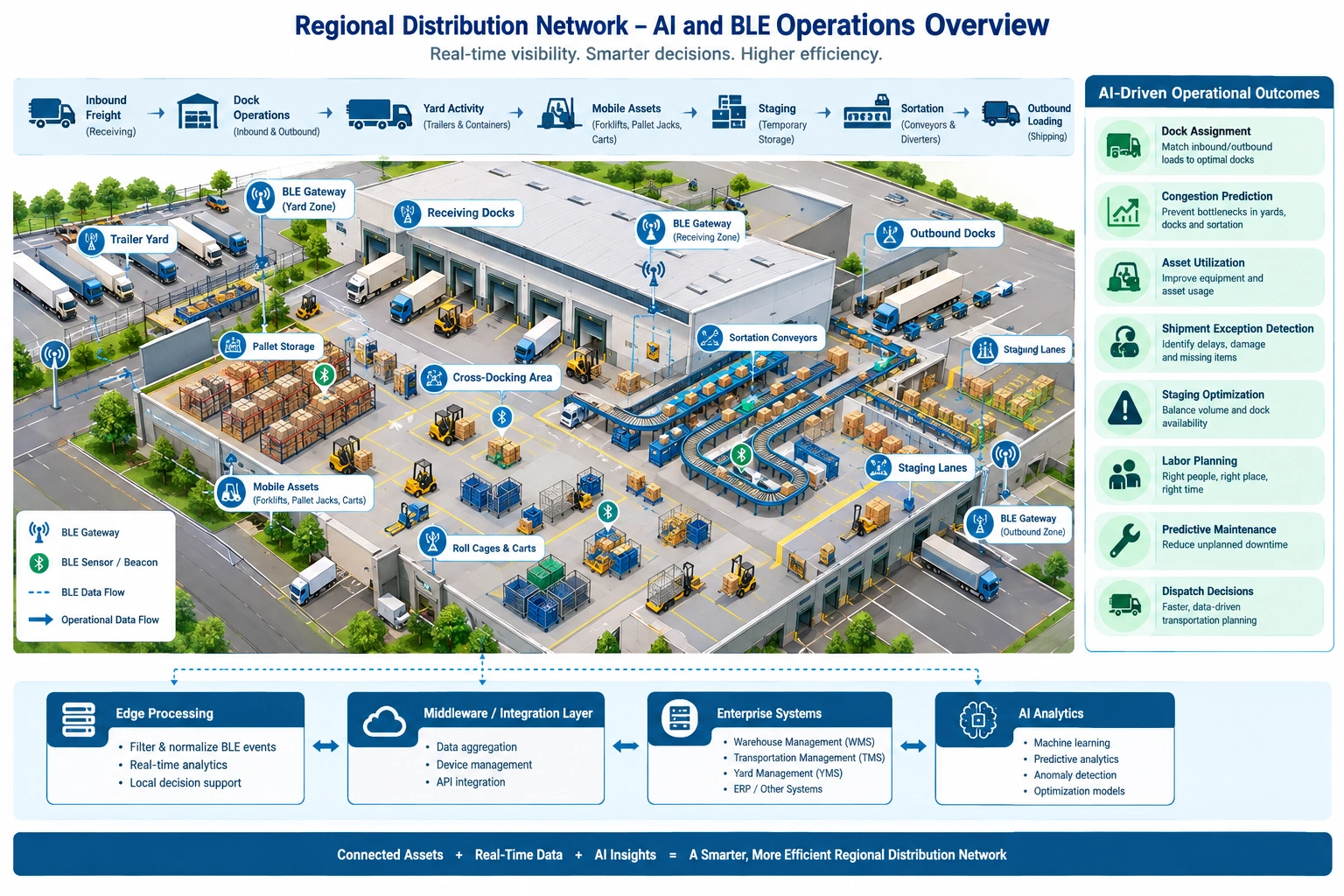
This enterprise operations diagram illustrates how AI and BLE connect inbound freight, receiving docks, trailer yards, mobile assets, staging lanes, sortation, and outbound loading. It shows BLE gateways, sensors, edge processing, middleware, and enterprise systems supporting AI-driven dock assignment, congestion prediction, asset utilization, shipment exception detection, and dispatch decisions.
Regional Distribution Network Workflows Supported by AI
AI becomes most useful when connected to the actual workflows that determine facility throughput and transportation performance. Regional distribution networks typically combine receiving, cross-docking, consolidation, sortation, staging, outbound loading, and dispatch activities within tight time windows.
Inbound Arrival and Dock Assignment
Inbound trucks and trailers arrive according to scheduled appointments, carrier commitments, transportation plans, and changing traffic conditions. Actual arrival time can differ from the planned schedule, creating uneven dock demand.
AI can combine appointment data, historical arrival patterns, current yard occupancy, dock status, shipment priority, unloading requirements, and labor availability to recommend dock assignments. BLE-based visibility can supplement these decisions by identifying tagged carts, equipment, trailers, or handling resources within defined operational zones.
A regional distribution facility can use this information to distinguish between an available dock and a dock that is technically open but operationally constrained because required equipment, personnel, or staging space is unavailable.
Receiving, Unloading, and Cross-Docking
Receiving operations involve trailer unloading, pallet movement, verification, staging, inspection, and routing to storage or outbound processing. Cross-docking adds another requirement because inbound freight may need to move rapidly toward an outbound door without entering conventional storage.
AI can compare inbound shipment characteristics with outbound requirements to identify opportunities for direct transfer. BLE events can provide supporting location information for reusable handling assets and mobile equipment involved in these movements.
The resulting operational picture can help supervisors identify where freight is waiting, where handling resources are accumulating, and where a downstream process is becoming constrained.
Sortation, Consolidation, and Staging
Regional distribution networks frequently consolidate shipments by destination, route, customer, carrier, service level, or departure window. Staging errors or excessive dwell can delay outbound loading even when inventory is technically available.
AI can analyze shipment priorities, planned departures, staging locations, historical dwell patterns, and current asset movements to recommend staging actions. Location events from BLE-enabled assets can help identify whether roll cages, carts, totes, pallets, or handling equipment are positioned where the workflow expects them to be.
This creates a stronger connection between physical movement and digital shipment records.
Outbound Loading and Dispatch
Outbound loading must coordinate shipment readiness, trailer availability, dock capacity, route sequencing, carrier schedules, and departure commitments. AI can identify conditions that threaten departure performance before a trailer reaches its planned loading completion time.
Regional distribution managers can use predicted exceptions to reallocate labor, adjust staging priorities, move handling equipment, or coordinate with transportation teams. The value comes from acting on operational risk while there is still time to correct it.
AI Applications Across Regional Distribution Networks
Regional distribution networks can apply AI to individual workflows while also using facility-wide operational data to understand how those workflows interact.
AI Dock and Yard Management
Dock and yard operations are highly sensitive to timing. Trailer dwell, gate activity, dock availability, yard congestion, and unloading duration can affect the entire distribution schedule.
AI models can evaluate historical dwell times, appointment schedules, carrier patterns, dock utilization, shipment characteristics, and current yard conditions to forecast congestion. Classification models can help categorize likely operational exceptions, while optimization methods can support dock and trailer assignment decisions.
BLE-enabled location events can add physical context when tagged equipment or assets move through defined dock and yard zones. A gateway can report beacon activity to the facility software, where events can be associated with known asset identities and operational states.
The system should distinguish between presence detection and precise positioning. BLE zone visibility may be sufficient for many asset-management workflows, while higher-resolution positioning may require additional infrastructure, calibration, or complementary technologies.
AI Asset Tracking and Utilization
Regional distribution facilities depend on mobile assets that frequently move between receiving, staging, sortation, storage, and outbound loading areas. Examples include carts, roll cages, pallet jacks, forklifts, reusable containers, totes, pallets, and specialized handling equipment.
AI asset tracking can analyze location events and movement histories to determine:
- Which assets are actively supporting current workflows
- Which assets remain idle for unusually long periods
- Which zones experience recurring asset shortages
- Which equipment moves repeatedly without contributing to productive workflows
- Where asset accumulation creates congestion
- When reusable containers should be repositioned or replenished
- Whether assets are following expected movement patterns
BLE beacons attached to mobile assets can provide identity and proximity events, while BLE gateways installed at strategic facility locations collect those events. AI then converts historical movement data into utilization patterns and operational recommendations.
GAO supplies connected hardware products and systems that can be incorporated into asset visibility solutions for regional distribution environments, with deployment choices based on facility geometry, asset density, RF conditions, and integration requirements.
Predictive Throughput and Congestion Management
Throughput depends on the combined performance of receiving, unloading, staging, sortation, consolidation, loading, and dispatch. A facility can have adequate labor and equipment while still experiencing congestion because resources are poorly synchronized.
AI can forecast workload and identify bottlenecks by correlating shipment volumes, process times, asset movement, dock utilization, staffing levels, and departure schedules. Time-series models are useful for workload forecasting, while anomaly detection can identify process behavior that differs significantly from normal operating conditions.
Regional distribution operators can use these predictions to adjust staffing, reposition assets, prioritize shipments, or modify processing sequences before congestion becomes a critical operational problem.
Shipment Exception Detection
Shipment exceptions may include missing handling units, unexpected dwell, incorrect staging, delayed processing, trailer assignment problems, or movement patterns that do not match the expected workflow.
AI can compare actual operational events with expected process sequences. A shipment that remains in staging substantially longer than its normal processing window can be flagged for investigation. Similarly, a handling asset that appears in an unexpected zone can trigger an operational exception.
BLE does not determine the business meaning of an event by itself. The event becomes useful when the BLE identity and location information are associated with WMS, TMS, yard management, shipment, order, and facility records.
Enterprise Technical Data Flow: Regional Distribution Network
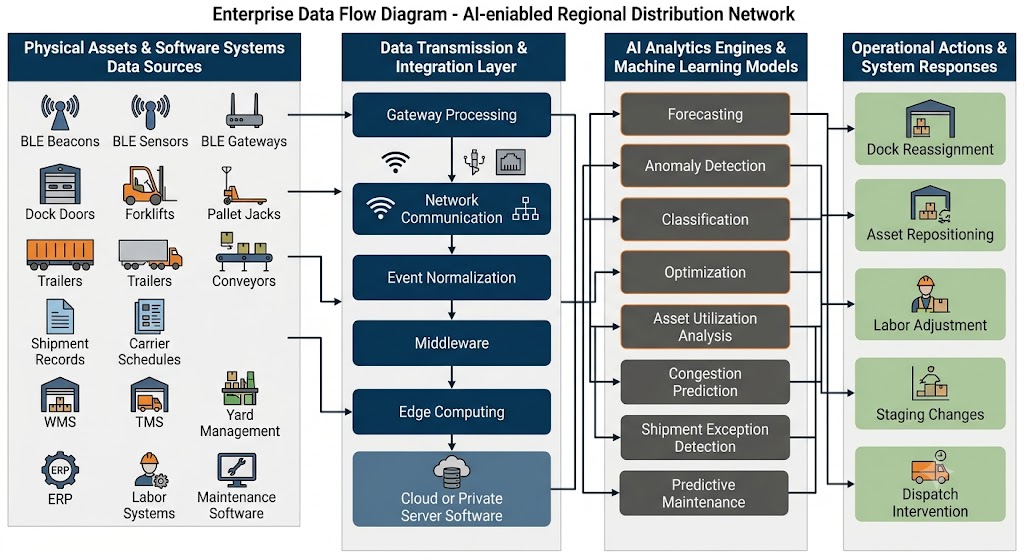
This enterprise data flow diagram maps how data from BLE sensors, logistic software, and physical assets—like trailers and conveyors—streams into an AI core. The process passes through edge computing and integration layers for anomaly detection and optimization. Ultimately, these insights trigger precise operational actions, such as labor adjustments or dispatch interventions, within the distribution network.
AI Labor and Handling Resource Planning
Labor and equipment availability directly influence receiving and outbound performance. Regional distribution networks may need to shift personnel between unloading, staging, sortation, replenishment, consolidation, and loading as workload changes.
AI can forecast expected workload by time interval and compare it with available labor and handling resources. The resulting analysis can identify periods when additional dock personnel, forklift operators, pallet jacks, carts, or other resources may be required.
BLE asset visibility strengthens this planning by providing evidence about where mobile resources are located and how frequently they are used. Managers can distinguish between an actual equipment shortage and an equipment-distribution problem where sufficient assets exist elsewhere in the facility.
BLE Hardware and AI Software for Regional Distribution Networks
BLE serves as an enabling connectivity layer for selected regional distribution assets and operational zones. The engineering objective is to collect useful physical-world events without creating unnecessary infrastructure or excessive data volume.
BLE Beacons for Mobile Distribution Assets
BLE beacons can be attached to carts, roll cages, reusable containers, pallets, tools, mobile equipment, or other assets where identification and proximity information can improve regional distribution workflows.
Beacon configuration requires consideration of advertising interval, transmission power, battery capacity, mounting location, expected movement frequency, and RF interference. Metal racks, trailers, conveyors, dense inventory, and industrial equipment can affect radio propagation.
Longer advertising intervals can reduce battery consumption but may reduce event responsiveness. Higher transmission power can improve detection range but may increase battery consumption and create more overlapping signals. Configuration should therefore be based on the actual workflow rather than a generic maximum-range setting.
BLE Gateways for Facility Visibility
BLE gateways collect beacon and sensor advertisements and forward relevant events to facility software. Gateway placement should consider dock geometry, staging areas, storage aisles, equipment density, wall materials, metal structures, and expected movement paths.
A regional distribution network may use gateways at receiving zones, dock areas, staging lanes, sortation areas, outbound zones, and other operational boundaries. A gateway deployment should be validated through an RF survey and pilot testing because theoretical coverage does not always represent actual performance inside a busy distribution facility.
Communication from gateways can use IP networking and protocols such as MQTT, HTTPS, or vendor APIs depending on the selected software environment. Event normalization is important when multiple gateway types or facilities contribute data to the same regional distribution system.
BLE Sensors for Operational Context
BLE sensors can provide additional environmental or equipment-related data where relevant to regional distribution workflows. Examples can include temperature, humidity, motion, vibration, or other telemetry depending on the sensor hardware and use case.
Such measurements can support condition monitoring, cold-chain handling workflows, equipment maintenance, or exception analysis. AI can correlate sensor observations with shipment events, asset movements, maintenance records, and operating conditions.
AI and Distribution Integration Software
The AI solution should not operate independently from the systems already responsible for distribution execution. Relevant integrations can include WMS, TMS, yard management systems, ERP software, warehouse control systems, order management systems, CMMS or EAM software, labor management systems, and carrier systems.
Middleware can normalize BLE events and connect them with asset master data, shipment identifiers, facility zones, work orders, and operational transactions. AI services can then analyze the combined dataset and return recommendations or alerts to the systems and personnel responsible for execution.
Cloud and Server Deployment for Regional Distribution Networks
Regional distribution operators commonly choose between cloud-hosted and privately hosted software based on connectivity, governance, integration requirements, data policies, latency requirements, and the number of facilities being managed.
Cloud Version
The Cloud Version hosts the application and AI services within cloud infrastructure. This model is well suited to regional distribution networks operating multiple facilities that need centralized analytics, cross-facility KPI comparison, shared AI models, remote monitoring, and coordinated software updates.
Cloud deployment can simplify centralized data aggregation across facilities. Regional operators can compare dock utilization, asset movement, shipment dwell, throughput, and exception patterns across locations without maintaining separate application environments at every site.
Edge processing can still be used for local event filtering or time-sensitive decisions before relevant data is transmitted to cloud services. This reduces unnecessary network traffic and allows selected facility functions to continue during temporary connectivity interruptions.
Server Version
The Server Version deploys software on edge servers, customer-managed servers, private data centers, facility servers, or other privately hosted enterprise infrastructure. This model can be appropriate when regional distribution operators require greater control over data location, integration boundaries, network connectivity, or local processing.
Private server deployment can also support facilities where operational systems are isolated from external networks or where local response time is important. The trade-off is that the organization becomes more responsible for server capacity, patching, backups, monitoring, redundancy, cybersecurity controls, and software lifecycle management.
Both deployment models can support AI-driven regional distribution operations. The correct choice depends on facility connectivity, governance requirements, operational continuity requirements, integration strategy, and the organization’s ability to manage distributed infrastructure.
Engineering Considerations for AI-Enabled Regional Distribution Networks
AI-driven regional distribution systems require careful engineering because physical warehouse conditions, operational timing, data quality, and system integration directly affect the quality of AI decisions. BLE visibility should therefore be treated as one component of a broader operational data system rather than as a standalone tracking function.
BLE Coverage and Location Accuracy
BLE deployment begins with understanding where location information is actually required. A regional distribution network may only need zone-level visibility for carts, roll cages, pallets, or reusable containers, while selected workflows may require more granular positioning.
Gateway placement should account for dock doors, trailer walls, steel racks, conveyors, mechanical equipment, building materials, and areas with high asset density. RF surveys and pilot deployments should validate actual signal behavior before large-scale installation.
Engineers should also establish clear location semantics. A signal received near a gateway does not automatically mean that an asset is physically at a precise coordinate. The software should define whether an event represents presence in a zone, movement between zones, last-known location, or a confidence-based position estimate.
Mobile Asset and Battery Management
Battery-powered BLE beacons require an asset lifecycle process that covers provisioning, installation, inspection, battery monitoring, replacement, and retirement. Regional distribution networks with thousands of reusable assets can otherwise develop visibility gaps when beacon batteries expire unnoticed.
Beacon configuration should balance advertising frequency, transmission power, detection reliability, and battery life. High-frequency advertising may be useful for rapidly moving equipment but unnecessary for assets that remain in staging areas for extended periods.
Asset identity should also remain synchronized with the distribution system. If a beacon is moved from one cart to another without updating the asset registry, AI analytics can generate misleading utilization and movement patterns.
Data Quality and Event Normalization
AI models depend on consistent operational data. BLE events may contain device identifiers, gateway identifiers, timestamps, signal measurements, and other telemetry. Those events must be associated with meaningful business entities such as assets, facility zones, shipments, trailers, dock doors, or work orders.
Middleware should normalize timestamps, duplicate events, missing events, device identities, zone identifiers, and facility codes before data reaches analytical models.
Useful data-quality controls include:
- Duplicate event filtering
- Device identity validation
- Gateway health monitoring
- Timestamp synchronization
- Missing-event detection
- Asset-to-beacon relationship validation
- Facility-zone master-data validation
- Outlier detection for unusual signal behavior
- Historical data retention policies
- Audit trails for important operational events
Poor data quality can create false congestion alerts, incorrect asset utilization calculations, and unreliable predictive models even when the AI algorithm itself is technically sound.
Integration with WMS, TMS, and Yard Management
Regional distribution operations depend on several systems with different responsibilities. WMS manages inventory and warehouse processes, TMS manages transportation planning and execution, yard management software manages trailers and yard activity, while ERP systems often provide broader order, procurement, financial, and master-data functions.
Integration should establish clear ownership for each business event. BLE should provide physical-world observations, while operational systems provide business context.
For example, a BLE event may indicate that a tagged roll cage entered an outbound staging zone. WMS or order-management data can identify which shipment the roll cage supports. TMS can provide the planned departure window. AI can then determine whether the asset’s location and timing represent normal progress or a potential departure risk.
Advanced AI Use Cases for Regional Distribution Networks
AI applications become more valuable when they combine physical movement data with transactional and scheduling information. Regional distribution networks can use these combined datasets to move from reactive exception handling toward predictive operations.
Predictive Dock Congestion
AI can forecast dock congestion by analyzing historical arrival patterns, carrier schedules, unloading duration, shipment volume, labor availability, current dock occupancy, and yard conditions.
A predictive model can estimate which time windows are likely to experience excessive dock demand. Distribution supervisors can respond by adjusting appointments, assigning alternative doors, reallocating labor, or prioritizing time-sensitive shipments.
BLE visibility can provide additional evidence about the physical availability of equipment and handling resources. This helps distinguish dock congestion caused by trailer volume from congestion caused by insufficient material-handling resources.
Trailer Dwell and Yard Optimization
Trailer dwell time can increase when inbound freight waits for an available dock, unloading labor, staging space, inspection, or downstream processing.
AI can model normal dwell by carrier, shipment type, facility, time period, and operational workflow. Deviations can be flagged for investigation before they affect subsequent appointments.
BLE-enabled equipment visibility can further show whether trailers are waiting because required handling equipment is unavailable or because downstream staging areas are already constrained.
Regional distribution operators can use these insights to prioritize yard moves, coordinate dock assignments, and reduce unnecessary trailer accumulation.
AI Shipment Prioritization
Not every shipment has the same operational urgency. Priority can depend on customer commitments, departure schedules, service levels, route sequencing, product characteristics, downstream availability, or transportation constraints.
AI can evaluate these variables alongside current facility conditions to recommend processing priorities. A shipment approaching a departure cutoff may receive a higher operational priority than another shipment with a later departure window.
The recommendation should remain connected to established business rules. AI should support operational decision-making rather than silently overriding transportation, safety, inventory, or compliance controls.
Asset Utilization Optimization
Regional distribution facilities frequently purchase or maintain more carts, pallet jacks, roll cages, forklifts, and reusable containers than are actively required during some operating periods. At the same time, individual zones may experience shortages.
AI can analyze historical movement and utilization data to identify recurring imbalance. BLE events provide the physical evidence required to understand where assets spend time and how often they move between operational zones.
The resulting analysis can support asset repositioning, maintenance planning, procurement decisions, and facility layout changes.
Predictive Maintenance for Material-Handling Equipment
Forklifts, pallet jacks, conveyors, dock equipment, sortation machinery, and other material-handling equipment can become operational bottlenecks when unexpected failures occur.
AI can combine maintenance history, operating hours, movement patterns, equipment telemetry, inspection records, fault codes, and environmental conditions to identify equipment with elevated maintenance risk.
BLE can provide identity and location context for mobile equipment so maintenance personnel can determine where an affected asset is operating. Integration with CMMS or EAM software can then associate the analytical finding with inspection and work-order processes.
Cybersecurity and Data Protection for Connected Regional Distribution Networks
BLE-enabled distribution systems connect physical assets with gateways, networks, middleware, enterprise applications, and AI services. Security controls should therefore cover the entire data path rather than only the BLE devices.
Device onboarding should use unique identifiers and controlled credentials. Gateway configuration should prevent unauthorized access and should be hardened against unnecessary services or exposed interfaces.
Recommended controls include:
- Authenticated device and gateway onboarding
- Unique device credentials
- Encrypted communication where supported
- Network segmentation for operational devices
- Role-based access control
- API authentication and authorization
- Gateway firmware and software patching
- Centralized logging and security monitoring
- Backup and recovery procedures
- Configuration management
- Asset inventory and device lifecycle tracking
- Controlled administrative access
- Regular vulnerability assessment
- Secure retirement of decommissioned devices
Regional distribution networks should also separate operational data from unnecessary personally identifiable information. AI models should receive only the information required for their intended purpose.
Security testing should include gateways, APIs, middleware, cloud services, privately hosted servers, integration interfaces, and administrative accounts. A secure BLE deployment is not simply a matter of encrypting wireless communications.
Deployment Lifecycle for AI and BLE Regional Distribution Networks
A successful deployment should proceed from operational requirements rather than beginning with hardware installation. Regional distribution facilities differ significantly in layout, throughput, asset density, RF conditions, and system integration requirements.
Planning and Facility Assessment
The planning stage should document the operational problems that the solution must address. Examples include asset shortages, staging congestion, trailer dwell, dock utilization, shipment exceptions, or limited visibility into reusable handling equipment.
The engineering team should map facility zones, dock doors, staging lanes, traffic paths, storage areas, equipment locations, network availability, and existing software interfaces.
Important planning questions include:
- Which assets require identification?
- Which workflows require location visibility?
- What location granularity is operationally useful?
- Which events should trigger AI analysis?
- Which existing systems own shipment and asset master data?
- Which decisions should remain human-controlled?
- What happens when network connectivity is interrupted?
- Which facilities should participate in a regional deployment?
Hardware Selection and Pilot Deployment
Hardware selection should consider beacon battery life, enclosure requirements, mounting methods, environmental conditions, gateway connectivity, sensor requirements, and expected asset movement.
A pilot should represent actual operating conditions rather than an empty facility. Engineers should test BLE performance around trailers, metal racks, forklifts, conveyors, dock equipment, pallets, and dense staging areas.
Pilot measurements should include event reliability, gateway coverage, battery behavior, asset identity accuracy, event latency, data completeness, and integration performance.
GAO supports organizations by providing BLE, RFID, and other IoT hardware products and systems that can be evaluated as part of this type of staged deployment approach.
Integration and System Testing
Integration testing should validate the complete path from physical event to business action.
A representative test sequence may begin with a beacon attached to a reusable container entering a staging zone. The gateway captures the event, middleware normalizes it, the software associates the device with the correct asset, WMS or shipment data provides business context, and AI evaluates whether the event matches the expected process.
Testing should verify both normal and abnormal scenarios. Missing events, duplicate events, gateway outages, incorrect asset associations, delayed messages, and invalid master data should all be deliberately tested.
Commissioning and Optimization
Commissioning includes final gateway placement, beacon configuration, network validation, software configuration, user access setup, alert thresholds, AI model validation, and operational training.
AI models should be monitored after deployment because facility behavior changes. Seasonal volume, new carrier schedules, altered layouts, equipment replacements, process changes, and new operating shifts can affect model performance.
Thresholds should be tuned using real operational data rather than arbitrary values. Distribution managers should also have mechanisms to provide feedback when an AI recommendation is incorrect or operationally impractical.
Scaling Across Regional Facilities
Multi-facility deployments require common data definitions while allowing local configuration. Asset types, facility zones, dock identifiers, shipment statuses, and operational events should use consistent data models wherever possible.
A centralized software environment can compare facility performance, while local edge or server components can handle facility-specific processing.
Scaling should also include standardized hardware provisioning, gateway configuration, cybersecurity policies, replacement procedures, support processes, and AI model governance.
KPIs for AI-Driven Regional Distribution Network Management
AI and BLE investments should be evaluated against operational measurements that reflect distribution performance. Location-event counts alone do not demonstrate business value.
Relevant KPIs can include:
- Dock utilization
- Trailer dwell time
- Yard dwell time
- Receiving cycle time
- Staging dwell time
- Cross-dock cycle time
- Sortation throughput
- Units processed per labor hour
- Outbound loading cycle time
- On-time departure rate
- Shipment exception rate
- Asset utilization
- Asset idle time
- Asset shortage frequency
- Equipment availability
- Forklift utilization
- Pallet-jack utilization
- Cart and roll-cage turnaround time
- Shipment processing time
- Order cycle time
- Dock-to-stock time
- Trailer turnaround time
- Congestion duration
- Rehandling frequency
- Predictive maintenance intervention rate
- Unplanned equipment downtime
- BLE event completeness
- Gateway availability
- Asset identity accuracy
- AI alert precision and operational acceptance
The most useful KPI framework connects physical operations to business outcomes. For example, improved BLE event completeness matters because it can improve asset visibility, while improved asset visibility matters because it can reduce equipment-search time, staging disruption, or resource imbalance.
Practical Benefits of AI and BLE for Regional Distribution Networks
The practical value of AI-enabled regional distribution visibility comes from connecting physical movement with operational decisions.
Better Dock and Yard Coordination
Predictive dock and yard analysis can help distribution teams identify congestion before it affects departure schedules. BLE provides additional visibility into the location of equipment and selected assets, allowing operational teams to distinguish physical resource constraints from scheduling problems.
Higher Asset Availability
AI asset tracking can reveal where mobile resources accumulate, where shortages repeatedly occur, and which assets remain idle. This information supports repositioning and more informed procurement decisions without relying entirely on manual searches.
Faster Exception Resolution
AI can identify deviations from expected shipment and asset workflows. Earlier detection gives supervisors more time to investigate missing handling units, delayed staging, trailer dwell, incorrect positioning, or equipment shortages.
More Predictable Throughput
Forecasting allows regional distribution managers to anticipate workload and resource requirements. Combining shipment schedules with physical activity data can improve coordination between receiving, staging, sortation, consolidation, and outbound loading.
Stronger Multi-Facility Visibility
A standardized data model can allow regional operators to compare operational patterns across facilities. Differences in dock utilization, staging dwell, asset availability, and shipment exceptions can identify facilities that require process optimization or additional resources.
More Effective Maintenance Planning
AI-driven equipment analysis can identify maintenance risks before failures interrupt critical workflows. BLE can help associate mobile equipment with physical locations, reducing the time maintenance teams spend searching for assets.
Implementation Recommendations for Regional Distribution Networks
Successful deployment depends on solving a defined operational problem before expanding the technology footprint. Regional distribution operators should begin with workflows where better physical visibility can produce a measurable operational response.
Recommended practices include:
- Start with one facility and a clearly defined operational use case
- Select assets that create measurable operational friction when unavailable or misplaced
- Perform an RF survey before finalizing gateway locations
- Establish asset and beacon identity management before collecting large volumes of events
- Integrate BLE events with WMS, TMS, yard management, ERP, CMMS, or other relevant systems
- Use middleware to normalize events before applying AI models
- Establish clear data ownership and master-data responsibilities
- Separate real-time operational alerts from longer-term analytical reporting
- Validate AI recommendations against actual distribution workflows
- Establish cybersecurity controls before connecting production systems
- Monitor gateway health and beacon battery status continuously
- Define procedures for replacing, relocating, and retiring tagged assets
- Measure operational KPIs before and after deployment
- Expand to additional facilities only after the pilot demonstrates reliable operational performance
- Maintain human oversight for decisions involving safety, compliance, transportation commitments, or unusual operational conditions
GAO can support organizations evaluating BLE, RFID, and other IoT technology-based hardware products and systems for regional distribution applications. Our engineering-oriented approach can help organizations consider hardware selection, deployment conditions, integration requirements, and technical support alongside the operational requirements of the facility.
Building More Responsive Regional Distribution Networks with GAO
Regional distribution networks increasingly require a connected view of freight, assets, equipment, docks, staging areas, and transportation activity. AI provides the analytical capability to forecast workload, detect exceptions, optimize resources, and identify operational patterns, while BLE can provide useful physical-world visibility for selected mobile assets and equipment.
GAO has served customers in the United States and Canada for three decades, including Fortune 500 companies, R&D organizations, universities, and government agencies. Our products and systems reflect substantial investment in R&D, supported by quality assurance processes and remote or onsite technical support.
Building the Future of Industrial AI and IoT with Aperture Venture Studio and GAO RFID Inc.
For more than three decades, GAO has invested heavily in industrial BLE, RFID, and IoT R&D. As generative AI became increasingly useful for industrial applications, we expanded our work across AI and IoT technologies relevant to regional distribution networks, including connected asset visibility, operational analytics, and intelligent logistics workflows. Through Aperture Venture Studio, we support technical collaboration around practical AI and IoT solutions for distribution and fulfillment operations. Aperture also brings together AI and IoT experts and industry participants through the Aperture Ventures Summit and TekSummit, helping advance technical knowledge and collaboration across these fields.