
AI and BLE for Residential Communities
AI-Enabled Residential Community Management with BLE
AI-enabled residential community management combines artificial intelligence with connected building devices, sensors and operational systems to improve how multifamily properties, apartment complexes, condominiums, gated communities and residential facilities are managed. BLE gateways, beacons and sensors provide location, occupancy, environmental and equipment data that AI software can analyze to identify patterns, exceptions and operational priorities.
For residential communities, the objective is not simply to connect more devices. The greater value comes from converting real-time building and resident-service information into actionable decisions. AI can help property and facility managers identify unusual occupancy patterns, prioritize maintenance requests, monitor common-area conditions, improve access operations and optimize energy-related activities. BLE provides a practical low-power connectivity layer for collecting information from distributed devices throughout residential buildings.
GAO supplies BLE gateways, beacons, sensors and related IoT hardware that can support residential property management applications. Its experience in BLE and IoT systems provides a foundation for evaluating device placement, connectivity, data collection and integration requirements.
AI-Driven Apartment Management Through BLE Sensor Data
How AI and BLE Work Together in Residential Communities
Artificial Intelligence of Things, commonly called AIoT or AI and IoT, combines artificial intelligence with IoT devices, sensors, connected equipment and building systems. In residential communities, AIoT can connect physical conditions inside buildings with software that detects patterns and assists property managers in making operational decisions.
BLE is particularly useful when residential facilities need low-power wireless connectivity for distributed devices. A BLE beacon can broadcast an identifier or other configured information, while BLE sensors can report conditions such as temperature, humidity, motion or equipment status. BLE gateways collect nearby device information and transfer it to software for processing.
The AI component operates above this connectivity layer. Machine learning can identify abnormal patterns in building conditions, estimate occupancy trends or prioritize maintenance events. Edge AI can process selected information locally when low latency or reduced network traffic is important. Computer vision may complement BLE in specific applications such as common-area occupancy analysis, although it should be deployed with appropriate privacy and security controls.
This distinction is important: BLE primarily provides identification, sensing and communication capabilities, while AI provides analysis, prediction and decision support.
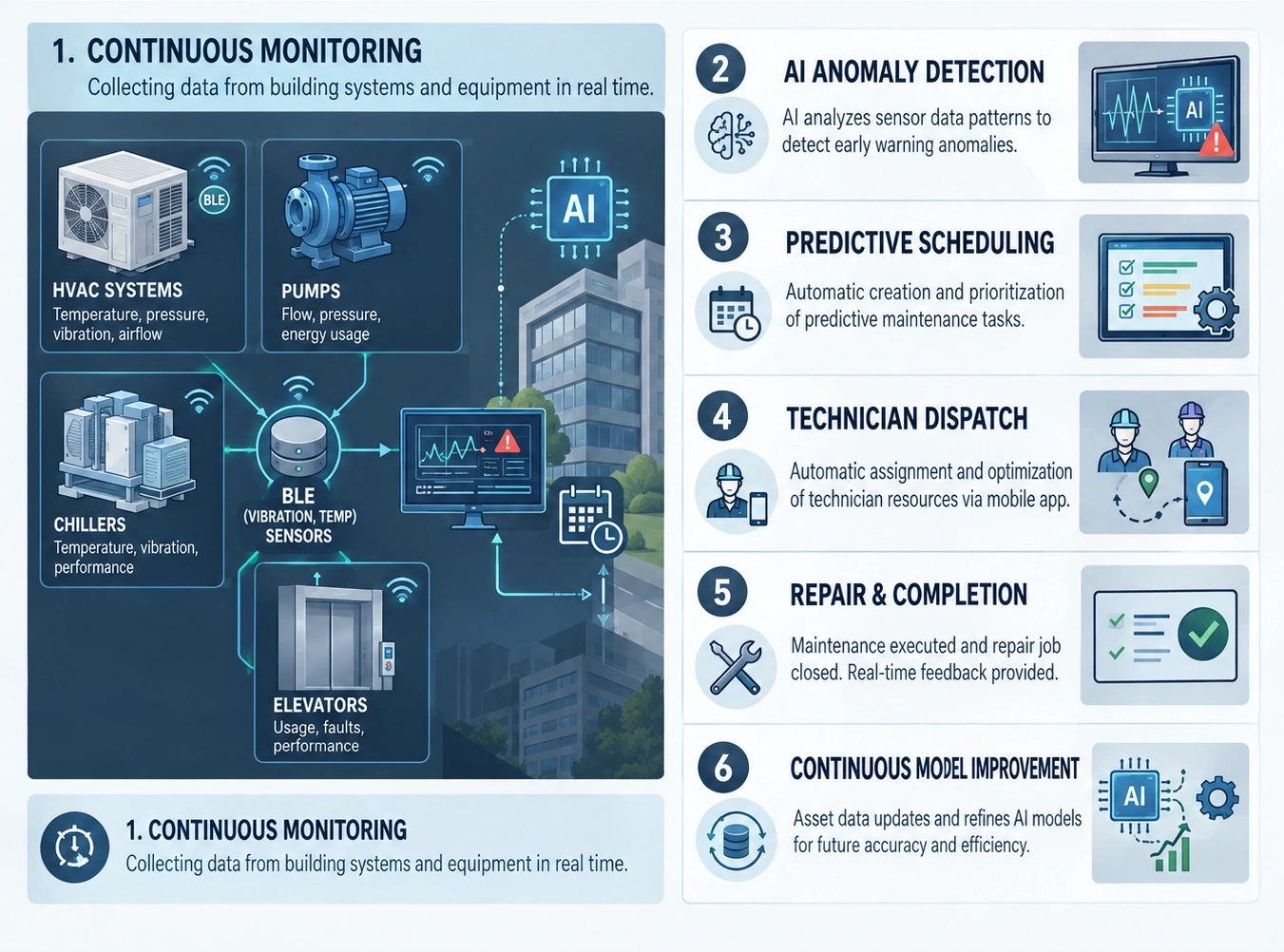
For residential communities, this combination can create a continuous operational feedback loop:
- BLE sensors and beacons capture physical or location-related events.
- BLE gateways collect information from devices within their coverage areas.
- Middleware validates and normalizes device events.
- Property management software receives relevant operational information.
- AI models analyze historical and current data.
- The system identifies anomalies, trends or recommended actions.
- Property managers, facility managers or maintenance personnel review the results.
- Authorized actions are performed and recorded.
- New operational data improves subsequent analysis.
Residential Community Applications for AI-Enabled BLE
Residential communities contain many distributed operational processes that can benefit from better visibility. The most effective applications are those where information is currently collected manually, where equipment conditions change frequently, or where locating assets and understanding building activity requires significant staff effort.
Smart Building Occupancy and Common-Area Management
AI can analyze BLE-derived occupancy information from selected common areas such as lounges, gyms, meeting rooms, laundry facilities and amenity spaces.
Property managers can use aggregated occupancy information to understand utilization patterns and support decisions concerning cleaning schedules, staffing and amenity management.
The system should distinguish operational occupancy analytics from individual resident surveillance. Where resident-associated data is involved, privacy requirements, consent, data minimization and access controls should be considered during system design.
Residential Facility Maintenance
AI can combine BLE sensor information with computerized maintenance management system records to identify conditions requiring attention.
For example, temperature or humidity sensors can identify unusual conditions in mechanical rooms, equipment spaces or other monitored areas. AI can compare current readings with historical patterns and generate an exception for facility personnel.
This approach can shift maintenance operations from purely reactive responses toward condition-based maintenance.
HVAC and Indoor Environmental Monitoring
Residential buildings contain large numbers of heating, ventilation and air-conditioning assets. BLE sensors can collect temperature, humidity and other environmental information from selected zones.
AI can identify recurring deviations from expected conditions and help facility managers investigate whether the cause relates to HVAC performance, occupancy patterns, equipment scheduling or environmental conditions.
The objective is not to let an AI model independently control critical building equipment without engineering validation. Rather, AI can provide information that helps personnel make better operational decisions.
Equipment and Maintenance Asset Tracking
Maintenance departments may need to manage ladders, power tools, inspection equipment, cleaning equipment, replacement equipment and other mobile assets.
BLE beacons attached to appropriate assets can provide identification and location-related information through nearby gateways. AI can then analyze movement patterns and utilization history.
This can help answer practical questions such as:
- Which maintenance assets are currently available?
- Where was a particular item last detected?
- Which equipment is repeatedly moved between buildings?
- Which assets appear underutilized?
- Which items have unusual movement patterns?
- Which equipment may require inspection or replacement based on operational records?
Access and Resident-Service Operations
BLE can support selected access-related workflows involving authorized credentials, mobile devices, staff equipment or BLE-enabled identification devices.
AI can analyze access events for operational anomalies, such as unusual patterns involving building entrances, maintenance areas or restricted service spaces.
Access decisions should remain governed by the property’s established security policies and authorization systems. AI-generated recommendations should not automatically override established access controls.
Parking and Residential Community Mobility
Parking facilities create operational challenges for multifamily communities, particularly properties with controlled garages, visitor parking and assigned spaces.
BLE-enabled devices can support selected vehicle, staff or space-identification applications. AI can analyze aggregated utilization patterns to help property managers understand parking demand, identify recurring congestion periods and improve allocation decisions.
Laundry and Amenity Equipment Monitoring
Residential communities often manage shared washing machines, dryers, fitness equipment, vending equipment and other resident-facing assets.
BLE sensors can provide equipment status information, while AI can identify abnormal usage or repeated equipment events. Maintenance teams can use the information to prioritize inspections and reduce unnecessary manual checks.
Waste and Cleaning Operations
BLE-enabled sensors can provide information about selected waste containers, cleaning equipment or service assets. AI can combine this information with service schedules and historical activity to help facility teams prioritize work.
This is particularly useful for larger residential communities where maintenance and cleaning personnel cover multiple buildings.
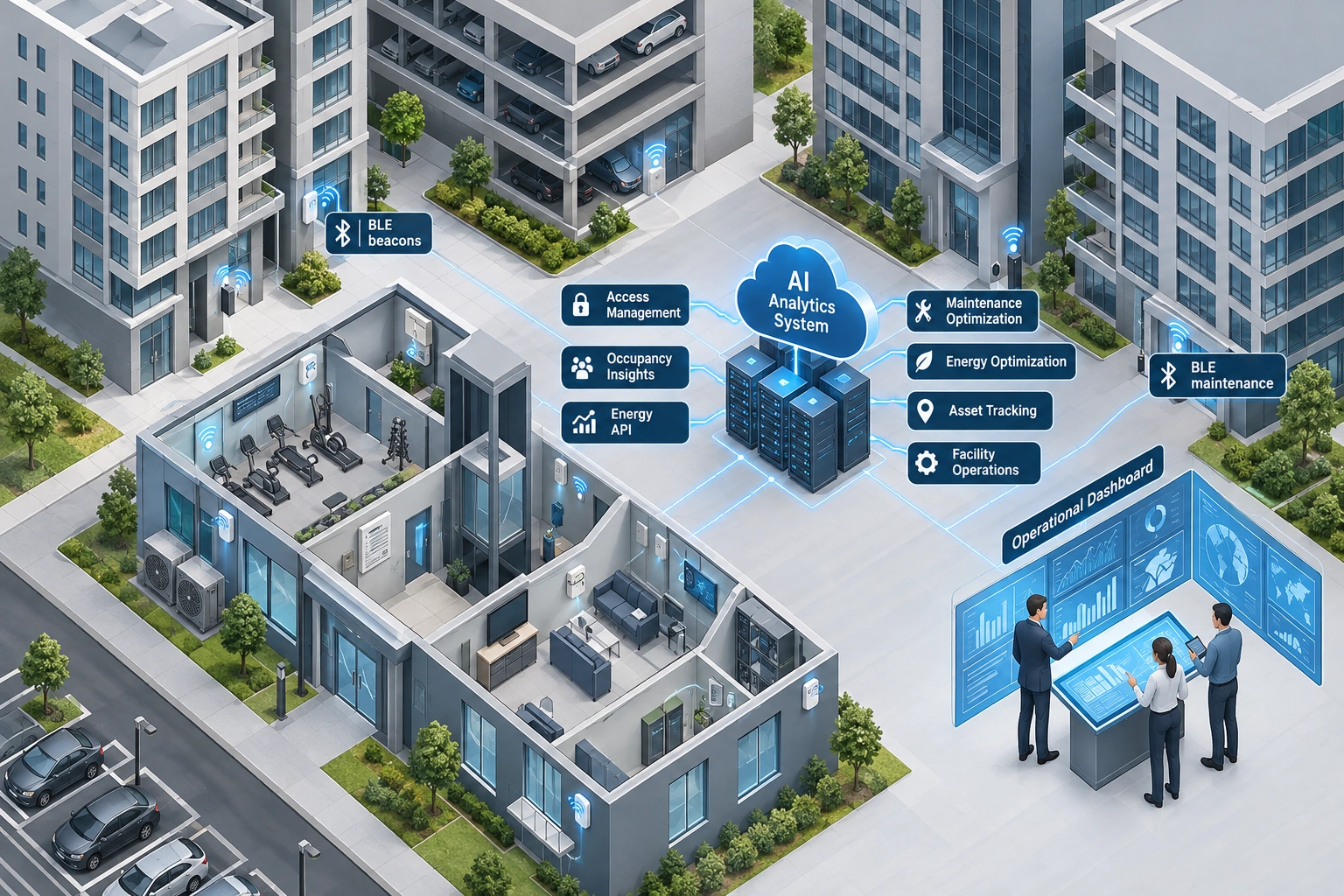
BLE-Enabled Smart Residential Community Site Plan
Operational Challenges in Residential BLE Deployments
BLE deployment in residential communities requires careful consideration of the physical building environment and operational workflows. Apartment buildings are not uniform wireless environments. Concrete walls, reinforced structures, elevators, mechanical rooms, utility spaces, metal doors and dense interior layouts can affect radio performance.
Device density also matters. A large residential development may contain hundreds or thousands of BLE-enabled devices. Gateway placement therefore needs to account for coverage, device density, expected traffic, interference and maintenance access.
Another consideration is battery management. Many BLE beacons and sensors are designed for low-power operation, but battery life depends on transmission interval, sensor activity, environmental conditions and device configuration. Property managers should establish a replacement and monitoring process rather than waiting for devices to fail.
Data quality is equally important. AI cannot reliably compensate for missing, duplicated or incorrectly associated sensor information. Each BLE device should have a defined identifier, location record, configuration state and maintenance status.
Residential communities also introduce privacy considerations that are less prominent in many commercial facilities. A technology deployment should collect only the information necessary for the stated operational purpose and should clearly distinguish building-management data from personally identifiable resident information.
BLE Hardware and AI Software for Residential Property Management
The hardware layer normally consists of BLE beacons, BLE sensors and BLE gateways.
BLE Beacons
BLE beacons can provide identifiers associated with rooms, zones, assets or other physical objects. They are useful where the primary requirement is to establish the presence or identity of an object within a BLE-enabled environment.
Examples include maintenance equipment, cleaning equipment, facility assets and selected location references.
BLE Sensors
BLE sensors can capture environmental or equipment-related measurements. Residential applications can include temperature, humidity, motion and selected equipment-state information.
Sensor selection should consider battery requirements, measurement accuracy, installation location, environmental exposure and required reporting interval.
BLE Gateways
BLE gateways provide the connection between BLE devices and the wider property-management software environment. Gateway placement should be based on actual building conditions rather than simply applying a theoretical coverage radius.
For larger properties, multiple gateways can be connected through Ethernet, Wi-Fi or cellular connectivity depending on site requirements. Network segmentation may be appropriate when BLE infrastructure connects to sensitive property-management systems.
GAO provides BLE gateways, BLE beacons and related hardware that can be evaluated for residential asset tracking, sensing and facility-management applications. GAO’s product range covers different BLE hardware configurations, allowing the device selection process to be matched to the property’s operational requirements. (GAO RFID)
AI Data Flow from Residential Buildings to Facility Decisions
A practical AI-enabled BLE deployment begins with physical events inside the residential community.
A sensor might detect a temperature change. A beacon attached to maintenance equipment might be detected by a nearby gateway. A gateway might receive repeated signals indicating that an asset has remained in a particular zone. These events become useful only after they are correctly associated with the relevant property, building, floor, room, asset or operational process.
The data flow can therefore include:
- BLE beacon and sensor transmission
- Gateway reception
- Device authentication and identification
- Local filtering and duplicate-event removal
- Timestamp and location association
- Middleware normalization
- Database storage
- Integration with property-management software
- AI analytics
- Exception or prediction generation
- Staff notification
- Maintenance or operational action
- Confirmation and record updating
This design also makes it possible to separate real-time operational functions from longer-term analytics. A gateway may handle immediate device communication, while historical information is processed by centralized software for trend analysis and forecasting.
Cloud and Server Deployment for Residential Communities
Residential property operators can select cloud-hosted or privately hosted software depending on portfolio size, IT policies, integration requirements and data-management preferences.
A Cloud Version can centralize BLE gateway information from multiple residential properties. This is useful for property-management organizations operating geographically distributed apartment communities because authorized personnel can access standardized information across multiple locations.
A Server Version can run software on customer-managed servers, private data centers or other privately hosted infrastructure. This approach can be appropriate where the property operator requires greater control over data storage, network connectivity, integration or internal IT governance.
Neither model is universally superior. The decision should consider:
- Number of residential properties
- Number of BLE devices
- Network availability
- Data-retention requirements
- Existing property-management software
- IT staffing
- Cybersecurity policies
- Integration requirements
- Remote management requirements
- Availability requirements
- Cost of operating and maintaining the selected infrastructure
Security should be designed into the deployment from the beginning. NIST guidance recommends treating IoT devices as components of the larger information system and considering the additional risks introduced when IoT products are acquired and integrated. NIST’s IoT cybersecurity guidance addresses areas such as device identification, configuration, data protection, interface access, software updates and device security. (NIST CSRC)
For residential communities, practical controls can include unique device credentials, controlled administrative access, encrypted communications where supported, network segmentation, software-update procedures, audit logging and defined device retirement processes.
AI-Driven Improvements in Residential Community Operations
AI becomes particularly valuable when BLE-generated information is combined with property-management records, maintenance histories, occupancy patterns, work orders, equipment data and service schedules. The objective is to turn disconnected building events into operational insights that property and facility managers can act upon.
Predictive Maintenance for Residential Facilities
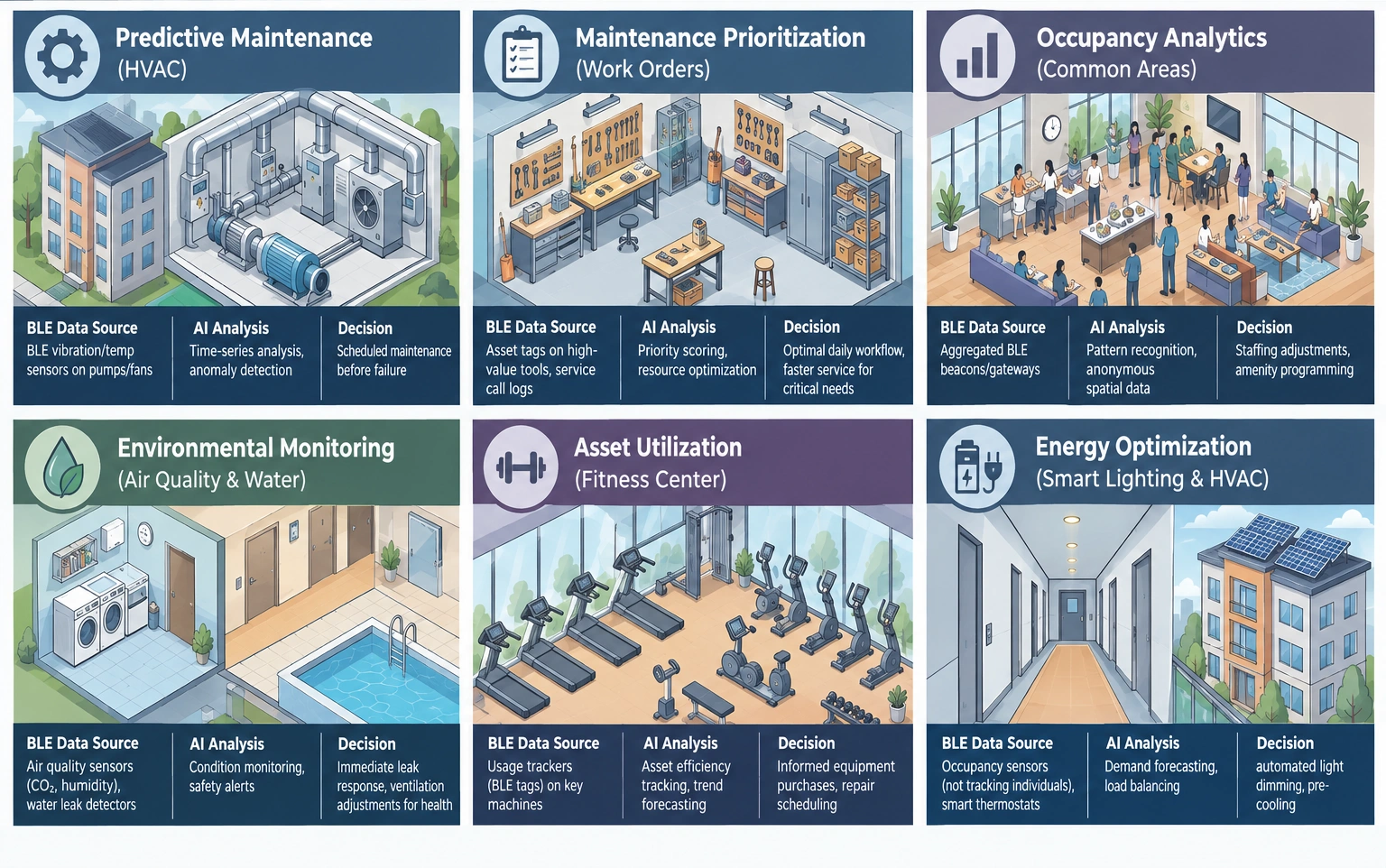
Traditional residential maintenance often depends on resident complaints, scheduled inspections or visible equipment failures. AI can supplement these approaches by analyzing sensor measurements and historical maintenance records to identify patterns that may precede equipment problems.
For example, repeated temperature deviations in a mechanical area can be correlated with previous HVAC service records. An AI model can identify whether the pattern warrants investigation and prioritize the event for a maintenance technician.
This approach can help reduce unnecessary inspections while allowing maintenance teams to investigate developing issues earlier.
Intelligent Maintenance Prioritization
Residential property teams frequently manage numerous maintenance requests simultaneously. AI can help classify and prioritize operational events based on factors such as equipment criticality, location, historical failure patterns, resident impact and service-level requirements.
A leaking pipe in a mechanical room, a malfunctioning access gate and a noncritical amenity-room sensor should not necessarily receive the same operational priority.
AI-assisted prioritization can provide maintenance teams with a more structured basis for determining which events require immediate attention.
Occupancy-Based Facility Management
BLE-generated occupancy information can provide property managers with aggregated information about the use of common areas.
AI can identify recurring patterns, such as peak gym usage, periods of low amenity utilization or unusually high activity in particular facilities. Managers can use these insights when planning cleaning, maintenance, staffing and amenity schedules.
Privacy should remain a fundamental design consideration. Residential occupancy analytics should avoid collecting unnecessary personally identifiable information and should use aggregated information whenever individual identification is not required.
Energy and Environmental Optimization
AI can correlate temperature, humidity, occupancy and equipment information to identify opportunities for improving building operations.
For example, if a common room consistently experiences high temperatures during periods of low occupancy, facility personnel can investigate HVAC scheduling, sensor placement or equipment performance.
AI should provide recommendations based on measured conditions rather than assuming that every energy anomaly originates from HVAC equipment.
Asset Utilization and Loss Reduction
Maintenance departments can use BLE-enabled asset identification to understand how tools and equipment move between buildings, maintenance rooms and work locations.
AI can analyze utilization frequency and movement history to identify assets that are rarely used, repeatedly misplaced or frequently required at particular properties.
This information can support decisions about equipment allocation and procurement without relying solely on manual inventory checks.
Six AI-Powered Use Cases for Smart Property Management
AI Models and Analytics for Residential BLE Systems
The appropriate AI method depends on the operational problem and the quality of the available data. A residential property operator should not select an AI model simply because it is technically sophisticated.
Useful approaches include:
· Anomaly detection: Identifies sensor or asset behavior that differs from established operating patterns.
· Time-series forecasting: Estimates future environmental conditions, equipment behavior or resource demand using historical measurements.
· Classification models: Categorize maintenance events, equipment conditions or operational exceptions.
· Clustering: Groups buildings, zones or equipment according to similar operational behavior.
· Predictive models: Estimate the likelihood of selected maintenance or operational events.
· Optimization algorithms: Help evaluate competing maintenance, staffing or resource-allocation decisions.
· Natural-language AI: Allows authorized personnel to query structured operational records using natural-language questions.
Data quality should be established before model development. Incorrect device identifiers, poor gateway coverage, missing readings and inconsistent property records can produce misleading AI results.
AI outputs should also be evaluated using measurable criteria such as false-positive rates, detection accuracy, prediction error and operational usefulness.
Residential Community Integration with Property Management Systems
AI-enabled BLE should complement existing property and facility management software rather than creating another isolated source of information.
Potential integration targets include:
- Property management systems
- Computerized maintenance management systems
- Enterprise asset management software
- Building management systems
- Access control software
- Work-order management systems
- Inventory management software
- Energy management systems
- Tenant or resident service applications
- Business intelligence and reporting software
A maintenance event detected through BLE can, for example, be associated with an existing equipment record and used to create or enrich a work order. A facility manager can then review the event, assign the work and record the completed maintenance activity.
APIs are often useful for connecting systems, but integration design should establish which application remains authoritative for each record. A BLE system should not unintentionally become the master database for resident, lease or financial information simply because it can exchange data with the property-management system.
GAO can supply the BLE hardware required to establish the physical data layer, while the final integration should be designed around the property operator’s existing software, IT policies and operational processes.
Security and Privacy for BLE Residential Communities
Security requirements become particularly important when BLE systems operate in residential environments because the technology may be located close to residents, staff, visitors and privately occupied spaces.
A secure deployment should consider the complete lifecycle of each BLE device.
Device Security
Each gateway and sensor should have controlled credentials and an appropriate configuration. Default credentials should not remain active in production environments.
Network Security
BLE gateways connecting to property networks should be placed within appropriately controlled network segments. Access between the IoT network and business systems should be restricted according to operational requirements.
Data Protection
Operational information should be protected during transmission and storage. Data retention should correspond to the actual business purpose rather than retaining every event indefinitely.
Identity and Access Management
Property managers, maintenance personnel, contractors and IT administrators may require different levels of access. Role-based access controls can prevent users from accessing information unrelated to their responsibilities.
Privacy-Aware Location Tracking
Location-related BLE applications require particular care in residential environments. Tracking a maintenance asset is fundamentally different from continuously tracking a resident.
Solutions should therefore define whether the tracked object is an asset, room, equipment item, staff device or resident-associated credential and collect only the information necessary for the intended operational purpose.
Selecting Uptime, Coverage and Battery Strategies
BLE deployments require engineering decisions that directly influence operational reliability.
Gateway density should be determined through a site survey that considers:
- Building dimensions
- Wall construction
- Floor-to-floor propagation
- Elevator shafts
- Mechanical rooms
- Metal equipment
- Radio interference
- Device density
- Required location accuracy
- Gateway backhaul connectivity
- Maintenance accessibility
Battery-powered sensors should also be selected according to the required reporting frequency. Increasing transmission frequency can improve data freshness but generally increases power consumption.
For a residential community, the appropriate configuration may therefore differ between a continuously monitored mechanical room and a low-frequency asset-tracking application.
A pilot deployment is strongly recommended before large-scale installation. Representative apartments, common areas, mechanical rooms and service spaces should be tested to establish actual RF performance.
Key KPIs for AI and BLE Residential Community Management
Performance should be measured against property-management outcomes rather than simply the number of connected devices.
Useful KPIs include:
- Asset-location accuracy
- BLE gateway availability
- Sensor data availability
- Battery replacement frequency
- Maintenance response time
- Mean time to repair
- Preventive maintenance completion rate
- Repeat maintenance events
- Unplanned equipment downtime
- Work-order completion time
- Common-area utilization
- Amenity utilization rate
- HVAC exception frequency
- Environmental-condition compliance
- Inventory discrepancy rate
- Lost or misplaced maintenance equipment
- Asset utilization rate
- Resident-reported maintenance response time
- AI anomaly detection accuracy
- AI false-positive rate
- Predictive maintenance precision
- Gateway communication failure rate
- Device replacement rate
- Energy-use anomalies detected
- Average time from alert to operational action
A useful KPI program should establish a baseline before implementation and then compare performance after deployment. This helps property operators determine whether AI-enabled BLE is producing measurable operational value.
Deployment Lifecycle for Residential Communities
Planning and Use-Case Definition
The deployment should begin by identifying a specific property-management problem.
Possible starting points include maintenance asset tracking, HVAC condition monitoring, amenity utilization or equipment monitoring.
The organization should define:
- Operational objective
- Assets or zones to be monitored
- Required data
- Users who need the information
- Existing software to be integrated
- Privacy requirements
- Cybersecurity requirements
- Required location accuracy
- Expected ROI or operational improvement
Site Survey and BLE Hardware Selection
A physical survey should identify suitable gateway locations and potential RF obstacles.
BLE beacons, sensors and gateways should then be selected according to the required range, battery life, sensing capability, installation method and environmental conditions.
Pilot Installation
A pilot should cover representative areas rather than only an ideal location. A residential property might test an apartment corridor, parking facility, mechanical room, lobby and amenity area.
Testing should verify signal performance, battery behavior, gateway connectivity, data accuracy and user workflows.
Software Integration
Validated BLE events can be connected to property-management, maintenance and asset-management systems.
Data mapping should clearly establish identifiers for buildings, floors, rooms, assets, devices and equipment.
AI Model Validation
AI models should be trained or configured using appropriate historical data and validated against actual operational outcomes.
A property manager should be able to determine why an alert was generated and what information supports the recommendation.
Production Deployment
Production rollout can proceed property by property or building by building.
Documentation should include gateway locations, device identifiers, installation records, battery information, software configuration and maintenance procedures.
Continuous Optimization
After deployment, property teams should review system performance periodically.
Changes in building layout, renovations, new equipment, gateway relocation and changes in property operations can affect BLE performance and AI model accuracy.
GAO BLE Solutions for Residential Community Applications
GAO provides BLE gateways, BLE beacons, BLE sensors and related IoT hardware that can support residential property and facility-management applications.
These technologies can be applied to selected use cases such as maintenance asset tracking, environmental sensing, equipment monitoring and location-aware facility operations. Hardware selection should be based on the physical environment, required sensing capability, connectivity requirements and the software systems receiving the data.
GAO’s broader work in BLE, RFID and IoT technologies provides experience relevant to organizations evaluating connected asset and facility-management solutions. Its products can serve as the physical data-collection layer while property operators integrate the resulting information with their existing maintenance, building and management software.
Headquartered in New York City and Toronto, Canada, GAO is ranked among the top 10 leading B2B and B2G BLE and RFID suppliers globally. GAO’s sister companies, GAO Research and GAO Tek, form GAO Group and are also based in New York City and Toronto.
For more than three decades, GAO Group has served customers across the United States and Canada, including Fortune 500 companies, leading R&D organizations, universities and government agencies. The group emphasizes R&D, quality assurance and technical support, including remote and onsite assistance.
Implementation Recommendations for AI and BLE in Residential Communities
Residential property operators should approach AI-enabled BLE as an operational improvement program rather than simply a wireless hardware installation.
Recommended practices include:
- Begin with a measurable property-management problem.
- Select BLE hardware according to the building environment and application requirements.
- Perform an RF site survey before finalizing gateway locations.
- Test sensors and beacons on representative surfaces and equipment.
- Establish consistent device and asset identifiers.
- Integrate BLE events with existing property and maintenance systems.
- Keep authoritative resident and financial records in the appropriate property-management applications.
- Use AI for anomaly detection, forecasting, classification and decision support where these methods provide measurable value.
- Protect resident privacy by minimizing personally identifiable information.
- Establish role-based access for property managers, maintenance staff, contractors and IT personnel.
- Monitor battery condition and device health.
- Establish cybersecurity and software-update procedures.
- Measure operational KPIs before and after implementation.
- Validate AI recommendations against actual maintenance and facility outcomes.
- Expand the deployment only after the pilot demonstrates reliable technical and operational performance.
Key Takeaways for AI and BLE in Residential Communities
AI-enabled BLE can help residential communities improve maintenance visibility, equipment monitoring, asset utilization, environmental management and selected occupancy-related facility operations.
BLE beacons, sensors and gateways provide the physical data needed to understand what is happening across buildings and shared facilities. AI adds analytical capabilities that can identify anomalies, forecast operational conditions, classify events and help property managers prioritize actions.
The strongest implementations begin with specific operational problems rather than attempting to connect every residential asset immediately. RF site surveys, appropriate gateway placement, reliable device identification, cybersecurity, privacy protection and software integration are fundamental to long-term performance.
GAO can support organizations evaluating BLE hardware and IoT systems for residential property and facility-management applications. Property operators can work with GAO to assess appropriate BLE gateways, beacons, sensors and related technical requirements for their facilities.
Building the Future of Industrial AI and IoT with Aperture Venture Studio and GAO RFID Inc.
For more than three decades, GAO Group of Companies has invested heavily in R&D involving industrial BLE, RFID and IoT technologies. As generative AI became increasingly useful in practical applications, we expanded our work in AIoT, including AI-enabled BLE and connected sensing solutions for property and facility management. We have also founded Aperture Venture Studio to build and scale AI and IoT solutions relevant to areas such as smart residential communities, connected facilities and intelligent asset management.
Aperture brings together AI and IoT technical experts, operational executives, investors and leading companies. We also organize Aperture Ventures Summit and TekSummit to explore advanced AI and IoT technologies.
We welcome participation as:
- Advisors, co-founders or employees
- Investors
- Customers