
AI and RFID for Corrugated Packaging
AI-Driven Corrugated Packaging Production and Traceability
AI and RFID for Corrugated Packaging combine AI-driven analysis with connected identification of corrugated sheets, rolls, WIP, finished cases, tooling, pallets, and production assets. The objective is not simply to automate identification, but to give corrugated packaging manufacturers better control over high-volume production, material consumption, order fulfillment, quality, and warehouse movement.
AI can analyze production orders, flute profiles, board grades, machine conditions, customer specifications, and historical performance to improve scheduling, waste reduction, quality control, and maintenance decisions. RFID provides physical identification and movement events that connect materials and products to those decisions. Together, these capabilities can help corrugated plants reduce manual transactions, improve WIP visibility, strengthen lot traceability, and identify operational exceptions earlier.
For corrugated packaging operations, the business value is particularly relevant because plants frequently handle short lead times, high order volumes, multiple board grades, rapid changeovers, variable print requirements, die-cutting, folding-gluing, bundling, palletizing, and time-sensitive shipping.
Fundamentals of AI and RFID in Corrugated Packaging
Corrugated packaging manufacturing converts paper-based materials into corrugated board, sheets, boxes, trays, partitions, displays, and other protective packaging products. Production may involve paper rolls, corrugators, flexographic printing, slotting, rotary die cutting, folder-gluer operations, stitching, bundling, palletizing, and warehouse staging.
The manufacturing sequence creates multiple points where material identity and production status can become difficult to track. A paper roll can move from receiving to a corrugator, corrugated board can become WIP sheets, sheets can be printed and converted, and finished bundles can move through staging before shipment. Manual barcode scans can provide useful transactions, but they depend on operator intervention and line-of-sight scanning.
RFID provides another identification mechanism. UHF RFID is particularly relevant to longer-range identification of paper rolls, board bundles, finished cases, pallets, and warehouse movements. HF RFID can support controlled short-range identification at workstations or specific process points, while LF RFID can be evaluated for specialized short-range asset-identification applications.
AI adds a decision layer above these physical events. Rather than merely recording that a pallet moved through a dock door, an AI-enabled solution can correlate the movement with the customer order, production status, quality release, shipping schedule, and inventory requirement.
GAO provides RFID, BLE, and IoT hardware products and systems that organizations can use to support identification, tracking, connected operations, and data collection across manufacturing and logistics workflows.
Corrugated Packaging Applications for AI-Driven Operations
Paper Roll and Raw Material Traceability
Paper rolls represent a major material input for corrugated packaging production. Mills, suppliers, grades, basis weights, widths, flute requirements, and material lots can vary according to customer specifications and production orders.
RFID identification can associate a paper roll with its material lot, supplier information, receiving transaction, storage location, and intended production requirements. AI can then use material availability and historical consumption information when evaluating production schedules and replenishment requirements.
This helps reduce the risk of selecting an incorrect paper grade or searching manually for a required roll.
Corrugator Production Tracking
Corrugators transform linerboard and medium into corrugated board using processes involving steam conditioning, adhesive application, flute formation, pressure rolls, cutting, and stacking.
AI can analyze corrugator operating data, production speed, order characteristics, material consumption, downtime, and waste patterns. RFID can associate resulting board bundles or WIP with the production order and material inputs.
This creates stronger traceability between the paper entering the corrugator and the board subsequently entering printing and converting operations.
Production Order and WIP Tracking
Corrugated plants often have WIP distributed across production areas, staging lanes, warehouses, and converting machines. Similar-looking board bundles can create identification risks when several customer orders use comparable grades or dimensions.
RFID can identify WIP bundles as they move between:
- Corrugator output
- Sheet storage
- Printing
- Slotting
- Die cutting
- Folding and gluing
- Bundling
- Palletizing
- Finished-goods staging
AI can use WIP location, production status, machine availability, customer priority, and due dates to identify orders at risk of delay.
AI-Based Production Scheduling
Production scheduling in corrugated packaging must account for board grade, flute profile, sheet dimensions, print requirements, die availability, machine capabilities, customer delivery requirements, and changeover constraints.
AI can evaluate these variables and recommend production sequences that reduce unnecessary setup and improve machine utilization.
RFID strengthens this process by providing current physical status. If a required die is still in another production area or a specific paper roll has not reached the corrugator staging area, the scheduling system can recognize that constraint instead of assuming the material is available.
Potential improvements include:
- Better corrugator sequencing
- Reduced setup and changeover time
- Improved press utilization
- Lower WIP waiting time
- Better schedule adherence
- Earlier identification of material constraints
- Improved on-time completion of customer orders
Printing and Converting Traceability
Flexographic printing, rotary die cutting, slotting, folding-gluing, stitching, and other converting processes introduce additional opportunities for tracking errors.
RFID can connect a WIP bundle or pallet to its production order while it moves through these operations. AI can evaluate production performance and identify relationships between machine conditions, setup parameters, substrate characteristics, and finished-product quality.
The resulting traceability is useful when a customer requires verification of the material, production order, machine route, or quality status associated with a shipment.
Tooling and Die Management
Rotary dies, printing plates, cutting tools, anilox rolls, forming tools, and other production tooling can affect both product quality and production availability.
RFID tags can identify tooling and associate it with:
- Customer or product number
- Die specification
- Tooling revision
- Storage location
- Usage history
- Maintenance status
- Production order
- Inspection status
AI can analyze tooling usage and production history to identify tools approaching maintenance or replacement thresholds. It can also identify repeated delays caused by unavailable tooling.
Quality Hold and Release
Corrugated packaging quality can be affected by board caliper, moisture, flute integrity, compression performance, print registration, color, dimensions, slotting accuracy, die-cut quality, glue application, folding accuracy, and other production variables.
AI-based machine vision and statistical models can identify abnormal patterns from inspection data. RFID can associate quality events with specific WIP bundles, production orders, material lots, or finished pallets.
When a defect is detected, the system can support controlled quarantine rather than allowing an incorrectly identified pallet to move into shipment staging.
Finished Goods and Shipment Verification
Finished corrugated packaging can be bundled, palletized, wrapped, staged, and loaded for shipment. Similar packaging products may be stored close together, increasing the risk of picking the wrong customer order.
RFID read zones at staging areas and dock doors can help verify physical movement. AI can compare the detected shipment against the customer order, production status, quality-release status, and shipping schedule.
This can reduce shipment errors while creating a stronger digital record of chain-of-custody events.
Operational Challenges in Corrugated Packaging
AI and RFID deployments should address actual corrugated plant constraints rather than treating the facility as a generic manufacturing environment.
Common challenges include:
- High production volumes and tight shipping windows
- Large numbers of customer-specific SKUs
- Similar-looking board grades and finished bundles
- Rapid corrugator and converting schedules
- Frequent changeovers
- Paper roll and board inventory discrepancies
- WIP distributed across multiple production zones
- Manual material transactions
- Tooling availability problems
- Die and printing plate retrieval delays
- Waste from trim, setup, and production defects
- Machine downtime
- Moisture and environmental variation affecting paper performance
- Dust and debris around production equipment
- Metal machinery affecting RFID performance
- Dense pallet and bundle storage
- Forklift traffic
- Dock congestion
- Quality holds and quarantine
- Customer-specific packaging specifications
- Shipment verification requirements
- Legacy PLC, SCADA, MES, ERP, WMS, and print MIS systems
These conditions make event accuracy particularly important. An RFID read should not automatically be interpreted as a completed business transaction without considering location, direction of movement, timing, and production context.
AI Applications That Improve Corrugated Packaging Operations
AI Waste and Yield Optimization
Material waste is a major operational concern in corrugated packaging because paper represents a substantial portion of manufacturing cost. AI can analyze trim waste, setup waste, rejected sheets, board defects, machine speed, order dimensions, and historical production results.
The system can identify production patterns associated with excessive waste and recommend improved sequencing, run parameters, or order grouping.
AI Quality Anomaly Detection
AI can detect relationships among machine conditions, board properties, print quality, dimensional measurements, and defect patterns. A quality model can flag unusual production behavior before a large quantity of material is affected.
RFID provides the identity needed to isolate affected WIP and finished goods.
Predictive Maintenance
Corrugators, flexographic presses, die cutters, folder-gluers, conveyors, stackers, palletizers, and other equipment contain components that can experience wear or failure.
IoT devices can collect vibration, temperature, motor current, runtime, speed, pressure, and fault information. AI can analyze these variables to identify abnormal operating patterns.
RFID can then help locate the required spare parts, maintenance kits, dies, or replacement components.
Inventory Forecasting
AI can forecast paper, adhesive, ink, tooling, packaging materials, and MRO requirements using production history, customer demand, order schedules, and inventory movement.
RFID events provide additional evidence about actual physical inventory movement, helping distinguish system inventory from material that has physically moved into production or staging.
End-to-End AI and RFID Workflow for Corrugated Packaging
A complete solution should connect physical events to business decisions through a controlled sequence.
Physical Data Acquisition
RFID tags are attached to appropriate paper rolls, WIP bundles, finished pallets, tooling, dies, or other trackable objects. IoT devices and machine interfaces collect operating information from corrugators and converting equipment.
Machine vision systems can capture images and measurements for quality analysis.
RFID Read Zones and Edge Collection
Readers and antennas are installed at controlled locations such as receiving points, production entrances, WIP transfer areas, warehouse aisles, staging lanes, and dock doors. Edge gateways collect and filter events close to the production environment. Duplicate reads can be suppressed and local business rules can determine whether an object actually crossed a defined process point.
Communication Infrastructure
Processed events can travel through Ethernet, industrial networks, Wi-Fi, cellular connectivity where appropriate, or other approved communications infrastructure.
Protocols and interfaces may include TCP/IP, HTTPS, MQTT, REST APIs, and OPC UA depending on the equipment and enterprise systems involved.
Middleware and Event Normalization
RFID middleware converts raw reader observations into meaningful events. A system might interpret multiple antenna reads as one verified movement from a corrugator staging zone into a converting area.
This event can then be associated with a production order rather than being treated as an isolated RFID transaction.
Enterprise Software Integration
The resulting events can be exchanged with:
- ERP
- MES
- WMS
- QMS
- CMMS or EAM
- SCADA
- PLC systems
- Print MIS
- Production historian
- TMS
- Shipping software
- Customer-order systems
The objective is to connect physical corrugated packaging operations with the software already responsible for production, quality, inventory, maintenance, and fulfillment.
AI Analytics and Decision Support
AI models consume validated production and RFID event data. Depending on the use case, models can include machine-learning forecasting, anomaly detection, optimization models, computer vision, classification models, predictive maintenance models, and statistical process-control methods.
AI outputs can include:
- Recommended production sequence
- Material shortage prediction
- WIP delay prediction
- Machine failure risk
- Quality anomaly alert
- Waste optimization recommendation
- Inventory replenishment forecast
- Shipment exception alert
Operational Action
The final stage is an operational decision. A production manager may change the schedule, a warehouse operator may redirect a pallet, a maintenance technician may replace a component, or a quality manager may place affected material on hold.
The closed-loop process becomes:
Physical event → Data capture → Edge processing → Communication → Middleware → Enterprise context → AI analysis → Operational decision → Verified action
AI and RFID in Corrugated Packaging Operations
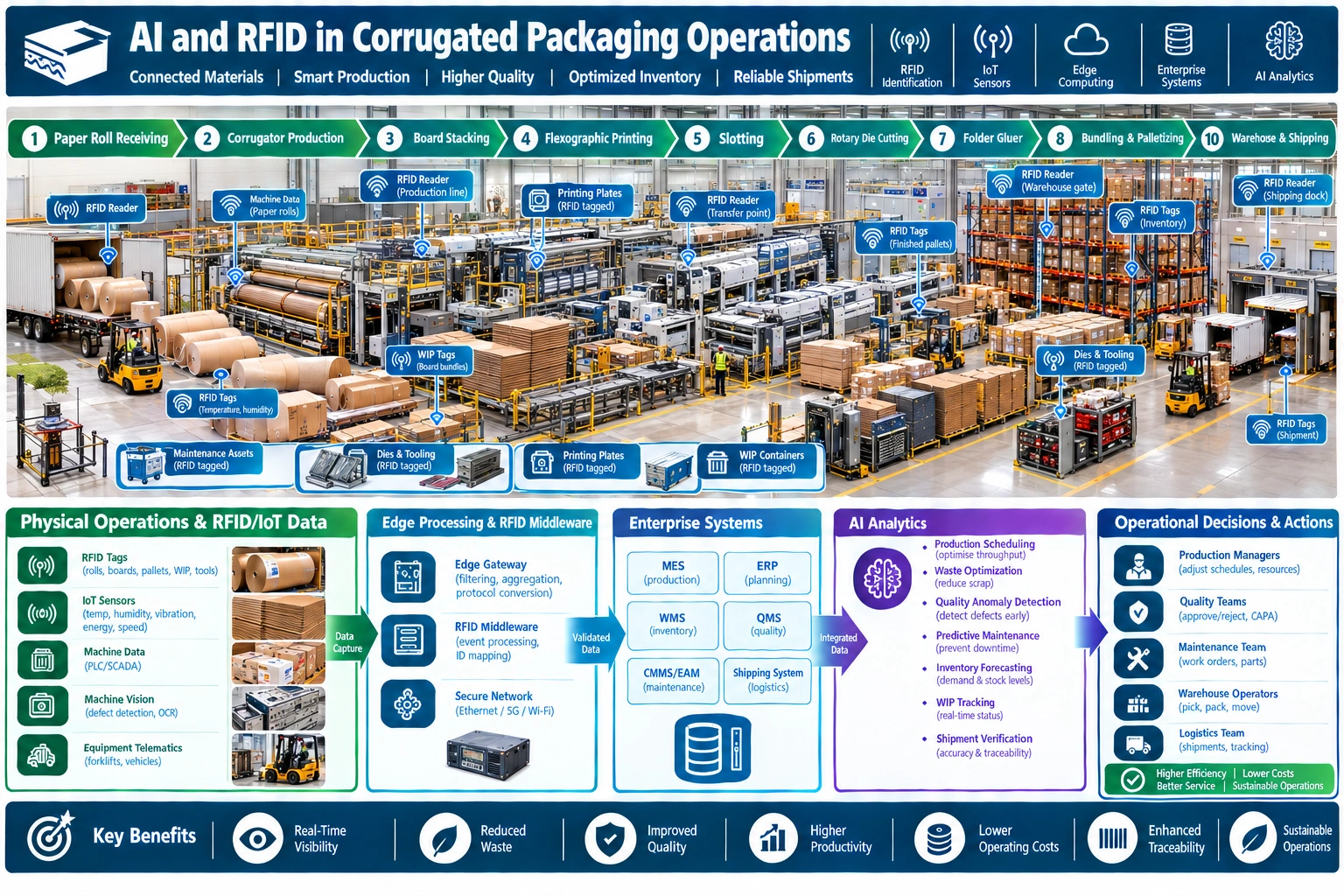
This infographic follows RFID-tagged materials and assets through paper roll receiving, corrugator production, printing, die cutting, bundling, palletizing, warehousing, and shipping. RFID, IoT sensors, machine data, and vision systems flow through edge processing and enterprise platforms into AI analytics that support production, quality, maintenance, inventory, WIP tracking, and shipment decisions.
Technical System Foundation for Corrugated Packaging
A technically sound deployment combines RFID hardware, IoT devices, edge computing, middleware, AI software, enterprise applications, and secure communications.
RFID Hardware
UHF RFID readers and antennas are well suited to many corrugated packaging movements because paper rolls, bundles, cases, and pallets can move through defined production and warehouse zones. Reader placement should account for forklift traffic, pallet orientation, antenna polarization, conveyor geometry, metal machinery, and nearby RF-reflective structures.
HF RFID can support short-range identification at controlled workstations, while LF RFID can be considered for specialized short-range applications where its operating characteristics fit the physical requirement.
Tag selection should be tested against actual corrugated materials. Dense paper stacks normally behave differently from metal-intensive environments, but the presence of machinery, foil-coated products, moisture, and nearby conductive surfaces can still influence read performance.
Edge Computing and RFID Middleware
Edge computers can receive reader data, filter duplicate reads, buffer events during network interruptions, and execute local rules. This is particularly useful around corrugators, presses, converting lines, and dock doors where immediate event processing may be required.
Middleware provides the translation layer between RFID events and enterprise transactions. It can apply location, timing, object identity, and workflow rules before sending validated information to MES, ERP, WMS, or other systems.
AI Models and Data Processing
AI models can operate on production records, RFID events, machine telemetry, quality measurements, and order data. Time-series models can support maintenance and production forecasting. Classification and anomaly-detection models can identify abnormal machine or quality conditions. Computer vision can inspect printed or converted corrugated products.
Model performance depends on data quality. Incorrect production-order associations, duplicate RFID reads, missing machine data, and inconsistent timestamps can degrade AI recommendations.
Cloud Version
The Cloud Version is a cloud-hosted SaaS deployment managed within cloud infrastructure. It can be appropriate for corrugated packaging manufacturers operating multiple plants that require centralized production visibility, consolidated analytics, shared reporting, and remote access to approved operational information.
Cloud processing is particularly useful for aggregating production and inventory information across plants without requiring every facility to maintain identical central computing infrastructure.
Server Version
The Server Version is software deployed on edge servers, customer-managed servers, private data centers, factory servers, or other privately hosted enterprise infrastructure. It is not limited to traditional on-premises deployment.
This model can fit corrugated packaging operations that require tighter control over data location, plant-network boundaries, OT connectivity, or integration with privately managed ERP, MES, WMS, and manufacturing systems.
A hybrid deployment can keep latency-sensitive RFID and machine processing near production equipment while transferring selected information to centralized cloud or private enterprise systems.
Security and Supporting Infrastructure
Security should cover RFID readers, gateways, edge computers, servers, APIs, enterprise applications, and user accounts.
Important controls include network segmentation, role-based access control, authenticated APIs, encrypted communications, secure remote access, logging, patch management, backup procedures, and controlled administrative privileges.
Corrugated plants should also design for communication interruptions. Local event buffering and store-and-forward mechanisms can prevent temporary network outages from creating unexplained gaps in WIP or shipment traceability.
The resulting system connects physical corrugated packaging events with production context, allowing AI to convert those events into operational predictions, recommendations, and controlled decisions
Advanced AI for Corrugated Packaging Production
AI becomes more valuable when RFID events are combined with production orders, machine telemetry, quality records, inventory transactions, tooling data, and shipping requirements. RFID establishes the identity and physical location of materials and products, while AI evaluates those events against production conditions and business requirements.
AI Production Scheduling and Order Sequencing
Corrugated packaging production schedules must account for board grade, flute profile, sheet dimensions, customer specifications, print requirements, die availability, machine capabilities, delivery dates, and setup requirements.
AI can evaluate these constraints simultaneously and recommend sequences that reduce unnecessary changeovers and improve machine utilization. RFID adds real-time physical status to the scheduling process.
For example, if a required paper roll is still in receiving or a rotary die has not been returned to the tooling area, the scheduling system can identify the constraint before the job reaches the production queue.
AI scheduling can support:
- Corrugator sequencing
- Flexographic press scheduling
- Die-cutting job sequencing
- Folder-gluer scheduling
- Tooling-dependent production planning
- Urgent-order prioritization
- Material availability analysis
- Production bottleneck identification
- Delivery-risk prediction
AI Changeover and Makeready Optimization
Short production runs can create substantial setup activity across corrugators, printers, die cutters, folder-gluers, and other converting equipment. AI can examine historical setup durations and identify the conditions associated with long changeovers.
RFID can identify the physical location of dies, printing plates, tooling, and required materials before a job begins. This allows production teams to prepare the required resources while the previous job is still running.
AI can identify whether recurring delays are associated with:
- Tool retrieval
- Printing plate preparation
- Die availability
- Board staging
- Ink preparation
- Machine setup
- Registration adjustment
- Print inspection
- Folder-gluer setup
- Cleaning and makeready
The resulting recommendations can reduce avoidable setup delays without removing operator control over production-critical adjustments.
AI Quality Inspection for Corrugated Packaging
Corrugated packaging quality depends on both board characteristics and converting accuracy. Defects may include print registration errors, color variation, damaged flute structures, incorrect dimensions, slotting errors, die-cut defects, poor folding, glue-line problems, and incorrect variable information.
Computer vision can inspect printed and converted products while machine-learning models identify patterns that are difficult to detect consistently through manual inspection alone.
RFID connects the inspection result to the physical production unit. A quality event can therefore be associated with a particular production order, WIP bundle, pallet, paper lot, machine, and production time.
This allows quality teams to isolate affected material instead of applying unnecessarily broad quality holds.
AI Predictive Maintenance for Corrugators and Converting Equipment
Corrugators, flexographic presses, rotary die cutters, folder-gluers, conveyors, stackers, palletizers, and other equipment contain mechanical and electrical components that require scheduled and condition-based maintenance.
IoT devices can collect vibration, temperature, motor current, speed, pressure, runtime, fault codes, and other machine information. AI can analyze time-series data to identify abnormal patterns and estimate potential equipment problems.
RFID can extend this workflow into the maintenance storeroom by identifying spare motors, bearings, belts, tooling components, maintenance kits, and other MRO assets.
When an abnormal condition is detected, the maintenance workflow can determine whether the required part is available and where it is physically located.
AI Predictive Maintenance in Corrugated Packaging Manufacturing
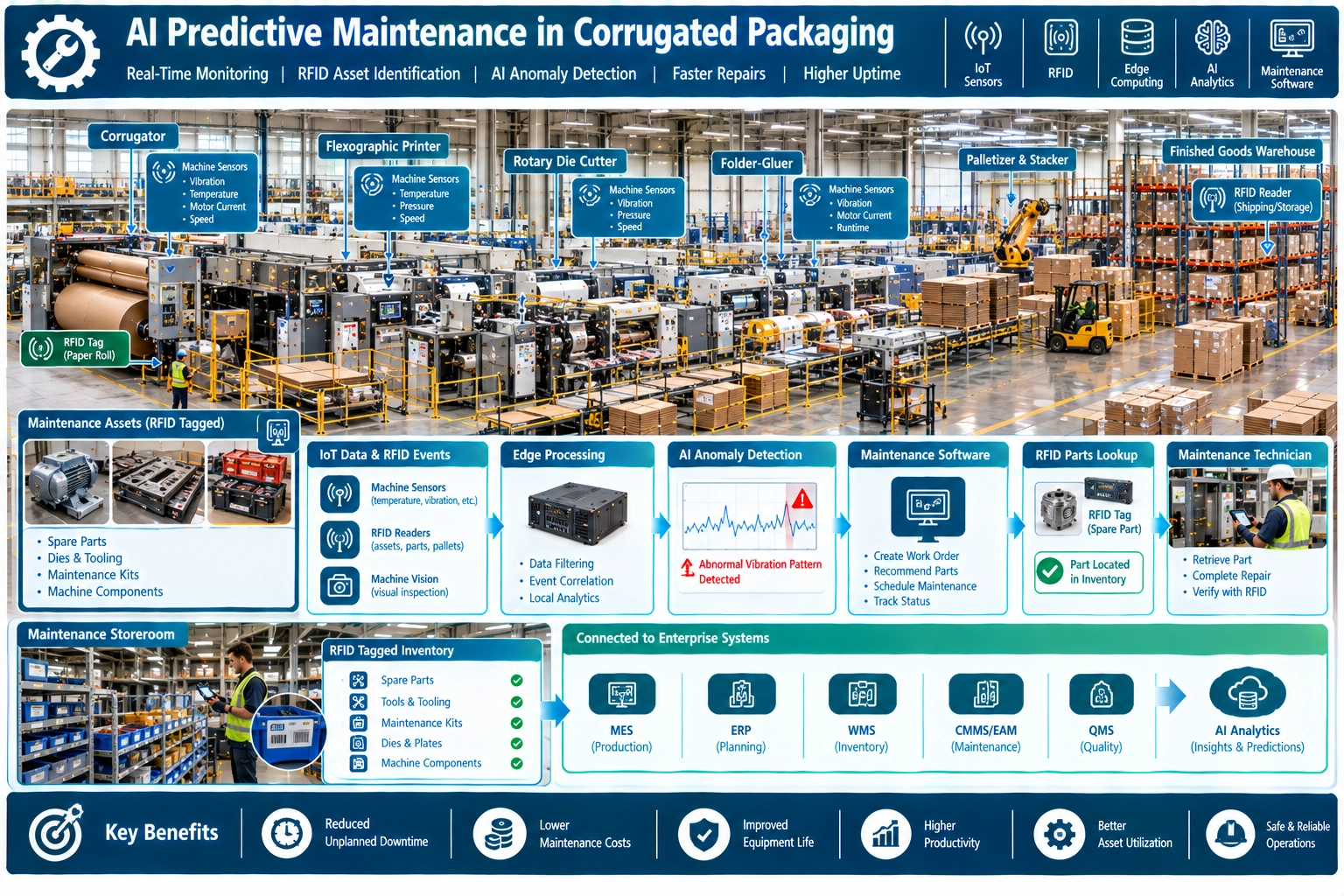
This visual shows IoT sensors monitoring corrugated packaging equipment while RFID identifies spare parts, tooling, maintenance kits, and machine components. Machine data flows through edge processing and AI anomaly detection to maintenance software, helping technicians locate the required parts and complete maintenance tasks before failures cause extended downtime.
Edge AI, Cloud, and Server Processing
Processing should be distributed according to response time, data volume, connectivity, cybersecurity requirements, and the operational importance of the decision.
Edge AI for Production Lines
Edge computing can process selected RFID, machine, and vision data close to the corrugator or converting line. This reduces dependence on round-trip communication to a remote computing environment.
Typical edge functions include:
- RFID event filtering
- Duplicate-read suppression
- Local object identification
- Machine anomaly detection
- Vision-based defect detection
- Production-line status evaluation
- Local alert generation
- Temporary data buffering
- Store-and-forward during network interruptions
Edge AI is particularly useful when an operator needs an immediate response to a production anomaly.
Cloud Analytics for Multi-Plant Corrugated Packaging
A cloud deployment can aggregate production, quality, inventory, maintenance, and shipping information from multiple corrugated plants.
A Cloud Version means the software is delivered as a cloud-hosted SaaS deployment managed within cloud infrastructure. It is appropriate when organizations want centralized access to operational analytics, multi-site reporting, common AI models, and consolidated inventory or production visibility.
Cloud deployment can be valuable for organizations operating multiple converting facilities or geographically distributed warehouses.
Private Server Deployment
A Server Version is software deployed on edge servers, customer-managed servers, private data centers, factory servers, or other privately hosted enterprise infrastructure. It is not restricted to conventional on-premises infrastructure.
This approach can be appropriate when a corrugated packaging manufacturer needs tighter control over data location, plant-network boundaries, OT integration, internal security policies, or privately managed enterprise applications.
A hybrid implementation can keep time-sensitive RFID and machine processing at the plant while transferring selected operational information to centralized cloud or private computing resources.
Communication and Integration with Corrugated Packaging Systems
AI-driven decisions are only useful when they can interact with the systems responsible for production, inventory, quality, maintenance, and fulfillment.
A corrugated packaging deployment may exchange information with:
- ERP
- MES
- WMS
- QMS
- CMMS or EAM
- SCADA
- PLC systems
- Print MIS
- Production historians
- TMS
- Shipping software
- Customer-order systems
- Barcode systems
Communication methods can include TCP/IP, HTTPS, MQTT, REST APIs, OPC UA, Ethernet-based industrial communications, and other interfaces selected according to the installed equipment.
RFID middleware should normalize reader events before transmitting transactions to business applications. For example, a pallet passing an RFID reader multiple times should not create several inventory transfers. Location, time, direction, reader identity, and workflow state should be evaluated before an event becomes a business transaction.
A useful event chain can be:
Paper roll received → Material identified → Roll staged → Corrugator production started → Board bundle created → WIP transferred → Printing completed → Die cutting completed → Quality released → Pallet stored → Order picked → Dock verified → Shipment completed
This event model allows production and logistics systems to work from consistent physical-state information.
Cybersecurity for Connected Corrugated Packaging Operations
RFID and AI systems introduce additional connections between production equipment, plant networks, edge computers, enterprise software, and remote services. Security controls therefore need to address both OT and IT environments.
Recommended controls include:
- Network segmentation between production and corporate systems
- Role-based access control
- Strong user authentication
- TLS-protected communications
- Controlled VPN access
- API authentication
- Secure reader and gateway configuration
- Patch and vulnerability management
- Audit logging
- Backup and recovery procedures
- Least-privilege administration
- Controlled remote maintenance access
- Monitoring for abnormal system activity
RFID middleware should also prevent unauthorized devices or applications from injecting false production events.
AI governance is equally important. Production teams should understand which data feeds a model, how predictions are generated, how model changes are controlled, and when human approval is required.
High-impact actions such as production rescheduling, quality disposition, or shipment release should normally retain an appropriate human approval mechanism unless the process has been thoroughly validated for automated execution.
Enterprise Implementation and Commissioning
A successful corrugated packaging deployment begins with workflow analysis rather than reader installation. Engineers should first determine which physical objects require identification, where those objects move, and which business decisions depend on their status.
Deployment Lifecycle
A practical implementation sequence includes:
- Map paper receiving, corrugator, converting, warehouse, and shipping workflows
- Identify high-value tracking points
- Define identifiers for paper rolls, WIP bundles, finished pallets, tooling, and MRO assets
- Review existing ERP, MES, WMS, QMS, CMMS/EAM, and print MIS interfaces
- Conduct an RF site survey
- Identify metal equipment, RF-reflective surfaces, dense pallet locations, and potential interference
- Select appropriate RFID frequencies and tag types
- Engineer reader and antenna locations
- Configure edge gateways and middleware
- Establish event rules and exception handling
- Integrate enterprise applications
- Prepare AI training and validation data
- Commission RFID read zones
- Test actual forklift, conveyor, pallet, and bundle movement
- Validate transaction accuracy
- Establish quality-hold and quarantine procedures
- Train production, warehouse, quality, maintenance, IT, and logistics personnel
- Measure baseline and post-deployment KPIs
- Expand the validated solution to additional workflows
Pilot Design for Corrugated Plants
A pilot should have a measurable operational objective. Tracking every object in the plant from the beginning can make commissioning unnecessarily complex.
A focused pilot might track paper rolls from receiving to corrugator staging, or finished pallets from production release to shipping verification. Once read accuracy, event logic, integration, and user procedures are validated, additional workflows can be added.
RFID Selection for Corrugated Packaging
RFID frequency and tag selection should follow the physical characteristics of the object and the required read zone.
| RFID Type | Corrugated Packaging Application | Primary Engineering Consideration |
|---|---|---|
| UHF RFID | Paper rolls, WIP bundles, finished pallets, warehouse and dock tracking | Longer read ranges and rapid identification require controlled antenna placement and RF testing |
| HF RFID | Controlled workstation or close-proximity identification | Useful where short-range intentional reads are preferred |
| LF RFID | Specialized short-range asset identification | Appropriate only where its operating characteristics match the specific use case |
UHF RFID will often be the first technology evaluated for pallet, bundle, roll, and warehouse movement. However, tag placement should be tested on the actual corrugated packaging configuration.
Paper stacks, wrapped pallets, moisture variation, metal machinery, conveyors, forklifts, and nearby RF-reflective structures can all affect the read environment.
AI and RFID KPIs for Corrugated Packaging
A deployment should establish baseline measurements before production rollout.
Important KPIs include:
- OEE
- Corrugator utilization
- Press utilization
- Throughput
- Run speed
- Changeover time
- Makeready time
- Downtime
- Schedule adherence
- First-pass yield
- Scrap rate
- Trim waste
- Board yield
- Paper consumption variance
- WIP aging
- Inventory accuracy
- Finished-goods dwell time
- Order accuracy
- Shipment accuracy
- Quality-hold duration
- Tooling availability
- Maintenance response time
- Mean time between failures
- Mean time to repair
- Production lead time
- On-time shipment rate
- Traceability completeness
- RFID read accuracy
RFID-specific metrics should not be considered sufficient by themselves. A high read rate has limited business value if events do not correctly update inventory, production status, quality status, or shipment records.
Standards, Regulations, and Compliance Considerations
Requirements vary according to geography, customer requirements, product application, material composition, and end-use market.
Relevant considerations may include:
- Regional radio-frequency regulations
- EPC Gen2 / ISO 18000-63 for applicable UHF RFID deployments
- ISO/IEC 15693 for applicable HF implementations
- ISO/IEC 14443 for applicable close-range HF identification
- Quality-management requirements applicable to the manufacturer
- Machinery and electrical safety requirements
- Workplace safety requirements
- Chemical-handling requirements for inks, adhesives, coatings, and cleaning materials
- Environmental and waste-management requirements
- Customer-specific traceability specifications
- Food-contact packaging requirements where applicable
- Pharmaceutical packaging requirements where applicable
- Data protection requirements
- Cybersecurity requirements
- Customer audit and record-retention requirements
Compliance should be evaluated for the complete solution, including RFID equipment, industrial networks, AI software, data handling, production equipment, and customer-specific packaging requirements.
Business Benefits of AI-Driven Corrugated Packaging Operations
The strongest business cases connect AI and RFID capabilities to measurable manufacturing problems.
Higher Material and Inventory Accuracy
RFID can reduce dependence on manual identification of paper rolls, WIP bundles, finished pallets, and warehouse movements. AI can use the resulting data to forecast consumption and identify inventory anomalies.
Lower Production Waste
AI can analyze paper consumption, trim waste, setup losses, production defects, and machine conditions to identify patterns associated with excessive material usage.
Better Machine Utilization
AI scheduling can consider actual material, tooling, machine, and order status rather than relying entirely on static planning information.
Faster Quality Containment
Connecting quality events to RFID-identified WIP and finished goods helps teams isolate potentially affected production units more precisely.
Improved Shipment Accuracy
RFID dock and staging events can provide an additional verification layer against customer orders and shipping records.
Stronger Traceability
A connected event history can link material lots, production orders, WIP, tooling, quality decisions, finished pallets, and shipments.
This can reduce the time required to investigate production discrepancies and customer complaints.
Engineering Tradeoffs and Deployment Considerations
AI and RFID should be deployed according to actual corrugated packaging workflows rather than treated as a single technology installation.
Important considerations include:
- Read range versus read-zone control: UHF can cover longer distances, but excessive range can produce unintended reads if antennas are not carefully positioned.
- Tag location versus packaging configuration: A tag that performs well on an exposed bundle may behave differently after wrapping, palletizing, or placement near machinery.
- Automation versus exception management: Unreadable, damaged, duplicate, or incorrectly associated tags require controlled exception procedures.
- AI automation versus operator control: Production-critical recommendations should be validated before being allowed to modify machine or scheduling decisions automatically.
- Cloud versus private server processing: Cloud deployment supports centralized multi-site analytics, while private server deployment can provide greater infrastructure and data-control flexibility.
- Raw events versus meaningful transactions: Capturing every reader observation is less valuable than converting validated observations into production, inventory, quality, and shipping events.
- Pilot coverage versus implementation risk: A targeted workflow pilot can expose RF and integration problems before the solution expands across the entire plant.
Recommended Starting Points for Corrugated Packaging Manufacturers
The highest-value initial applications are generally workflows where material identification, production timing, or shipment accuracy directly affects cost and customer service.
Recommended starting points include:
- Paper roll receiving and traceability
- Corrugator material staging
- WIP bundle movement
- Finished pallet tracking
- Rotary die and tooling management
- Quality-hold and quarantine control
- Warehouse location tracking
- Shipping and dock verification
- Predictive maintenance for high-value machinery
- MRO and spare-parts tracking
UHF RFID can be evaluated first for roll, bundle, pallet, and warehouse applications requiring longer-range identification. HF and LF should be evaluated where controlled short-range identification is more appropriate.
AI should be introduced where adequate historical data exists. Production scheduling, quality inspection, predictive maintenance, waste optimization, inventory forecasting, and anomaly detection are particularly suitable because their results can be measured against established operational KPIs.
GAO has supplied RFID, BLE, and IoT hardware products and systems to organizations supporting asset identification, connected operations, industrial monitoring, and data collection. For corrugated packaging manufacturers, these capabilities can be evaluated as components of a broader solution that connects physical production events with AI-enabled operational decisions.
Key Insights for Corrugated Packaging Operations
The main opportunity is not simply to attach RFID tags to corrugated packaging assets. The larger value comes from connecting physical production events with accurate operational context and AI-driven analysis.
Key insights include:
- RFID provides physical identification and movement evidence for paper rolls, WIP bundles, finished pallets, tooling, and other assets.
- AI can turn production, machine, quality, inventory, and order data into predictions and recommendations.
- Edge processing supports low-latency decisions near corrugators and converting equipment.
- Cloud deployment supports centralized multi-plant analytics and reporting.
- Server deployment supports privately controlled enterprise infrastructure, including factory servers and private data centers.
- RFID middleware is essential for converting reader observations into validated production and logistics events.
- ERP, MES, WMS, QMS, CMMS/EAM, and print MIS integration determines how effectively physical events become business transactions.
- RF site engineering is important around metal machinery, conveyors, dense pallet storage, forklifts, and controlled production zones.
- AI quality inspection becomes more useful when defects can be associated with specific production orders, material lots, WIP, and finished pallets.
- Predictive maintenance becomes more actionable when required spare parts can also be identified and located.
- KPI baselines should be established before implementation.
- Human approval and controlled exception handling remain important for production-critical AI decisions.
GAO Expertise in RFID and IoT for Manufacturing Operations
Headquartered in New York City and Toronto, Canada, GAO RFID Inc. is ranked among the top 10 leading B2B and B2G, and to a lesser degree B2B2C and B2D, BLE and RFID suppliers in the world.
GAO RFID Inc. and its sister companies, GAO Research Inc. and GAO Tek Inc., form GAO Group, all based in New York City and Toronto, Canada. For three decades, GAO Group has served customers throughout the U.S. and Canada, including many Fortune 500 companies, leading R&D firms, prestigious universities, and U.S. and Canadian government agencies.
GAO Group has invested heavily in product and system R&D, stringent quality assurance processes, and expert technical support provided remotely or onsite. GAO’s RFID, BLE, and IoT products and systems can support organizations that require practical identification, monitoring, tracking, and connected operational capabilities across manufacturing and logistics environments.
Building the Future of Industrial AI and IoT with Aperture Venture Studio and GAO RFID Inc.
For more than three decades, GAO Group of Companies has invested heavily in R&D involving industrial RFID, BLE, and IoT. As generative AI became useful in industrial applications, we expanded our work in AI and IoT, including RFID and BLE, and founded Aperture Venture Studio to advance practical AI and IoT solutions for industries such as Corrugated Packaging and Printing & Packaging. Aperture brings together AI and IoT technical experts, operational executives, investors, and leading companies. We also support technical discussions through Aperture Ventures Summit and TekSummit. We welcome advisors, employees, investors, and customers interested in advancing AI and IoT for Corrugated Packaging operations.
Explore AI, RFID, and IoT Solutions for Corrugated Packaging
Corrugated packaging manufacturers evaluating AI-driven production scheduling, material traceability, WIP visibility, quality control, predictive maintenance, inventory management, or shipment verification should begin with the physical workflow and measurable business problem.
GAO can help organizations evaluate RFID, BLE, and IoT hardware products and systems according to the required read zones, production environment, connected equipment, enterprise software interfaces, and deployment model. Engineering teams can use a phased approach to validate identification accuracy, data integration, AI performance, cybersecurity, and operational KPIs before expanding the solution across additional corrugators, converting lines, warehouses, and shipping areas.