
AI and BLE for School Campuses
AI-Enabled School Campus Operations with BLE
AI and IoT solutions for school campuses combine artificial intelligence with connected sensors, devices, and campus systems to improve safety, facility utilization, asset visibility, and operational decision-making. BLE gateways, beacons, and sensors provide location, proximity, occupancy, environmental, and equipment data that AI software can analyze in near real time. For school campuses, this enables applications such as AI-assisted student and staff location awareness, classroom occupancy analysis, equipment tracking, maintenance prioritization, and environmental monitoring. AI models can correlate BLE data with access control, building management, schedules, campus maps, and other operational information to identify patterns and support timely decisions. GAO supplies BLE, RFID, and IoT hardware products and systems that can provide the data foundation for these applications. Properly engineered deployments also consider privacy, cybersecurity, battery life, radio coverage, device density, data retention, and integration with existing school information systems.
What AI Means for Modern School Campuses
AI-enabled campus management extends conventional connected-device monitoring by converting continuous operational data into actionable information. Rather than relying only on manually reported incidents, periodic facility inspections, or static schedules, school administrators and facilities teams can use AI to identify changing conditions and prioritize responses. A school campus may include classrooms, laboratories, libraries, athletic facilities, cafeterias, dormitories, administrative offices, parking areas, workshops, storage rooms, and outdoor activity spaces. Each environment creates different requirements for sensing, location accuracy, environmental monitoring, and access management. AI can process information from multiple sources, including:
- BLE location and proximity events
- BLE temperature, humidity, motion, occupancy, or other sensor readings
- RFID identification and inventory events
- Access-control events
- Building management system data
- HVAC operating conditions
- Fire and life-safety system information
- Campus schedules and room reservations
- Computerized maintenance management system records
- School asset and inventory databases
- Security incident records
- Energy consumption measurements
The resulting AI solution can support decisions such as whether a classroom is being underutilized, whether an occupied space has abnormal environmental conditions, whether mobile equipment has moved outside its expected area, or whether maintenance personnel should investigate a facility condition.
AI Applications Across School Campus Operations
AI use cases should be selected according to the operational requirements of the specific campus rather than treating BLE as an objective by itself.
| School Campus Application | AI Function | BLE Contribution | Operational Outcome |
|---|---|---|---|
| Student and staff location awareness | Pattern analysis and event correlation | Proximity and location signals | Faster operational response |
| Classroom occupancy analytics | Occupancy estimation and anomaly detection | Presence and movement sensing | Better room utilization |
| Laboratory equipment tracking | Asset-location correlation | BLE tags and gateways | Reduced search time |
| Facility monitoring | Anomaly detection | Environmental and motion sensors | Earlier intervention |
| Energy management | Demand and usage analysis | Occupancy and environmental data | Better HVAC scheduling |
| Security support | Event correlation | Proximity/location information | Improved situational awareness |
| Maintenance management | Predictive or risk-based analysis | Equipment condition data | Better maintenance prioritization |
| Inventory management | Movement and consumption analysis | BLE or hybrid identification | Improved inventory visibility |
AIoT-Enabled Smart Campus: Connected Learning, Facilities, Security & Operational Intelligence
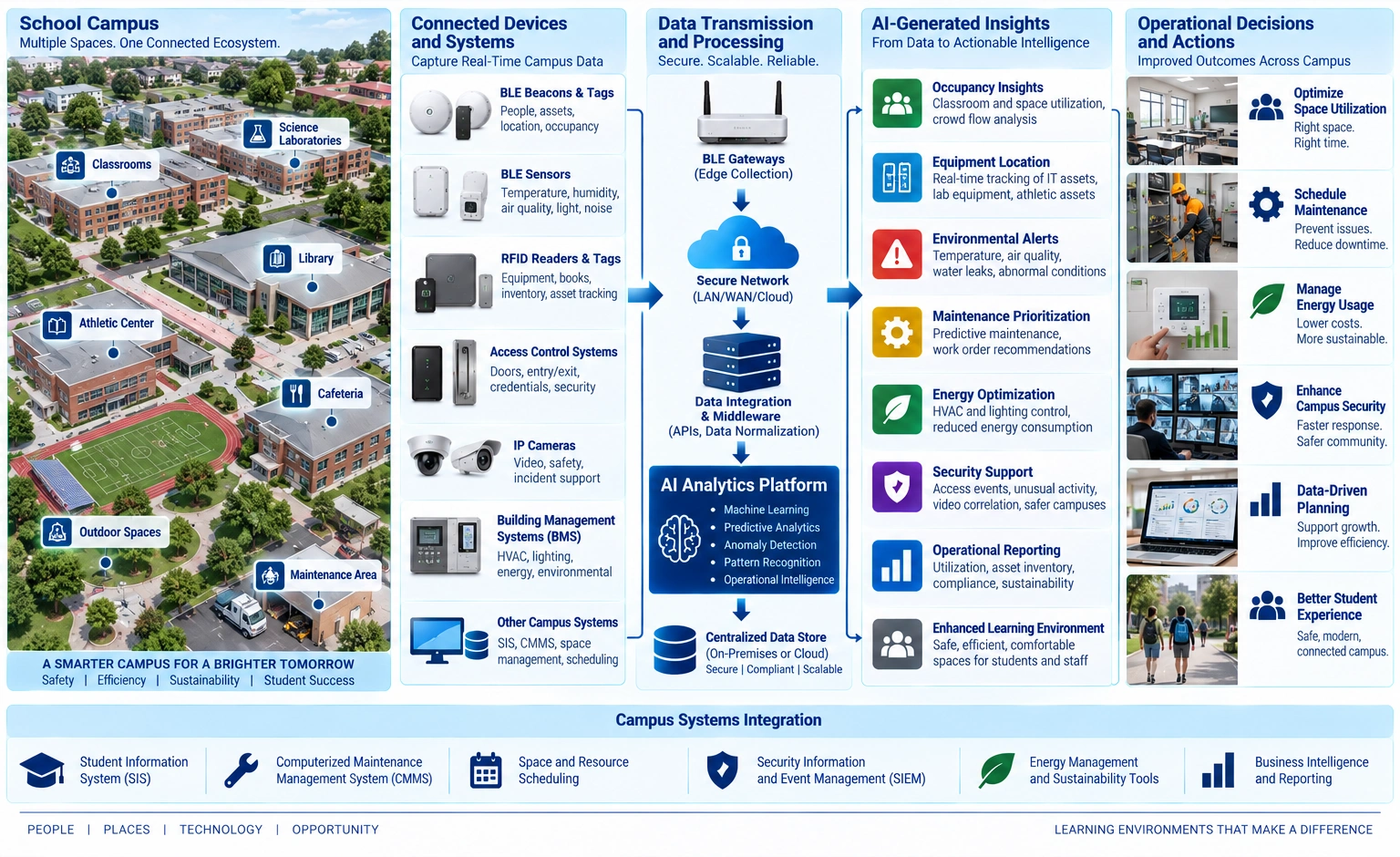
School campus AIoT overview linking BLE, RFID, and building data to AI insights and operational decisions.
School Campus Workflows Supported by AI and BLE
A useful deployment begins with the operational workflow rather than with hardware selection. The engineering team should first identify what decision the school needs to improve, what data is required, where that data originates, and how an operational employee will respond to the resulting information.
Location and Proximity Data
BLE beacons can provide identifiable reference signals throughout classrooms, laboratories, libraries, equipment rooms, athletic facilities, and other campus areas. BLE tags attached to mobile assets can transmit identifiers that are received by gateways positioned at appropriate locations. BLE gateways can forward collected events to local servers or cloud software. Depending on the design, the system can estimate proximity, zone-level location, movement patterns, or more precise positioning using techniques such as received signal strength indication, angle-based methods, or other supported positioning techniques. School campuses should avoid assuming that one positioning method provides the same accuracy everywhere. Concrete walls, metal laboratory equipment, human body absorption, furniture, building materials, elevators, and dense equipment rooms can affect radio performance.
AI Processing and Decision Support
Once location and sensor information reaches the processing layer, AI models can identify patterns that are difficult to manage manually. Examples include:
- Detecting unusual movement of high-value laboratory equipment
- Identifying rooms with persistent occupancy anomalies
- Correlating occupancy with HVAC operation
- Detecting environmental conditions outside configured thresholds
- Identifying unusual equipment movement between buildings
- Prioritizing maintenance work based on condition and historical records
- Estimating space utilization from recurring presence patterns
- Correlating multiple campus events to support security investigations
The AI output should normally be treated as decision support unless the application has been validated for automated action. A school may use an AI-generated alert to request a facilities inspection rather than automatically changing a critical building-control parameter.
From Sensor Event to Campus Action
A practical school campus workflow can follow this sequence:
- A BLE sensor, beacon, or tagged asset generates an event.
- A nearby BLE gateway receives the wireless transmission.
- The gateway filters or forwards relevant data.
- Middleware normalizes device identifiers, timestamps, locations, and sensor values.
- The server or cloud software stores and processes the information.
- AI models detect patterns, anomalies, or operational conditions.
- Analytics associate the result with a classroom, building, asset, maintenance record, or scheduled activity.
- Authorized personnel receive an alert, dashboard result, work-order recommendation, or operational report.
- The resulting action is recorded for later analysis and model improvement.
BLE Hardware and AI Software for School Campuses
BLE is most useful when it is selected as part of a complete sensing and data-collection solution. School campuses commonly require a mixture of fixed beacons, wearable or asset-mounted tags, environmental sensors, and gateways.
BLE Beacons
BLE beacons can act as fixed reference points within campus buildings. They may be installed near classroom entrances, corridors, laboratories, libraries, equipment rooms, or other defined zones. Their principal value is providing identifiable radio reference points that software can associate with physical campus locations. Beacon placement should account for building geometry, radio propagation, mounting height, interference, expected occupancy, and maintenance accessibility.
BLE Sensors and Tags
BLE sensors can collect environmental or operational information such as temperature, humidity, motion, or other supported measurements. Asset tags can identify mobile equipment such as laboratory instruments, audiovisual equipment, laptops, carts, athletic equipment, maintenance tools, or specialized educational equipment. Battery-powered devices require a maintenance plan. Battery chemistry, advertising interval, transmit power, environmental conditions, and expected device lifetime should be considered before deployment.
BLE Gateways
Gateways provide the connection between BLE radio devices and the school’s IP network. Ethernet, Wi-Fi, cellular, or other network connectivity may be appropriate depending on the building and deployment requirements. Gateway placement is particularly important in multi-building campuses. A gateway installed for maximum radio coverage is not necessarily positioned optimally for network availability or maintenance access. Engineering surveys should evaluate both radio coverage and IP connectivity. GAO provides BLE and RFID hardware products and systems that can be incorporated into school campus deployments, including applications requiring asset visibility, sensing, and wireless data collection.
AI, Middleware, and Campus Software
The AI processing layer can use statistical models, machine learning, anomaly detection, time-series analysis, classification, forecasting, and other appropriate methods. Computer vision may complement BLE where visual confirmation is required, although cameras introduce separate privacy, storage, cybersecurity, and governance considerations. Middleware is responsible for translating device events into information usable by campus software. Typical integration targets include:
- Computerized maintenance management systems
- Building management systems
- Access-control software
- Asset management systems
- Inventory management software
- School scheduling systems
- Identity and directory services
- Security information systems
- Data warehouses and analytics software
- Notification and incident-management systems
The integration should preserve timestamps, device identity, location context, and event provenance so that administrators can determine how an AI-generated result was produced.
Cloud Version and Server Version
A Cloud Version can host application software, databases, analytics, and AI processing within managed cloud infrastructure. This model can simplify centralized management when a school district operates multiple campuses and needs common software, centralized analytics, remote administration, and scalable data storage. A Server Version can run on customer-managed servers, private data centers, campus servers, or other privately hosted infrastructure. This model can be appropriate where a school or university has strict data-governance requirements, existing server infrastructure, network isolation requirements, or a preference for maintaining greater control over application and data processing. Hybrid deployment can also be practical. A school may perform selected processing locally while sending approved, aggregated, or operational data to centralized software. The appropriate design depends on network reliability, latency requirements, data governance, cybersecurity policy, IT staffing, and the number of campuses involved.
Engineering Considerations for Campus BLE Deployments
School campus deployments require more than installing wireless devices and connecting them to software. Radio performance, building construction, device density, cybersecurity, privacy, network availability, and maintenance must be evaluated together.
Coverage and Positioning
A radio survey should be performed before large-scale installation. The survey should identify dead zones, interference sources, high-density areas, stairwells, mechanical rooms, laboratories, reinforced concrete structures, and locations where gateway access may be difficult. Zone-level location can be sufficient for many applications. A laboratory equipment tracking system, for example, may only need to determine whether an instrument is inside the laboratory, storage room, or maintenance area. More precise positioning should only be adopted when the operational requirement justifies the additional infrastructure and calibration effort.
Privacy and Data Governance
Student and staff-related location information requires particular care. Technical teams should establish data minimization, role-based access, retention periods, audit logging, encryption, and appropriate authorization before collecting persistent location information. A school should clearly distinguish operational asset tracking from continuous individual tracking. Where personal data is involved, system design should account for applicable federal, state, provincial, district, institutional, and contractual requirements.
Cybersecurity and Network Segmentation
BLE devices and gateways should be incorporated into the school’s cybersecurity program rather than treated as isolated facilities equipment. Relevant controls can include:
- Unique device credentials
- Secure gateway administration
- Encrypted network communication
- Network segmentation
- Least-privilege access
- Firmware management
- Vulnerability monitoring
- Centralized logging
- Backup and recovery procedures
- Role-based access control
- Security incident procedures
GAO’s experience supplying connected hardware and systems to organizations in the United States and Canada supports the importance of combining device selection with deployment, integration, quality assurance, and technical support considerations.
AI-Driven Improvements in School Campus Management
Combining AI with BLE-enabled sensing can improve how school campuses understand occupancy, equipment movement, environmental conditions, and facility activity. The value comes from correlating wireless sensor data with operational context rather than simply collecting more device readings.
Intelligent Classroom and Space Utilization
Classroom utilization can be difficult to measure accurately using schedules alone. A room may be reserved but unused, occupied beyond its scheduled period, or repeatedly underutilized. BLE presence signals can provide additional operational evidence, while AI models analyze recurring patterns across rooms and time periods. Facilities teams can use these insights to identify underused classrooms, evaluate timetable efficiency, support space planning, and improve allocation of specialized rooms such as science laboratories, computer labs, music rooms, and technical workshops. The objective is not simply to determine whether a room is occupied. A more useful system relates occupancy patterns to room capacity, scheduled activities, HVAC operation, maintenance requirements, and campus resource planning.
Laboratory and Educational Equipment Visibility
School laboratories often contain equipment that is expensive, mobile, shared between departments, or difficult to locate quickly. Examples include microscopes, laboratory analyzers, balances, projectors, computers, scientific instruments, robotics equipment, and specialized teaching devices. BLE tags can associate equipment with defined campus zones, while AI software can identify unusual movement patterns or repeated transfers between departments. This can support:
- Faster equipment searches
- Department-level asset accountability
- Identification of equipment frequently moved between buildings
- Reduced duplicate purchasing
- Better utilization of shared laboratory equipment
- Maintenance scheduling based on equipment history
- Investigation of equipment that leaves an authorized area
RFID can complement BLE where item-level identification at controlled points is more important than continuous location awareness. A hybrid BLE and RFID deployment can therefore use each technology according to the physical workflow.
Environmental Monitoring and Facility Operations
Temperature and humidity conditions can affect laboratories, libraries, server rooms, archives, storage rooms, classrooms, and other campus facilities. BLE environmental sensors can provide periodic measurements without requiring extensive wired sensor installation. AI can evaluate historical readings rather than relying only on fixed alarm thresholds. For example, an AI model may identify a gradual increase in temperature that precedes a refrigeration or HVAC problem. Facilities personnel can then receive a prioritized maintenance recommendation before the condition becomes a significant operational problem.
AI-Assisted Maintenance Prioritization
School maintenance departments frequently manage competing requests involving HVAC systems, lighting, plumbing, electrical equipment, laboratory facilities, doors, elevators, and other building assets. AI can combine sensor readings with work-order history, equipment age, previous failures, room usage, and environmental conditions. This can help maintenance teams distinguish between routine service requirements and conditions that warrant earlier inspection. A practical implementation should preserve human approval for consequential maintenance decisions. AI should assist facilities personnel rather than obscure the underlying evidence used to prioritize a work order.
Energy and HVAC Optimization
Occupancy information can provide useful context for HVAC scheduling. A classroom scheduled for use but consistently empty may have a different operational requirement from a laboratory that experiences extended occupancy during practical sessions. AI can analyze occupancy, temperature, humidity, outdoor conditions, schedules, and HVAC operating data to identify opportunities for improved control. Where integration with building management systems is permitted, the resulting recommendations can support more efficient heating, ventilation, and air-conditioning operation.
Secure Campus AIoT Architecture: BLE Connectivity, Network Segmentation, AI Analytics & Privacy Controls
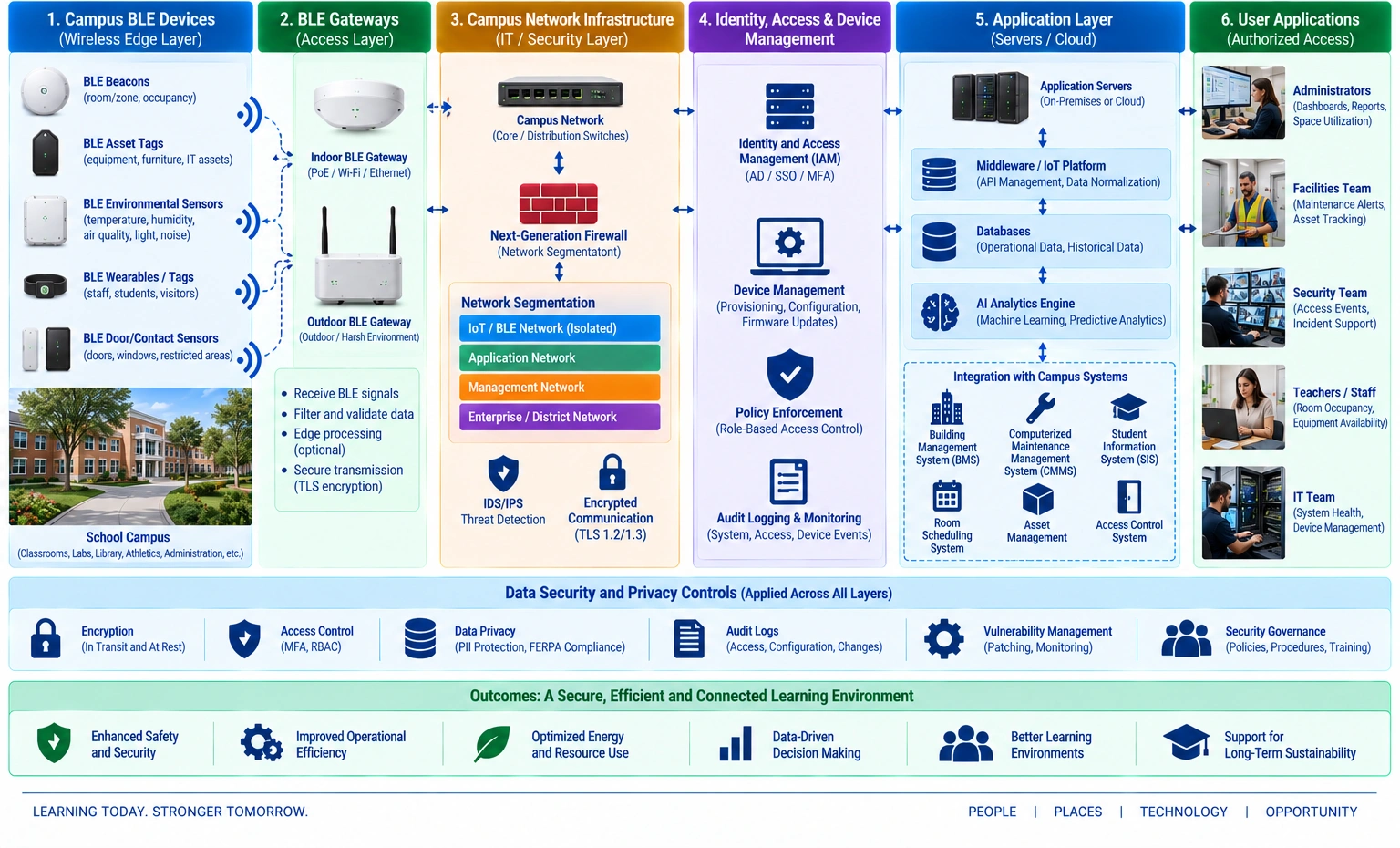
Secure school BLE architecture linking devices, segmented networks, AI analytics, privacy controls, and campus systems.
Integrating AI and BLE with School Information Systems
A BLE deployment becomes substantially more useful when its information can be correlated with software already used by the school or district.
Building Management Systems
Building management systems can provide HVAC status, temperature readings, equipment states, alarms, and other facility information. BLE occupancy and environmental data can add localized information where existing building controls have insufficient sensor coverage. The integration should establish consistent identifiers for buildings, floors, rooms, equipment, and sensors. Without consistent naming conventions, AI analytics may incorrectly associate an event with the wrong physical location.
Computerized Maintenance Management Systems
A CMMS can receive condition alerts or maintenance recommendations generated from sensor data. For example, repeated abnormal temperature readings from a server room can trigger an inspection request. The integration should retain the source event, timestamp, sensor identifier, location, and relevant measurements so maintenance personnel can validate why the recommendation was generated.
Asset and Inventory Systems
School asset databases can contain serial numbers, purchase information, department ownership, warranty status, and equipment categories. BLE identifiers can be associated with these records to add location context. This approach can provide a more complete asset record without replacing the existing asset management system.
Identity and Access Management
Where authorized personnel need access to AI and BLE information, integration with existing identity services can reduce the number of independent accounts maintained by IT teams. Role-based permissions should ensure that facilities personnel, laboratory managers, IT administrators, security personnel, and school administrators see only the information appropriate to their responsibilities.
School Campus Deployment, Testing, and Commissioning
Successful deployment depends on commissioning discipline as much as hardware selection. A school should establish measurable acceptance criteria before installing large numbers of BLE devices.
Planning and Site Survey
The planning stage should document:
- Buildings and floors requiring coverage
- Required location granularity
- Assets requiring tags
- Environmental parameters requiring monitoring
- Expected device density
- Network availability
- Gateway locations
- Battery replacement requirements
- Data retention requirements
- Integration requirements
- Cybersecurity controls
- User roles and permissions
- AI outputs required by each operational department
A representative pilot area should normally be selected before campus-wide deployment. A laboratory, library, classroom wing, or equipment storage area can provide a controlled environment for validating the proposed design.
Radio and Network Validation
Commissioning should test BLE coverage under realistic conditions. Measurements taken in an empty building may not represent actual performance after students, teachers, furniture, equipment, and other objects occupy the space. Testing should consider:
- BLE signal coverage
- Gateway connectivity
- Packet reception
- Sensor reporting intervals
- Location accuracy
- Device battery performance
- Network latency
- Gateway failover behavior
- Data synchronization
- Operation during high occupancy
- Areas with reinforced concrete or significant metal structures
AI Model Validation
AI models should be evaluated using representative school campus data. Accuracy should not be assessed only in laboratory conditions. For occupancy analytics, useful measures may include occupancy estimation accuracy and false-positive rates. For equipment movement monitoring, the school may evaluate detection accuracy, alert latency, and the proportion of alerts requiring human investigation. Model performance should also be monitored after deployment because room usage patterns can change with semesters, examinations, holidays, timetable changes, renovations, and changes in campus operations.
Smart Campus AIoT & BLE Lifecycle: From Planning and Deployment to Continuous Optimization
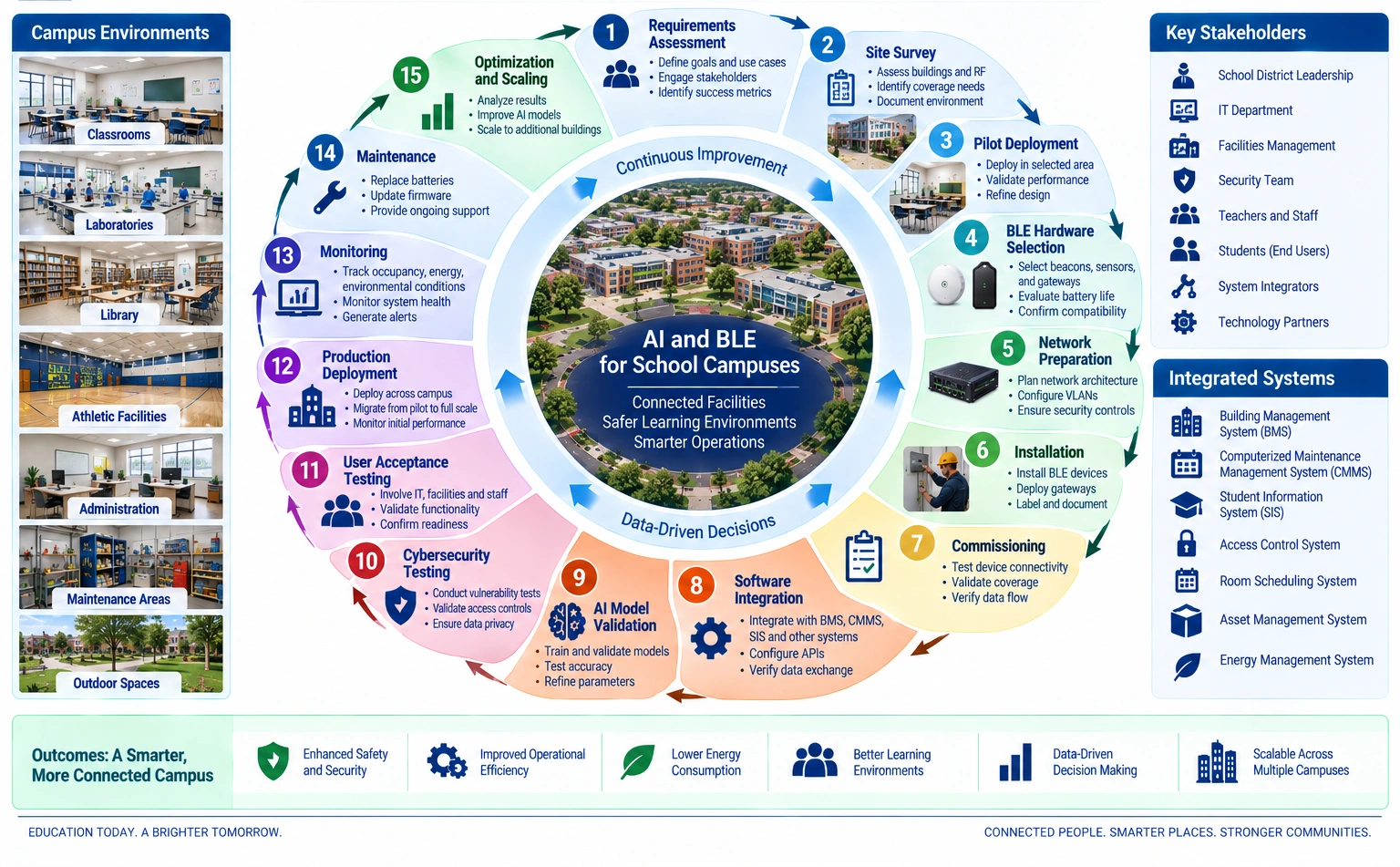
School AI and BLE lifecycle showing planning, installation, testing, rollout, monitoring, maintenance, and optimization.
Scaling AI and BLE Across School Campuses
Multi-building school districts introduce additional engineering requirements. A solution that performs well in one building may require adjustments when deployed across dozens of facilities. A scalable deployment should standardize device naming, gateway configuration, building identifiers, room identifiers, asset identifiers, firmware management, security policies, and data schemas. District IT teams should also maintain an inventory of installed BLE devices and gateways. Each device record can include its physical location, installation date, configuration, firmware version, battery status, associated application, and responsible maintenance team. Centralized monitoring can help identify gateways that stop communicating, sensors with declining battery levels, or buildings experiencing abnormal data loss. GAO’s experience serving organizations across the United States and Canada, including Fortune 500 companies, leading research and development organizations, universities, and government agencies, provides relevant perspective on deploying connected hardware in environments where reliability, technical support, and integration are important.
Security, Privacy, and Governance for School Campus AI
School campus technology requires a security model that considers both connected devices and the information generated from them. BLE identifiers should not automatically be treated as anonymous simply because BLE communication itself does not necessarily contain a person’s name. When an identifier is associated with a student, employee, credential, or other identifiable record, the resulting information may become sensitive institutional data. Technical teams should therefore implement:
- Data minimization
- Appropriate retention periods
- Encryption in transit and at rest
- Role-based access controls
- Administrative audit logs
- Secure gateway configuration
- Firmware update procedures
- Network segmentation
- Credential management
- Vulnerability management
- Backup and disaster recovery
- Incident response procedures
- Clear data ownership and governance rules
Student-facing applications require additional consideration because location and behavioral information can create privacy risks if collected unnecessarily or retained indefinitely. AI-generated conclusions should also remain explainable enough for authorized staff to understand the evidence behind important operational recommendations. A facilities manager should be able to determine which sensor readings, historical patterns, or operational events contributed to a maintenance alert.
Choosing the Right AI and BLE Solution for School Campuses
A technically appropriate solution should be selected according to the operational problem, not according to the number of devices available. School IT, facilities, security, procurement, and academic departments should jointly evaluate the proposed solution against the following considerations:
- Required location accuracy
- Number and type of buildings
- Indoor and outdoor coverage requirements
- Number of assets and sensors
- Existing network infrastructure
- Existing campus software
- Cloud or privately hosted deployment requirements
- Cybersecurity policies
- Data governance requirements
- Battery maintenance resources
- Integration capabilities
- AI analytics requirements
- Vendor technical support
- Hardware lifecycle expectations
- Expansion requirements
- Total cost of ownership
GAO can support organizations evaluating BLE, RFID, and IoT hardware products and systems for these requirements. A practical procurement process should assess device specifications, gateway capabilities, software interfaces, installation requirements, support arrangements, and long-term maintenance rather than comparing hardware prices alone.
Key Takeaways for AI and BLE in School Campuses
AI-enabled school campus management becomes more effective when wireless sensing is connected to clearly defined operational decisions. BLE gateways, beacons, tags, and sensors can provide location, proximity, environmental, and equipment information, while AI can correlate these signals with schedules, maintenance records, building conditions, and other campus data. The strongest implementations begin with a defined operational requirement, validate radio coverage through a pilot, establish cybersecurity and privacy controls, integrate with existing school software, and measure results using operational KPIs. Cloud, private server, or hybrid deployment should be selected according to IT capabilities, data governance, network requirements, and campus scale. GAO provides BLE, RFID, and IoT hardware products and systems that can support applications including asset tracking, sensing, identification, and connected campus operations. Organizations evaluating AI-enabled school campus solutions can learn more about GAO’s products, technical capabilities, engineering support, and deployment options to determine which approach fits their specific facilities and operational requirements.
Building the Future of Industrial AI and IoT with Aperture Venture Studio and GAO RFID Inc.
For more than three decades, GAO Group of Companies has invested heavily in R&D for industrial BLE, RFID, and IoT technologies. As AI became increasingly useful for connected applications, we expanded our work across AI, IoT, BLE, and RFID and founded Aperture Venture Studio to advance practical AI and IoT solutions for application areas such as intelligent school campus operations. Aperture brings together AI and IoT technical experts, experienced operational leaders, investors, and industry participants. We also organize Aperture Ventures Summit and TekSummit to discuss advanced AI and IoT topics. We welcome advisors, employees, investors, and customers to participate in these initiatives.