
AI and BLE for Scientific Research Centers
AI-Enabled Scientific Research Center Operations
AI for Scientific Research Centers combines artificial intelligence, connected sensors, laboratory data, and operational software to improve how research facilities monitor people, equipment, specimens, inventory, environmental conditions, and workflows. BLE beacons, BLE gateways, and BLE sensors provide location and condition data that AI systems can correlate with laboratory schedules, equipment utilization, maintenance records, inventory systems, and facility-management information. This enables research organizations to move from manually checking laboratory assets and environmental conditions toward continuous, data-driven operational decisions. Typical applications include laboratory equipment tracking, researcher and technician location awareness, specimen and sample movement, freezer monitoring, controlled-room monitoring, inventory visibility, equipment utilization analysis, and workflow optimization. For Scientific Research Centers managing high-value instruments, sensitive biological materials, regulated research processes, and shared laboratory resources, AIoT can provide actionable intelligence while maintaining appropriate cybersecurity, privacy, and data-governance controls.
Why AI Matters for Scientific Research Centers
Scientific Research Centers operate environments where the availability, condition, location, and correct use of physical resources can directly affect research continuity. A laboratory may contain centrifuges, spectrometers, microscopes, incubators, biosafety cabinets, ultra-low-temperature freezers, liquid nitrogen storage systems, analytical instruments, research samples, reagents, and specialized mobile equipment.
Traditional spreadsheets, manual inspection rounds, barcode scans, and isolated equipment-management records can provide useful information but often lack continuous operational context. AI changes this model by correlating data from connected research assets with time, location, environmental conditions, maintenance history, laboratory schedules, and operational events.
AIoT, or Artificial Intelligence of Things, combines artificial intelligence with IoT devices, sensors, connected equipment, and industrial or institutional systems. For Scientific Research Centers, the combination can include machine learning, Edge AI, computer vision, predictive analytics, anomaly detection, and, where autonomous physical actions are appropriate, Physical AI.
AI can help answer questions such as:
- Which shared laboratory instruments are underutilized or consistently overbooked?
- Which freezer or controlled-temperature area shows abnormal environmental behavior?
- Where is a mobile research instrument currently located?
- Which equipment requires preventive maintenance based on operating patterns?
- Where are delays occurring in sample, reagent, or material movement?
- Which laboratory resources are repeatedly unavailable when researchers need them?
- Which environmental readings require immediate investigation?
- Which inventory movements differ from expected laboratory workflows?
GAO supplies BLE, RFID, and IoT hardware products and systems that can provide the physical data layer required for these applications. The resulting system can connect research-center operations with analytics and business actions rather than treating asset visibility as an isolated tracking function.
AIoT-Enabled Research Center: Connecting Assets, Environment, Inventory & Workflows
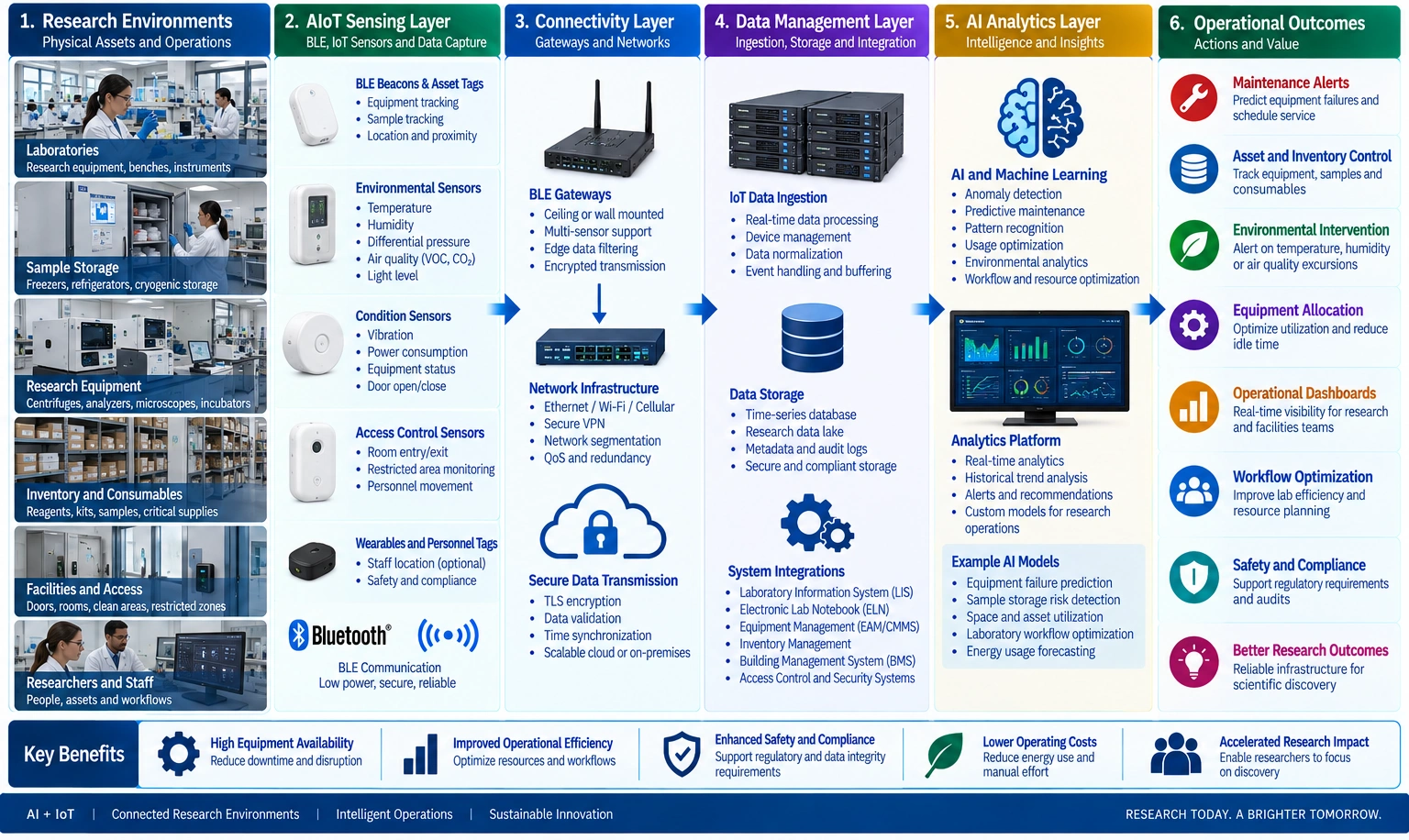
Scientific Research Center Applications for AI and BLE
AI-Powered Laboratory Equipment Tracking
Shared research instruments frequently move between laboratories, preparation rooms, analytical areas, clean spaces, storage areas, and maintenance locations. BLE beacons attached to equipment can provide location observations through strategically positioned gateways. AI can analyze historical movement and utilization patterns to identify equipment bottlenecks, abnormal movement, idle resources, and recurring allocation problems.
The operational objective is not simply to display an instrument’s location. A useful system combines location observations with equipment identity, calibration status, maintenance records, reservation schedules, and laboratory workflows. This can help research managers determine whether a high-value instrument is available, misplaced, awaiting service, or being used inefficiently.
Research Sample and Specimen Movement
Scientific Research Centers may move samples, specimens, reagents, test materials, and research containers through receiving areas, preparation laboratories, analytical laboratories, cold storage, biobanks, and controlled-access rooms.
BLE can support location awareness for tagged containers or transport assets, while RFID can provide complementary identification and event capture at controlled points such as receiving stations, storage locations, laboratory entrances, and material handoff points. AI can correlate movement events with expected workflows and identify unusual delays, missing transitions, or process deviations.
AI-Driven Environmental Monitoring
Research materials and experiments can depend on stable temperature, humidity, pressure, air quality, or other environmental parameters. BLE sensors can collect measurements from freezers, refrigerators, incubators, storage rooms, laboratory spaces, and controlled environments.
AI models can establish normal operating patterns and detect deviations that may not be obvious from a single threshold alarm. For example, gradual temperature drift, repeated short-duration excursions, unusual compressor behavior, or differences between adjacent storage areas can trigger investigation before a severe condition develops.
Shared Laboratory Resource Optimization
Scientific Research Centers often operate expensive equipment shared by multiple research groups. AI can analyze utilization rates, reservation patterns, idle periods, service interruptions, and actual equipment activity to improve scheduling and resource allocation.
The result can be more effective use of instruments such as mass spectrometers, chromatographs, flow cytometers, sequencers, microscopes, centrifuges, and other specialized research equipment. BLE location and proximity data can supplement formal booking records by providing evidence of actual equipment presence and movement.
Researcher and Technician Workflow Awareness
BLE-based location awareness can help identify where mobile personnel or operational teams are working when privacy, security, and institutional policies permit such use. AI can use aggregated operational data to identify workflow congestion, unnecessary movement, prolonged response times, or recurring delays in facility-support activities.
Such systems should be designed around the minimum information necessary for the operational objective. Personnel tracking should not automatically become employee surveillance. Data retention, access control, consent requirements where applicable, and role-based visibility should be established during system design.
Scientific Research Center Operational Challenges Addressed by AIoT
AI-enabled connected systems are most valuable when they address measurable operational problems rather than simply adding another source of data.
- High-value equipment visibility: Research instruments may be moved frequently between rooms, making manual location records unreliable.
- Cold-storage risk: Ultra-low-temperature freezers, refrigerators, and other controlled storage systems require continuous condition monitoring and rapid intervention.
- Instrument downtime: Unexpected failures can disrupt experiments, scheduled research, sample processing, and grant-funded work.
- Resource underutilization: Expensive equipment may remain idle because utilization is not measured accurately.
- Inventory discrepancies: Reagents, consumables, samples, and research materials can become difficult to reconcile across multiple laboratories.
- Workflow delays: Manual handoffs between receiving, preparation, experimentation, analysis, and storage can create undocumented delays.
- Fragmented operational data: Laboratory systems, maintenance software, inventory databases, access-control systems, and facility-management software may not share sufficient contextual information.
- Research-space constraints: Specialized laboratories and controlled environments require careful management of access, occupancy, equipment placement, and environmental conditions.
- Cybersecurity requirements: Connected laboratory devices must be controlled without creating unnecessary pathways into sensitive research networks.
- Data governance: Research operations may involve confidential research information, regulated records, intellectual property, and personally identifiable information that require appropriate controls.
GAO’s hardware and IoT systems can be incorporated into these environments as part of a broader operational solution, with device selection based on required sensing range, battery life, environmental conditions, connectivity, security, and integration requirements.
From Research Environment Data to AI-Driven Decisions
A Scientific Research Center AIoT solution typically begins with physical observations and ends with a decision or operational action. The complete workflow should be designed before hardware installation because the required data model, gateway locations, integration interfaces, and AI outputs depend on the decisions the organization needs to make.
Data Acquisition at Laboratories and Research Facilities
BLE beacons can identify tagged assets or locations, while BLE sensors can collect measurements such as temperature, humidity, motion, occupancy-related signals, or other supported conditions. BLE gateways receive and forward relevant observations to local or remote processing systems.
Other technologies can complement BLE. RFID can provide reliable identification at defined read points, while wired sensors, Wi-Fi, cellular IoT, Ethernet, or building-management interfaces may provide additional operational data.
Connectivity and Edge Processing
Gateway placement should consider laboratory walls, equipment enclosures, cold-storage rooms, metallic surfaces, interference, required coverage, and device density. Edge processing can filter duplicate observations, validate sensor readings, buffer data during temporary network outages, and forward only relevant events to central software.
Research facilities with segmented networks should define the communication path between gateways, IoT services, laboratory systems, and authorized analytics environments. Network segmentation can reduce the consequences of a compromised connected device.
Middleware and Data Normalization
Middleware converts heterogeneous device observations into a consistent operational data model. A useful model can associate an equipment identifier with location, laboratory, department, responsible team, maintenance status, utilization information, and historical events.
Time synchronization is important because AI models and workflow analysis depend on reliable event ordering. Systems should also account for missing observations, duplicate messages, battery-related interruptions, gateway outages, and sensor calibration requirements.
AI Analytics and Decision Support
The normalized data can feed machine-learning models, anomaly detection, forecasting, rules engines, or other AI methods. Edge AI may be appropriate when rapid local decisions are required or when sending raw data to a central environment is undesirable.
Cloud-based AI can provide broader historical analysis across multiple research facilities, while private server deployments may be preferable where research data governance, network isolation, institutional policy, or integration requirements favor customer-controlled infrastructure.
Operational Action and Feedback
AI-generated insights have value only when connected to a response process. A freezer anomaly might generate a notification to laboratory operations, while equipment utilization analysis could inform scheduling changes. Predictive maintenance analysis could create a service request, and repeated sample-processing delays could trigger workflow investigation.
The system should record the resulting action where practical. This creates a feedback loop that allows research-center managers to measure whether AI recommendations actually improve equipment availability, response time, environmental stability, inventory accuracy, or research workflow performance.
AIoT Workflow: From Laboratory Data to Intelligent Operational Actions
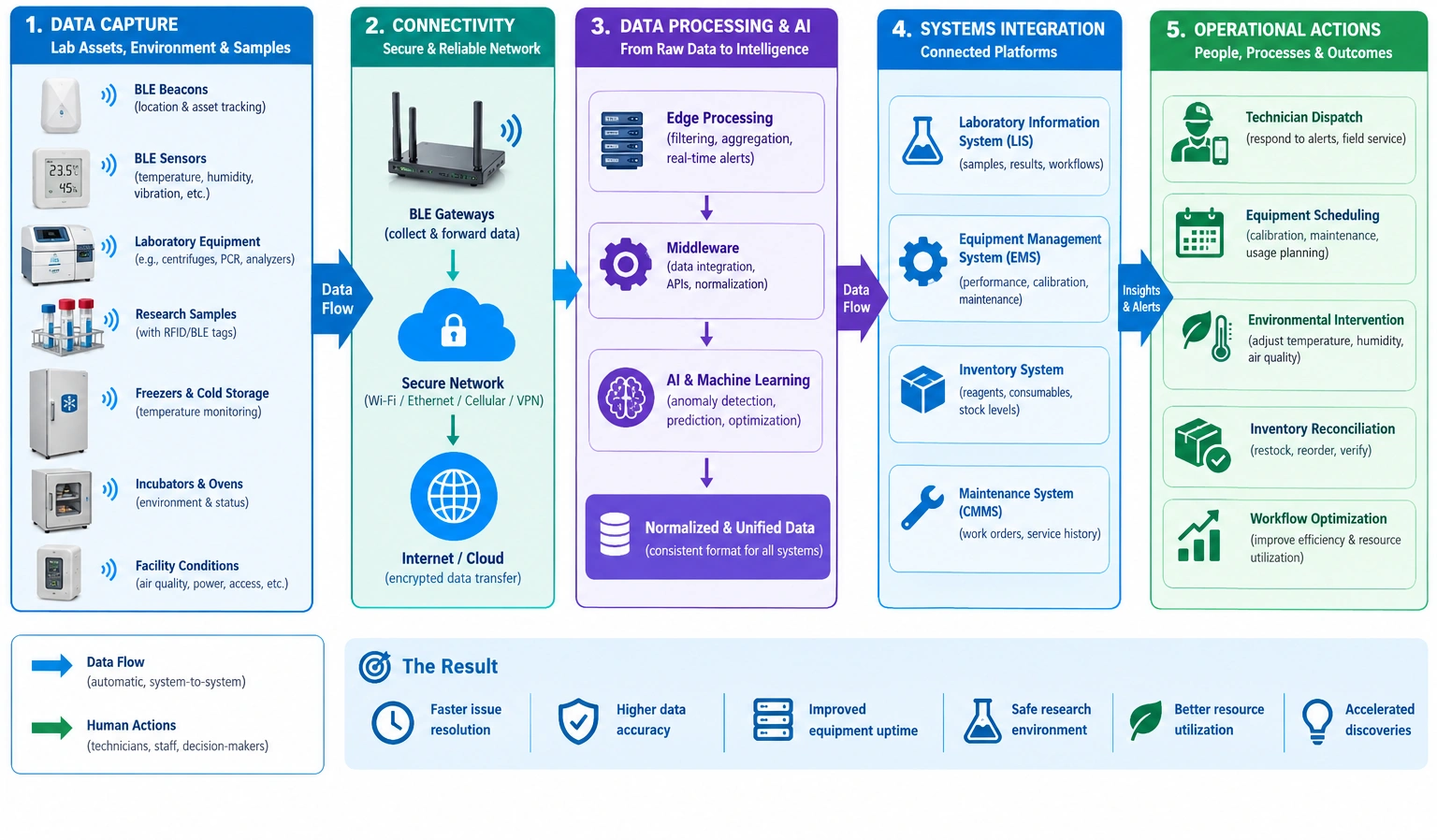
BLE Hardware and Software for Scientific Research Center Solutions
BLE implementation should be treated as a component of the research-center solution rather than as the objective itself. The hardware and communication design must support the required location accuracy, sensing frequency, environmental conditions, battery life, security controls, and integration requirements.
- BLE beacons: Small wireless devices can be attached to research equipment, mobile assets, containers, carts, or designated locations to provide identification and proximity information.
- BLE sensors: Sensors can monitor environmental or equipment-related conditions where supported by the selected device.
- BLE gateways: Gateways collect BLE observations and forward them through Ethernet, Wi-Fi, cellular, or another supported network connection to local or remote software.
- Device-management software: Research facilities need mechanisms for device provisioning, configuration, battery monitoring, firmware management, and fault detection.
- Location and event software: Location observations can be converted into room-level, zone-level, or other operational events according to the deployment requirements.
- AI and analytics software: Machine learning, anomaly detection, forecasting, and statistical analysis can convert historical and real-time observations into operational insights.
- Integration interfaces: APIs, databases, message brokers, and standard enterprise interfaces can connect the solution with laboratory information management systems, computerized maintenance management systems, inventory software, facility-management software, scheduling systems, and other authorized applications.
- Security controls: Device authentication, encrypted communications where supported, network segmentation, least-privilege access, credential management, secure software updates, logging, and controlled administrative access should be incorporated into deployment planning.
GAO provides BLE beacons, BLE gateways, BLE sensors, RFID products, and related IoT systems that can be selected according to the physical and operational requirements of Scientific Research Centers.
AIoT-Enabled Research Facility: Connected Labs, Equipment, Storage & Operations
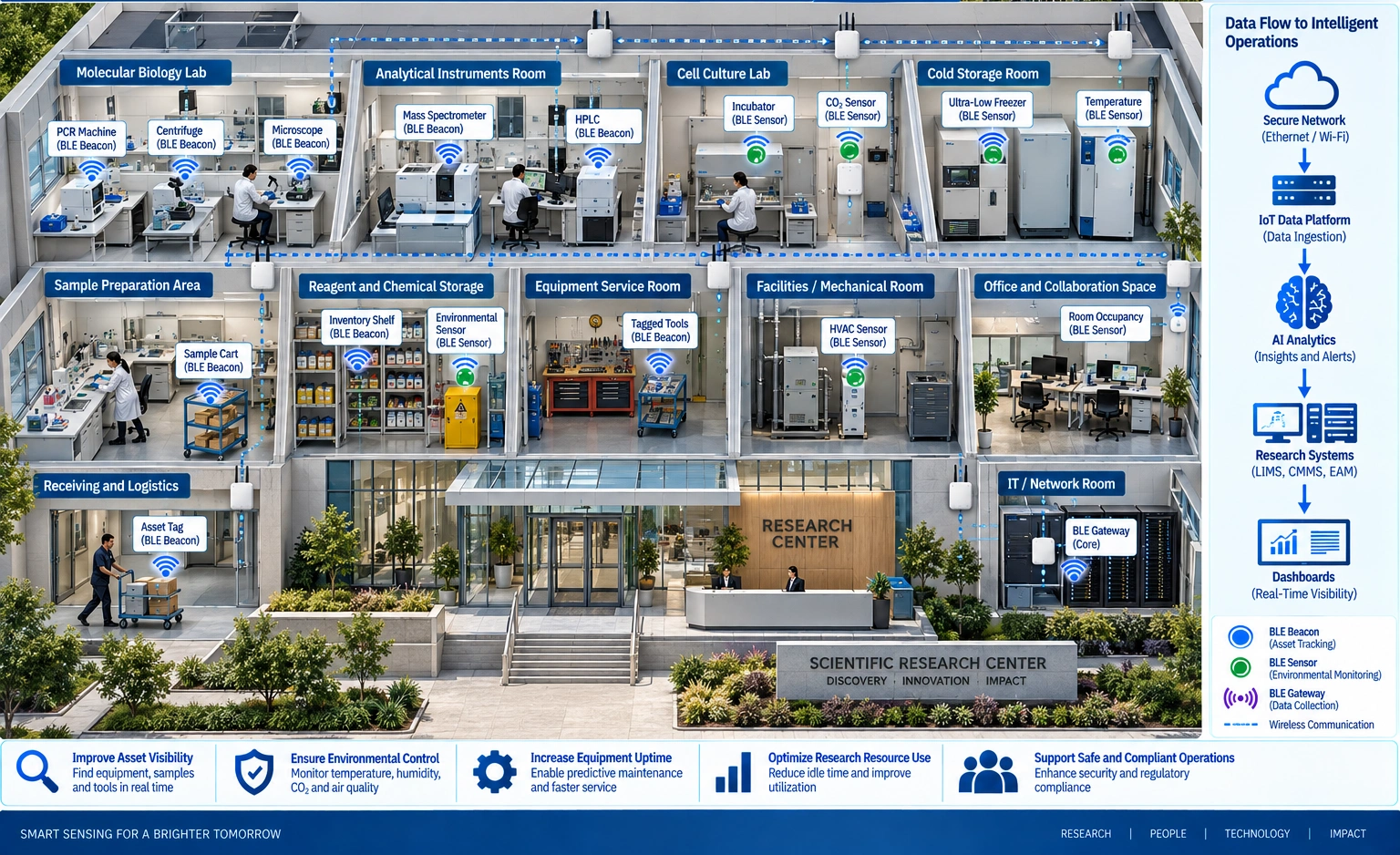
Cloud and Server Deployment for Scientific Research Centers
Scientific Research Centers can select either cloud-hosted software or privately hosted server software according to data governance, connectivity, integration, cybersecurity, and institutional IT requirements.
Cloud Version
A cloud-hosted SaaS deployment can centralize device data, dashboards, analytics, alerts, and AI processing without requiring the research organization to operate the full application infrastructure. This model can be useful for organizations with multiple research facilities, geographically distributed laboratories, limited internal infrastructure resources, or a need for centralized operational visibility.
Connectivity design remains important because gateways must securely communicate with the cloud service. Local buffering and edge processing can help maintain operational continuity when internet connectivity is temporarily unavailable.
Server Version
A Server Version can run on customer-managed servers, private data centers, institutional computing infrastructure, or other privately hosted enterprise environments. This approach may be appropriate where research institutions require tighter control over data location, network connectivity, system integration, authentication, retention policies, or internal cybersecurity controls.
Private deployment does not eliminate security responsibilities. Patch management, backups, access control, vulnerability management, monitoring, disaster recovery, and software lifecycle management remain essential.
AI-Enabled Capabilities for Scientific Research Centers
Combining AI with connected research assets enables Scientific Research Centers to move beyond simple visibility toward predictive and context-aware operations. The strongest results occur when AI outputs are tied to specific laboratory decisions, measurable KPIs, and established response procedures.
Predictive Maintenance for Research Equipment
AI can analyze equipment location, operating patterns, maintenance history, service events, environmental conditions, and utilization data to identify indicators associated with equipment degradation or abnormal operation. BLE observations can provide contextual information such as whether equipment has been moved, whether it remains in its assigned laboratory, or whether a mobile instrument is available for inspection.
Predictive maintenance can help laboratory operations teams prioritize inspections for high-value instruments and reduce avoidable downtime. It should complement, rather than replace, manufacturer maintenance schedules, calibration requirements, service procedures, and qualified technician judgment.
Anomaly Detection for Laboratory Environments
AI-based anomaly detection can establish normal environmental behavior for individual laboratories, cold-storage areas, equipment rooms, or other controlled spaces. Instead of relying exclusively on a fixed threshold, models can consider historical patterns, time of day, equipment behavior, and related sensor observations.
This can help identify gradual deterioration, repeated excursions, unusual fluctuations, or sensor inconsistencies. Research staff can then investigate the physical cause before an environmental condition becomes a significant research or material-management event.
Intelligent Equipment Utilization
Equipment utilization analysis can distinguish scheduled availability from actual operational use. Combining BLE location events with reservation information, service records, and other authorized operational data can reveal idle periods, scheduling conflicts, frequent relocations, and equipment that is consistently difficult to access.
Research directors and laboratory managers can use these insights when planning instrument purchases, shared-resource scheduling, maintenance windows, and laboratory-space allocation.
AI-Assisted Inventory and Material Visibility
Research inventories can include expensive reagents, consumables, sample containers, laboratory supplies, and specialized research materials. AI can identify unusual consumption patterns, movement anomalies, recurring shortages, or discrepancies between expected and observed material activity.
BLE can support location awareness, while RFID can be particularly useful for identification at receiving, storage, dispensing, and controlled transition points. Combining both technologies can be appropriate when a research center needs continuous location context together with reliable event-based identification.
Research Workflow Optimization
AI can analyze time-stamped operational events to identify bottlenecks between receiving, preparation, experimentation, analysis, storage, maintenance, and disposal processes. For example, repeated delays between sample receipt and laboratory processing may indicate a staffing, equipment, scheduling, storage, or handoff problem.
The purpose is not simply to generate more dashboards. The objective is to identify measurable process constraints and provide laboratory managers with evidence for corrective action.
Closed-Loop AIoT: From Laboratory Data to Intelligent Action & Continuous Optimization
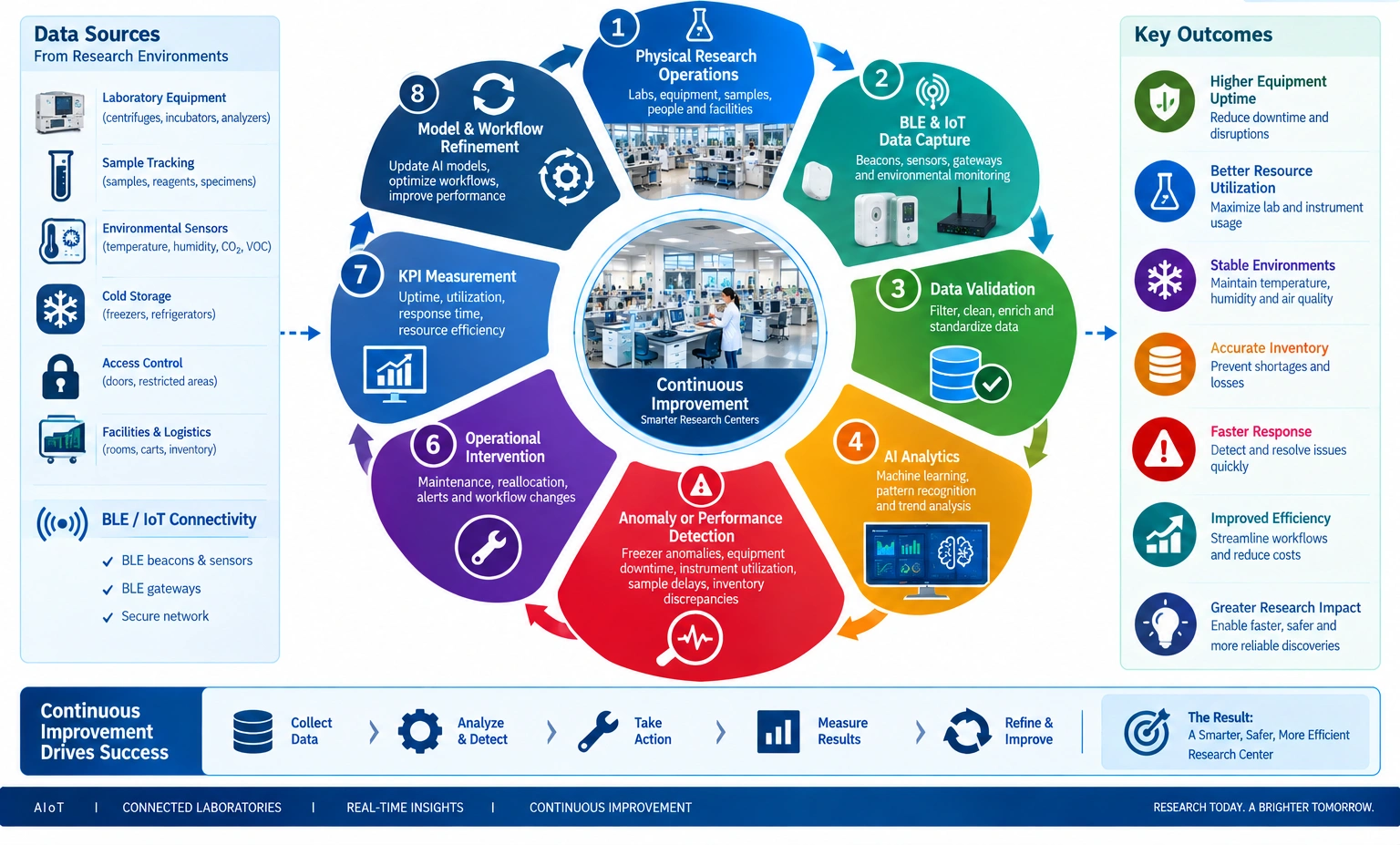
Engineering Considerations for Scientific Research Center Deployments
A successful deployment requires more than selecting BLE devices and installing gateways. Laboratory construction materials, research equipment, environmental conditions, network policies, cybersecurity requirements, and operational workflows can materially affect system performance.
RF Planning and Gateway Placement
BLE radio performance can be affected by reinforced concrete, metal cabinets, laboratory instruments, cryogenic equipment, dense storage, walls, doors, and other physical obstructions. Gateway placement should therefore be determined through site surveys and representative testing rather than by applying a uniform coverage assumption.
Room-level positioning may be sufficient for equipment-finding applications, while more demanding applications may require additional gateways, calibrated signal measurements, or alternative positioning techniques. Research centers should establish the required accuracy before selecting hardware.
Battery and Environmental Requirements
Battery-powered BLE devices require a maintenance strategy. Expected battery life depends on transmission interval, sensor sampling frequency, radio configuration, temperature, battery chemistry, and operating conditions.
Cold rooms and freezer environments require particular attention because low temperatures can affect battery performance. Devices should be evaluated for their actual deployment environment rather than relying solely on nominal laboratory battery-life specifications.
Sensor Accuracy and Calibration
Environmental AI is only as reliable as the underlying measurements. Temperature, humidity, or other sensors used for research-support decisions should have specifications appropriate to the intended application. Calibration schedules, sensor placement, replacement procedures, and out-of-range detection should be defined during commissioning.
A sensor installed in an unsuitable location can produce technically correct measurements that do not represent the condition the research center is attempting to monitor.
Data Quality and AI Model Reliability
AI models require consistent historical data. Missing gateway observations, duplicated events, incorrectly assigned asset identifiers, sensor drift, clock inconsistencies, and changes in laboratory layout can produce misleading conclusions.
Scientific Research Centers should therefore establish data-quality rules before deploying sophisticated models. Human review remains important for high-impact decisions, especially where an AI alert could affect valuable samples, experimental continuity, equipment service, or regulatory records.
Interoperability with Research Systems
AIoT data should integrate with existing systems rather than create another isolated information store. Depending on the organization, relevant systems can include laboratory information management systems, electronic laboratory notebooks, computerized maintenance management systems, inventory management software, building-management systems, access-control systems, scheduling software, research data repositories, and institutional identity-management services.
API-based integration, database interfaces, message brokers, or other approved interfaces can allow authorized information to move between systems while preserving ownership and access controls.
Cybersecurity and Data Governance for Research-Center AIoT
Scientific Research Centers can hold valuable intellectual property, unpublished research results, proprietary experimental methods, regulated information, and sensitive institutional data. Connected physical devices therefore need to be considered within the center’s broader cybersecurity program.
Recommended controls include:
- Segment BLE gateway traffic from sensitive research networks where practical.
- Use authenticated administrative access and strong credential-management practices.
- Encrypt communications where supported by the device and network design.
- Apply least-privilege permissions to dashboards, APIs, administrative tools, and databases.
- Maintain an inventory of deployed BLE beacons, sensors, gateways, firmware versions, and associated credentials.
- Establish procedures for firmware updates, vulnerability response, device replacement, and secure decommissioning.
- Log security-relevant administrative and system events for investigation and audit purposes.
- Define data-retention periods for location, environmental, equipment, and personnel-related information.
- Restrict personnel-related information to legitimate operational requirements and authorized users.
- Separate research-content data from operational IoT data when the use case does not require access to research records.
- Establish backup and recovery procedures for server-based deployments and critical operational databases.
GAO’s role in such deployments can include supplying the BLE, RFID, and IoT hardware and systems that form part of the physical data-collection layer, while the research organization and its technology partners establish controls appropriate to the complete environment.
Implementation Lifecycle for AI and BLE in Scientific Research Centers
Requirements Assessment
Begin by documenting the research-center problems that require improvement. Define the assets, laboratories, environmental conditions, workflows, users, systems, KPIs, and decisions that the solution must support.
A requirements assessment should distinguish between location tracking, condition monitoring, equipment utilization, inventory visibility, workflow analysis, and personnel-related applications because each requires different data and governance controls.
Site Survey and Solution Design
Survey laboratory layouts, walls, doors, equipment density, network availability, environmental conditions, gateway mounting locations, and potential RF interference. Identify areas requiring different coverage or sensing strategies.
The design should also define the data path from BLE devices to gateways, edge processing, software, AI analytics, and integrated research systems.
Pilot Deployment
A controlled pilot can validate BLE coverage, battery behavior, sensor performance, gateway connectivity, data quality, and integration before organization-wide deployment.
A useful pilot should represent actual laboratory conditions. Testing only in an empty room can produce results that differ significantly from an operating research environment containing people, equipment, carts, metal storage, freezers, and other RF-obstructing objects.
Commissioning and Validation
Commissioning should verify device identity, sensor readings, gateway connectivity, alert behavior, software integration, user permissions, data timestamps, and failure recovery.
Acceptance criteria should be measurable. Examples include location-detection reliability, environmental measurement accuracy, alert latency, gateway availability, asset-record completeness, and successful integration with designated research systems.
Optimization and Scaling
After commissioning, operational data can reveal locations where additional gateways, different transmission intervals, revised sensor placement, or software adjustments are necessary.
Scaling should be based on validated requirements rather than simply multiplying the pilot configuration. Large Scientific Research Centers may have different RF conditions, network constraints, laboratory types, and operational workflows across buildings.
Maintenance and Lifecycle Management
Long-term operation requires battery replacement planning, device inventory management, firmware maintenance, sensor calibration, gateway health monitoring, cybersecurity reviews, software updates, and periodic performance evaluation.
Research facilities should also establish procedures for relocating tagged equipment, changing laboratory layouts, adding new research spaces, retiring assets, and updating integrations. These lifecycle processes prevent the physical system from diverging from the organization’s digital records.
KPIs for AI-Enabled Scientific Research Center Operations
Measurement should connect the technology to research-center outcomes. Suitable KPIs vary according to the use case, but organizations can consider:
- Equipment location accuracy and successful location-observation rate
- High-value instrument availability
- Instrument utilization rate
- Equipment downtime and mean time to repair
- Preventive-maintenance compliance
- Environmental excursion frequency and duration
- Mean alert-to-response time
- Cold-storage monitoring coverage
- Inventory record accuracy
- Reagent or consumable stockout frequency
- Sample handoff or processing time
- Research workflow cycle time
- Gateway availability
- BLE device battery replacement frequency
- Sensor data completeness
- AI anomaly-detection precision and false-alert rate
- Integration transaction success rate
- Authorized-user adoption of operational dashboards
- Number of unresolved asset-location exceptions
- Cost associated with avoidable equipment downtime
KPIs should be established before production deployment where possible. This allows the research center to compare baseline performance with post-deployment results and determine whether AI-enabled workflows are delivering measurable operational value.
Standards, Compliance, and Governance Considerations
The appropriate compliance framework depends on the type of research performed, the materials involved, funding requirements, institutional policies, and applicable jurisdictions. Technical teams should therefore conduct a formal compliance assessment rather than assuming that one standard applies to every Scientific Research Center.
Relevant considerations can include:
- NIST Cybersecurity Framework: Useful for organizing cybersecurity risk-management activities around identification, protection, detection, response, and recovery.
- NIST SP 800-series guidance: Relevant where institutional information-security controls require more detailed technical guidance.
- ISO/IEC 27001: Potentially relevant to information-security management programs.
- ISO/IEC 27701: Relevant where privacy information-management practices are applicable.
- HIPAA: Potentially relevant to research environments handling protected health information in covered contexts.
- FDA requirements: Relevant to certain regulated research, laboratory, medical-device, pharmaceutical, or clinical environments depending on the activity.
- Good Laboratory Practice requirements: Relevant to applicable regulated nonclinical laboratory studies.
- Good Manufacturing Practice requirements: Relevant when research operations connect to regulated manufacturing activities.
- Institutional biosafety and laboratory safety procedures: Essential for laboratories handling biological, chemical, radiological, or other hazardous materials.
- Research data-governance policies: Important for intellectual property, controlled research information, retention, access, and data-sharing requirements.
Technology teams should map these requirements to concrete system controls, records, access permissions, audit processes, and operational procedures.
Practical Deployment Recommendations for Scientific Research Centers
Organizations planning AI-enabled BLE deployments should prioritize operational requirements over technology selection. The following practices can reduce implementation risk:
- Define the research decision the AI system must improve before selecting sensors or tracking methods.
- Separate equipment location, environmental monitoring, inventory identification, and personnel-location requirements rather than assuming one technology will perform every function equally well.
- Conduct RF surveys under realistic laboratory operating conditions.
- Select sensor specifications based on actual temperature, humidity, chemical, mechanical, and enclosure conditions.
- Establish asset identifiers and authoritative equipment records before large-scale tagging.
- Integrate with existing laboratory, maintenance, inventory, and facility systems where the business process requires shared information.
- Use edge processing when local buffering, low latency, or reduced upstream data transmission is important.
- Establish cybersecurity ownership between the research organization, IT team, system integrator, and technology supplier.
- Validate AI models against known operational events before relying on automated recommendations.
- Keep human approval in workflows where incorrect action could damage research materials, interrupt experiments, or affect regulated records.
- Establish battery, calibration, firmware, and device-replacement procedures before production rollout.
- Measure performance against defined KPIs and periodically reassess whether the AI system continues to support actual laboratory requirements.
Technical and Business Value of AI for Scientific Research Centers
AI-enabled Scientific Research Center operations can connect physical research environments with actionable operational intelligence. BLE beacons, gateways, and sensors can provide continuous observations, while AI converts those observations into patterns, anomalies, forecasts, and prioritized actions.
The resulting value can include improved visibility of high-value instruments, faster response to environmental anomalies, better utilization of shared laboratory resources, stronger inventory control, reduced avoidable equipment downtime, and improved understanding of research workflows.
GAO has served customers in the United States and Canada for three decades, including Fortune 500 companies, leading R&D organizations, prestigious universities, and government agencies. GAO, GAO Research Inc., and GAO Tek Inc. operate as sister companies within GAO Group, with operations based in New York City and Toronto, Canada. GAO has invested substantially in R&D and maintains quality-assurance processes and technical support capabilities that can include remote and onsite assistance.
For Scientific Research Centers evaluating AIoT, BLE, RFID, and connected research operations, the most effective approach is to begin with measurable operational requirements, validate the physical environment, and then select the hardware, software, AI methods, and deployment model that fit those requirements. Readers can learn more about GAO’s BLE, RFID, IoT hardware products and systems, engineering capabilities, and technical support when evaluating solutions for laboratory and research-facility operations.
Building the Future of Industrial AI and IoT with Aperture Venture Studio and GAO RFID Inc.
For more than three decades, GAO Group of Companies has invested heavily in R&D of industrial BLE, RFID, and IoT. As generative AI has become increasingly useful for industrial and research applications, we have continued developing AI and IoT technologies and have founded Aperture Venture Studio to advance AI and IoT solutions relevant to scientific research, laboratory operations, and other specialized industries.
Aperture has attracted AI and IoT technical experts, entrepreneurial and operational executives, influential investors, and leading companies. We have also developed the Aperture Ventures Summit and TekSummit to discuss advanced AI and IoT topics.
These efforts have helped build diverse technical communities around AI and IoT. We welcome you to join us as:
- Advisors, Co-founders, or Employees
- Investors
- Customers