
AI-Driven BLE Monitoring for Seafood Food Production and Manufacturing
AIoT Solutions for Seafood Manufacturing, Traceability, and Quality
AI-driven BLE monitoring helps seafood food production and manufacturing teams protect cold-chain integrity, improve lot traceability, reduce spoilage risk, and make faster decisions across receiving, processing, packaging, and dispatch. BLE beacons, sensors, and gateways provide location, temperature, humidity, door-state, equipment-condition, and worker-process data from refrigerated receiving bays, blast freezers, wet-processing rooms, cold stores, and reefer loading areas. AI converts these time-stamped signals into usable actions, such as detecting temperature excursions, predicting freezer compressor issues, identifying dwell-time bottlenecks, or prioritizing at-risk seafood lots for quality review.
For seafood processors, the value is not simply collecting sensor readings. The value comes from linking BLE data with HACCP critical control points, lot codes, production schedules, laboratory results, ERP transactions, and warehouse movements. GAO has helped organizations source BLE and IoT hardware systems that support these connected seafood production workflows, with practical attention to cold, moisture, washdown conditions, radio coverage, and integration requirements.
AI-Enabled BLE Architecture for Seafood Production & Manufacturing
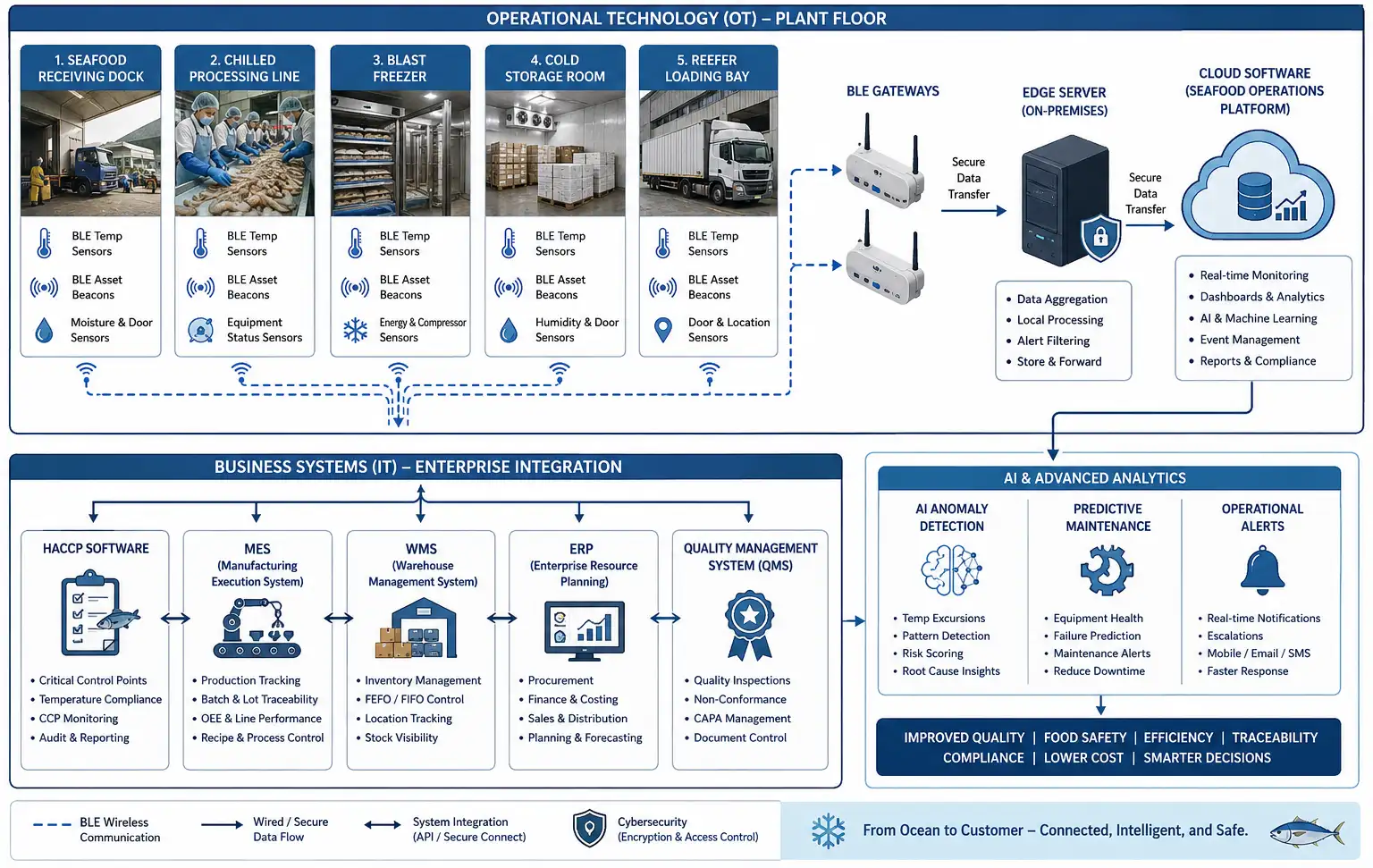
This architecture diagram illustrates how BLE-enabled sensors and asset beacons collect real-time data across seafood receiving, chilled processing, blast freezing, cold storage, and reefer loading. Data flows securely through BLE gateways, an edge server, and cloud software to enterprise platforms—including HACCP, MES, WMS, ERP, and QMS—where AI powers anomaly detection, predictive maintenance, operational alerts, compliance, and production optimization.
What AI-Driven Seafood Production Monitoring Means
Seafood food manufacturing relies on short biological shelf life, tightly controlled temperatures, rapid handling, documented sanitation, and dependable lot segregation. AIoT, or Artificial Intelligence of Things, combines AI with connected sensors, equipment, and industrial systems to make these controls measurable and responsive. In a seafood plant, AI examines BLE sensor telemetry alongside production context, rather than treating each temperature reading as an isolated event.
A practical example is a chilled fillet lot moving from raw-material receiving to grading, trimming, packing, and finished-goods cold storage. A BLE sensor can report local temperature and humidity while a beacon identifies the tote, pallet, insulated cart, or rolling rack. AI can correlate that information with lot identity, supplier intake time, product species, target storage band, door-open events, sanitation cycle status, and expected line dwell time. Quality teams receive an exception based on risk, not merely a long list of raw alerts.
BLE is particularly useful for short-range, indoor visibility in seafood facilities where Wi-Fi may be congested, metal equipment can affect radio propagation, and mobile assets continuously cross chilled zones. The technology enables the AI solution, but seafood safety controls, process discipline, and integrated quality data remain the central design considerations.
Why AI Is Reshaping Seafood Food Manufacturing Decisions
Artificial intelligence improves seafood operations when it identifies patterns that are difficult to see through manual inspection, spreadsheet review, or periodic data logging. A refrigerated room may remain within its average temperature target while certain racks near an evaporator, door, or staging lane repeatedly experience short excursions. Those localized conditions can affect shelf-life risk, especially for fresh salmon, shrimp, tuna, cod, scallops, crab, oysters, and value-added seafood packs.
AI methods most relevant to seafood food production include:
- Time-series anomaly detection for chilled-room temperature, humidity, compressor cycling, and defrost behavior.
- Predictive maintenance models for refrigeration compressors, evaporator fans, condensers, pumps, belt drives, vacuum packers, conveyors, and ice machines.
- Computer vision for fillet grading, species verification, defect detection, portion measurement, packaging seal inspection, label verification, and foreign-material screening.
- Machine-learning risk scoring for seafood lots using temperature exposure, handling time, supplier history, microbial test results, and remaining shelf-life data.
- Process-mining analysis that identifies delays between receiving, washing, filleting, glazing, freezing, packing, and dispatch.
- AI-assisted sanitation verification that compares cleaning schedules, ATP swab results, chemical concentration records, and equipment-area usage.
This approach supports HACCP plans and preventive controls by making deviations easier to detect, investigate, and document. It does not replace the plant’s qualified personnel, critical limits, verification procedures, or corrective-action program. Seafood quality managers still determine whether a flagged condition requires product hold, rework, microbiological testing, disposal, supplier escalation, or release.
Seafood Production Use Cases That Benefit from BLE-Enabled AI
Cold-Chain Excursion Management for Fresh and Frozen Seafood
Fresh seafood processing depends on continuous control from dock receipt through final shipment. BLE temperature sensors placed in receiving zones, cold rooms, packaging areas, blast freezers, and reefer staging lanes give AI a facility-level view of thermal exposure. The AI system can distinguish a normal short door opening from a recurring loading-bay problem, an overloaded cold room, poor airflow behind stored pallets, or a refrigeration unit drifting outside normal cycling behavior.
For frozen seafood, the analysis focuses on maintaining stable frozen storage and detecting thaw-refreeze exposure risks. For fresh seafood, it emphasizes cumulative time-temperature exposure and its relationship to product shelf life. GAO supplies BLE sensors and gateways that can be selected for low-temperature operation, appropriate enclosure ratings, battery-life expectations, calibration needs, and facility-specific radio conditions.
Lot, Tote, Pallet, and Reusable-Asset Visibility
Seafood processors routinely manage fish totes, luggers, pallet jacks, insulated bins, rolling racks, stainless-steel carts, reusable plastic containers, and finished-goods pallets. Missing or improperly staged assets create delays and can disrupt lot segregation. BLE beacons can identify mobile assets as they move through defined zones, while AI estimates dwell time, identifies congestion, and flags unexpected route patterns.
The solution becomes more useful when beacon events are joined with barcode, QR code, or RFID identification used for lot records. BLE supplies continuous proximity and movement context; barcode or RFID systems can provide explicit scan-based identification at receiving, packing, QA hold, and shipping checkpoints. This complementary design is often more reliable than attempting to use a single identification method for every process.
Refrigeration and Utility Equipment Reliability
Refrigeration outages are a high-consequence event in seafood food manufacturing. AI can monitor refrigeration telemetry, BLE vibration or temperature sensor data, supervisory-control data, compressor run hours, suction and discharge conditions, defrost sequences, electrical trends, and work-order history. The objective is to detect deterioration before it turns into a cold-room failure or lost production shift.
Useful maintenance indicators include abnormal compressor cycling, rising condenser temperature, fan vibration changes, repeated high-temperature alarms, prolonged pull-down time after sanitation, and unusually frequent defrosts. Maintenance teams can use these signals to schedule inspections around production windows, reduce emergency repairs, and improve spare-parts planning.
Smart Seafood Cold-Chain Workflow with AI Risk Scoring and Quality Decisions
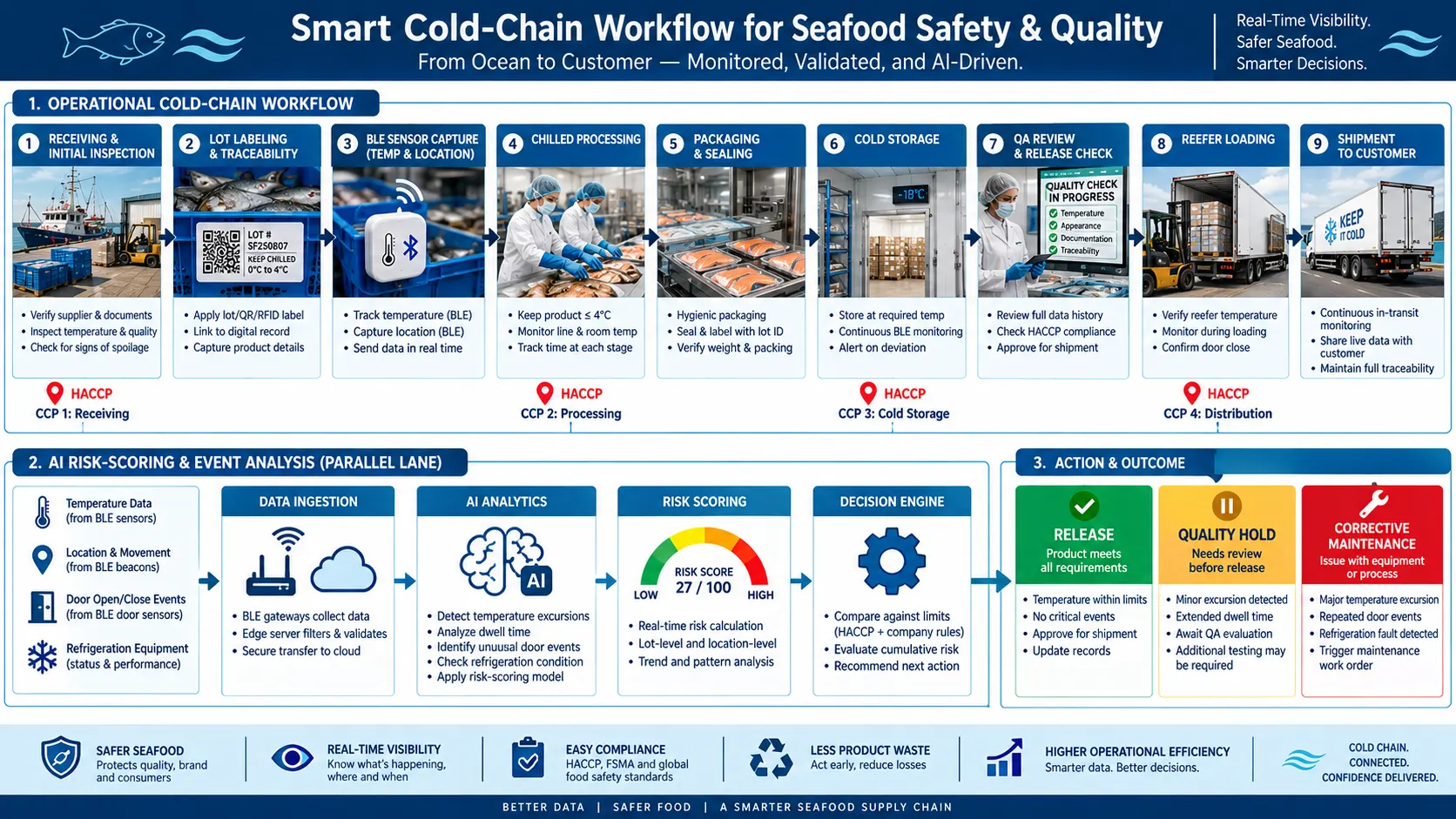
This workflow diagram illustrates the complete seafood cold-chain process from receiving inspection and lot labeling through BLE-enabled temperature and location monitoring, chilled processing, packaging, cold storage, QA review, reefer loading, and shipment. A parallel AI risk-scoring engine continuously analyzes temperature excursions, dwell time, door events, and refrigeration performance to determine whether each shipment is released, placed on quality hold, or routed for corrective maintenance.
Production Flow, Yield, and Labor Coordination
Seafood lines can be constrained by raw-material variability, seasonality, species mix, manual trimming rates, packaging material availability, ice supply, and freezer capacity. BLE zone data helps quantify how long lots, carts, or racks wait before the next process. AI can compare this dwell time with planned production runs, line output, yield records, quality holds, and staffing patterns.
A processor may discover that a grading station is creating a recurring queue that increases chilled holding time before packing. Another facility may see that finished-goods pallets are staged too long near a dock door before reefer loading. These are process and quality insights, not merely asset-tracking results.
Seafood Food Manufacturing Workflow, From Sensor Capture to Business Action
A dependable AIoT deployment begins by mapping the actual product and asset flow. Teams should document receiving docks, wet rooms, processing lines, chilled staging areas, blast freezers, cold stores, shipping lanes, QA hold cages, and waste handling. Each zone needs defined temperature targets, product-handling rules, lot status, critical control points, and responsible roles.
Data Acquisition and Commissioning
BLE sensors, beacons, and equipment interfaces are installed according to the process risk being measured. Sensor placement should avoid direct washdown exposure unless the device rating supports it, prevent contact with product unless approved for that use, and reflect the true thermal condition being evaluated. A sensor next to an evaporator coil or cold-room door may produce data that is technically accurate but unsuitable as a representative product-area measurement.
Commissioning includes:
- Radio-site testing around stainless-steel machinery, insulated panels, freezer doors, rack systems, and wet-processing equipment.
- Gateway placement testing for cold rooms, high-bay storage, loading docks, and connecting corridors.
- Sensor calibration, calibration certificates where required, and defined recalibration intervals.
- Time synchronization among gateways, edge servers, refrigeration controls, quality systems, and production records.
- Asset-to-beacon assignment rules, including procedures for battery replacement, loss, reassignment, and sanitation.
- Alert thresholds aligned to HACCP critical limits, operational limits, escalation responsibilities, and corrective-action procedures.
Communication, Edge Processing, and Data Quality
BLE gateways receive advertising packets from sensors and beacons, then forward normalized data through Ethernet, Wi-Fi, cellular, or private industrial networks. An edge server is useful when the facility requires local alerting during internet disruption, rapid response to freezer alarms, integration with local PLCs, or retention of sensitive production data under customer control.
Edge software can filter duplicate readings, identify missing devices, apply zone rules, buffer data during network loss, and generate immediate alarms. It can also calculate local measures such as maximum temperature excursion, exposure duration, gateway health, and battery status. This reduces unnecessary upstream traffic and prevents unreliable data from distorting AI models.
Cloud vs Server AI Deployment Comparison for Seafood Manufacturing
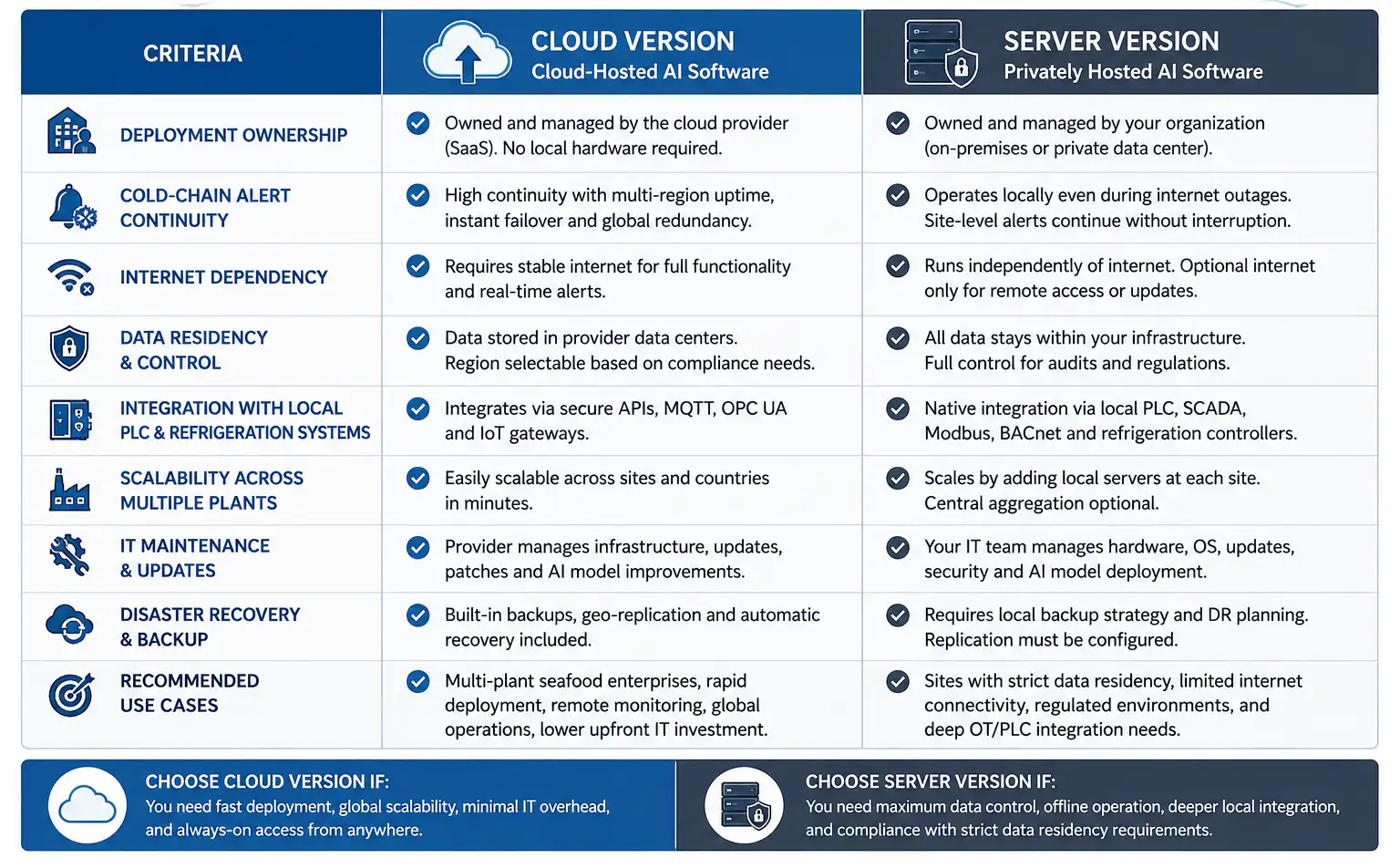
This comparison table evaluates cloud-hosted and privately hosted AI software for seafood manufacturing operations. It compares deployment ownership, cold-chain alert continuity, internet dependency, data residency, PLC and refrigeration system integration, scalability, IT maintenance, disaster recovery, and recommended deployment scenarios to help processors select the most suitable architecture.
Cloud Version and Server Version for Seafood AI Systems
A Cloud Version runs the seafood monitoring, analytics, and AI software in cloud-managed infrastructure. It is suitable for processors operating multiple plants, regional cold stores, distribution centers, or contract-packaging locations that need consolidated reporting and standardized workflows. Cloud deployment simplifies central model updates, cross-site benchmarking, supplier-performance analysis, and corporate dashboards for temperature compliance, spoilage exposure, energy intensity, and shipment readiness.
A Server Version runs on a customer-managed edge server, factory server, private data center, or privately hosted environment. It is appropriate when a seafood processor needs local alarm continuity during internet outages, close integration with PLCs and refrigeration controls, lower response latency, strict data-residency requirements, or direct access to existing plant networks. The server can continue collecting BLE telemetry, applying HACCP rules, and issuing local alerts even when cloud connectivity is unavailable.
Many facilities use a hybrid model. Edge servers manage immediate freezer, cold-room, and loading-dock exceptions, while cloud software supports enterprise reporting, remote support, long-term model training, and multi-site analysis. The choice should follow the processor’s cold-chain risk profile, IT governance, available connectivity, cybersecurity policy, and operational recovery requirements.
Technical Building Blocks for BLE-Enabled Seafood AI
A complete seafood food manufacturing solution combines sensing, integration, AI software, and quality procedures. BLE hardware is only one component and should be chosen around the process condition being measured.
- BLE temperature sensors measure refrigerated receiving areas, chilled processing rooms, blast freezers, cold stores, reefer staging areas, and insulated containers. Select devices according to temperature range, sensor accuracy, calibration requirements, enclosure rating, washdown exposure, battery replacement method, and expected transmission interval.
- BLE asset beacons identify mobile seafood totes, rolling racks, palletized finished goods, insulated bins, forklifts, and reusable containers. Zone-based location is often sufficient for process-flow analysis; room-level or sub-zone accuracy should be validated before using the data for automated quality decisions.
- BLE gateways collect sensor and beacon advertisements. Gateways need planned coverage, reliable power, network redundancy where required, secure firmware management, and physical placement that accounts for freezer walls, metal racking, equipment interference, and door movement.
- Edge servers normalize device data, preserve local operations during connectivity loss, apply alert logic, and integrate with local refrigeration controllers, PLCs, SCADA systems, and operator interfaces.
- AI software evaluates time-series signals, process events, quality data, maintenance history, and lot records. Anomaly detection identifies unusual conditions; predictive models estimate failure or quality risk; optimization models recommend sequencing, staging, or inspection actions.
- Middleware connects sensor records to HACCP software, manufacturing execution systems, warehouse management systems, ERP, laboratory information management systems, computerized maintenance management systems, and quality management software.
- Communication infrastructure may include industrial Ethernet, segmented Wi-Fi, cellular backhaul, VPN connections, MQTT, HTTPS APIs, OPC UA, Modbus TCP, and secure message queues. Protocol selection should reflect equipment age, site network policy, data volume, and integration capability.
- Security controls include unique device identities, encrypted communications, role-based access control, network segmentation, secure boot where supported, signed firmware updates, vulnerability management, audit logging, backup procedures, and incident-response playbooks.
GAO helps seafood food manufacturers identify suitable BLE gateways, beacons, sensors, and related IoT hardware systems for these conditions. Hardware selection should follow a site survey and documented requirements, not a catalog-only comparison.
Seafood AI Deployment Decision Tree: Choosing Cloud, Server, or Hybrid
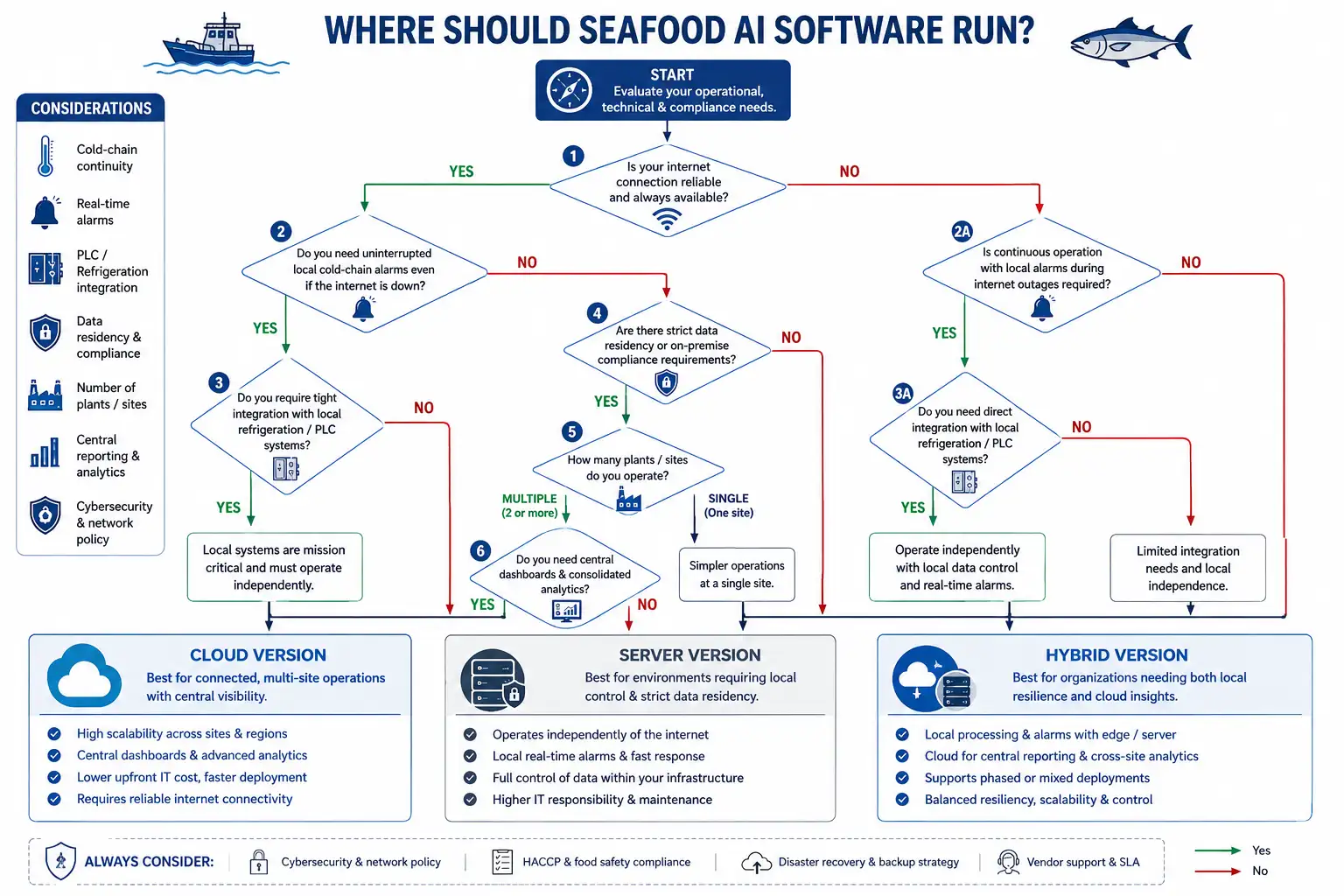
This decision-tree infographic guides seafood manufacturers through key deployment considerations, including internet reliability, local cold-chain alarm requirements, refrigeration PLC integration, data residency policies, plant count, and centralized reporting needs. Based on operational and cybersecurity priorities, it recommends the most suitable AI deployment model: Cloud Version, Server Version, or Hybrid Version.
Operational Improvements From AI-Driven BLE Data
AI-driven seafood monitoring produces practical value because it joins physical conditions with business context. A cold-room alert becomes more actionable when the system identifies the affected lot, product species, time of exposure, remaining shelf life, location, processing stage, and shipment commitment.
Better Product Quality and Traceability
Seafood quality teams can investigate an exception using a connected record of lot movement, environmental conditions, process dwell time, QA holds, inspection results, and shipment status. This supports root-cause analysis following temperature deviations, customer complaints, rejected loads, or supplier-quality disputes.
Useful traceability outcomes include:
- Faster identification of lots exposed to a defined temperature or handling condition.
- Clearer evidence for product disposition decisions, including release, hold, rework, additional testing, or disposal.
- Reduced reliance on handwritten temperature logs and manual location searches.
- More consistent documentation for HACCP verification, seafood HACCP plans, preventive controls, and customer audits.
- Improved recall readiness by narrowing the population of potentially affected lots.
Lower Spoilage, Waste, and Energy Risk
AI can identify recurring conditions that threaten product quality before they become major incidents. Examples include a cold-storage door repeatedly left open during busy shifts, a blast freezer losing pull-down performance, pallets staged too close to a warm loading lane, or a refrigeration unit cycling abnormally after defrost.
Performance measures should be defined before deployment:
- Percentage of cold-chain excursions detected before shipment.
- Mean time to acknowledge and close refrigeration and temperature alarms.
- Product hold rate associated with verified temperature deviations.
- Spoilage, rework, and disposal value by product category and production line.
- Average lot dwell time in chilled staging and QA hold.
- Refrigeration energy use per pound of processed seafood.
- Unplanned refrigeration downtime and maintenance response time.
- Traceability investigation time for a selected lot or shipment.
More Reliable Production and Maintenance Planning
Maintenance teams gain a clearer picture of refrigeration asset condition when BLE telemetry is combined with equipment data and work-order history. Production planners gain visibility into cold-storage capacity, unfinished lot queues, freezer utilization, and shipment staging. These insights can reduce last-minute production changes that jeopardize product temperature or delivery performance.
GAO’s technical support can assist teams with device-selection questions, gateway placement, integration planning, and deployment testing. GAO is headquartered in New York City and Toronto, Canada, and is recognized among the top 10 global B2B and B2G BLE and RFID suppliers. That experience is relevant when a seafood processor needs dependable hardware guidance rather than generic consumer-location technology.
Engineering Considerations for Seafood BLE and AI Deployments
Seafood plants are demanding radio and sensor environments. Stainless-steel surfaces, wet floors, ice, insulated panels, freezer rooms, moving pallet racks, washdown procedures, and high-humidity zones can all affect device reliability and radio performance. A pilot should test real operating conditions across production shifts, sanitation windows, peak receiving periods, and reefer-loading activity.
Design and Validation Priorities
- Define the decision first. Identify whether the solution must support temperature compliance, location visibility, refrigeration maintenance, production flow, QA hold management, or a combination of these outcomes.
- Map product and asset movement before installing devices. Include raw seafood receipt, ice addition, washing, sorting, filleting, glazing, freezing, packing, cold storage, order picking, and reefer dispatch.
- Validate sensor placement against the condition being measured. Ambient-room monitoring, product-proximity measurement, trailer monitoring, and equipment-condition monitoring each require different placement and acceptance criteria.
- Test radio coverage with loaded pallets, closed freezer doors, operating machinery, and wet-process conditions. Empty-room tests rarely represent production performance.
- Define data ownership, retention, access rights, and audit requirements. Quality, operations, maintenance, IT, and food-safety teams should agree on the authoritative system for each record.
- Establish alert governance. Every alert needs a severity, recipient, acknowledgement window, escalation path, corrective-action procedure, and review process to prevent alarm fatigue.
- Keep AI recommendations explainable. Quality and maintenance teams need to see the data pattern, threshold, model confidence, and operational context behind a recommended action.
- Maintain calibration, battery, firmware, and asset-assignment records. Device maintenance is part of the seafood quality system, not an afterthought.
Standards, Compliance, and Food-Safety Alignment
Seafood processors should align implementation with applicable FDA seafood HACCP requirements, Food Safety Modernization Act preventive controls, 21 CFR Part 123, current good manufacturing practices, local food-safety regulations, customer specifications, and recognized schemes such as BRCGS, SQF, FSSC 22000, ISO 22000, and Global Food Safety Initiative benchmarked programs where applicable. Seafood exporters may also need to consider National Marine Fisheries Service requirements, import-country rules, chain-of-custody controls, and retailer-specific temperature documentation.
Sensor data strengthens compliance only when it is accurate, protected, reviewed, and connected to documented corrective actions. A dashboard alone does not establish food-safety compliance.
Seafood BLE and AI Deployment Checklist for Cold-Chain Operations
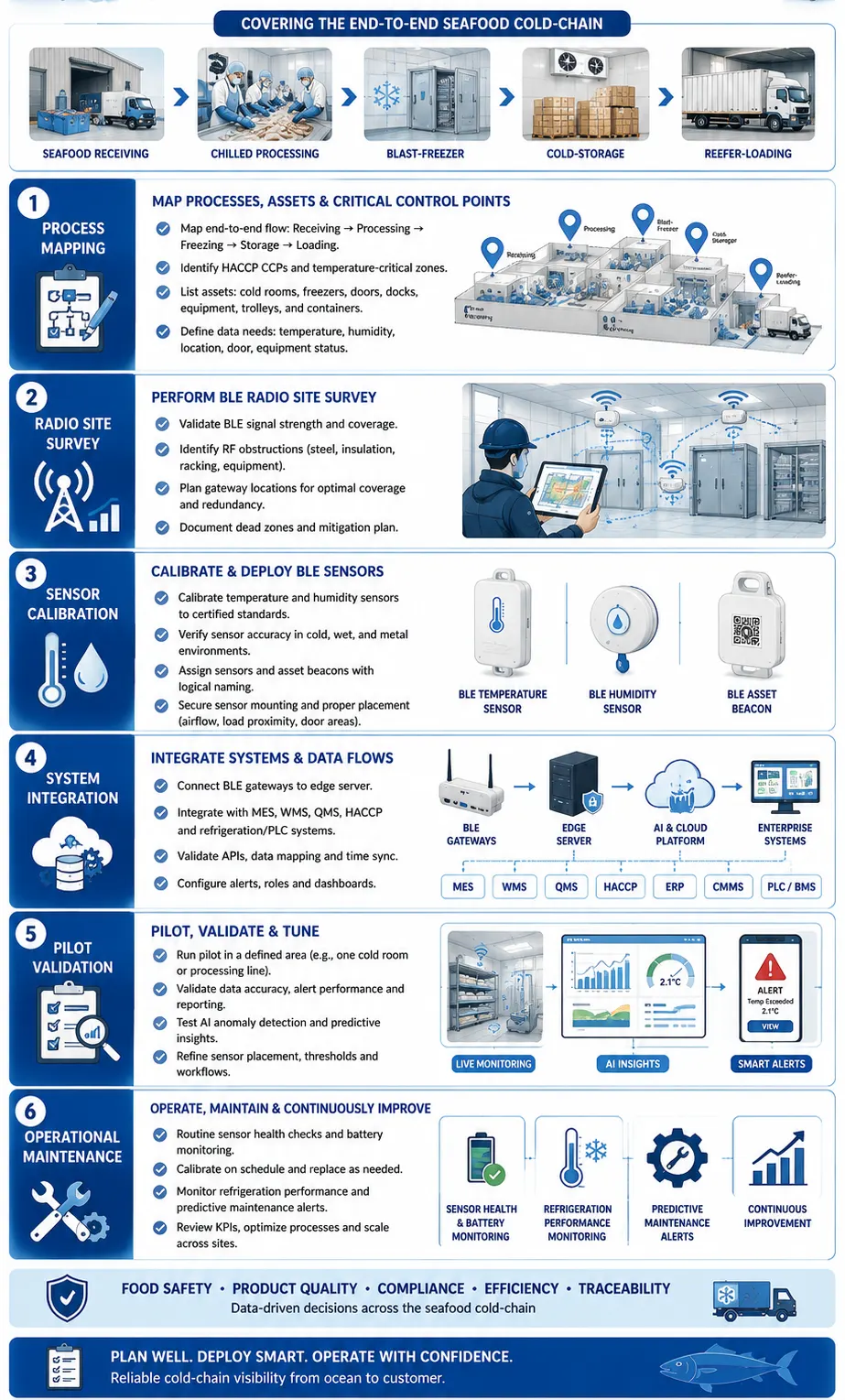
This vertical infographic provides a step-by-step deployment checklist for implementing BLE and AI across seafood manufacturing facilities. It covers process mapping, radio site surveys, sensor calibration, system integration, pilot validation, and ongoing operational maintenance, with guidance spanning seafood receiving, chilled processing, blast freezing, cold storage, and reefer loading to support reliable cold-chain monitoring and food safety.
Implementation Recommendations for Seafood Food Manufacturers
Start with a bounded operational problem that has measurable consequences. A chilled-storage excursion program, reusable-tote visibility project, blast-freezer performance initiative, or reefer staging control is usually more effective than deploying devices across every area at once.
A disciplined implementation sequence includes:
- Establish baseline KPIs using existing temperature logs, maintenance data, hold records, throughput records, and shipment exceptions.
- Select one production area and representative product mix for a pilot, including fresh and frozen conditions where relevant.
- Integrate only the systems required to support the target decision, such as HACCP records, WMS lot status, refrigeration controls, or maintenance work orders.
- Validate data accuracy, alert response, process adoption, and business value through real shifts and sanitation cycles.
- Expand by proven use case, maintaining device governance, cybersecurity controls, calibration discipline, and operating procedures.
GAO, together with GAO Research and GAO Tek, has served U.S. and Canadian customers for three decades, including Fortune 500 companies, leading R&D organizations, universities, and government agencies. We apply stringent quality-assurance processes and provide expert remote or onsite support to help seafood food manufacturers move from a pilot to a dependable operational system.
Seafood AI Monitoring: Key Takeaways
AI-enabled seafood monitoring turns BLE data into decisions about product quality, cold-chain control, asset flow, refrigeration reliability, and shipment readiness. The strongest deployments connect sensor telemetry with HACCP procedures, lot records, quality results, maintenance history, and production workflows. They begin with defined risk and KPI targets, test under actual seafood plant conditions, and maintain clear accountability for alarms, calibration, cybersecurity, and corrective actions.
GAO provides BLE, RFID, and IoT hardware products and systems that support these seafood food manufacturing requirements. Contact us to explore appropriate sensor, gateway, beacon, integration, and technical-support options for your facility.
Building the Future of Industrial AI and IoT with Aperture Venture Studio and GAO RFID Inc.
For more than three decades, GAO Group of Companies has invested heavily in industrial BLE, RFID, and IoT research and development. As generative AI has demonstrated practical value in industrial operations, we have expanded work on AIoT solutions for sectors such as seafood food manufacturing and established Aperture Venture Studio to advance and scale applied AI and IoT solutions. Aperture brings together AI and IoT technical experts, operational leaders, investors, and leading organizations. Through Aperture Ventures Summit and TekSummit, we foster technical discussion and active AIoT communities. We welcome participation as advisors, employees, investors, or customers.