
AI and BLE for Senior Care Facilities
AI-Driven Senior Care Operations with BLE-Connected Data
AI and BLE for Senior Care Facilities combines artificial intelligence with BLE beacons, BLE sensors, wearable devices, and gateways to improve resident safety, staff workflows, asset visibility, and facility operations. BLE provides location, proximity, environmental, and event data, while AI converts that data into actionable insights such as unusual movement patterns, room occupancy changes, wandering risk indicators, equipment utilization trends, and maintenance alerts. The approach is particularly useful in skilled nursing facilities, assisted living communities, memory care centres, and long-term care environments where staff must continuously balance resident care with operational demands. A properly engineered solution can connect resident wearable, beds, doors, medical equipment, environmental sensors, and staff devices with care-management and facility systems. GAO supplies BLE hardware and IoT systems that can support these deployments while allowing organizations to select cloud-hosted or privately managed software according to their security, integration, and operational requirements.
AI-Driven Senior Care Operations Using BLE
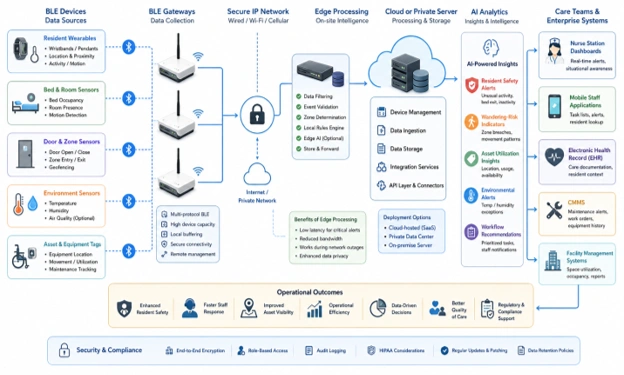
This diagram shows how BLE wearable, room and environmental sensors, equipment tags, and BLE gateways feed data through secure networks into edge processing and cloud or private server systems. AI analytics then generate resident safety alerts, wandering-risk indicators, asset utilization insights, environmental alerts, and workflow recommendations for care teams and senior care software.
What AI-Enabled BLE Means for Senior Care Facilities
Senior care facilities generate continuous operational data from residents, caregivers, rooms, equipment, entrances, common areas, medication-support areas, and building systems. Much of this information is traditionally observed manually. AI can help convert connected observations into patterns that staff can use for prioritization and operational decision-making.
BLE acts as a practical data-acquisition layer because small, battery-powered devices can be attached to people, equipment, doors, beds, carts, rooms, and other relevant assets. BLE gateways collect advertisements or sensor messages and forward them to software for processing. Depending on the use case, the system can estimate proximity, determine location zones, monitor environmental conditions, identify equipment movement, or detect changes in routine.
AI becomes valuable after sufficient contextual data has been collected. Machine learning models can establish normal operating patterns and identify deviations. For example, an AI system can analyse repeated movement and location events to identify changes in a resident’s established routine that warrant staff attention. It should support care teams rather than independently diagnose a medical condition.
Relevant AI methods can include:
- Anomaly detection for unusual resident or facility activity patterns
- Time-series analysis for temperature, humidity, occupancy, and equipment data
- Predictive analytics for equipment maintenance and utilization
- Classification models for operational event categorization
- Geo-fencing logic for controlled-area and wandering-risk workflows
- Computer vision where separately deployed cameras are appropriate and permitted
- Edge AI for low-latency processing of selected events
- Rule-based automation combined with machine learning for safety workflows
The practical value comes from combining AI reasoning with reliable physical-world observations. A model cannot compensate for poor sensor placement, weak RF coverage, inaccurate timestamps, missing gateway data, or poorly defined operational rules.
Why Senior Care Facilities Need Context-Aware AI
Senior care operations differ from acute-care hospitals because residents may remain in the same facility for months or years, routines can vary significantly between individuals, and staff frequently manage both care-related and facility-related responsibilities.
AI solutions therefore need resident-specific and facility-specific context. A movement pattern that is normal for one resident may be unusual for another. Similarly, a door opening may be routine during daytime hours but operationally significant during a configured overnight period.
Useful context can include:
- Resident room and authorized care areas
- Normal movement periods and routine patterns
- Staff schedules and assigned care zones
- Facility floor plans and restricted areas
- Equipment ownership and department assignment
- Environmental thresholds for rooms and storage areas
- Maintenance schedules and equipment service history
- Emergency procedures and escalation rules
GAO’s BLE hardware and IoT systems can provide the underlying device and connectivity layer required to collect these events consistently across senior care environments.
Priority AI Applications for Senior Care Facilities
AI Resident Safety and Activity Monitoring
AI-supported resident monitoring can combine wearable BLE tags, room-level BLE sensors, bed occupancy sensors, door sensors, and location information to identify changes in routine.
Potential applications include:
- Detecting unusual night time movement patterns
- Identifying unexpected room exits
- Monitoring transitions between resident rooms and common areas
- Supporting wandering-risk workflows in memory care areas
- Identifying prolonged inactivity that requires staff verification
- Prioritizing alerts according to time, location, resident profile, and event severity
- Supporting post-event review through time stamped activity records
A critical engineering consideration is alert fatigue. A system that produces excessive notifications can become operationally ineffective. Thresholds, event correlation, escalation delays, and staff acknowledgment workflows should therefore be tested with actual caregivers before facility-wide deployment.
AI Fall-Risk Support and Bed-Exit Monitoring
BLE-enabled sensors can contribute to workflows surrounding bed occupancy, room activity, and resident movement. AI can analyse sequences of events rather than treating every individual sensor event as an emergency.
For example, a sequence involving bed occupancy, repeated movement near a bed, a door event, and prolonged absence can be evaluated differently from a single BLE proximity event.
Such systems should be positioned as fall-risk and safety-support tools, not as autonomous clinical diagnosis systems. Where a facility requires certified medical-device functionality, the selected hardware and software must be evaluated against the applicable regulatory requirements for the intended use.
AI Wandering and Memory Care Workflows
Memory care facilities have specialized requirements for managing resident movement without unnecessarily restricting resident independence.
BLE wearable’s and zone beacons can provide location or proximity information across configured areas. AI and rules engines can then evaluate:
- Entry into restricted zones
- Unexpected movement toward exterior doors
- Repeated movement between specific locations
- Unusual night time activity
- Resident-specific movement patterns
- Duration spent outside an expected care area
The workflow should route only actionable events to designated staff. Facility policies should define who receives an alert, what verification is required, when escalation occurs, and how events are documented.
AI Asset Tracking for Senior Care Equipment
Senior care facilities often have high-value mobile equipment distributed across resident rooms, nursing stations, therapy areas, storage rooms, and maintenance locations. Staff may lose time searching for equipment even when sufficient inventory exists.
BLE asset tags can be attached to suitable equipment, while gateways and location-aware software provide visibility into movement and utilization.
Applications include:
- Wheelchairs and transport equipment
- Patient lifts
- Mobility aids
- Vital-sign monitoring equipment
- Portable diagnostic equipment
- Emergency equipment
- Therapy equipment
- Medication carts and supply carts
- Maintenance tools
- Portable environmental monitoring devices
AI can identify equipment utilization patterns, underused assets, abnormal movement, recurring shortages by location, and potential maintenance priorities.
AI Environmental Monitoring for Resident Areas
Environmental conditions can directly affect comfort, building operations, equipment storage, and certain facility workflows. BLE temperature and humidity sensors can continuously collect measurements from resident rooms, medication-related storage areas, food-service spaces, utility areas, and other locations where environmental monitoring is required.
AI and analytics can identify:
- Persistent temperature drift
- Repeated humidity excursions
- Abnormal room-level environmental patterns
- HVAC-related anomalies
- Sensor readings that differ significantly from neighbouring areas
- Conditions requiring maintenance investigation
Environmental monitoring should use calibrated sensors appropriate to the required accuracy and application. Critical thresholds should remain governed by facility policies and applicable requirements rather than being determined solely by an AI model.
AI Use-Case Matrix for Senior Care Facilities Using BLE
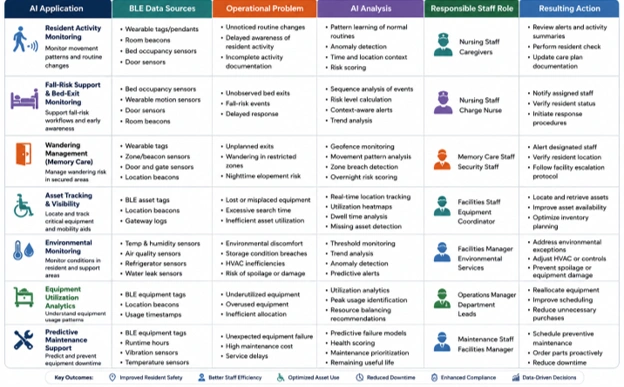
The matrix maps seven senior care AI applications to their BLE data sources, operational challenges, AI analysis methods, responsible staff roles, and resulting actions. It highlights how BLE-enabled data can support resident safety, wandering management, asset visibility, environmental monitoring, equipment utilization, and predictive maintenance.
Senior Care Operational Workflow from BLE Data to AI Action
A practical deployment should treat data acquisition, connectivity, analytics, workflow integration, and human response as one operational chain.
Data Acquisition
The process begins with appropriately selected BLE devices.
Resident-oriented devices may include wearable tags, pendants, wrist-worn devices, or other approved form factors. Facility-oriented devices may include door sensors, occupancy sensors, environmental sensors, BLE beacons, and equipment tags.
Device selection should consider battery life, enclosure design, cleaning procedures, mounting method, transmission interval, sensor accuracy, radio performance, and compatibility with the facility’s operating environment.
BLE Communication and Gateway Collection
BLE devices transmit data over short-range wireless links. Gateways positioned throughout the facility receive BLE advertisements or sensor messages and forward them through Ethernet, Wi-Fi, cellular, or another approved IP connection.
Gateway placement requires an RF survey rather than simple visual coverage assumptions. Concrete walls, elevator shafts, fire doors, metal equipment, building layouts, and other radio sources can affect coverage and location accuracy.
Senior care facilities should also account for coexistence with Wi-Fi and other 2.4 GHz systems. RF testing should be performed during representative operating conditions where possible.
Edge Processing
Edge processing can reduce unnecessary data transmission and support rapid local decisions.
Examples include:
- Filtering duplicate BLE events
- Validating sensor payloads
- Timestamp normalization
- Local buffering during network interruptions
- Zone determination
- Preliminary anomaly detection
- Gateway health monitoring
- Local alert handling for selected time-sensitive workflows
Edge processing is particularly useful where a facility requires continued operation during temporary cloud or WAN connectivity problems.
Cloud or Private Server Processing
Processed events can be forwarded to cloud-hosted software or privately managed server infrastructure. The appropriate choice depends on the facility’s IT policies, data governance requirements, integration strategy, network design, and operational support model.
Cloud deployment can simplify centralized management across multiple facilities. A privately managed server can provide greater control over infrastructure placement and internal data handling.
Neither model automatically makes a system secure. Identity management, encryption, network segmentation, patch management, logging, backup procedures, vulnerability management, and access controls remain essential.
AI Analytics and Operational Decision-Making
The analytics layer correlates BLE events with resident, facility, equipment, schedule, and location context.
A typical decision chain may look like:
- BLE sensor captures an event
- Gateway receives and validates the event
- Software associates the event with a resident, asset, room, or zone
- Rules and AI models evaluate the event sequence
- The system calculates an operational priority
- An authorized staff member receives an alert or recommendation
- Staff verifies the physical situation
- The action is documented in the appropriate system
- Historical data is retained for analytics, quality improvement, or maintenance review
Human verification remains important for safety-sensitive workflows. AI should prioritize and contextualize information rather than encourage staff to treat algorithmic output as unquestionable clinical truth.
Senior Care AI and BLE Operational Data Flow
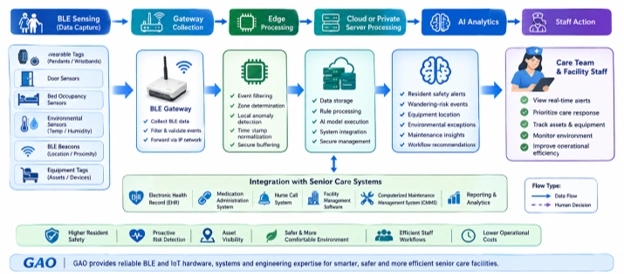
The completed workflow illustrates how resident and equipment data moves from BLE sensors through gateway collection, edge processing, cloud or private server processing, and AI analytics before reaching care staff. It also shows integration with care-management software, EHR, CMMS, facility management software, and reporting systems, connecting technical data flows with operational actions.
Engineering Priorities Before Senior Care Deployment
Successful implementation depends on facility-specific engineering rather than simply installing BLE devices.
RF Survey and Coverage Planning
A deployment team should document floor plans, resident rooms, nursing stations, elevators, stairwells, common areas, exterior doors, restricted areas, equipment storage rooms, and other relevant zones before determining gateway locations.
Testing should evaluate:
- BLE signal strength and receiver sensitivity
- Gateway coverage
- Location-zone accuracy
- 2.4 GHz interference
- Physical obstructions
- Network availability
- Gateway redundancy requirements
- Battery-powered device performance
Resident Privacy and Data Governance
Senior care deployments can involve sensitive personal information. Organizations should define what information is collected, why it is collected, who can access it, how long it is retained, and where it is processed.
Where protected health information is involved, the facility and its technology providers should evaluate applicable HIPAA and HITECH obligations, contractual requirements, access controls, audit logging, encryption, and data-handling procedures.
BLE device identifiers should not automatically be treated as anonymous simply because they are wireless identifiers. When an identifier can be associated with a resident, the resulting data may become sensitive within the operational context.
Interoperability with Senior Care Software
The solution should be designed around existing workflows rather than forcing caregivers to monitor another disconnected application.
Depending on the facility, integration targets may include:
- Electronic health record systems
- Electronic medication administration record systems
- Nurse call systems
- Care-management software
- Building management systems
- Computerized maintenance management systems
- Asset management software
- Identity and access management systems
- Facility management software
- Reporting and business intelligence systems
Standards such as HL7 and FHIR may be relevant where healthcare information needs to move between systems, while REST APIs, web hooks, MQTT, and secure messaging can support IoT event integration where appropriate. The exact interface should be selected according to the capabilities and security requirements of the systems being integrated.
Senior Care AI and BLE Integration Map
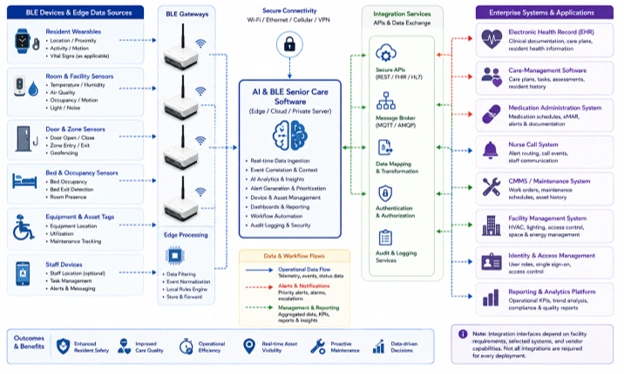
The completed map shows how BLE wearable’s, room sensors, door sensors, bed sensors, equipment tags, and staff devices connect through BLE gateways and edge processing to AI-enabled senior care software. Secure APIs and data services then connect relevant information with EHR, care management, medication administration, nurse call, CMMS, facility management, identity, and reporting systems, while noting that integrations depend on facility requirements and vendor capabilities.
BLE Hardware, AI Software, and Deployment Models for Senior Care Facilities
A technically sound senior care solution separates sensing, wireless collection, data processing, AI analytics, integration, and human action. Each layer should be selected according to the facility’s physical environment, resident-care workflows, IT policies, and security requirements.
BLE Beacons and Location Infrastructure
BLE beacons can provide fixed reference points for room, zone, proximity, or location workflows. Their placement should follow the facility floor plan and the required location granularity.
Room-level presence may require a different beacon density and receiver arrangement than zone-level tracking. Facilities should avoid promising precise positioning unless the selected hardware, gateway density, RF environment, and positioning method have been validated through testing.
BLE Sensors and Wearable Devices
BLE sensors can collect information such as temperature, humidity, occupancy, motion, door status, and other facility-specific measurements. Wearable BLE devices can provide an identifier or sensor data associated with an authorized resident, caregiver, or asset.
Device selection should evaluate:
- Battery life and replacement procedures
- Enclosure and cleaning requirements
- Transmission interval
- Sensor accuracy
- Operating temperature range
- Mounting and attachment method
- Tamper detection where required
- RF performance
- Device management capabilities
- Firmware update mechanisms
Senior care facilities should also establish procedures for lost, damaged, unassigned, or reassigned devices.
BLE Gateways
BLE gateways bridge short-range wireless devices with the facility’s IP network. They can receive data from multiple BLE devices and forward validated events to edge or server software.
Gateway selection should consider device capacity, receiver sensitivity, Ethernet and Wi-Fi connectivity, local storage, protocol support, remote management, power availability, and failover requirements.
PoE-enabled gateways can simplify deployment in suitable locations because power and network connectivity can be provided through a single Ethernet connection.
Edge Processing
Edge servers or gateway-level processing can perform filtering, buffering, event normalization, zone determination, and selected AI inference close to the facility.
This approach can reduce WAN traffic and improve response time for workflows that do not need centralized processing. Local buffering is also useful when network connectivity is temporarily unavailable.
AI and Analytics Software
AI software can combine BLE events with historical data, schedules, locations, asset records, and operational context. Depending on the application, machine learning can identify anomalies, predict equipment maintenance needs, classify events, or estimate patterns of utilization.
Model performance should be measured against operational requirements rather than generic accuracy claims. Facilities should define acceptable false-positive and false-negative rates for each workflow and establish procedures for model monitoring and recalibration.
Cloud Version and Server Version
A Cloud Version can host data ingestion, device management, analytics, dashboards, APIs, and AI processing within managed cloud infrastructure. This model can be appropriate for organizations operating multiple senior care facilities that need centralized monitoring and software administration.
A Server Version can run on customer-managed servers, private data centers, facility servers, edge servers, or other privately hosted infrastructure. This model may be appropriate where the organization requires greater control over data location, network boundaries, integration interfaces, or internal IT operations.
A hybrid approach can also be appropriate. For example, a senior care facility may use local edge processing for immediate event handling while sending selected data to cloud software for centralized analytics.
Cloud vs. Server Deployment Matrix for Senior Care AI & BLE Systems
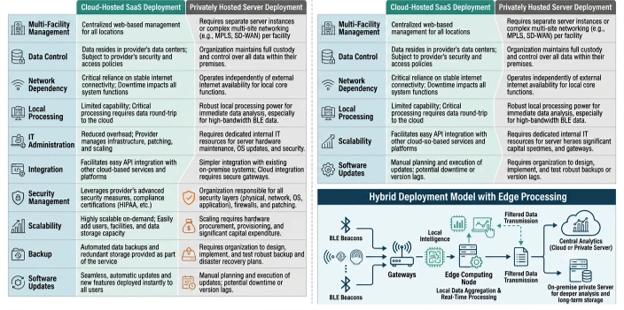
A technical comparison chart contrasting cloud-hosted SaaS and privately hosted server deployments across ten key operational and security dimensions for senior care facilities. The graphic includes a architectural diagram illustrating a hybrid model where local BLE gateways and edge computing nodes process real-time telemetry before passing filtered data to cloud or on-premise central analytics.
Security and Privacy Engineering for Senior Care BLE Systems
Security should be designed into the deployment rather than added after installation.
A senior care BLE solution can involve information associated with residents, staff, assets, rooms, schedules, and facility operations. The security design should therefore address the complete path from the BLE endpoint to the software and user interface.
Key controls include:
- Unique device identities
- Secure device provisioning
- Encryption for data in transit
- Encryption for sensitive data at rest
- Role-based access control
- Multi-factor authentication for appropriate users
- Network segmentation
- Gateway hardening
- Secure API authentication
- Audit logging
- Firmware and software patch management
- Vulnerability assessment
- Backup and recovery procedures
- Device decommissioning
- Data retention and deletion policies
BLE itself should not be treated as a complete security solution. The radio layer is only one component of the system. Security must also cover gateway operating systems, IP networks, application interfaces, cloud or server infrastructure, user accounts, and administrative procedures.
Where the solution processes protected health information, the organization should assess applicable HIPAA requirements and related contractual and privacy obligations. Security controls should be validated against the facility’s risk assessment and internal policies rather than assumed from a product label.
GAO’s experience supplying BLE and IoT hardware and systems can support organizations that require hardware selection, technical integration, deployment assistance, and remote or onsite engineering support.
What AI Improves in Senior Care Facility Operations
The primary value of AI is not simply collecting more BLE data. Its value comes from converting large volumes of physical-world events into prioritized information that staff can act upon.
Faster Identification of Operational Exceptions
A traditional workflow may require staff to notice an event manually, investigate it, and determine whether it is significant. AI can continuously analyse sensor events and identify patterns that deserve attention.
For example, an unusual combination of room activity, bed occupancy changes, and door events can be prioritized for review without requiring staff to manually examine every individual event.
Better Resident Safety Workflow
AI can correlate time, location, movement patterns, and facility rules to help staff distinguish routine activity from potentially important deviations.
The result is not autonomous clinical decision-making. Instead, the system can provide context such as the affected zone, event sequence, time, and relevant historical pattern so authorized staff can make a faster informed decision.
Improved Asset Utilization
Asset tracking becomes more valuable when historical movement data is analyzed rather than simply displayed on a map.
AI can identify:
- Equipment that remains unused for extended periods
- Areas experiencing repeated equipment shortages
- Assets frequently moved between departments
- Abnormal utilization patterns
- Potential equipment allocation problems
- Maintenance events correlated with usage
Facility managers can use these insights when planning purchases, reallocating equipment, or reviewing operational processes.
Predictive Maintenance Support
Equipment failures can disrupt resident care workflows and increase maintenance costs. Where suitable sensors and historical maintenance records are available, machine learning can identify patterns associated with equipment degradation.
Predictive maintenance should begin with equipment for which failure has measurable operational consequences and sufficient historical data exists. A model should not be deployed merely because a device can generate sensor readings.
Reduced Alert Fatigue
AI can help prioritize alerts by considering multiple variables instead of treating every threshold violation equally.
A practical alerting system should distinguish:
- Informational events
- Events requiring staff review
- Events requiring prompt intervention
- Events requiring escalation according to facility policy
Alert routing should also consider staff roles, location, shift schedules, acknowledgment status, and escalation rules where the required interfaces support those functions.
Key KPIs for Measuring AI and BLE Deployment
Senior care facilities should establish baseline measurements before deployment and compare them with post-deployment results.
Relevant KPIs can include:
- Average time to acknowledge priority operational alerts
- Average time to locate mobile equipment
- Equipment utilization rate
- Number of unresolved asset-location events
- Environmental excursion frequency and duration
- Gateway and sensor uptime
- BLE device battery replacement frequency
- False-positive alert rate
- Alert acknowledgment rate
- Network connectivity availability
- Mean time to repair supported equipment
- Preventive maintenance completion rate
- Staff time spent searching for equipment
- Number of repeated environmental exceptions
- Integration transaction success rate
Resident safety metrics should be interpreted carefully. A decrease in reported incidents does not automatically prove that an AI system caused the improvement. Facilities should account for workflow changes, staffing, documentation practices, resident population changes, and other variables.
Senior Care Deployment Lifecycle and Implementation Recommendations
A controlled deployment should progress through defined engineering stages.
Discovery and Workflow Mapping
Document resident-care workflows, facility operations, existing systems, RF conditions, security policies, and the specific problems that the technology is expected to address.
Avoid beginning with hardware procurement. Start with operational requirements.
Site Survey and Solution Design
Review floor plans, building materials, network infrastructure, gateway locations, power availability, resident zones, equipment storage areas, and restricted areas.
Define the required location granularity and sensor coverage before determining device quantities.
Pilot Deployment
Begin with a representative area rather than immediately deploying across every floor.
A useful pilot should include realistic resident-care workflows, typical network conditions, actual staff users, and the equipment types that the final deployment will support.
Commissioning and Testing
Test:
- BLE coverage
- Device registration
- Gateway connectivity
- Event timestamps
- Location-zone accuracy
- Sensor readings
- Data buffering
- Network recovery
- AI alert generation
- User permissions
- API integration
- Audit logs
- Battery behaviour
- Firmware updates
Testing should include failure scenarios. Disconnect a gateway, interrupt network connectivity, remove a sensor, generate duplicate events, and test recovery behaviour.
Staff Validation and Workflow Optimization
Caregivers, nurses, facilities personnel, IT administrators, and other intended users should participate in acceptance testing.
An technically correct system can still fail operationally if alerts are excessive, dashboards are difficult to interpret, or the response process is unclear.
Cyber security Validation
Before production use, validate identity management, encryption, access permissions, network segmentation, patching, logging, backup, recovery, and device decommissioning.
Security testing should be repeated as the system expands.
Scale-Out and Continuous Optimization
After the pilot meets defined acceptance criteria, deployment can expand to additional resident areas, floors, buildings, or facilities.
The operating team should periodically review:
- Sensor health
- Gateway utilization
- Battery life
- RF performance
- AI model performance
- Alert volume
- Integration reliability
- Security events
- Staff feedback
- KPI trends
This creates a measurable improvement cycle rather than treating deployment as a one-time installation.
The 12-Stage Lifecycle of Senior Care AI and BLE Technology
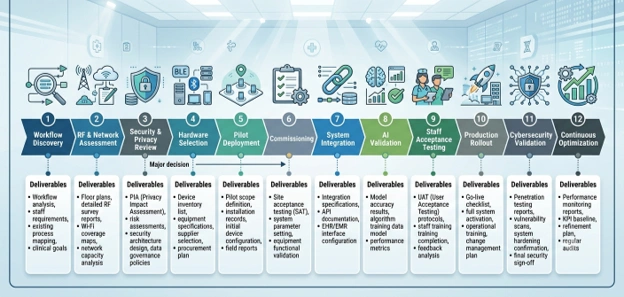
A comprehensive roadmap outlining the structured approach for deploying advanced AI and BLE technologies in senior care facilities. This visual breaks down the transformation into twelve distinct, logical phases, beginning with essential ground-level research and security assessments. It progresses through systematic hardware choices, initial pilot tests, full system integration, and rigorous operational validation. The final stages focus on successful facility-wide rollout, concluding with essential cybersecurity certification and ongoing refinement to ensure optimal performance and care. Each step detail specific, measurable deliverables.
Engineering Lessons for AI-Enabled Senior Care Facilities
- Start with a measurable operational problem: Resident safety workflows, equipment search time, environmental monitoring, and maintenance are easier to evaluate when the desired outcome is clearly defined.
- Treat RF engineering as part of the solution: BLE coverage and location accuracy depend on building characteristics, gateway placement, interference, device orientation, and required positioning precision.
- Design alerts around human workflows: An alert without a defined owner, response procedure, and escalation path creates little operational value.
- Keep safety-critical decisions under appropriate human oversight: AI should provide context and prioritization unless a separately validated and regulated application is specifically designed for autonomous operation.
- Separate data collection from data interpretation: Reliable sensors and timestamps are prerequisites for dependable analytics.
- Plan interoperability before deployment: API specifications, identity requirements, data ownership, event schemas, and integration responsibilities should be documented early.
- Use edge processing where local resilience matter: Facilities can continue selected workflows during temporary network interruptions when local buffering and processing are appropriately designed.
- Measure performance continuously: Gateway uptime, battery life, alert quality, integration reliability, and operational KPIs should be reviewed after deployment.
- Design cyber security across the entire system: BLE devices, gateways, networks, servers, APIs, applications, and user accounts all require appropriate protection.
- Scale only after the pilot is operationally proven: A successful pilot should demonstrate technical reliability and staff acceptance before expansion.
GAO Support for AI and BLE Senior Care Solutions
GAO provides BLE, RFID, and IoT hardware products and systems that can be used as building blocks for connected senior care applications, including BLE gateways, beacons, sensors, tags, and related wireless technologies. Our role can extend beyond hardware selection to technical guidance, system integration considerations, deployment support, and engineering assistance.
GAO’s companies are headquartered in New York City and Toronto, Canada, and GAO is recognized among the leading B2B and B2G BLE and RFID suppliers globally. For three decades, GAO Group has served organizations across the United States and Canada, including Fortune 500 companies, research and development organizations, universities, and government agencies.
Our R&D investment, quality assurance processes, and remote and onsite expert support provide a practical foundation for organizations evaluating connected senior care technologies.
Key Takeaways for AI and BLE in Senior Care Facilities
AI-enabled senior care solutions are most effective when they connect physical-world data with clearly defined operational decisions. BLE wearables, sensors, beacons, equipment tags, and gateways provide the data required to understand resident movement, equipment location, environmental conditions, and facility events.
AI can then identify patterns, prioritize exceptions, support asset management, improve maintenance planning, and provide staff with contextual information. The strongest deployments combine accurate sensing, engineered RF coverage, resilient connectivity, secure software, appropriate AI models, interoperability, human oversight, and measurable KPIs.
Organizations planning a deployment should begin with a workflow assessment and site survey, then validate the technology through a controlled pilot before scaling across additional senior care areas or facilities. GAO can provide BLE and IoT hardware, systems, and technical support for organizations evaluating these requirements.
Building the Future of Industrial AI and IoT with Aperture Venture Studio and GAO RFID Inc.
For more than three decades, GAO Group of Companies has invested heavily in R&D of industrial BLE, RFID, and IoT. As generative AI became useful for industrial applications, we expanded our work in AI and IoT technologies, including BLE and RFID, and founded Aperture Venture Studio to advance AI and IoT solutions relevant to connected senior care and other industries.
Aperture has attracted AI and IoT technical experts, entrepreneurial and operational executives, influential investors, and leading companies. We have also developed Aperture Ventures Summit and TekSummit to discuss advanced AI and IoT topics and strengthen technical communities.
We welcome you to join us as:
- Advisors, Co-founders, or Employees
- Customers
- Investors