
AI and BLE for Ship Construction
AI-Driven Ship Construction with Connected BLE Systems
Artificial Intelligence of Things, or AIoT, is becoming increasingly useful in ship construction because shipyards must coordinate thousands of materials, tools, workers, subcontractors, production zones, blocks, machinery components, and inspection activities across constantly changing work environments. AI-enabled solutions using BLE gateways, BLE beacons, and BLE sensors can provide continuous location and condition data that complements shipyard production systems. The resulting data can support AI applications for material traceability, block and module progress monitoring, worker safety, equipment utilization, logistics planning, quality assurance, and predictive maintenance. The value is not simply knowing where an object is. AI can correlate location, time, work orders, environmental conditions, production status, and historical events to identify deviations and recommend actions. For ship construction, this creates a practical connection between physical production activities and digital decision-making while supporting the traceability, safety, testing, and quality controls required during new-vessel construction.
Why AI Matters in Modern Ship Construction
Ship construction is a project-oriented manufacturing environment with unusually high physical complexity. A vessel may move through design, steel preparation, cutting, forming, welding, block assembly, blasting, painting, outfitting, pipe installation, electrical installation, machinery integration, testing, commissioning, harbor trials, and sea trials. Thousands of components may be temporarily staged before being installed in locations that become progressively harder to access.
The production problem is therefore partly a state visibility problem.
A production manager may need to determine:
- Where a prefabricated pipe spool is located.
- Whether a machinery component has reached the correct block.
- Which tools are being used by a particular production team.
- Whether a work package is progressing according to schedule.
- How long material remains in staging before installation.
- Whether a critical component has passed inspection.
- Which workers or contractors are present in a restricted production zone.
- Whether a welding or coating activity occurred under acceptable environmental conditions.
- Whether mobile equipment is being utilized efficiently.
- Which assets require maintenance before they affect production.
Traditional ERP, MES, PLM, CAD, ship-design, quality, and maintenance systems contain valuable information, but many physical events occurring on the shipyard floor are difficult to capture automatically.
AIoT addresses this gap by combining AI with connected sensors, equipment, industrial systems, and physical assets. BLE provides one practical source of real-time proximity and location data, while AI transforms large volumes of events into operational information.
The most useful design principle is to begin with the shipbuilding problem, not with the wireless technology.
For example, a shipyard seeking to reduce production delays may implement AI-assisted material tracking rather than simply deploying BLE tags. The BLE infrastructure becomes the sensing mechanism for a larger solution that connects material identity, location, production schedule, work-package status, and installation requirements.
AI-Driven Ship Construction with BLE-Enabled IoT
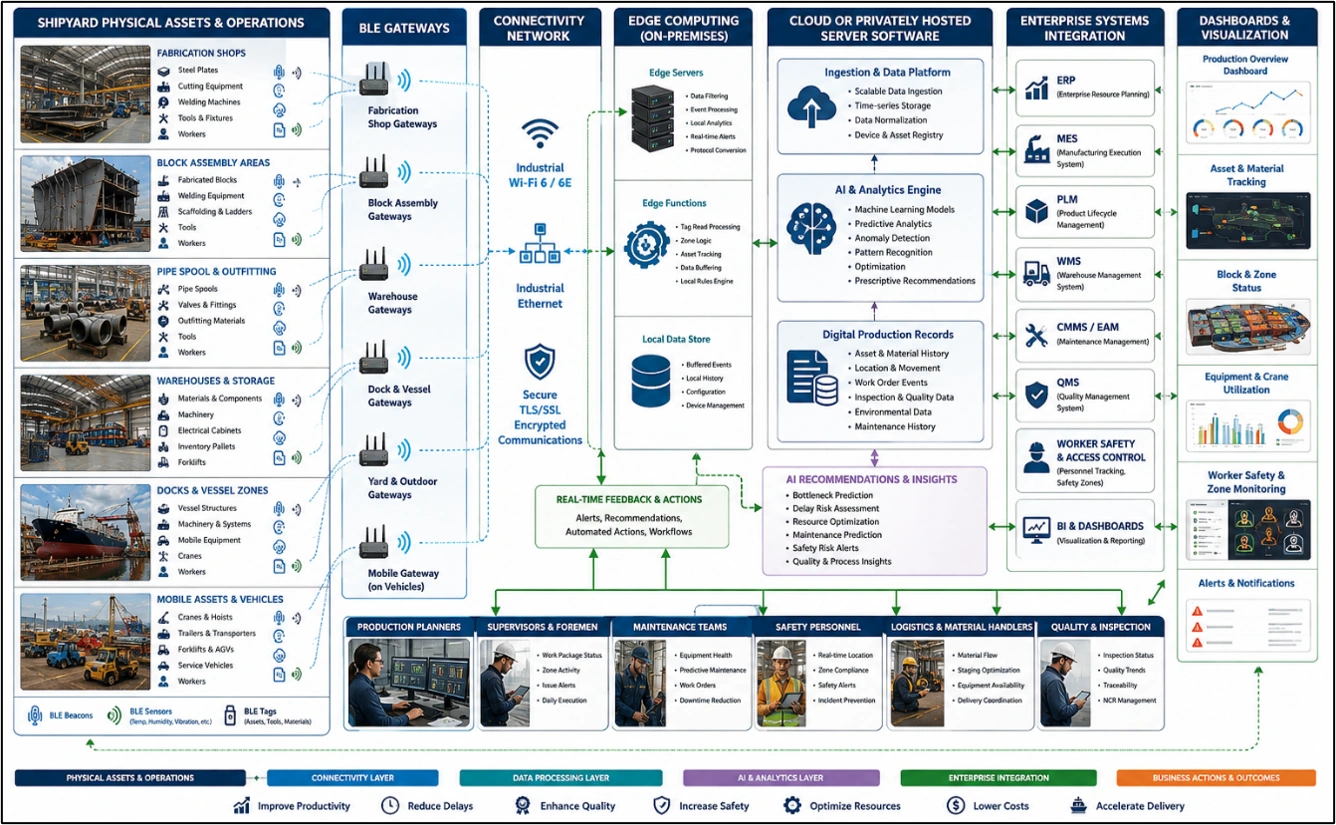
Ship Construction Applications for AI-Enabled Operational Visibility
AI applications in ship construction should be selected according to the production constraint being addressed. The same location data can support different AI models depending on whether the objective is material flow, worker safety, quality, maintenance, or schedule control.
AI Material Tracking and Traceability
Shipyards handle steel plates, profiles, fabricated assemblies, piping, valves, electrical components, HVAC equipment, insulation, machinery, outfitting components, consumables, and thousands of smaller installation items.
BLE-enabled identification can associate physical material with a unique identifier while gateways capture proximity events. AI can then evaluate:
- Material arrival and staging patterns.
- Time spent in intermediate storage.
- Movement between fabrication and assembly zones.
- Missing or misplaced components.
- Material availability against production schedules.
- Abnormal movement patterns.
- Installation readiness for a block or work package.
The practical objective is to reduce the time supervisors spend searching for material and improve confidence that the correct component reaches the correct production area.
AI Block and Module Progress Monitoring
Modern shipyards commonly divide vessels into blocks, sections, modules, and work packages. The physical location of these items changes as fabrication progresses.
BLE events can contribute to a production-status model by showing when an assembly enters a fabrication area, leaves staging, reaches block assembly, or moves toward erection.
AI can compare observed movement with planned production sequences.
For example, if a block remains in a staging area substantially longer than comparable blocks, the system can flag a potential bottleneck for investigation. The AI should not automatically assume the cause. The deviation may result from welding rework, material shortages, inspection holds, crane availability, engineering changes, or downstream production constraints.
This distinction is important for shipyard deployment: AI should identify operational anomalies and probable causes while leaving safety-critical or production-authority decisions under appropriate human control.
AI Worker Safety and Personnel Location
Ship construction involves welding, cutting, heavy lifting, confined spaces, elevated work, abrasive blasting, painting, machinery installation, electrical work, and vehicle movement.
BLE-enabled personnel badges can provide location or proximity information when appropriately engineered for the shipyard environment. AI can correlate personnel presence with production zones, work permits, restricted areas, emergency events, and equipment activity.
Potential applications include:
- Restricted-zone entry detection.
- Personnel presence near lifting operations.
- Muster and emergency accountability support.
- Worker exposure-zone monitoring.
- Contractor presence verification.
- Abnormal occupancy patterns.
- Safety-zone boundary alerts.
- Support for permit-to-work workflows.
Such systems should complement established safety procedures rather than replace trained safety personnel, formal risk assessments, lockout/tagout procedures, confined-space controls, or emergency response processes.
ISO 45001 provides a recognized framework for occupational health and safety management, including hazard identification, risk assessment, operational controls, incident investigation, and continual improvement. (ISO)
AI Quality and Inspection Support
Ship construction quality depends on controlled fabrication, welding, dimensional accuracy, coating processes, installation procedures, inspection, testing, and documentation.
AI can associate inspection events with physical locations and production history.
A practical system can correlate:
- Component identity.
- Block or vessel zone.
- Work package.
- Technician or contractor.
- Production timestamp.
- Inspection status.
- Rework history.
- Environmental measurements.
- Movement history.
- Installation status.
Computer vision can further complement BLE-based location data for visual inspection of welds, surface preparation, coatings, labels, PPE compliance, and production conditions where suitable cameras and controlled inspection procedures are available.
BLE does not replace nondestructive testing, class inspection, dimensional inspection, welding procedure qualification, or other formal acceptance processes. Its value is in providing additional context and traceability around those activities.
AI Predictive Maintenance for Shipyard Equipment
Shipyards depend on cranes, forklifts, welding machines, compressors, generators, ventilation equipment, blasting equipment, pumps, mobile platforms, transport vehicles, and other production equipment.
BLE sensors can contribute equipment condition or utilization information, while AI combines that information with CMMS/EAM records, maintenance history, operating hours, alarms, vibration data, temperature, power consumption, and utilization patterns.
The resulting models can identify equipment whose behavior differs from historical norms.
This can support:
- Crane utilization analysis.
- Forklift maintenance planning.
- Welding equipment utilization.
- Compressor condition monitoring.
- Generator maintenance forecasting.
- Mobile equipment allocation.
- Abnormal idle-time detection.
- Maintenance prioritization.
The strongest implementations combine BLE location data with actual equipment telemetry rather than treating location alone as a predictive-maintenance signal.
Shipyard Operational Challenges AI Can Address
AI-enabled ship construction solutions are most valuable where physical complexity creates recurring information gaps.
Material and Component Search
Material can be physically available but operationally unavailable because the responsible team cannot locate it quickly. This creates avoidable waiting time, duplicate material requests, congestion, and schedule uncertainty.
Location-aware AI can estimate where material is most likely to be found and identify unusual movement or prolonged staging.
Dynamic Production Environments
Shipyards continuously change their production layout. Temporary staging areas, completed blocks, cranes, scaffolding, vessels under construction, transport routes, and subcontractor work zones can change the radio environment.
A BLE deployment therefore requires a site survey and periodic validation rather than assuming that a gateway location will provide permanent coverage.
Steel Structures and RF Propagation
Large steel hulls create challenging radio conditions. Bulkheads, decks, machinery, tanks, compartments, containers, and temporary structures can attenuate or alter BLE signals.
A practical deployment may require different gateway densities for open fabrication shops, enclosed workshops, block assembly areas, warehouses, and partially completed vessels.
RSSI-based positioning should be validated against actual shipyard conditions. Where higher accuracy is needed, the engineering team may combine multiple BLE measurements, calibrated zones, gateway geometry, motion models, and other sensors instead of relying on a single RSSI threshold.
Production Schedule Variability
Shipbuilding projects frequently experience schedule changes caused by engineering revisions, supplier delays, rework, inspection holds, labor availability, weather, equipment constraints, and downstream dependencies.
AI models should therefore distinguish normal schedule variation from statistically meaningful anomalies.
A model trained on only one vessel or one production campaign may also perform poorly when ship type, block geometry, workforce, or production methods change. Model retraining and validation should be included in the operational lifecycle.
Safety and Access Control
Shipyards contain areas with controlled access, hazardous work, heavy lifting, hot work, confined spaces, and simultaneous operations.
Personnel location information should be treated as safety-related operational data and protected accordingly. Access-control decisions should remain governed by formal policies, credentials, work permits, and safety procedures.
IMO guidance recognizes that shipyards can interact with ships and port facilities from a security perspective, with responsibility and applicable security requirements depending on the shipyard and regulatory circumstances. (IMO)
AI-Enabled Ship Construction Workflow
A useful shipyard solution begins with physical events and ends with a production decision.
Data Capture
BLE beacons and BLE sensors can be attached to:
- Steel assemblies and blocks.
- Pipe spools.
- Machinery and equipment.
- Production tools.
- Forklifts and transport assets.
- Worker or contractor badges.
- Material containers.
- Temporary storage units.
- Environmental monitoring points.
BLE gateways receive wireless events and forward them into the shipyard data system.
The sensing layer should be designed around the required business resolution. A shipyard does not necessarily need centimeter-level positioning for every asset. Zone-level information may be sufficient for material staging, while higher accuracy may be justified for specific safety or logistics applications.
Edge Processing and Data Normalization
Raw wireless events can contain duplicate observations, weak signals, temporary losses, and rapidly changing readings.
Edge processing can perform:
- Event filtering.
- Timestamp normalization.
- Duplicate suppression.
- Signal-quality assessment.
- Gateway health monitoring.
- Local buffering during network interruptions.
- Preliminary location-zone determination.
MQTT can be used for lightweight telemetry transport, while industrial Ethernet, Wi-Fi, or other site networks can provide gateway connectivity. Integration should follow the shipyard’s existing IT and OT security policies.
AI Inference
Normalized events can then be combined with production and enterprise information.
AI models may include:
- Classification models for production-state recognition.
- Anomaly detection for unusual material movement.
- Time-series models for equipment condition.
- Predictive models for delays.
- Optimization algorithms for logistics.
- Computer vision models for visual inspection.
- Spatial models for zone occupancy.
- Forecasting models for resource demand.
The AI layer should preserve event provenance so supervisors can understand which observations contributed to an alert.
Operational Decision
AI results can be delivered to production planners, logistics supervisors, maintenance teams, quality personnel, safety teams, or project managers.
Examples include:
- “Pipe spool required for Block 42 has remained in staging beyond the expected window.”
- “Forklift utilization in fabrication area B has exceeded its normal operating pattern.”
- “Personnel presence detected in a restricted production zone.”
- “Equipment utilization suggests maintenance should be reviewed.”
- “Block movement sequence differs from the planned production workflow.”
The recommended action should be traceable back to the relevant physical events and enterprise records.
End-to-End AI Workflow for Ship Construction Operations
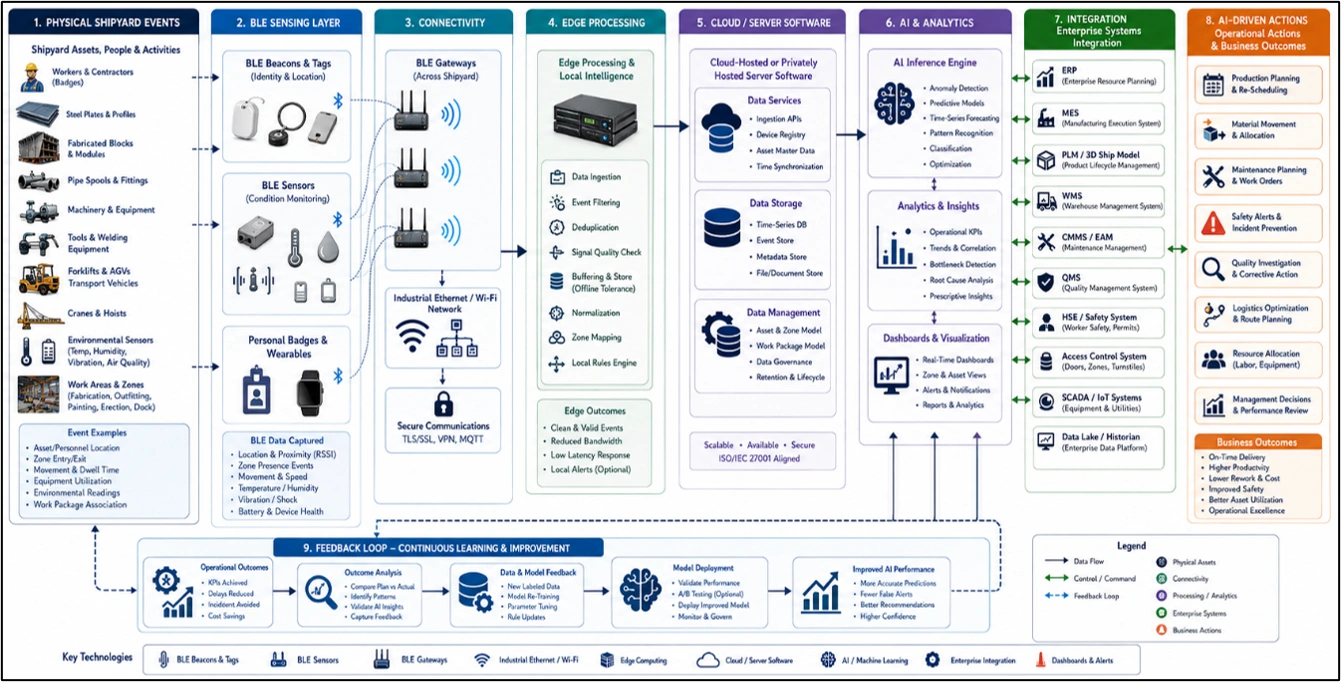
BLE Hardware and AI Software for Shipyard Deployment
BLE should be treated as an enabling sensing technology within a larger ship construction solution rather than as the primary business objective.
BLE beacons provide identifiable wireless signals that can be associated with physical assets, personnel badges, tools, containers, or work packages. BLE sensors can add measurements such as temperature, motion, vibration, or other application-specific parameters. BLE gateways collect these events and forward them into the processing environment.
The engineering design depends heavily on the shipyard’s physical layout.
A typical deployment may include gateways in:
- Steel fabrication shops.
- Plate processing areas.
- Block assembly halls.
- Outfitting areas.
- Warehouses.
- Material staging zones.
- Dockside construction areas.
- Vessel compartments where wireless coverage has been validated.
- Equipment maintenance areas.
The software layer performs considerably more work than simply displaying locations. It can normalize events, associate them with asset IDs, correlate them with work orders, maintain historical movement records, expose APIs, and provide data to AI models.
GAO supplies BLE, RFID, and IoT hardware products and systems that can be incorporated into these types of industrial tracking and sensing deployments, with engineering support for organizations evaluating hardware, integration, and deployment requirements.
Cloud Version vs. Server Version for Ship Construction
Cloud Version uses cloud-hosted software and infrastructure. This approach can be useful for shipbuilders operating multiple facilities, geographically distributed production operations, or centralized analytics teams.
Advantages include:
- Centralized fleet and site management.
- Easier scaling of storage and compute.
- Centralized AI model management.
- Multi-site production analytics.
- Remote engineering access.
- Integration with cloud-based enterprise software.
Server Version deploys software on customer-managed edge servers, private data centers, shipyard servers, or other privately hosted infrastructure.
This approach can be appropriate where:
- Production data must remain within controlled infrastructure.
- Network connectivity to external cloud services is limited.
- Low-latency local processing is important.
- Shipyard cybersecurity policies restrict external data transfer.
- Existing IT teams require direct infrastructure control.
- Integration with legacy production systems favors local deployment.
A hybrid model can also place event filtering and selected AI inference at the shipyard while synchronizing approved information with cloud analytics.
Ship Construction Integration and Communications
A production-grade AI solution should not create another isolated data repository.
Integration should connect physical events with the systems that already govern ship construction.
Relevant systems may include:
- ERP for purchasing, inventory, financial, and supplier information.
- MES for production execution and work-order status.
- PLM for engineering and product information.
- WMS for warehouse and material staging.
- CMMS or EAM for shipyard equipment maintenance.
- QMS for inspection, nonconformance, and corrective actions.
- HSE software for safety events and worker-management processes.
- Access-control systems for identity and controlled-area events.
- SCADA or equipment-monitoring systems where appropriate.
- Data lakes and analytics environments for historical AI analysis.
Communication should be designed for the actual shipyard network rather than assuming continuous connectivity. Industrial Ethernet can provide reliable gateway backhaul in fixed areas, while Wi-Fi or other wireless infrastructure may support mobile or difficult-to-cable zones.
Network segmentation is particularly important when AIoT systems interact with operational technology.
IEC 62443 provides a useful cybersecurity reference framework for industrial automation and control environments. IEC 62443-2-1:2024 addresses security-program requirements for asset owners, while IEC 62443-4-2 specifies technical security requirements for industrial automation and control system components. (IEC Webstore)
Ship construction projects should also consider the cyber requirements that may affect the vessel itself. IACS UR E26 and UR E27 address cyber resilience of ships and onboard systems and equipment, with revised requirements applying to new ships contracted for construction from July 1, 2024, subject to their applicability. (Safer and Cleaner Shipping – IACS)
The shipyard’s AIoT network should therefore be separated from safety-critical shipboard systems unless an approved integration requires otherwise.
Engineering Capabilities of AI-Enabled Ship Construction Systems
AI-enabled ship construction solutions become valuable when they convert fragmented physical events into actionable production intelligence. The strongest implementations combine location, condition, identity, production, quality, and maintenance information rather than treating BLE data as an isolated tracking feed.
Real-Time Material and Asset Visibility
Continuous location awareness can reduce the uncertainty surrounding material staging and internal transportation.
For ship construction, this is particularly useful for:
- Hull blocks awaiting movement or erection.
- Pipe spools awaiting installation.
- Main and auxiliary machinery.
- Valves, pumps, motors, and electrical cabinets.
- Welding equipment and specialized tools.
- Outfitting materials.
- Containers and material kits.
- Mobile handling equipment.
AI can establish expected movement patterns from historical production data. A deviation can then generate an investigation request before a missing component becomes a production delay.
GAO’s BLE and IoT hardware products can provide the physical sensing layer for asset and material visibility, while application software and enterprise integrations determine how those events are converted into shipyard decisions.
AI-Based Production Bottleneck Detection
Ship construction contains many interdependent production stages. A delay in steel fabrication can affect block assembly, which can affect outfitting, painting, erection, commissioning, and vessel delivery.
AI can analyze relationships between:
- Planned and actual material movement.
- Work-order completion.
- Block location.
- Inspection holds.
- Rework events.
- Equipment availability.
- Labor allocation.
- Crane utilization.
- Material shortages.
- Subcontractor activity.
Rather than reporting only that a production milestone is late, an AI model can rank contributing factors according to historical patterns and current evidence.
A practical implementation should expose the underlying evidence. Production supervisors should be able to see the events that caused a recommendation rather than receiving an unexplained “AI delay prediction.”
Predictive Logistics and Internal Transportation
Shipyards often move heavy or oversized objects using cranes, trailers, forklifts, transporters, and specialized handling equipment.
AI can use historical movement data to identify recurring congestion and inefficient transportation patterns.
Potential optimization objectives include:
- Reducing unnecessary material movement.
- Improving equipment utilization.
- Minimizing staging duration.
- Identifying frequently congested routes.
- Improving material delivery timing.
- Reducing empty equipment travel.
- Coordinating material delivery with work-package readiness.
BLE location information can establish where assets and equipment are located, while production systems provide the context required to determine whether a movement is actually necessary.
Environmental Monitoring for Shipyard Processes
Environmental conditions can influence painting, coating, curing, storage, equipment operation, and worker conditions.
BLE sensors can be used where suitable to collect measurements such as temperature and humidity. AI can evaluate trends and identify conditions that differ from established process limits.
For coating operations, environmental information can be associated with the relevant work area, component, and production timestamp. This creates a stronger historical record for investigating coating defects or process deviations.
The AI system should not replace approved coating specifications, manufacturer requirements, inspection procedures, or ship classification requirements. Instead, it can provide earlier visibility into conditions that warrant attention.
Tool and Equipment Utilization
Production tools can become difficult to manage when equipment is distributed across large fabrication halls, workshops, vessels, and staging areas.
AI-assisted tool tracking can identify:
- Frequently relocated tools.
- Equipment with unusually low utilization.
- Tools repeatedly left outside designated areas.
- Assets associated with repeated search events.
- Equipment demand by production zone.
- Potential shortages during planned work packages.
This can support tool allocation and maintenance planning without requiring supervisors to manually maintain location records.
Ship Construction KPIs for AI and BLE Deployments
A shipyard should establish measurable operational objectives before installing sensors and gateways. Useful KPIs can include:
| KPI | Ship Construction Measurement | AI/BLE Contribution |
|---|---|---|
| Material search time | Time required to locate components | Location history and probability-based search |
| Material staging duration | Time between receipt and production use | Movement analytics |
| Block dwell time | Duration a block remains in a production zone | Zone-event analysis |
| Work-package delay rate | Delayed work packages by production area | Schedule and event correlation |
| Equipment utilization | Productive versus idle equipment time | Location and utilization events |
| Crane utilization | Active operating versus waiting time | Movement and zone data |
| Asset recovery time | Time to locate tools or equipment | Historical location |
| Restricted-zone events | Unauthorized or unexpected presence | Personnel location events |
| Maintenance response time | Time from alert to intervention | Condition and location correlation |
| Inspection traceability | Completeness of physical-to-digital records | Asset identity and event history |
| Material movement count | Number of internal transfers | Movement analytics |
| Staging congestion | Occupancy and dwell patterns | Spatial analytics |
| Environmental excursion rate | Time outside approved conditions | Sensor history and alerts |
| Rework correlation | Rework events associated with production conditions | Historical data correlation |
| Production schedule variance | Actual versus planned activity | AI forecasting |
The correct KPI set depends on the shipyard’s production method, vessel types, existing information systems, and operational objectives. A tracking system should not be judged by the number of tagged assets. Its value should be measured through reductions in search time, delays, rework, unnecessary movement, equipment downtime, or safety exposure.
Cybersecurity and Data Protection for Shipyard AIoT
Cybersecurity should be incorporated before commissioning rather than added after deployment.
A ship construction solution can contain information about personnel, production schedules, engineering activities, vessel construction status, equipment, suppliers, material locations, and operational processes. Some deployments may also exchange information with systems that have implications for vessel cybersecurity.
Network Segmentation
BLE gateways should normally communicate through controlled network segments. Traffic between the sensing layer, edge servers, enterprise applications, and external cloud services should be explicitly controlled.
Useful controls include:
- Segmented VLANs or equivalent network zones.
- Firewall rules based on required communications.
- Encrypted gateway-to-server communications.
- Mutual authentication where supported.
- Certificate and credential management.
- Role-based access control.
- Centralized logging.
- Security monitoring through SIEM.
- Secure remote administration.
- Gateway firmware and software lifecycle management.
Identity and Access Management
Personnel-location information and production information should not automatically be visible to every system user.
Access should be based on operational responsibility.
For example:
- Production planners may require block and work-package information.
- Logistics teams may require material and equipment location.
- Maintenance teams may require equipment history.
- Safety teams may require personnel-zone information.
- IT security teams may require gateway and network events.
This separation supports least-privilege access while reducing unnecessary exposure of operational information.
AI Model Security
AI introduces another security consideration. Models can become unreliable when production processes change or when data quality deteriorates.
A controlled AI lifecycle should include:
- Training-data validation.
- Model versioning.
- Performance baselines.
- Drift monitoring.
- Controlled model deployment.
- Human review of high-impact recommendations.
- Periodic retraining.
- Audit records for model-generated decisions.
Shipyard personnel should be able to distinguish an observed event from an AI prediction. This distinction is especially important when an AI recommendation could affect safety, production release, inspection status, or equipment operation.
Shipyard Deployment Engineering and Commissioning
Successful deployment depends more on engineering discipline than on the number of sensors installed.
Define the Operational Scope
The initial deployment should focus on a measurable ship construction problem.
Suitable pilot objectives include:
- Reducing pipe-spool search time.
- Tracking high-value machinery.
- Monitoring block movement.
- Improving warehouse-to-production material flow.
- Tracking specialized production tools.
- Supporting equipment utilization analysis.
- Monitoring personnel presence in defined zones.
Trying to track every object across an entire shipyard during the first deployment can create unnecessary complexity.
Perform RF and Physical Site Surveys
The survey should document:
- Steel structures.
- Bulkheads.
- Decks.
- Machinery.
- Crane structures.
- Warehouses.
- Production halls.
- Outdoor staging.
- Containerized storage.
- Vehicle routes.
- Gateway mounting positions.
- Network availability.
- Power availability.
- Areas with changing geometry.
Shipyards should expect RF conditions to change as vessel blocks are assembled and moved. Gateway placement may therefore require periodic validation.
Establish Location Accuracy Requirements
Different applications require different accuracy.
A warehouse material-search application may only require reliable zone-level identification. A personnel safety application may require more carefully defined boundaries. A mobile equipment application may need enough resolution to distinguish adjacent production areas.
The engineering specification should therefore define:
- Required positioning accuracy.
- Update interval.
- Maximum acceptable latency.
- Coverage percentage.
- Battery-life target.
- Event-loss tolerance.
- Gateway availability.
- Environmental operating range.
These requirements should be tested against real shipyard conditions instead of being derived solely from laboratory specifications.
Commission Against Real Production Events
Testing should use actual ship construction workflows.
A commissioning test can follow a component from:
warehouse receipt → staging → fabrication → inspection → block assembly → outfitting → installation → testing
The system should demonstrate that the physical event is correctly associated with the appropriate asset identifier and production record.
Negative tests are equally important.
The team should test:
- Gateway failure.
- Network interruption.
- Duplicate events.
- Missing events.
- Battery depletion.
- Temporary RF obstruction.
- Unauthorized device registration.
- Server failure.
- Cloud connectivity loss.
- Incorrect asset association.
A system that works only during normal conditions has not been fully commissioned.
AI-Enabled BLE Deployment and Commissioning Decision Tree for Ship Construction
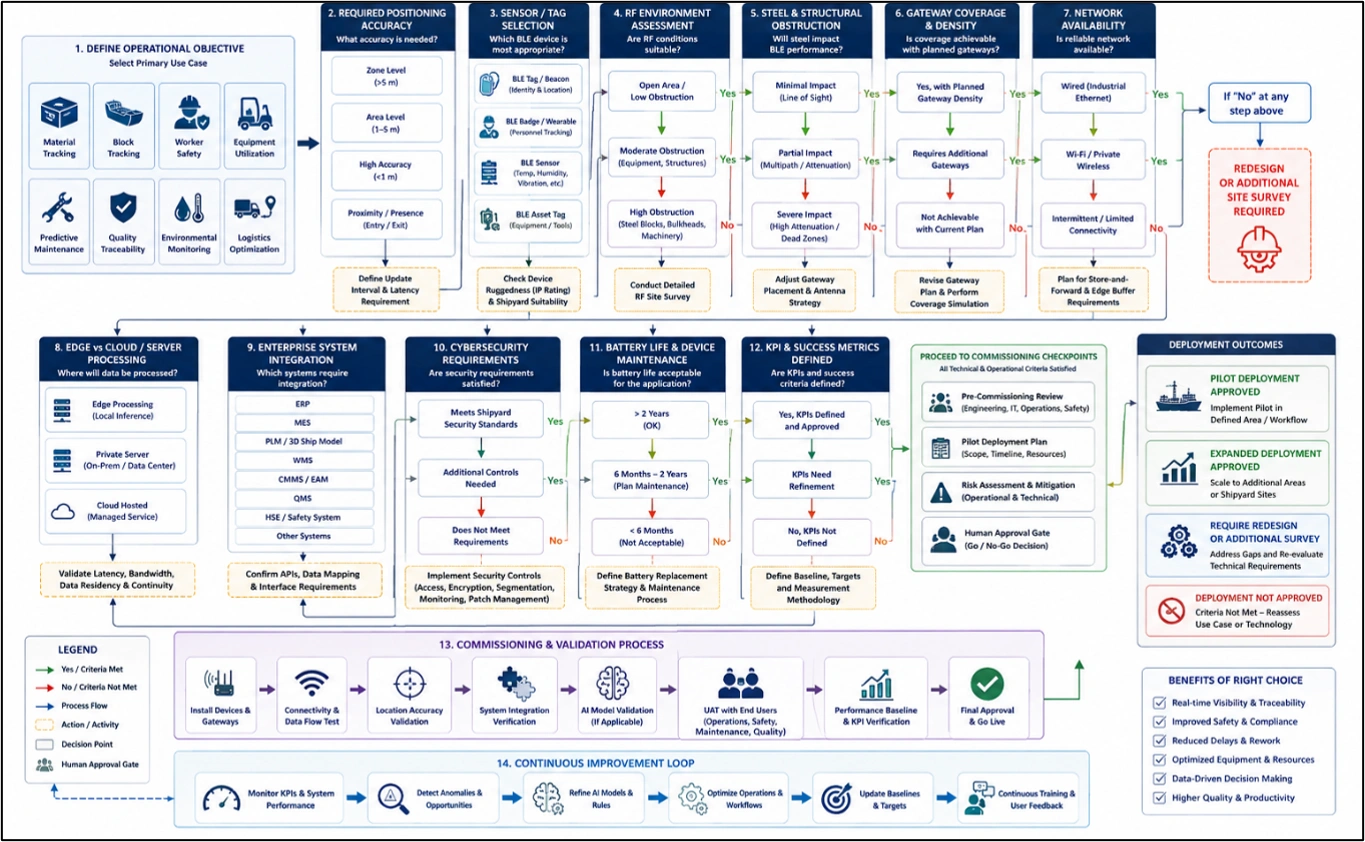
Scaling AI and BLE Across Ship Construction Operations
After a successful pilot, expansion should follow operational value rather than simply increasing the number of tagged objects.
A practical scaling sequence can move from one production area to adjacent workflows:
- Fabrication-shop material tracking.
- Warehouse and staging visibility.
- Block assembly tracking.
- Internal logistics.
- Outfitting material tracking.
- Mobile equipment utilization.
- Worker safety applications.
- Quality and inspection traceability.
- Predictive maintenance.
- Cross-vessel production analytics.
Standardized asset IDs and event schemas become increasingly important as deployments expand.
A pipe spool tracked in one fabrication hall should retain the same logical identity when it enters staging, moves to block assembly, and reaches installation. Otherwise, the AI system may interpret one physical component as several unrelated objects.
Data governance should therefore establish consistent:
- Asset identifiers.
- Location identifiers.
- Production-zone definitions.
- Work-package references.
- Timestamp formats.
- Event types.
- Equipment identifiers.
- Personnel identifiers.
- Sensor metadata.
- Gateway identifiers.
GAO’s experience supplying RFID, BLE, and IoT hardware products and systems can support organizations that need to evaluate sensing hardware and integration requirements as these deployments expand.
Practical Implementation Recommendations for Shipbuilders
The following engineering principles provide a useful foundation for AI-enabled ship construction projects:
- Start with a measurable shipyard production or safety problem rather than beginning with a sensor inventory.
- Select BLE tracking accuracy according to the operational decision that must be made.
- Conduct RF surveys under representative steel and vessel-construction conditions.
- Design for changing shipyard layouts and temporary structures.
- Combine BLE events with ERP, MES, PLM, WMS, CMMS/EAM, QMS, and production data where appropriate.
- Use edge processing when local continuity and low latency are important.
- Use cloud infrastructure when centralized multi-site analytics and scalable computing are priorities.
- Use privately hosted server infrastructure when data governance, network independence, or existing IT requirements favor controlled deployment.
- Maintain local buffering so temporary network interruptions do not automatically create permanent event gaps.
- Validate AI models against actual shipyard workflows rather than generic manufacturing datasets.
- Maintain human approval for safety-critical and production-authority decisions.
- Establish cybersecurity requirements before installing gateways and servers.
- Monitor battery condition, gateway health, event quality, and positioning performance as operational KPIs.
- Introduce AI progressively after sufficient historical operational data has been collected.
- Revalidate models whenever vessel type, production methods, facility layout, or major equipment changes.
- Treat commissioning, maintenance, cybersecurity updates, and model lifecycle management as continuing operational activities.
GAO Expertise for AI-Enabled Ship Construction Solutions
GAO supports organizations in the United States and Canada with BLE, RFID, and IoT hardware products and systems used for asset identification, location awareness, sensing, monitoring, and connected operations. Its engineering-oriented approach is relevant to ship construction because deployment requirements vary significantly between fabrication shops, warehouses, block assembly areas, outdoor staging locations, and dockside operations.
GAO is headquartered in New York City and Toronto, Canada, and is ranked among the world’s top 10 leading B2B and B2G BLE and RFID suppliers. Its sister companies, GAO Research Inc. and GAO Tek Inc., form GAO Group, with operations based in New York City and Toronto.
For three decades, GAO Group has served customers across the United States and Canada, including Fortune 500 companies, major R&D organizations, universities, and government agencies. Its product and system development has been supported by substantial R&D investment, stringent quality assurance processes, and expert technical support delivered remotely or onsite.
For shipbuilders evaluating AI-enabled material tracking, equipment monitoring, worker-location applications, production visibility, or related IoT requirements, the appropriate next step is to define the operational objective, accuracy requirement, site conditions, integration boundaries, cybersecurity requirements, and target KPIs before selecting hardware and software.
Key Takeaways for AI and BLE in Ship Construction
AI-enabled ship construction solutions can turn physical production events into actionable information for material flow, block movement, equipment utilization, worker safety, quality traceability, environmental monitoring, and predictive maintenance.
BLE gateways, beacons, and sensors provide useful sensing capabilities, but the business value comes from correlating those events with shipyard production data and applying appropriate AI methods.
The most reliable implementation approach is incremental. Shipbuilders should begin with a clearly measurable operational problem, validate RF performance in actual steel-intensive environments, integrate location events with existing production systems, establish cybersecurity controls, and measure results against operational KPIs.
GAO can provide BLE, RFID, and IoT hardware products and systems together with technical expertise to help organizations evaluate and implement these technologies for demanding ship construction environments.
Building the Future of Industrial AI and IoT with Aperture Venture Studio and GAO RFID Inc.
For more than three decades, GAO Group of Companies has invested heavily in R&D of industrial BLE, RFID, and IoT. As generative AI became increasingly useful for industrial applications, we expanded our work across AI and IoT technologies, including BLE and RFID, and founded Aperture Venture Studio to advance practical AI and IoT solutions relevant to industries such as ship construction and maritime manufacturing.
Aperture has attracted AI and IoT technical experts, entrepreneurial and operational executives, investors, and leading companies. We have also developed Aperture Ventures Summit and TekSummit to facilitate discussion of advanced AI and IoT topics.
We welcome you to join us as:
- Advisors, co-founders, or employees
- Investors
- Customers