
AI and BLE for Space Systems Manufacturing
AI for Space Systems Manufacturing with BLE-Enabled Industrial IoT
Space systems manufacturing requires precise control of high-value materials, flight hardware, tooling, work-in-process assemblies, environmental conditions, and production records. AI can turn data from these physical assets into actionable intelligence for aerospace manufacturing teams, while Bluetooth Low Energy (BLE) beacons, gateways, and sensors provide a practical mechanism for collecting location, condition, and utilization data across production environments. AI-driven asset tracking can help manufacturers identify where critical hardware is located, detect abnormal process conditions, predict maintenance requirements, and improve production scheduling. For space systems manufacturers, the value extends beyond visibility. Connecting BLE-generated operational data with manufacturing execution systems (MES), enterprise resource planning (ERP), quality systems, maintenance software, and analytics enables engineers and operations managers to make faster decisions while maintaining configuration control and traceability. GAO provides BLE, RFID, and IoT hardware and systems that can support these connected manufacturing requirements.
AI and BLE for Space Systems Manufacturing: Connected Factory and Data Intelligence
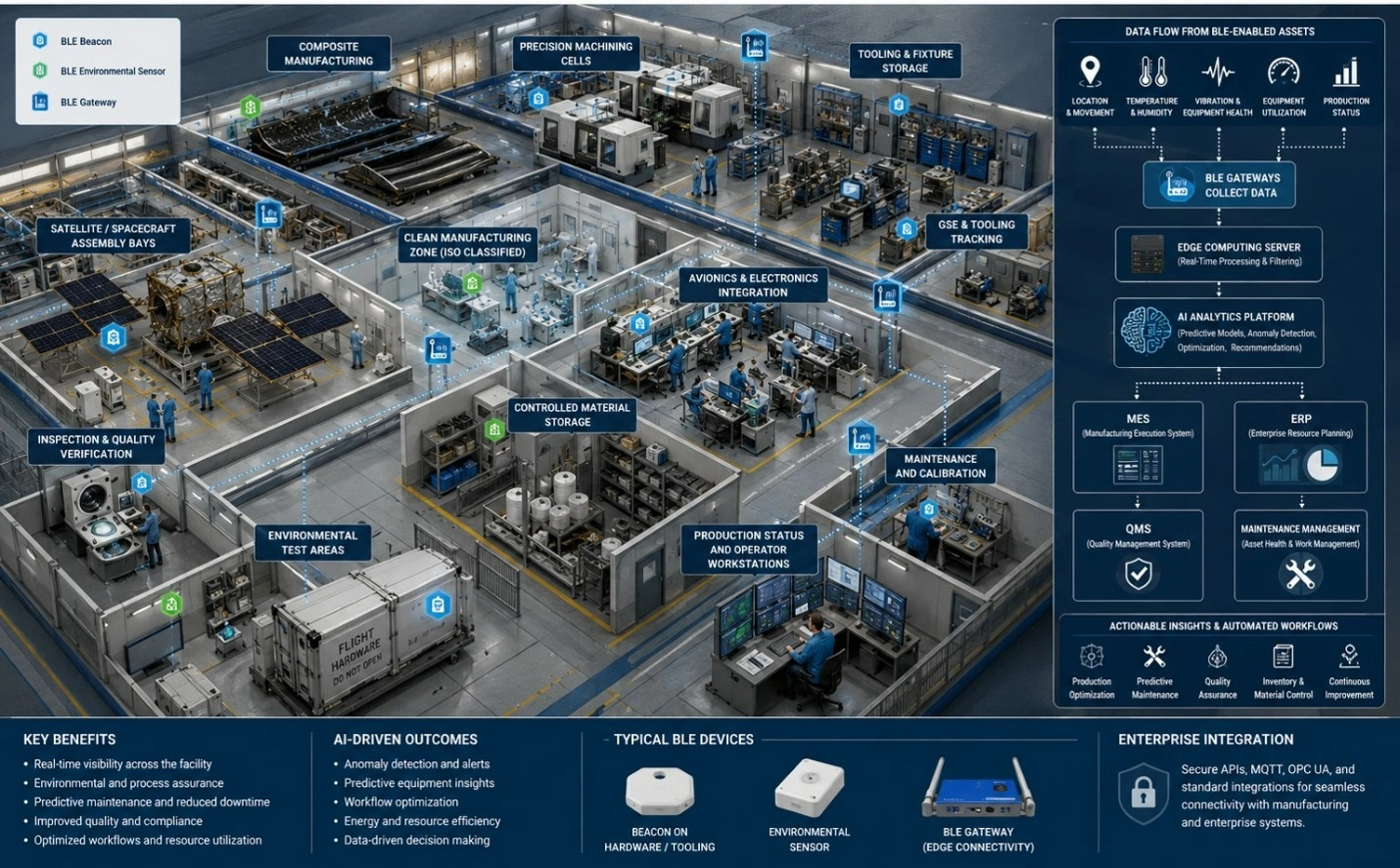
This infographic illustrates a BLE-enabled space systems manufacturing facility, showing spacecraft assembly, avionics integration, precision machining, controlled material storage, and environmental testing. BLE beacons, sensors, and gateways feed edge computing and AI analytics that connect with MES, ERP, QMS, and maintenance systems to support asset visibility, predictive maintenance, quality assurance, and production optimization.
How AI Improves Space Systems Manufacturing
AI in space systems manufacturing refers to the use of machine learning, computer vision, Industrial AI, Edge AI, and other analytical methods to interpret manufacturing and operational data and support decisions involving production, quality, maintenance, material movement, and asset control.
The technology becomes particularly useful when AI receives reliable data from physical manufacturing environments. BLE gateways can collect transmissions from BLE beacons and sensors associated with tooling, containers, work-in-process assemblies, environmental monitoring points, and other mobile or stationary assets. The resulting data can be processed at the edge or transmitted to centralized software for analysis.
A space systems manufacturer can use these capabilities for applications such as:
- AI-assisted tracking of satellite components and flight hardware
- Tool and fixture location monitoring
- Work-in-process visibility across assembly and integration areas
- Environmental condition monitoring for sensitive materials
- Predictive maintenance for manufacturing equipment
- Detection of abnormal equipment behavior
- Production bottleneck identification
- AI-assisted inventory reconciliation
- Material movement analysis
- Quality investigation and traceability support
- Manufacturing schedule optimization
- Exception detection for critical production assets
AI does not replace configuration management, engineering approval, quality procedures, or human decision-making. Instead, it can provide production and engineering personnel with additional evidence for making those decisions.
For example, if a BLE sensor associated with a controlled storage container reports temperature excursions, an AI system can correlate the event with material identity, storage duration, location history, and applicable production orders. A quality engineer can then investigate the affected material using a consolidated operational record rather than manually reconstructing its movements.
Space Systems Manufacturing Use Cases for AI-Driven Asset and Production Visibility
Space systems manufacturing contains numerous high-value assets that move between receiving, inspection, storage, machining, integration, test, rework, and controlled staging areas. Manual tracking becomes increasingly difficult as production programs grow and multiple spacecraft or subsystems move through parallel workflows.
AI Asset Tracking for Flight Hardware and High-Value Components
Flight hardware can include spacecraft structures, propulsion components, avionics assemblies, electronic modules, harnesses, instruments, payload components, and other configuration-controlled items.
BLE beacons can provide periodic identification and location information for tagged containers, mobile equipment, fixtures, and selected assets. BLE gateways installed at strategic facility locations receive these transmissions and forward the data to the tracking system.
AI can analyze the resulting location history to identify unusual movement patterns, extended dwell times, missing assets, or deviations from expected manufacturing routes.
For space systems manufacturing, this can help answer operational questions such as:
- Where is a specific component now?
- Which production area last received the component?
- How long has a work-in-process assembly remained in one area?
- Which tooling is currently available for an integration operation?
- Which assets have not moved according to the expected production schedule?
- Are critical tools concentrated in one manufacturing area?
GAO can support these implementations with BLE beacons, gateways, sensors, and related IoT hardware selected according to facility layout, transmission range, asset characteristics, and deployment requirements.
AI-Assisted Work-in-Process Monitoring
Work-in-process tracking is particularly important when spacecraft and subsystem assemblies pass through multiple controlled operations.
A BLE-enabled system can associate an asset or container with manufacturing zones while AI software analyzes movement and dwell-time patterns. Instead of simply displaying the current location, the system can identify production conditions that require attention.
For example, repeated delays between integration operations can indicate a material-handling constraint, limited tooling availability, inspection delays, or a downstream production bottleneck. AI can analyze historical movement and production data to identify recurring patterns.
This creates an important distinction between basic asset tracking and AI-assisted manufacturing intelligence. Location data becomes useful not merely because it tells an operator where an item is, but because historical and contextual analysis can help explain why the item is there and whether its current status is consistent with the production plan.
Environmental Monitoring for Sensitive Aerospace Materials
Some materials, electronics, adhesives, composites, and other manufacturing inputs require controlled environmental conditions. BLE sensors can collect temperature, humidity, vibration, or other applicable measurements and transmit the readings through BLE gateways.
AI can evaluate sensor histories to detect trends and abnormal conditions rather than relying exclusively on threshold alarms.
A manufacturing team could use this capability to identify:
- Gradual temperature drift
- Repeated humidity excursions
- Abnormal storage conditions
- Sensor patterns associated with equipment problems
- Environmental differences between production areas
- Recurring conditions associated with material handling events
Environmental data can also become part of an investigation when a material, component, or assembly requires quality review.
From BLE Sensor Data to AI-Driven Manufacturing Decisions
A practical AIoT deployment for space systems manufacturing normally involves several connected stages. AIoT, or Artificial Intelligence of Things, combines artificial intelligence with IoT devices, sensors, connected equipment, and industrial systems. Industrial AI, Edge AI, machine learning, computer vision, and, where appropriate, Physical AI can be incorporated depending on the manufacturing application.
The operational data path can be represented as:
BLE Sensors and Beacons → BLE Gateways → Edge or Server Processing → Data Integration → AI Analytics → Manufacturing Systems → Human or Automated Action
Data Acquisition
The process begins with physical data generated by manufacturing assets and production environments.
BLE beacons can provide asset identity and presence information, while BLE sensors can capture applicable environmental or equipment-related measurements. Sensor selection should reflect the actual engineering requirement rather than simply maximizing the number of measured parameters.
Asset tagging also requires careful consideration. A beacon mounted to a reusable tooling fixture has different requirements from one attached to a transport container or a temporary production asset.
AI Data Flow for Space Systems Manufacturing: BLE to Intelligent Decisions
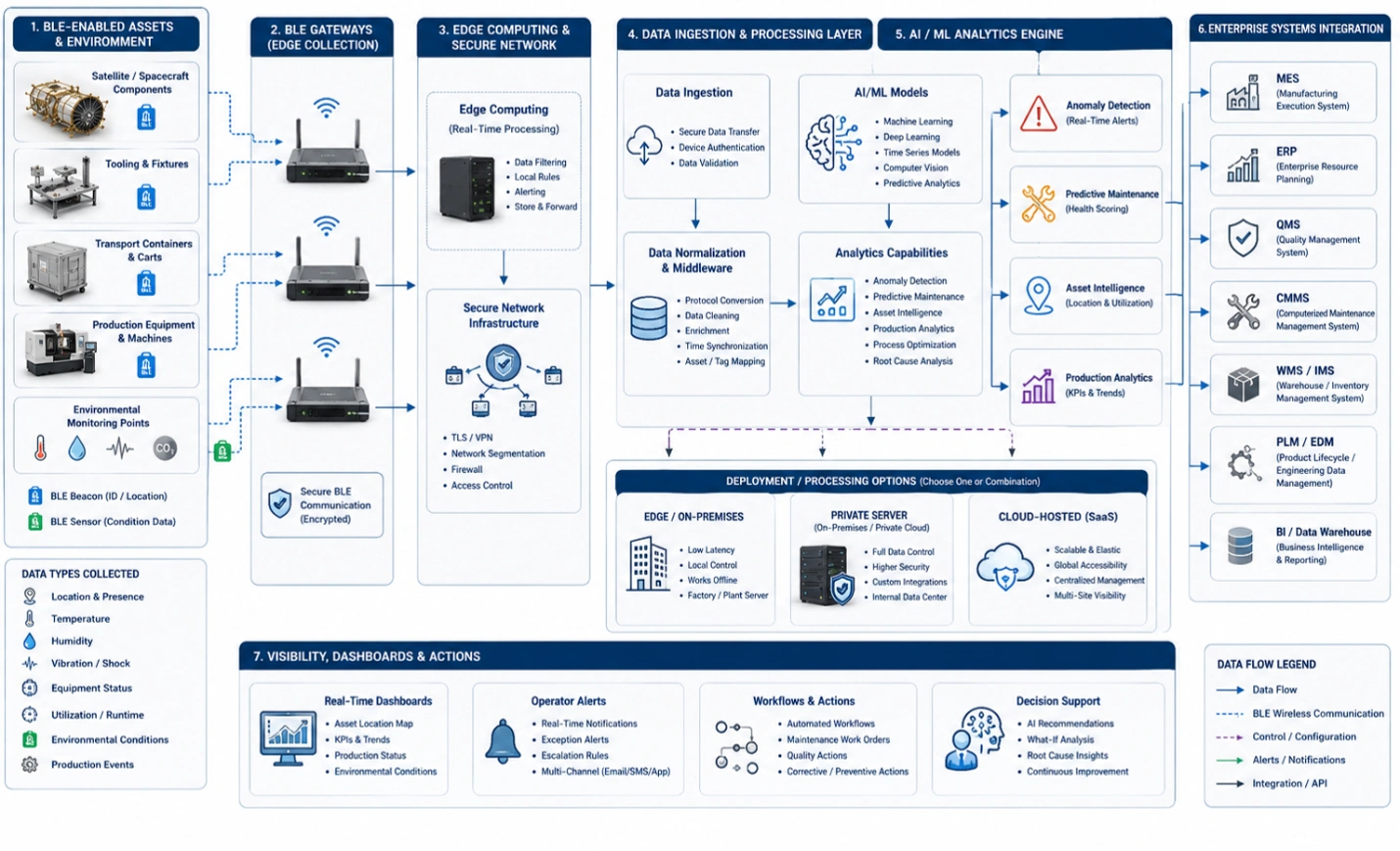
This technical workflow illustrates how BLE-enabled spacecraft components, tooling, containers, equipment, and environmental sensors transmit data through BLE gateways and secure edge infrastructure. The data is normalized and analyzed using AI/ML before connecting with MES, ERP, QMS, maintenance, inventory, and engineering systems to support predictive maintenance, asset intelligence, production analytics, and operational decisions.
BLE Gateway and Communication Layer
BLE gateways receive wireless transmissions from nearby BLE devices and forward relevant data to software systems through available wired or wireless backhaul.
Gateway placement should be determined through a site survey that considers:
- Manufacturing cell layout
- Metal structures and equipment
- Radio interference
- Required location accuracy
- Gateway density
- Asset movement patterns
- Facility construction materials
- Network availability
- Areas requiring environmental monitoring
Space systems manufacturing facilities often contain substantial metallic equipment, enclosed work areas, machinery, racks, and other structures that can influence radio propagation. Consequently, BLE deployment should be validated under actual operating conditions rather than relying only on theoretical transmission distances.
Edge Processing and AI Analytics
Edge processing can reduce latency and limit the amount of raw data transmitted to centralized infrastructure. This can be useful when manufacturing personnel require rapid alerts or when operational data should remain within controlled facility infrastructure.
AI models can process location histories, sensor readings, equipment data, production records, and other approved information to detect anomalies, estimate conditions, classify events, or identify operational patterns.
For example, an AI model could evaluate asset dwell time against historical production behavior and flag an assembly that has remained in a staging area significantly longer than expected.
Manufacturing Software Integration
The value of AI-generated insights increases when results can be connected with existing manufacturing software.
Potential integration points include:
- Manufacturing execution systems
- ERP software
- Quality management systems
- Computerized maintenance management systems
- Warehouse and inventory management software
- Laboratory or test data systems
- Production scheduling software
- Engineering data management systems
- Business intelligence software
Integration should preserve authoritative system records. The AI system should not automatically overwrite configuration-controlled production information simply because an analytical model generates a prediction.
BLE Hardware and Software Considerations for Space Systems Manufacturing
Selecting BLE hardware for aerospace production environments requires more than evaluating wireless range. Engineers should consider asset geometry, mounting method, battery requirements, update intervals, environmental conditions, gateway density, network availability, and the required location or sensing performance.
BLE Deployment Across a Spacecraft Manufacturing Facility
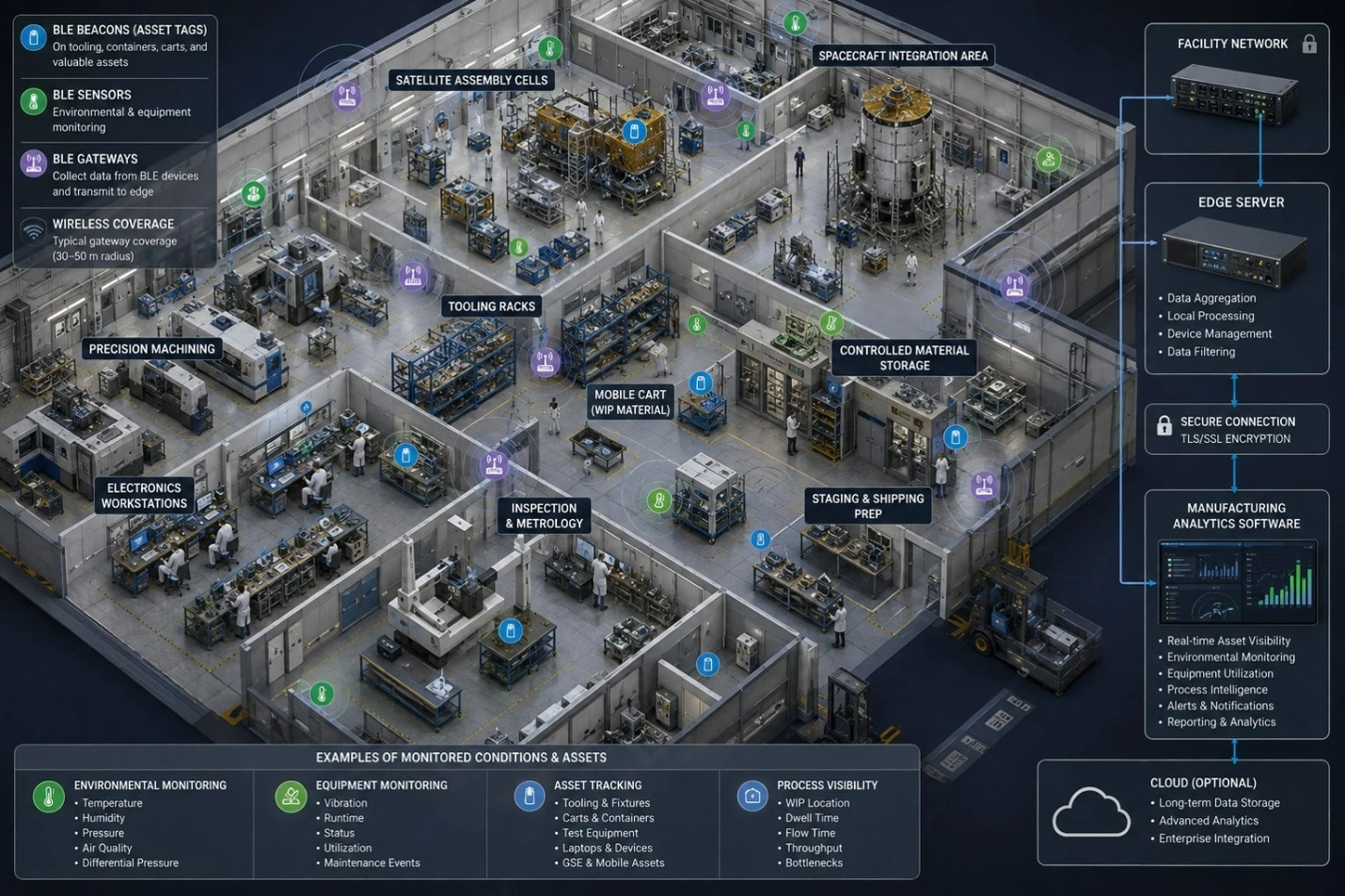
A realistic isometric cutaway showing BLE beacons, sensors, and gateways deployed throughout satellite assembly, spacecraft integration, precision machining, electronics workstations, material storage, inspection, tooling, and staging areas. The infrastructure connects through an edge server and secure network to manufacturing analytics software for real-time asset tracking, environmental monitoring, equipment status, and process visibility.
BLE Beacons
BLE beacons can be attached to mobile assets, tooling, containers, carts, fixtures, or other equipment requiring identification and location visibility.
Battery-powered devices are appropriate where wired power is impractical. Battery life depends on advertising interval, transmission power, operating conditions, battery characteristics, and device configuration.
BLE Sensors
BLE sensors extend asset visibility into condition monitoring. Depending on the application, sensors may measure temperature, humidity, motion, vibration, or other parameters supported by the selected hardware.
The engineering objective should be to capture measurements that support an actual manufacturing decision. Excessive sensing without a defined analytical use case can increase data volume without providing proportional operational value.
BLE Gateways
Gateways provide the connection between BLE devices and the wider software environment. A deployment may use multiple gateways across manufacturing cells, storage areas, integration zones, test areas, and material-handling routes.
Gateway density should be determined from the required service area and location performance rather than from a generic coverage estimate.
Cloud Version and Server Version
A cloud-hosted SaaS deployment can be appropriate when geographically distributed manufacturing operations need centralized access to asset data, analytics, and dashboards. It can simplify centralized software management and support scalable data processing.
A Server Version deployed on customer-managed servers, private data centers, factory servers, or other privately hosted infrastructure can be preferable where manufacturing data requires tighter infrastructure control, specific cybersecurity requirements, or integration with restricted production networks.
Space systems manufacturers should evaluate the two approaches based on data governance, network segmentation, latency, cybersecurity requirements, existing IT infrastructure, integration constraints, and operational support responsibilities.
GAO’s experience supplying BLE, RFID, and IoT hardware and systems can support the hardware layer of these deployments, while system design should be aligned with the customer’s production environment and integration requirements.
Cybersecurity and Data Integrity
Connected manufacturing systems should be designed with cybersecurity from the beginning. BLE devices, gateways, edge computers, servers, APIs, and enterprise software integrations create multiple points that require appropriate controls.
Relevant considerations include:
- Device authentication
- Secure gateway configuration
- Network segmentation
- Access control
- Encryption where appropriate
- Credential management
- Software and firmware lifecycle management
- Audit logging
- Data retention
- API security
- Monitoring for unauthorized device activity
- Controlled administrative privileges
For space systems manufacturing, cybersecurity must also be considered alongside configuration management and production data integrity. AI predictions should be traceable to their underlying data and model version where the result influences an engineering or quality decision.
AI-Driven Production Intelligence for Aerospace Manufacturing
The strongest applications combine physical asset data with manufacturing context. A location event by itself may have limited meaning. The same event becomes substantially more useful when correlated with a work order, production operation, asset identity, operator workflow, quality status, or expected production cycle.
For example, an AI system can combine:
- Asset location history
- BLE sensor readings
- Production order information
- Work-in-process status
- Equipment utilization
- Maintenance records
- Inspection results
- Material movement
- Historical cycle times
- Manufacturing schedules
This contextual approach allows AI to identify relationships that are difficult to discover through isolated monitoring systems.
For space systems manufacturing, the resulting intelligence can support production supervisors, manufacturing engineers, quality teams, maintenance personnel, material managers, and program managers without removing established approval and control processes.
Technical Capabilities and Operational Improvements
AI-enabled BLE systems can provide several layers of intelligence for space systems manufacturing. The practical value comes from connecting physical manufacturing events with production context and applying analytics to identify conditions that require attention.
Real-Time Asset Visibility
BLE-generated location information can help manufacturing personnel identify the current or recent location of mobile tooling, containers, fixtures, test equipment, and selected flight hardware.
AI can add historical context by analyzing movement patterns and dwell times. This can help distinguish normal staging activity from potentially problematic delays.
Predictive Maintenance
Manufacturing equipment such as CNC machines, environmental-control equipment, compressors, test equipment, and material-handling equipment can generate operational information that contributes to maintenance analysis.
AI models can evaluate historical measurements and maintenance records to identify patterns associated with equipment degradation. BLE sensors can supplement this information where appropriate by providing measurements such as vibration or temperature.
Predictive maintenance does not eliminate scheduled maintenance. Instead, it can provide maintenance teams with additional evidence for prioritizing inspections and investigating abnormal equipment behavior.
Production Bottleneck Detection
Production delays can originate from equipment availability, material shortages, tooling constraints, inspection queues, rework, or limited production capacity.
AI can compare actual asset movement and process durations with historical production behavior. When combined with MES or scheduling information, the system can identify operations with unusually long dwell times.
This is particularly valuable for space systems programs because individual assemblies can remain in production for extended periods and may pass through numerous specialized operations.
AI-Assisted Quality Investigation
AI can help quality teams correlate production information when investigating an anomaly or nonconformance.
Relevant information may include:
- Component and container movement history
- Environmental sensor records
- Production operation timestamps
- Equipment utilization
- Inspection events
- Maintenance history
- Work-order information
- Material handling events
BLE location data should be treated as supporting evidence rather than automatically replacing formal quality records.
Improved Tool and Fixture Utilization
Specialized tooling and fixtures can represent significant production constraints. Knowing whether a required fixture is available, in use, staged, or awaiting maintenance can reduce unnecessary searching and improve scheduling.
AI can analyze utilization history to identify underused resources, recurring shortages, and scheduling conflicts.
GAO can provide BLE hardware that supports these visibility requirements, with deployment parameters selected according to the asset, facility, and required monitoring performance.
Deployment Planning for Space Systems Manufacturing
Successful deployment should begin with operational requirements rather than hardware installation.
The first stage is identifying the manufacturing processes where better visibility or condition monitoring can produce a measurable improvement. A pilot may focus on tooling, material containers, work-in-process assemblies, or environmental monitoring before expanding to broader production operations.
Site Survey and Radio Planning
A physical survey should identify:
- Production cells
- Assembly areas
- Storage locations
- Controlled environments
- Material-transfer routes
- Equipment density
- Metal obstructions
- Network connection points
- Potential RF interference
- Gateway mounting locations
- Areas requiring higher location accuracy
BLE performance should be tested using representative assets and normal manufacturing conditions.
Asset and Tag Selection
Every asset category should have a defined tagging strategy.
A reusable transport container may require a different beacon mounting method and battery profile than a tooling fixture. A temperature-sensitive material may require an integrated sensor rather than a simple identification beacon.
The tag should also be positioned so that the manufacturing process does not interfere with its operation or create a new handling hazard.
Commissioning and Validation
Commissioning should verify that the deployed system performs according to defined acceptance criteria.
Testing can include:
- BLE beacon detection
- Gateway coverage
- Asset identification accuracy
- Location-zone accuracy
- Sensor measurement validation
- Data transmission reliability
- Network connectivity
- Timestamp consistency
- API integration
- Dashboard behavior
- Alert generation
- Data retention
- Cybersecurity controls
Production validation should use representative operational scenarios rather than laboratory-only tests.
Integration with MES, ERP and Quality Systems
AI-driven manufacturing intelligence becomes more useful when it can exchange data with existing production systems.
An MES can provide production order and operation context. ERP software can provide inventory and procurement information. Quality management software can provide inspection and nonconformance information. Maintenance software can provide equipment history.
The BLE and AI system can contribute location, movement, condition, and event information to these processes.
A practical integration pattern is:
Physical Asset → BLE Device → Gateway → Data Processing → Integration Layer → AI Analytics → Manufacturing Application
Middleware can normalize device data before it reaches enterprise applications. APIs can expose selected events and analytical results while maintaining separation between operational data sources and authoritative production records.
Data ownership should also be defined during system design. For example, the ERP system may remain authoritative for inventory quantities while the BLE system provides physical location evidence.
Cloud and Private Server Deployment Considerations
Space systems manufacturers should select the deployment model according to operational, cybersecurity, connectivity, and data-governance requirements.
Cloud-Hosted Deployment
A cloud-hosted deployment can be useful when multiple facilities need centralized access to analytics and operational information.
Potential advantages include:
- Centralized software management
- Elastic analytical computing
- Multi-site reporting
- Remote access for authorized personnel
- Simplified centralized data aggregation
Network availability and data governance should be evaluated before production deployment.
Private Server Deployment
A privately hosted Server Version can operate on customer-managed servers, factory servers, private data centers, or other controlled infrastructure.
This approach may be appropriate where manufacturing networks are highly restricted, latency requirements favor local processing, or organizational policies require tighter control of operational data.
Edge processing can also coexist with either model. Time-sensitive detection can occur locally while selected historical information is transferred to centralized systems for deeper analysis.
AI Models and Analytics for Space Systems Manufacturing
Different manufacturing problems require different analytical methods. There is no single AI model suitable for every aerospace manufacturing application.
Potential methods include:
- Anomaly detection for unusual sensor or movement behavior
- Time-series models for equipment and environmental measurements
- Classification models for production events
- Predictive models for equipment maintenance
- Optimization algorithms for scheduling and resource allocation
- Computer vision for inspection and manufacturing-process monitoring
- Generative AI for controlled access to manufacturing documentation and operational knowledge
Model selection should be driven by data availability, decision requirements, explainability, validation requirements, and acceptable error rates.
For safety-critical or quality-sensitive operations, AI outputs should normally remain advisory unless the application has undergone the required validation and authorization for automated action.
AI Decision Workflow for Space Hardware Production
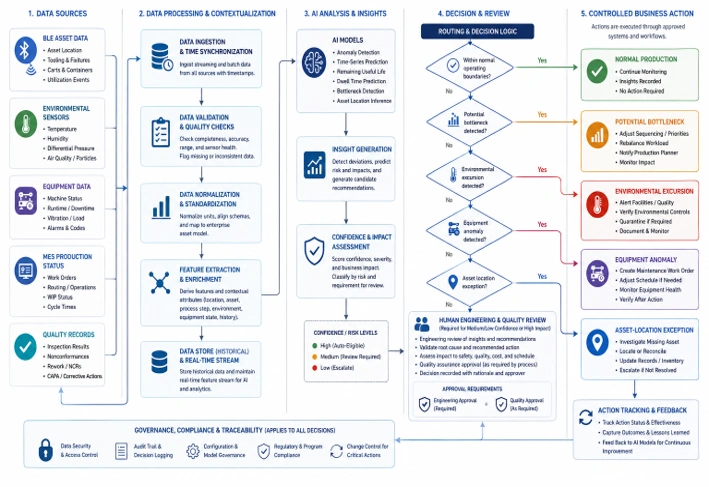
A professional process-flow infographic showing how BLE, environmental, equipment, MES, and quality data are transformed through validation, normalization, AI analysis, confidence assessment, and human engineering review into controlled manufacturing actions. The workflow includes decision paths for normal production, bottlenecks, environmental excursions, equipment anomalies, and asset-location exceptions.
Key KPIs for AI-Enabled Space Systems Manufacturing
Measurement should begin before deployment so that the manufacturer can compare baseline and post-deployment performance.
| KPI | Measurement Purpose |
| Asset location accuracy | Measures reliability of physical asset visibility |
| Asset search time | Measures time required to locate tooling or production assets |
| Work-in-process dwell time | Identifies production delays and staging inefficiencies |
| Tool utilization | Measures availability and use of specialized tooling |
| Production cycle time | Tracks changes in manufacturing throughput |
| Environmental excursion rate | Measures controlled-condition exceptions |
| Equipment downtime | Measures production impact from equipment availability |
| Predictive maintenance accuracy | Evaluates maintenance model performance |
| Inventory variance | Compares system records with physical conditions |
| Traceability completeness | Measures availability of required production history |
| Alert response time | Measures how quickly teams respond to exceptions |
| BLE read success rate | Measures wireless data capture reliability |
These KPIs should be associated with specific operational objectives. Improving the number of BLE detections, for example, does not necessarily mean that manufacturing performance has improved.
Scalability, Maintenance and Lifecycle Management
A production deployment should be designed for expansion from the beginning.
A manufacturer may initially track a limited number of tools or containers before extending the system to additional production cells, programs, facilities, or asset categories.
Scalability considerations include:
- Increasing BLE device populations
- Gateway capacity
- Network bandwidth
- Database growth
- AI processing requirements
- Device provisioning
- Battery replacement
- Firmware management
- Sensor calibration
- API throughput
- User access management
- Data retention
Lifecycle management is particularly important for battery-powered BLE devices. Battery replacement intervals should be incorporated into maintenance procedures, and device health information should be monitored where supported.
Calibration requirements also need to be defined for sensors used in applications where measurement accuracy affects material handling or quality decisions.
Engineering Trade-Offs and Implementation Lessons
BLE-enabled AI systems should be engineered around the actual manufacturing problem.
Higher location precision can require greater infrastructure density. Longer battery life can require less frequent transmissions. More frequent sensing can increase data volume and energy consumption. Cloud processing can simplify centralized analytics while private server deployment can provide greater infrastructure control.
These trade-offs should be evaluated before hardware quantities and software configurations are finalized.
A phased implementation is often more practical than attempting to instrument an entire space systems manufacturing operation immediately.
A representative implementation sequence can include:
- Define the manufacturing problem and measurable KPI
- Identify assets and processes requiring visibility
- Survey the production environment
- Select BLE beacons, sensors, and gateways
- Establish network and cybersecurity requirements
- Deploy a controlled pilot
- Validate data quality and location performance
- Integrate selected manufacturing systems
- Validate AI models against historical and live operational data
- Establish commissioning and acceptance criteria
- Train production and engineering personnel
- Expand to additional manufacturing areas
- Monitor system performance and continuously optimize
GAO’s three decades of investment in BLE, RFID, and IoT R&D and its experience serving organizations in the United States and Canada provide a foundation for supplying the connected hardware and systems required by these deployments.
H2: Space Systems Manufacturing AI Deployment Roadmap
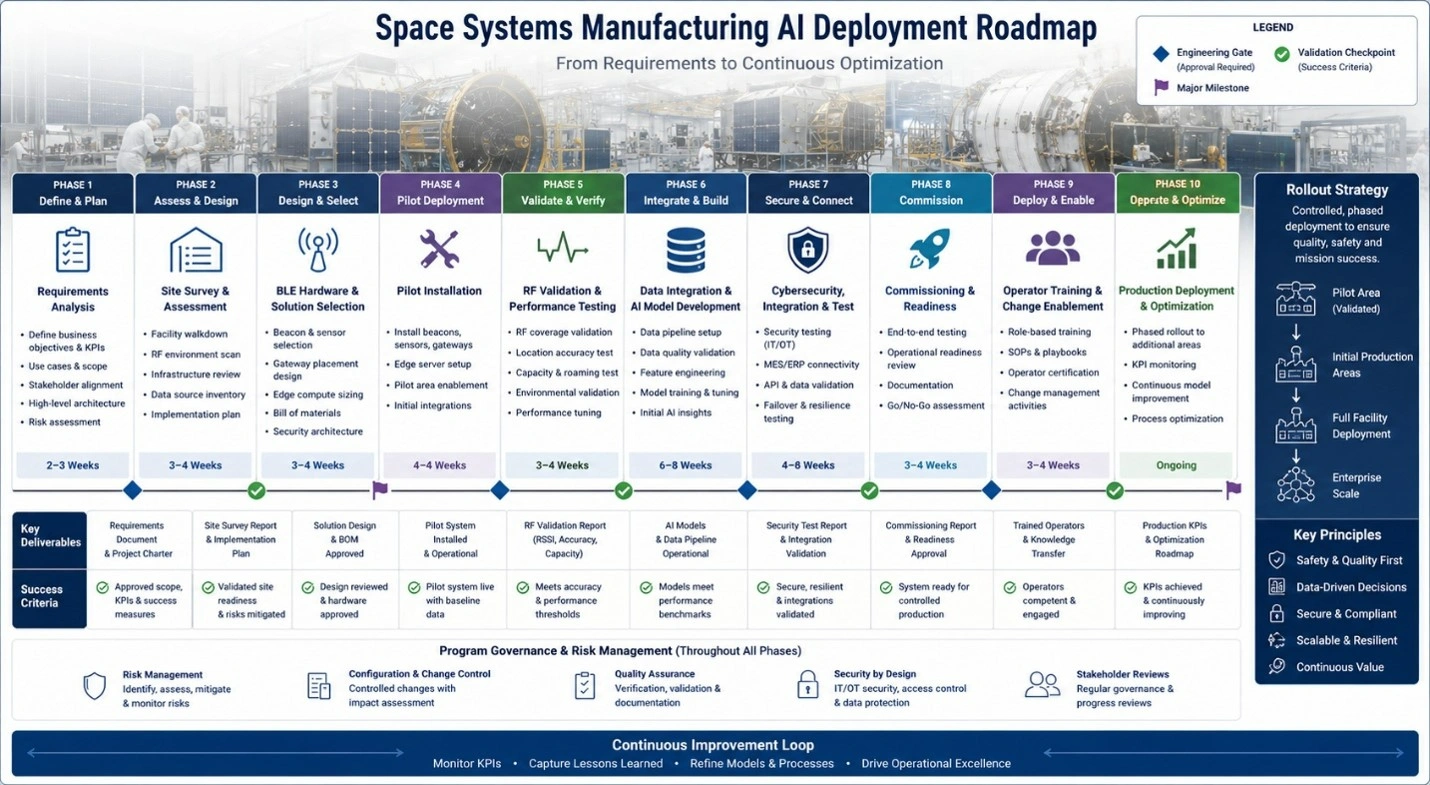
A professional implementation roadmap illustrating the controlled deployment of AI-enabled manufacturing across a spacecraft production environment. It progresses from requirements analysis and site assessment through BLE selection, pilot deployment, RF validation, data and AI integration, cybersecurity testing, commissioning, operator training, production rollout, and continuous optimization.
GAO Solutions for AI-Enabled Space Systems Manufacturing
AI-driven space systems manufacturing depends on reliable physical data. BLE beacons, gateways, and sensors can provide the connectivity layer required to observe assets, tooling, environmental conditions, and manufacturing activities.
GAO supplies BLE, RFID, and IoT hardware products and systems that can be incorporated into manufacturing visibility and monitoring solutions. Its product and engineering capabilities can support applications involving asset identification, wireless sensing, location monitoring, and connected industrial operations.
Headquartered in New York City and Toronto, Canada, GAO serves B2B and B2G customers and has worked with Fortune 500 companies, R&D organizations, universities, and government agencies across the United States and Canada. Its sister companies, GAO Research and GAO Tek, together form GAO Group, with substantial investment in product and system R&D and technical support capabilities.
For space systems manufacturers, technology selection should be based on the production process, asset characteristics, facility conditions, integration requirements, cybersecurity constraints, and measurable operational objectives.
Key Takeaways for Space Systems Manufacturing
AI can transform space systems manufacturing when it is connected to reliable operational data and existing manufacturing processes.
BLE provides a practical method for collecting physical asset, location, and condition information across manufacturing environments. AI can then turn this information into production intelligence by detecting anomalies, identifying bottlenecks, supporting predictive maintenance, improving asset utilization, and assisting quality investigations.
Successful implementation requires more than deploying wireless devices. Manufacturers should establish clear KPIs, perform facility surveys, validate RF performance, integrate with authoritative manufacturing systems, secure connected infrastructure, validate AI models, and establish lifecycle management procedures.
AI & IoT Innovation for Space Systems Manufacturing
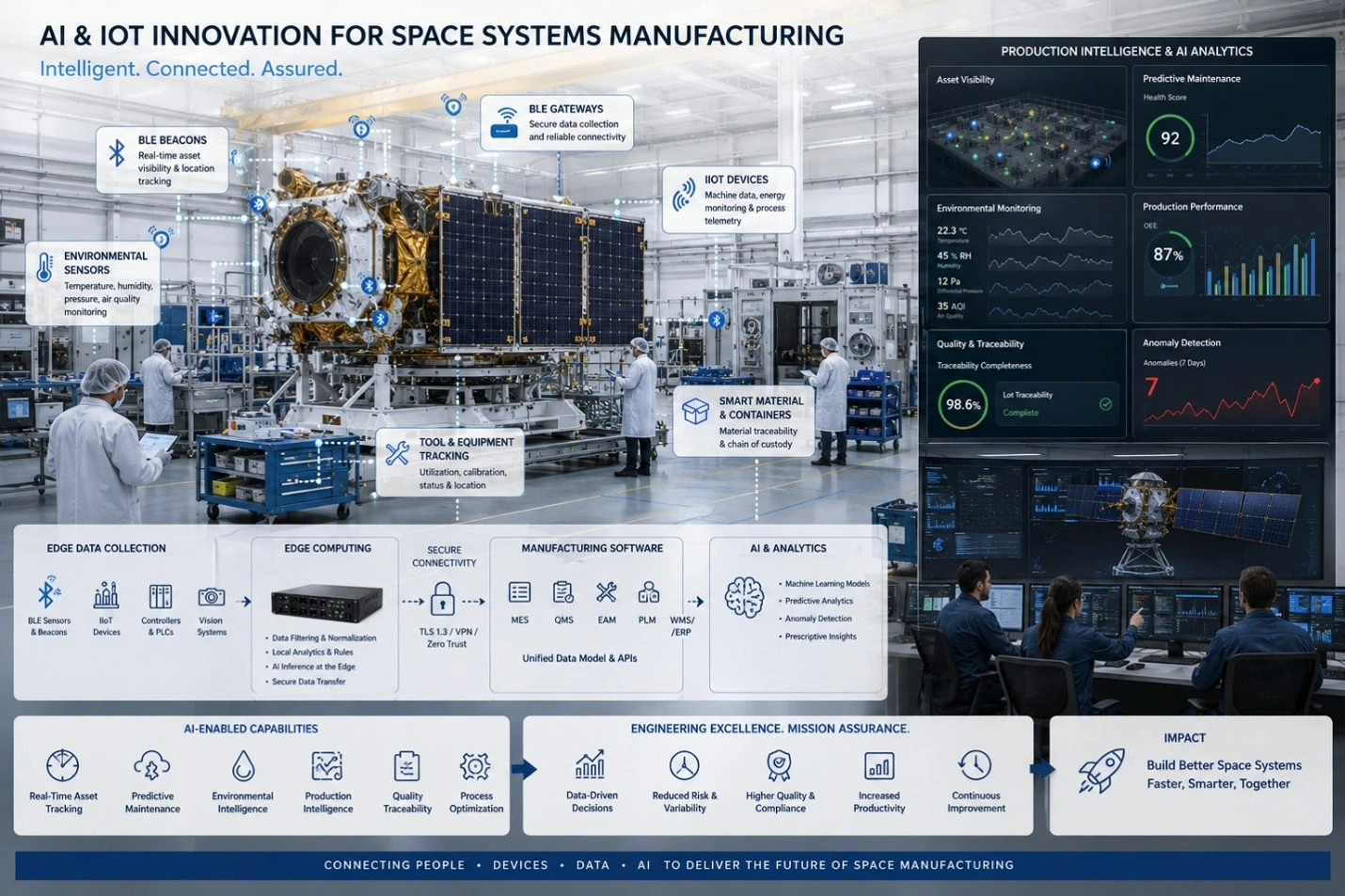
A sophisticated aerospace manufacturing illustration showing BLE, environmental sensors, IIoT devices, edge computing, manufacturing software, and AI analytics working together around spacecraft production. It highlights asset tracking, predictive maintenance, environmental monitoring, production intelligence, quality traceability, and process optimization.
GAO can support organizations evaluating BLE, RFID, and IoT hardware and systems for these applications. Readers can explore GAO’s technology solutions and technical support capabilities when planning AI-enabled manufacturing visibility, monitoring, and asset intelligence projects.
Building the Future of Industrial AI and IoT with Aperture Venture Studio and GAO
For more than three decades, GAO Group of Companies has invested heavily in R&D for industrial BLE, RFID, and IoT. As AI became increasingly useful in industrial applications, we expanded our work in AI and IoT technologies and founded Aperture Venture Studio to support the development and scaling of AI and IoT solutions relevant to industries such as space systems manufacturing.
Aperture has attracted AI and IoT technical experts, entrepreneurial and operational executives, investors, and leading companies. We have also developed Aperture Ventures Summit and TekSummit to facilitate discussion of advanced AI and IoT technologies.
These activities have helped establish diverse technical communities around AI and IoT. We welcome organizations and professionals interested in contributing as advisors, co-founders or employees, investors, or customers.